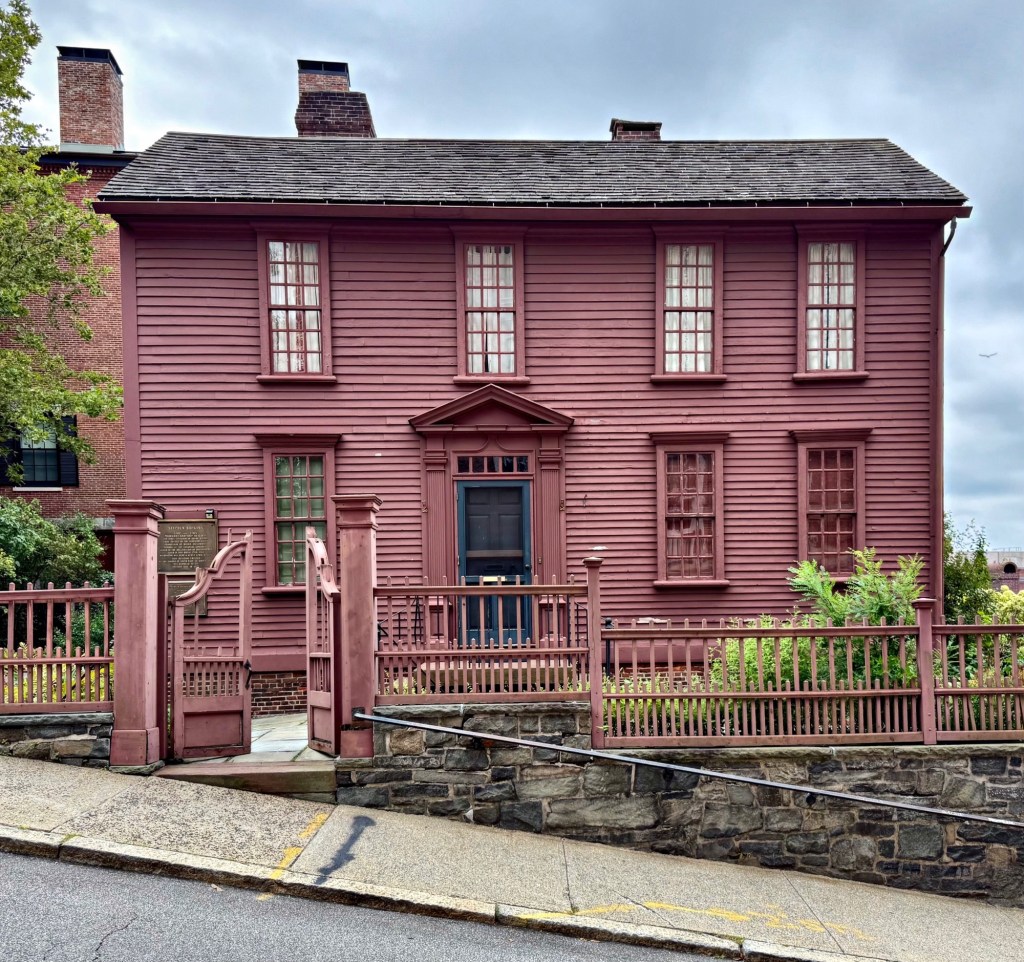
Stephen Hopkins House // 1743

The Stephen Hopkins House is a Colonial-era house in the East Side neighborhood of Providence, and has survived waves of commercialization and redevelopment for nearly 300 years. The home is associated with Founding Father of the United States, Stephen Hopkins (1707–1785), who served as Governor of the Colony of Rhode Island and Providence PlantationsChief Justice of the Rhode Island Supreme Court, and was a signer of both the Continental Association and Declaration of Independence. In 1742, Stephen Hopkins purchased a one-story cottage built in 1707 on Main Street, and enlarged the original house to its present size by 1743, incorporating the original cottage as the rear ell. The eight-room residence was occupied by Gov. Hopkins, his family, as well as enslaved Africans who lived under the same roof until his death in 1785. During his ownership, George Washington slept here, twice. After 150 years of successive ownership, in 1928, the house was moved to its current location at the corner of Hopkins and Benefit Streets to facilitate the construction of the new Providence County Courthouse complex. The Hopkins House was restored by architectural historian and architect, Norman M. Isham, and is owned by The National Society of the Colonial Dames of America, operating it as a historic house museum. The Gov. Stephen Hopkins House is a National Historic Landmark.

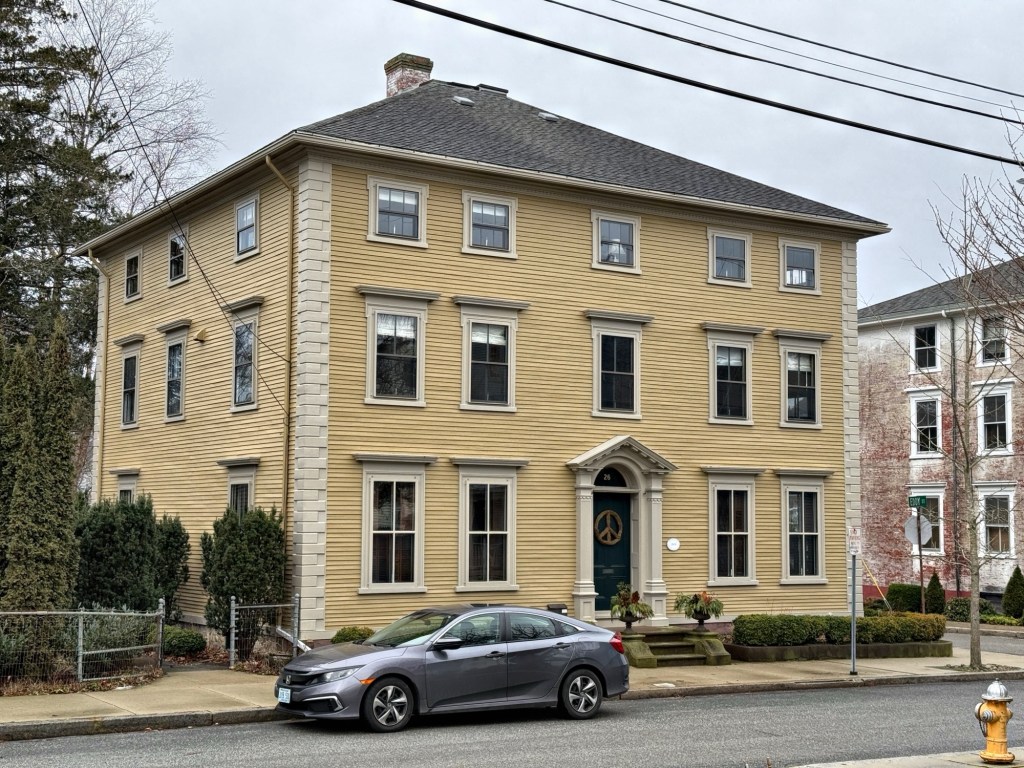
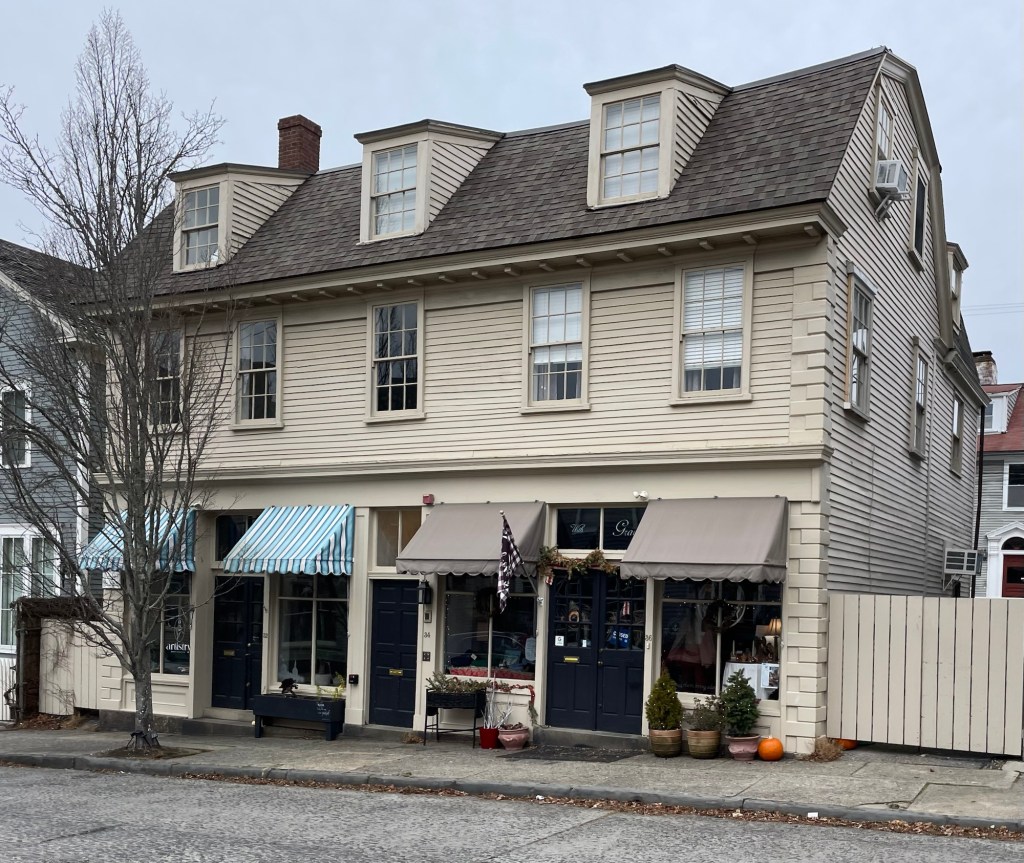
C & J Mauran Company Warehouse // c.1820

In Providence, even industrial warehouses are architecturally interesting to look at! This is the C & J Mauran Company Warehouse at 369 South Main Street in Providence’s East Side neighborhood. The building was constructed around 1820 for brothers, Carlo (1779-1844) and Joshua Mauran (1782-1847), who were wealthy merchants who stored goods from their ships trading in the Indies here. Before all of this, the site was home to an earlier structure from the 1770s, built by Deacon Joseph Sheldon, and the site was occupied by a warehouse, later owned by his son, Christopher Sheldon, and was known as the “Slave Pen” for its use of holding and transporting enslaved people. The “slave pen” burned in 1801 and the structure was later rebuilt by the Earle Brothers, and then again (the current structure) by Carlo and Joshua Mauran. Later in the 19th century, a brick façade and storefront were added to the building as the street shifted firmly to commercial uses, with noxious industrial buildings moving further to the periphery of the established College Hill neighborhood. From 1856 to 1939, the Ferry Coal Yard Company and the National Coal Company stored coal in the building After WWII, the City of Providence took the building and adjacent block by eminent domain to make way for urban renewal, and luckily for us, the building was rehabilitated rather than demolished at this time. The structure was converted to office use, and was again restored in the 2010s by Newport Collaborative Architects.

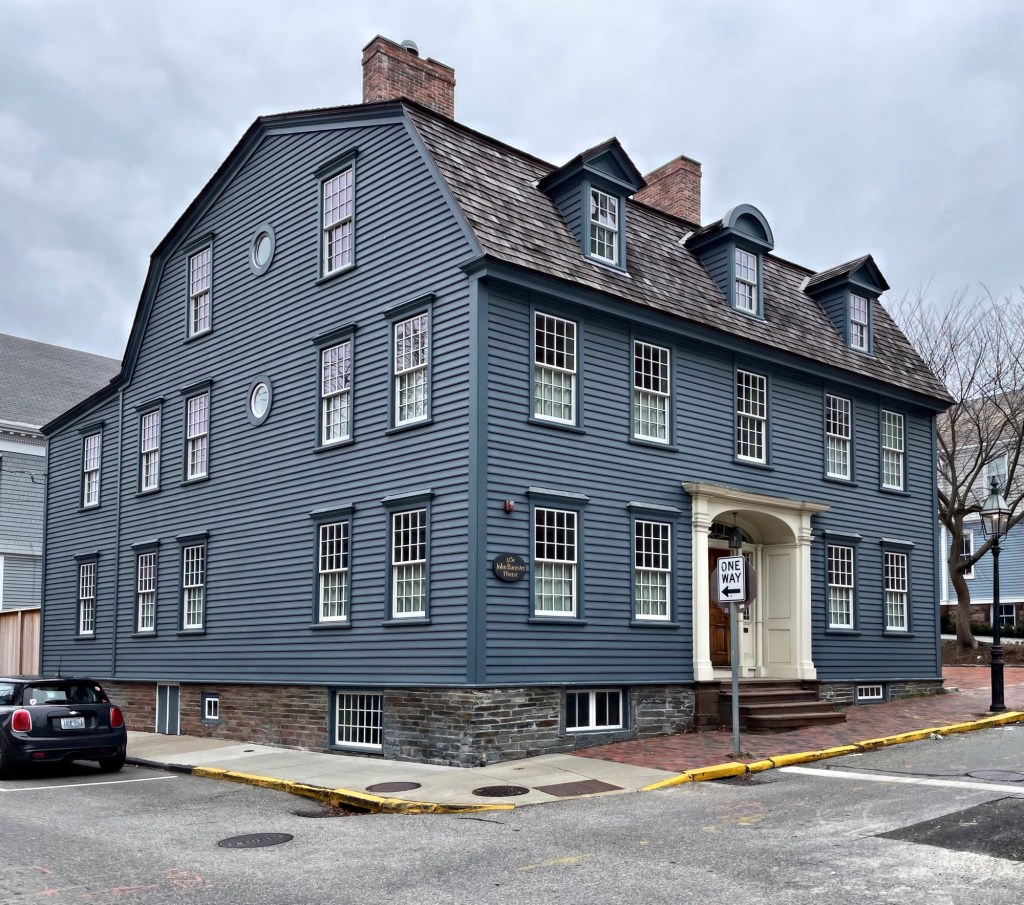
John Banister House // 1751

This deep, gambrel-roofed house is among my favorites in Newport. The house was built in 1751 for John Banister (1707-1767), a Boston-born merchant who moved to Newport in 1736, marrying Hermoine Pelham (1718-1765), a granddaughter of Gov. Benedict Arnold, that next year. Banister quickly established himself as a leading Newport merchant, trading with England, the West Indies, engaging in privateering and the slave trade. In 1752, he held one of the last public slave auctions in Rhode Island at his store, describing them in advertisements as “the finest cargo of slaves ever brought into New England”. The couple also built a country estate in Middletown, Rhode Island. John and Hermione had two sons, John and Thomas, who grew up in this home. John inherited the house after his father’s death in 1767, but the two brothers would soon find themselves on opposite sides of the battle for independence. Thomas was a loyalist, and even enlisted in the British army during the occupation of Newport, while John supported American independence. In retaliation for his patriot views, the occupying British forces seized this house, along with John’s farm in nearby Middletown. The house became the headquarters of General Richard Prescott during the occupation, although John later reclaimed his property following the British evacuation of Newport in 1779. The house has a later Federal entry, but otherwise is one of the best-preserved Colonial homes in Newport. It is a single-family home.

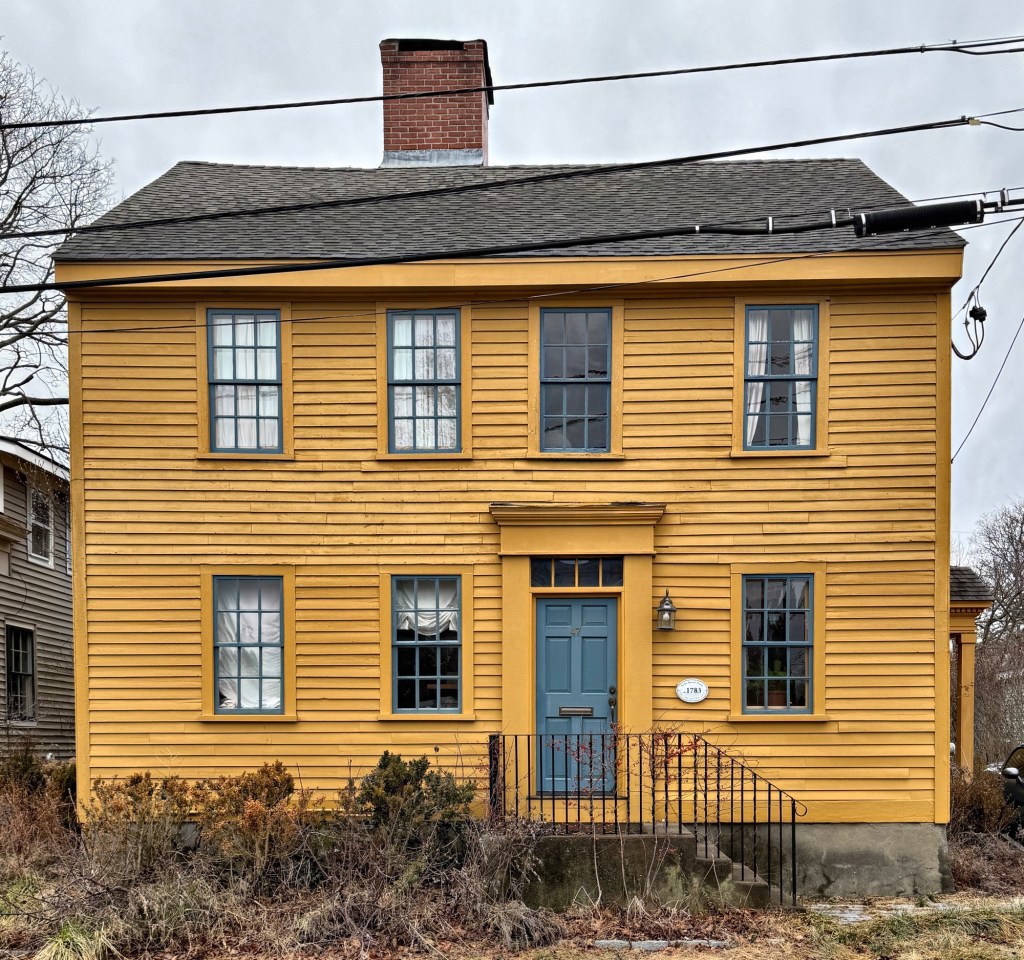
Captain Caleb Godfrey House // c.1740

In Newport, Rhode Island, you can find that even the more regular-looking historic buildings often hold an interesting (and sometimes troubling) past. Little information was available on this Georgian-era house, but I did some digging and turned up a lot. Rhode Island and Newport specifically had been a hub of trade going back to its founding by white settlers. Even though it was the smallest of the colonies, the great majority of slave ships leaving British North America came from Rhode Island ports. Historian Christy Clark-Pujara, in her book Dark Work, The Business of Slavery in Rhode Island, indicates that during “the colonial period in total, Rhode Island sent 514 slave ships to the coast of West Africa, while the rest of the colonies sent just 189.” Captain Caleb Godfrey, who owned this home on Franklin Street in Newport, was a sea captain and hired by wealthy merchants to pick up slaves in West Africa and bring them back to the British colonies. In 1754, Samuel and William Vernon of Newport hired Caleb to take their ship, “Hare“, taking captives from Sierra Leone and embarking them from South Carolina. Godfrey left Sierra Leone with 84 slaves aboard, but 16 died on the 10-week voyage or soon after the ship arrived in Charleston, their bodies were dumped at night into the sea. In South Carolina, a prominent slave dealer named Henry Laurens handled the sale of African captives from the Hare, placing an advertisement to attract the attention of local rice planters. Godfrey’s Newport home is a visual reminder on New England’s direct ties to the enslavement of African people and how the colonies benefited financially from this terrible trade.

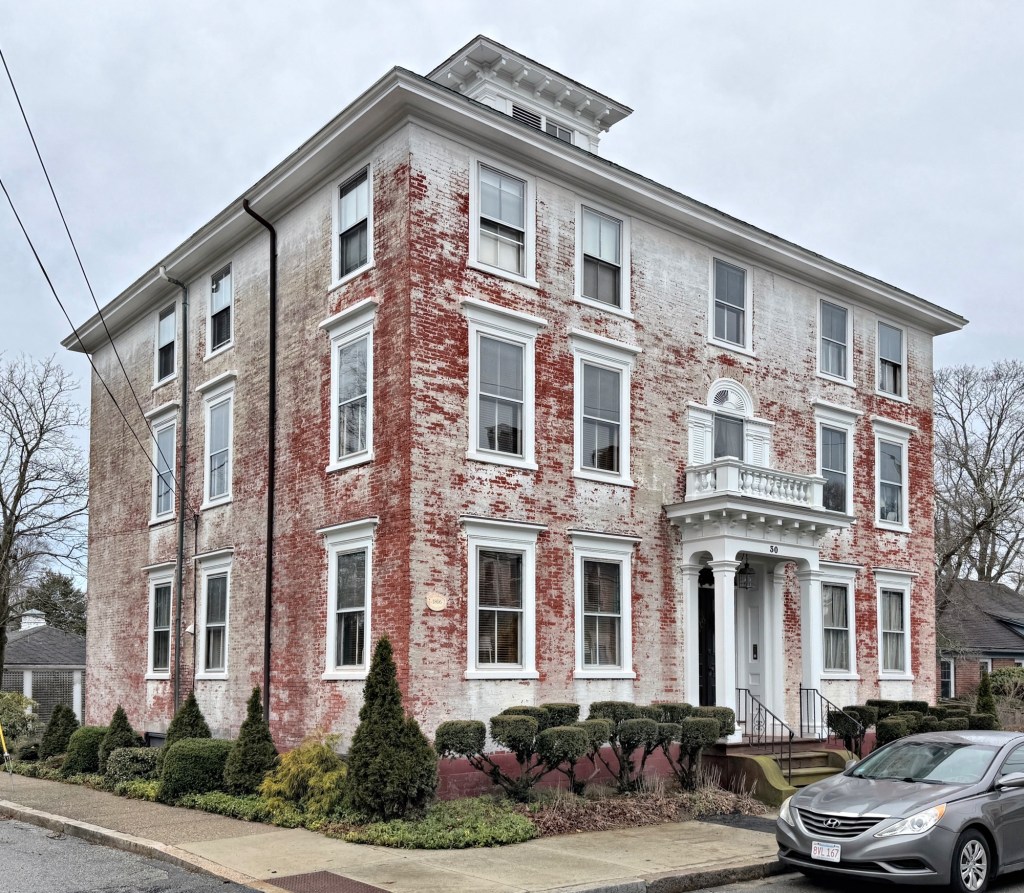
Captain George Benson House // 1797

One of the finest Federal period mansions in Providence is this well-sited home on College Hill known as the Captain George Benson House. George Benson was a partner of the mercantile firm of Brown, Benson & Ives, who made immense sums of money at the end of the 18th century. The firm did well as the movement to abolish the transatlantic slave trade grew at the time in Rhode Island, many abolitionists placed their faith in so-called “legitimate commerce,” an African trade centered on commodities other than enslaved people. In 1794, the firm run by Nicholas Brown, Jr., and his partners George Benson and Thomas Ives, tried the legitimate trade, and dispatched the ship Charlotte to Freetown Africa, under the command of Benson’s half brother, Martin. George’s half-brother Martin was a slave trader, a job that may have accounted for the unusually explicit tone in a 1794 letter of instructions: “by no means take any Slaves on board the Ship on any terms whatever as we desire to have nothing to do with business.” Three years later, George had this Federal style mansion constructed on the peak of College Hill which remains one of the best in the area over 200 years later.

Chaddock Boarding House // 1799

Calvin Chaddock (1765-1823) graduated from Dartmouth in 1791 and three years later earned a Master of Arts degree from the college. In 1792, he married Meletiah Nye and they settled in Rochester, Massachusetts, where he became pastor of a Congregational parish in the rural northern part of town. In 1798, he opened an academy for boys and girls in the village and built this beautiful Federal style home as a boarding house for students to reside in (the schoolhouse is no longer extant). By 1804, he had “a respectable number of students from different parts of the United States.” The man moved to Ohio before settling in Charlestown, West Virginia, where he lived in a homestead with his family and three enslaved people, Charles, Thomas, and an unnamed woman. Upon his death in 1823, the three people enslaved by Chaddock, were sold at auction. The former boarding house in Rochester was later occupied as a tavern and stagecoach stop, and a store, when it was given some 19th century alterations. It has been a private home for the past hundred years.

Mount Hope Farm // 1745

Land that Mount Hope Farm sits upon in Bristol, Rhode Island was formerly council lands of the Wampanoag Indians, where King Philip’s War of 1675 may be said to have begun and ended. For those of you who do not know about the war, it was an armed conflict running 1675–1678 between indigenous peoples of New England and New England colonists and their indigenous allies. Massasoit, leader of the Wampanoag, had maintained a long-standing alliance with the colonists. Metacom (c. 1638–1676) was his younger son, and he became “sachem” (elected chief) in 1662 after Massasoit’s death. Metacom, however, forwent his father’s alliance between the Wampanoags and the colonists and they fought back. Metacom’s forces could not beat the growing numbers of the colonists, and he was eventually killed near Mount Hope, in Bristol. After his death, his wife and nine-year-old son were captured and sold as slaves in Bermuda. Philip’s head was mounted on a pike at the entrance to Plymouth, Massachusetts, where it remained for more than two decades. His body was cut into quarters and hung in trees. This story, shows how American history is built upon death and suffering and has often been whitewashed to portray early settlers treating native peoples with respect and as equals, which was rarely the case.

Mount Hope Farm as we know in colonial times, was originally 550 acres in size, owned in 1680 by Nathaniel Byfield. In 1744, the estate was acquired by Isaac Royall. Royall began construction of the house soon after. Isaac Royall Jr. was the son of Isaac Royall Sr. (1677–1739) a slave owner, slave trader, and Antiguan plantation owner who had a home and slave quarters (both extant) in Medford, MA. After his father’s death, Royall Jr. inherited his immense wealth, built upon the backs of others, and built this Georgian farmhouse. It is unknown to me if he ever resided there or had slaves maintain the property, but the home was rented for some time. In 1776, Mount Hope Farm was confiscated by the state, after Royall, a loyalist to England, fled to Nova Scotia. The property was added onto in the 19th and 20th centuries and now sits on 127-acres of land, and is run as a park, inn, and event space.

William Throop Jr. House // 1805

While much of the downtown area of Bristol features early 19th century wood-frame houses, there are some substantial masonry homes providing a great layering of styles and materials in the neighborhood. This brick Federal style home was built in 1805 for William Throop Jr. (1771-1850), a stonemason and merchant, who had a shop on the DeWolf wharf in Bristol, where many slave ships set sail from. Throop himself was a descendant of William Throope, who built “Throope Place” (previously featured) on the north side of town. We understand that William Jr. likely had connections to the slave traders of Bristol based on his ties to the DeWolf Family, which is compounded by the fact his two daughters Juliana and Jane married Judge James Eppinger of Georgia. Juliana first married Eppinger in 1820, but died in 1859, and her younger sister Jane then married James Eppinger one year later. The Eppingers built a house in Bristol where they would spend time, and often brought enslaved with them to maintain their home. On October 12, 1829, Nancy Gindrat, a 22 year old slave to James and Juliana Throop Eppinger, escaped in Bristol. Eppinger frantically wrote to his father in-law William Throop and others that he would offer a large sum to anyone who could find her, though he never did. It was interesting to learn how inter-connected Rhode Island and Georgia were in the early 19th century, both bonded by the slave trade. The William Throop Jr. House remained in the family for a century until it was converted into a rooming house in the early 20th century, to house workers at the nearby industrial buildings. The home was restored and reverted back to a one-or-two-family residence in the 1970s.

Reynolds-DeWolf House // c.1760

New England is lucky to have so many examples of pre-Revolution Georgian homes to gawk at, and this home in Bristol is one of them. The home was likely constructed by Benjamin Reynolds, a cobbler (shoemaker) for his family. The home was purchased by Benjamin and Abigail Bosworth sometime before the Revolutionary War, and Benjamin served with the Continental Army, at the rank of Major. In 1786, Mark Antony DeWolf the patriarch of the infamous DeWolf Family (who made their fortunes on the backs of the enslaved) returned to Bristol after it was burned by the British, and purchased this home where he lived until his death in 1793. At that time, one of Mark Antony DeWolf’s many children, Levi, moved into the home. Levi DeWolf (1766-1848) was a Quaker, who was an avid reader. While his involvement in the slave trade was a shadow of that of his siblings, he was complicit and travelled to Africa at least three times on behalf of his brother James. After the trips, James offered to outfit a vessel for him to continue the trade, but Levi’s conscience likely caused him to decline. In the late 1790s, Levi had the home updated, with a new, elaborate pedimented entrance with a modillion and dentil cornice.

Lewis and Harriet Hayden House // 1833

Lewis Hayden was born into slavery in Lexington, Kentucky, in 1811, as one of a family of 25. Hayden was first owned by a Presbyterian minister, Rev. Adam Rankin. He sold off Lewis’ brothers and sisters in preparation for moving to Pennsylvania, and he traded 10-year-old Hayden for two carriage horses to a man who traveled the state selling clocks. In the mid-1830s, Hayden married Esther Harvey, also a slave. She and their son were sold to U.S. Senator Henry Clay, who sold them both to the Deep South, and Hayden never saw them again. By 1842, Hayden married a second time, to Harriet Bell, who was also enslaved, and he cared for her son Joseph as his stepson. After this marriage, Hayden began making plans to escape to the North, as he feared his second family might be split up like the first. In 1844, he and his family escaped with assistance of abolitionists all the way to Canada. From Canada, the Haydens moved in 1845 to Detroit in the free state of Michigan, and the next year, they moved to Boston, at the center of anti-slavery activity with the city’s strong abolitionist base. In Boston, Hayden became a lecturer and ran a clothing shop, acquiring enough money to live in this large home in Beacon Hill. The Haydens routinely cared for fugitive slaves at their home, which served as a boarding house. Guests included Ellen and William Craft, who escaped from slavery in 1848. Hayden prevented slave catchers from taking the Crafts by threatening to blow up his home with gunpowder if they tried to reclaim the pair. Hayden died in 1889, outliving the abolishment of slavery. Harriet died in 1894 and left $5,000, the entirety of their estate, to the Harvard University for scholarships for African American medical students. It was believed to have been the first, and perhaps only, endowment to a university by a former slave. Their former home remains a stop on Boston’s Black Heritage Trail.