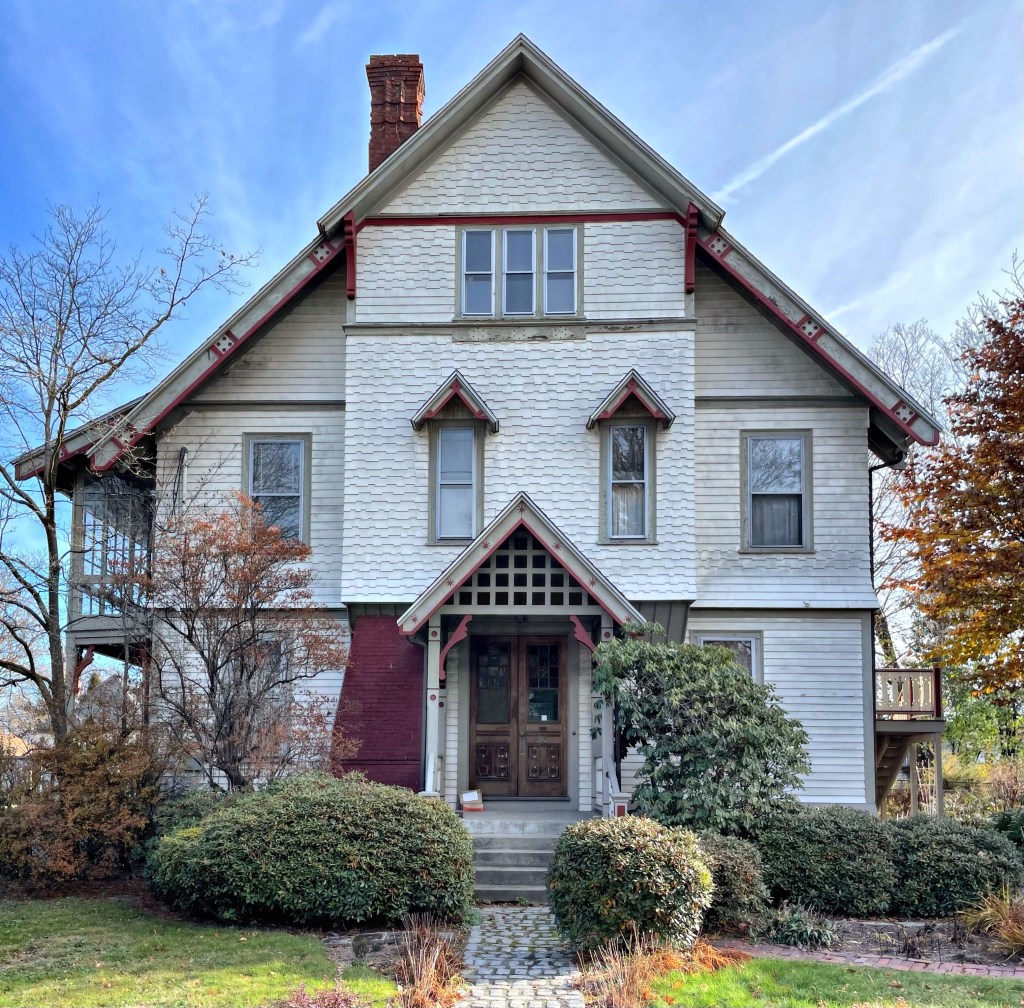
Johnston-Sullivan House // c.1894

One of the more exuberant and ornate homes in Roxbury’s Washington Park neighborhood is this charmer on Howland Street. The eclectic house was built in around 1894 for Ellen S. Johnston from plans by local architect Timothy Edward Sheehan and stands out for its preserved exterior in a neighborhood where many homes are covered in later siding, obscuring the ornate details underneath. Details include: swag and garland applied ornament, two bays at the facade (one polygonal and one rounded), a Colonial Revival style porch, and central rounded dormer. Wow!

George Cobb House // c.1865

While most of the early homes in Newton Centre were built by a few landowners and rented to tenants, this charming Mansard cottage was owner-occupied from the start. Tucked away on the quiet (and appropriately named) Pleasant Street, the George Cobb House is one of the most beautiful old Victorians in the neighborhood. An early resident was George Washington Cobb (1840-1925) was a druggist who ran an apothecary in East Boston, and he made the long commute there every day from this house. The property has a mansard roof with pedimented dormer and three-story tower capped by a bell-cast mansard roof. Paneled pilasters and brackets add a lot of detail to the primary facade.

Wales House // 1883

Built in 1883 for a member of the Thomas Wales family, this house in Clam Point, Dorchester, possesses a compact essentially rectangular clapboard and wood shingle-clad form. The architect, John A. Fox, designed the main façade elegantly with an open Stick style porch projecting from the center of the first floor which is enclosed by a steeply-pitched roof. The pitch of the porch roof is echoed in the small and shallow gable-like lintels which are really unique to the area. The treatment makes the facade read somewhat like a face.

Whelen Cottage // c.1891

For the last cottage on Grindstone Neck, I present the stunning Whelen Cottage. Charles S. Whelen (1850-1910), a banker and philanthropist who served as one of the directors of the Gouldsboro Land Improvement Company and as one of several of its stock agents in Philadelphia, purchased a house lot for him and his wife Migonette Violett. The couple did not hire Lindley Johnson, like so many other cottage-holders did, but they worked with esteemed architect Wilson Eyre to design the home. The Whelens were typical of the type of person who chose to summer on Grindstone. While comfortably well off, they were not in a financial position to commission the sort of cottages built on an ever increasing scale in Bar Harbor. The property left the Whelen’s ownership in 1897, and the house was altered and enlarged in 1900. The large porte cochere, porch, and additional rooms added at this time by William Winthrop Kent, an alumni of H. H. Richardson’s office.

Lorenzo and Mary Hawkins House // c.1870

Another of the charming mini mansard cottages in Stoneham, Massachusetts is this home, the Lorenzo and Mary Hawkins House. The home was built for Lorenzo D. Hawkins and his wife, Mary around 1870. Lorenzo worked as a shoe and elevator manufacturer in town and in Downtown Boston. The house is a two-story wood-frame structure with irregular massing. It has the classic mansard roof, an ornately decorated entry porch, heavily bracketed cornice, and round-arch windows in its dormers and front bay.

E. A. Durgin House // 1870

Would you just look at this house?! Massachusetts may have the most Second Empire/Mansard style houses in the United States, but some really stand out. This home in Stoneham, Massachusetts was built around 1870 for local shoe dealer Erastus A. Durgin. The mini mansard home is pretty typical besides the prominent square tower with a steeply pitched gable roof that stands over the entrance. Charming!

Juniper Ledge Cottage // 1889

Ellen Kemble (Bartol) Brazier was born in New York City in 1844, the eldest of four children of Barnabas and Emma Bartol. Her father had many business interests in sugar refining and the family was able to travel the world from his wealth and success. The family spent most of their time in Philadelphia, but like many of the city’s wealthy residents, they often summered elsewhere. Ellen Bartol married Joseph Harrison Brazier in 1866 and they had two children. When her father Barnabas died, Ellen inherited some of his remaining fortune and as a part of high society, she had a summer cottage in Kennebunkport built. Working with Maine architect John Calvin Stevens, she oversaw the designs of Juniper Ledge, this gorgeous, eclectic shingled residence in the Cape Arundel summer colony. Ellen would summer at the cottage until her death in 1925, but before she died, she joined her daughter in the 1910s and 1920s at Women’s Suffrage events and fundraisers, helping to pass the 19th Amendment, allowing women the right to vote in the United States. Ellen is buried in the West Laurel Hill Cemetery in Philadelphia next to her husband, not far from her parents.

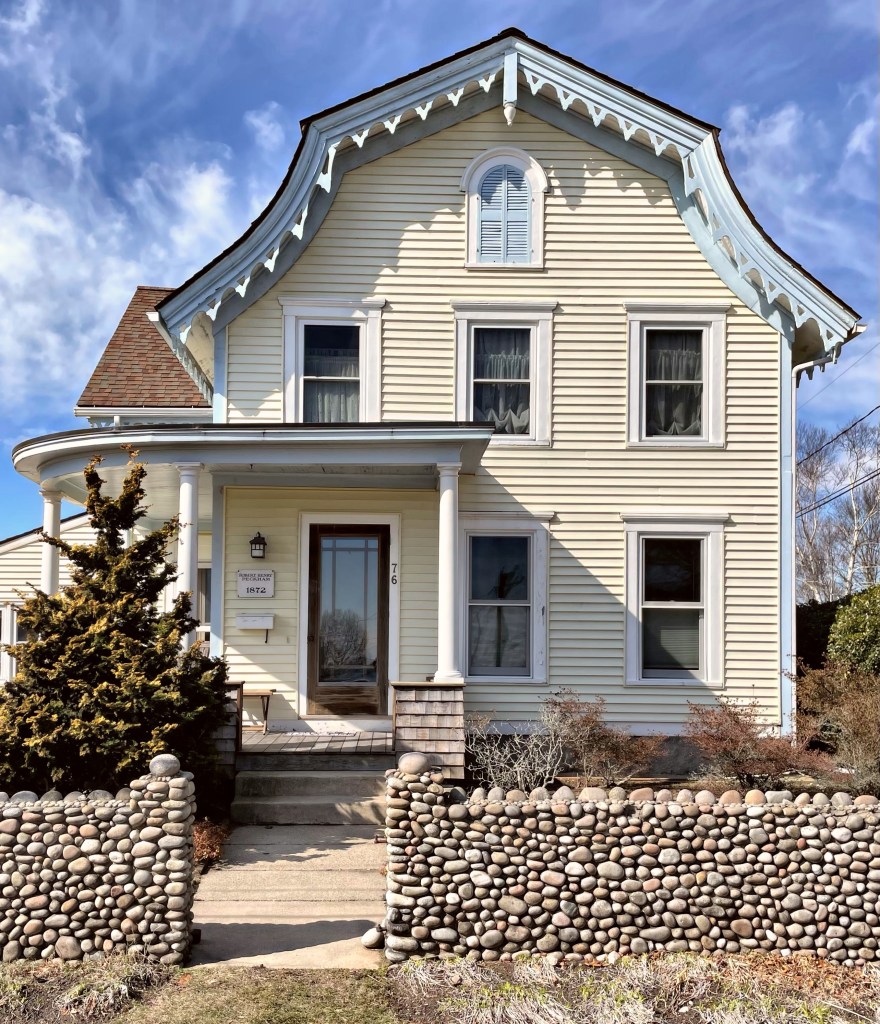
Robert Henry Peckham House // 1872

Another of Noank’s stunning Victorian-era seaside cottages is the 1872 Robert Henry Peckham house which is located across the street from the village’s most ornate cottage, the Deacon Robert Palmer House (featured previously). The house exhibits a gambrel roof which reads as a mansard roof at the side elevations. A round arched window is set into the gable end. Decorative cut bargeboards add much complexity to the design. It appears that in the early 20th century, as Noank was re-establishing itself as an artist colony, the owners added the small wrap-around porch and stone garden wall.

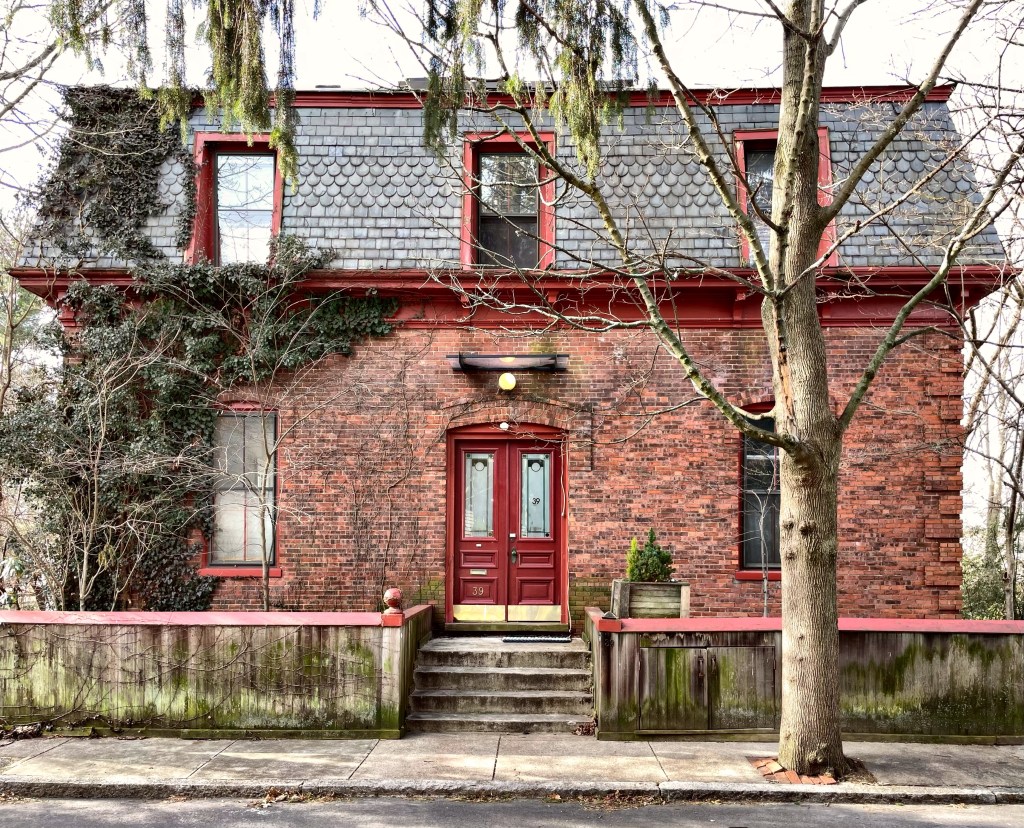
Dadmund-Glennon House // 1875

Boston’s many unique neighborhoods have some amazing hidden architectural gems. It always helps to get out and explore by walking or biking your city to see things from a different perspective than a car or bus. This brick mansard house sits on a quiet dead-end street in the Stonybrook section of Jamaica Plain and was built in the mid-1870s for Joseph A. Dadmund, a coppersmith. From the 1880s-1920s, the house was occupied by the Glennon Family, who built two large wooden stables in the rear yard, both of which remain to this day.

Riverbend Cottage // c.1860

No, this is not Martha’s Vineyard, it is Collinsville, Connecticut! Perched on a hill near the banks of the Farmington River, this quaint little Victorian cottage is one of the better-preserved examples of worker’s cottages in the former industrial village. I could not locate much on the house’s history, beyond that it may have once been part of a larger home, and moved to this site in the 20th century.