Former Appleton Academy Building // 1942

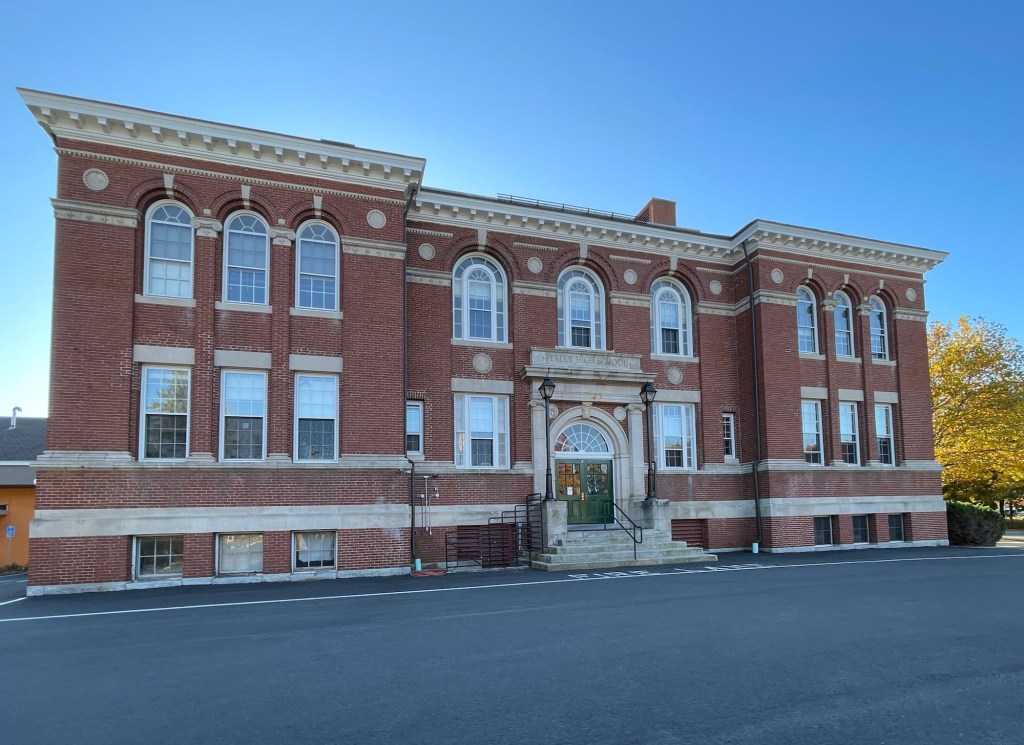
Appleton Academy (aka the New Ipswich Academy) was established in New Ipswich, New Hampshire, in 1789, being the second oldest private academy in the state. The school was named after benefactor Samuel Appleton, the largest early donor, who grew up in town at his father, Isaac Appleton’s homestead. This is the fourth Academy building in New Ipswich. The original 1789 frame building was outgrown and in 1816, it was decided that the academy would be shared with the new town hall building, occupying the second floor. Sharing a prestigious academy building with the town functions was deemed insufficient, and a new prominent site near Appleton Common was acquired, with a new brick academy building constructed there in 1853. The Italianate style structure was funded by the Appleton Family, and was designed by Boston architect, William Washburn. In January 1941, the main Academy building was destroyed by fire. The next year it was rebuilt, closely following the design of the earlier brick structure. The school closed in 1974 and was used by a non-profit and schools until it sold in 2018 and appears to be a residence now.

Gould-Goodnough-Lyman House // 1816

The largest house in the smallest town (in Middlesex County) of Ashby, Massachusetts, is this towering, three-story Federal period home on South Road. Local history states that the home was originally a two-story Federal style home with shallow hipped roof. The Goodnough’s “modernized” the home by the 1870s, adding a mansard roof and built a stable on the property. Lastly, the third major owner, Jesse P. Lyman, and his wife, Mary Chapman Lyman, had the home “modernized” again, in 1898, but in the Colonial Revival style, harkening back to the house’s original Colonial-inspired roots. Fitchburg-based architect Henry M. Francis converted the old mansard roof to a full third-floor, updated the carriage house, and added side wings to flank the main block of the house (similar to his design at the old Lyman School in town). The house recently sold for over $600,000 in 2020, which may be the best steal ever! This house is a stunner!

Lyman School – Ashby Town Hall // 1903

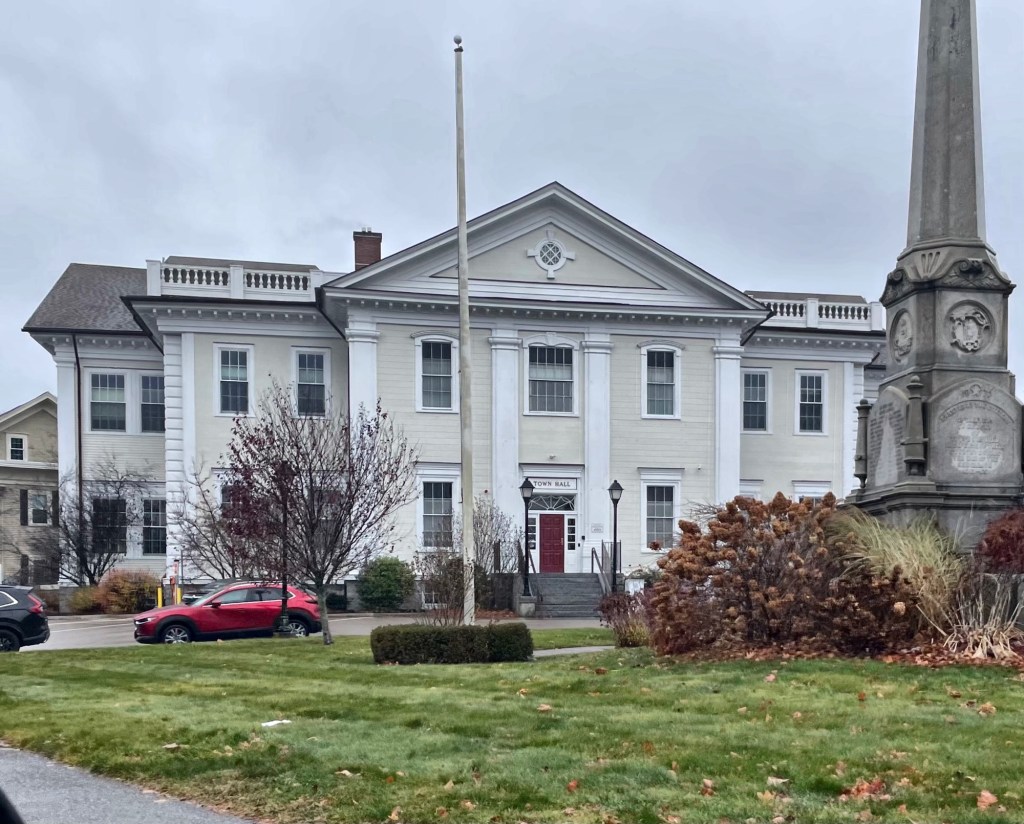
Originally built in 1903 as the central school for the town of Ashby, Massachusetts, the significant Colonial Revival style Lyman Building is one of the most significant and well-preserved buildings in the village. The building was designed by architect Henry M. Francis of Fitchburg and educated pupils in town from grades 1-12. The two-story, hip-roofed building displays a symmetrical facade with a central section displaying five arched upper story windows, flanked by two pediment-topped pavilions atop projecting, flat-roofed arched entrance vestibules with quoined corners. The symmetry of the original design was preserved when the identical side wings constructed in 1922. Ashby public schools merged with Pepperell and Townsend and this building was later converted to the town hall. I love when towns value their historic buildings and retrofit them for new uses!

Boston City Hospital Relief Station, Haymarket // 1902-1960s

Image courtesy of City of Boston Archives

In 1858, as Boston began to see a massive influx of immigration into the city and rapid industrialization, the City of Boston authorized the creation of a new hospital whose purpose was the “reception of those sick and injured: citizens of Boston who, from any cause, were unable to otherwise obtain care and treatment,” especially in cases of “acute illness and for the victims of accident or injury.” This was the Boston City Hospital, which was established in the South End, and is now known as the Boston Medical Center. The hospital was thought to be too far away for victims of injury of illness to get to promptly, so a relief station was built in Haymarket Square, replacing the recently demolished Boston & Maine Railroad Station. The new, standalone hospital building was constructed of brick and stood three stories tall and opened in 1902. On its first day of operation, doctors and staff saved the life of a man who had attempted suicide by ingesting carbolic acid. A Boston Globe reporter speculated that had the patient been  transported to the more distant Massachusetts General or City Hospitals, he would have surely died. The Colonial Revival style building was designed by the firm of Kendall, Taylor & Stevens, who specialized in medical facilities and other institutional building designs. The structure was demolished by the 1960s, when much of the Government Center/West End areas were razed for urban renewal.

Sunnyside // 1886

Photo from recent real estate listing

During the height of the Shingle and Queen Anne styles’ popularity, architect Stanford White of McKim, Mead & White completed plans for one of the earliest Colonial Revival style residences, “Sunnyside” in Newport, Rhode Island. The residence was built in 1886 for “Commodore” William Edgar (1810-1887) and his wife, Eliza Lucille Rhinelander (1832-1916). William was a co-founder of the New York Yacht Club in 1844 and heir to a New York fortune. Eliza was an aunt of Edith Wharton and a grand-daughter of William Rhinelander, co-founder of the Rhinelander Sugar Refinery. The property remained in the Edgar Family as Lucille Rhinelander Edgar (1858-1948), an unmarried daughter of the couple, would live here year-round with servants. The house is built of buff-Roman-brick with a large central block flanked by L-plan wings under a hipped roof punctuated by massive chimneys. Of special note on the facade are the rounded bays, entry portico with Palladian window above, and side porch.

Oakwood/ // 1902

Oakwood, another massive gambrel-roofed “cottage” in Newport, Rhode Island, is another of the McKim, Mead & White designed residences in the Old Beach Road vicinity of town for wealthy summer residents. Built in 1902 for George Gordon King (1859-1922), Oakwood is a large, elongated two-and-one-half-story structure with a gambrel roof with walls in pebbledash finish. Its off-center main entrance with double-height engaged Corinthian columns supporting a pedimented gable and a blind balustrade set on smaller Ionic capitals. The massive home was later converted to condominiums. It sometimes amazes me that families (but with many servants) would live in these houses just for a season…

Mary Walcott Almon Cottage // 1883

Andrew Belcher Almon was born in Nova Scotia in 1824. He would enroll at Harvard College and graduate with a law degree before moving to Salem, Massachusetts, marrying Mary Walcott Baker, the daughter of Samuel Baker and Martha Pickman Wolcott. The couple first lived in Cambridge before relocating to Salem to live Mary’s widowed aunt, the late wife of Ezekiel Hersey Derby. After her aunt died, Mary and Andrew moved back to Cambridge until they built this fine Colonial Revival style mansion on Red Cross Avenue in Newport. No architect is attributed to the house, but due to it being an early Colonial Revival style house for the period, it can be inferred that it was a Boston/Salem-area architect. Does anyone know more?

Bigelow-Stuntzner House // 1896

The Bigelow-Stuntzner House is a large, Colonial Revival style dwelling located on a side street in Norwood Center. The house was completed in 1896 for Waldo H. Bigelow (1856-1926), a lumber dealer with offices in Boston. Mr. Bigelow clearly used the best lumber for his own residence here in Norwood, and his Colonial Revival style house stands out for its gambrel gable which exhibits a modified Palladian window with diamond-shaped panes and a key stone arch. The central entrance is sheltered by a portico supported by Tuscan columns. In 1919, the house was sold to Guido Stuntzner (1876-1964), a German immigrant who arrived in the U.S. in 1887 and went on to become a successful Norwood businessman. The Stuntzer’s lived in the home through at least the 1960s.

Atlantic Hall // 1920

Atlantic Hall is one of the most iconic buildings in the well-visited town of Kennebunkport, Maine. The landmark structure was completed in 1920 as a volunteer fire station, by the Atlantic Hose Company. The volunteer fire-fighting company was founded in April 1906, and different members kept different parts of fire fighting equipment in each of their barns without a consolidated station. With the advent of the automobile, the community raised funds and purchased a Chevrolet hose truck, but had no station to put it. Without having the town pitch in money, residents (both permanent and summer “rusticators”) donated funds and a central location in Cape Porpoise was selected as a site for the new station. Construction started on a modest building in 1914, but was halted during WWI. After the war, local resident, Marion Goodall Marland hired the well known firm of Kilham, Hopkins and Greeley to furnish updated designs for the station, in a more elaborate version of the Colonial Revival style, fitting for the charming town. The building opened in 1920 with an engine room at the first floor and a meeting hall on the second floor. It was in 1958 that the Atlantic Hose Company outgrew its station at Atlantic Hall, and a new fire house was built across the street. Atlantic Hall was renovated for library and event use and has remained a significant piece of Cape Porpoise ever since!

Turk’s Head Inn // 1890-1970

The Turk’s Head Inn was once Rockport’s grandest getaway. For those uninterested in building their own summer cottage to spend the along the coast of Massachusetts, luxury summer resorts provided summer rentals for those escaping the hot and polluted cities in favor of cool ocean breezes. Once situated in the  Land’s End section of Rockport, the Turk’s Head Inn, had sweeping views of the coast and islands in the distance. The initial portion was built from 1889 to 1890 by builder J. M. Wetherill of Rockport based on plans by architect H. M. Stephenson of Boston. It was expanded and became this rambling, E-shaped Colonial Revival structure with a seaboard frontage of two hundred feet and wraparound verandas over three hundred feet in length. Over the years, the Turk’s Head Inn suffered a number of fires, and its central and southeast wings were rebuilt, the latter in 1905 by then owner C.B. Martin. With a peak capacity of 200, the hotel, uncharacteristic of the regional hospitality industry, remained in operation for eighty years before it was closed down, partially destroyed by fire, and the remains removed in 1970.