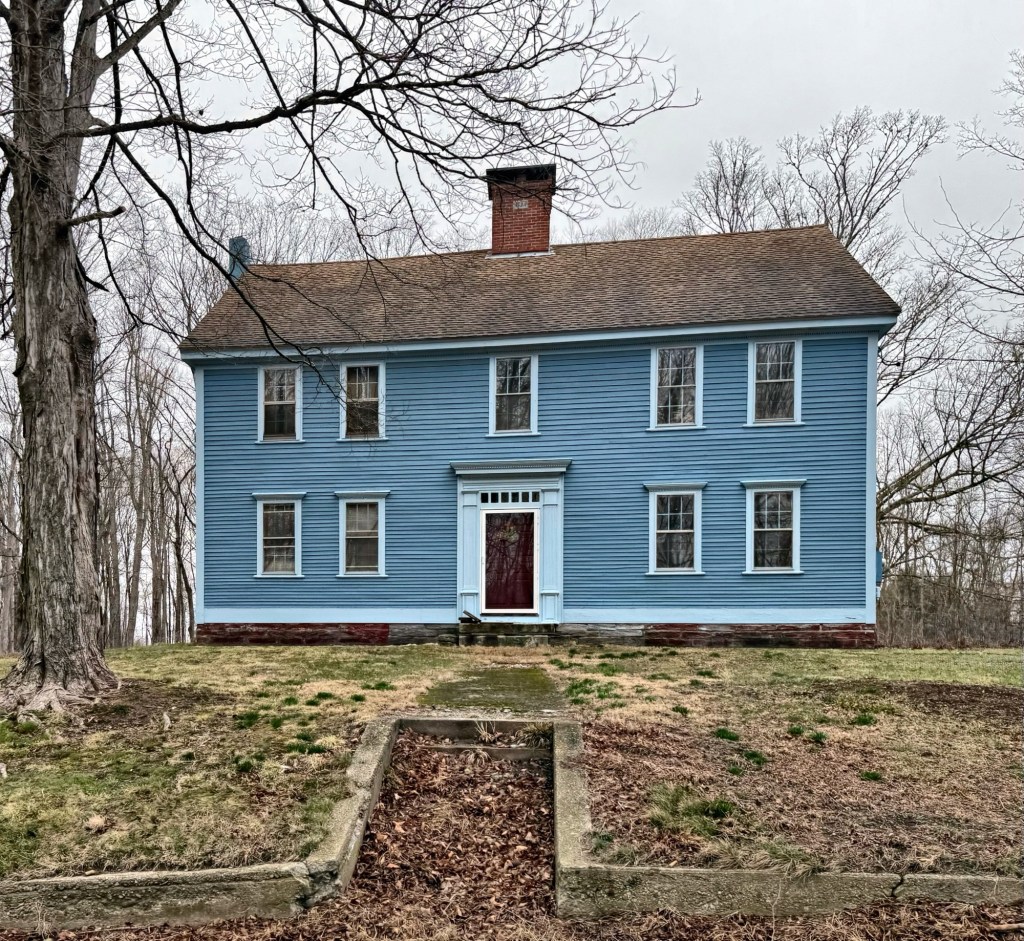
In 1794, Revolutionary War veteran, Jacob Bacon (1754-1844), built this house on S. Canterbury Road outside the main village of Canterbury, Connecticut. The late Georgian/Federal style house features a large central chimney, symmetrical five-bay facade with center entrance, and a bold blue paint color. The house was seemingly built following Jacob’s 1793 marriage to a Martha Clark. Do you like the color of this house, or would you paint it something different?
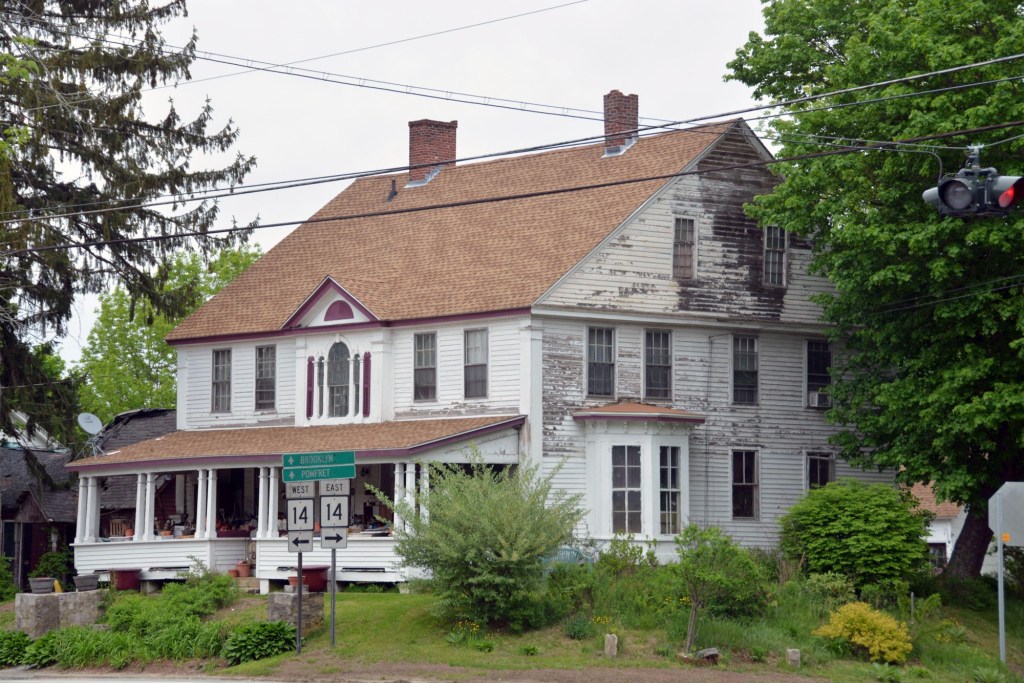
Formerly located at the intersection of two historic turnpikes in Canterbury, Connecticut, the William Moore House was a historic and architecturally significant residence that stood over 200 years until its demolition in 2019. The large, Federal style house was built in 1803 for William Moore, a merchant who operated a store and also served as the town postmaster. The upper floor of this house at one time accommodated a ballroom where the local Masonic organization met. Later in the 19th century, the house became the home of prominent merchant, banker, and politician Marvin H. Sanger, Connecticut Secretary of State from 1873 to 1876. In 1921, it was the home of Lillian Frink when she became one of the first women ever elected to the Connecticut General Assembly, along with four other women elected that same year. The house with its projecting center pedimented bay, elaborate corner pilasters on pedestals, and elegant Palladian window represented the height of country Federal-period architecture until destroyed by a fire in 2018, leading the town to raze the building a year later in 2019. The lot remains vacant as of 2025.
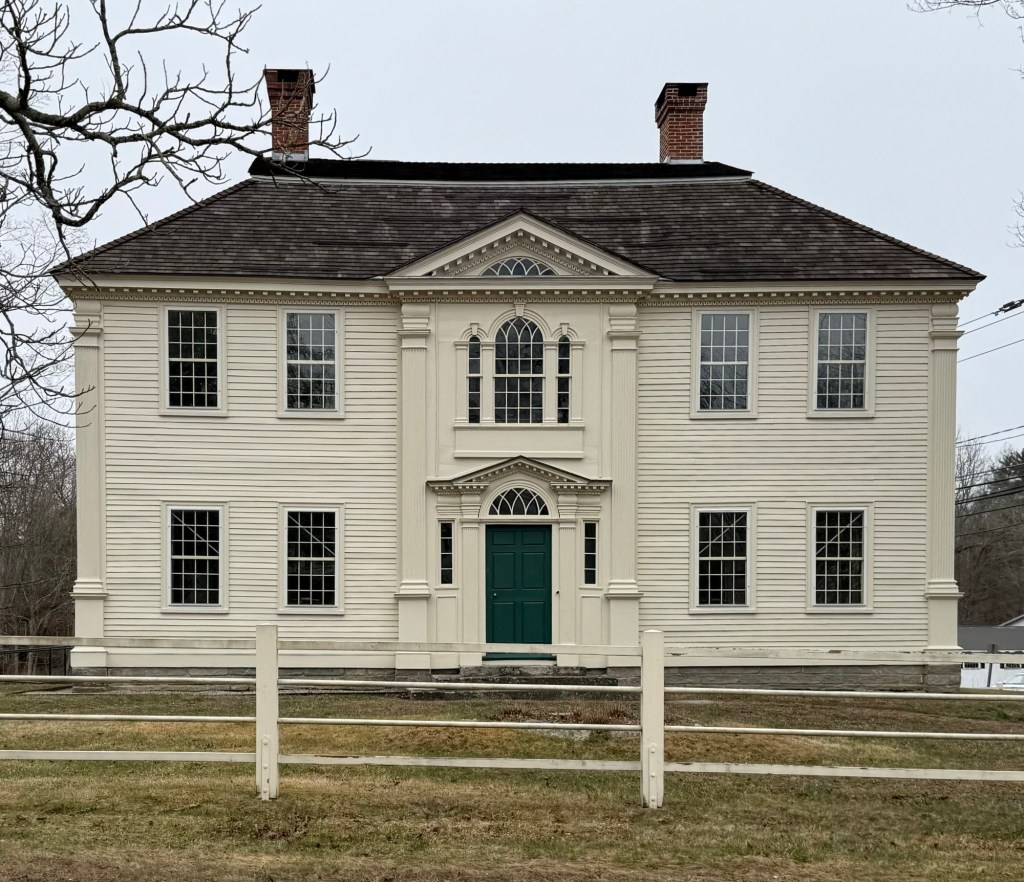
Built c.1805 for Elisha Payne, this architecturally distinguished Federal style mansion in Canturbury, Connecticut is one of the most significant buildings in the state, not only for its architecture but historical significance. In 1831, a young white woman, Prudence Crandall, was asked to open a boarding school for girls in Canterbury. She purchased this mansion and began operations for the school, which was attended by many wealthy girls in town. In 1832, Ms. Crandall was approached by a young Black girl who worked as a servant in town, named Sarah Harris, asking to attend the school. Encouraged by conversations with both Harris and Maria Davis, a Black woman who worked for Crandall and shared copies of the abolitionist newspaperThe Liberatorwith her, Crandall agreed to admit Harris. Almost immediately, residents protested the school’s admission of a Black girl and parents threatened to withdraw their students, Crandall undeterred, closed her school and reopened in 1833, solely for Black and Brown students. Young girls traveled from several states to attend the school. The legislature of Connecticut responded by passing the “Black Law,” which prevented out-of-state Black and Brown people from attending school in Connecticut towns without local town approval. Crandall was arrested, spent one night in jail, and faced three court trials before the case was dismissed. In September 1834, a nighttime mob of men attacked the house, smashing the windows, leading Crandall to close the school out of fear for her students as no protections were afforded to them. These events made national and international news in the 1830s and galvanized the burgeoning abolitionist movement. Crandall would later marry and left Connecticut, never to return. For her vision and brave actions at this school, Prudence Crandall is Connecticut’s official state heroine and the house was designated a National Historic Landmark in 1991.
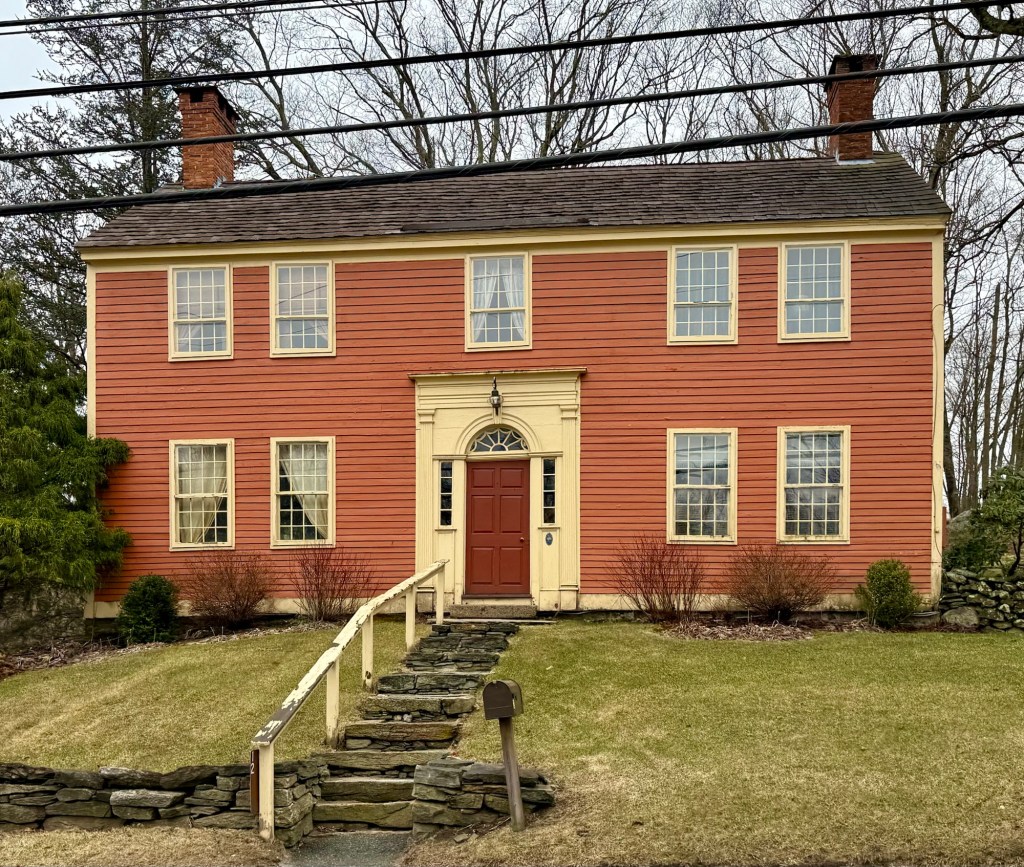
This house in Canterbury, Connecticut, is known as the Turnpike House and dates to the early 19th century. A great example of a Federal style residence, the symmetrical, five-bay home exhibits pair chimneys, multi-light double-hung windows, and an elaborate center entry with sidelights and fanlight transom. The house was built along the Windham Turnpike (now Connecticut Route 14), which was an early toll road established in 1795. Behind the main block of the house is a squat gambrel-roofed ell, that is believed to be made from an older house that previously stood on this site, perhaps dating as early as 1745. According to tradition, this early house, which was also at one time supposedly used as a jail, was the home of Rev. Dr. James Coggswell when he ran a school for boys in Canterbury. One of his pupils at that school was Benedict Arnold, the infamous turncoat.
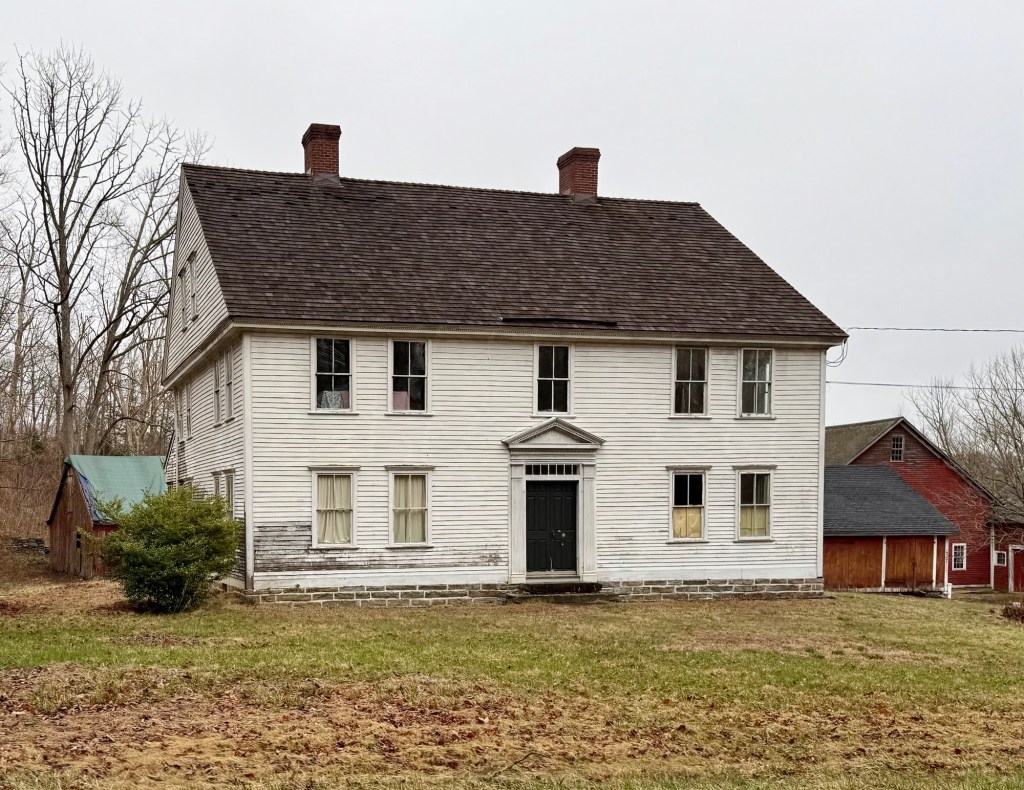
Located in northern Canterbury, Connecticut, this rural farmhouse was built following the American Revolution, showcasing the emergence of the Federal style from the Colonial Georgian type farmhouses before. The house dates to 1783 and was built by Captain Asa Bacon (1735-1819), a wealthy farmer and captain in the Revolutionary War. The home was also occupied by his son, Asa Bacon Jr. (1771-1857) a Yale educated lawyer who practiced law in town before moving to Litchfield. Asa Jr. was a turnpike promoter, advocating for turnpikes through the formerly sleepy agricultural town, opening it up to trade and commerce. The early Federal-period home features a five-bay facade and central entry with triangular pediment and fluted pilasters. The house appears much like it would have when originally built besides the Victorian-era two-over-two window sashes installed in the late 19th century. The farm even retains a few 19th century barns, likely built when the windows were replaced by later owners.
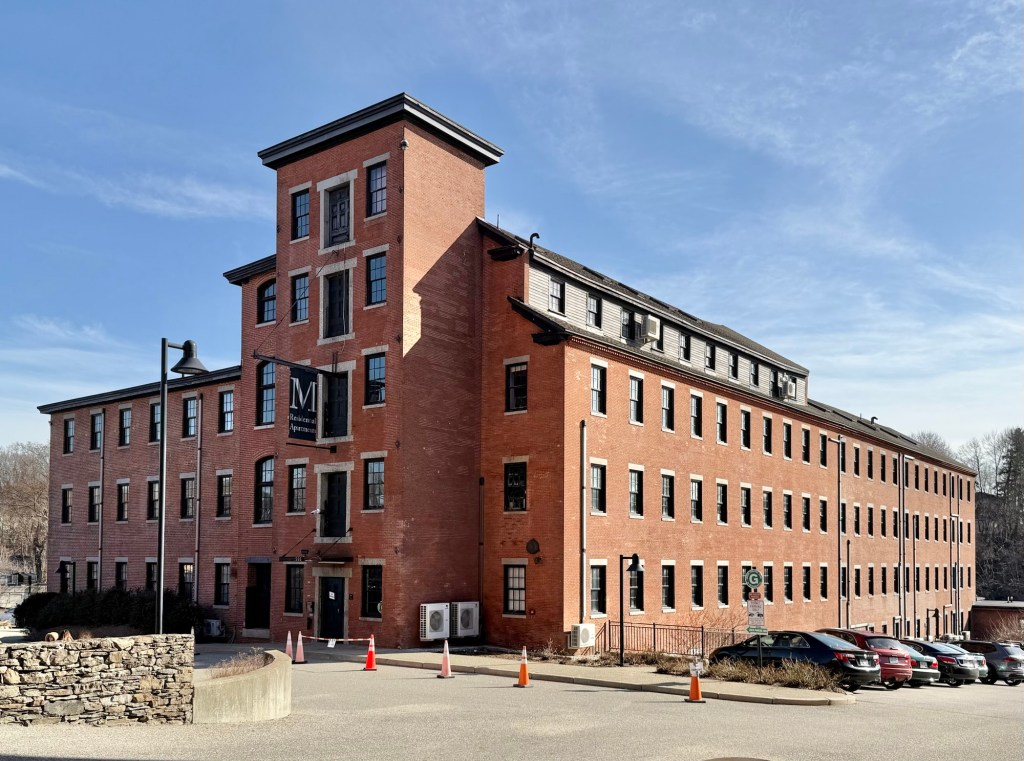
One of the oldest mills in Central Falls, Rhode Island, is this four-story brick building constructed in 1825 is important as one of the earliest extant brick mills in Rhode Island, at a time when such buildings were shifting from wood construction to fire-proof brick or stone construction. Built on one of the first industrial sites in the city, along the Blackstone River, the mill was originally constructed for a John Kennedy as a cotton manufactory. The complex was purchased and expanded in the 1860s by the Stafford Manufacturing Company, who built a new dam on the river and extension to the 1825 building. The structure features a five-story square end tower with freight doors, and a monitor roof which runs the span of the original 1825 building, terminating where the Stafford Company addition begins. Originally, canals flowed directly under the building, powering the building and three mills downstream, but they were filled in by 1965. Elizabeth Webbing started in the Kennedy/Stafford mill buildings in 1933. After over 70 years of making cloth straps used for seat belts, dog collars, luggage straps and more, it ceased operations in March of 2001. The complex, which included 19 nearby mill buildings, was split up and sold off. In 2007 work began on converting the former mill to residential use with the first phase of the project opening to tenants in 2009. It’s another great example of adaptive reuse into housing, the best type of project!
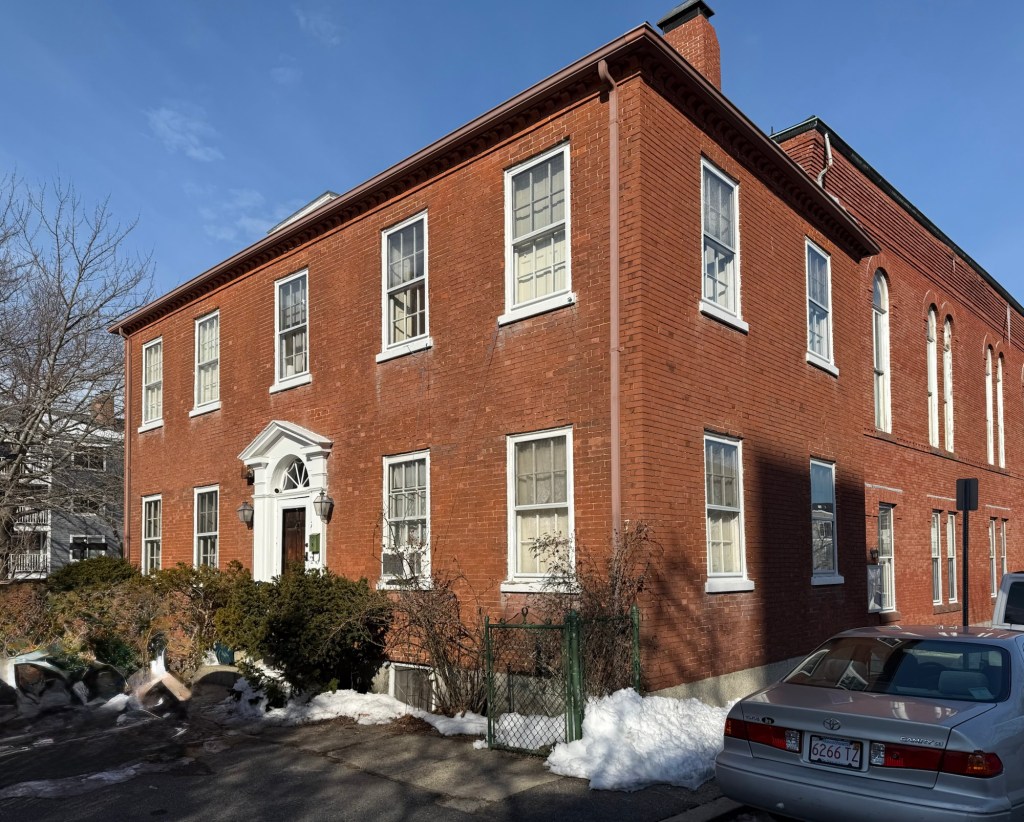
Built adjacent to and two years after the construction of the Essex County Jail in historic Salem, Massachusetts, this 1813 brick Federal style house was originally the jailkeeper’s residence. It has been speculated that the house was built by Samuel Field Mclntire (1780-1819), son of preeminent Salem carver and master carpenter, Samuel Mclntire, although there is no conclusive evidence. The house displays a 5 x 2-bay massing and is capped by a hip roof with three, large brick chimneys and a center entry with elliptical fan light transom, sidelights, and shallow portico. The jail was in operation until 1991, and at that time was considered the oldest active penitentiary in the United States. Years prior, in 1984, several detainees had successfully sued the county for inadequate living conditions, leading to the closure of the building. A preservation restriction was established for the building and in 2009, the property was conveyed to a developer who converted the complex into 23 apartments, with 19 in the old jail, three in the old jail keeper’s residence, and one in a converted carriage house. The great preservation/adaptive reuse firm of Finegold Alexander Architects furnished the plans for the successful renovation that provided a new life for a once crumbling eyesore.
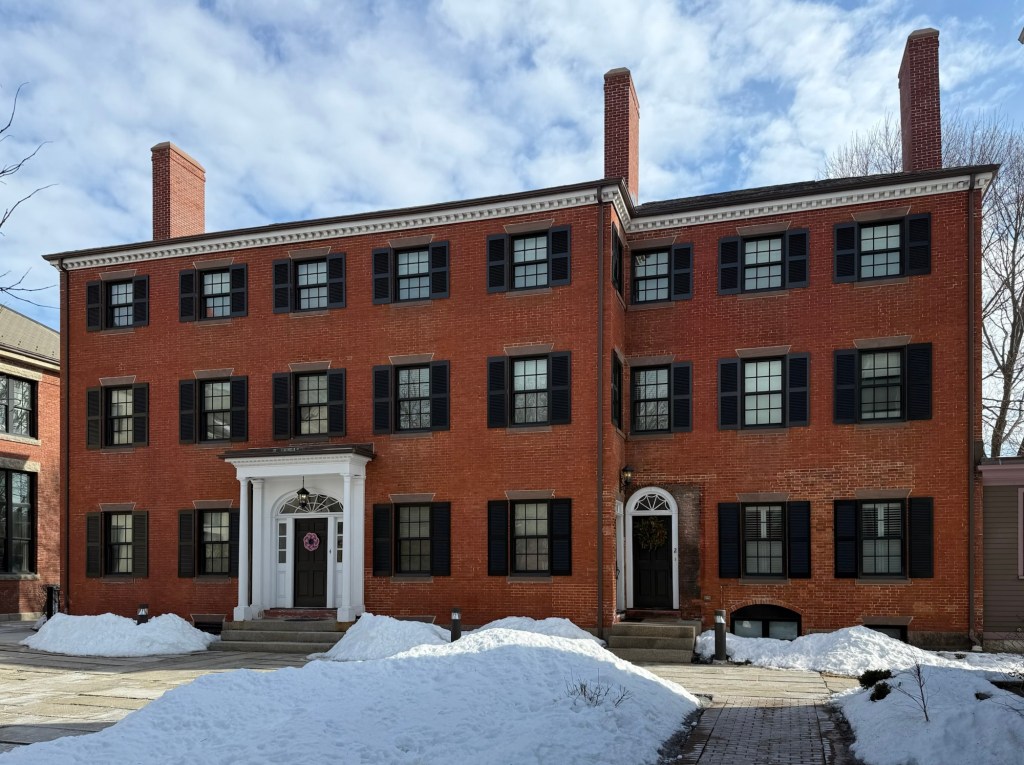
This brick, Federal style house, is located adjacent to the First Universalist Church of Salem amongst a sea of urban renewal-period housing, and is a reminder for Planners to think about the long-term implications in their work. This house was built in 1811 for Thomas Perkins, a local merchant whose brother was its first occupant. After successive ownership throughout the 19th and early 20th centuries, in 1950, Bessie E. Monroe purchased the premises and moved into the home. When the city began urban renewal planning for the area in the 1960s, the building was occupied by Bessie Monroe, who at the time was an elderly woman. The Salem Redevelopment Authority acquired the house through eminent domain and the house was targeted for demolition. The Redevelopment Authority, concerned with how relocation would affect Bessie Monroe’s health, decided to take the property but allow Mrs. Monroe to live there until her death. This decision delayed the planned demolition of the building, even though all other targeted properties were demolished. Luckily, the renewal plan changed its focus from new construction to restoration of existing buildings between the time of the taking and Bessie Monroe’s death. The building was then sold to an owner interested in restoring the structure, now the building is listed on the National Register of Historic Places and is a testament to the benefits of preservation over short-sighted planning policy.
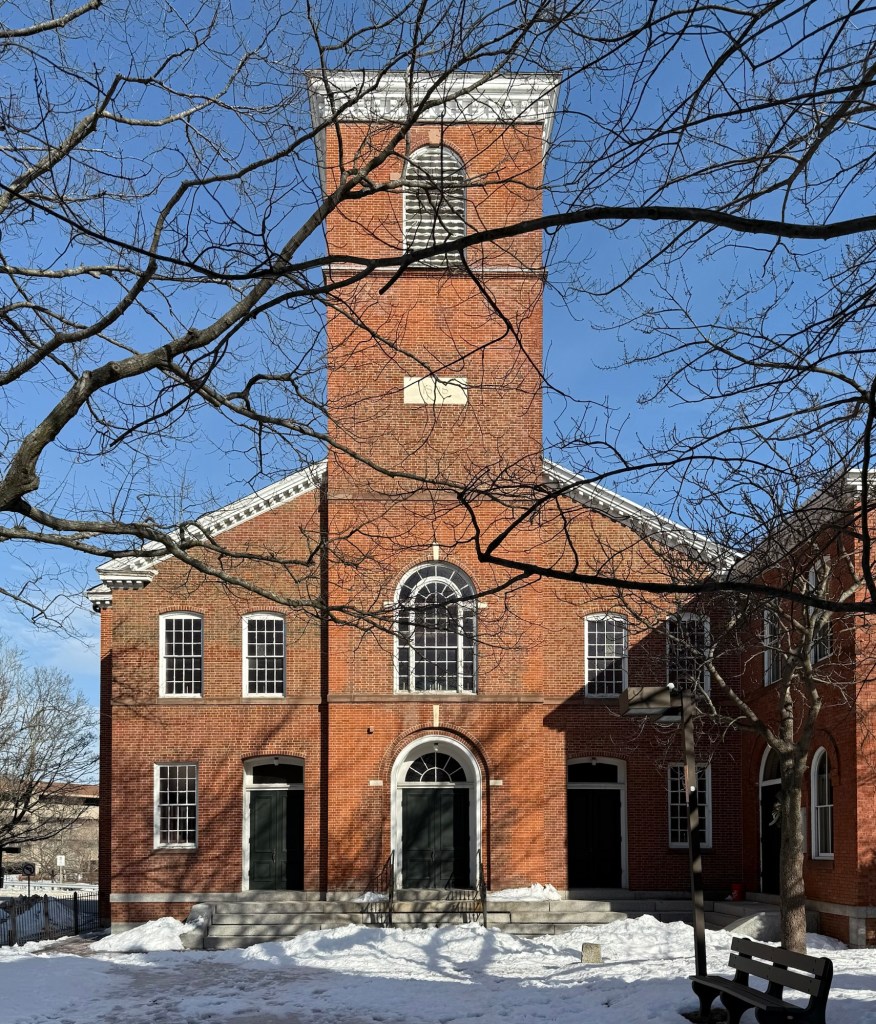
The First Universalist Church of Salem, Massachusetts, is a landmark example of a brick, Federal style church in New England. Tucked away within a network of Urban Renewal-era townhomes and backing up into a busy thoroughfare, the church is overlooked by many who pass behind its rear elevation, not knowing how special the building’s primary facade truly is! The church was constructed between 1808-1809 with early Church records showing that the interior carvings were done by Samuel McIntire, a Salem native, who was trained as a wood carver and later became an architect. It is unclear if any of McIntire’s work remains as numerous building modifications were completed throughout the 1800s; including a major exterior remodel in 1855 by architect Enoch Fuller, changing the appearance from Federal to Italianate. The church would again fall back to changing tastes in 1924, when they restored to an approximation of its original appearance by the office of R. Clipston Sturgis, a prominent Boston architect who specialized in Colonial Revival architecture. While the building’s significance is lessened by the urban renewal infill and streets surrounding it, the building remains one of the oldest in Salem and a significant architectural landmark in the city.
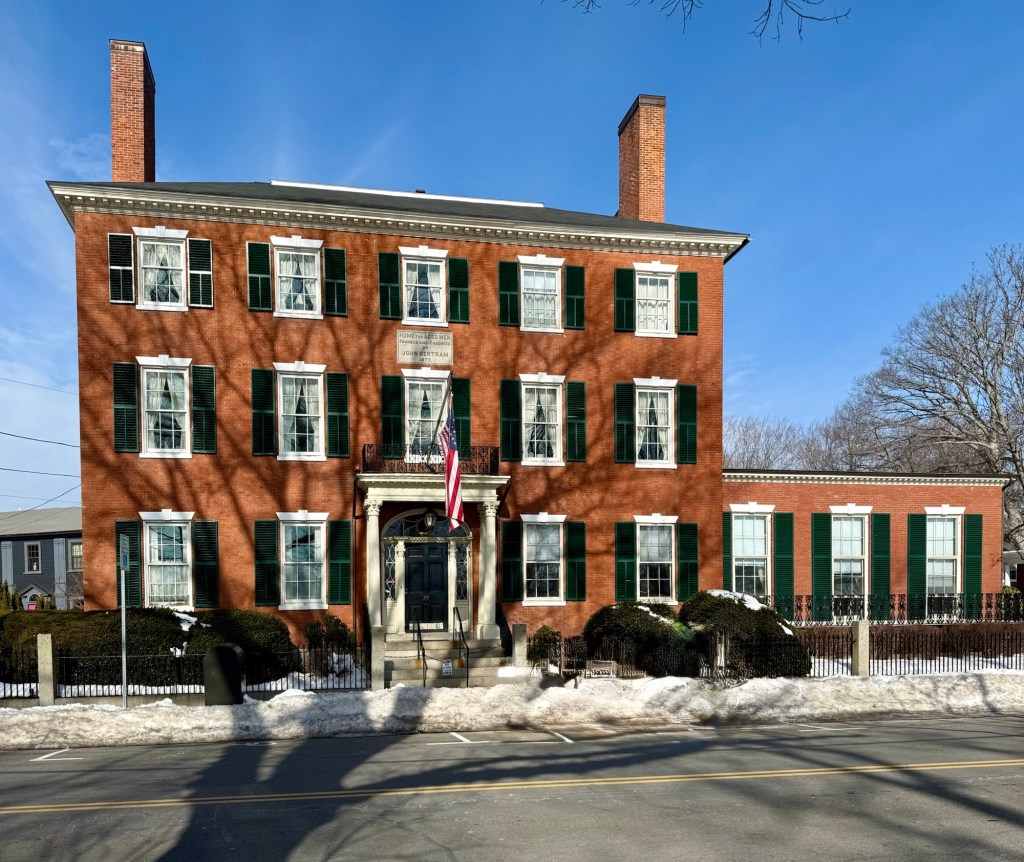
Overlooking the Salem Common, this 1818 Federal style dwelling has served as everything from a single-family home to a boarding house and ultimately an assisted living facility, showcasing that old buildings can always be repurposed into new uses. The home was built for Captain John Forrester, son of Simon Forrester, one of Salem’s most successful merchants. The Forrester House was purchased in the 1830s by George Peabody, who added the one-story ballroom wing. Peabody lived in the house until 1892 and the building later housed the Salem Club, a men’s social organization with over two-hundred well-connected members. In the 1920s, it became the Bertram Home for Aged Men, named after Captain John Bertram, who founded the organization in 1877 as a charitable residence providing housing and socialization space for aged men in Salem. The home had fallen into disrepair when it was closed in 1988, to reopen two years later as the first free-standing assisted living community for men and women in Massachusetts, today known as the Bertram House.
 Buildings of New England