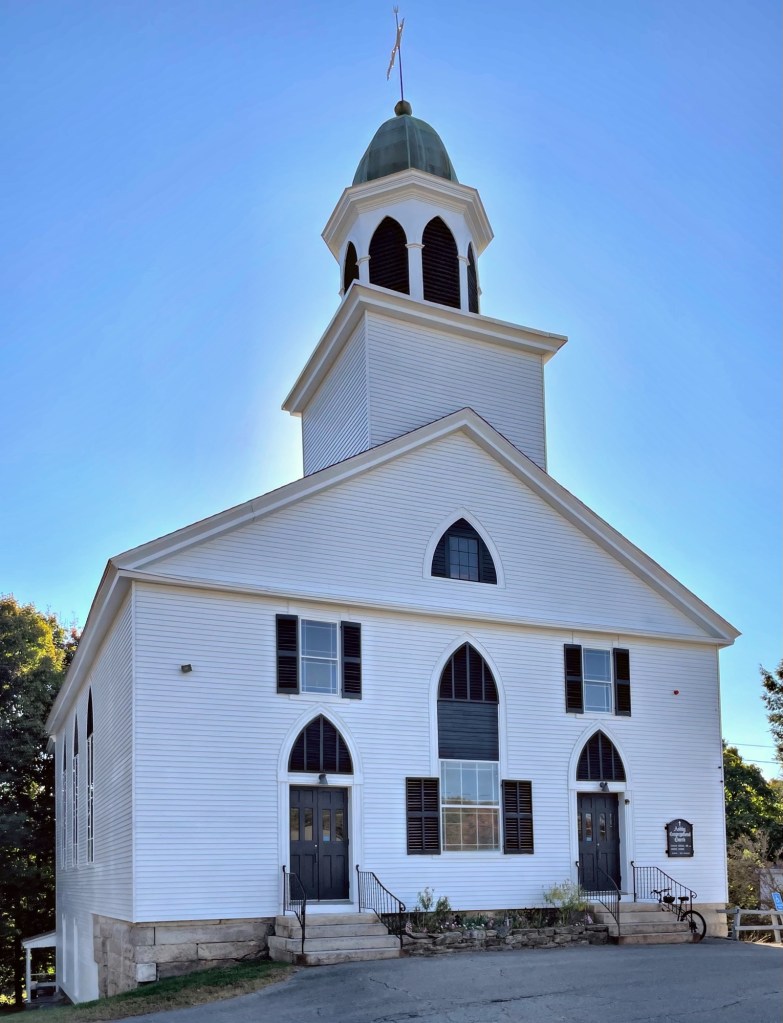
Ashby Congregational Church // 1835

Combining Greek and Gothic revival styles, the 1835 Ashby Congregational Church in Ashby, Massachusetts, is a significant building showcasing the transitional tastes of ecclesiastical architecture in 1830s New England. The church had its beginnings in 1818, when a group of church members disillusioned to the current teachings separated from the town’s Unitarian roots and the accompanying meeting house, the First Parish Church. In 1820 a church for the Congregationalists was built on the opposite end of the town common. In 1835 it was sold and this, the current church building was constructed on a new site facing the Common. The original 1820 church building became the Ashby Academy and is now a Grange Hall. The design of the Ashby Congregational Church shows the leaning towards Gothic detailing wit its prominent pointed arch detailing, yet retains some traditional Greek Revival features like the two-story pediment and pilasters at the belfry.

St. Paul’s Episcopal Church, Brookline // 1852

The St. Paul’s Episcopal Church of Brookline, Massachusetts is an architecturally and historically significant landmark to the area. The congregation was established in 1849, and within months, in May 1850, the corporation, which was made up of wealthy Boston-area residents, accepted an offer from Augustus Aspinwall of a building lot to erect a church. Esteemed ecclesiastical architect, Richard Upjohn, the architect of Trinity Church in New York, was hired to design the church in Brookline of the same, Gothic style. The wealth of the congregation was evident by the consistent expansions of the complex, to include a chapel, rectory, parish house, and other expansions to those buildings. St. Paul’s Church is the oldest religious structure in Brookline, and almost was lost when the sanctuary was devastated by fire in 1976, leaving only its exterior walls and two stained glass windows. The congregation rebuilt the interiors and the building remains well-preserved at its exterior, built of Roxbury Puddingstone.

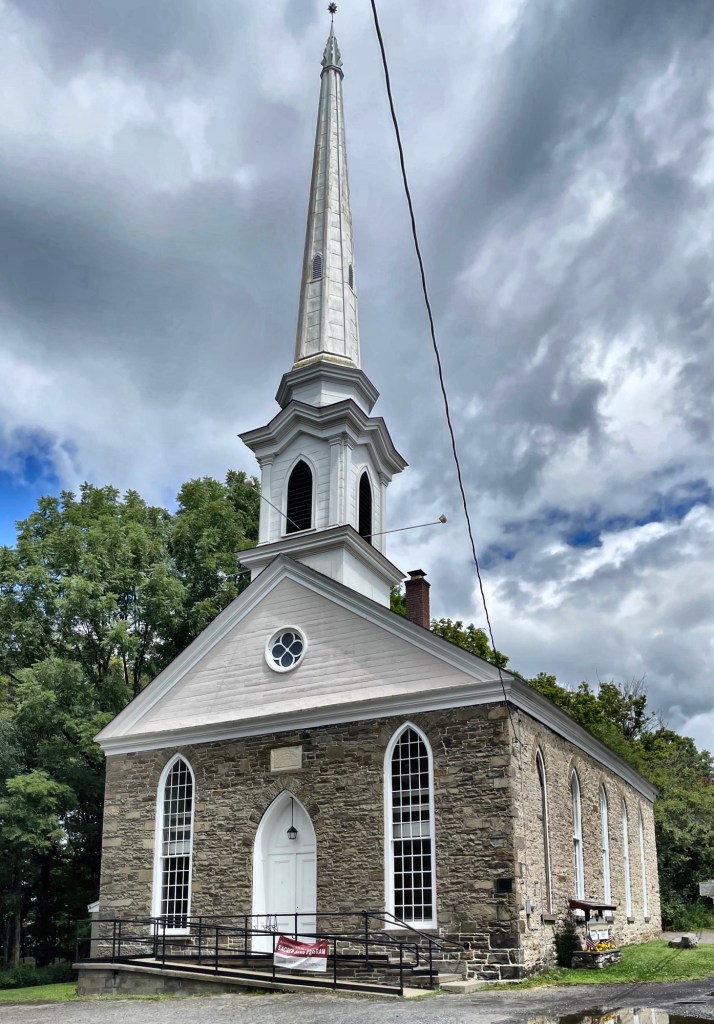
Katsbaan Reformed Church // 1732

The first church on this site in Katsbaan, Saugerties, New York, was a 1732 simple stone church built by Dutch and German settlers. Church services were first held in the German language,  and gradually came to be also held in Dutch and English, as the village and surrounding area developed. The original church was rebuilt in 1816 using the same stone base, but the entrance was shifted away from the street. Larger windows and the steeple were added at this time. In 1867, the steeple was heightened and the windows were enlarged with Gothic points, giving the building its present appearance. The Katsbaan Reformed Church remains an architectural and historical landmark noting the early history of Ulster County and its growth.

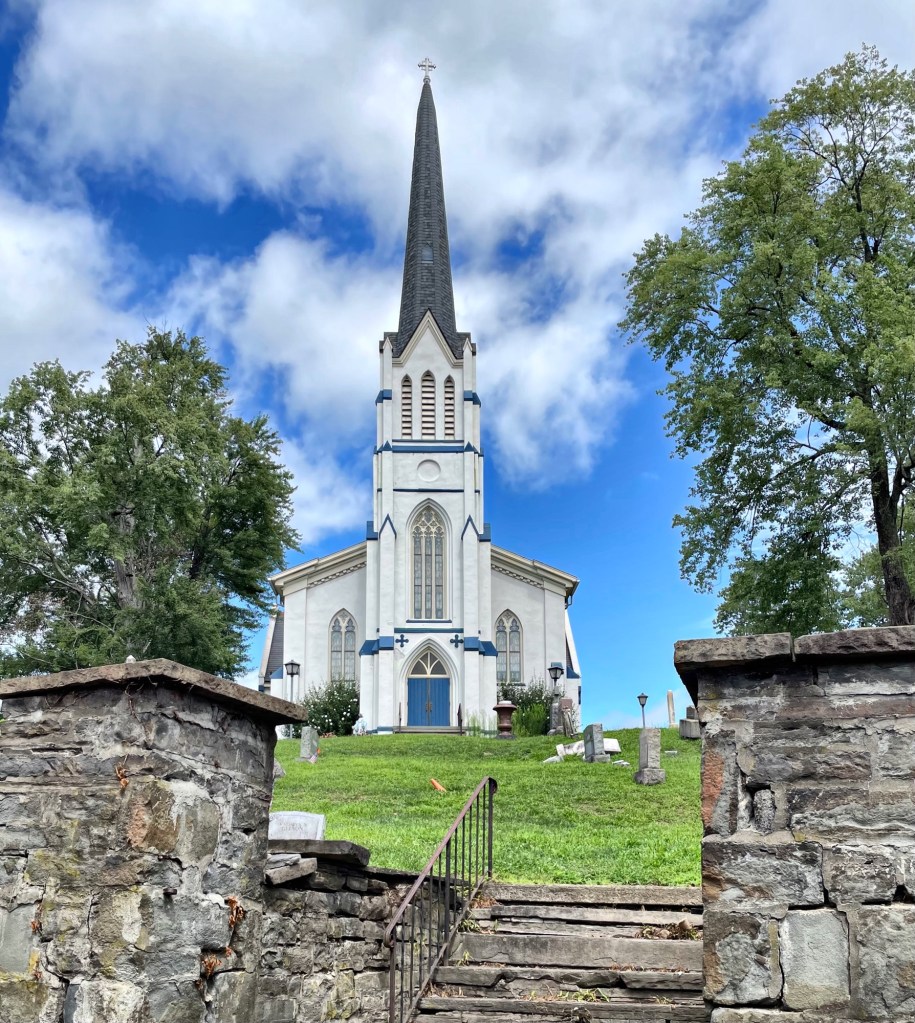
St. Mary’s of the Snow Catholic Church // 1833

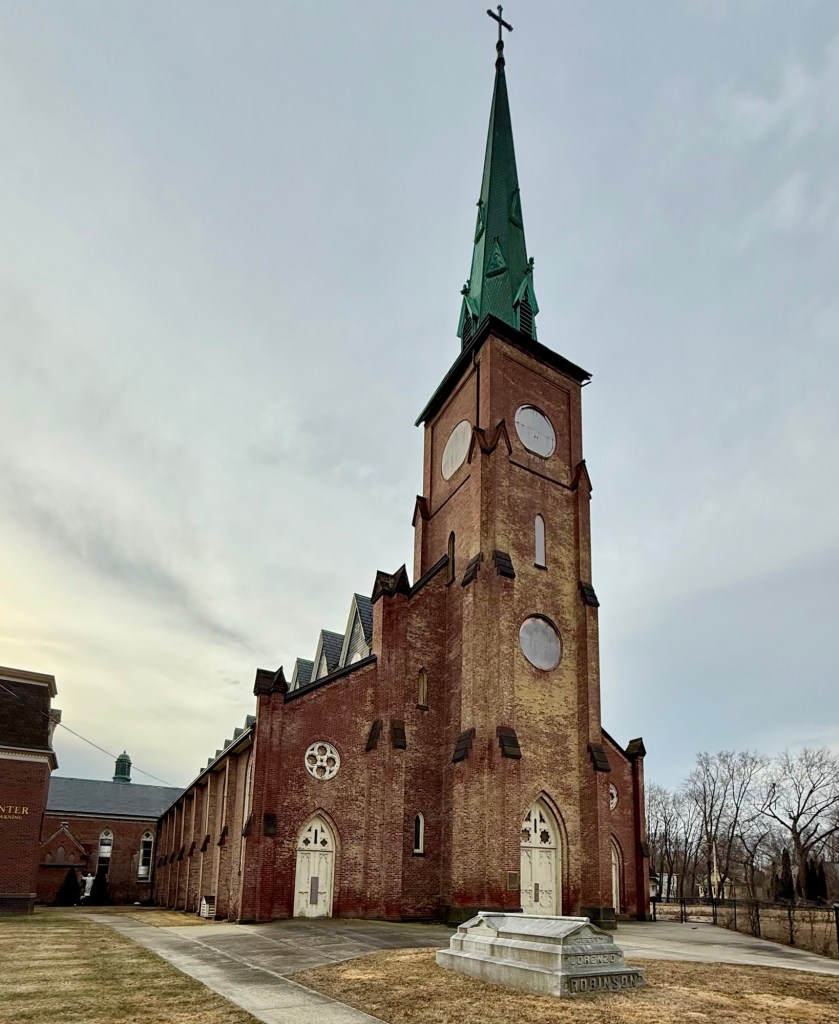
In 1830 Rev. Philip O’Reilly was sent by Bishop John Dubois to establish missions and build churches along the Hudson River wherever there were sufficient resident Catholics. O’Reilly visited the village of Saugerties, in Ulster County in 1832 and began holding services in private homes. The area was home to many Irish residents working in industry, a large number of which were Catholics, and as a result, the village here became the location of the first Catholic church in the county. Father O’Reilly founded St. Mary’s in 1833 creating the first parish of the Hudson, spanning New York City to Albany, with the cornerstone of the new church laid that same year; though, the church would be dedicated a decade later. The church cemetery grew from the first graves around the church in 1833 to fill much of the church property now occupied setting the Gothic edifice in a sea of gravestones. The church grew and eventually the steeple was added in the 1860s. It is also said that the church basement was used as a stop on the Underground Railroad. The church (like many in the United States) has struggled to maintain its large campus, which originally contained the church, a school, and convent, but the church remains in good condition, shining like a beacon on a hill on the Hudson.

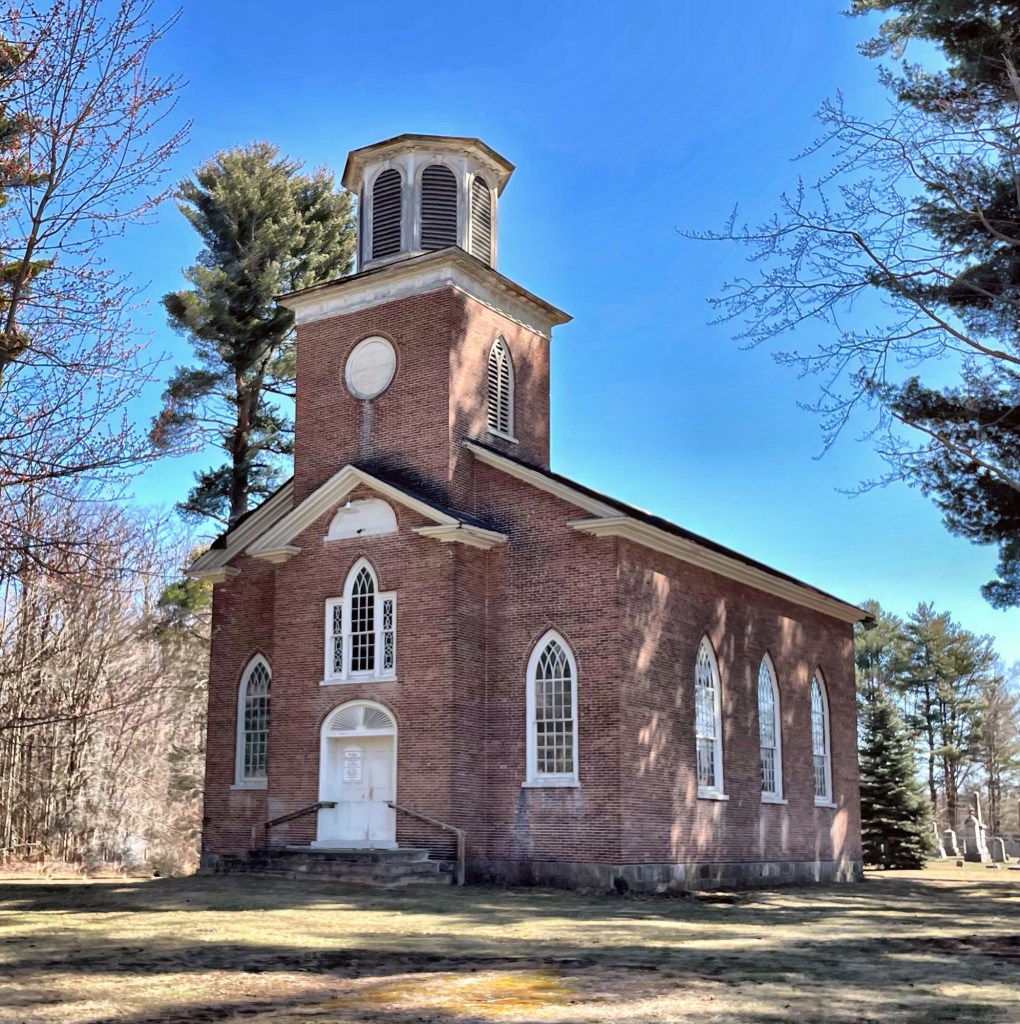
St. John’s Episcopal Church, Highgate // 1831

St. John’s Episcopal Church stands in a grove of pine trees at the southeastern end of the Highgate Falls village green in Highgate, Vermont. The church is built in a transitional style which combines the pointed arches of Gothic architecture with a unique Gothic-Palladian window, but with a traditional plan and massing commonly found in Federal style churches in New England. The church was built between 1831-1833 by Joel Whitney of nearby Enosburg, and was consecrated on May 21, 1834, by Rev. John Henry Hopkins, the first Bishop of the Episcopal Diocese of Vermont. The congregation was a full parish until 1896 and maintenance has since struggled due to dwindling use. The wooden steeple was removed in the late 20th century, but the church stands as an important architectural landmark for the small town.

Derby Cottage // c.1848

Located off Touro Park in Newport, you may be surprised to find an early Gothic Revival style cottage obscured from view by the towering stone Channing Memorial Church. Newport has so many hidden treasures! Very little is written about this cottage, but it appears to have been built c.1848 for Richard Crowninshield Derby (1777-1854) of the famous Derby Family of Salem, Massachusetts. Richard Derby would move to Philadelphia and split his time between there, Boston, and his newly built summer cottage in Newport, Rhode Island. He did not get to fully appreciate the home as he died in 1854. The Gothic Revival cottage was inherited by his widow, Louisa S. Bomford Derby until her death and later by the couple’s two children (from both of their first marriages), Richard Catton Derby and Louisa Lincoln Lear Eyre, the mother of famed architect Wilson Eyre. The property was eventually sold by the half-siblings and the site became home to the 1880 Channing Memorial Church, which now dominates the site. Luckily for us, the cottage was spared and moved to the extreme rear of the lot and converted to the parish hall for the church.

Head Tide Church // 1838

In the early 19th century, Head Tide was a bustling village within the Town of Alna, Maine, supported by mills at the dam, agriculture and apple orchards, boat building, fishing and forestry. As Head Tide grew in population, village leaders determined to build their own Congregational church so they would not have to travel the three miles to the 1789 Meeting House in Alna Center. The Head Tide Church in Alna, Maine was dedicated in November 1838 and sits on a hill overlooking the village. The Head Tide Church is a handsome rural Maine house of worship which exhibits a combination of Federal style, Greek Revival, and Gothic Revival elements in its design. The facade displays the outline of a Grecian temple front with its six pilasters and strongly accented triangular pediment. The Federal fan motif appears above the two facade windows as well as in the center of the pediment and the Gothic Revival influence is felt in the two pointed arch windows on either side of the church and in the simple pinnacle at the top of each corner of the belfry. The church is a high-style building for the rural Maine village and is kept very well by the community. The congregation disbanded, but the church remains an important part of the town and is rented for memorial services, events, weddings.

Weare Town House // 1837

Weare, New Hampshire has a pretty cool history. Located at the northern edge of Hillsborough County, the land presently known as Weare was granted to veterans of the Canadian wars in 1735 by Governor Jonathan Belcher, who named it “Beverly-Canada” after many of the veteran’s hometown, Beverly, Massachusetts. After various disputes over the settlement and naming of the town, it became known as “Weare’s Town” before being incorporated by Governor Benning Wentworth in 1764 as Weare, after Meshech Weare, who served as the town’s first clerk and later went on to become New Hampshire’s first Governor. The town grew slowly during the 18th and 19th centuries around five major villages, with farmland and forests connecting them. Near the geographic center of town, this Town House was built in 1837 to be a government and religious center of the town. Originally, town meetings were held on the first floor and the Universalist Church met on the second floor and the local high school was installed on the second floor in 1919. The building remains the town offices with event space for rent inside today. The building is a great example of a vernacular Greek/Gothic Revival town house of the period with a two-stage tower with pinnacles at the corners of each stage and a louvered belfry at the bell.

Yale University – Alumni Hall // 1851-1911

Detroit Publishing Company image

Alumni Hall at Yale was designed and built between 1851-1853, at the northwest corner of Yale’s Old Campus. Its was designed by Gothic specialist architect Alexander Jackson Davis, who completed Dwight Hall (the Old Library) a some years prior. The building had a large, open floorplan on the first floor for large gatherings as well as the entrance examinations, along with the biennial examinations that every student had to take at the end of his sophomore and senior years. As the building turned 50 years old, the campus around it was already looking very different. Shifting priorities for dormitory space in the yard necessitated its demolition for Wright Hall (next post). Alumni Hall was razed in 1911, but its two crenelated towers were salvaged when the building was demolished. They were incorporated into Weir Hall which has been incorporated into Jonathan Edwards College, one of Yale’s residential colleges.

Yale University – Dwight Hall // 1842

One of the most architecturally significant college buildings in the United States, Dwight Hall was designed to house the growing book collection of Yale College as its library. The former Yale College Library, now Dwight Hall, represents a significant shift in Yale’s campus architecture from Georgian and Federal brick buildings to the Gothic mode which the campus is largely known for today. Dwight Hall was designed by local architect Henry Austin with the guidance of esteemed architects Ithiel Town and Alexander Jackson Davis, both experts in early high-style Gothic buildings in America. The design, to me, resembles the 1443 King’s College Chapel in Cambridge, England. The structure is constructed of brownstone from Portland, Connecticut, and it is composed of a central block with two smaller flanking wings on either side connected by smaller linking spaces. At the yard facade, two octagonal towers with domed copper roofs rise, flanking a large, pointed lancet arch window that extends above the doorway. The library was outgrown fairly quickly, necessitating an annex next door and eventually collections were transferred to Sterling Memorial Library in 1930, the Old Library was converted to a chapel and community service building and is known as Dwight Hall.