Old Boston Public Library // 1855-1898

Courtesy of BPL collections.

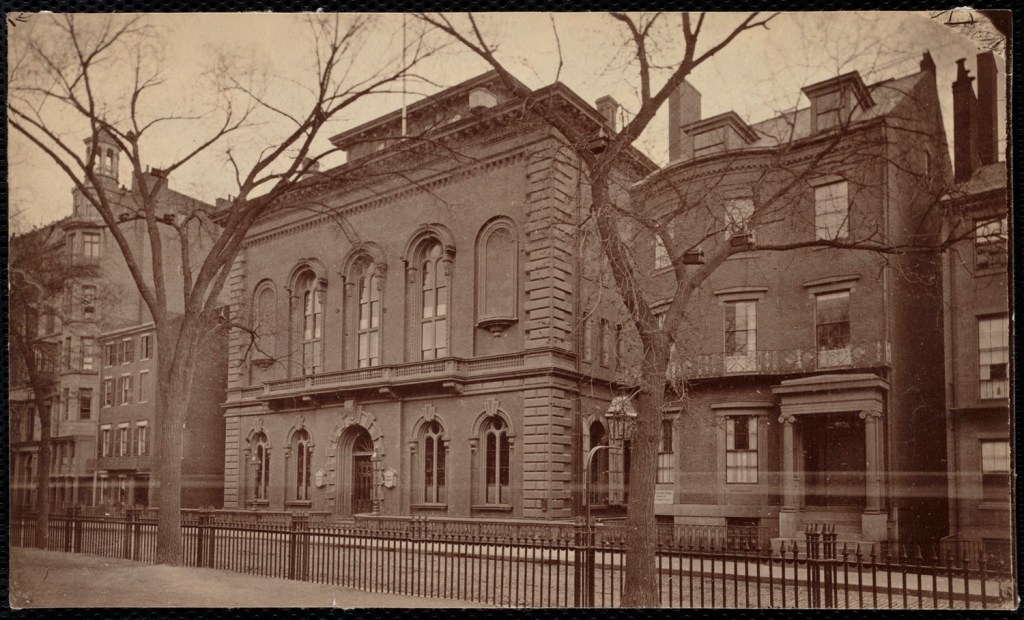
Established in 1848, the Boston Public Library was the first large, free municipal library in the United States. The Boston Public Library’s first building of its own was a converted former schoolhouse located on Mason Street that opened to the public in 1854. As soon as the library occupied the building, it was apparent that the amount of visitors and collections could not effectively be held in the cramped quarters. Planning began almost immediately for it’s first purpose-built library. Less than a year later, in December 1854, library commissioners were authorized to purchase a lot and fund the construction of the new library. A desirable building lot on Boylston Street, opposite the Boston Common, was purchased and a public invitation for proposals from architects was held. The requirements for the building included: a library hall with alcoves capable of containing on fixed shelves at least 200,000 volumes, a general reading room with ample accommodations at tables for at least 150 readers, a ladies reading room, an adjacent library room for the arrangement of 20,000 books “most constantly demanded for circulation,” and quarters for the Trustees and Librarian. The facade was to be of brick, with stone dressing”. The selected design by architect, Charles Kirk Kirby, was for this handsome Italianate style building which took nearly three years to build, opening in September 1858. Twenty years later, as the library outgrew that space, the Trustees asked the state legislature for a plot in the newly filled Back Bay, and planning began on the McKim Building, built in 1895 down Boylston Street. This building, the first purpose-built Boston Public Library building, was demolished in 1898, and replaced by the ten-story Colonial Theater Building. It stood just 40 years.

Edgar Allan Poe Birthplace // c.1805-1965

Courtesy of BPL archives

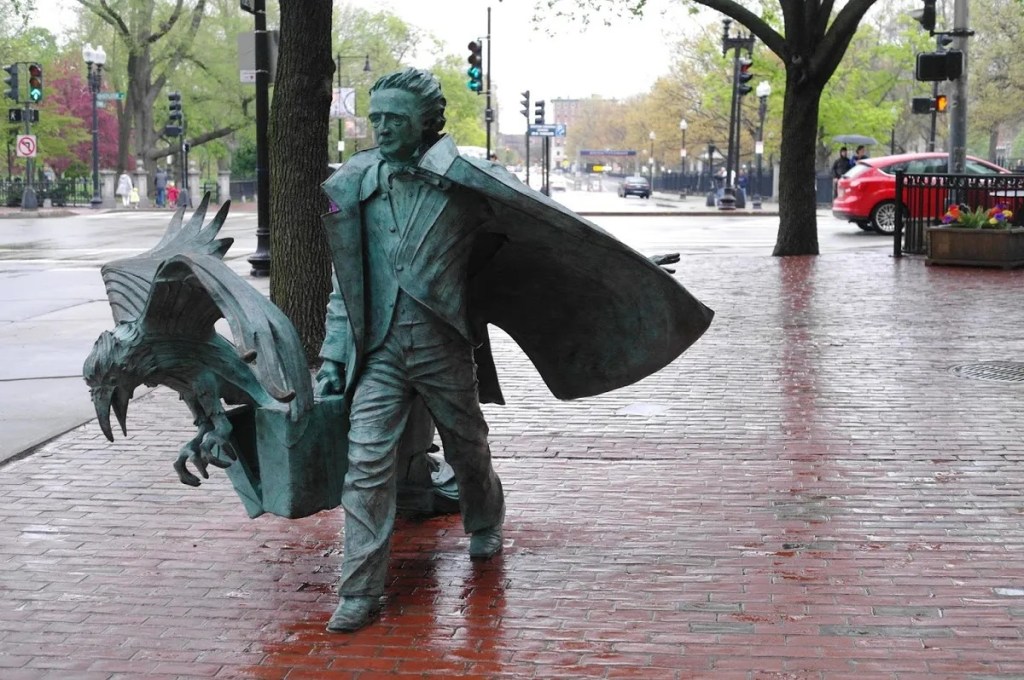
Famed author Edgar Allan Poe was born in this house on Carver Street in Boston, Massachusetts, on January 19, 1809, the second child of American actor David Poe Jr. and English-born actress Elizabeth Arnold Hopkins Poe. His father abandoned the family in 1810 and his mother died a year later from pulmonary tuberculosis. He would be adopted by John Allan, a merchant and slaver in Richmond, Virginia, his adopted family gave him the name “Edgar Allan Poe”. He would live a somewhat nomadic life, moving around often to cities all over the East Coast until his death in 1849 in Baltimore. Although it was his birthplace, Poe’s troubled early childhood likely contributed to his disdain for Boston, where he often referred to Bostonians as “Frogpondians,” after the frog pond on Boston Common, though as an insult. The poet’s seminal work The Raven was published in January 1845 to widespread success. Several months later, Poe was invited to read at the Boston Lyceum with the support of James Russell Lowell, a Harvard professor and editor of The Atlantic Monthly. It did not go well. His childhood home on Carver Street would be razed by 1962 and is presently a surface parking lot for an electrical substation. The city would honor its macabre author by renaming an alley off Boylston Street, Edgar Allan Poe Way, and in 2014, the City commissioned a public statue titled, “Poe Returning to Boston“. Designed by Stefanie Rocknak, the statue depicts Poe walking, facing away from the Boston Common. His figure is accompanied by an oversized flying raven; his suitcase lid has fallen open, leaving a “paper trail” of literary works embedded in the sidewalk behind him.

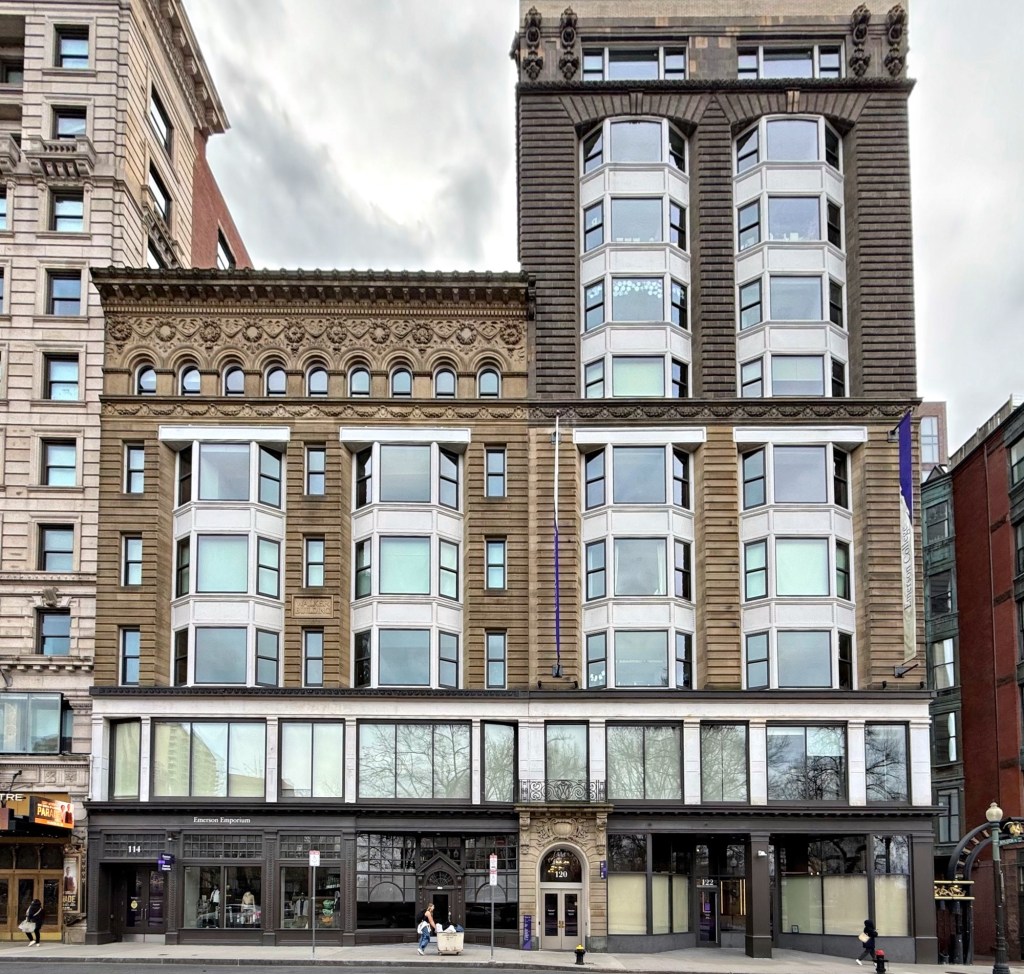
Walker Building // 1891

On Boylston Street overlooking the Boston Common, this historic building with two distinct parts is not photographed as much as some of its neighbors, but it is an important visual reminder of the period of growth and development in the city in the late 19th and early 20th centuries. This is the Walker Building, an early office building that was constructed beginning in 1891 in two phases by owner Joseph W. Walker. Mr. Walker hired the architectural firm of Winslow & Wetherell to design the building, which was finished in the Romanesque Revival style with a notable cornice with nine-bay arcade of arched windows and ornate wreath and swag motifs. A major tenant in the building was the Boston office of the S. S. White Dental Manufacturing Company, the largest dental manufacturing company in the world. Less than a decade after the six-story Walker Building opened, Joseph Walker purchased and razed the parcels nextdoor and again hired the same firm (at this time renamed Winslow & Bigelow), to expand the Walker Building, building a ten-story addition in a similar style. The second Walker building housed piano company showrooms and offices along with professional offices of numerous architects and professionals. The Walker Building is now owned by Emerson College, and is used as classrooms, computer labs, and study spots for students with the dining center and bookstore in the former retail spaces.

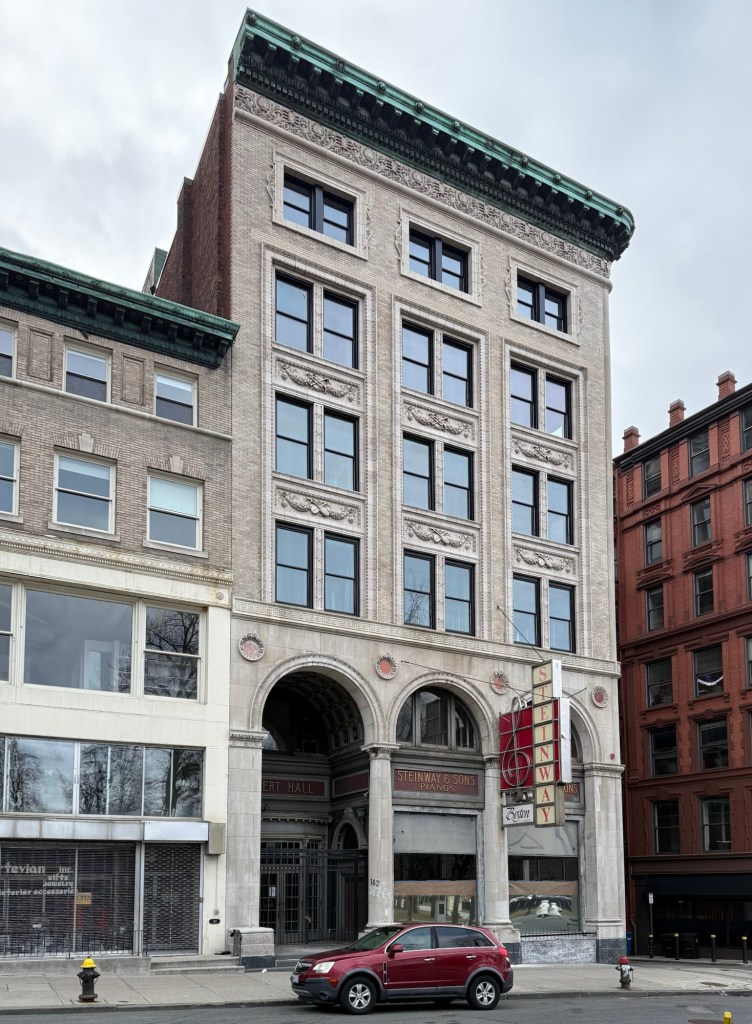
Steinert Building // 1894

The Steinert Building on Boylston Street in Boston is one of the city’s most iconic and mysterious buildings. The Beaux Arts style building was constructed in 1894 from plans by architects Winslow & Wetherell and contained three floors of display rooms, three floors of teaching studios and practice rooms. The building is arguably best-known for the 650-seat Steinert Hall, a basement concert hall constructed 35′ under ground and considered by some to be one of the most perfect concert halls, acoustically, in the U.S. The building was constructed as the national headquarters for the prestigious firm of M. Steinert & Sons, one of the largest and finest music stores in New England. Established in 1860 by Morris Steinert, a Bavarian musician, musical instrument collector and founder of the New Haven Symphony (originally Steinert’s Family Orchestra). The company was expanded under his second son, Alexander Steinert, who had the Steinert Building in Boston built, requiring a music hall to showcase musicians and their products. The subterranean concert hall closed in the 1940s, following the 1942 Cocoanut Grove fire, the third-deadliest building fire in American history, which resulted in deaths of 492 people. This tragedy inspired an entirely new set of building and fire codes throughout the city; which ultimately would close Steinert Hall, as it had only one means of egress, making it too cost-prohibitive to bring the theatre into compliance. The building was long-operated as a piano showroom, but closed in 2017 and has been vacant ever-since. The basement music hall remains frozen in time, awaiting a new life.

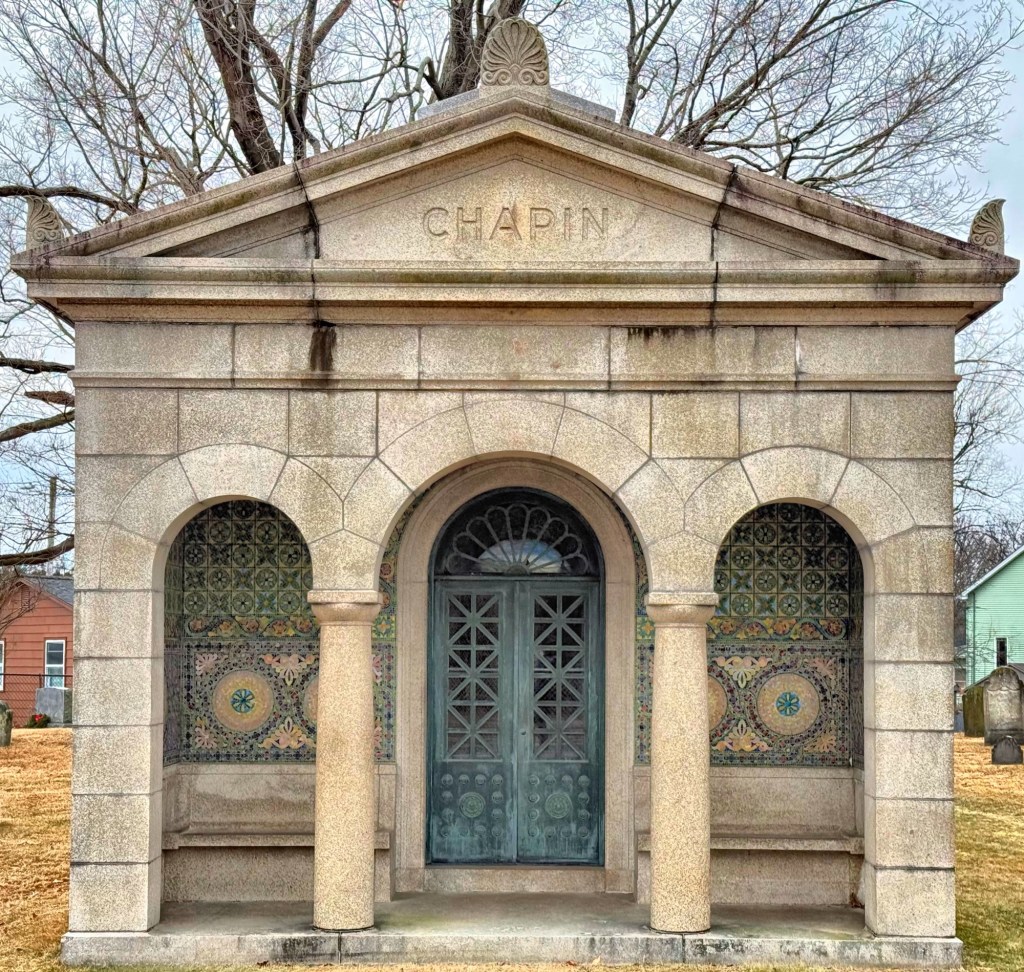
Chapin Mausoleum // 1914

The Chapin Mausoleum was built as a memorial to Chester and Dorcas Chapin by their son, Chester W. Chapin Jr. Located in the Chicopee Street Cemetery in Chicopee, Massachusetts, the otherwise ordinary burial ground is adorned by this stately mausoleum, which was designed by none other than Louis Comfort Tiffany. Chester W. Chapin, the father of the mausoleum builder, was one of the Connecticut Valley’ s most important 19th century businessmen. After more humble beginnings operating a store, Chapin operated a business for coaches and steamboats, and later, he became president and director of the Western Railroad Corporation (1854 to 1867), and president of the Boston and Albany Railroad Company (1868 to 1878). He was elected as a Democrat to the US House of Representatives and served from 1875 to March 3, 1877. His son, Chester Williams Chapin (1842-1922), followed his father’s footsteps and serves as president of the New York & New Haven Steamship Company and one of the organizers of the Central New England Railroad. Chapin Jr. hired Louis Comfort Tiffany to design and decorate this mausoleum as a memorial to his parents, in the cemetery where hundreds of family members are buried in Chicopee. The mausoleum is constructed of “Tiffany granite”, from a granite quarry in Cohasset that Tiffany Studios purchased in 1914. The entrance to the mausoleum is through a Romanesque portico complete with round arches, stocky columns, and Favrile glass mosaics on the sides. Two marble benches flank a specially designed Tiffany bronze door. Inside, it is said that there are 12 catacombs of richly veined white marble under a Favrile glass mosaic ceiling.

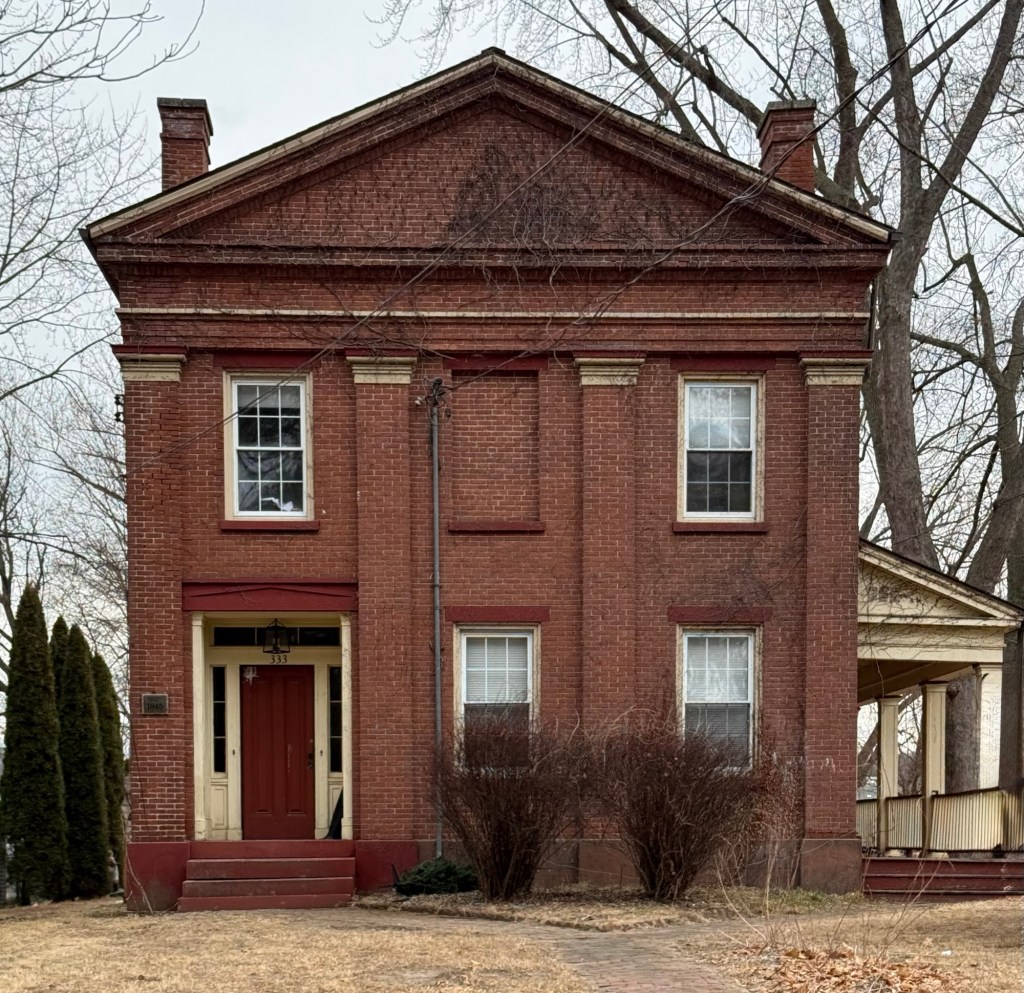
Elias Gates House // 1843

In 1843, Elias Gates (1801-1886) a young farmer, purchased land from the family of his wife, Mary A. Stedman, and had this handsome brick, Greek Revival style house built. The family would reside here less than ten years, and relocate to Albany, where Elias worked as a bookseller. The house was purchased numerous times throughout the 19th and 20th centuries, and operated as a farmhouse until much of the land was sold and subdivided for new housing. The Gates House is a great example of the Greek Revival style with a side hall plan, recessed entry with original sidelights and transom, and bold facade with brick pilasters dividing the bays with brick entablature and gable end facing the street.

First Congregational Church of Chicopee // 1825

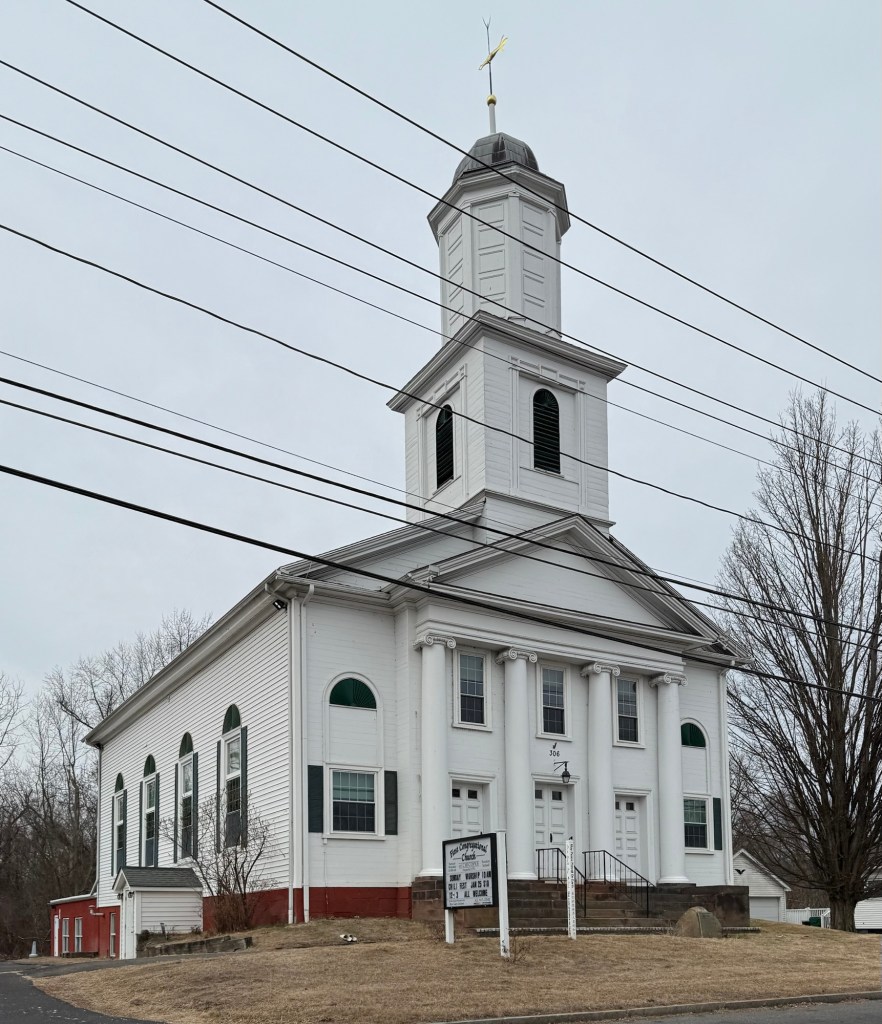
The First Congregational Church Society of Chicopee was organized as the Second Church of Springfield in 1751, when residents of land today known as Chicopee and Holyoke (then a part of Springfield) sought a parish church closer to their homes. Before Chicopee officially split from Springfield in 1844, the Second Church of Springfield built this Federal-Greek Revival style church building in 1825. Shepherd and Whitmarsh, prominent builders of Springfield were hired to erect the church. Both were trained under architect, Isaac Damon, thus the close resemblance to his designs for this church in Chicopee. The clapboard structure is simply designed but holds strong proportions and symmetry. The church has a four-columned portico with Ionic columns and a two-story square tower containing the belfry, blind octagonal stage with molded trim above, all capped by a dome surmounted by a weathervane. While the church now has replacement windows and plastic, ill-fitting shutters, the building is in great shape and tells the story of the early days of the development of Chicopee from sleepy parish town to industrial city.

Governor Robinson House – Assumption Church Rectory // c.1870

Located next to the Assumption Roman Catholic Church of Chicopee, this handsome Second Empire style residence is significant not only architecturally, but as the residence of a Massachusetts Governor. This house was built around 1870 for a Frank D. Hale, who resided here until 1878, when the property was purchased by George Dexter Robinson (1834-1896), who moved to Chicopee and eventually got engaged in politics, in 1873 winning election to the Massachusetts House of Representatives, and was elected to the Massachusetts Senate in 1875. In 1876, Robinson was elected to the United States House of Representatives, where he served most of four terms, buying this home about half-way through his time as a Representative in Washington. While serving in Congress, Robinson was nominated to run for Governor of Massachusetts in 1883, he won and served three, one-year terms. After his time as Governor, he went back to his law practice, and in 1892, Robinson took on his most famous client, Lizzie Borden. During the infamous trial, Robinson was also able to cast significant doubt on the reliability of several witnesses to the events surrounding the murders. Lizzie Borden was ultimately acquitted of the criminal charges, and Robinson was a highly visible presence in the media circus that attended the trial. In the 20th century, this handsome property was acquired by the Assumption R.C. Church of Chicopee, who used the house as a rectory for its new church next door. It remains a well-preserved example of the Second Empire architectural style with slate mansard roof crowned by iron cresting.

Assumption Roman Catholic Church // 1922

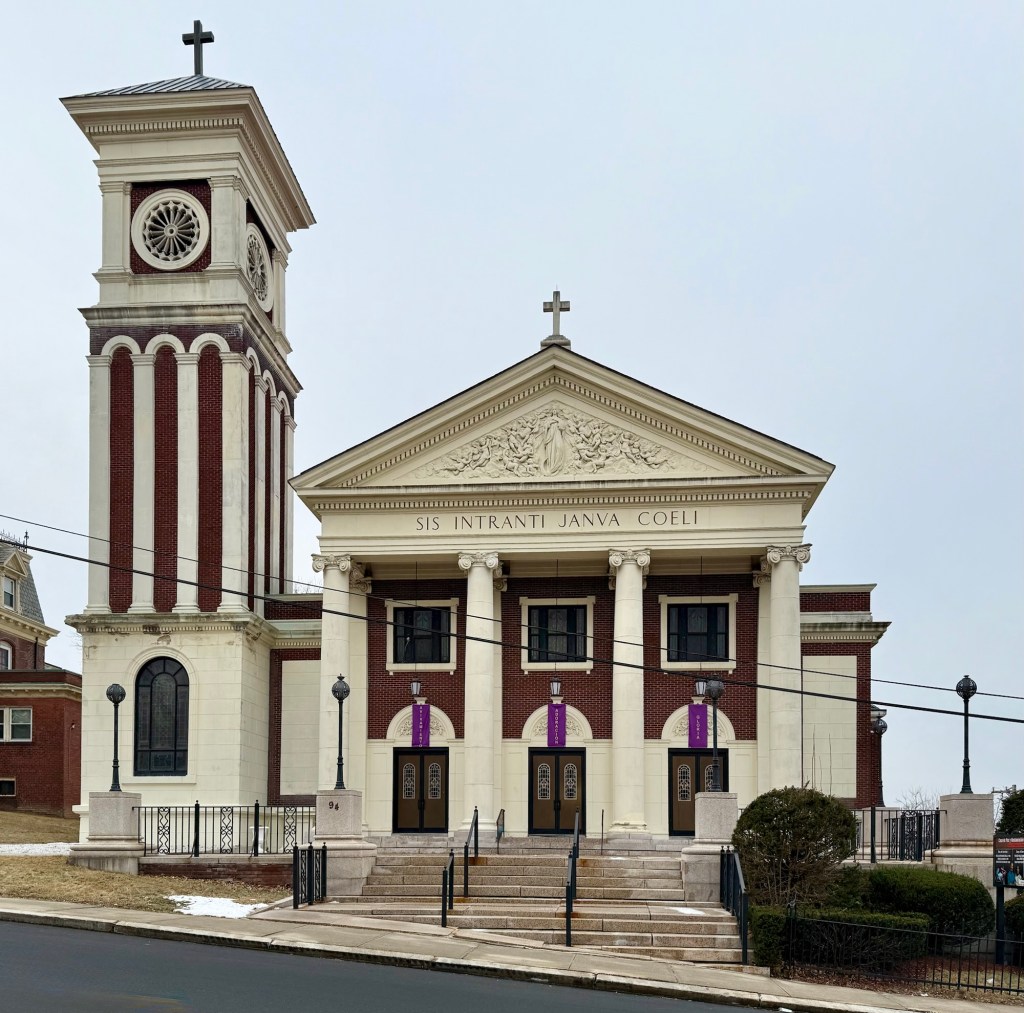
As Chicopee developed into one of the major industrial cities in Western Massachusetts, immigrant groups moved there, finding work at some of the major manufacturing companies. Irish and Polish churches were built and French and French Canadian residents too built their own church, where they could gather and worship in their native language. A wood-frame church was first built in the 1870s and used until it was destroyed by fire in 1912. It took a decade for the congregation to gather enough funds to purchase a new lot and build a new church, but patience was a virtue as their church is a stunner! The cornerstone for the church was laid in 1922 and the building was designed by local architect, George P. Dion, and constructed at the cost of $200,000. The building was dedicated in 1925 and is one of the finest, and most unique churches in the state. Italian Renaissance Revival in style, the church stands out for its 85-foot-tall campanile and cast-stone high-relief in the pediment at the facade. It is believed that within the relief, that depicts the figure of Mary surrounded by Cherubs, depicting the “Assumption of the Virgin,” George P. Dion used the likeness of his granddaughter as a face of one of the cherubs. The congregation moved out of the building but has been recently mortgaged to a new church, Iglesia Cristiana Casa De Paz y Restauración, showcasing the ever-changing demographics that keep our cities vibrant and stewards that do right by our collective history and buildings.

Third Congregational Church of Chicopee // 1868

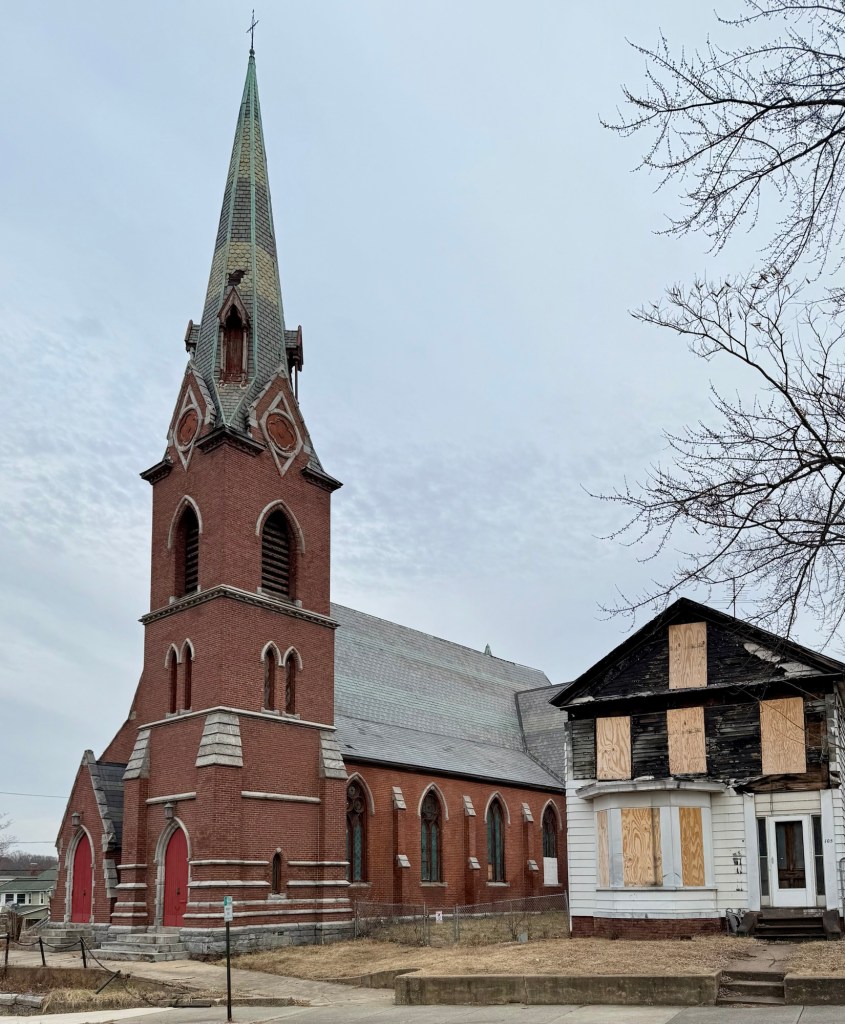
The Third Congregational Church of Chicopee was built on a prominent lot on Springfield Street in 1868, replacing the congregation’s first church there, which was outgrown. The present building was designed by Charles Edward Parker, a Boston-based architect, who was an expert in Gothic architecture. He would design the Chicopee City Hall just years later. The building is constructed of brick and atop a granite base and features lancet (pointed arch) doors and windows, a corner steeple, and steep gable end with large rose stained glass window. The interior is preserved as well. Due to shifting demographics in Chicopee in the early 20th century, the church merged in 1925 with the Central Methodist Episcopal Church, forming the Federated Church of Chicopee. The congregation eventually closed and the church has sat vacant in recent years, and was briefly listed for sale in 2024, 9,339 square feet for just $200,000.