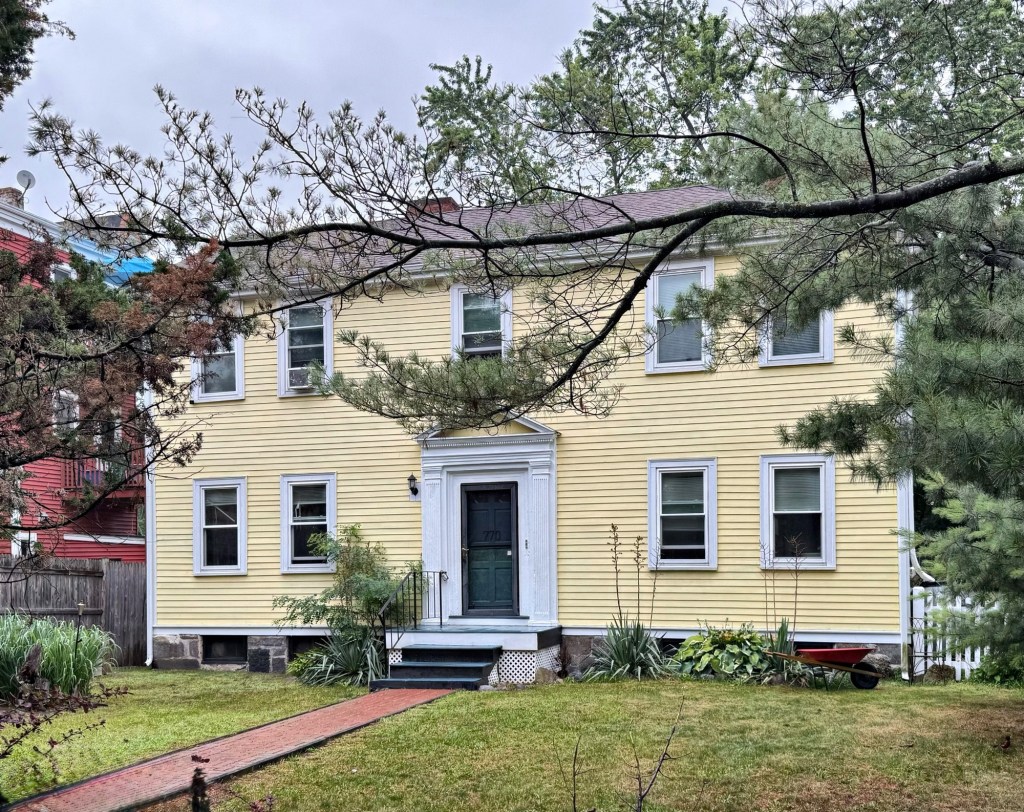
Joseph Royall House // c.1770

This is one of the oldest buildings in Boston! The Joseph Royall House is located at 770 Washington Street in the Ashmont section of Dorchester, set back from the street and passed by thousands who likely do not know its history and significance. The house dates to around 1770 and was built by Joseph Royall, of the infamous Royall Family of Cambridge, Medford, and Antigua, who made much of their money through sugar plantations in the Caribbean and enslaved Africans. Joseph was a nephew of Isaac Royal Jr., the patriarch of the family who resided at what is now the Royall House and Slave Quarters in Medford. Upon the outbreak of the American Revolution, the Tory Royalls were forced to flee for protection, Joseph would move to England. Isaac’s daughter (and Joseph’s cousin), Penelope Royall Vassall had her Cambridge home confiscated as a Tory property during the Revolution, causing her to flee to Antigua. When she returned to Boston after the war she was a widow and lived in poverty. Her cousin, Joseph, would sell her this Dorchester estate in 1782 nearly for free, allowing her to sell the property for money to survive in Boston. The house would remain here for another two-and-a-quarter centuries, as Ashmont grew around it. One-story stores were built in the front yard, completely obscuring the Georgian residence until later owners, Bob and Vicki Rugo, restored the house and demolished the stores in front, preserving this house for centuries to come. While the house is one of the oldest in Boston, it is not a landmark or listed on the National Register of Historic Places.
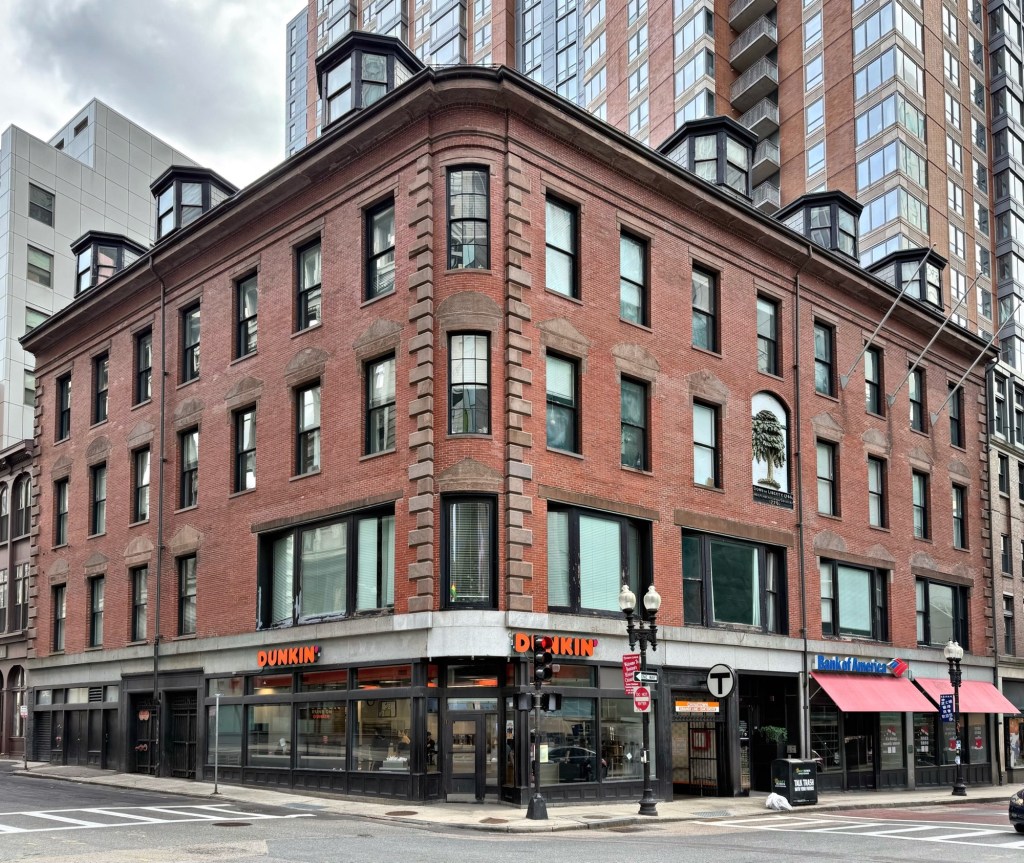
Liberty Tree Block // 1850

The Liberty Tree Block is located at one of Boston’s oldest and most important intersections, Boylston and Essex streets. It is said that near this site, the Liberty Tree stood, and where in 1765, Patriots in Boston staged the first act of defiance against the British government under its branches, The Stamp Act protests. The tree became a rallying point for the growing resistance to the rule of Britain over the American colonies. The Liberty Tree was cut down by British Loyalists in 1775, but the tree’s symbolism lives on in the building constructed on the site 75 years later. Nineteenth-century real estate developer David Sears had this commercial block built in 1850, which housed stores at the street with ballrooms on the upper floors. The Liberty Tree Block is best-known and named so due to the wooden relief plaque of the Liberty Tree on the Washington Street elevation. The motif stands 8′ high and 5′ wide and was carved by ship carvers. The bas relief is inscribed with “Liberty–1765” across the top, “Law and Order” at its roots, and at the bottom, “Sons of Liberty, 1765. Independence of their Country, 1776.” The building (and its carving) are protected Landmarks in Boston.

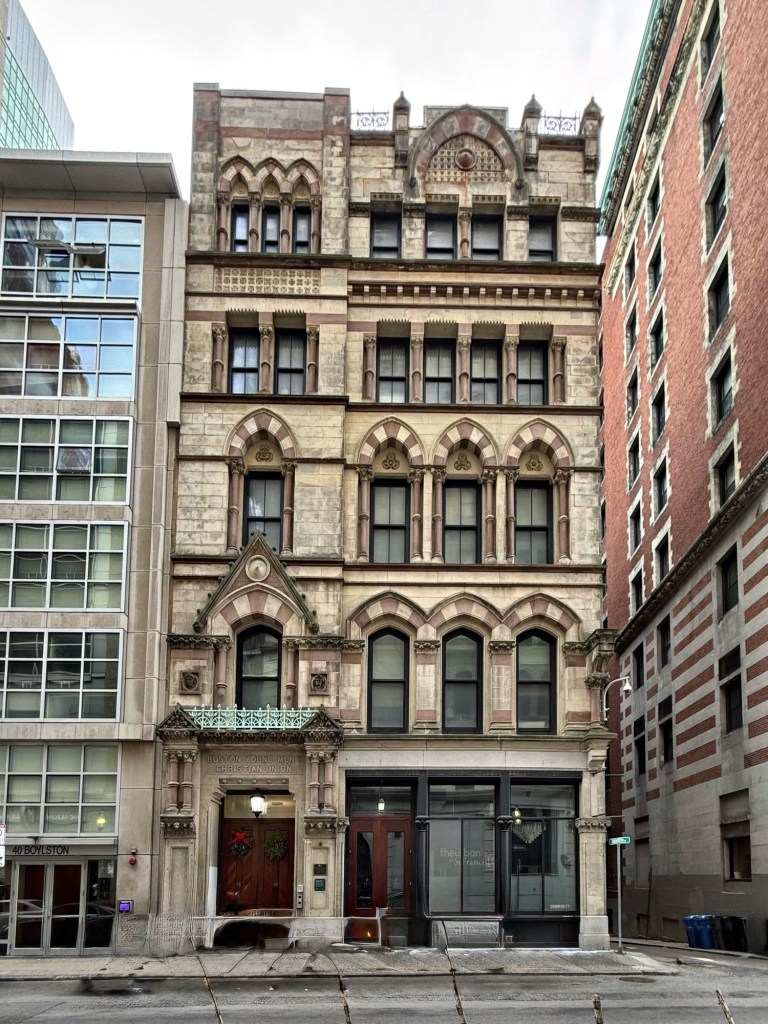
Boston Young Men’s Christian Union Building // 1875

The Boston Young Men’s Christian Union was founded in 1851 by a group of Harvard students as a biblical and christian literature discussion group, which incorporated the following year. First located on School Street, the organization’s activities were to provide a focal point for the intellectual, religious, and social life of primarily middle-class, well-educated Christians. The organization grew to the point that a new building was needed, and in 1873, a site on Boylston Street was acquired as a perfect central location for the group. Architect Nathaniel J. Bradlee of Bradlee and Winslow was hired to design the structure, principally because Mr. Bradlee by then a prominent architect and public figure, was also a life member of the Union and the brother of one of its founders. The building was completed in 1875 and included ground floor retail with an auditorium, gymnasium, library, social and game rooms, and offices for the Union above and behind. Designed in the High Victorian/Ruskinian Gothic style, derived from a mixture of English, Italian, French, and some German Gothic precedents, the style emphasized complicated, asymmetrical massing, polychromy, ornate details, and lancet or Gothic arched openings, in this building a sandstone facade was used. The building became a City of Boston Landmark in 1977. In 2016, the building was converted to an affordable housing development by The Architectural Team Inc., and called “The Union”. The development provides 46 units of affordable housing, including 25 targeted to those who have experienced homelessness. What a great rebirth of the building. Historic Preservation and Affordable Housing can work together and create great projects.

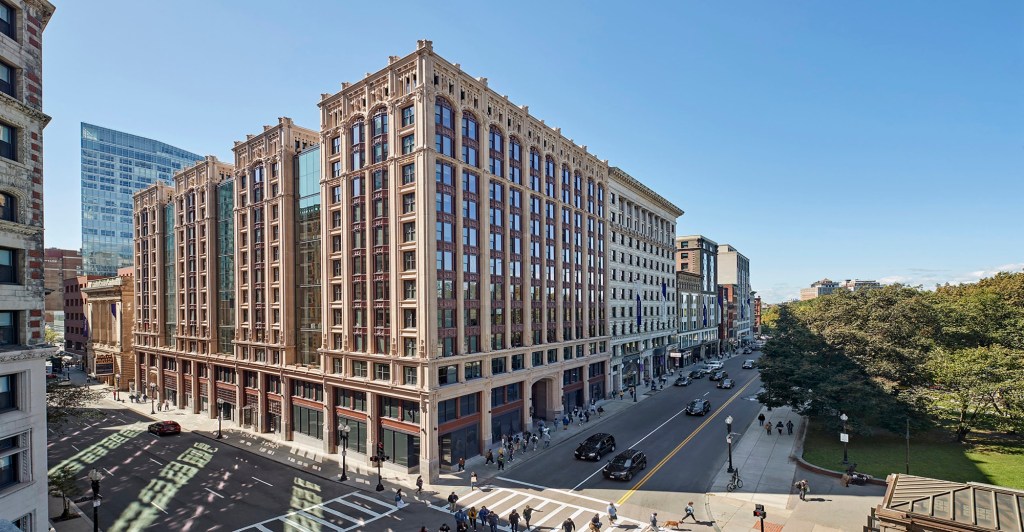
Little Building // 1917

The Little Building sits prominently at the busy corner of Boylston and Tremont streets overlooking the Boston Common. Like the Colonial Theater next door, the Little Building was designed by architect Clarence Blackall and named after its developer and owner, John Mason Little. Blackall designed the Little Building in the Neo-Gothic style with a steel frame and a two-story Tudor-arched entrance on Boylston Street. The original facade was granite and cast stone, and the floors were made from reinforced concrete. The building replaced the Hotel Pelham which occupied the site since the 1850s. After being completed in 1917, the Little Building was considered significant enough that it was featured in American Architect and Building News, highlighting many architectural details inside and out. The Little Building was advertised as a “City Under One Roof” with 600 offices, dozens of shops, a post office, restaurants, and connections to the nearby subway and theaters. Emerson College purchased the Little Building in March 1994 for $5 million and converted the building to dormitories. After years of deteriorating masonry, Emerson College hired Elkus Manfredi Architects to oversee a full renovation of the building, including a sweeping facade restoration and the insertion of three glazed elevations between street-facing light wells. The “new” Little Building is a splendid re-imagining of a historic building, showing how old buildings can be renovated to meet contemporary uses through well intentioned design and care.

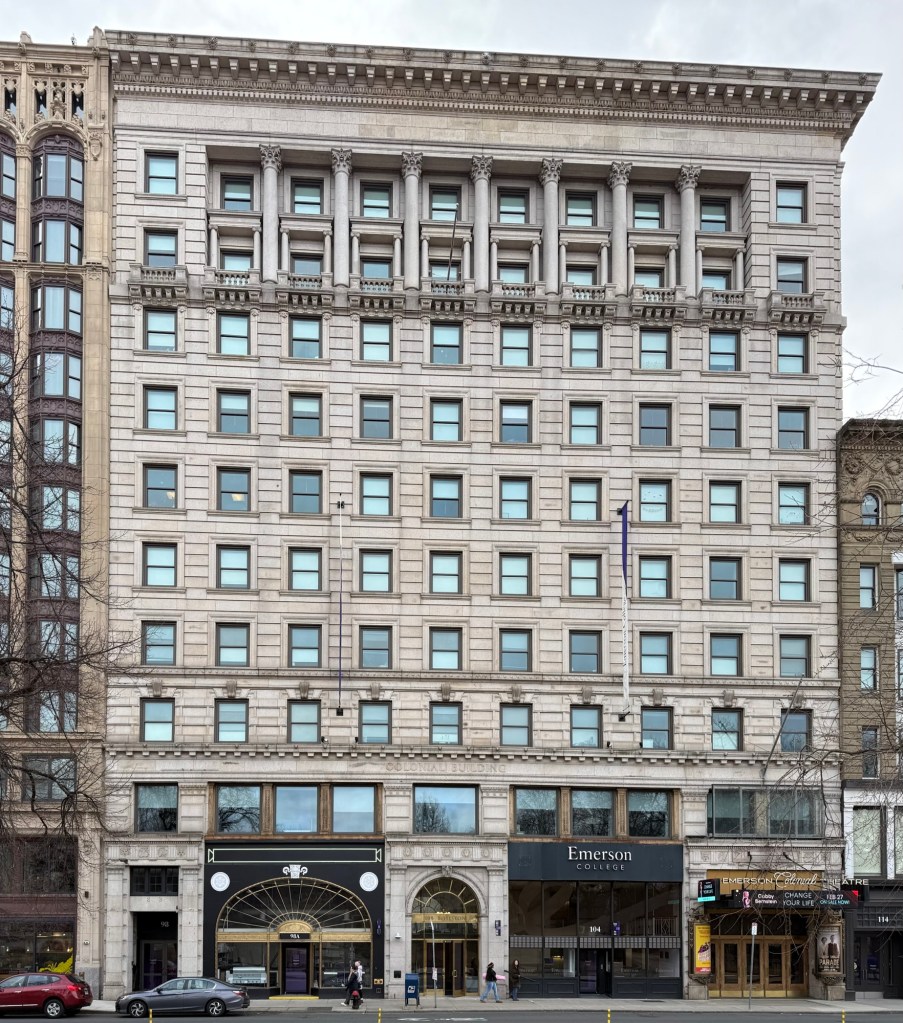
Colonial Theater Building // 1899

One of my favorite buildings on Boylston Street in Boston is the ten-story Colonial Theater Building, a landmark Classical Revival style structure of stone. Built in 1899, the Colonial Theater replaced the original Boston Public Library building (1855) which was demolished by 1898, and relocated to Copley Square. The Colonial Theater was designed by famed theater architect, Clarence Blackall and is said to be the oldest, intact theater in Boston. The theatre first opened its doors for a performance of Ben-Hur on December 20, 1900 with a sold out show. Ben-Hur operated with a cast and crew of 350 people and featured eight live horses on stage in full gallop during the chariot race scene, with the play being so mechanically and technically extraordinary it was featured on the cover of Scientific American. While cheekily named the Colonial Theater, the interior theater spaces were anything but. The spaces originally contained murals and Baroque style finishes, many of which remain today. Beyond the 1,700-seat theater, the building contained between 250-300 professional offices. The building is owned by Emerson College, who underwent a massive restoration project of the building with Elkus Manfredi architects. Allowing the oldest Boston theater to shine again!

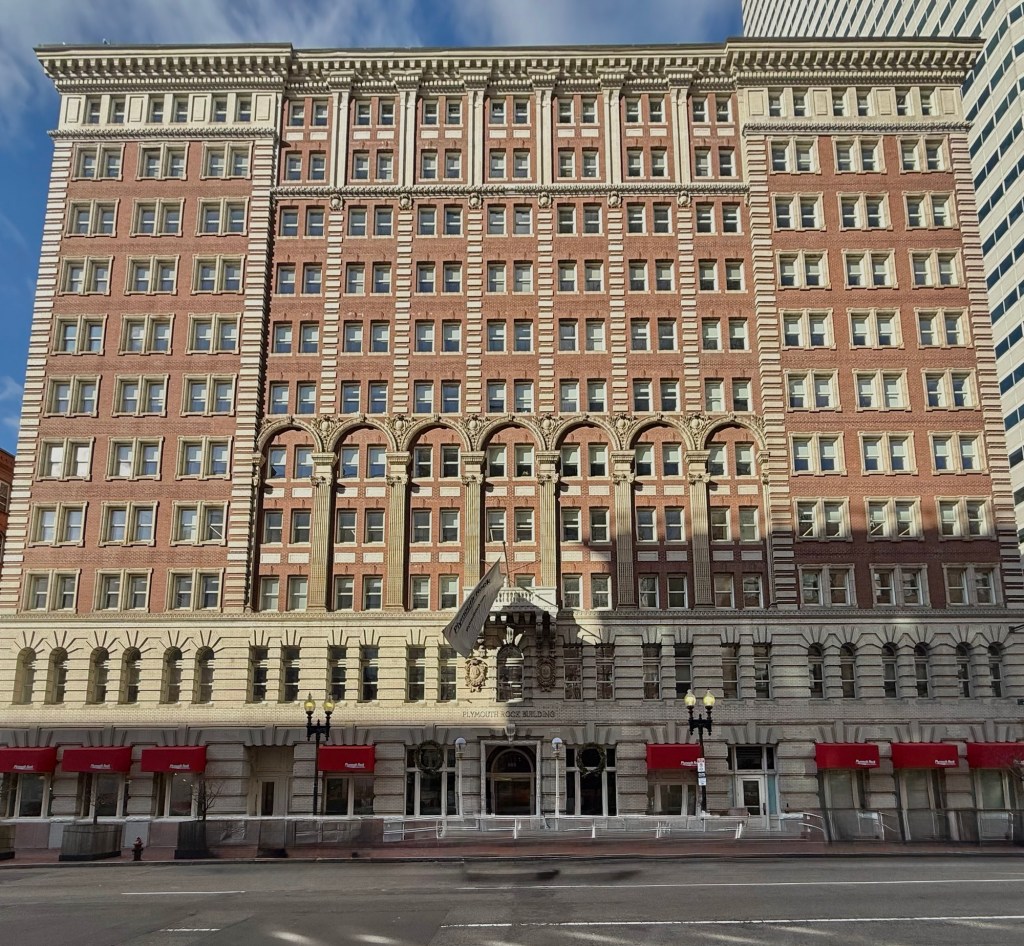
Hotel Essex – Plymouth Rock Building // 1900

The construction of a new South Station Terminal in 1899, prompted a development boom for the nearby area, which had for the previous decades been almost entirely mercantile and centered around the leather and woolen industries. Due to increased land values and an influx of travelers to the area, developers saw an opportunity to erect this building to serve as a hotel for visitors to Boston via South Station. Boston architect, Arthur H. Bowditch, furnished plans for this building in the Beaux Arts/Renaissance Revival style, with use of brick and limestone construction, ornate finishes at the façade including the fluted pilasters, arches and cartouches in the spandrels. The building was completed in 1900 and known as Hotel Essex and featured a long, storied history as a hotel until it closed in the second half of the 20th century. After years of deteriorating conditions, the building was adapted as the corporate offices for Plymouth Rock Assurance Corporation in 1982. The building was restored and has been known as the Plymouth Rock Building ever since.

South Station // 1899

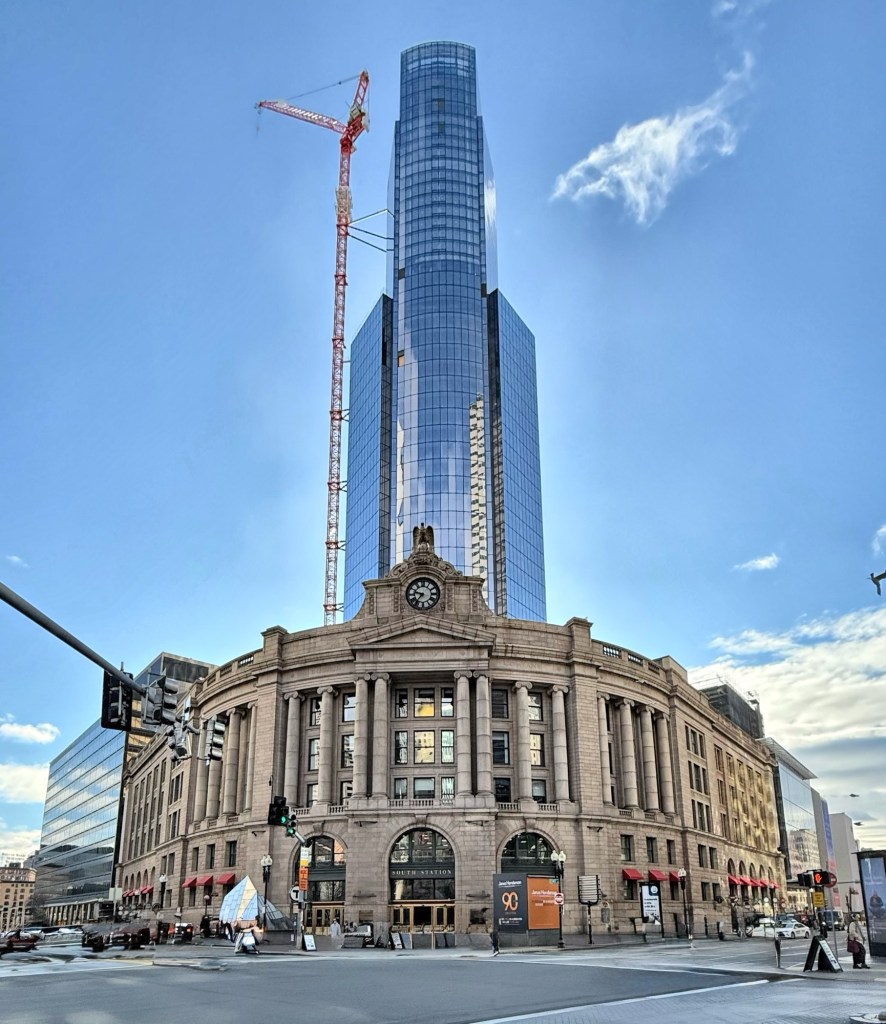
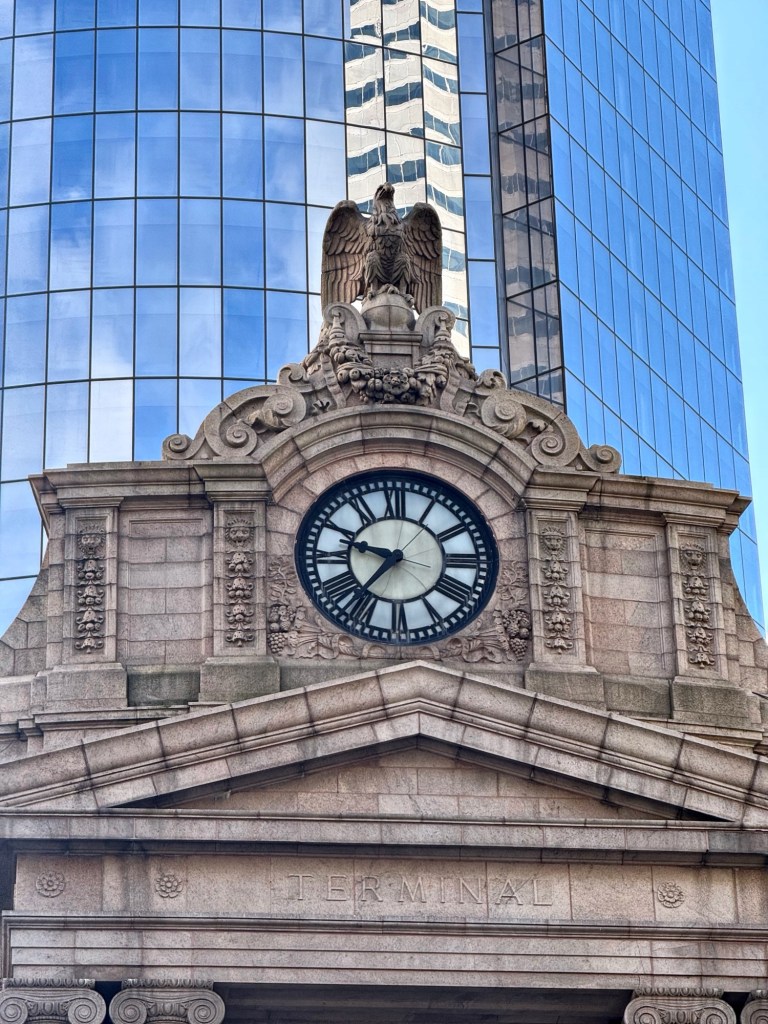
When the railroads serving Boston were first laid out and built, each line stopped at its own terminal which created a dysfunctional and cumbersome travel experience for those entering or leaving the city. The Boston Terminal Company, established in 1897, was charged with the task of consolidating service from the four terminals at a single terminal, a union station (similar to North Station), for routes south of the city. South Station was designed by architects were Shepley, Rutan and Coolidge of Boston and quickly became New England’s busiest transportation center. The five-story Classical Revival style station built of stone is an architectural landmark with three-story Ionic colonnade crowned by a clock surmounted by an eagle, stands above the triple-arched brick masonry lower level corner entrance. While the station handled 125,000 passengers each day during World War II, post-war passenger rail traffic declined in the US. South Station was sold to the Boston Redevelopment Authority in 1965 and (surprise!) they demolished portions of the building and later developed plans to demolish the rest of the station and replace it with a multi-use development including a new train and bus station with large parking garage. Luckily for everyone, the BRA failed in this endeavor and the building remained to the point where public transportation is again invested in and beloved and the building has since been restored. Recently, a glass “crown”, known as South Station Tower, a 51-story designed by Pelli, Clarke & Partners, with new office space, luxury residences, and a redesigned, arched interior concourse (which in my opinion, is the best part). The redevelopment is a push towards transit-oriented development and blends new and old in an innovative way.

What do you think of it?

Faxon Block // 1886

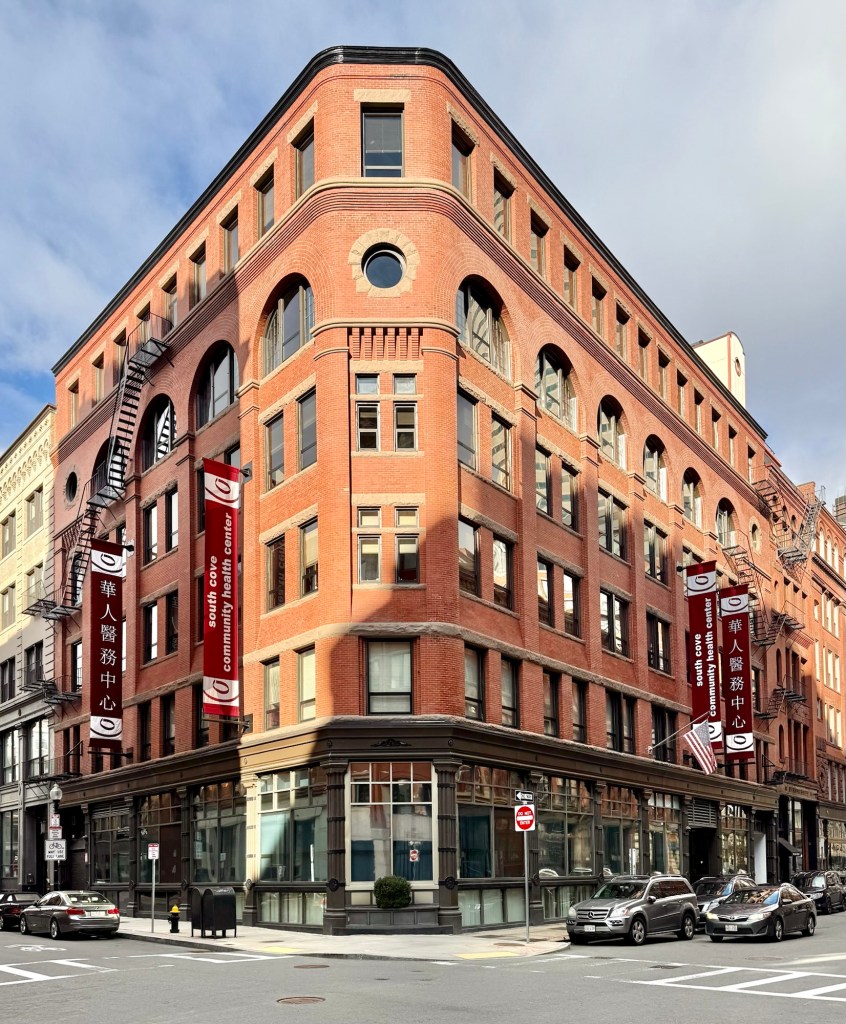
This impressive commercial block is prominently sited at the corner of Beach and South streets in Boston’s Leather District, a wonderful enclave of late 19th and early 20th century mercantile buildings, historically centered around the leather and shoe-making industries. Like many in this block, the building was developed by the Faxon Brothers, some of the major developers of this district and areas of Quincy. Also like many other buildings in the Leather District, the block was designed by 1886 in the Romanesque Revival style, constructed of brick and brownstone with a clipped corner and Syrian arches and an oculus window at the fifth floor. The building was designed by relatively unknown architect, John H. Besarick and today houses professional offices.

United States Leather Company Warehouse // 1901

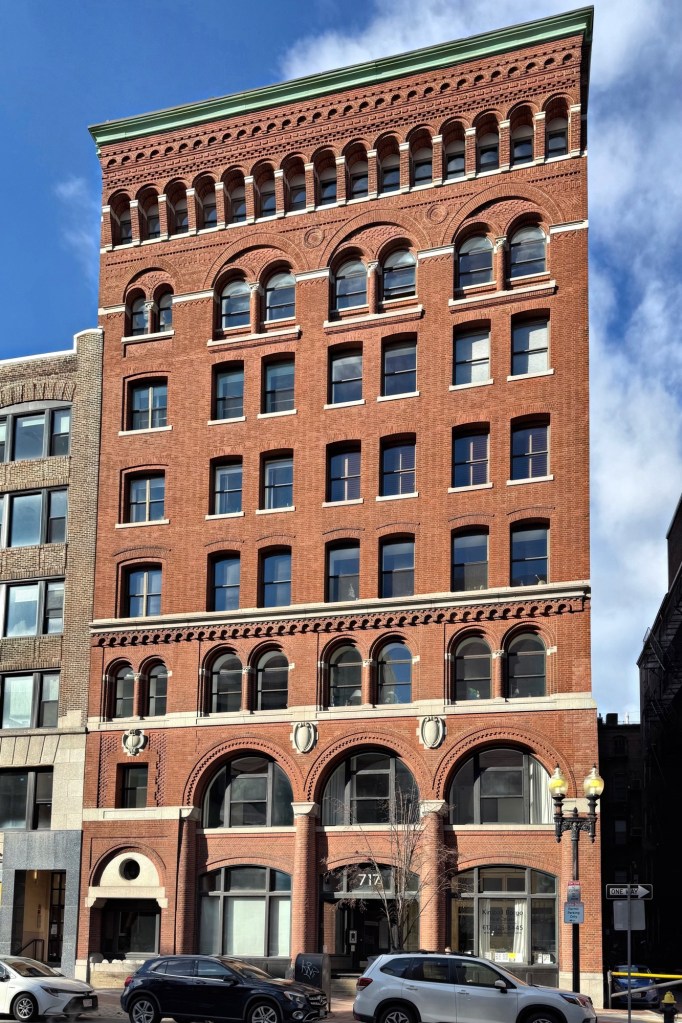
As far back as Colonial days, the boot and shoe industry was one of the State’s leading industries. Buyers came suburban towns to purchase supplies, and in the early 1800s, the larger manufacturers began to open offices and stores in Boston. Soon, most of the leading merchants had established places of business in Boston, by the late 19th century, many were located in the South Cove area, which became known as the Leather District. The Leather District is characterized today by large, brick structures with flat roofs and feature continuous floor levels, band courses, and cornice lines. This handsome brick building on Atlantic Avenue was built in 1901 for Charles G. Rice and the Heirs of Nehemiah W. Rice as a warehouse for the U.S. Leather Company. The building was designed by William Gibbons Rantoul, who studied architecture at Harvard, and apprenticed with Henry Hobson Richardson as a draftsman in the 1880’s before opening his own practice. In 1946, the subject property was purchased by Frank Einis, and the new tenants, Fur Merchants Cold Storage, Inc., used the building for the storage of skins and furs for manufacturing into soft goods. Architecturally, the building showcases the lasting influence of Richardson on architects and industrial buildings in Boston from the late 19th century into the early 20th century. The building can be classified as Romanesque Revival in style with its use of arches in the façade both structural and decorative, the Venetian arches at the 7th floor, as well as its arcaded corbelling over the 3rd level and at the cornice. I especially love the tall, engaged brick columns at the storefront, they are very unique!

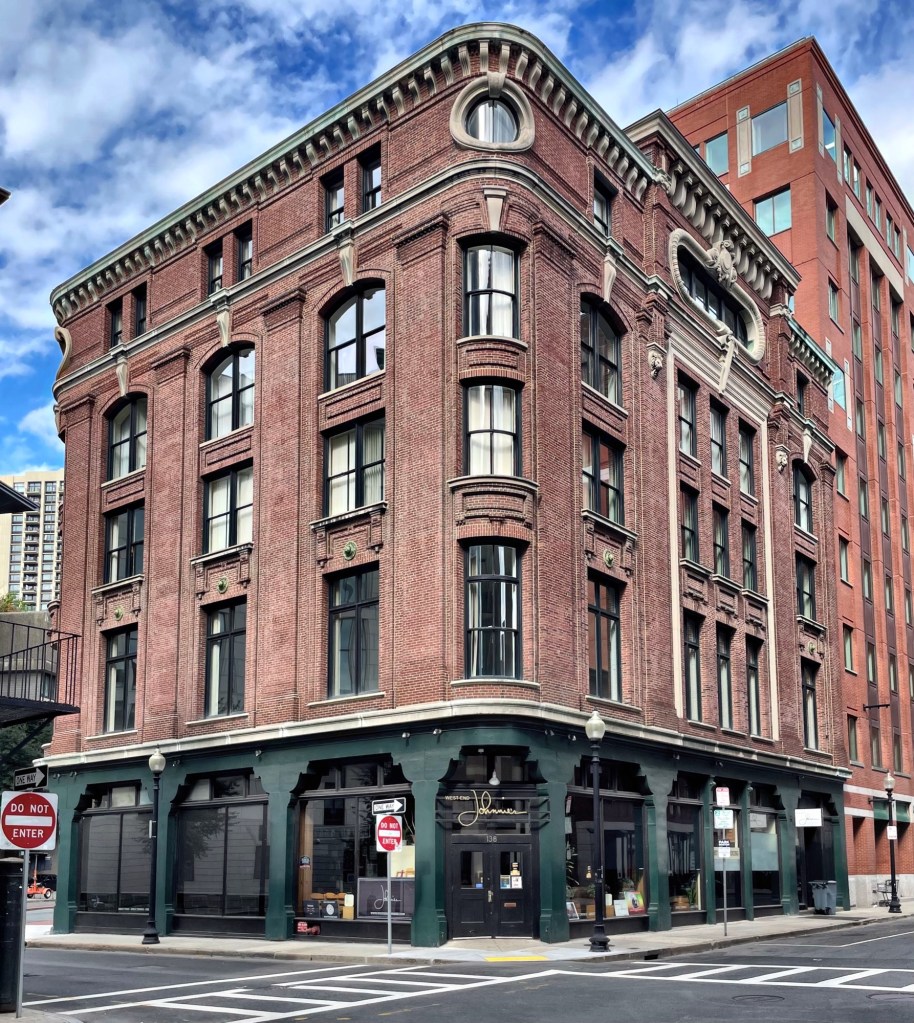
Tarbell Building // 1896

Similar to the Heywood Brothers & Wakefield Co. Building on Portland Street in the Bulfinch Triangle Historic District, the equally stunning building here was also designed by the same architect in a matching style. The building was constructed in 1896 by owner Catherine E. Tarbell , and the Boston branch of the National Casket Company moved in as tenants soon after its completion as part of its national expansion. The company would become the largest manufacturer and supplier of caskets in New England by 1906. The Tarbell building was designed by Stephen Codman in the Beaux-Arts style and is notable for its use of oxeye windows, rounded corners, and engaged pilastered facades. The company held its regional headquarters and sales offices from this building, which benefited from rail access for shipping caskets all over the region. The building is one of the finest examples of the Beaux Arts and Classical Revival styles in Boston.