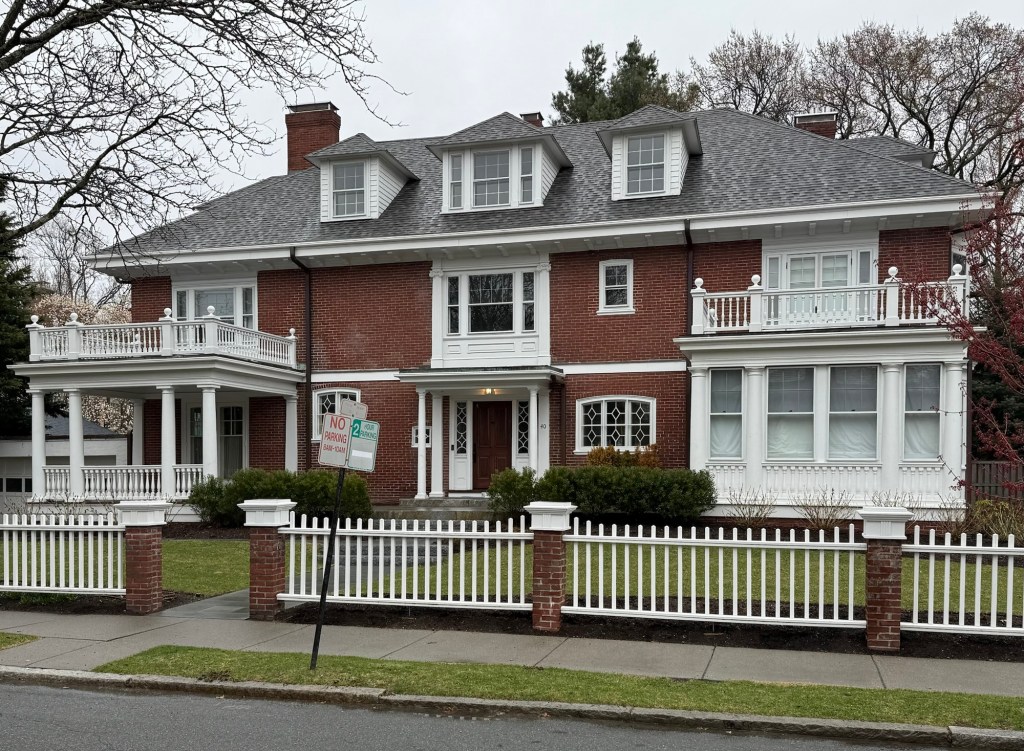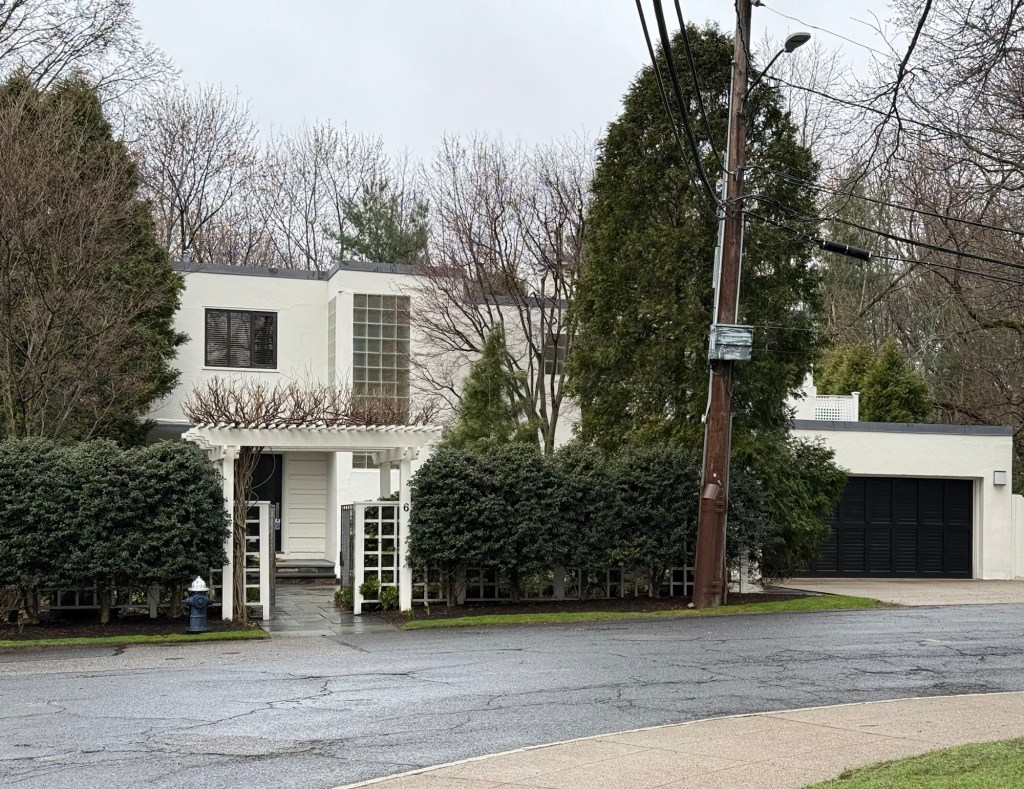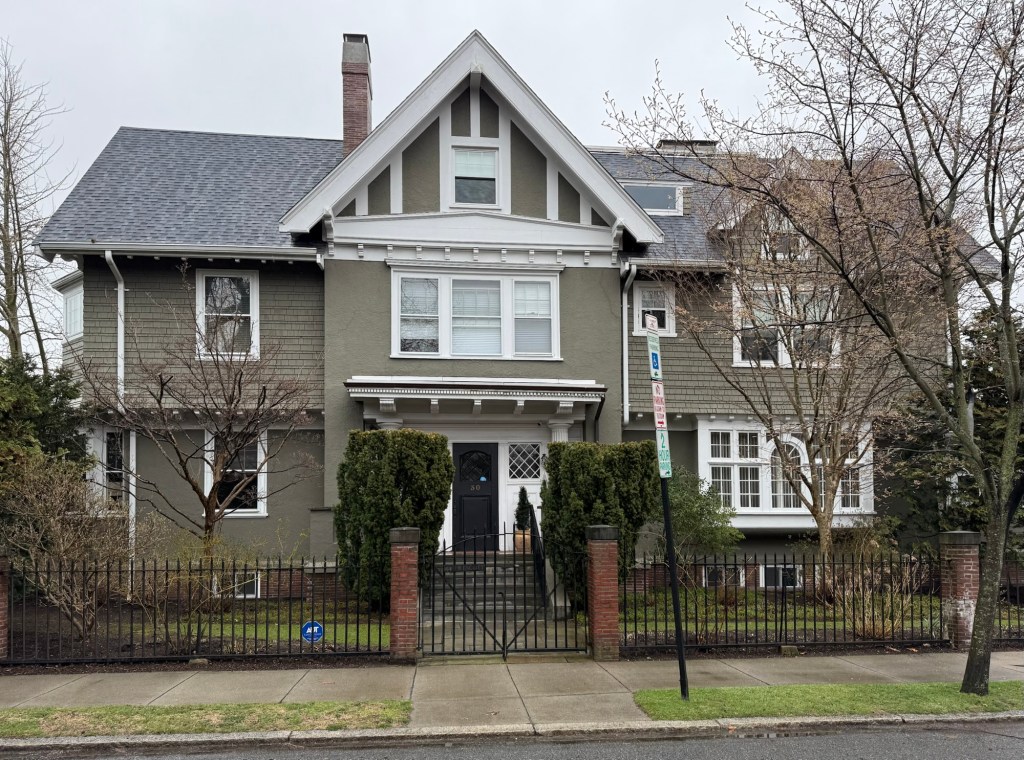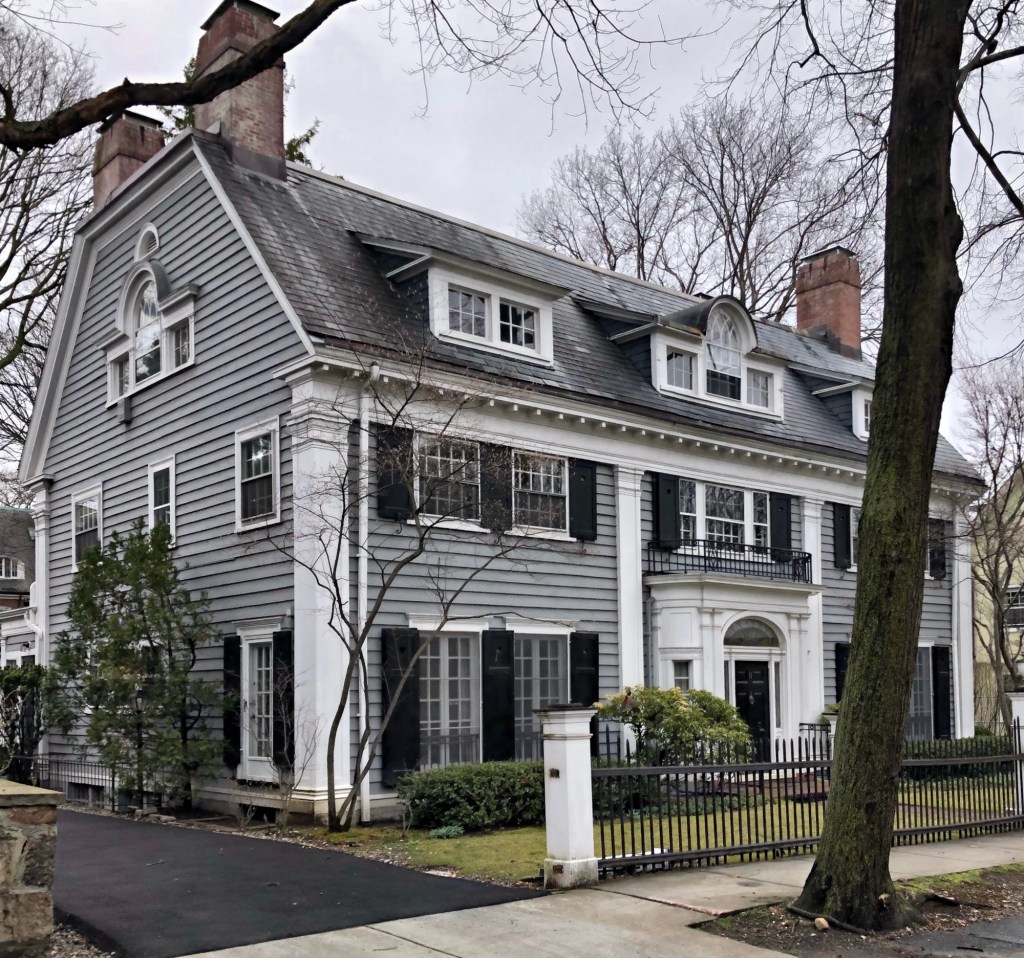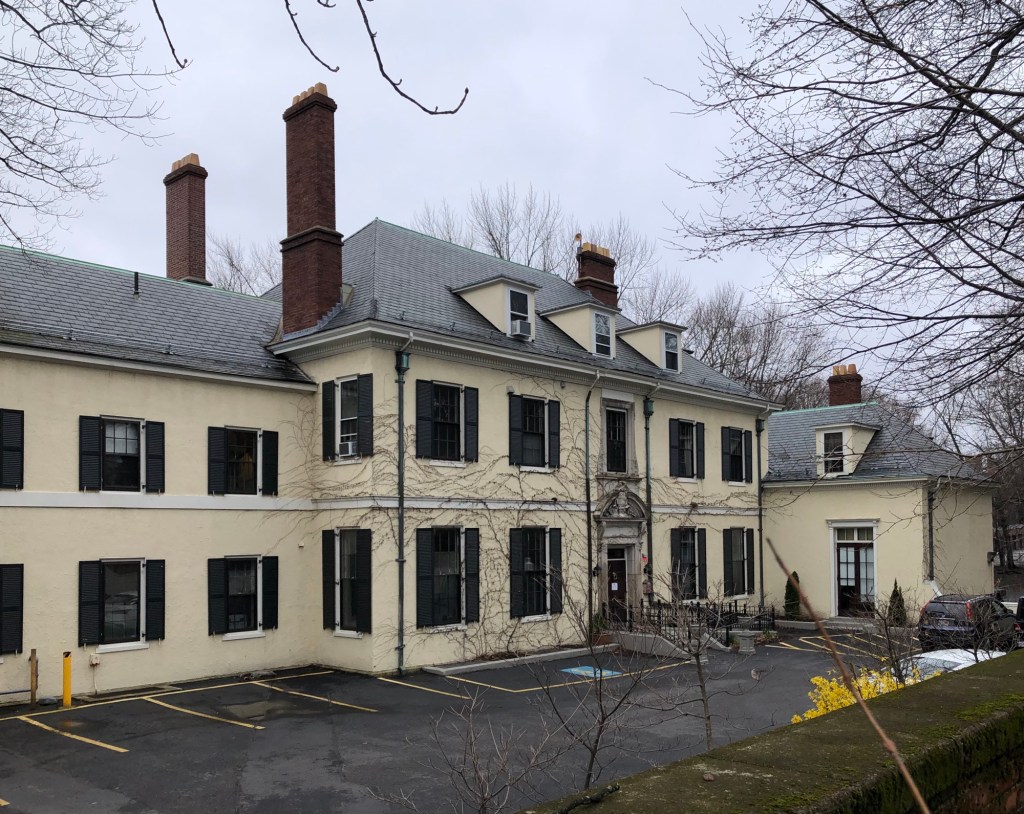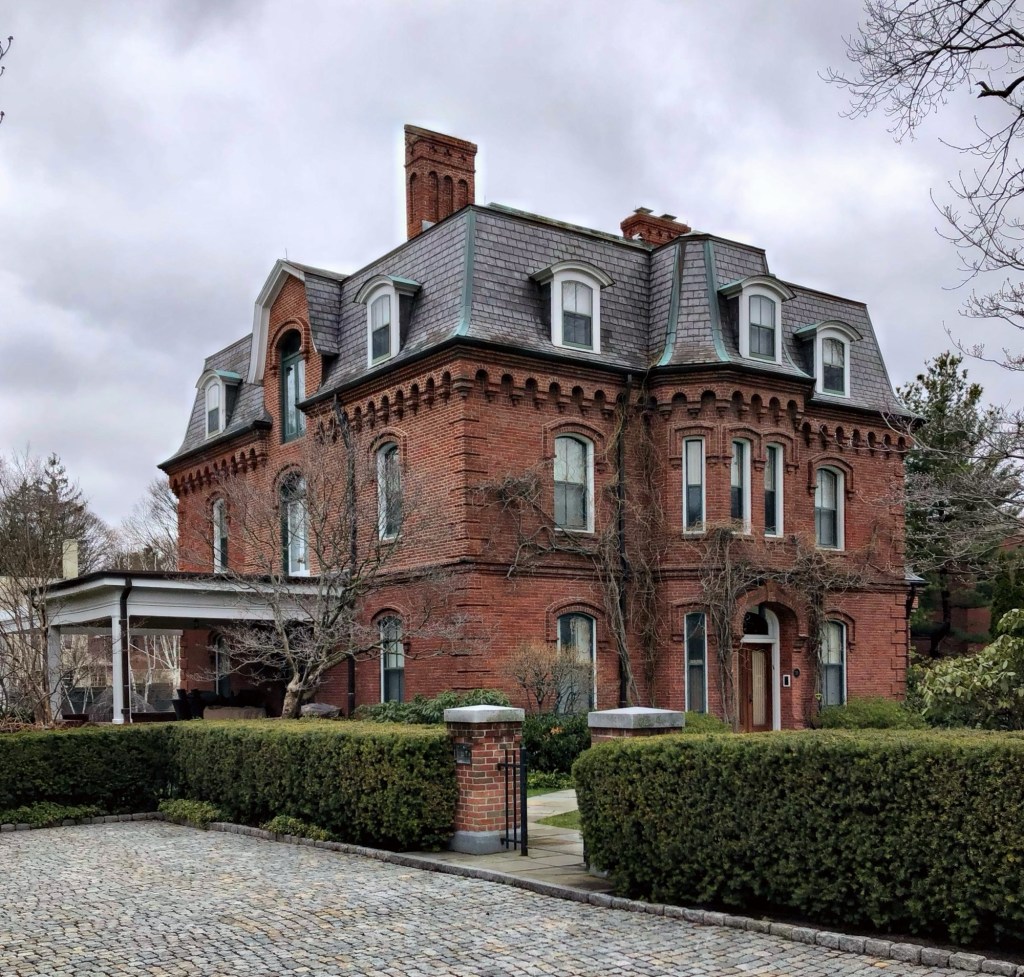
One of the finest Second Empire style houses in Brookline can be found on Prescott Street in the fashionable Cottage Farm neighborhood of the city. Built around 1868 by Amos A. Lawrence, who lived in a house nearby, this “cottage” was rented out to John Wells (1819-1875), a Judge on the Massachusetts State Supreme Court until his death. The property remained in the Lawrence family into the 20th century and was later rented to George E. Bullard, a banker. The brick house is notable for its siting at the center of the lot, corner quoins, brick corbelled cornice, arched door and windows, and slate mansard roof.
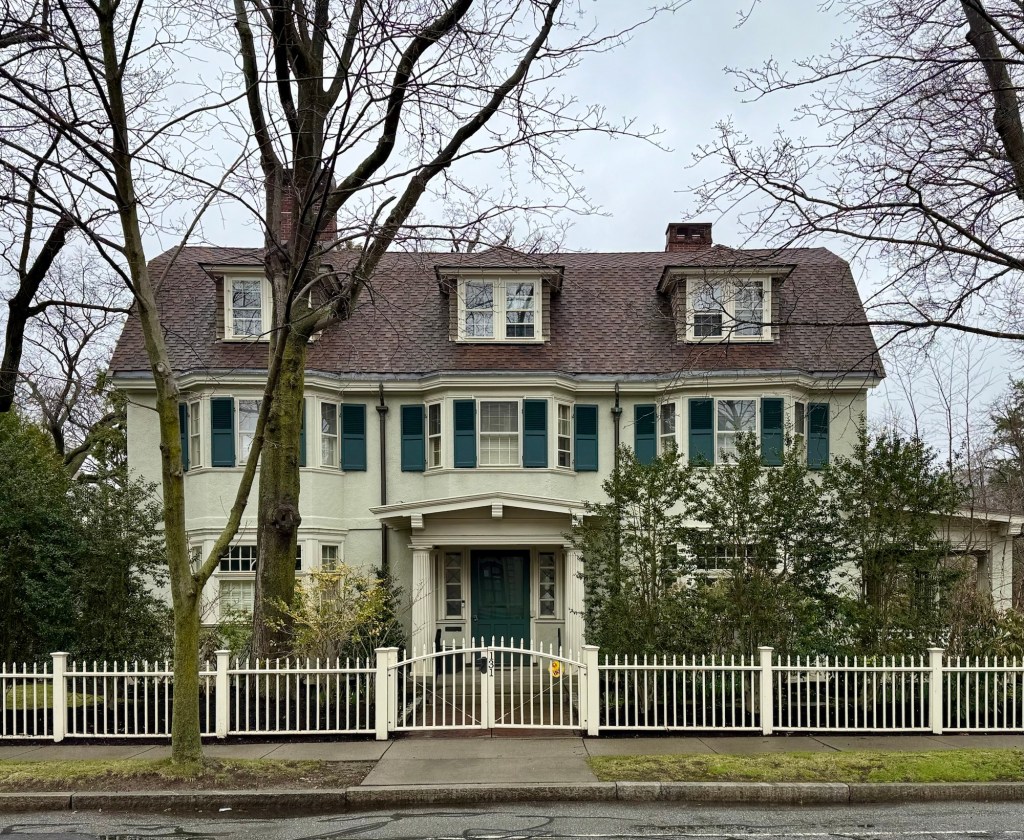
Built in 1864 as one of the rental properties owned by Amos A. Lawrence as part of his exclusive Cottage Farm neighborhood in Brookline, this house has been extensively altered and even moved but retains significance as a surviving mid-19th century “cottage” in the neighborhood. The house was likely constructed as a one-story, stone cottage with a second floor contained within a mansard roof. In 1903, Mrs. Francis W. Lawrence hired the well-known architect and Brookline resident, Julius A. Schweinfurth, to make extensive alterations to the cottage, replacing the mansard roof with a new second floor with gable roof, along with a new porch. Schweinfurth’s design included wood shingle siding for the upper floors, which were replaced with stucco in 1970. The house was moved to its current site at the corner of Carlton and Mountfort streets in 1929 when the street was re-oriented to follow the old Boston & Albany Railroad tracks. When moved, the cottage was occupied by Philip Stanley Parker, a judge, and his wife, Eleanor. Today, the cottage is owned by Boston University and known as the Core House.
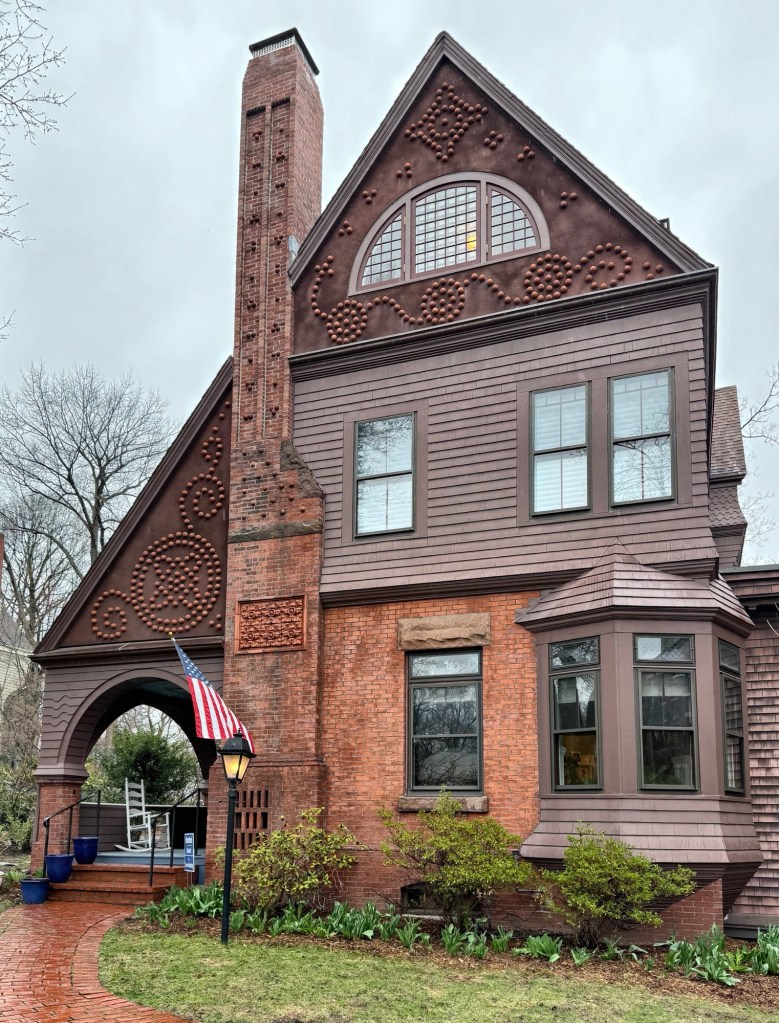
One of the finest Arts and Crafts style “cottages” in the Cottage Farm neighborhood of Brookline, Massachusetts, can be found on Ivy Street as the Whidden House. The property here was developed by Renton Whidden (1859-1942), a real estate developer and politician elected into the Massachusetts House of Representatives, who purchased a house lot from Thomas B. Hall, who owned a house next door. Renton Whidden hired architect, Arthur Hunnewell Bowditch, to furnish plans for the large home, which was completed in 1912. The stucco house features a brick entrance with projecting roof off the front, a unique twin gabled facade, segmental arched dormers, and a Palladianesque window and balconette above the front door.
Built across the street from the Amos A. Lawrence House in the Cottage Farm neighborhood in Brookline, the Dexter-Hall Cottage is an early Gothic Revival style residence built in the first period of the district’s history. Architect, George Minot Dexter was gifted a desirable house lot in the neighborhood from Amos Lawrence as a reward for his designing his own property, and in turn, designed this cottage in 1851 in the the same mode as the Lawrence House. The stone cottage has a three bay façade with enclosed center entry. On the second floor are wall dormers as well as a central jerkinhead dormer with a gambrel slate roof. The property was later owned by George M. Dexter’s daughter, Emily, and her husband, Thomas Bartlett Hall. The house remained in the Hall family through at least the 1920s.
The area was developed thanks to Amos A. Lawrence (1814-1886), a wealthy second-generation Bostonian, who provided much of the capital and enthusiasm for the growth of the cotton industry in New England prior to the Civil War. Lawrence’s involvement in the industry aided the development of the Massachusetts mill towns of Lowell and Lawrence, whom the city was named after. In 1851, Amos Lawrence purchased 200 acres of land from David Sears, who himself developed the equally beautiful Longwood neighborhood of Brookline on the other side of Beacon Street. Amos began to subdivide the land, working with the architect George Minot Dexter and landscape architect and surveyor, Alexander Wadsworth, who designed Mount Auburn Cemetery in Cambridge, to create an early picturesque residential suburb. With houses designed in the newly popular Gothic Revival and Mansard styles and several small parks, the area became known as Cottage Farm. This house was built for Amos Lawrence as an early, brick Mansard home, and rented out to Frederick Almy, a wealthy Boston attorney. The property was sold out of the Lawrence Family and later purchased by John Gorham Palfrey (1875-1945) a lawyer, who modified the house by removing the mansard roof and replacing it with a full third story with a brick veneer to match the walls below to give it a more Colonial Revival design.
The Charles Mason Cottage at 89 Carlton Street is one of two extant brick cottages built by Amos A. Lawrence as part of his Cottage Farm neighborhood in Brookline, Massachusetts. The Gothic Revival style cottage was built around 1853 and owned by Lawrence for rental purposes. By 1861, this house had been sold to Reverend Charles Mason (1812-1862), who married Amos Lawrence’s late sister, Susanna. The property was inherited by the couple’s daughter, Mary and her husband, Howard Stockton, a lawyer and onetime president of American Bell Telephone Company. The Mason Cottage is unique for its brick construction, projecting entry with porches on either sides, lancet doors and window, wall and shed dormers at the roof, and the original windows with chimney pots.
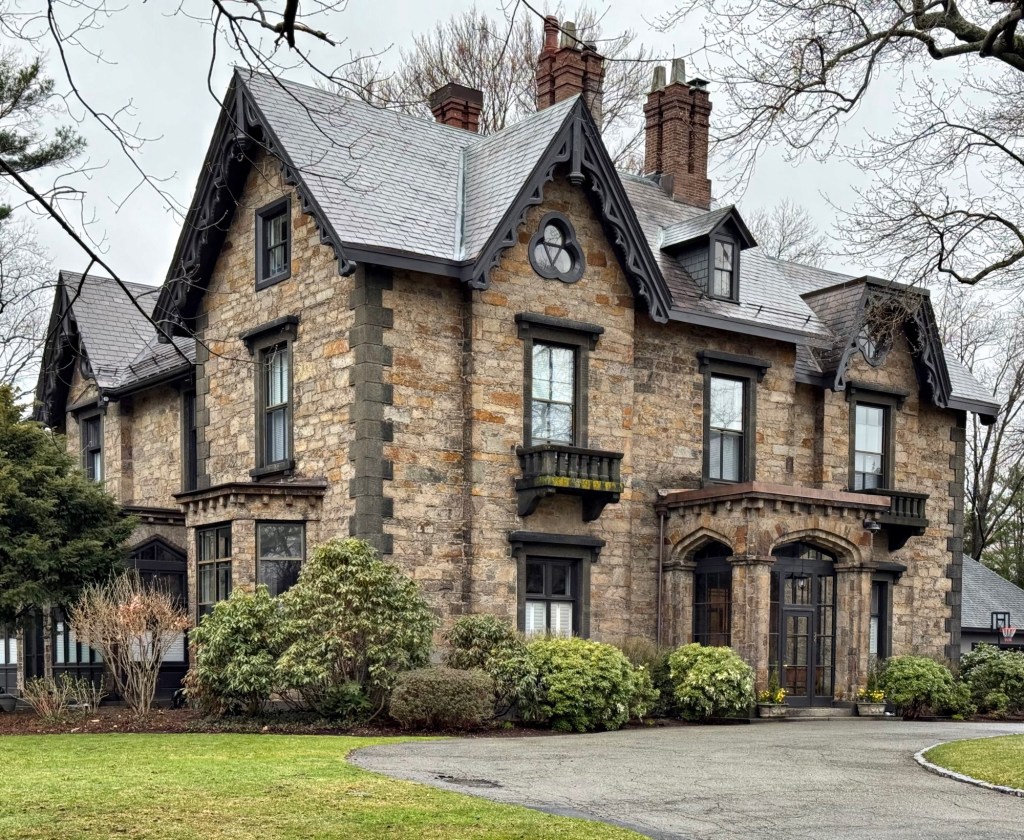
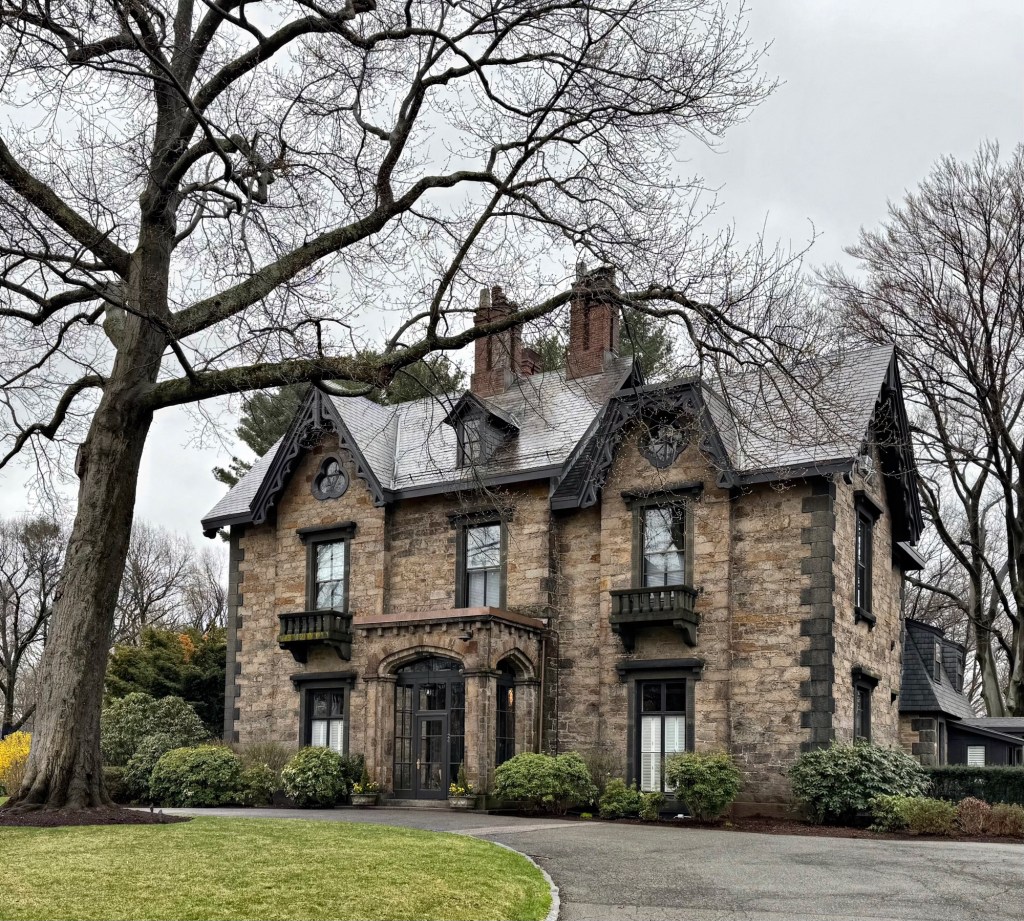
Cottage Farm area of Brookline is one of the finest neighborhoods in all of New England. The area was developed thanks to Amos A. Lawrence (1814-1886), a wealthy second-generation Bostonian, who provided much of the capital and enthusiasm for the growth of the cotton industry in New England prior to the Civil War. Lawrence’s involvement in the industry aided the development of the Massachusetts mill towns of Lowell and Lawrence, whom the city was named after. In 1851, Amos Lawrence purchased 200 acres of land from David Sears, who himself developed the equally beautiful Longwood neighborhood of Brookline on the other side of Beacon Street. Amos began to subdivide the land, working with the architect George Minot Dexter and landscape architect and surveyor, Alexander Wadsworth, who designed Mount Auburn Cemetery in Cambridge, to create an early picturesque residential suburb. With houses designed in the newly popular Gothic Revival and Mansard styles and several small parks, the area became known as Cottage Farm. This stone house was designed by George M. Dexter and was the country residence of Amos Lawrence, who had other homes built nearby and rented out to wealthy friends and family. By 1888, the property was owned by Amos’ daughter, Hettie S. Cunningham, who later, subdivided the estate into five house lots, and moved this stone house to the corner of Ivy and Carleton streets. Expressive of English architectural traditions over the more ornate Gothic Revival popularized by Andrew Jackson Downing, the Lawrence House is one of the finest residences in the Boston area. Built of granite with limestone trim and set behind landscaping and a perimeter fence, the mansion is surprisingly hard to get decent photos of, but it is a stunner. Today, the house is owned by Boston University and is known as Sloane House.
One of the most unique and architecturally pleasing buildings in Brookline has to be these apartments on Egmont and St. Paul streets that break the mold of traditional brick or wood-frame apartment houses. Built in 1917 by the New England Fireproof Construction Company as an example of how cheaper cement material can be used effectively and beautifully to design and construct high-quality housing. The company hired architect G. Bertram Washburn to design the buildings which utilize concrete block and cast concrete details with the facades embellished with pilasters capped with Corinthian capitals, engaged balusters, and modillioned and corniced entrances decorated with a lion’s head over each doorway. Additionally, a special touch is the recessed wells in the facade which not only break up the massing of the building, but provide additional light and air into the apartments inside.
By the beginning of the 20th century, Brookline was developing rapidly as a desirable Boston suburb, with easy-access to downtown via streetcar and rail, all with less cramped land and less industrial development impacting the air quality. Developers soon realized that they could build high-quality apartment blocks within established neighborhoods to market to middle-income families who wanted to live in these desirable enclaves without breaking the bank. Developers Snider & Druker (a precursor to the Druker Company) purchased house lots in the neighborhood adjacent to Cottage Farm, a rich enclave of large homes on large lots, and began building apartment buildings. They hired architect Frederick A. Norcross, who specialized in multi-family housing designs, to furnish plans for these Renaissance Revival style apartments at the corner of Browne and Powell streets. Besides the use of buff brick, limestone trim and detailing, and the use of projecting bays to break up the facades, the building’s terracotta roof adds intrigue and individuality to a building form often maligned for blandness.