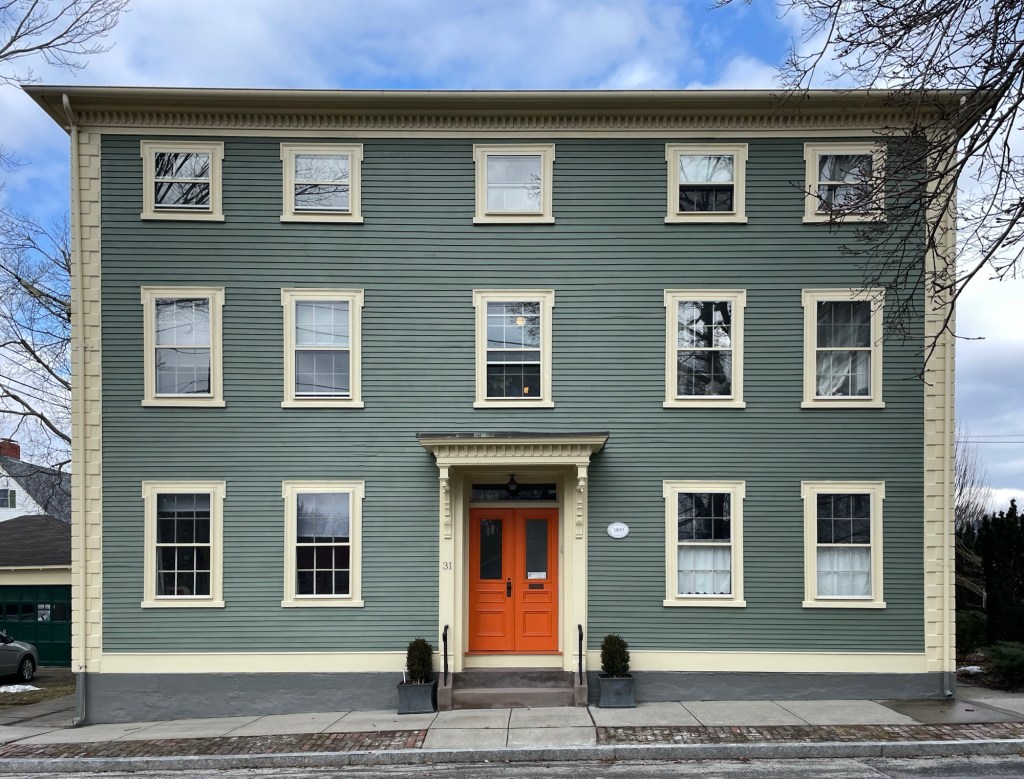
Judge Alfred Bosworth House // c.1849

The only two-story temple-front Greek Revival style house in Warren, Rhode Island, the Judge Alfred Bosworth House on Federal Street, is believed to be the work of great architect Russell Warren. Alfred Bosworth (1812-1862) ran a law office in Warren and Providence and represented Warren in the General Assembly from 1839 until 1854 and then served as a justice on the Rhode Island Supreme Court. Bosworth was of counsel for Rhode Island in suits growing out of the boundary question between Rhode Island and Massachusetts, specifically around Fall River. Judge Bosworth died at home in 1862 and his widow, Anne, lived here afterwards. At the end of the century the Bosworth House was converted to an ice cream parlor, named Maxfield’s, which became a very popular attraction in town. The company, owned by Nathaniel and Julia Maxfield, attracted throngs of local residents every summer who would eat ice cream on the front yard of the house. Maxfield’s was even frequented by Providence writer, H. P. Lovecraft, when he was a young man. During the mid-1900s, the house served as a nursing home until 1988, when owners restored the house back to a residence and removed the asphalt siding that was added to the exterior around the time of the Great Depression.

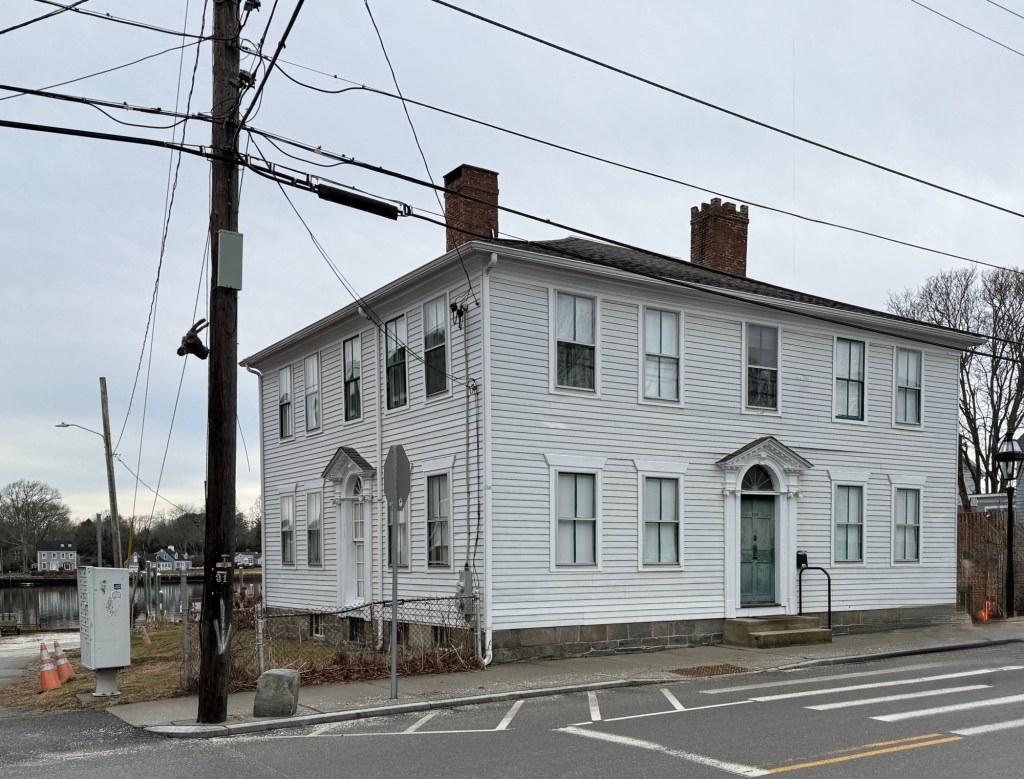
Old Cooper Shop // c.1800

This stunning Greek Revival house on Lyndon Street in Warren, Rhode Island, was according to historians, built around the turn of the 19th century as a cooper shop! A cooper as a professional, would make wooden barrels, tubs, and casks from wooden staves, which were all made in this building before it was converted and renovated around 1830 in the Greek Revival style for Deacon John J. Bickner, who was likely affiliated with the Episcopal Church across the street, which was designed by architect, Russell Warren. Due to the connection, it is possible that the renovation for Bickner was undertaken by Russell Warren as well. On its facade, the house has two-story applied pilasters which break up the bays and smooth flushboard siding which makes the house even more stately!

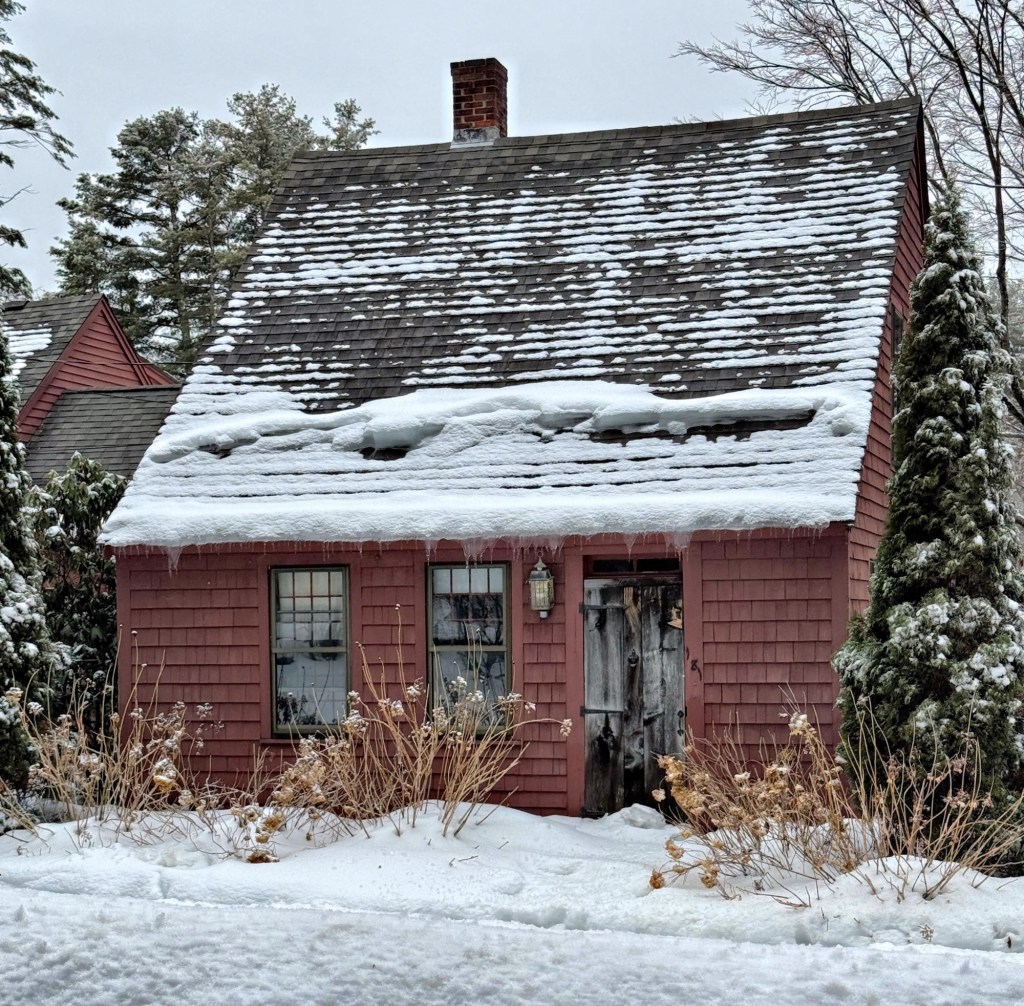
Capt. James W. Barton House // c.1842

One of four seafaring brothers who lived in Warren, Rhode Island, this charming cottage was built after Captain James Barton purchased a house lot at the northwest corner of Liberty and Union streets in 1841, likely building the home within a year. Captain James Barton (1790-1877) commanded a two-and-a-half year long whaling voyage to the Indian Ocean and undertook three subsequent trips to the Pacific. Upon retiring from the sea in 1867, Captain Barton established the Warren Gazette, where he worked as both owner and publisher. Before his time as a sea captain, James Barton had experience working in a printing office in Providence. Upon the Captain’s death in 1877, his wife Mary, continued to reside here with their daughter Nora B. Easterbrooks and her husband. Built as a modest Greek Revival style cottage for Barton’s wife while he was away at sea, the residence features a touch of the romantic Gothic Revival style in its window trim and the stable behind.

George Cole House // c.1863

This stunning Italianate style residence with ample front yard on Cole Street in Downtown Warren, Rhode Island, was built for a prominent member of a prominent local family. William Bradford Cole, a local housewright and builder, constructed this handsome residence for his brother, George Cole, around 1863, just before he enlisted to fight for the Union in the Civil War, ultimately giving his life for his country in New Orleans in 1865. George Cole was the owner and proprietor of the famed Revolutionary-era Cole’s Hotel located a short distance up Joyce Street at the corner of Main Street until it burned in 1893. The George Cole House exhibits many of the hallmarks of the Italianate style, including: a low pitched roof with overhanging eaves and a bracketed cornice, an entry porch, and proportionally narrow windows capped with shallow hoods.

Charles Wheaton Jr. House // c.1815

Charles Wheaton (1761-1863) enlisted in the his local militia at just 14 years old and served in Colonel Robert Elliott’s Regiment of Artillery to protect Narragansett Bay. After the war, Charles settled in Warren, Rhode Island, and married Abigail Miller. They would have at least nine children, with one of their children, Charles Wheaton, Jr., (1791-1863) marrying Abiah Goodwin Turner in 1815, the daughter of a wealthy sea captain. Around the time of their marriage, they built this house on Liberty Street in Warren in the Federal style with a three bay facade, monitor on hip roof, and portico at the entrance with Ionic columns. By the end of the 19th century, the house was enlarged and a bay window was added over the entry portico.

Bowen-Haile Farmhouse // c.1680

Possibly the oldest building in Warren, Rhode Island, this historic farmhouse on Market Street, near the state line, has framing that possibly dates to the 1680s! After Sachem Massasoit and his oldest son, Wamsutta, sold land to Plymouth Colony settlers what is present-day Warren, Barrington, Swansea and Rehoboth, Massachusetts, the town of Swansea was established in 1667. Obadiah Bowen (1627-1710) was an original proprietor of Swansea and was listed as number 23 in the order to draw lots for the meadows on the northside of town. By 1679, he received a ten-acre house lot of uplands and salt meadow, reaching from the Palmer River inland and across Market Street to the Birch Swamp.  He built a farmhouse on the rocky highland where he farmed the property until his death. His son, Thomas Bowen (1664-1743), later purchased the farm and added to it another 70 acres making the property a total of 170 acres. The old Bowen property was sold to Richard Haile in 1708 and remained in the Haile family until the late 19th century. After successive ownership in the Haile Family, the property became known as the “Judge Haile farm,” after owner, Levi Haile (1797-1854), a justice of the Supreme Court of Rhode Island, he served on the court that tried Thomas Dorr, the leader of the Dorr Rebellion, a struggle to extend voting rights in Rhode Island to non-property owners. Levi Haile made improvements on his house and farmed the land, as did his two sons. The property sold out of the Haile family in the late 19th century and remained a farm until the 1980s, when part of the property was subdivided for development and part donated to the Warren Land Trust, who maintains the property as the Haile Farm Preserve. While the farmland is protected, the old farmhouse is not protected as a town landmark nor through the community’s demolition delay bylaw.

Lillibridge Farmhouse // c.1770

Located in northern Willington, CT, this farmhouse on a quiet, country road, dates to before the Revolutionary War! David Lillibridge (1744-1831) of Exeter, Rhode Island, served from 15 to 17 in the French and Indian War, and manned Fort Stanwix. In 1767, when he was a lieutenant in his local militia, he converted, and entered the Baptist ministry. In 1777, he purchased a farm from Moses Holmes, but it is unclear if this residence was existing or if he built this large farmhouse. In Willington, David Lillibridge became a farmer-preacher, establishing a Baptist ministry here. The home remained in the Lillibridge family at least until the 1870s, when it was owned by Burnham Lillibridge. The Georgian saltbox residence is set back from the street and sits upon the bucolic rolling fields of the property.

Baker-Byrd House // 1888

Located on Brimmer Street in Beacon Hill, this handsome residence is constructed of rough-faced brownstone laid in a random ashlar pattern and is among the most unique in a neighborhood known for brick townhouses. Decorative treatment includes a stone band that is carved with foliate and faces, colonettes that rise along the facade at the bay, and an ornate molded copper entablature and parapet at the roof. The residence dates to 1888 and was built for Seth R. Baker, a Boston real estate developer at the end of the 19th century. It can be inferred that the building was designed by architect, Ernest N. Boyden, as Baker hired Boyden as architect for a half-dozen other apartment buildings between 1888-1890. Antoino Xavier, a Portuguese-born mason is listed as the builder. In the 1910s, the property was purchased by Marie Ames Byrd, wife of polar explorer Richard A. Byrd, who lived a few houses away at 9 Brimmer Street. She rented the four apartments to boarders through the 1930s.


Perkins House – Diocesan House // 1832

Constructed of red brick and trimmed with brownstone, the beautiful townhouse at 1 Joy Street, is one of a few properties in Boston’s Beacon Hill neighborhood to have a front yard. Built in 1832, the four-story residence has its primary facade characterized by a flat entrance with a rounded bay extending upwards to the roof. Designed by architect, Cornelius Coolidge, who designed many other homes in this section of Beacon Hill, the completed house was purchased by Thomas Handasyd Perkins, Jr. (1796-1850), the eldest son of the enormously wealthy and influential Thomas Handasyd Perkins, Sr., who is considered by many to have been the most successful merchant prince of Boston’s Federal period. In 1892, the Episcopal Association purchased 1 Joy Street for use as headquarters of the diocese, and it became known as the Diocesan House. Today, the building is divided up into condominium units, providing residences just steps from the Boston Common.

Tuckerman-Parkman Mansion // 1825

The Tuckerman-Parkman Mansion at 33 Beacon Street, like its neighbor, was built in 1825 from plans by architect, Cornelius Coolidge, in the Greek Revival style. The residence was originally purchased by Edward Tuckerman, a wealthy merchant and father of Professor Edward Tuckerman, a prominent lichenologist for whom Tuckerman Ravine on Mount Washington was named. Tuckerman Sr. lived here at 33 Beacon Street until his death. The next owners, Mrs. Eliza Parkman and her son, George Francis Parkman (1823-1908) moved here after the brutal murder and following sensational trial of her husband, Dr. George Parkman (1790-1849). The 1849 trial of Parkman’s murderer, Professor John White Webster of the Harvard Medical School, was called the “case of the century”. Professor Webster owed Dr. Parkman a substantial sum of money. The professor lost patience with Parkman’s constant reminders that his payment was long overdue and killed Parkman in a rage, dismembered his tall, lanky frame and concealed the body parts in a wall of a Harvard Medical School laboratory. With the help of a janitor, Dr. Parkman’s body was discovered. A murder trial ensued, and Professor White was found guilty and subsequently hung. The murder trial has been widely cited as one of the earliest uses of forensic evidence to identify a body. Seeking refuge from the attention and pain from the loss of the family patriarch and trial, Ms. Parkman and her son, George, moved to this home in 1853. Widow, Eliza Parkman died in 1877 and George F. Parkman lived in this home until 1908. In his will, Mr. Parkman bequeathed his mansion and over $5 Million to the City of Boston for the maintenance of the Boston Common. The Tuckerman-Parkman Mansion was restored by the City of Boston in 1972 and used almost exclusively as the Mayor’s residence until 1984. The house is now the official reception hall of the Mayor’s office and appears much as it did when built 200 years ago.