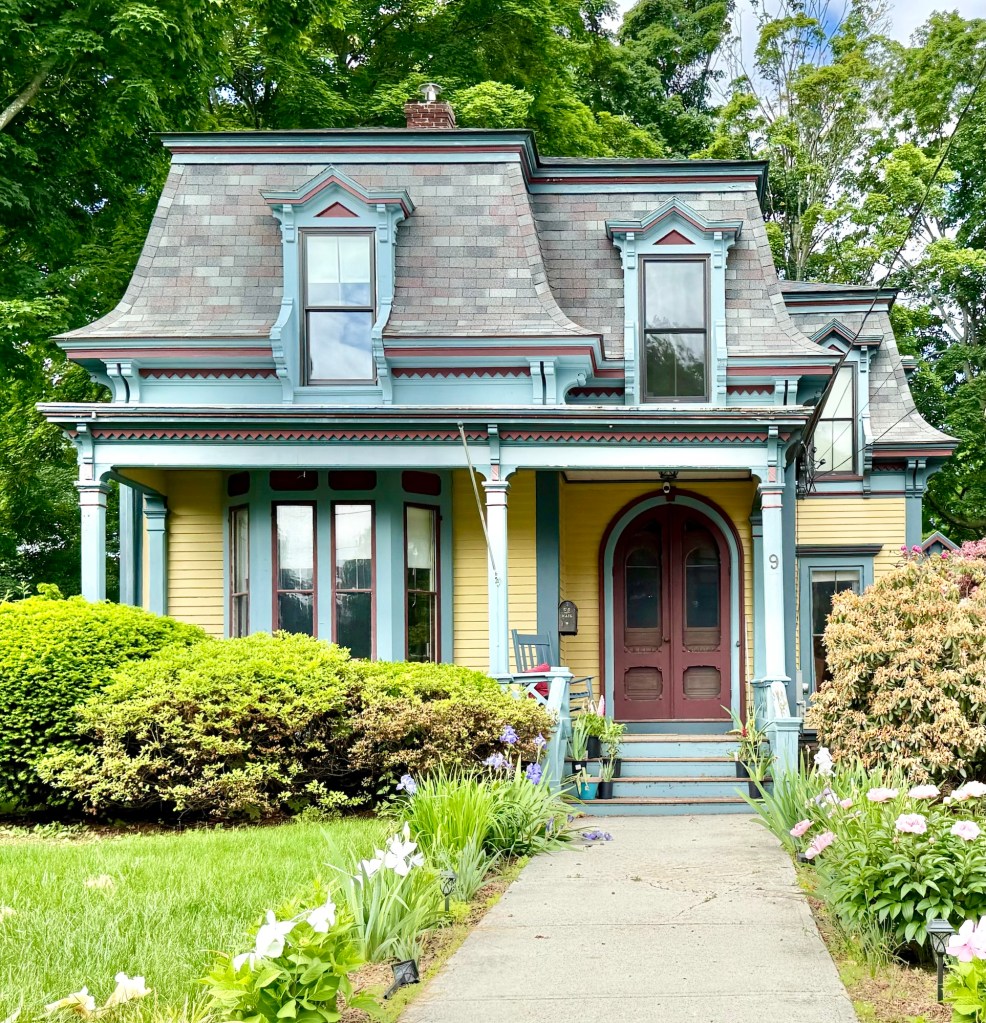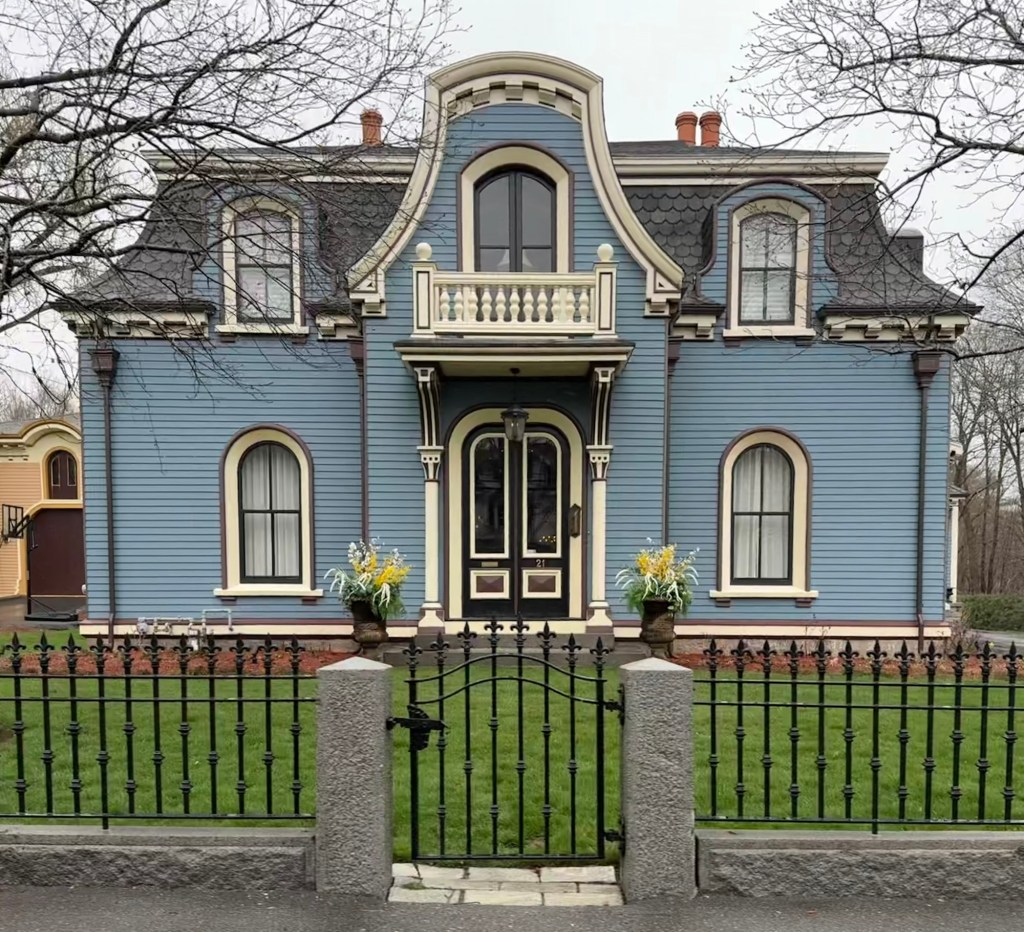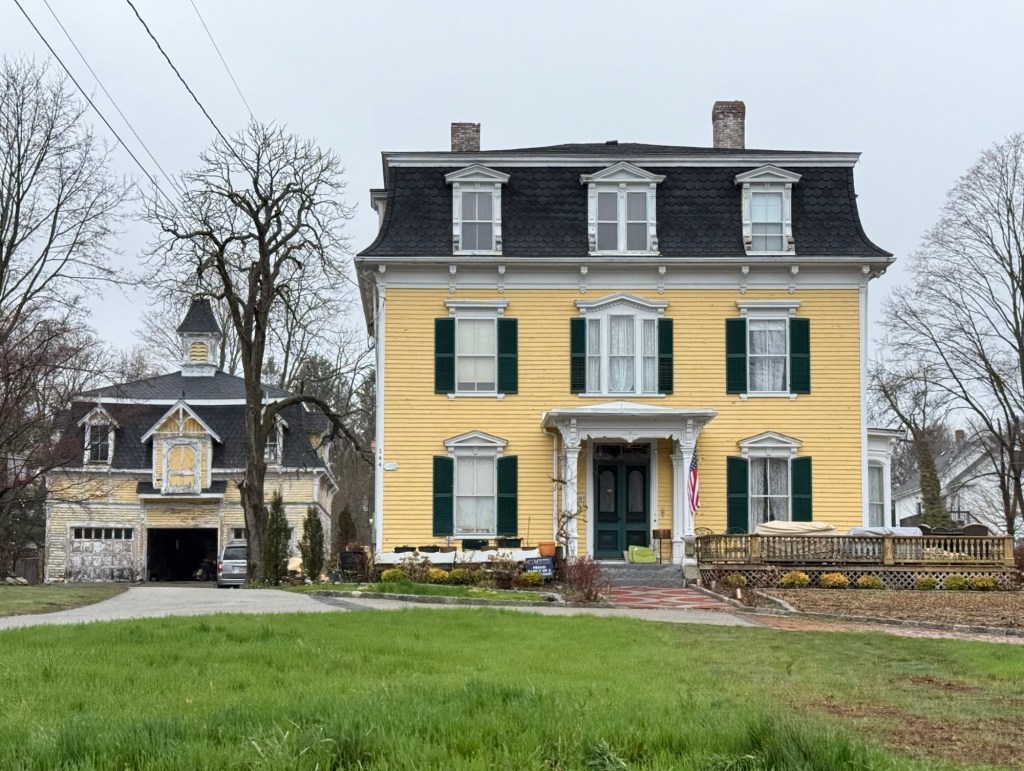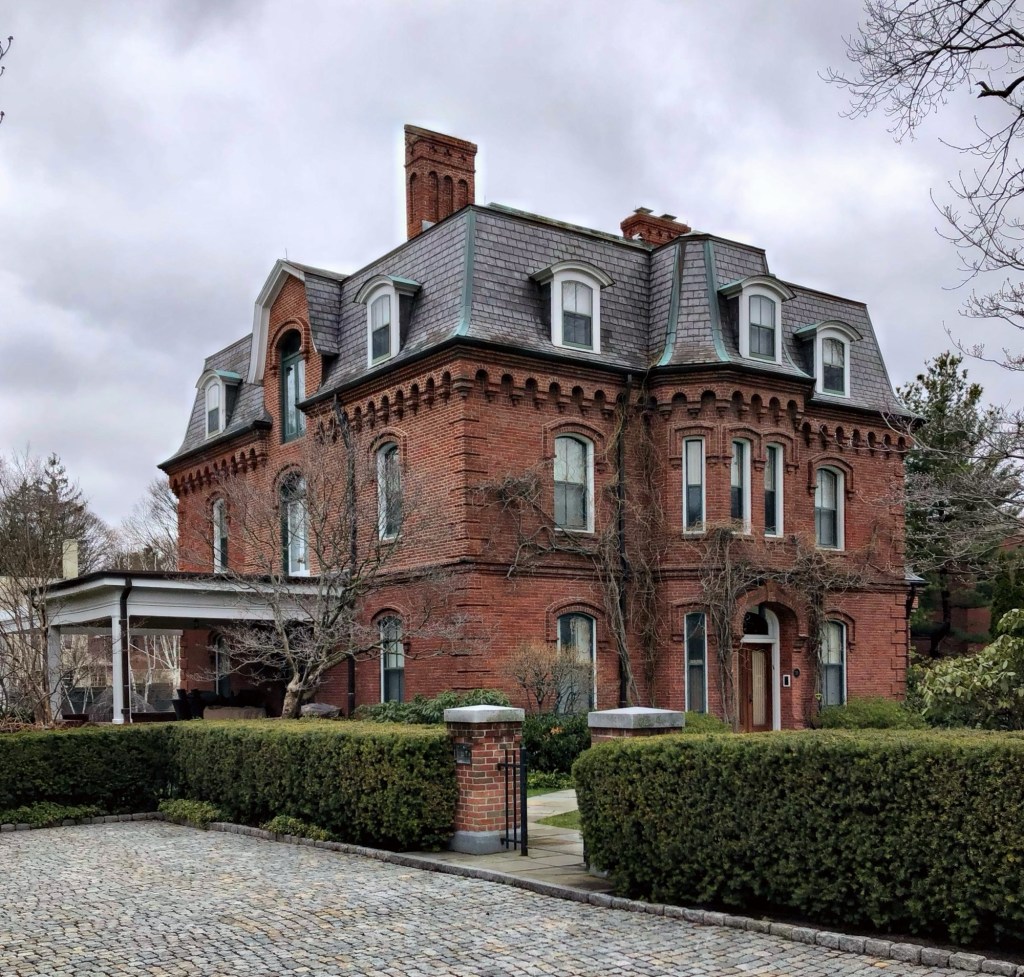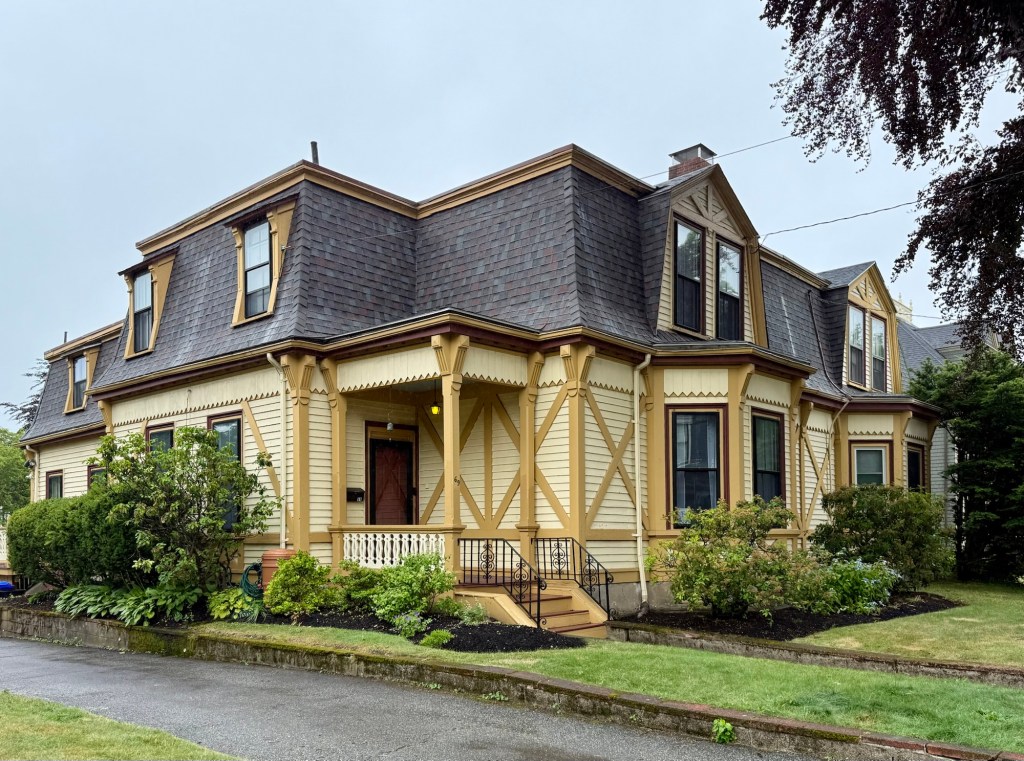
Langley-Dudley Cottage // c.1870

This charming mansard-roofed cottage can be found at 54 Prospect Hill Street in Newport, Rhode Island. While presently a residence, the cottage was originally built around 1870 as a stable or carriage house for the former Bowen-Newton-Tobin House at 204 Spring Street. After the Bowen heirs sold the property, this structure was owned by Mr. John S. Langley, an furniture dealer (who also made coffins and caskets) with the firm Langley & Bennett. The building may have been used for the storage of horses or as a workshop until it was purchased by Mary B. and Dudley Newton, a prominent local architect. They appear to have converted the former stable into a cottage, and rented the property out for additional income. In the renovation, Dudley Newton preserved much of the original detailing above the cornice, and altered openings to provide windows and doors convert the formerly utilitarian structure into a cottage.

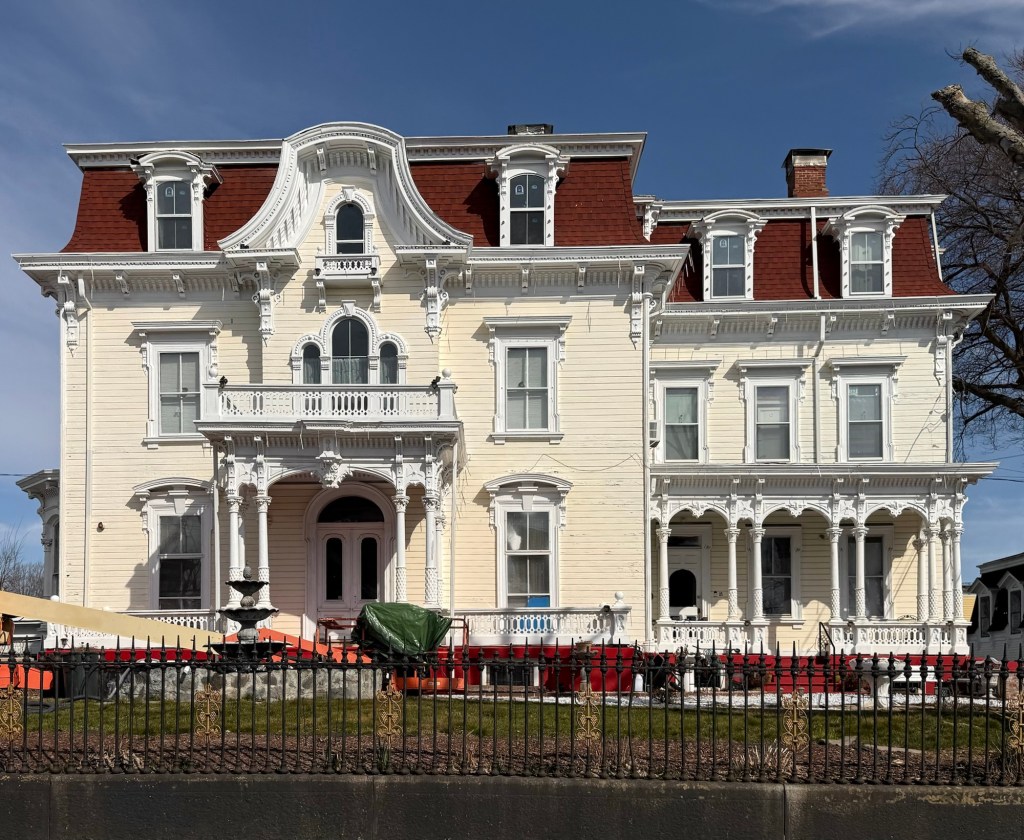
Captain Albert F. Ames Mansion // 1874

Located next door to the William H. Glover House on Talbot Avenue in Rockland, Maine, this equally impressive Second Empire style Victorian residence stands as one of the finest in town. The abode was built in 1874 for Captain Albert Franklin Ames (1831-1887) by the architectural firm of Kimball & Coombs of Maine. Albert F. Ames was a sea captain and merchant who would later own many ships to distribute his manufacturing of lime casks which were sold and transported all down the east coast to build American cities. The stately home would later be the subject of one of artist Edward Hopper‘s paintings in Rockland, titled, “Talbot House” after a later owner.

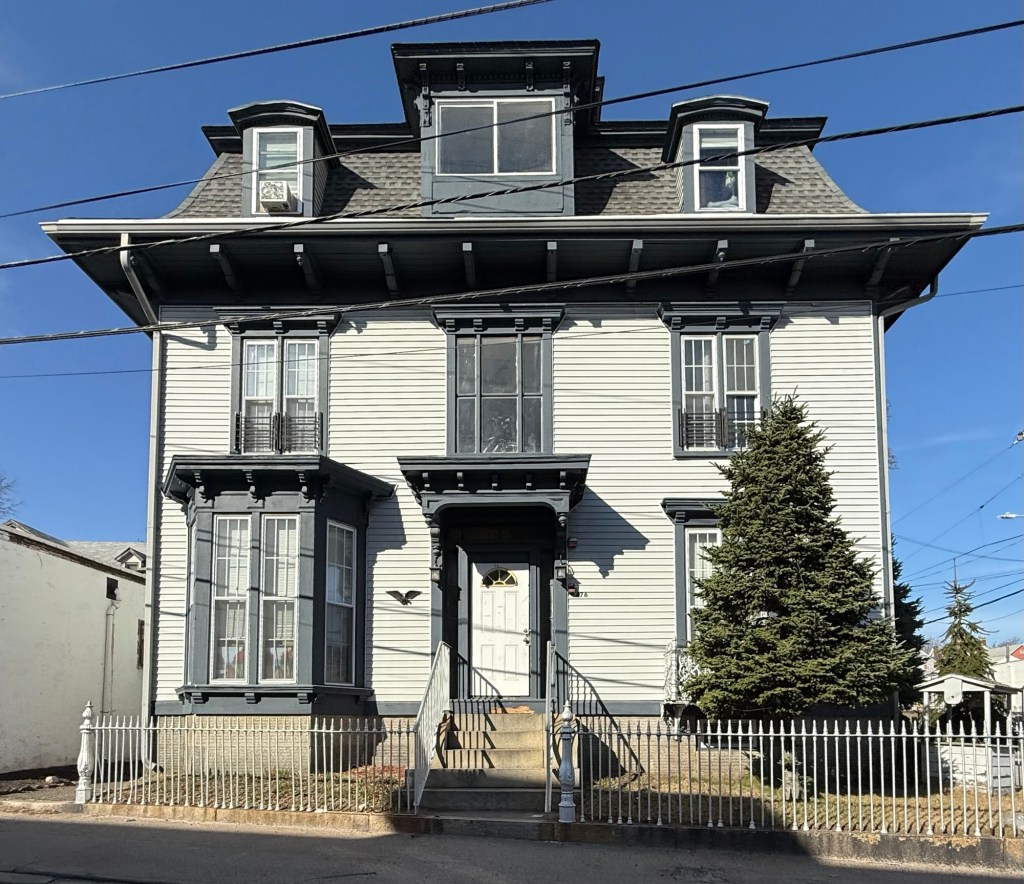
William H. Glover House // 1873

William Hurd Glover (1834-1910) was a prominent lumber dealer and builder in Rockland, Maine, and would built this house as his residence on Talbot Avenue. Mr. Glover hired architect Charles F. Douglas, to furnish the plans for the Second Empire style mansion. While covered in vinyl siding, the handsome residence features a slate mansard roof, central tower, delicate projecting portico over the entrance, and decorative window hoods and brackets. The house is one of the best examples of the style in Maine, even with the later siding.

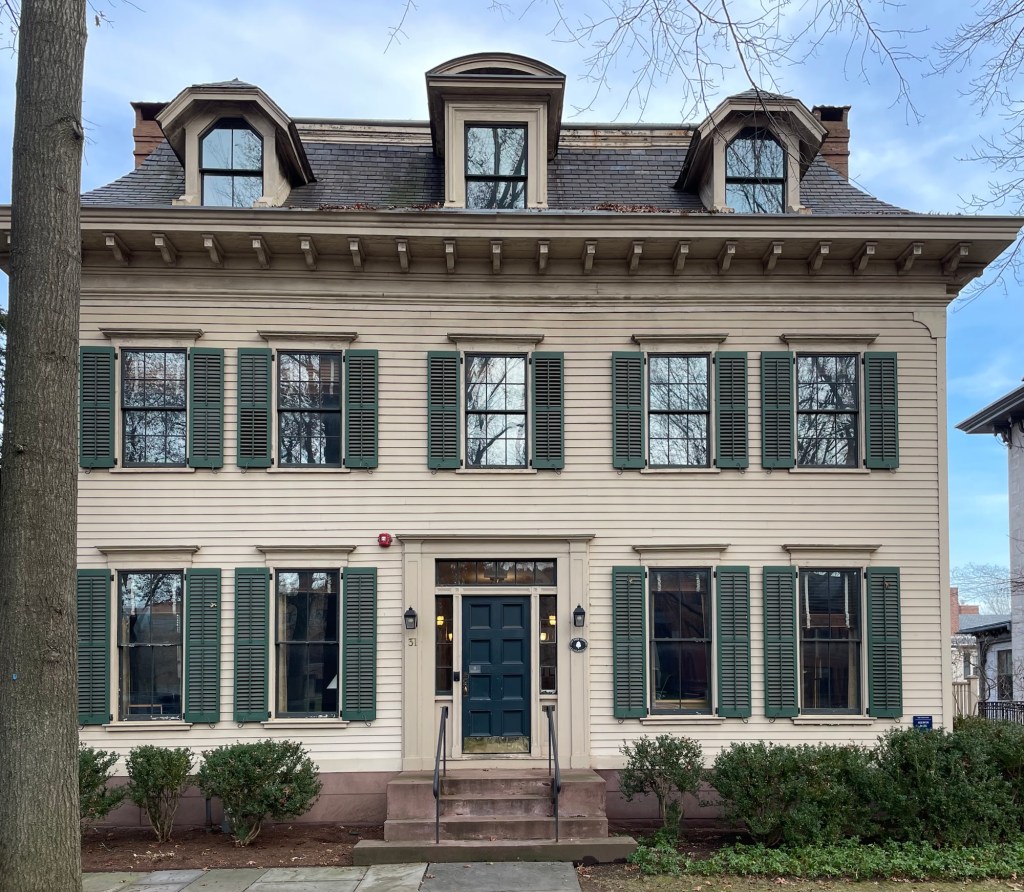
Samuel D. Garey House // c.1870

Samuel D. Garey (1825-1891) was born in Auburn, Maine, and worked as a carriage manufacturer there before moving to Newton, Massachusetts to use his carpentry skills building houses in the rapidly developing Boston suburb. He became a prominent builder and developer in Newton Centre, residing there and building this mini-mansard house on Gibbs Street before 1870. Garey likely rented the house out to tenants for supplemental income, with the family maintaining the charming cottage into the 20th century.

John H. Sanborn Mansion // c.1868

One of the finest Second Empire style residences in Newton, Massachusetts, can be found on Herrick Road in Newton Centre. This is the John H. Sanborn house, built before 1870 for John H. Sanborn, a Boston broker and commission merchant who also served as a Representative to the Massachusetts General Court. The imposing residence is a two-story house based on a rectangular plan, and capped with a bellcast Mansard roof of gray, fish-scale patterned slates. The focal point of the design is the four-story, towered entrance pavilion which dominates the facade.

Tenney-Root House // c.1865

This house in Georgetown Center, Massachusetts dates to the 1860s and appears to have been built for Milton G. Tenney, a shoe manufacturer. By the early 20th century, the home was owned by the third member of the Root family to practice medicine in Georgetown. The first, Dr. Martin Root, established a practice in 1827, serving the community for more than 50 years. His son, Dr. Richmond B. Root, owner of 24 North Street (featured previously), was in turn the father of Dr. Raymond Root (1882-1958), owner of this fancy Second Empire style dwelling. In addition to his private practice, Dr. Raymond Root was a school physician for many years, and served as Town Clerk from 1937 to 1944. The house is Second Empire in style with a mansard roof, window mouldings and two-over-two windows, but features a Colonial Revival portico with what may possibly be a Federal-period entry of fanlight with sidelights, salvaged from his father’s home when that house was renovated.

Bread Loaf Campus – Birch Cottage // c.1900

Welcome back to the Bread Loaf Campus! For more early history and context of the complex, check out the post on the Bread Loaf Inn. By 1900, owner Joseph Battell’s enterprise exceeded the capacity of the original inn, and cottages were added to accommodate more guests visiting his new permanent home in the mountains of Ripton, Vermont. An early cottage built by Battell is this late-Mansard structure, named Birch Cottage. The structure clearly took cues from the Bread Loaf Inn, built over a decade earlier, and originally had two floors of porches wrapping around the entire structure.

Sears-Amster Cottage // c.1865

Prior to 1850, the area today known as the Longwood neighborhood of Brookline remained largely farmland on the banks of the Muddy River, the border of Boston. In the first half of the 19th century David Sears (1787-1871) and Amos Lawrence (1814-1886), both prominent Boston businessmen, bought up large tracts of what had been Sewall’s estate. The arrival of the Brookline Branch Railroad (now the MBTA Green Line D branch) served as an impetus to develop the area more fully. Some of the houses built by Lawrence and Sears became homes to friends and business associates, but neither lived in the area. One of the rented houses built and rented by David Sears is this Second Empire cottage likely built in the 1860s. The house was long-rented to wealthy families until the Sears heirs sold the house to Nathan Leo Amster and his wife, Estelle Dreyfus who was raised in Boston. Nathan L. Amster was a railroad executive who eventually became president of the Manhattan Railway Company. When the purchased the cottage, the Amster’s hired Boston architect Clarence Blackall to renovate and “modernize” the home, which added the Classically inspired elements. The couple did not appear to live in the house long, as they spent most of their years in their Fifth Avenue NYC residence. The Sears-Amster Cottage remains an important early house in the Longwood development of Brookline.

Highgate Manor // c.1870

Henry Baxter (1821-1897), a doctor and owner of a local mill and multiple area farms, built one of the most remarkable Second Empire style houses in New England, and it can be found in the small town of Highgate, Vermont! Dr. Baxter was said to have acquired an earlier Federal period house on the site in the 1860s and began planning a high-style Mansard estate here for his family. The earlier Federal house was incorporated as a rear ell and the new Second Empire mansion was built in front. Architecturally, the house stands out for its bellcast mansard slate roof topped by a square belvedere with arched windows and heavy scrolled brackets. His patented medicine, Dr. Baxter’s Mandrake Bitters, was sold throughout Vermont in the late 19th century and afforded him the wealth to erect this stately home. There are many unsubstantiated claims of Dr. Baxter “performing experiments on his children” for the sake of people to state that the house is haunted, but this appears to be lore in poor taste. It is said that the house was also a stop on the Underground Railroad, but that appears unproven as well. After Dr. Baxter’s death in 1897, the property became a lodge and restaurant. A basement bar was built and during prohibition, was said to have hosted the likes of Al Capone. Today, Highgate Manor, with its larger-than-life lore, remains one of New England’s most important and high-style Second Empire houses in one of the most unlikely places. It goes to show that it is worth exploring all of New England!

Betteley Cottage // c.1883

Albert Cabot Betteley (1816-1893) was an inventor and coal dealer in Boston. He invented an elevator to hoist goods into a warehouse, a peat grinder for the speedy drying of peat for fuel, and even patented wooden pavement…seriously. He eventually would build this home on Cobden Street in Roxbury where he and his wife Mary Jane would live out their retirement. While he didn’t “make it big” persay with his inventions, he exemplified the typical middle-class resident of Roxbury at the time and built this modest home, with its two-story form with octagonal bay, bracketed cornice, and mansard roof. The cottage was recently repainted the purple color, which I really enjoy!