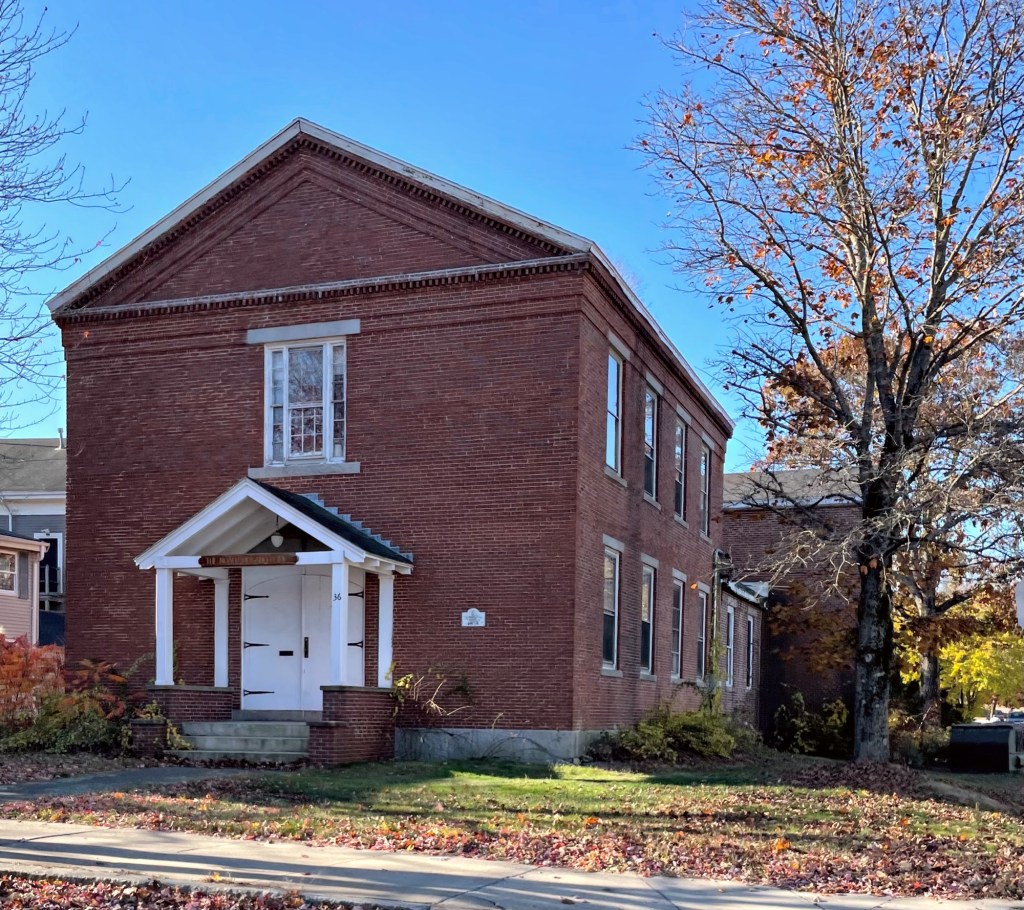
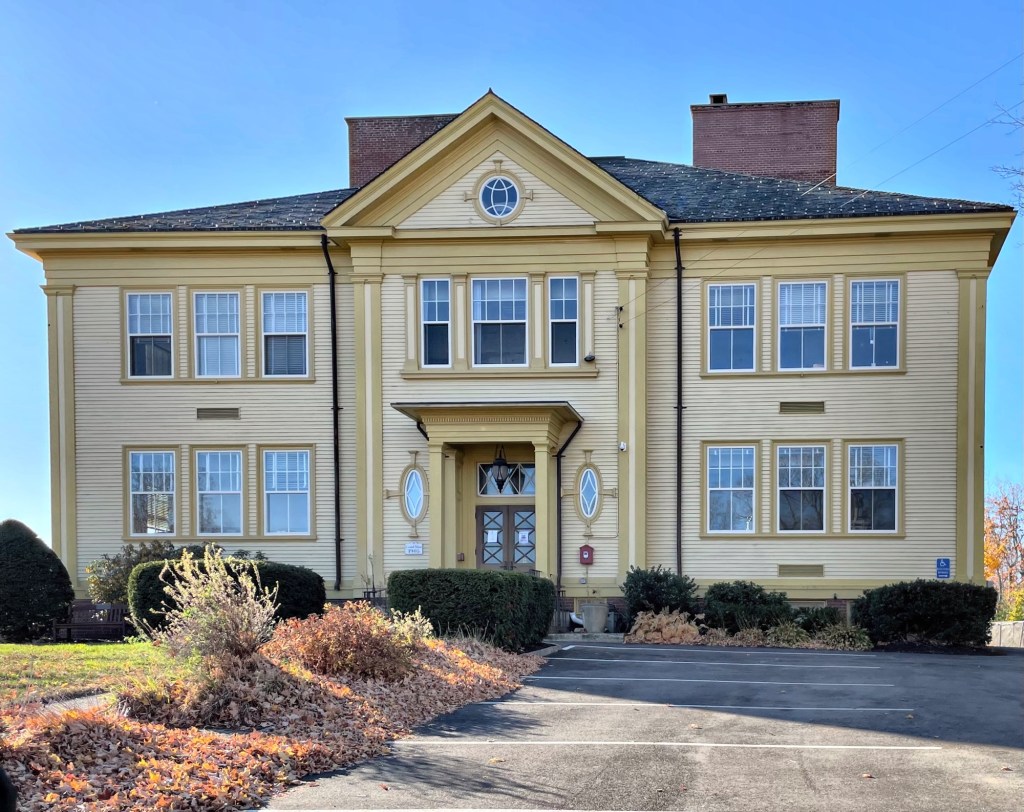
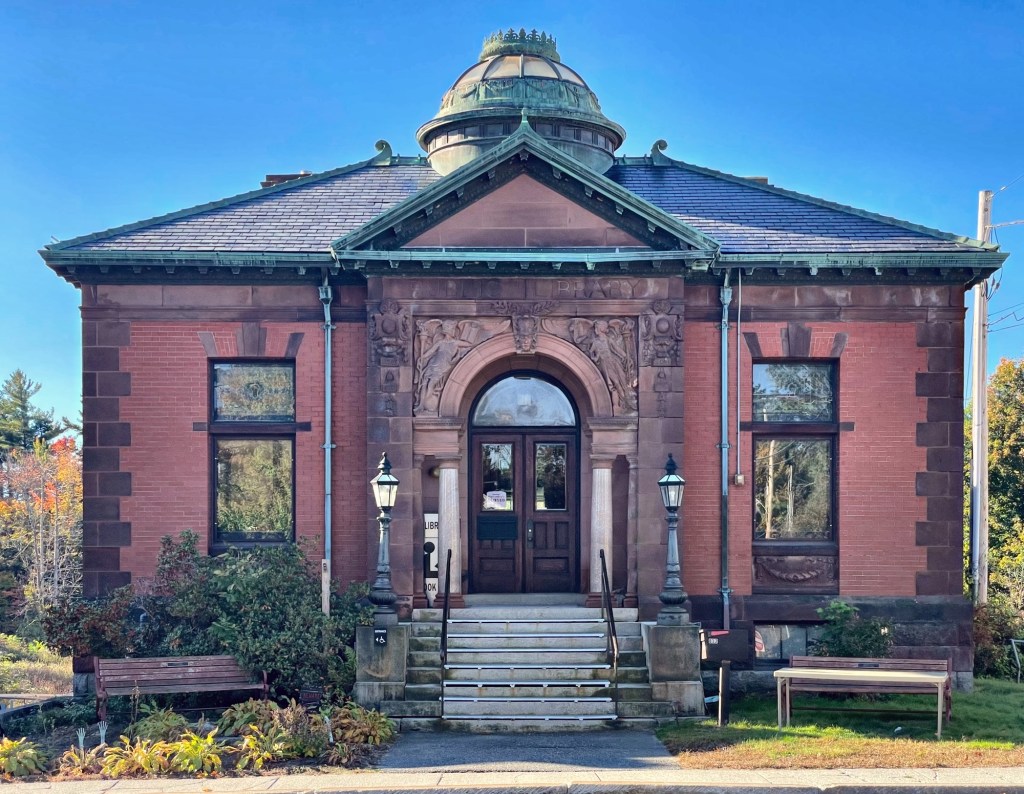
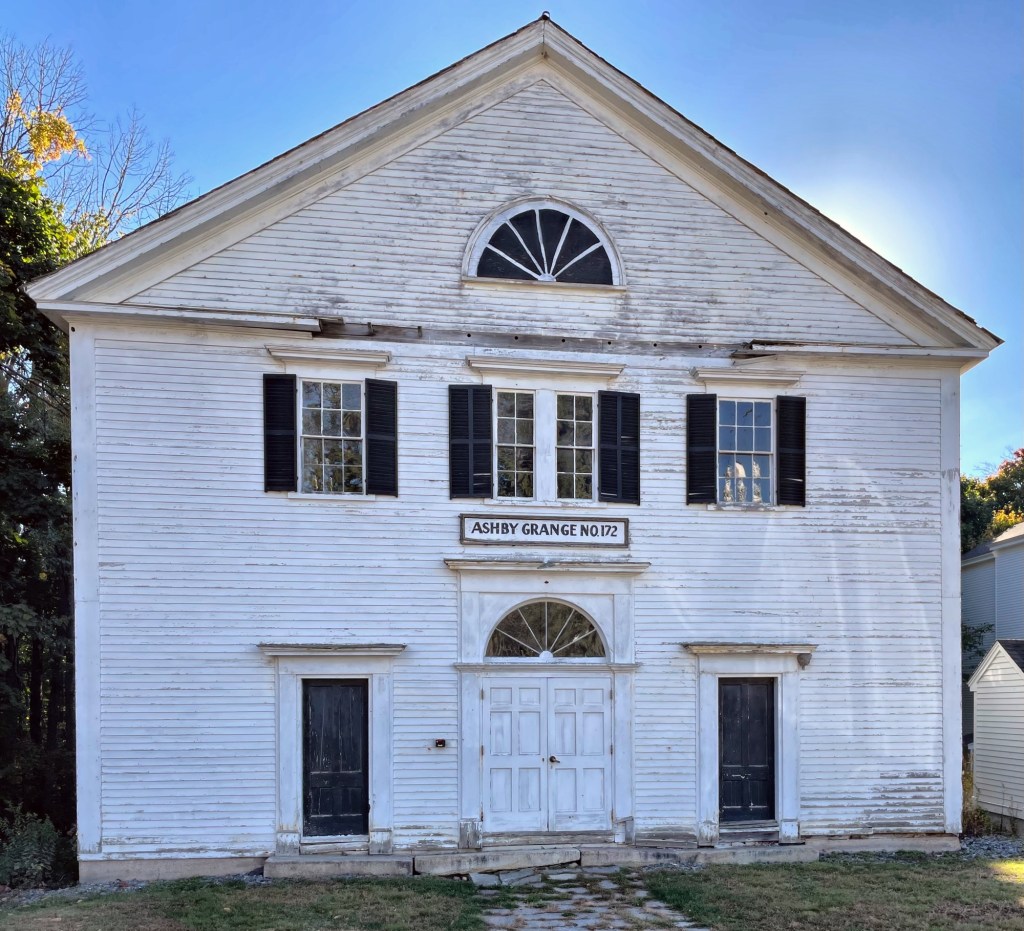
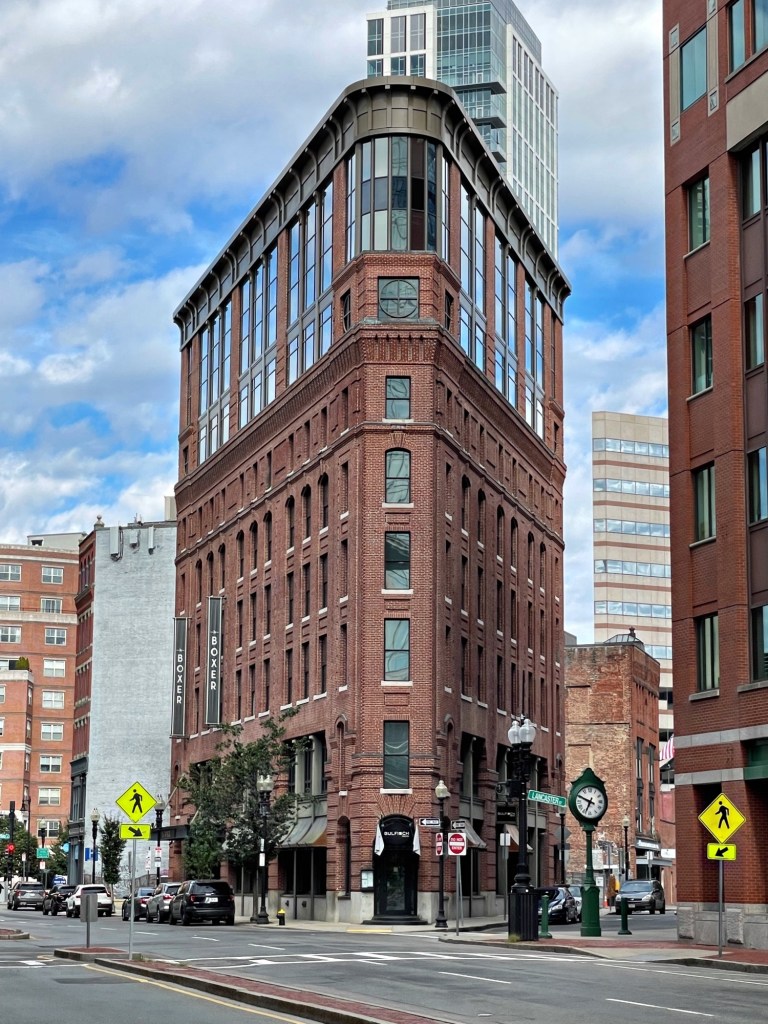
When the old Broadway school in Chicopee Falls became neighbors with the Overman Wheel Company, an early bicycle manufacturing company, there was so much noise and distraction that the Chicopee School Committee voted to sell the school and build a new school building down the street. A triangular lot on Broadway was purchased and Springfield architect, Francis R. Richmond, was chosen to design the new building in 1894. The school was dedicated to Dr. Samuel Alvord, a Chicopee Falls resident who was first principal of the local high school and local doctor that died in 1892. The Alvord School is a great example of a Richardsonian Romanesque school building of brick and brownstone, with recessed entry within a Syrian arch and decorative terracotta tiles. The school would close in the second half of the 20th century, and today is known as the Helen A. O’Connell Administration Building, a municipal office building.
The Fisk Rubber Company was founded in Chicopee, Massachusetts, in 1898 by Noyes Wilson Fisk, who purchased the Spaulding and Pepper Company in 1895 and renamed it to the Fisk Rubber Company. The company originally produced bicycle tires and other rubber items, later branching out with automobile tires in 1899 which proved to be an impressive success. The company’s “Fisk Tires” became a household name, especially popular among early automobile owners for their durability and performance. At its peak, the company employed thousands of workers, contributing significantly to the local economy of Chicopee, as well as other branch factories in in New Bedford, Massachusetts, Jewett City, Connecticut and Pawtucket, Rhode Island. The firm grew rapidly, and an entire complex was built here in Chicopee, centered around this building, constructed around 1916 as the Administrative Offices for the company. Architect George B. Allen designed the building in the Classical Revival style. During the Great Depression, Fisk Rubber was crippled by competition and eventually was acquired by United States Rubber (later Uniroyal) in 1940. Uniroyal, Inc. closed their Chicopee plant in 1980, and the complex sat largely unused for decades, with a majority of buildings demolished in recent years. Hopefully this lovely building, instrumental to the growth of Chicopee and America as we know it, will be preserved for generations to come.
Tucked to the side of the towering City Hall building on Market Square in Chicopee, Massachusetts, this long-vacant former public library is undergoing a major renovation to convert the building to a business incubator and community hub. The library was built in 1911 and was designed by the Springfield architectural firm of Kirkham & Parlett and is a great example of a Classical Revival style civic building with its strict symmetry, Ionic columned and pedimented entrance, and corner quoins. The original town library was organized as early as 1846 under the name “Cabot Institute” a subscription-based library. In 1853, the Cabot Institute donated its collection of nine hundred books to form a public library. The town voted that year to support a public library from tax dollars, making the Chicopee Public Library the first library funded by public funds in Western Massachusetts. The library was located in the City Hall building when it was completed in 1871, and was later moved out of the building to make space for the Board of Aldermen offices. In 1907, Mrs. Sarah Cooley Spaulding bequeathed $20,000 in her will towards a new library building as a memorial to her late husband, Justin Spaulding, and in May 1913, the Chicopee Library opened its first building built solely for the purpose of being a library. The library was expanded in the latter half of the 20th century and ultimately outgrew its space, with the City building a new library in 2004 on Front Street. This library closed at that time and had sat vacant until plans were unveiled to re-imagine this significant building as a community hub. I love to see old buildings repurposed rather than demolished!
Chicopee, Massachusetts, was first settled in the early 17th century and incorporated as a town in 1848. Originally part of Springfield, Chicopee grew rapidly in the 19th century, fueled by industrialization and following immigrants arriving to the city to work in factories there. Many of these ethnic groups established cultural centers and built churches, creating the diverse and architecturally unique city we see today. Sadly, like many other 19th century industrial cities, many of the factories closed or relocated in the mid-late 20th century. While the loss of industry harmed the local economy, Chicopee is poised for growth and rebirth as the second largest city in Western Massachusetts, and anchored by its great architecture. The Chicopee City Hall, built in 1871, is one of the region’s finest buildings and one of a handful built in the Romanesque Revival style. The present building was constructed on land the City purchased in 1869 from the Ames Manufacturing Company, a major employer in town with mill buildings nearby along the river. Architect, Charles E. Parker of Boston, was hired to design the new building which is said to have been loosely modelled after the Palazzo Vecchio, the historic town hall of Florence, Italy. The City of Chicopee have been great stewards to their historic City Hall, undergoing numerous restoration projects in the past decades.
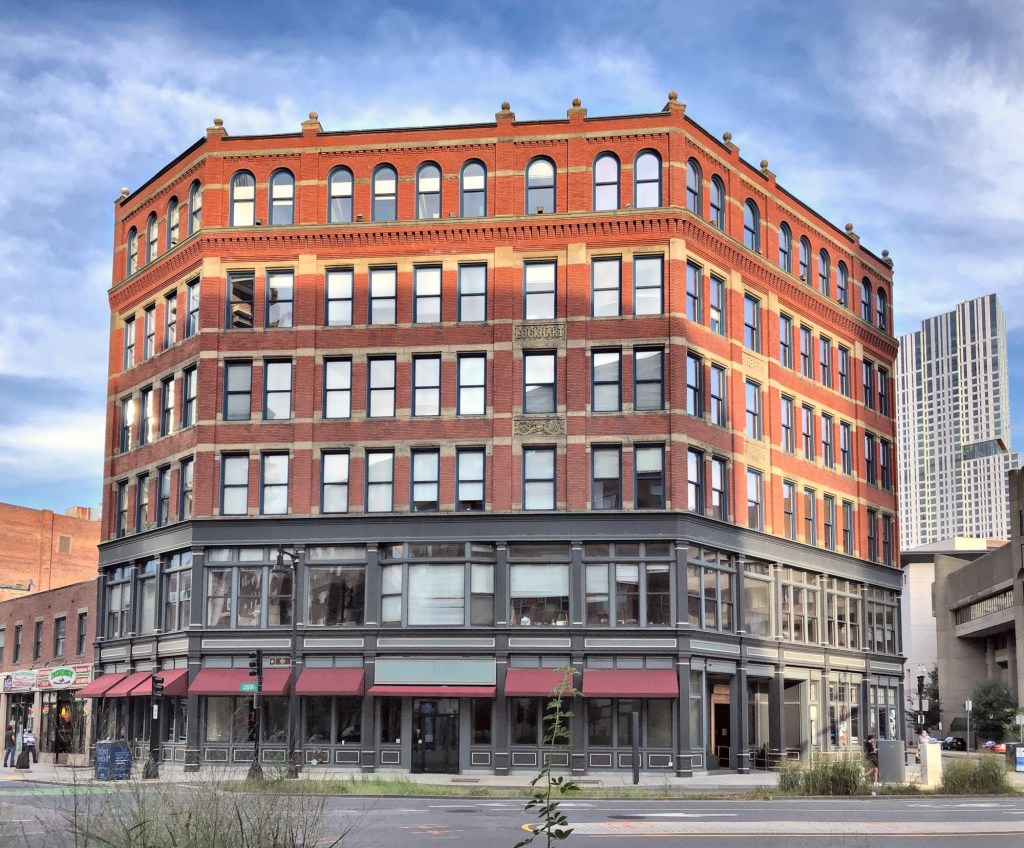
One of the last major 19th century buildings erected in Boston’s Leather District is also one of the finest examples of Beaux Arts architecture in the city. This is the Albany Building, built in 1899, and fills an entire city block. The Albany Building was designed by Peabody and Stearns and built by Norcross Brothers as the offices for the United Shoe Machinery Corporation. Its two-story base is adorned with swags and cartouches and its fifth floor is topped with a complex cornice. The use of beveled corners and ornate detailing break up the massing of the building which otherwise, would read like a box. The building today serves as an important visual gateway into the Leather District and its context of late 19th century commercial blocks centered around the leather and shoe manufacturing businesses.
When the railroads serving Boston were first laid out and built, each line stopped at its own terminal which created a dysfunctional and cumbersome travel experience for those entering or leaving the city. The Boston Terminal Company, established in 1897, was charged with the task of consolidating service from the four terminals at a single terminal, a union station (similar to North Station), for routes south of the city. South Station was designed by architects were Shepley, Rutan and Coolidge of Boston and quickly became New England’s busiest transportation center. The five-story Classical Revival style station built of stone is an architectural landmark with three-story Ionic colonnade crowned by a clock surmounted by an eagle, stands above the triple-arched brick masonry lower level corner entrance. While the station handled 125,000 passengers each day during World War II, post-war passenger rail traffic declined in the US. South Station was sold to the Boston Redevelopment Authority in 1965 and (surprise!) they demolished portions of the building and later developed plans to demolish the rest of the station and replace it with a multi-use development including a new train and bus station with large parking garage. Luckily for everyone, the BRA failed in this endeavor and the building remained to the point where public transportation is again invested in and beloved and the building has since been restored. Recently, a glass “crown”, known as South Station Tower, a 51-story designed by Pelli, Clarke & Partners, with new office space, luxury residences, and a redesigned, arched interior concourse (which in my opinion, is the best part). The redevelopment is a push towards transit-oriented development and blends new and old in an innovative way.
One of the hidden gems of Boston can be found tucked away in the Leather District, one of the last remaining diner cars in the city, this is South Street Diner. At this site, at the corner of South and Kneeland streets, a diner car has existed since about 1935. In 1947 the present diner car was built by the Worcester Lunch Car Company and moved on this site as the Blue Diner opened, possibly named after its patrons, largely blue-collar workers. The diner would be renamed the South Street diner in 1992, a name that has stuck ever-since. The diner attracts tourists, nearby workers, and drunken college students, serving as a much-needed melting pot for people of different backgrounds to grab a good bite to eat.
Located at 127-133 South Street in the under-appreciated Leather District of Boston, the 1886 Beebe Building is an excellent vestige of the leathergoods trade and commercial architecture of the late 19th century. This building was constructed by J. Franklin Faxon (1832-1912), a business owner who engaged in real estate development and built a number of commercial blocks in this part of Boston. Rand & Taylor, architects, designed the building in an effective blending of Classical and Romanesque styles with rock faced brownstone ashlar above the storefronts, oculus windows, and segmental arched openings on the top floor. The Classical detailing of the two-story brick pilasters and modillion cornice add to its complexity. The building was originally occupied by the Thomas E. Proctor Leather Company and was later purchased by leather goods company Lucius Beebe & Sons and the storefront was renovated by Hutchins & French in 1930. The building has since been known as the Beebe Building and has been well-maintained by subsequent owners.
The General Israel Putnam Housein Danvers, Massachusetts, was built circa 1648 by Lieutenant Thomas Putnam on farmland that then consisted of 100 acres. In 1692, his youngest son, Joseph Putnam, lived here, inheriting the property over his half-brother, Thomas Putnam, Jr. (1652-1699), causing friction within the family. During the infamous witch trials and hysteria in Salem Village, Joseph Putnam was one of two people who took notes during the examinations of the first three to be accused of witchcraft in 1692 – Sarah Good, Sarah Osborne, and Tituba. From that point forward, he was one of the most outspoken opponents of the proceedings, which put him in direct conflict with most of the Putnam family, especially that of his half-brother Thomas. Fearing accusations against him by his half-brother, Joseph was said to have kept horses saddled at all times, ready to escape at a moment’s notice. He was never accused, though Thomas Putnam was responsible for the accusations of 43 people, and his daughter was responsible for 62. In 1718, Israel Putnam, the son of Joseph Putnam, and later Commander of the colonial troops at the Battle of Bunker Hill, was born in this house. It is the only extant structure with direct ties to Commander Putnam. During the Battle of Bunker Hill, Putnam is thought to have ordered William Prescott to tell his troops, “Don’t fire until you see the whites of their eyes.” This command has since become one of the American Revolution’s notable quotations. It was given to make the best use of the low ammunition stocks that the troops had. The Putnam House remained in the family into the 20th century, and due to highway and commercial expansion, the property now sits in the middle of a cloverleaf intersection of two highways. The house was given by the Putnam family to the Danvers Historical Society in 1991, but as of 2020, the Putnam family once again owns the property. The house is not holding up well and I could not locate plans for restoration or preservation of it online. This house deserves to be preserved.
This large house sits on Peabody Avenue in Danvers, Massachusetts, and is thought to be the oldest house built of cement in the United States! Joshua Sylvester Silvester (1803-1888), the house’s original owner, was born in Wiscasset, Maine, and began working in the shoemaking business, expanding his products in England, taking many business trips there. While in England, he is said to have particularly admired Charles Dickens’s estate, Gad’s Hill, and modeled his Danvers home after it. Joshua Silvester not only designed this house, but directly supervised its construction which is of hand-poured cement/stucco by two masons imported to town to work on the house. The fifteen-room residence with octagon-shaped barn was complete by 1858. In 1880, the property was purchased by Isaac B. Howe of Clinton, Iowa. Howe was a civil engineer who had helped to lay out the Transcontinental Railroad and had been superintendent of the Iowa division of the Chicago and Northwestern Railroad. Howe died within a year of moving to Danvers, but his family continued to live in the house for many years.