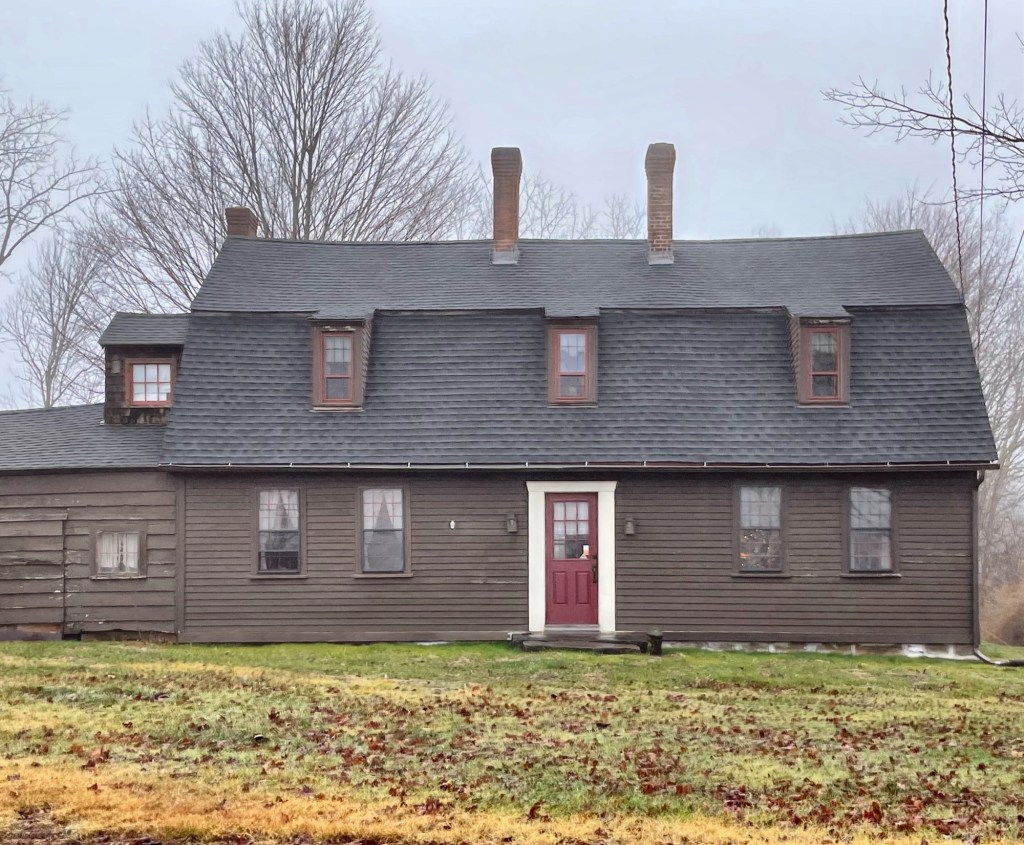
Known locally as the ‘Ye Olde Manse‘, this stunning Georgian cape house is located at the eastern edge of the town green in Willington, Connecticut. Thought to be the oldest extant house in the small, rural community, the gambrel-roofed homestead was possibly built by John Watson of Hartford, who was thought to have been an original proprietor of Willington, but was instead an assignee of George Clark who was. In the 19th century, the homestead operated as the congregational church parsonage. Today, the Georgian cape house with gambrel and saltbox roof is a single family home and has been lovingly preserved by centuries of stewards of this old manse.
Located in northern Willington, CT, this farmhouse on a quiet, country road, dates to before the Revolutionary War! David Lillibridge (1744-1831) of Exeter, Rhode Island, served from 15 to 17 in the French and Indian War, and manned Fort Stanwix. In 1767, when he was a lieutenant in his local militia, he converted, and entered the Baptist ministry. In 1777, he purchased a farm from Moses Holmes, but it is unclear if this residence was existing or if he built this large farmhouse. In Willington, David Lillibridge became a farmer-preacher, establishing a Baptist ministry here. The home remained in the Lillibridge family at least until the 1870s, when it was owned by Burnham Lillibridge. The Georgian saltbox residence is set back from the street and sits upon the bucolic rolling fields of the property.
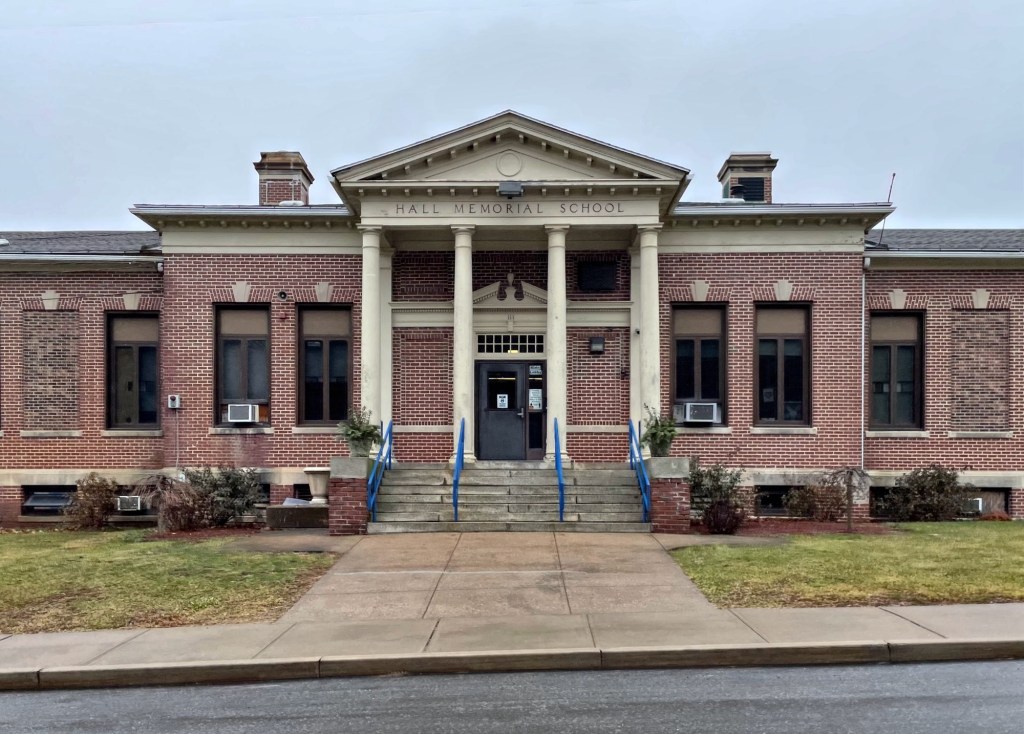
Located in South Willington, Connecticut, this Colonial Revival style school building was built to serve the mill village pupils, many of whom were first- and second-generation Americans who immigrated to the area to work at the local mill. In his will, William Henry Hall (1867-1922), the son of industrialist Gardiner Hall Jr., who established the business under his name, donated funds to the community to erect a new, suitable school building for the village. Beyond his work at his family’s business, William H. Hall served in the Connecticut House of Representatives in 1893–1897 and again in 1905, 1909, and 1911, and he was generous with his money throughout his life and in his will. For the Hall Memorial School, his heirs selected architect, Harry L. Sprague of Springfield, Massachusetts, who designed the one-story school built of brick and limestone trim and a tall, pedimented portico at the entry supported by four tuscan columns. The school has seen additions, but it retains much of its architectural integrity in the over 100 years of use as a public school.
Located between his family factory and the memorial church built for his late sister, the William H. Hall House in South Willington, Connecticut, is among the community’s finest Victorian residences built for a wealthy industrialist. William Henry Hall (1867-1922) was the son of industrialist Gardiner Hall Jr., who established the business under his name, which manufactured thread and spools, hiring hundreds of employees. After the death of his father, William Hall became the head of the company, but clearly was successful long before this as he had this stately Queen Anne style mansion built in 1896. Beyond his work at his family’s business, William H. Hall served in the Connecticut House of Representatives in 1893–1897 and again in 1905, 1909, and 1911, and he was generous with his money throughout his life and in his will. Hall served on the board of trustees of his alma mater, Wesleyan University, from 1912 until his death, with his estate donating $175,000 to Wesleyan to construct a chemical laboratory named in his honor. Closer to his home, his heirs partially funded the the Hall Memorial School in South Willington in his honor. The property remained in the family after his death, and in the 1980s, it became an assisted living facility, with large additions constructed, but the Hall House remains a great architectural landmark for the mill village.
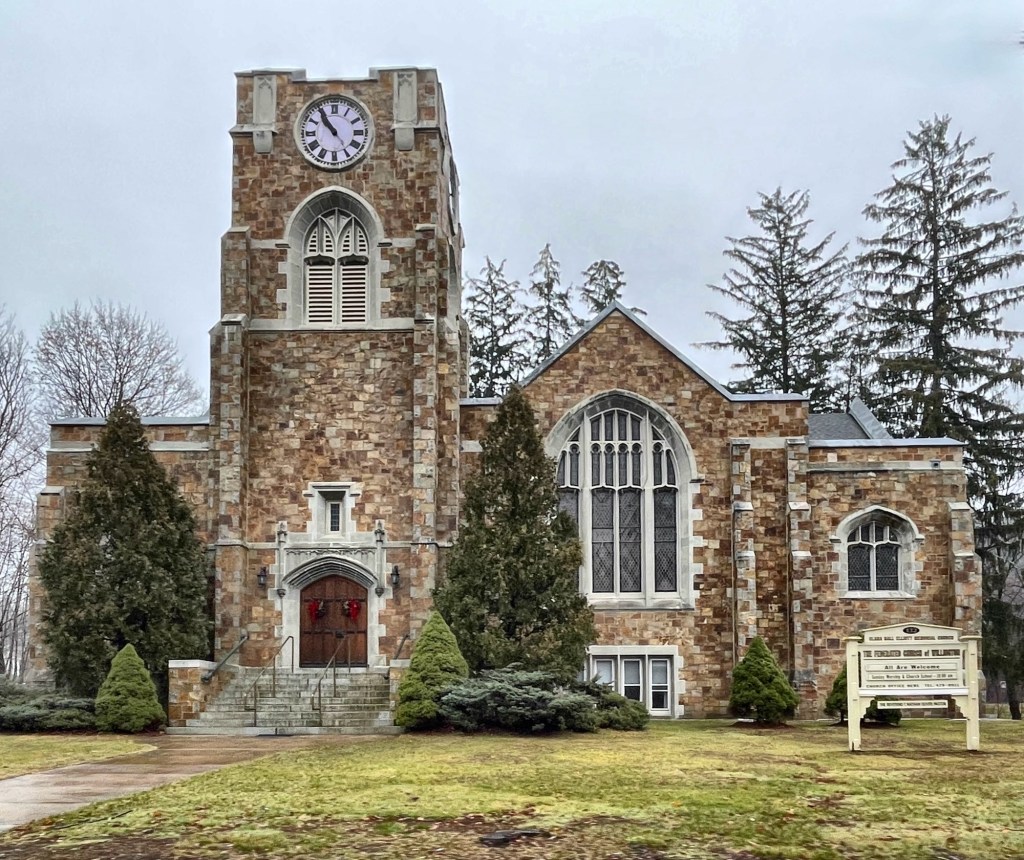
This handsome stone church in South Willington, Connecticut, was commissioned in 1909 by Gardiner Hall Jr., a terminally ill industrialist, in memory of his late daughter Clara, who tragically died in 1899 at the age of 30. The church was used by area residents, many of which included mill workers hired to work at Mr. Hall’s factory nearby and lived in mill housing just behind this church. Following the construction of this Memorial Church in South Willington, Baptist and Congregational Churches of Willington merged to form the Federated Church of Willington, which has worshiped at this location ever since. Neo-Gothic Revival in style, the church is constructed of multicolored random ashlar sandstone with limestone trim and features a corner clock tower with belfry, buttresses, stained glass windows, and limestone tracery. The church was designed by Boston architect, Thomas Marriott James and was completed by 1911.
In 1860, Gardiner Hall Jr. (1839-1915) founded a spool cotton thread business called the Hall & Manning Company, and later renamed the Hall Thread Company. The new business failed in a year with the onset of the Civil War and the accompanying shortage of cotton. During the war, in 1861, Hall designed and patented a machine for finishing thread and moved to South Willington, Connecticut, founding the Gardiner Hall Jr. Company. He had a three-story mill building constructed around 1862 where his small operation took off. In the following decades, the factory complex expanded rapidly, and machine, blacksmith, and bleach and dye shops were built on the property to increase production. Coinciding with this growth, Gardiner Hall built tenements, a boarding house and a community building for his growing workforce in the 1870s nearby. Before his death in 1915, Hall donated funds to erect a memorial church in memory of his daughter, and donated generously to his workers. His son, William Henry took over operations and was succeeded by his sister, Rosa Hall, until the factory closed in 1954. The industrial buildings were used for decades from various manufacturing companies and today are occupied by retail stores, a tattoo parlor, and event space, perfect adaptive reuse!
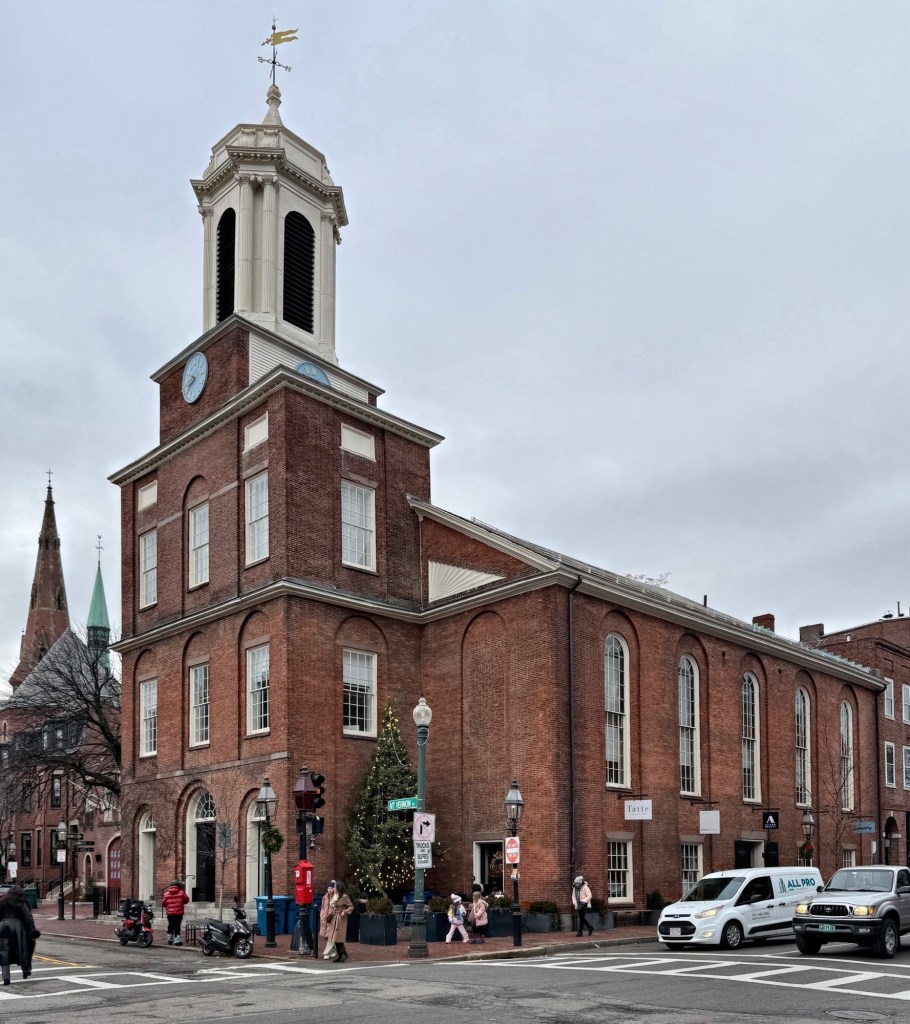
The Charles Street Meeting House at the corner of Charles and Mount Vernon streets in Boston’s Beacon Hill neighborhood is one of the finest examples of a Federal period meeting house in New England. The building is thought to have been designed by architect, Asher Benjamin, due to its similarities to his Old West Church on Cambridge Street built a year prior. At the time of construction in 1807, the church stood near the banks of the Charles River, but is now a distance away from the Charles following a land-filling campaign to expand buildable land in the city. The Charles Street Meeting House consists of a two-story gable-roof main structure with a three-story tower on the south (primary) elevation that supports a clock tower and wooden cupola with double Ionic pilasters supporting the domed roof. The building was constructed for the Third Baptist Church congregation, who used the nearby Charles River for baptisms. In the years before the American Civil War, it was a stronghold of the anti-slavery movement, and was the site of notable speeches from such anti-slavery activists as Frederick Douglass, William Lloyd Garrison, Wendell Phillips, Harriet Tubman and others. The Baptists sold the structure to the First African Methodist Episcopal Church in 1876, which was part of the first Black independent denomination in the United States. The AME Church sold the building in 1939 to the Charles Street Meeting House Society, and after a period of use as an Albanian Orthodox church, it was sold to the organization that is now, Historic New England, who were required to keep restrictions to preserve the building’s exterior. It served as a Universalist church from 1949 to 1979 with rented space inside to tenants, including a LGBT newsletter, Gay Community News, which was founded in the building in 1973. In 1980 the Meeting House was purchased by the Charles Street Meeting House Associates, who worked with the architectural firm of John Sharrat Associates to restore the building and adaptively reuse it into four floors of offices, with retail on the ground floor.
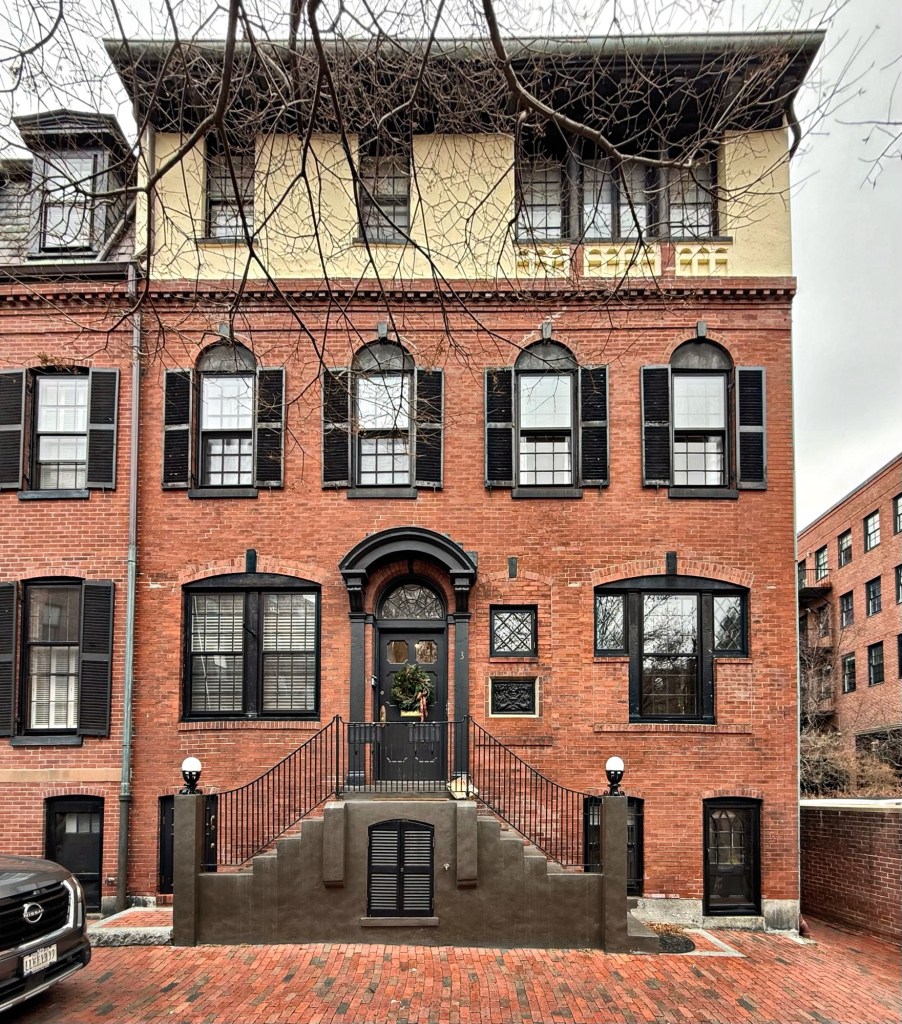
This charming residence is one of a few hidden houses tucked away on Mt. Vernon Square in Boston’s Beacon Hill. The small enclave of four houses with a stable was developed in 1869 by the partnership of builder Daniel Davies and Grenville T. W. Braman, a businessman turned real estate developer in the mid-late 19th century. The residence pictured is today known as 3 Mt. Vernon Square, but was once a double-house that was rented to families by Braman before they were sold off to separate owners. In 1903, Philip Cabot (1872-1941), a member of the wealthy Cabot Family of Boston, purchased both 3 and 4 Mt. Vernon Square and had the homes combined to a single-family home for his family. It is unclear who was hired as architect, but the property was renovated with a new central entrance, full third floor faced with stucco replacing the former mansard roof, diamond-pane and blind arched windows, and a decorative metal or cast-stone panel inlaid in the facade. Philip was married to Lucy Fuller but filed for divorce in 1910 after she deserted him according to local papers, and in 1911, she married Winthrop Ames, of the wealthy Ames Family of North Easton, Massachusetts. Philip Cabot also remarried, and sold the house on Mount Vernon Square to Frank Washburn Grinnell, a successful attorney.
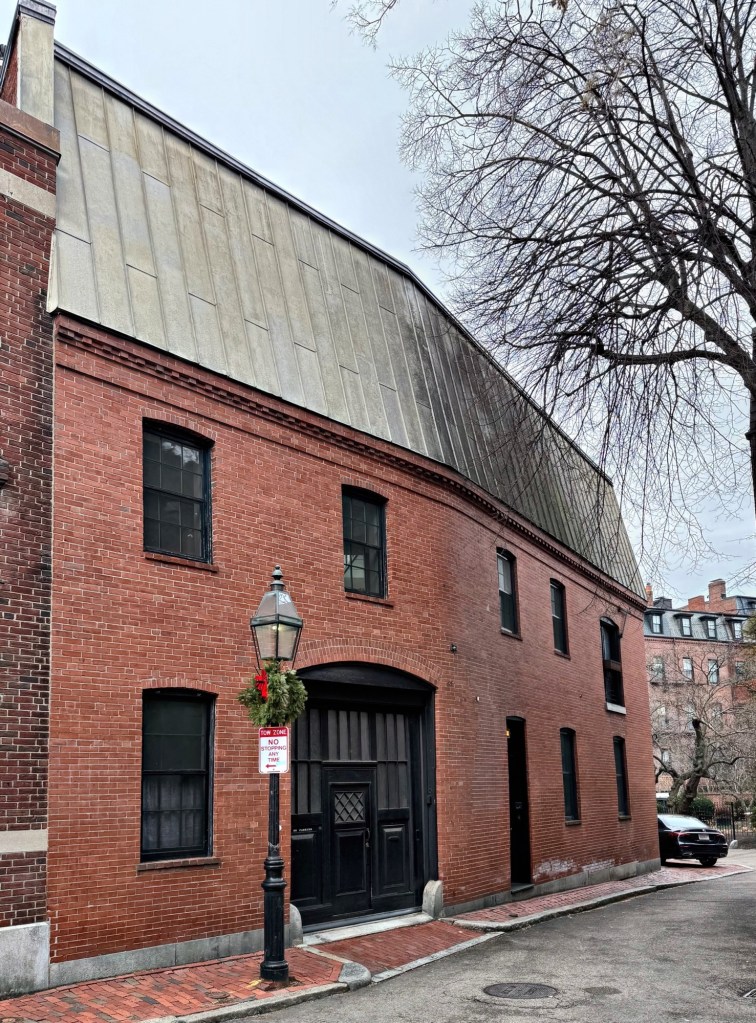
Located behind the iconic former fire station on Mt. Vernon Street in Boston, this converted stable maintains the important nickname for the Beacon Hill Flat as the “horsey” part of the neighborhood, which developed on filled land and contained many stables for wealthy Beacon Hill residents. This two-story stable fronts River Street and dates to 1870 and was built along with the townhouses fronting the hidden Mount Vernon Square for Grenville Temple Winthrop Braman (1832-1902), who partnered with a builder, Daniel Davies, to develop the lots here. The stable, which originally had a flat roof, was occupied as private stables and later as storage for the townhouses for nearly 100 years until it was purchased in 1968 and converted into residences by architects and partners, Joan E. and Marvin Goody, who established Goody/Clancy, a Boston architectural and design firm. The interior was modernized and the addition of a contemporary metal “mansard” roof fits well within the context of the neighborhood and was an important early “remodel” in the Beacon Hill Historic District.
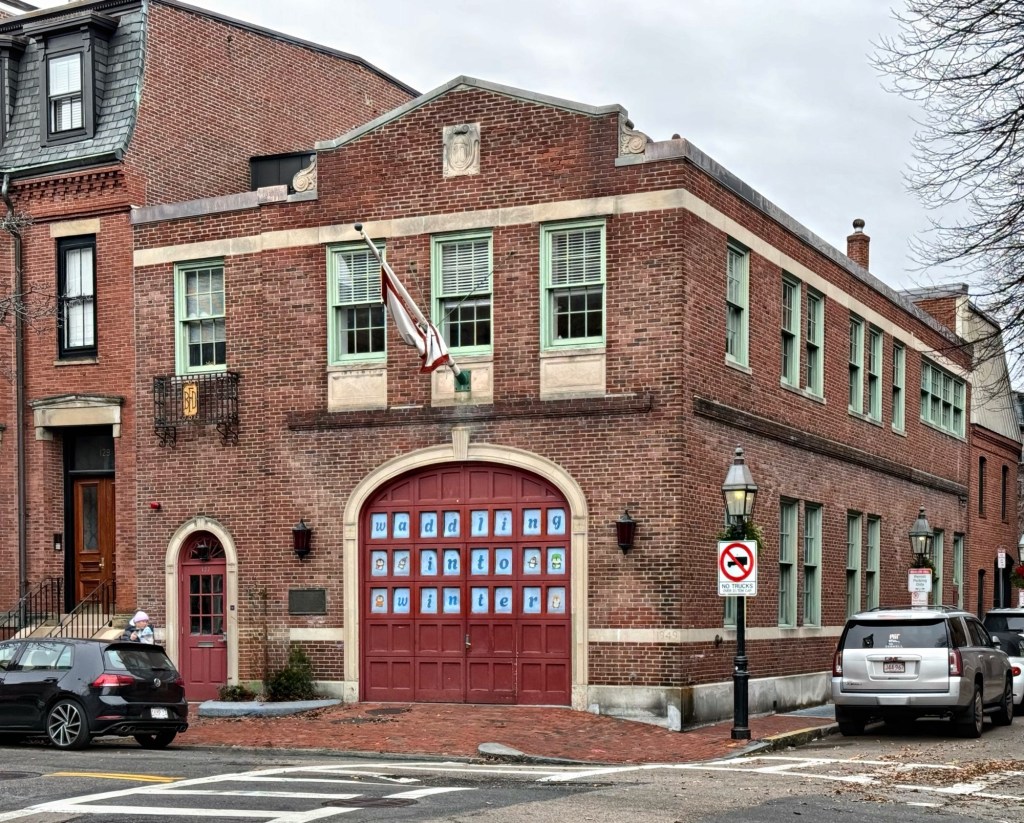
This iconic former firehouse at the corner of Mount Vernon and River streets in Beacon Hill, was built in 1949 and despite its relatively young age, has become an iconic landmark in the neighborhood. Since the mid-19th century, this site has been occupied by a fire station, most of which as a Second Empire, brick engine house with a mansard roof. After WWII, the Fire Department struggled to use the 1860s station which was built before the large, vehicular fire trucks replaced horses-drawn apparatus. In 1946, the Victorian station was razed and architect, John Mathew Gray, furnished plans for a new, Colonial Revival style station that could accommodate the larger fire trucks. The new station opened in April 1949 and Engine 10 remained here until 1982, when the company moved to 123 Oliver Street, Downtown. The Fire Department retained ownership of the building until 1995, and around this time, the building served as the filming location for television shows Spenser For Hire, which ran from 1985 to 1988 and the MTV seriesThe Real World, which was broadcast in 1997. Since 1998, the property has been home to Hill House, Inc. a long-standing non-profit providing sports activities for children, adult education classes and programs for senior citizens.
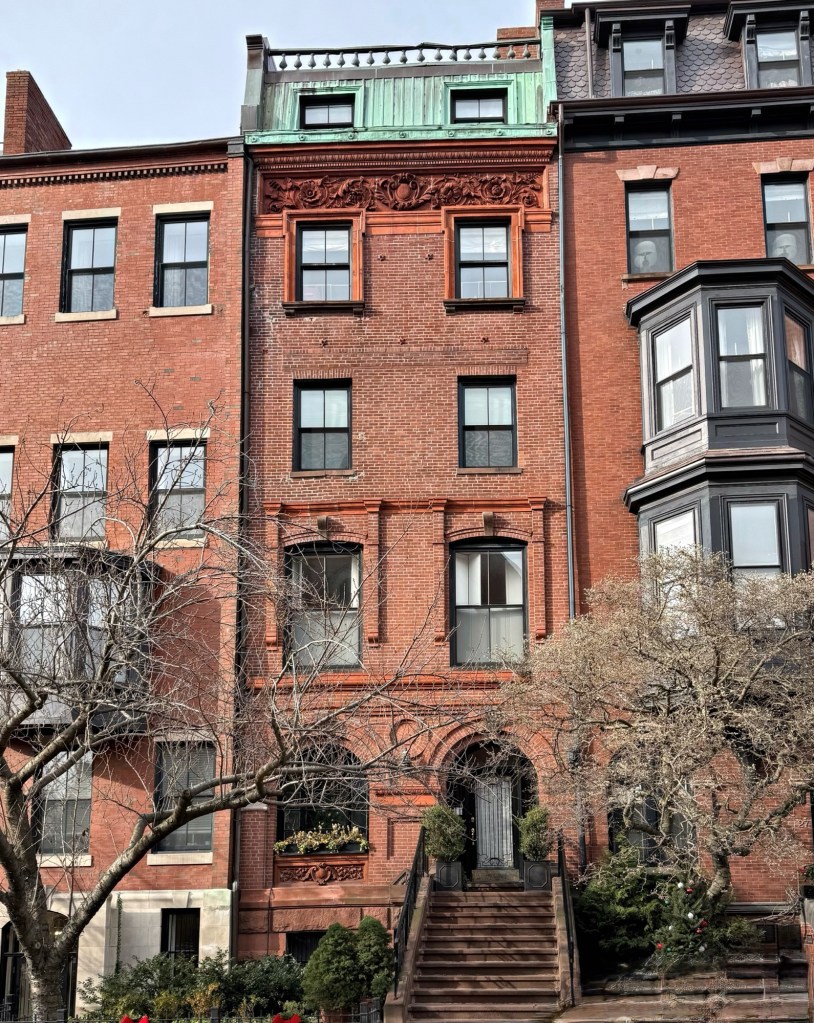
This unique house at 29 Brimmer Street in Boston’s Beacon Hill, was completed in 1881 is architecturally distinctive compared to the early 19th century homes that the neighborhood is known for. The five-story residence has a raised entrance up a flight of steps set within an arched opening. To the side, an arched window frames the facade and has an ornate terracotta panel as a base. More terracotta ornament can be found at the second floor and under the cornice as a thick band frieze with a copper-clad mansard roof above. The single-family residence was built in 1881 for Charles Faulkner (1811-1885), a commission merchant, for his daughter, Ann Ruth Faulkner the year of her marriage to Charles Rowley Hayden. Mr. Hayden was a musician and vocalist. For the new wedding gift, Faulkner hired the esteemed architectural firm of Bradlee & Winslow prepare the designs. The former Faulkner-Hayden House today contains five condominiums.
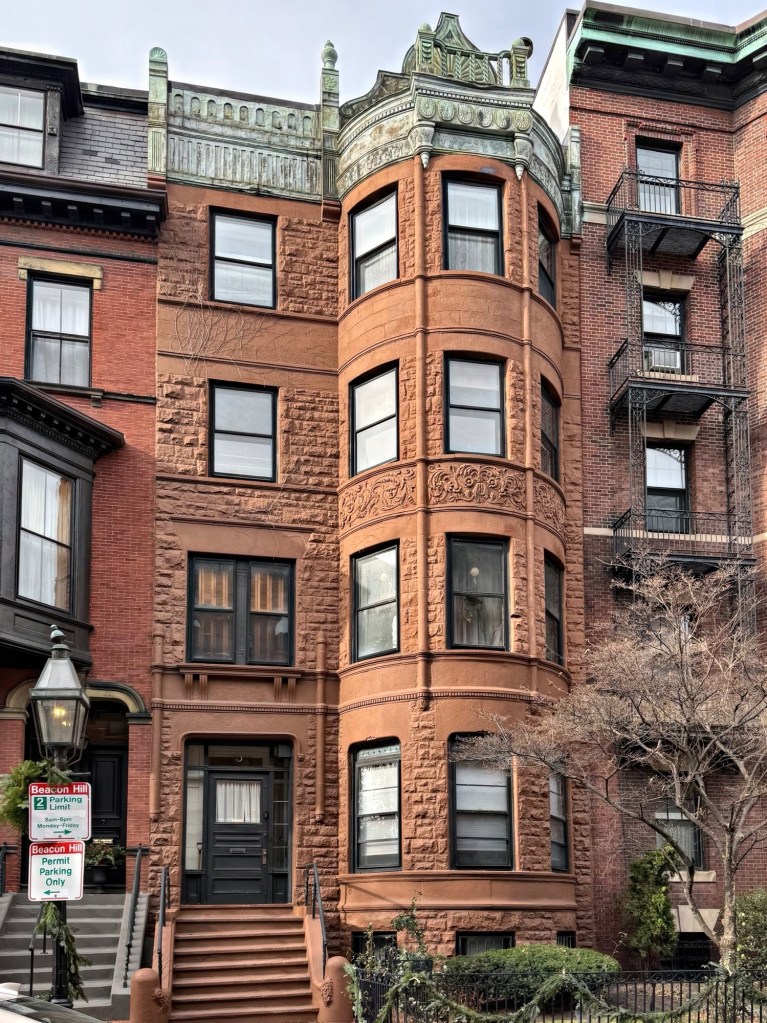
Located on Brimmer Street in Beacon Hill, this handsome residence is constructed of rough-faced brownstone laid in a random ashlar pattern and is among the most unique in a neighborhood known for brick townhouses. Decorative treatment includes a stone band that is carved with foliate and faces, colonettes that rise along the facade at the bay, and an ornate molded copper entablature and parapet at the roof. The residence dates to 1888 and was built for Seth R. Baker, a Boston real estate developer at the end of the 19th century. It can be inferred that the building was designed by architect, Ernest N. Boyden, as Baker hired Boyden as architect for a half-dozen other apartment buildings between 1888-1890. Antoino Xavier, a Portuguese-born mason is listed as the builder. In the 1910s, the property was purchased by Marie Ames Byrd, wife of polar explorer Richard A. Byrd, who lived a few houses away at 9 Brimmer Street. She rented the four apartments to boarders through the 1930s.
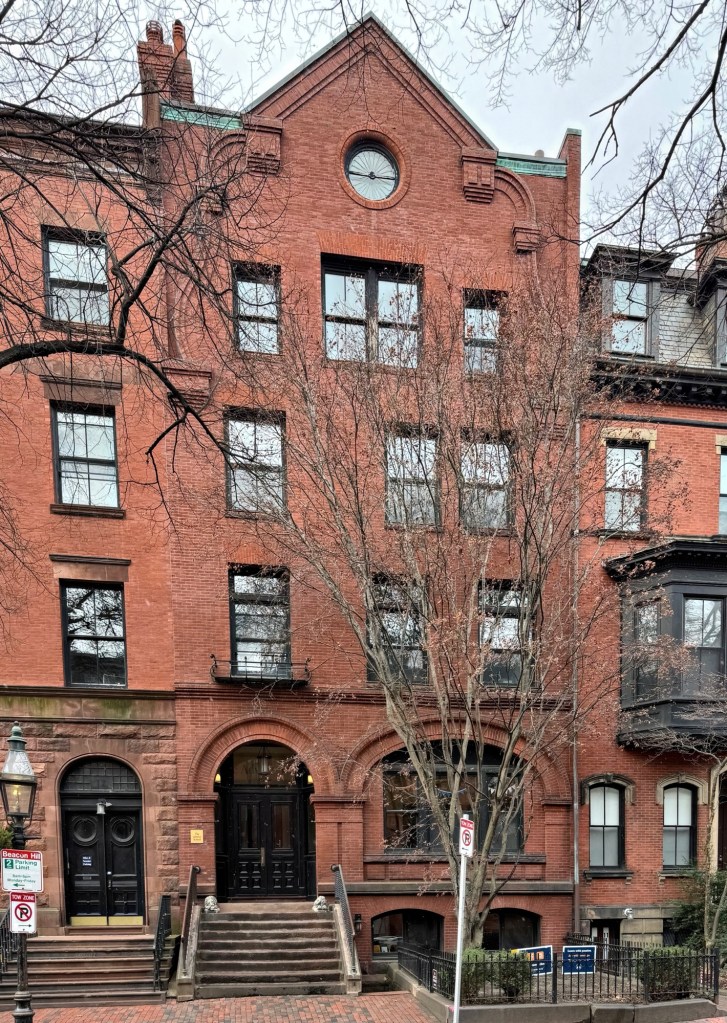
One of the many great townhouses on Brimmer Street in Boston’s Beacon Hill neighborhood is this residence designed as a unique interpretation of Queen Anne and Romanesque Revival styles. Original owner, Eliot Channing Clarke (1845-1921), an MIT-educated civil engineer. His uncle, Thomas Curtis Clarke, was a noted civil engineer, a member of the firm of Clarke, Reeves & Co., Bridge Builders in Pennsylvania, and served later as President of the American Society of Civil Engineers. When Thomas Clarke’s firm was designing and building a new bridge over the Mississippi River in Quincy, Illinois, he had his nephew lead in the design. In 1876, Eliot was appointed engineer in charge of a survey for a main drainage system for Boston. The project was adopted and construction began a year later, taking years to complete. In 1885, Clarke published the work that he oversaw, modernizing a rapidly growing Boston water and plumbing system. He became one of the leading sanitary engineers of the United States. In 1884, Clarke hired architect, S. Edwin Tobey, who designed this townhouse with a unique gable containing a ocular window and panel brick parapet as an interpretation of a Flemish gable. A traditional arched entry in brick is a nod to the Romanesque Revival style, which surged in popularity in Boston following the completion of H. H. Richardson’s Trinity Church. In 1969, the Clarke house’s interior was connected with its neighbor as the Advent School, a private K-6 school associated with the Church of the Advent across the street.
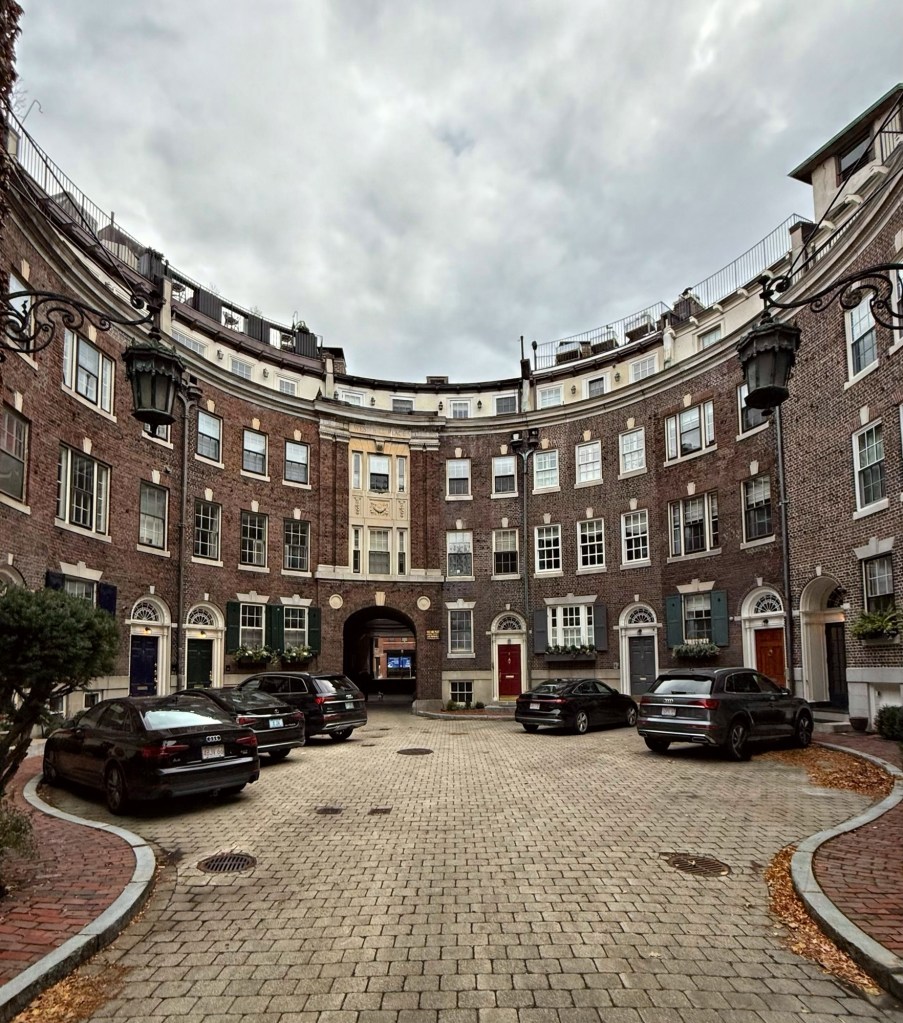
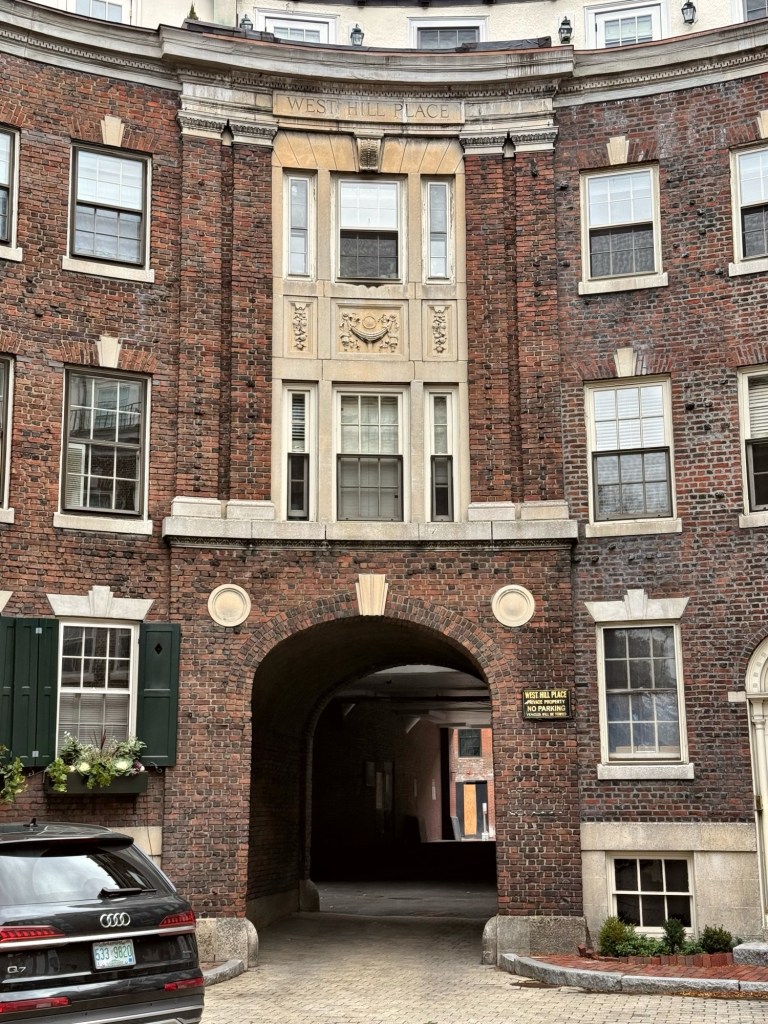
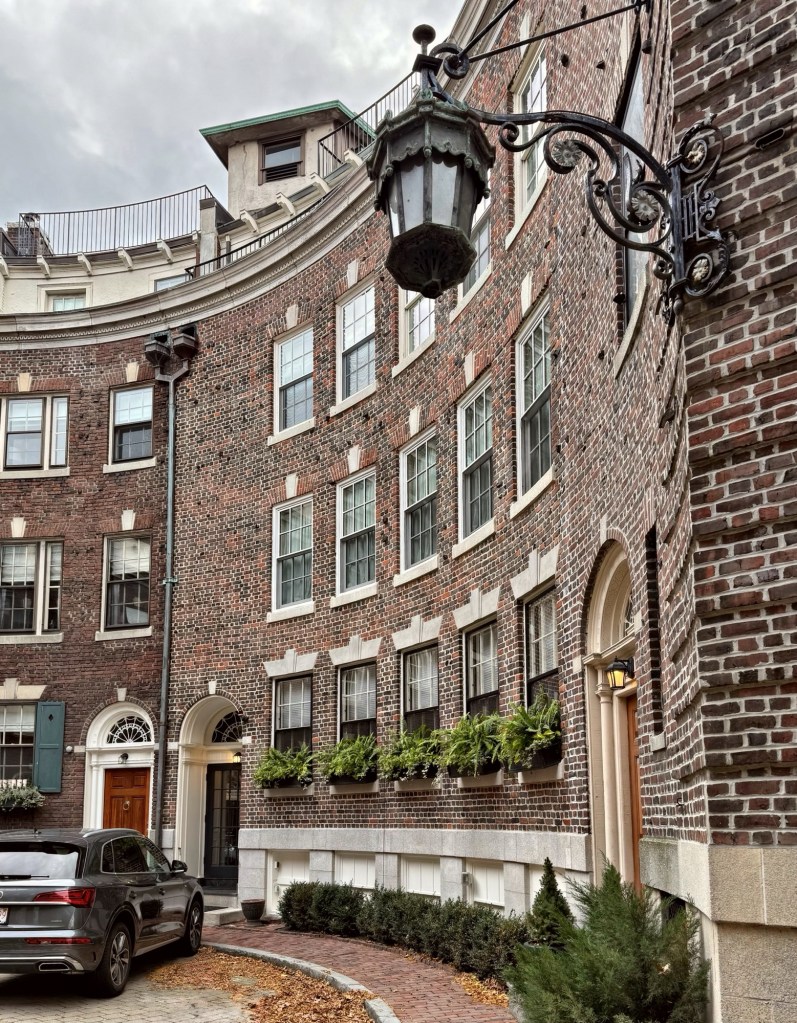
West Hill Place is a small development in Beacon Hill that feels like it was transported to Boston from London! The group of 14 four-story brick townhouses that comprise West Hill Place were built on the site of a gas holder in 1916. The Georgian Revival style development was designed by the firm of Coolidge and Carlson, who aligned six of the townhomes to face west on the Charles River Embankment and arranged the remaining eight residences around a circular court. The development was inspired by Charles River Square, located to its south and built six years prior. The driveway extends off what is today Storrow Drive, with a second exit set within an arched passageway that connects through the Charles Street garage, which was built later. The dark brick with cast stone trim works elegantly with the curving facades facing the courtyard, many of which are adorned with arched doorways and the original iron lanterns. The development has been harmed by the creation of Storrow Drive in the 1950s, but it remains one of the most unique and picturesque enclaves in New England.
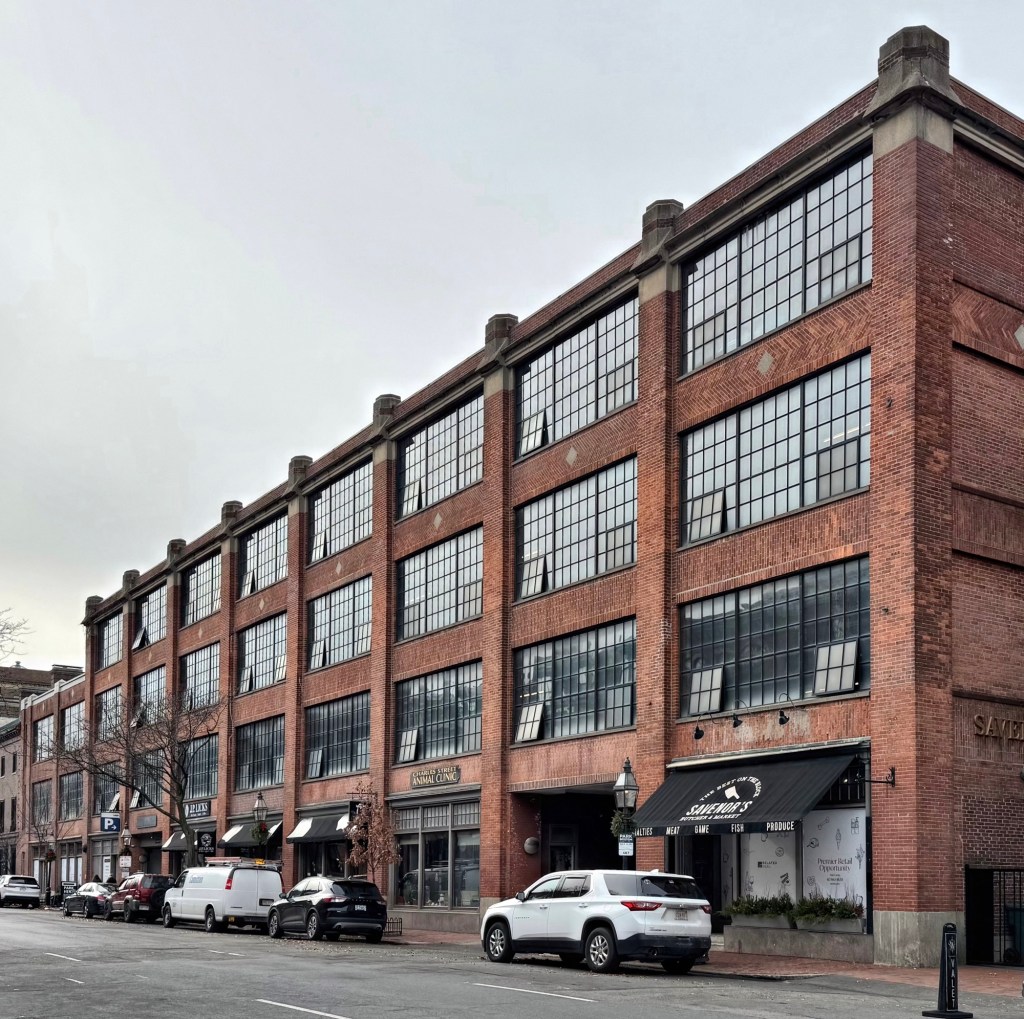
The area west of Charles Street in Boston’s Beacon Hill is known as the Beacon Hill Flat, which is largely built on 19th century-made land along the Charles River. The area developed into housing with a high percentage of carriage houses and horse stables built by the wealthy families living on Beacon Hill. Today, many of these edifices have been converted into charming residences, shops, and in the 20th century, garages. As the personal automobile took over horses as the desired method of transportation, savvy developers developed garages where wealthy residents could “stable” their vehicles, especially important in a dense neighborhood like Beacon Hill without much off-street parking. Built in 1919, the Charles Street Garage stands four stories tall with large expanses of multi-light windows and ground floor retail spaces set within the bays to enliven the street.