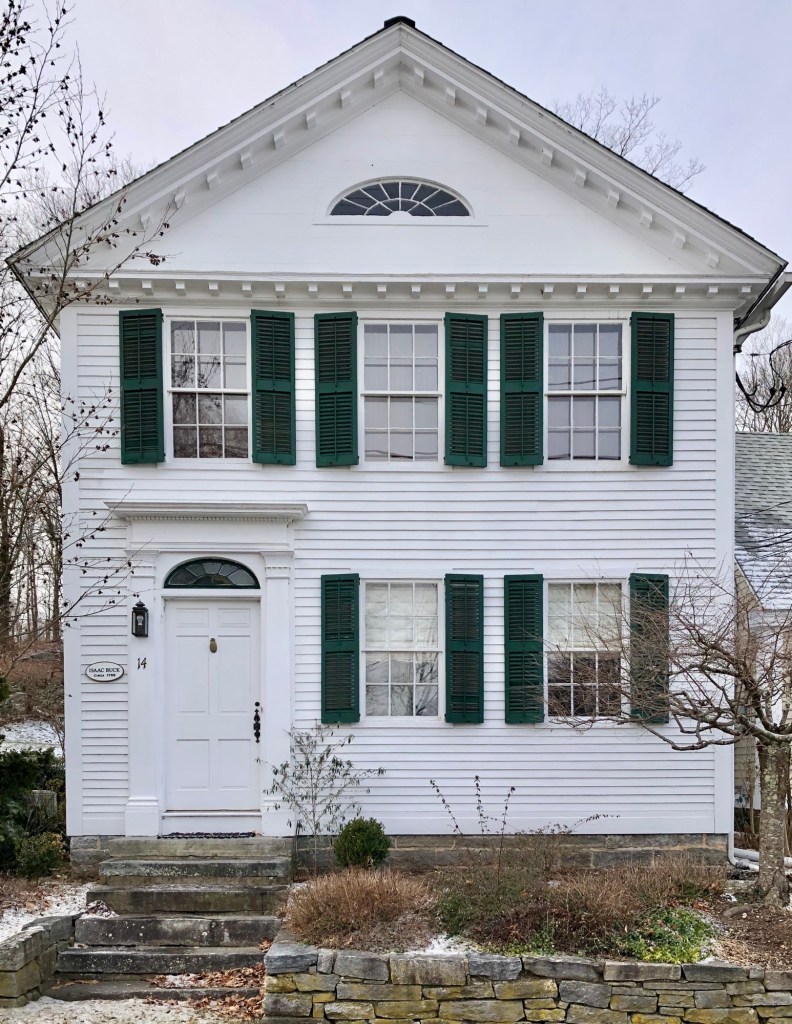
Pierce-Guild Lightning Splitter House // 1781

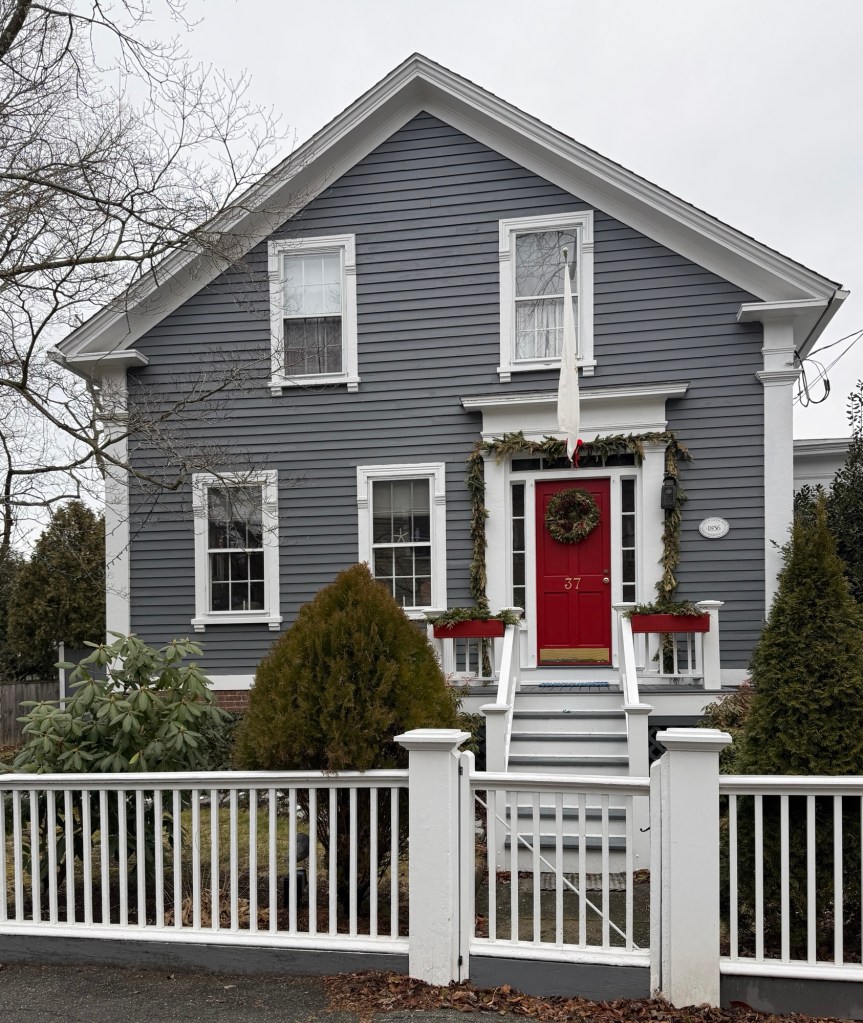
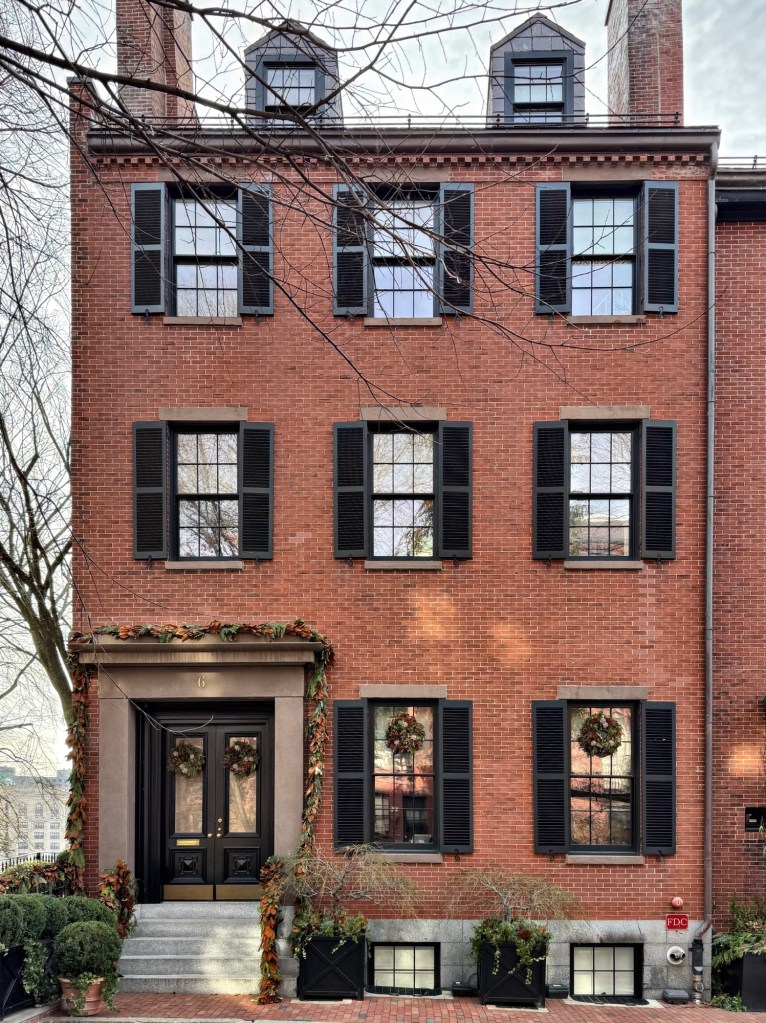
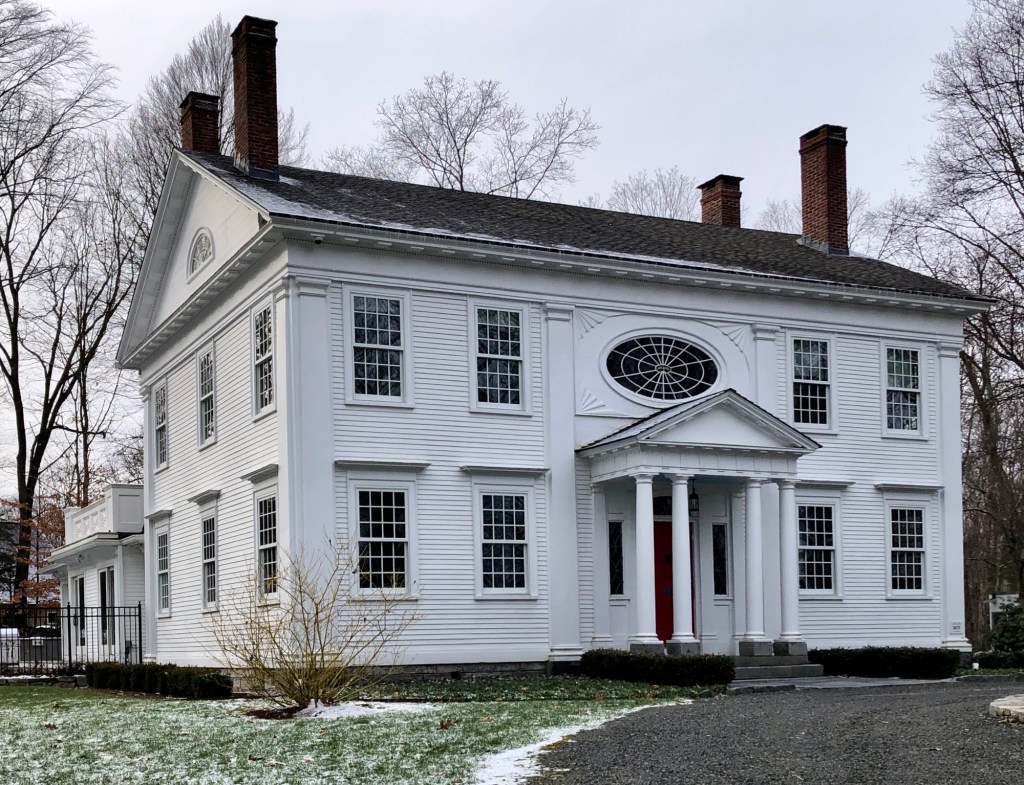
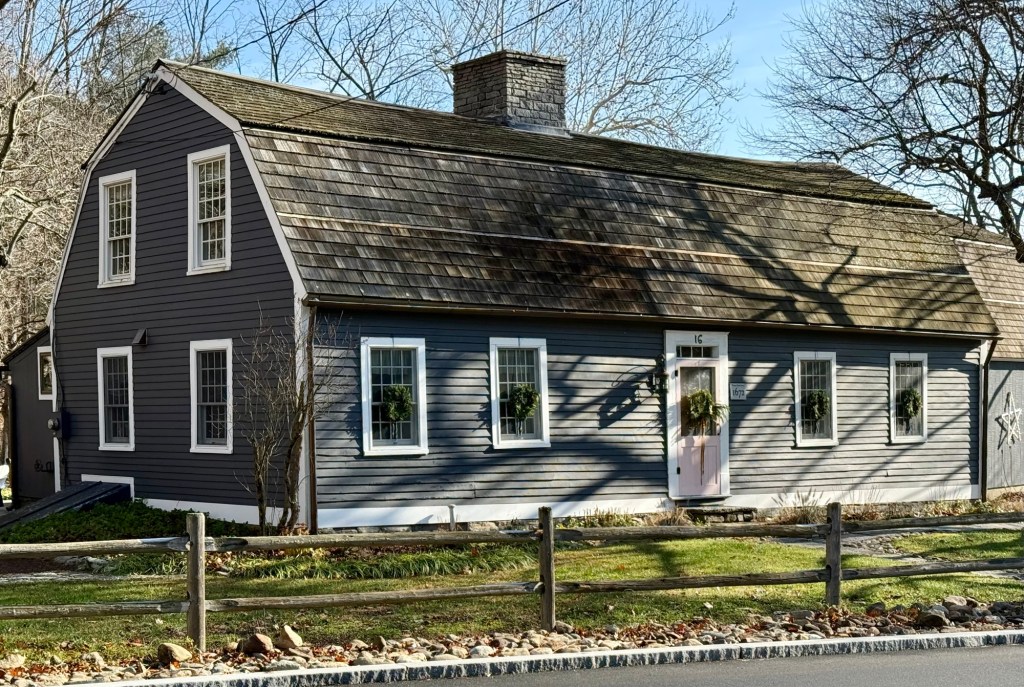
The Pierce-Guild House at 53 Transit Street in the Fox Point neighborhood of Providence, Rhode Island, is one of the most iconic and photographed residences in the state. Known as a “lightning splitter”, the unique name is taken from local folklore that the sharp angle of the gable roof will deflect or split lightning if struck. Whether or not this superstition is true, the unique house form numbers to less than a dozen in Rhode Island. This house, arguably the most well-known for its location off Benefit Street, was originally built in 1781 as a modest 1-1/2-story cottage with a gambrel roof for Daniel Pierce (Pearce), a tailor. In 1844, the property was sold to George Guild, a grocer, who modernized the house by creating the massive gable roof to provide a narrow third floor, which was illuminated by the end windows and a diminutive dormer at the roof. The house retains much of its character, after a restoration by owners in the mid-late 20th century.

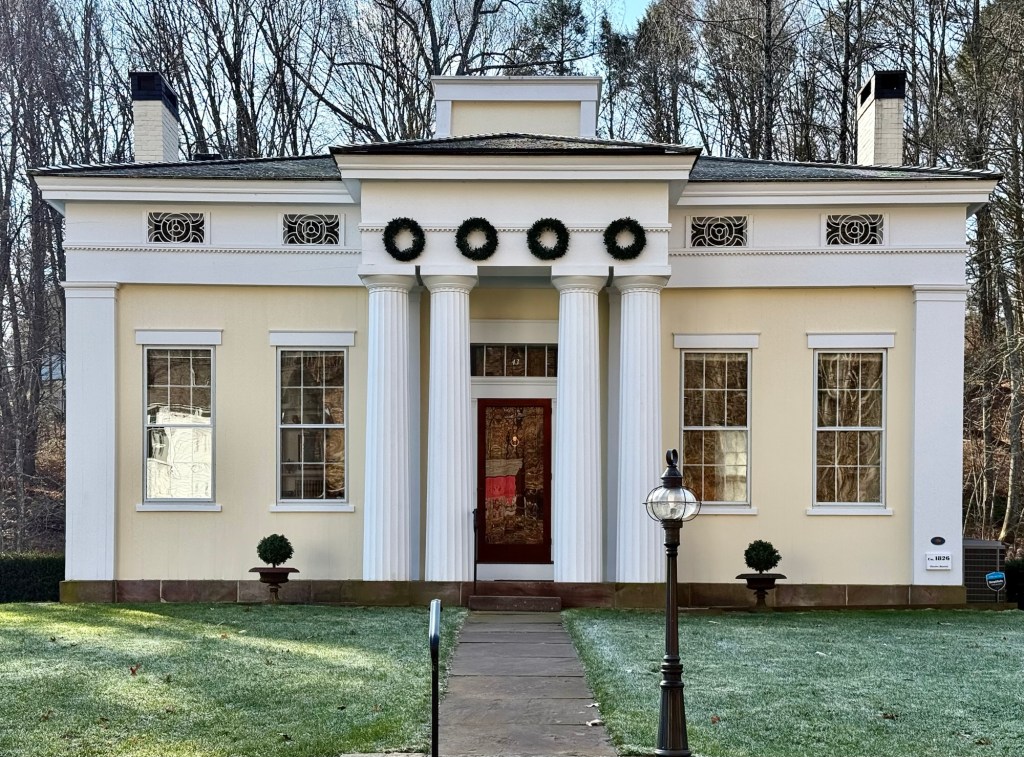
Benoni Cooke House // 1828

The Benoni Cooke House at 110 South Main Street in Providence, Rhode Island, is one of the finest examples of an architect-designed Federal style residence in the state. A fine and somewhat-typical example of architect, John Holden Greene’s 1820s work in the Federal style, the residence is actually the remaining half of what was originally a pair of mirror-image houses, built for two brothers-in-law and business partners, which once faced one another across a driveway leading to a large, well-preserved service court defined by connected stables (most of which remain). The mirror house, built for Rufus Greene, was demolished in 1895 for the expansion of the Old Stone Bank next door. The Benoni Cooke House was built in 1828 and sits atop an arcaded basement on the street elevation, which historically was used for commercial use. The Cooke House retains its iconic hipped roof with monitor (common for John Holden Greene’s works), an Ionic portico sheltering the entry with sidelights and fanlight transom, and elaborate stairhall window above. The building was later occupied as offices for the Old Stone Bank, and along with the Old Stone Bank, was acquired by Brown University, who sold the property in 2009 to an LLC, but its current use is unclear.

Tillinghast House // c.1800

The Tillinghast House at 10 James Street in Providence, Rhode Island, was built around 1800 by Captain Joseph Tillinghast (1734-1816), and it was occupied by a number of his children in the early 19th century. By 1818, with Joseph already deceased, the Federal style home was owned by two of his daughters, Mary, and Amey Tillinghast, who operated a small store from the basement. The two-and-a-half-story, brick Federal house is set on a high basement all with brownstone trim at the stringcourse (between first and second stories) and at the entrance. The house was restored in the late 1970s, along with a new clapboard addition by designers, Luigi Bianco and Georgia Patterson Boomer, of Bianco/Boomer. Without nearly as much ornate detail as many other Federal style homes in the East Side area of Providence, this residence proves that high-quality materials and strong proportions can make a home truly stand out!

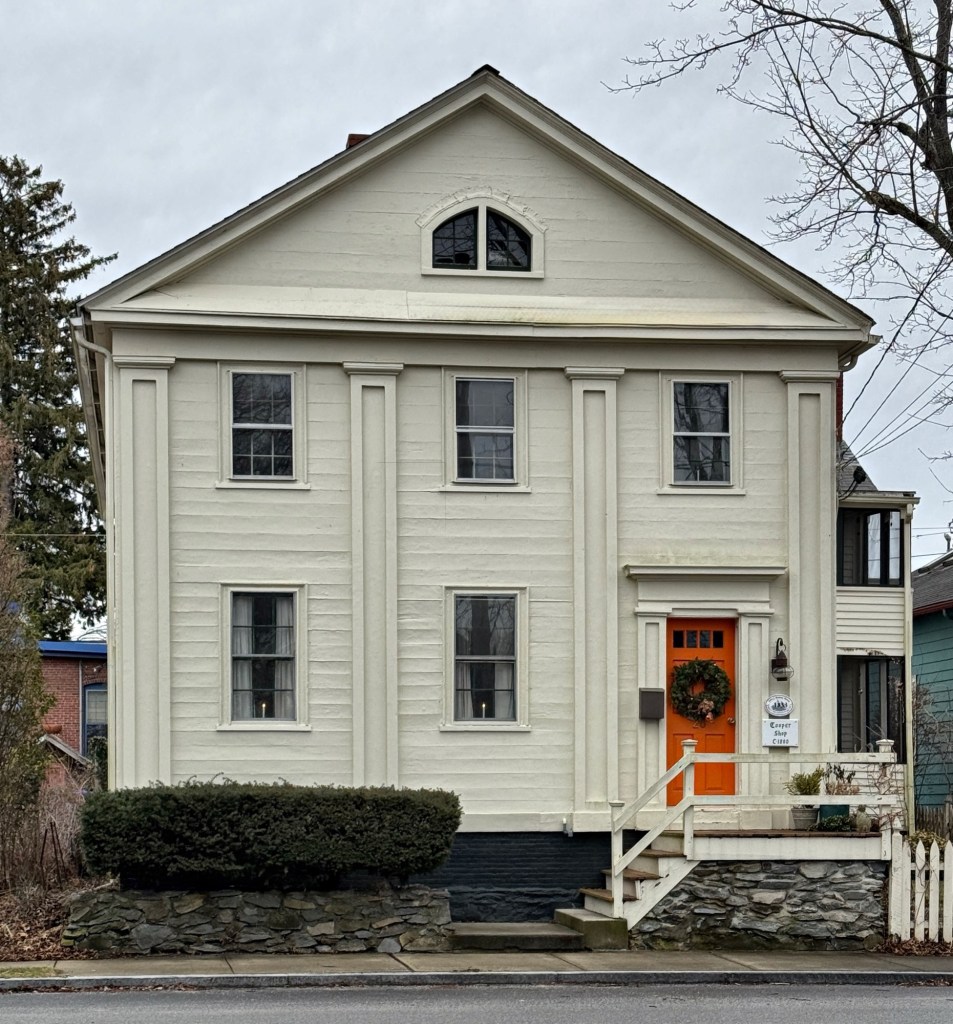
Walker – Russell House // 1797

In 1797, housewright Calvin Walker acquired a house lot on Transit Street in Providence’s Fox Point/East Side neighborhood and built this Federal period residence for his family. The three-bay Federal style home was a side-hall form with off-center entry and a monitor roof. In 1824, Calvin sold the residence to his daughter, Mary and her husband, Daniel Russell, a grocer and shoemaker, for $250. By the 20th century, the house was altered with later siding and a new entry, which were later restored by later owners, back to the home’s original grandeur. The blind fan with engaged columns adorned by rounded capitals, really enhances the design. The Walker-Russell House remains as an excellent example of a Federal style residence in Providence built for middle-class residents. 

Peirce Mansion // 1799

The Peirce Mansion on Court Street in Portsmouth, New Hampshire, is one of the finest, high-style Federal period homes in the United States. Built in 1799 for John Peirce (1746-1814), the residence is said to have been designed by Bradbury Johnson, a local carpenter and builder who was inspired by the designs of Charles Bulfinch. John Peirce began his career in the counting room of Daniel Rindge and worked in business and banking in Portsmouth. Peirce opposed the American rebellion against England but did not serve either side during the war. After the Revolution, in 1789, John Peirce was one of the leading citizens appointed to escort President George Washington around Portsmouth. The Peirce Mansion remained in the family over 150 years until it was sold by his descendants to the Middle Street Baptist Church in 1955, who extensively modified the residence to serve as a vestry and meeting space for church activities. The building was moved back from the road with the four tall chimneys were removed. Architecturally, the Peirce Mansion stands out for its massing, hip-roof with cupola adorned by a balustrade and urns, and the facade with elliptical arches, molded medallions, pilasters, and the Federal style entry treatment with fanlight transom and sidelights.

Long-Ladd House // 1812

The Long-Ladd House at 3 Richards Avenue in Portsmouth, New Hampshire, showcases the versatility of the Federal style, an architectural style that dominated American architectural tastes from the 1780s through the 1830s. This house dates to 1812 and was built for George Long (1762-1849), a sea captain and trader until engaging in politics in his later years. He remained in the home until his death in 1449, leaving the property to his only heir, Marcy, and her husband, Henry Hurd Ladd. The Long-Ladd House is constructed of brick with the facade dominated by four, full-height pilasters breaking up the bays. A center portico shelters the main entrance which is adorned by a fanlight transom and classical surround. In a city full of Federal style homes, this one really stands out!

Larkin-Ladd House // c.1813

The Larkin-Ladd House at 180 Middle Street in Portsmouth, New Hampshire, is a three-story, masonry Federal-style residence with symmetrical facade, built for one of the city’s wealthiest merchants. Samuel Larkin (1773-1849) was born in Charlestown and moved to Portsmouth, marrying Ann Jaffrey Wentworth, a daughter of Col. Joshua Wentworth. During the War of 1812, Samuel Larkin made his fortune as an auctioneer, selling the contents of English ships captured by local privateers. It is believed that fourteen privateers and their crews worked out of Portsmouth Harbor and are said to have captured an estimated 419 British ships! With the profits from stolen goods from these British ships, Larkin purchased lots on Middle Street and began construction of this stately residence. He (and mostly his wife), had twenty-two children, although roughly half of them died before reaching adulthood. By the late 1820s, financial hardship fell on Larkin and he sold this property, moving into his house next door, which before this was his original residence and later rented to boarders. The Federal style mansion was later owned by Henry H. Ladd, a prosperous Portsmouth shipping merchant, who also served as President of New Hampshire Bank and Portsmouth Savings Bank. The Larkin-Ladd House is undoubtedly one of the finest Federal style residences in New England, and stands out for its entrance, flanked by Palladian windows and the slightly recessed elliptical surrounds at the first and second floor windows. Additionally, the historic stable, also from the 1810s, maintains much of its architectural integrity.

Captain Benjamin Damrell House // c.1812

The people and buildings of Portsmouth, New Hampshire, have always been closely tied to the sea. Many old houses and commercial buildings here were built for merchants, ship builders, sea captains, and fishermen, who made their living from the charming port town. This historic house at 333 Marcy Street in the Downtown area of Portsmouth, was built around 1812 for Benjamin Damrell (1781-1821) a sea captain, privateer during the War of 1812, and member of the Portsmouth Marine Society and Alert Fire Society of Portsmouth, a volunteer fire fighting group. Captain Damrell died in 1821 while at sea and his property was inherited by his widow, Lucy, who appears to have remained here for some time, raising their daughter.

Delano Warehouse and Wharf // 1803

In 1802, Kingston-based merchants and landowners Benjamin Delano and brother-in-law Peter Winsor built this stone wharf and warehouse at Rocky Nook, a small peninsula at the end of the Jones River where it meets Plymouth Bay. The Rocky Nook had several warehouses in the early 1800’s which were used to hold cargo for the busy Kingston vessels that carried passengers and goods all down the eastern seaboard for transit, with larger vessels sent to the West Indies for trade. Benjamin Delano and his son Joshua either owned or partly owned 37 vessels between 1803 and 1882 and were a wealthy family that built their fortune on shipbuilding and trade. The warehouse, built at the end of the wharf was used to store goods and also served as a ship chandlery, a store selling goods needed for newly outfitted ships that were berthed up the Jones River.  A combination of the coming of the railroad and the need for faster and bigger vessels caused the decline of the shipping business in Kingston in the late 19th century with the shipbuilding industry largely evaporating by the 20th century. The Delano warehouse at the end of the wharf has since been converted to a private residence yet retains its unique character and siting with arguably the best view in town. 

William Sever House // 1755

The William Sever House is an architecturally and historically significant residence in the town center of Kingston, Massachusetts. A prosperous merchant, owner of ships involved in coastal and international trade and member of the colony’s House of Representatives, William Sever (1729-1809) was prepared to erect a home of appropriate status when he married his cousin, Sarah Warren, in 1755. Sever joined his father Nicholas Sever’s commercial shipping business after graduating from Harvard College in 1745 and in 1754, was elected to the Massachusetts Bay Colony’s House of Representatives. In 1769, Squire Sever was elected to the Governor’s Council, a position he held until 1774 when he joined the Provincial Congress. Due to his experience and seniority, Sever was appointed to head the Congress and was declared “President of Massachusetts” and endowed with the governor’s executive powers. After his death in 1809, the house remained in the Sever family for generations, including as a summer residence for James W. Sever, the namesake of Sever Hall at Harvard University. The residence is well-preserved and showcases the telescoping nature of some of these early Colonial-era properties, with the main house adjoined by a barn and carriage house and diminutive ells and was thoroughly documented in the 1930s through the Historic American Buildings Survey, with detailed drawings, plans, and photographs of the exterior and interior spaces.