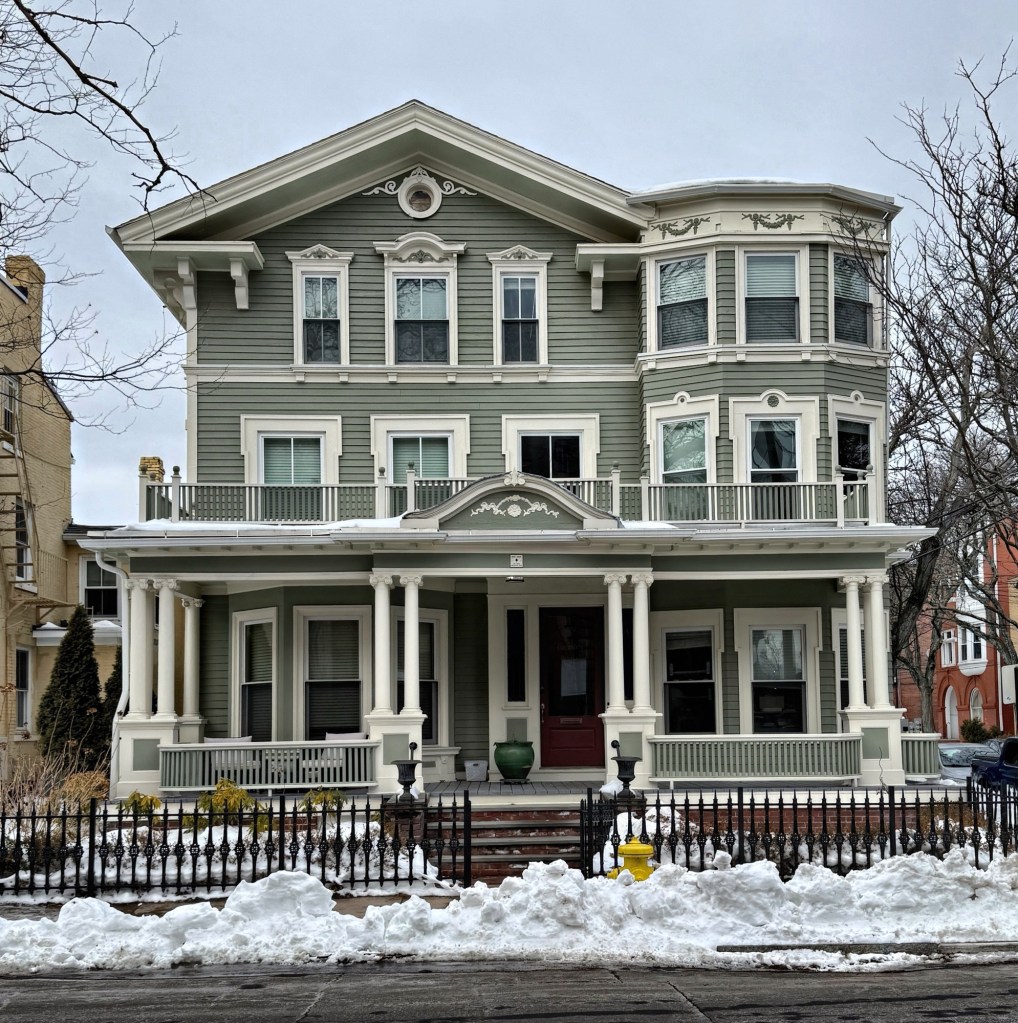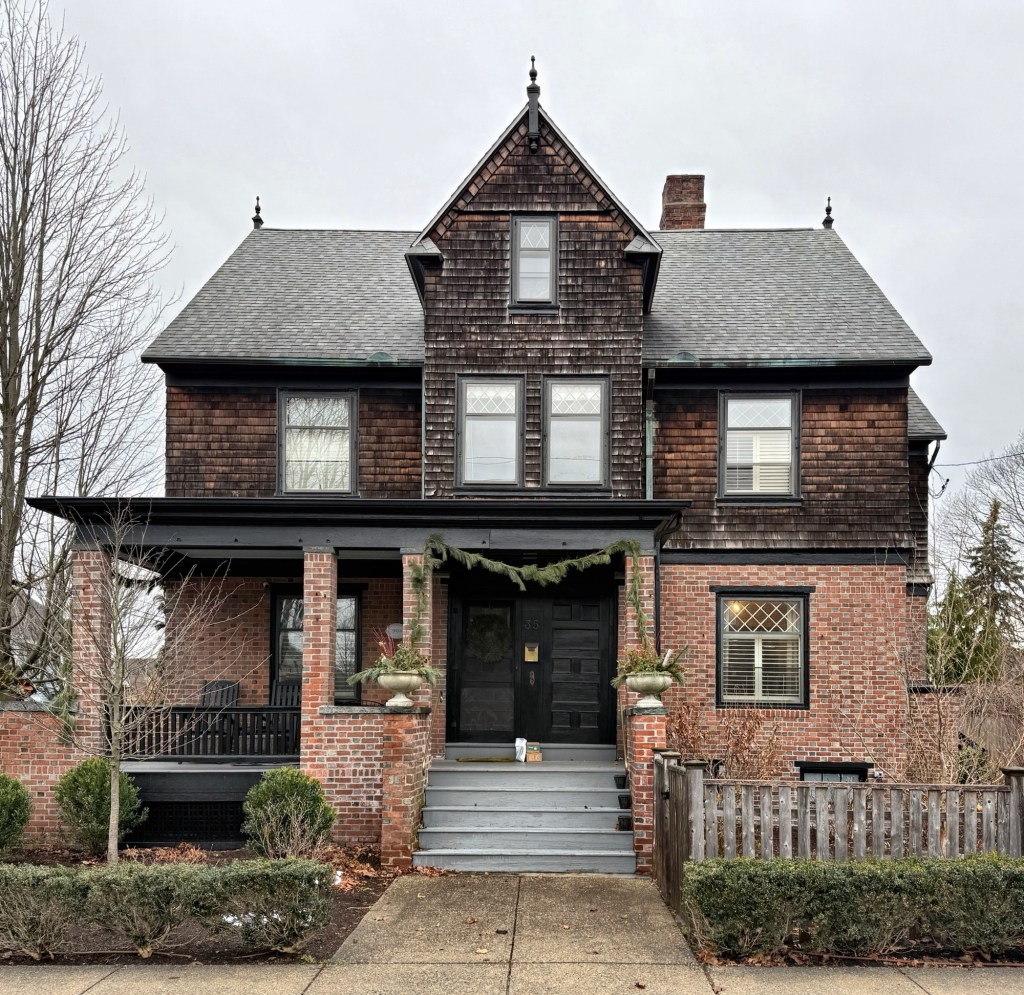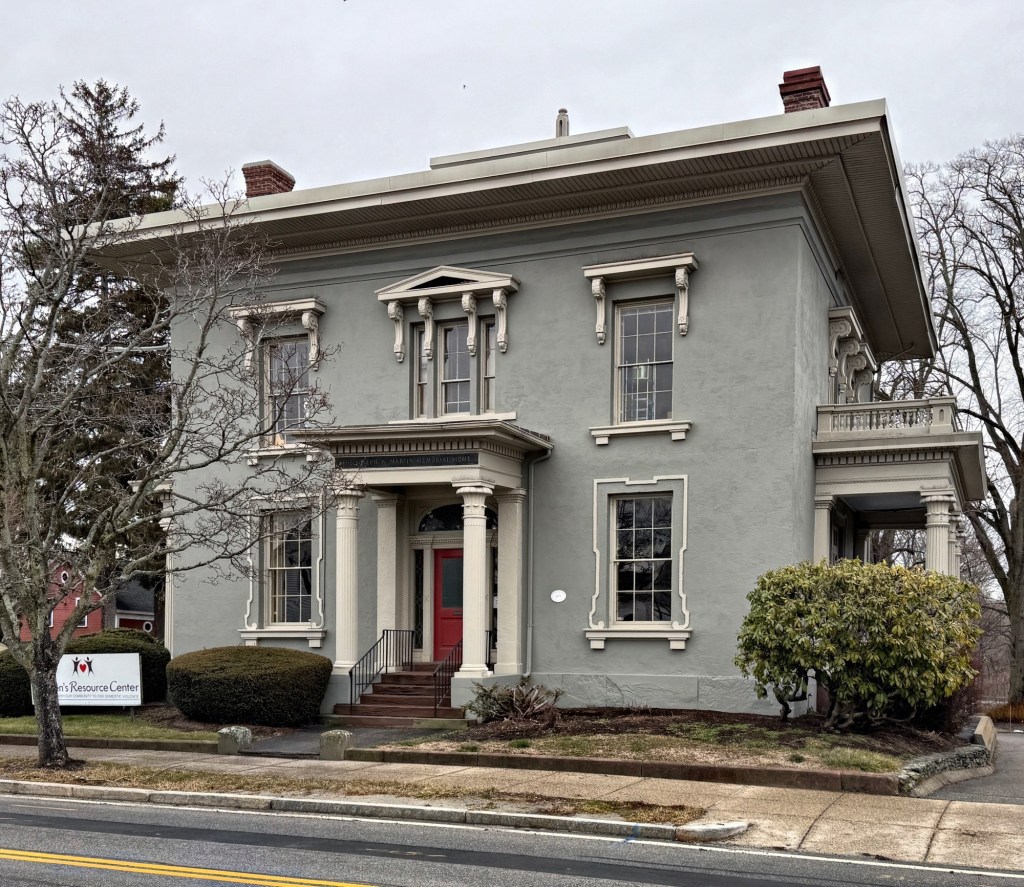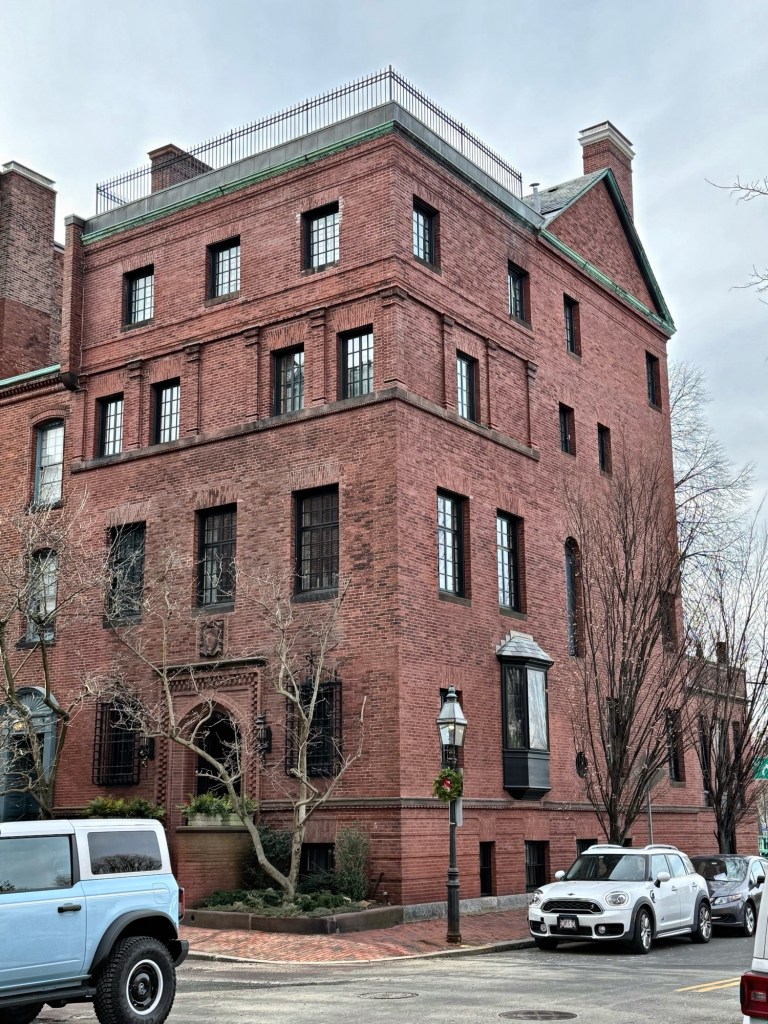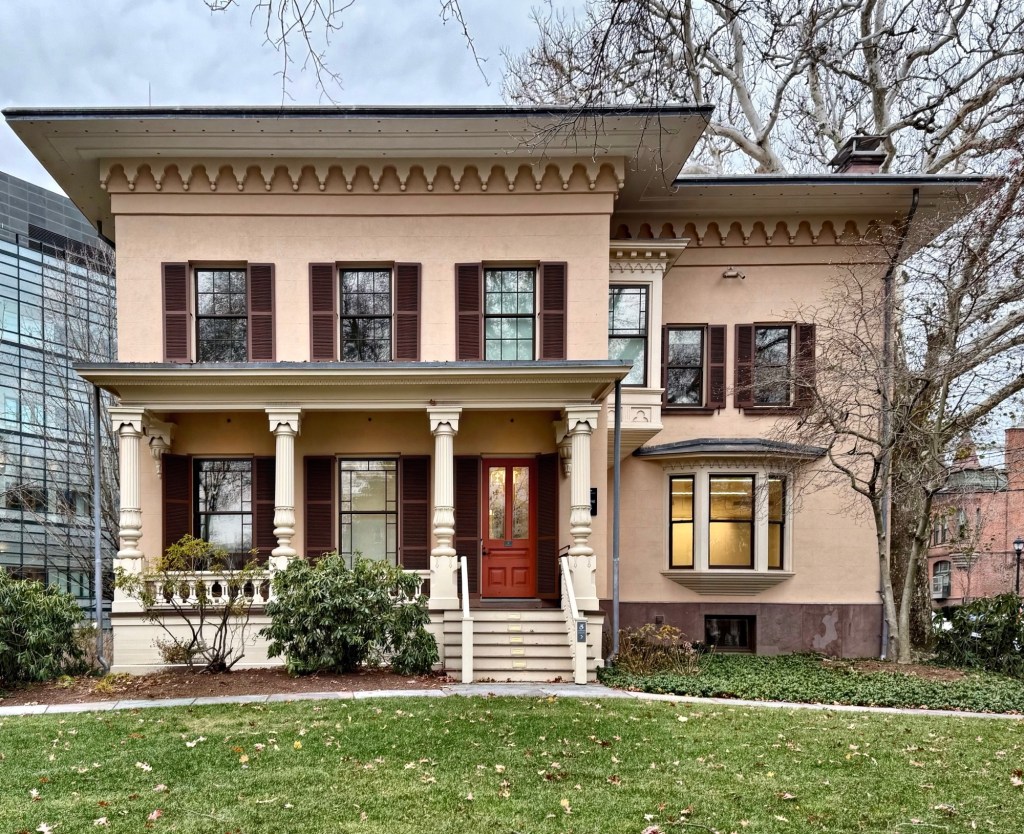
Lawrence-Bartol House // 1861

This handsome Victorian residence on Main Street in Lancaster, Massachusetts, was built in 1861 for Rev. Amos E. Lawrence (1812-1897), pastor of the local Evangelical Congregational Church. Amos Lawrence lived in the house for just 4 years until he sold it to Rev. George Bartol, of the First Church of Christ, Unitarian in Lancaster. George Murillo Bartol (1820-1906) served as the pastor for the iconic Bulfinch church for over 50 years until his death in 1906. The residence was then inherited by Reverend Bartol’s son, John Washburn Bartol, a prominent Boston physician who would spend time away from the city at his family home. The unique form of this mansard/gambrel-roofed house stands out along with its Colonial Revival alterations, which likely occurred in the late 19th or early 20th century.

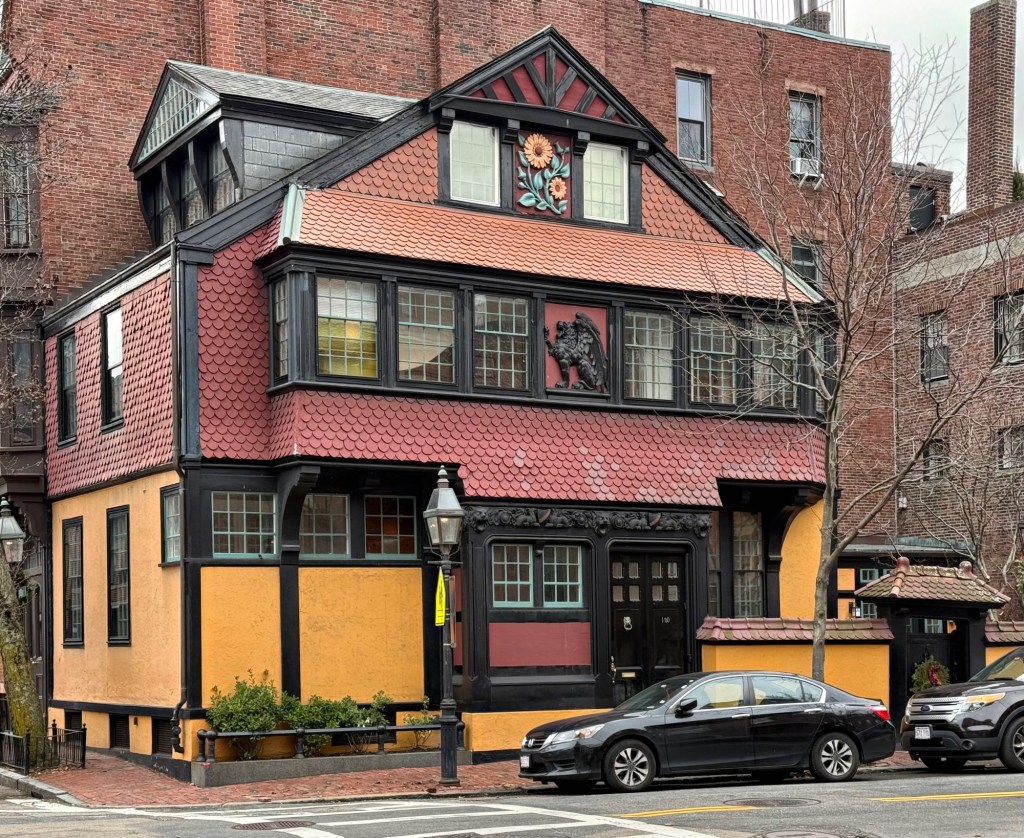
Edward Stanwood House // 1880

The Edward Stanwood House at 76 High Street in Brookline, Massachusetts, is one of the finest and exuberant examples of the English Victorian Queen Anne style, notable for its varied wall textures and materials, unique form, and applied ornament. The house was built in 1879-1880 for Edward Stanwood, who was for many years the editor of the Boston Daily Advertiser, and a children’s magazine, The Youth’s Companion. The ornate residence was designed by Clarence Sumner Luce, with interiors by Thomas Dewing. The Stanwood House features a well-preserved exterior and period-appropriate paint scheme, highlighting the bas-relief sunflower ornament and gargoyles. Of particular note is the use of hung tile siding, overlaid to give the appearance of fish scales and the roof cresting.

Ambrose Burnside House // 1866

What do this unique Victorian house and sideburns have in common? Well, you are about to find out!

The Ambrose Burnside House is sited on an oddly shaped, and sloping corner lot on Benefit Street in Providence’s East Side neighborhood, and is one of the most unique Second Empire style residences in New England. The house was built in 1866 for General Ambrose Burnside (1824-1881), a Union general in the American Civil War, who returned to Providence and was about to begin a term as governor, followed by two terms in the United States Senate. Ambrose Burnside hired local architect, Alfred Stone, to design his new city mansion, which upon completion, was deemed one of the most “modern residences” in Providence. Built of brick with Nova Scotia stone with a concave slate mansard roof and one-of-a-kind rounded corner bay, the Ambrose Burnside House does not disappoint! Ambrose Burnside died in 1881 and the property was occupied by his sister-in-law until the property was sold in 1884 and housed the Providence Children’s Friend Society House for Aged Women and the Providence Association for the Benefit of Colored Children, providing shelter and food for elderly women and children of color without parents or guardians. After WWII, the Burnside House was converted to apartments.

Now, to the sideburns… Ambrose Burnside was noted for his unusual beard, joining strips of hair in front of his ears to his mustache but with the chin clean-shaven; the word burnsides was coined to describe this style. The syllables were later reversed to give sideburns.

Pierce-Guild Lightning Splitter House // 1781

The Pierce-Guild House at 53 Transit Street in the Fox Point neighborhood of Providence, Rhode Island, is one of the most iconic and photographed residences in the state. Known as a “lightning splitter”, the unique name is taken from local folklore that the sharp angle of the gable roof will deflect or split lightning if struck. Whether or not this superstition is true, the unique house form numbers to less than a dozen in Rhode Island. This house, arguably the most well-known for its location off Benefit Street, was originally built in 1781 as a modest 1-1/2-story cottage with a gambrel roof for Daniel Pierce (Pearce), a tailor. In 1844, the property was sold to George Guild, a grocer, who modernized the house by creating the massive gable roof to provide a narrow third floor, which was illuminated by the end windows and a diminutive dormer at the roof. The house retains much of its character, after a restoration by owners in the mid-late 20th century.

Joseph Brown House // 1774

Constructed in 1774 by architect Joseph Brown (1733-1785) of the Brown family of Rhode Island as his personal residence, the John Brown House of Providence, stands as one of the oldest (if not the oldest) house built by an American architect for his own use. Joseph Brown, while a member of the Brown Family, was not as much in the shipping business as others in his family, instead turning his attention to scientific matters, becoming an expert in astronomy, electrification, and architecture. He was an architect in the Thomas Jefferson-gentleman mode, owning English architectural books from which he selected motifs for inclusion in his designs. It is believed that the eccentric curved ogee gable that caps the façade was adapted from the roof design of a garden house published in William Salman’s Palladio Londinensis, owned by Joseph Brown’s builder, Martin Seamans. The same ogee gable was later replicated in the Colonial Revival period in Providence. The residence’s entrance was originally raised above ground and accessed via symmetrical flights of stairs; in the late 18th century, the entrance was moved to street level in the brownstone basement level. Over a decade after Joseph’s death in 1785, the structure was acquired by the Providence Bank, an enterprise founded by Brown’s brothers John and Moses, and used as an office. The bank occupied the structure until 1929, and the Joseph Brown House was subsequently owned by the Counting House Corporation, and still appears to be owned by descendants of the Brown Family.

Delano Warehouse and Wharf // 1803

In 1802, Kingston-based merchants and landowners Benjamin Delano and brother-in-law Peter Winsor built this stone wharf and warehouse at Rocky Nook, a small peninsula at the end of the Jones River where it meets Plymouth Bay. The Rocky Nook had several warehouses in the early 1800’s which were used to hold cargo for the busy Kingston vessels that carried passengers and goods all down the eastern seaboard for transit, with larger vessels sent to the West Indies for trade. Benjamin Delano and his son Joshua either owned or partly owned 37 vessels between 1803 and 1882 and were a wealthy family that built their fortune on shipbuilding and trade. The warehouse, built at the end of the wharf was used to store goods and also served as a ship chandlery, a store selling goods needed for newly outfitted ships that were berthed up the Jones River.  A combination of the coming of the railroad and the need for faster and bigger vessels caused the decline of the shipping business in Kingston in the late 19th century with the shipbuilding industry largely evaporating by the 20th century. The Delano warehouse at the end of the wharf has since been converted to a private residence yet retains its unique character and siting with arguably the best view in town. 

Old Kingston Town House // 1841

Overlooking the town green in Kingston, Massachusetts, this stately Greek Revival home was once the original town house for the community, containing meeting hall, town offices and even a jail cell! Before we go into that further, it is helpful to learn about history first. Present-day Kingston was within the tribal homeland of the Wampanoag people, who in the decades prior to the arrival of the Mayflower, saw their populations decimated from a rapidly spreading pandemics due to earlier contacts with Europeans. Originally part of Plymouth, Kingston was first settled by Europeans shortly after the landing of the Pilgrims at Plymouth Rock in 1620. In 1717, residents in the northern part of Plymouth petitioned the General Court to be set off from Plymouth as a separate township or a precinct. They were allowed to become the north precinct of Plymouth on the condition that they maintain a suitable minister. The northern precinct was wealthier and led to present-day Kingston incorporating as its own town in 1726, following a tax dispute. Early town meetings were held in the parish church until the separation of church and state necessitated a new town hall. The town hall here was built in 1841. As the town grew the building was re-oriented southward and enlarged in 1871 from plans by architect Luther Briggs. Further alterations were made to the building in 1935 under the guidance of the architectural firm of J. Williams Beal & Sons. In the early 2000s, space, parking, and accessibility concerns led the Town of Kingston to sell the 1841 Town House, which was purchased by private owners and converted to a residence. Inside, remnants of the old town house include old signs, office doors for city departments, former vaults converted to closets, and even a jail cell in the basement. Talk about a unique adaptive reuse!

Dr. Edson F. Whitman House // 1852 

One of the most eccentric and architecturally unique houses in Somerville can be found on Bow Street, in the middle of the busiest commercial district of the city. This is the Dr. Edson F. Whitman House (often known as the E.C. Mann House), which was built around 1852 and long-occupied by Dr. Whitman until just before his death in 1900. The house was likely a modest, 1850s Italianate style residence with its gable facing the street. Over time, as business increased, Dr. Whitman expanded his house and practice, adding Victorian flair to the once usual house. An entry tower with pyramidal roof and final was added with quatrefoil window and Stick style porch, an angled two-story addition was also added to the facade with a second-story porch, and applied ornament and curiosities were added to the doctor’s office and residence through the 19th century. Luckily for us, the Dr. Whitman house has remained relatively unaltered for the next 125 years! 

Wadleigh – Friend House // 1893

One of the most beloved houses in Somerville, Massachusetts is this beauty on Highland Avenue, known best for the unique assemblage of colorful found objects in the front yard, as a living museum. The residence was built in 1893 for William Y. Wadleigh, a wholesale grocer who operated markets all over the region. The house is an eclectic blending of Queen Anne and Colonial Revival styles with an asymmetrical plan and rounded corner tower taken from Victorian styles, along with a classical porch and swan’s neck pedimented dormers at the roof, clearly Colonial Revival in style. Today, the Wadleigh House is best-known for its owner, artist Martha Friend, who has preserved the house, and created an enchanting, ever-evolving installation outside and inside the residence. Sapphire City, an installation in the front yard, draws passersby in to see the assemblage of blue bottles and Dance Party, an assortment of animals at the porch roof, make the house a favorite in the neighborhood. It is houses and owners like this that make Somerville such a vibrant and great place to live and explore.

Lane-Smith-Bailey House // 1848

The most colorful house in Rockland, Massachusetts can be found on Union Street, the town’s busiest corridor, lined with houses and buildings of all ages and styles. The Lane-Bailey House was built in 1848 for Marshall Lane, a shoe manufacturer in town. The Greek Revival style residence features a gable roof oriented towards the street, which reads as a pediment and a full-length columned porch that wraps around the side of the home. The property was purchased in the early 20th century by William Andrew Grant Smith (1863-1908), a wealthy jeweler, who apparently added a second floor to the house, up from a 1-1/2 story cottage, and likely added the wrap-around porch at this time. Jumping ahead to the turn of the 21st century, the prominent house was owned by Brad and Sam Bailey, who painted the residence bold colors, added a wishing well and birdhouses to the front yard, and replaced the traditional grass lawn with crushed seashells. In an article talking about the house, Brad Bailey stated, “We do it because lots of things in life [that] are dull. Our house shouldn’t have to be.” Despite the polarizing thoughts and opinions from those who walk or drive by, the house is loved and certainly causes people to stop and smile!