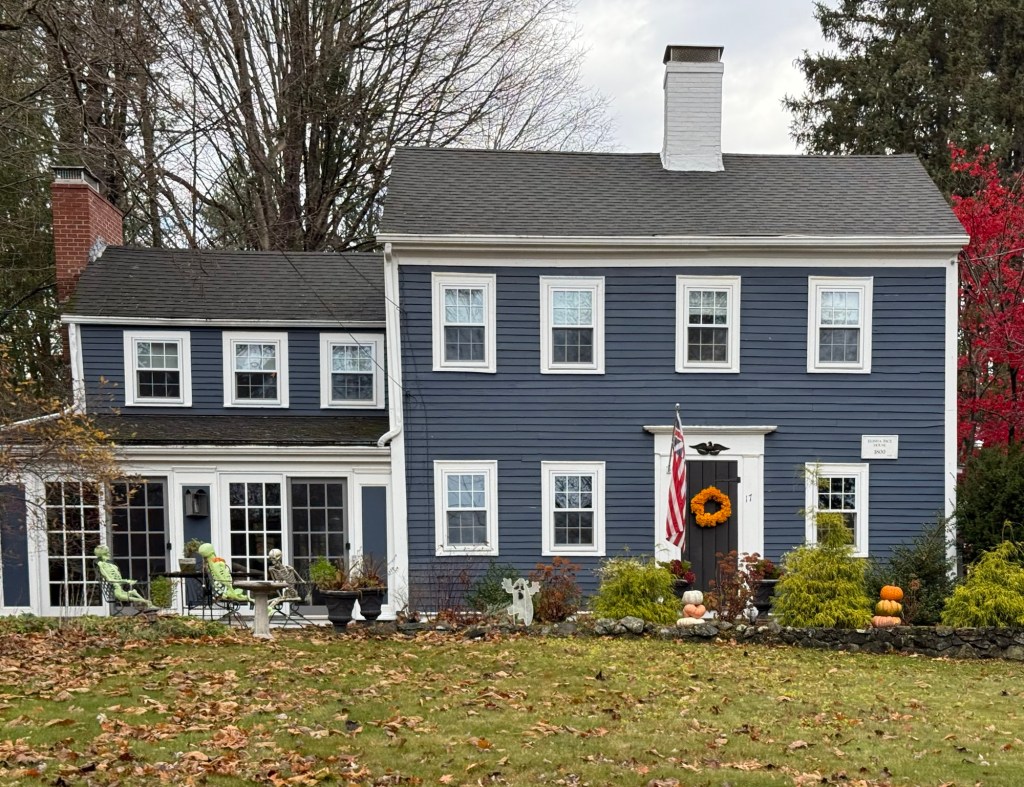
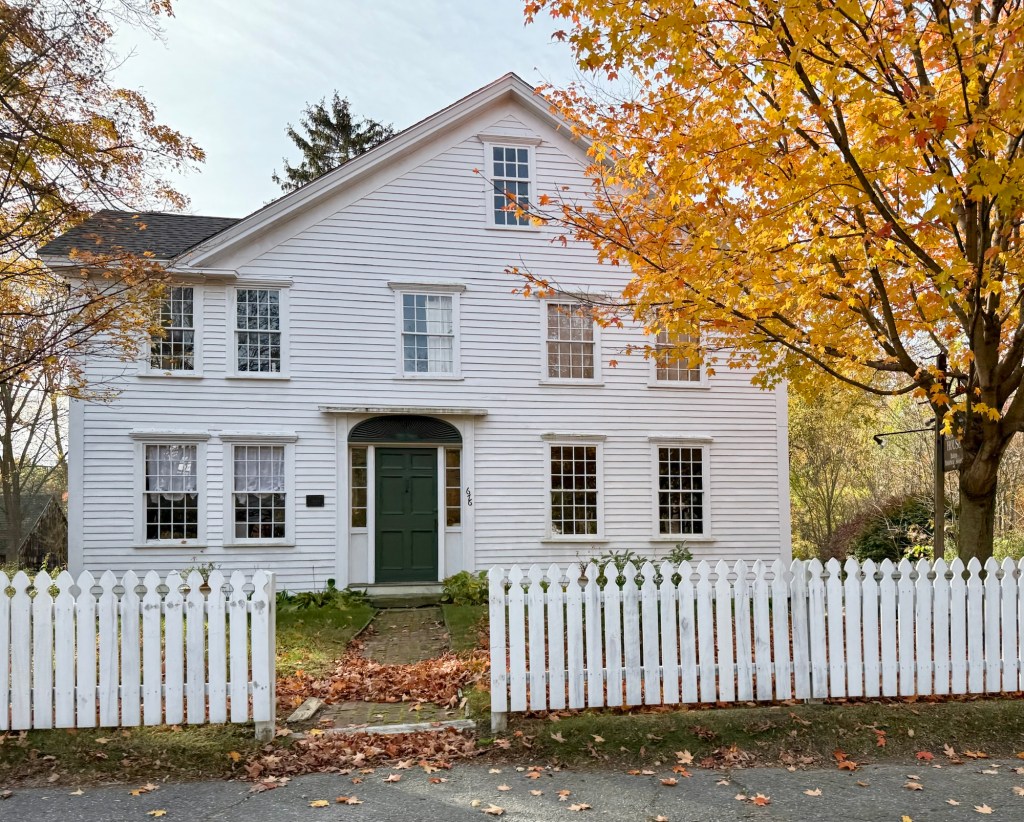
Elisha Rice (1784-1841) moved to Wayland, Massachusetts in 1800 and built this charming house on Bow Road for himself and his family. Elisha worked as a wheelwright, a craftsman who builds and repairs wooden wheels, and was able to build this home near the village. While built and later occupied by later artisans, the community has become an exclusive and wealthy Boston area suburb, which has subsequently made it so many “working class” citizens can no longer afford such a house, but has also allowed many of these great old homes to be lovingly preserved and maintained for future generations.
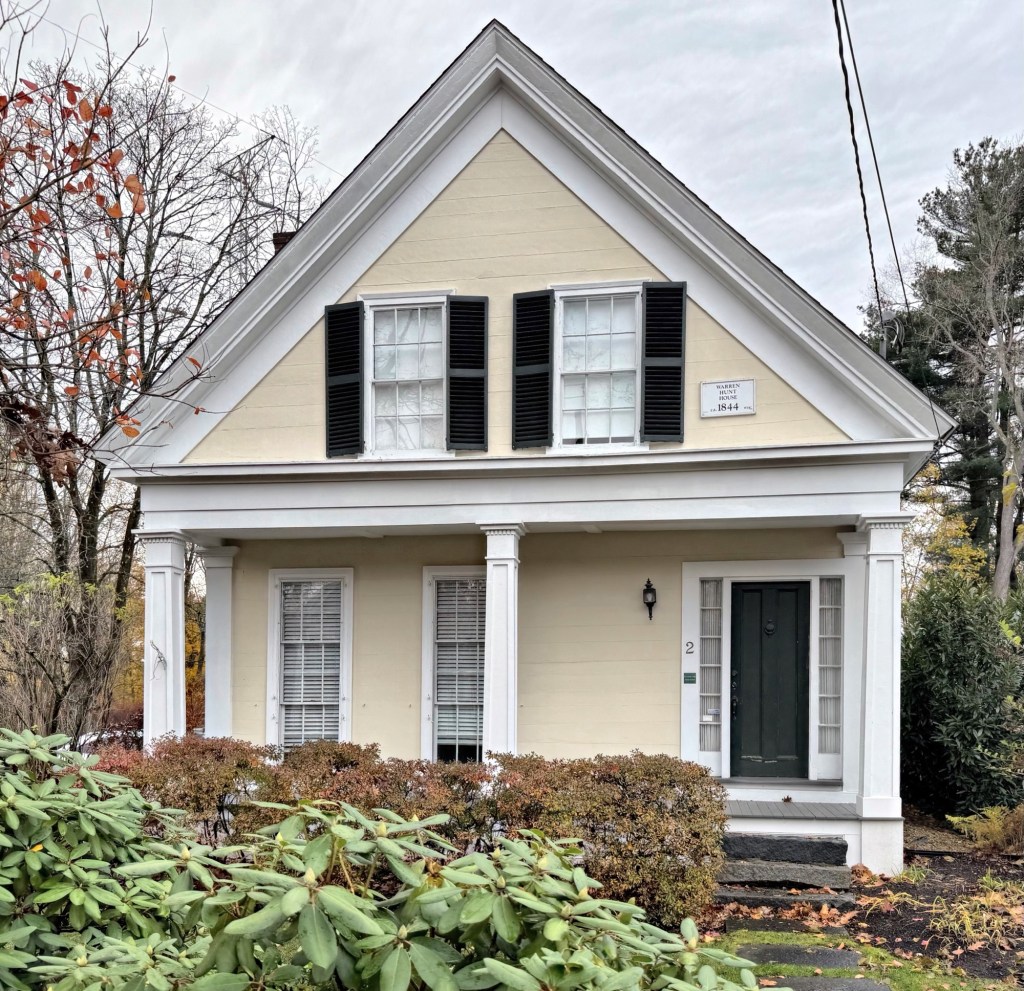
Located in the Wayland Center village, this c.1844 Greek Revival style cottage stands out not for flourish or scale, but for its excellent design, proportions, and state of preservation. The three-bay facade has a recessed first story set under the pediment extending over the open porch. The pediment is carried by squared, tapered columns with dentils and the facade retains its unique flush-board siding and triple-hung first-story window sash. The house was built by 1844 for Warren Hunt, who operated a small dry goods store near the town common. Not long after he had the house built, Hunt sold the property and store to Luther B. White (1822-1884), who lived here for at least two decades. In 1888, Mrs. Alice Dickey and her husband, Charles F. Dickey, a carpenter, purchased the house and expanded it at the rear.
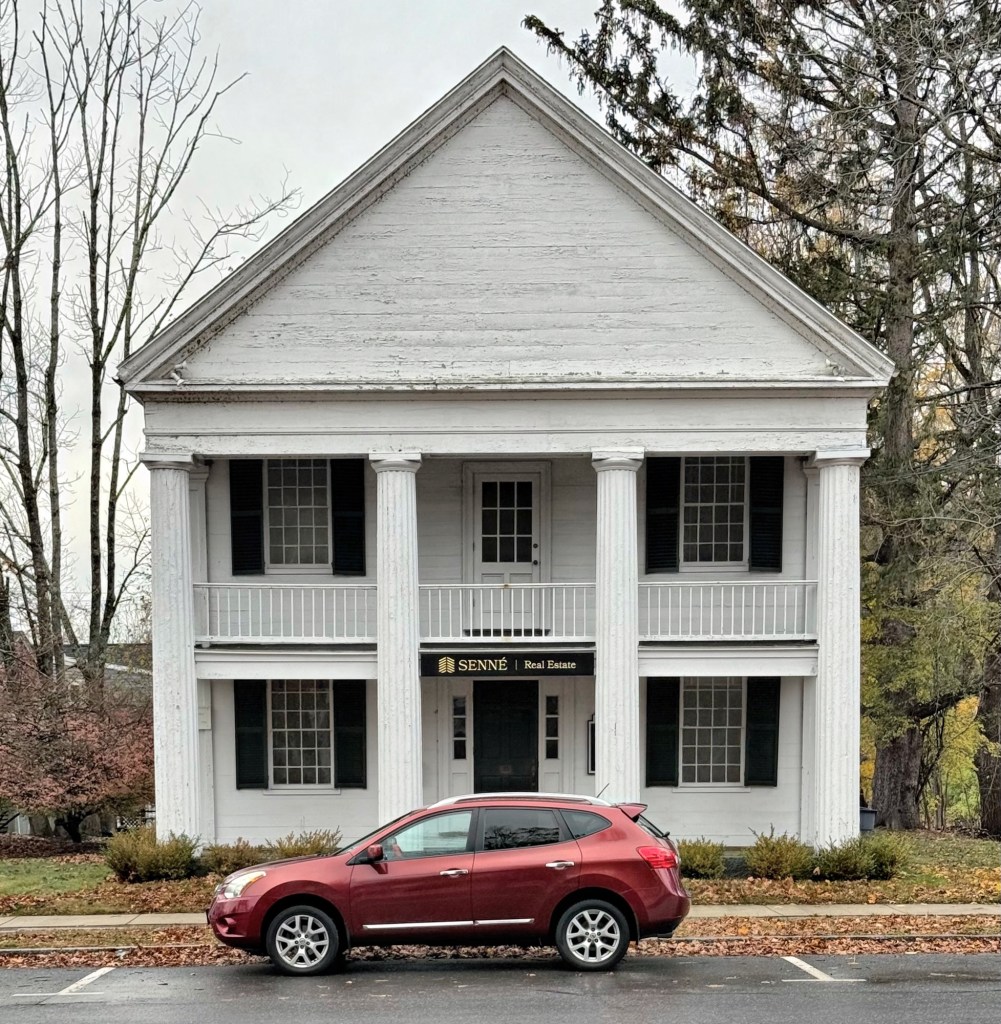
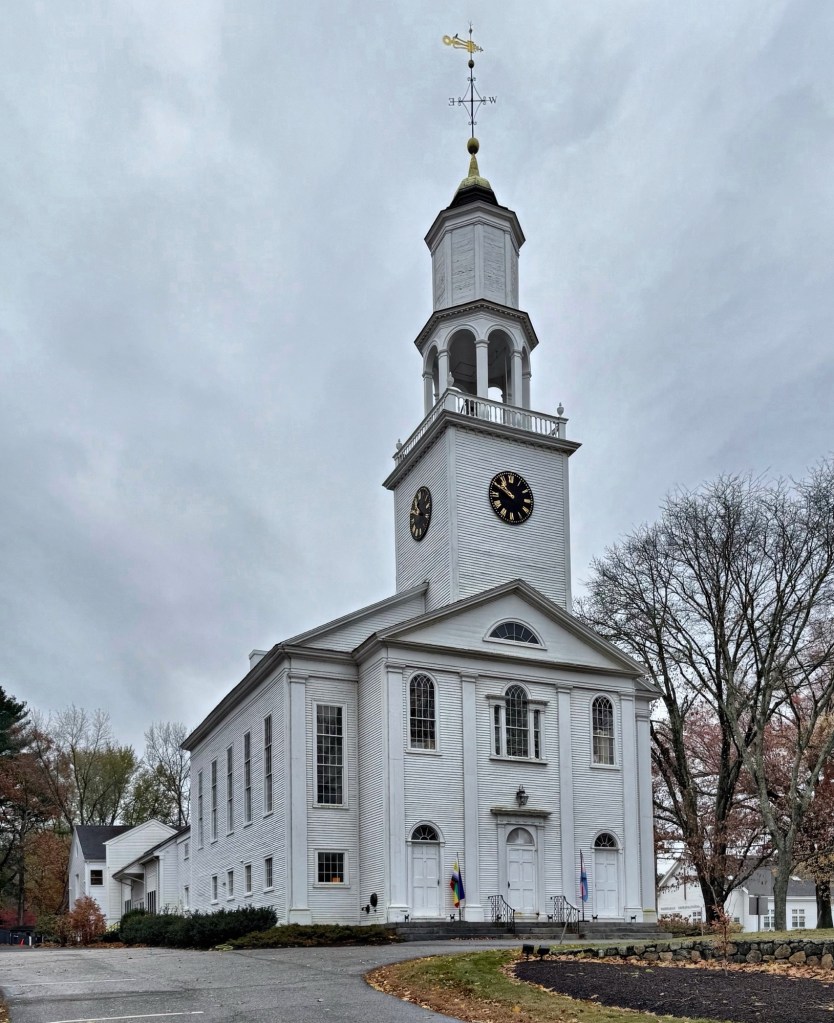
The Old Wayland Town House on Cochituate Road is an imposing Greek Revival temple-front building that has served various uses for the community. The structure was built in 1841 to serve as Wayland’s first municipal building and it was referred to as the Town House, with a large classroom and a small entry space on the first floor and a town meeting hall on the second. In 1850, the Wayland Free Public Library was opened in the building, in a small room in the front of the building. The small building was quickly outgrown for its civic uses, and in 1878, Wayland built a new, large Stick style town hall (demolished in 1958). The old Town House was sold to Lorenzo Knight Lovell (1837-1909), who soon after converted the Town House into a dry goods and grocery store known as Lovell’s Market. Following Lorenzo Lovell’s death, his son William S. Lovell ran the store until about 1922 when he leased the building to Lawrence Collins, who remained here for nearly 60 years operating his own store. Collins Market was eventually purchased in the late 1980s and converted to office space, which remains today.
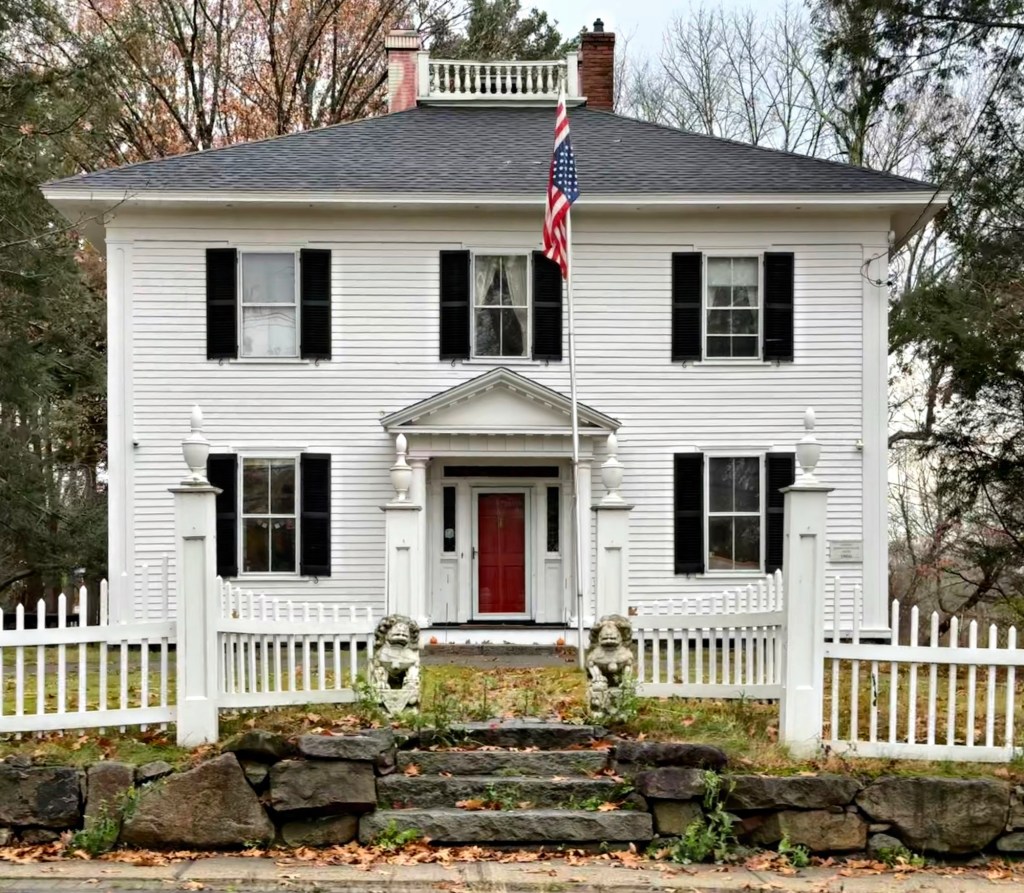
Built around 1865, this stately residence in Wayland, Massachusetts, was originally owned by sea captain, Edward Pousland who came to Wayland with his family around 1859. Interestingly, Mr. Pousland continued working as a sea captain, travelling to Salem and Beverly, where he would be at sea for months at a time. Likely due to his profession, the house features a ‘widow’s walk’, a common feature of houses by the sea where folklore holds that the wives of ships’ captains looked out for the return of their husbands. Edward, his wife Hannah W. (Langmaid) Pousland lived in this house at least until Edward’s death. After successive ownership, the property was purchased by Jonathan Maynard Parmenter (1831-1921), who gifted the house to the First Parish Church across the street, for use as a parsonage a use that continued until 1984 when the church sold the house back into private ownership. The house, designed in the Italianate style, was “modernized” in the early 20th century with Colonial Revival alterations, which added the portico and likely removed the brackets at the eaves.
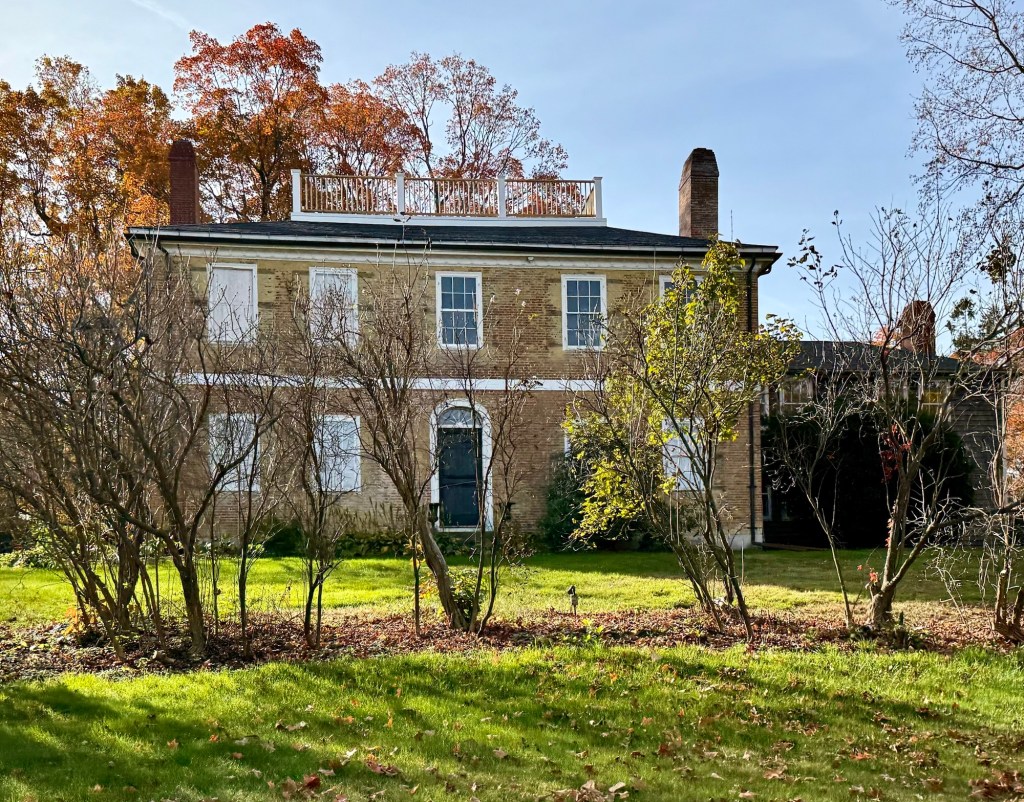
This stately Federal style residence constructed of brick sits atop a lovely hill in the town of Bolton, Massachusetts, and has been lovingly maintained by its owners for over 225 years. The home was built by Caleb Moore (1768-1826) just before his marriage to Achsah Whitney in 1796. Caleb was a merchant and later a shareholder and president of the Lancaster & Bolton Turnpike Corporation, chartered in 1805, to collect tolls for travellers from or to Boston from central Massachusetts. Caleb and Achsah had eight children, sadly, five of their children died as teenagers or young adults. The farmhouse was inherited by Alpheus Moore (1802-1882), who operated his late-father’s store and held a liquor license, possibly running the home as a tavern along the turnpike.
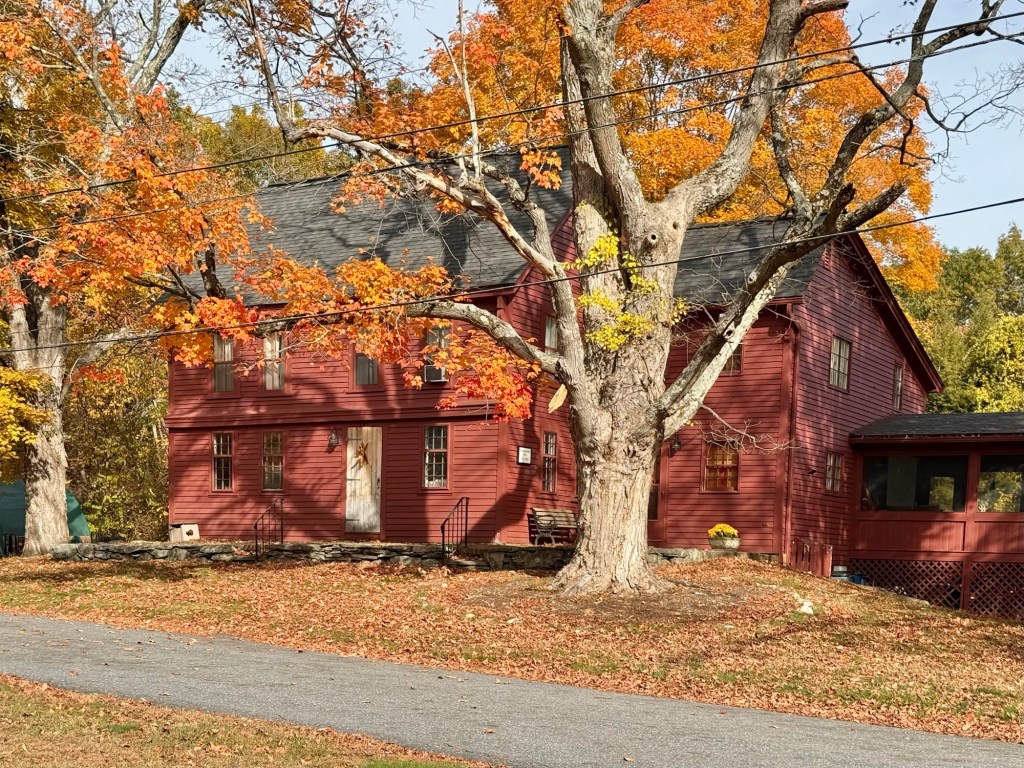
This charming old home on Burnham Road in Bolton, Massachusetts, was built in 1822, but as a one-story three-quarter cape house with the additional story added later in the 19th century. The residence was built for William Coolidge, a Revolutionary War veteran. After successive ownership, the property was sold in 1855 to Reuben Burnham, a carpenter, who soon after added the second floor onto his new home, keeping the original cornice which now serves as a visual reminder of the home’s changes. Sadly, around 100 years later, the highway cut through the town, bisecting this property, which now abuts the busy road, but owners have maintained and preserved this stunning property which is evocative of the early days of Bolton.
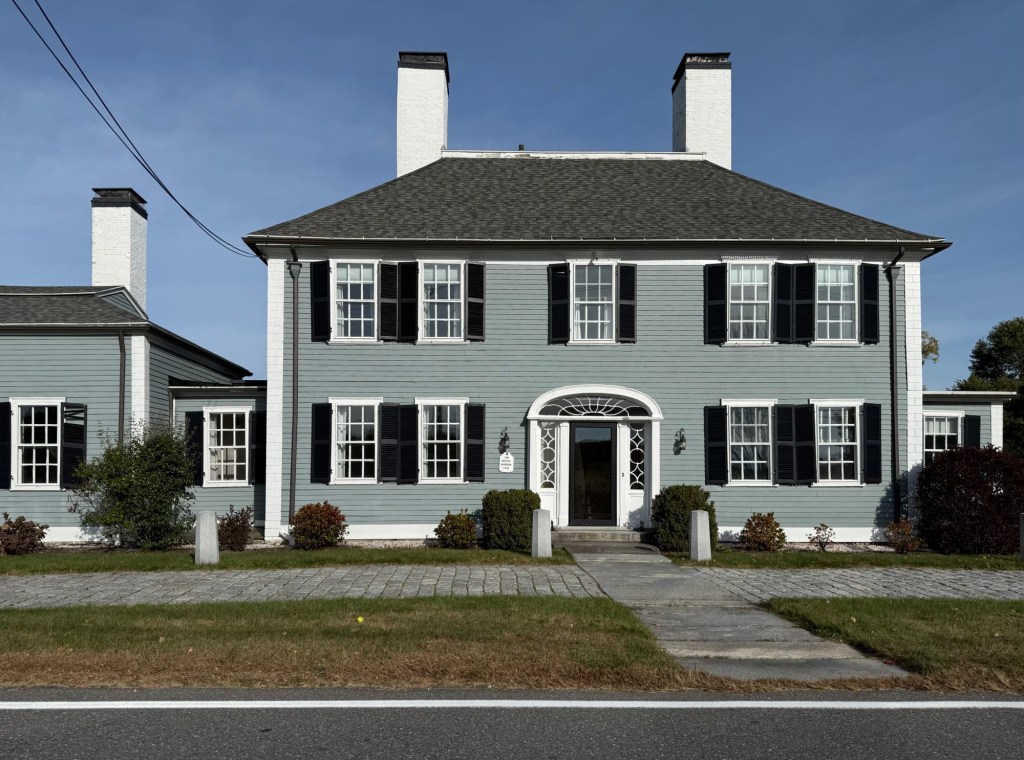
The Wilder Mansion at 101 Wilder Road in Bolton, Massachusetts, was built in about 1738 as an early Georgian farmhouse by Josiah Richardson, a Revolutionary War veteran who died in the home in 1799. By 1814, Sampson Vryling Stoddard Wilder purchased the property and “modernized” the old farmhouse which due to its location along the Bay Path, a major east-west route from Lancaster to Boston, operated it as an inn and tavern. Mr. Wilder expanded the property, purchasing additional nearby farmland to create a country seat worthy of a wealthy agent for some of the most influential merchants in the shipping trade in Boston. During his tour of the United States in 1824, Marquis de Lafayette spent the night here on September 2nd between visits to Boston and Lancaster. Sampson V. S. Wilder lost the property following economic crises, and the property changed hands many times until the early 20th century. Stockbroker John L . Saltonstall (1878-1929), first cousin to Massachusetts Governor Leverett Saltonstall, hired Boston architects Bigelow & Wadsworth in 1910, to return the house to a more Colonial appearance. He and his family were apparently only summer residents here, and he was probably absent for a long period during the First World War, when he worked with the Navy and the War Trade Board in Washington, D.C. In about 1915, he sold the property, and in the early 1920’s he relocated to Topsfield, Mass. After WWI, the house had a series of short-term owners, one of which was Henry Forbes Bigelow, who designed the renovation of the house just years prior. Bigelow would later relocate to a new summer house nearby in Lancaster.
The building that became the Bolton Historical Society in Bolton, Massachusetts had unusual beginnings. According to town records, this residence-turned-historical society was built around 1805 as an addition to the famed Holman Inn, which stood in town from 1767 until its demolition in the 1870s. The wing contained a ballroom on the first floor, and guest chambers on the second. The main part of the inn was eventually torn down in 1874, but the east wing, this structure, was moved down the street to the present site, where it was converted to a house by owners Charles S. Rich, a Civil War veteran, and his wife Mary. In 1904, the house was bought by Arthur H. Nourse, who enlarged the property by purchasing adjacent land from his uncle, and bought two small buildings from the Town of Bolton, the historic engine house and old hearse house, which he moved to the site. The house was purchased in 1923 by Perley and Florence Sawyer. Mrs. Sawyer was a charter member of the Bolton Historical Society at its founding in 1962, and later, by 1970, she gave the house, with over three acres of land, to the Society. The property is still owned by the Historical Society, which operates it as a house museum and a repository for local historical documents.
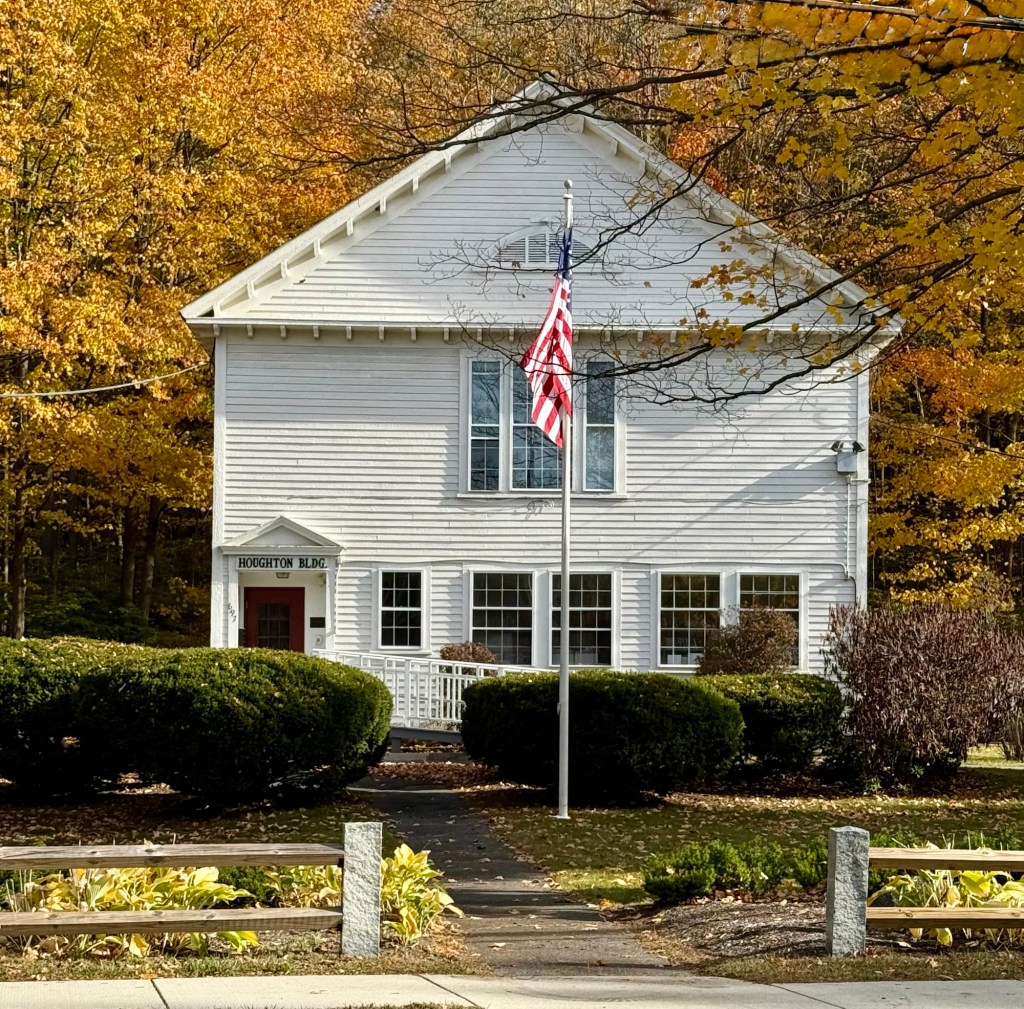
In 1849, the Town of Bolton, Massachusetts, built its first high school, the Houghton School at 697 Main Street in the town center. Blending Greek Revival and Italianate styles, similar to Bolton’s 1853 Town Hall, the Houghton School is a large, two-story, pedimented building of wood-frame construction. Interestingly, the school was largely funded privately by a local resident, Joseph Houghton (1772-1847), who in his will, bequeathed land and $12,000 for a public high school for the town. By the terms of the donation, nine men (all of whom had at one time served as a Bolton tax assessor) and their descendants, were barred from attending the school for a hundred years. Questions about the bequest were put before the Massachusetts Supreme Court, which disallowed this clause. An additional requirement, stipulated that no teacher could serve there longer than two years. That restriction was eventually put aside in the early 20th century. In 1917, the high school was discontinued. The fenestration was likely altered around this time. Bolton began sending its high-school students out of town to a school of their choice, and the Houghton School became the Bolton junior high school. In 1970-71, the building was converted to town offices, with the Town Clerk and Assessor on the first floor and the Police Department on the second. Since 2012, the building houses Bolton Access TV, as well as The Conservation Trust and Friends of the Bolton Library.
 Buildings of New England