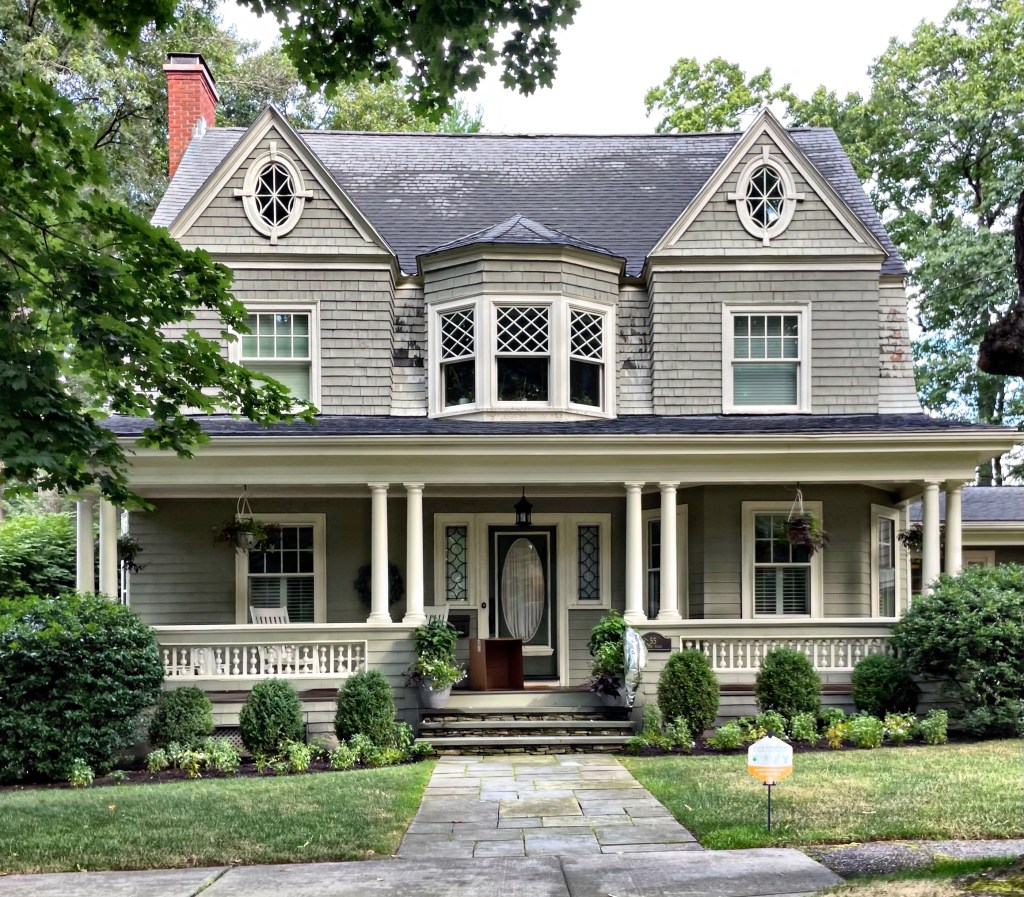
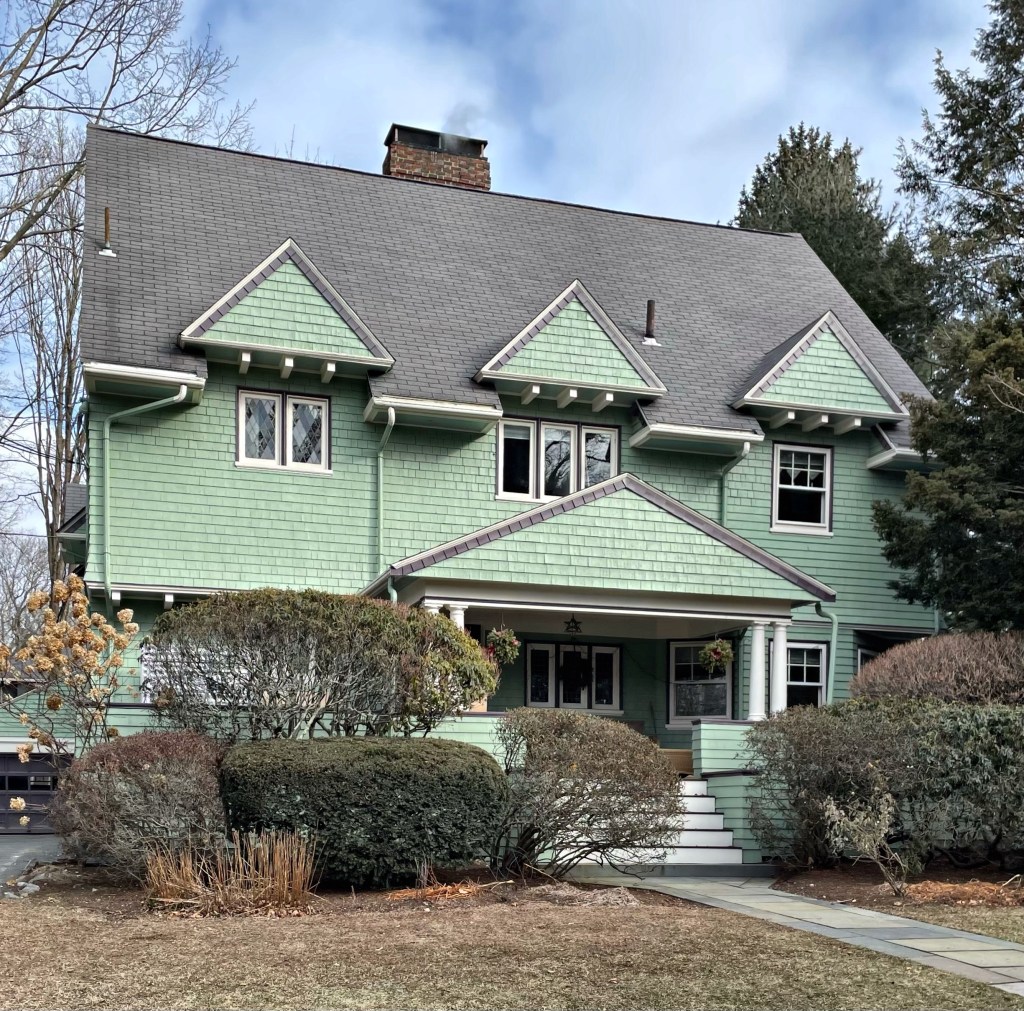
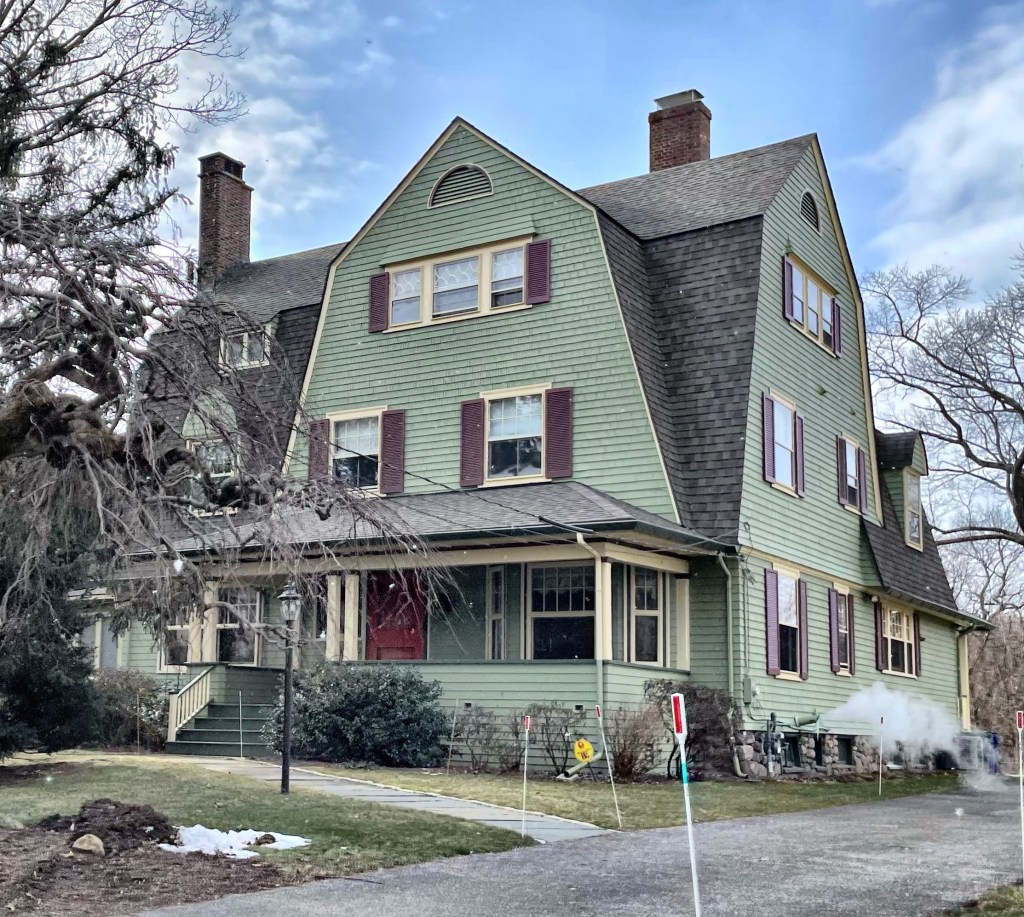
In 1907, William F. Lamont and his family moved into this beautiful turn-of-the-century home in the rapidly developing Waban Village in Newton, Massachusetts. The extension of the circuit railroad connected this part of Newton (which had previously been farmland) to Downtown Boston, opening up the area to development for middle-income families who sought land and fresh air in the suburbs. The first house on Alban Road in Waban was built for the Lamont Family, and it perfectly blends multiple architectural styles under a gambrel roof.
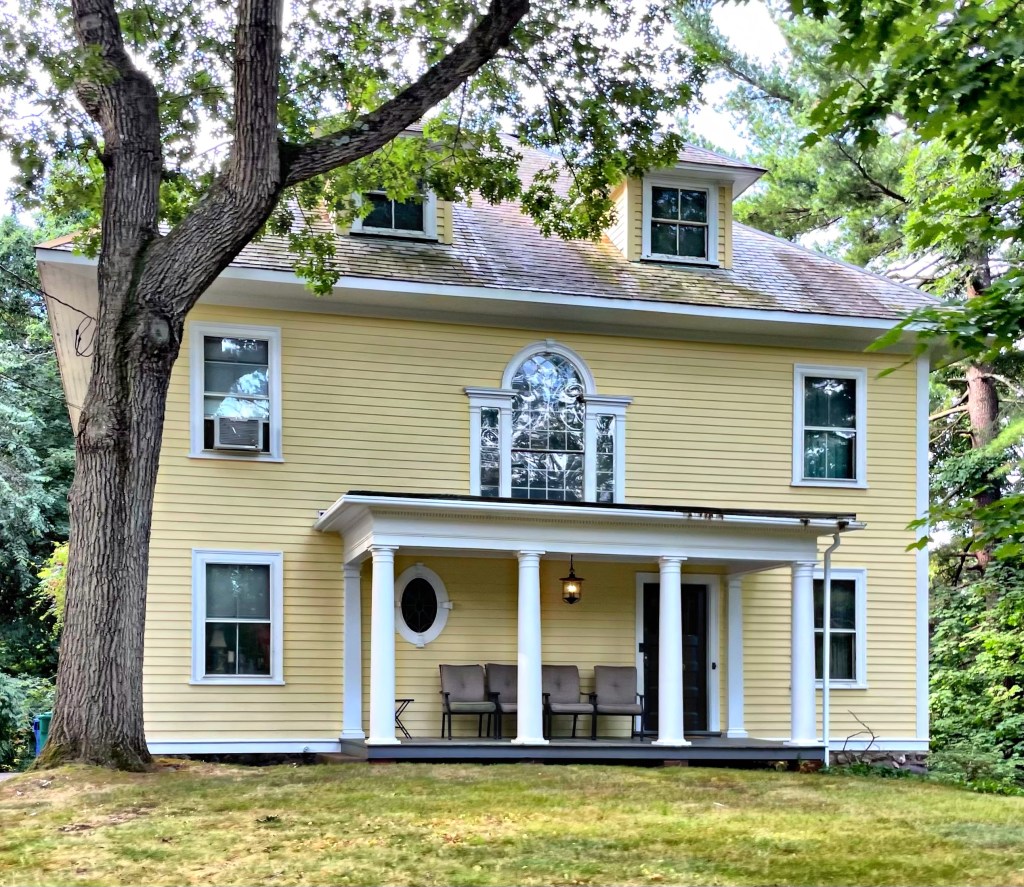
Okay, there is just something about this house that is so intriguing and unique and stands out among all the other (thousands) of Colonial Revival style houses I have seen. I just can’t quite put my finger on it! This late 19th century beauty was built in 1898 for Eva Bailey and Francis Southwick eight years after their marriage and after the birth of their children. It is unclear who the young family hired as an architect to design the home, but they definitely went with a loose adaptation of the Colonial Revival style in an American Foursquare form. The house has a large Palladian window and a minimal front portico supported by Doric columns.
Another eclectic house in Waban is this beauty, a blending of Queen Anne and Colonial Revival styles under an impressive gambrel roof. The home was occupied by Ernest L. Zeiss, a salesman. Waban, which was once a neighborhood within the reach of the middle-class, has since become one of the most desirable neighborhoods in one of the most exclusive towns in the Boston metro. It is safe to say an ordinary 9-5 salesman would not be able to afford a house like this today!
Eclectic homes that can not be pigeonholed to a single architectural style are among my favorite as they blend features elegantly into a single, unique composition. This house on Windsor Road in the Waban village of Newton, Massachusetts is an example of an “eclectic” late 19th century home. This old house exhibits elements of the Queen Anne and Tudor Revival styles. The house was built in 1897 for Daniel and Ida Baker. After their death, the home was purchased by a James H. Mason, who got it for an estimated $25,000 in 1909. A listing at the time mentions the property included a 14-room house and large stable, the latter still stands at the rear of the lot (since converted to a car garage).
At the very end of Windsor Road in Waban Village, Newton, you will find this large, stuccoed Tudor home. The property was one of the last developed on the street and was designed by Newton-based architect William J. Freethy. The first owner of the house was James R. Bancroft, a nationally known economist who taught at Boston University and for years served as President of the American Institute of Finance. The Bancroft House is a refined example of the Tudor Revival style with stucco siding without half-timbering or other masonry detailing which is seen in so many other examples nearby.
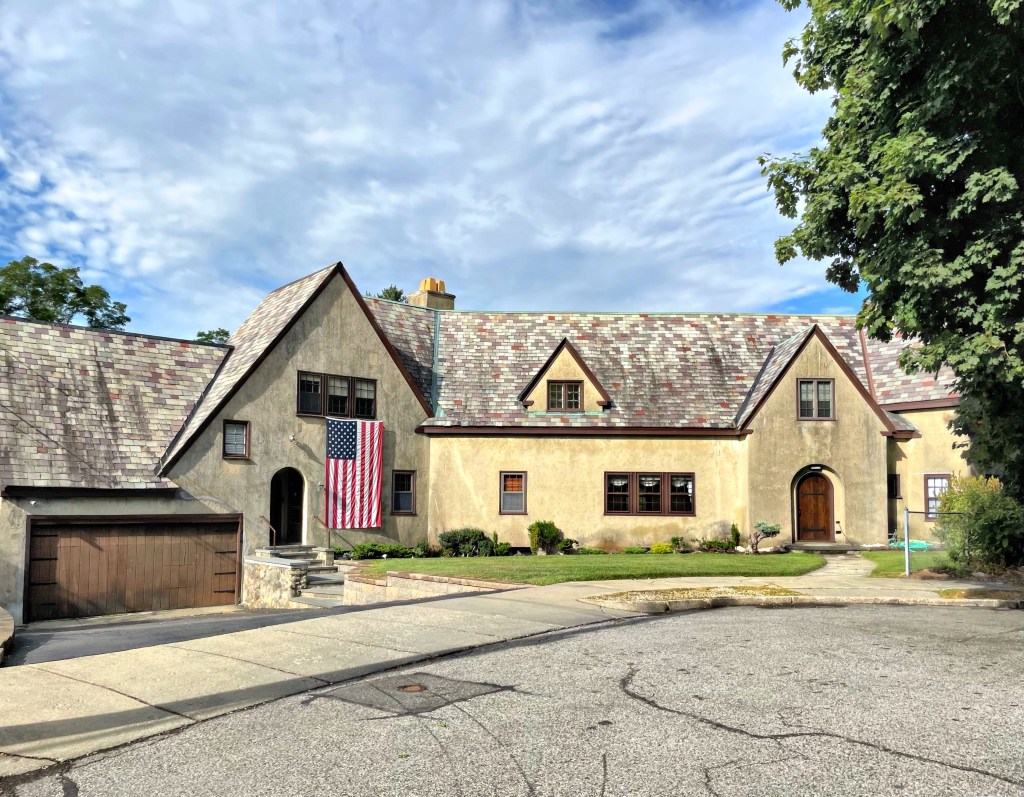
My favorite part about the Boston suburbs is the sheer number of well-preserved early 20th century residences. The collection of Colonial Revival, Tudor, and Arts and Crafts style houses found in Waban Village, Newton, are among my favorites. This two-story stucco-clad house enclosed by a slate gable roof with exposed rafter ends was built in 1923 from designs by architect Harry Morton Ramsay. Ramsay was hired to design dozens of middle-upper class houses in Newton during its period of rapid development in the early 20th century. The original owner was James H. Gardner, who lived here with his family and a maid for a couple decades.
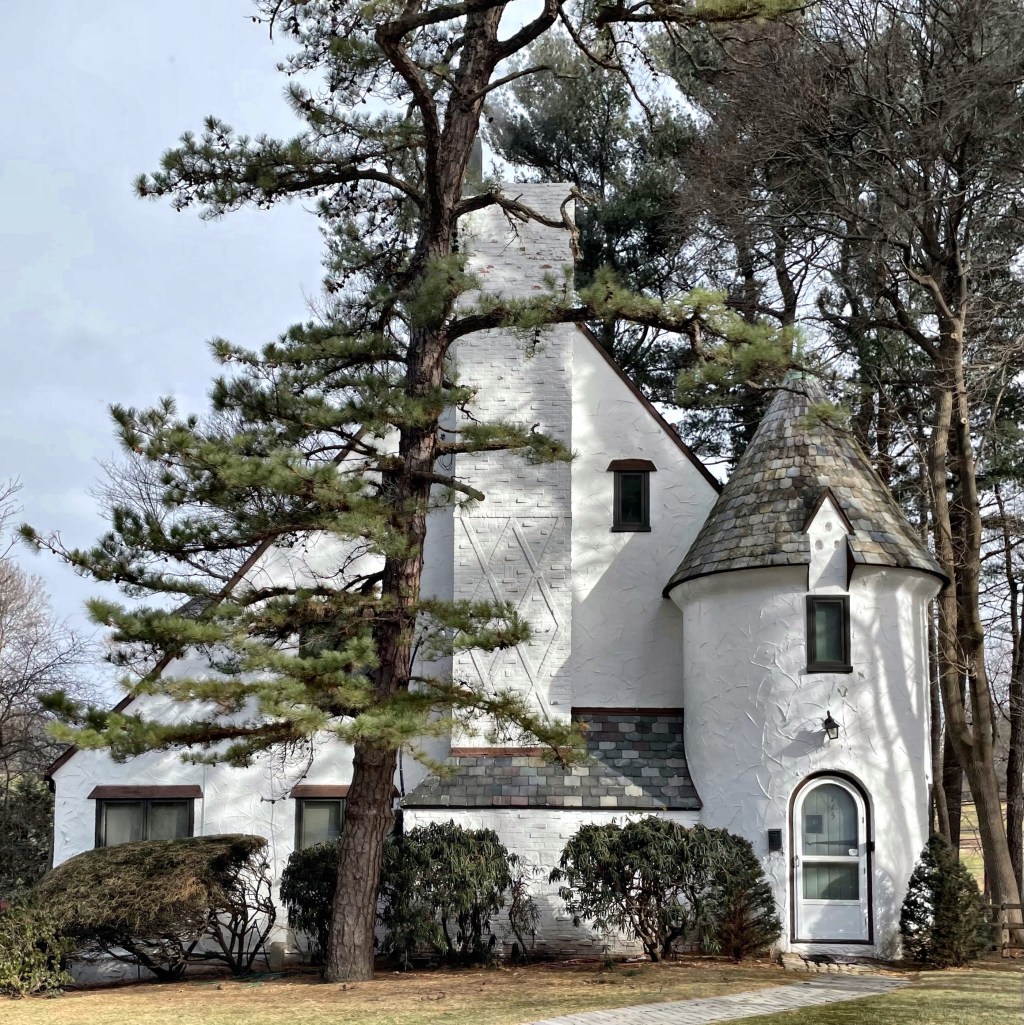
In the inter-war period, Norman Revival houses took off in popularity (though never at the same level as Tudor or Colonial Revival styles), partially due to returning soldiers who served in Normandy France in WWI. Many plans include a small round tower topped by a cone-shaped roof, resembling the grain silos of the ancient Normandy style. The architecture is characterized by steep, conical roofs or hipped roofs and round stair-towers. The style is much less common in the Boston area, but this notable example in Waban Village, Newton, was too good to pass by without snapping a photo! The home was built around 1929 for Edmund and Ethel Sprague. Edmund is listed in directories as a landscaper for trees and shrubs.
Waban is full of eclectic homes from the end of the 19th century, and this example is probably my favorite! The Herbert and Georgia Stetson House was built in 1897 and demonstrates how elements of the Colonial Revival style were incorporated into a less rigid Queen Anne style plan. Herbert was a lumber dealer, and likely used his own product in his home. The mixture of ornament includes Colonial Revival style pedimented dormers, a Palladian motif window, oval windows, and a modillion cornice in combination with bays, oriels, a dramatically overshot gable roof, and a swept dormer reminiscent of the Queen Anne style. Together, the composition is perfection, and really makes you stop and analyze all the details!
In 1897, tailor Charles L. Hovey and his wife Bertha, had this house in Waban built for their family. The architecture really stands out as an eclectic blending of styles, common at the end of the 19th century, when architects and builders would design homes to exhibit architectural details from multiple styles, all under one roof. The shingled house has a steep gable roof and three gabled dormers, which reflects Queen Anne theme. The diamond-pane windows and the technique of cantilevered dormers and the second floor overhanging the first, is First Period-Medieval in style, a unique interpretation of American architecture. What do you think of this home?
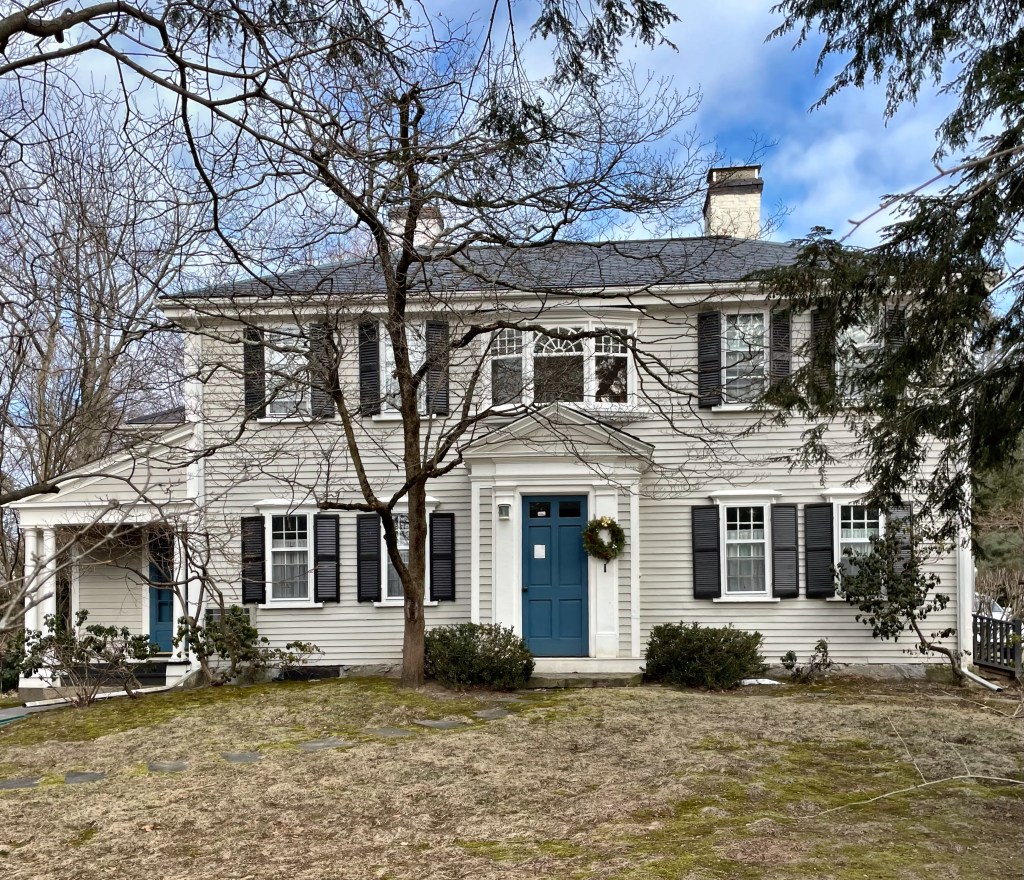
One of the oldest extant homes in Waban Village, Newton, is this 18th century farmhouse which is an excellent example a Federal-period home in the Boston area. Dates of construction for this house have ranged from c.1765 to 1790. The earliest recorded ownership of 38 acres of land at this location is attributed to Eleazer Hyde (1664-1731), one of Newton’s earliest citizens and one of a long line of Hydes in Newton. From 1772 to 1791, the house was owned by Josiah Starr. Immediately after, this property was owned by a housewright named Capt. Ebenezer Richardson, who possibly built or re-built this house in the current configuration. Thaddeus Tower owned the land from 1844-1866, when the City of Boston took a portion of it in 1848 for the new Cochituate Aqueduct, which ran right behind his home. Not long after, Thaddeus sold the farm to Edward Wyman, a linen importer from Roxbury. He subsequently sold it to his brother Dr. Morrill Wyman in 1869. Dr. Morrill Wyman sold 150-acre property to developers, never appearing to have lived in the home, after the railroad came west from Boston in 1886 and increased the value of the surrounding farmland, later known as the village of Waban. All of the land was developed with homes, and all that remains of the old farm is the farmhouse seen here.
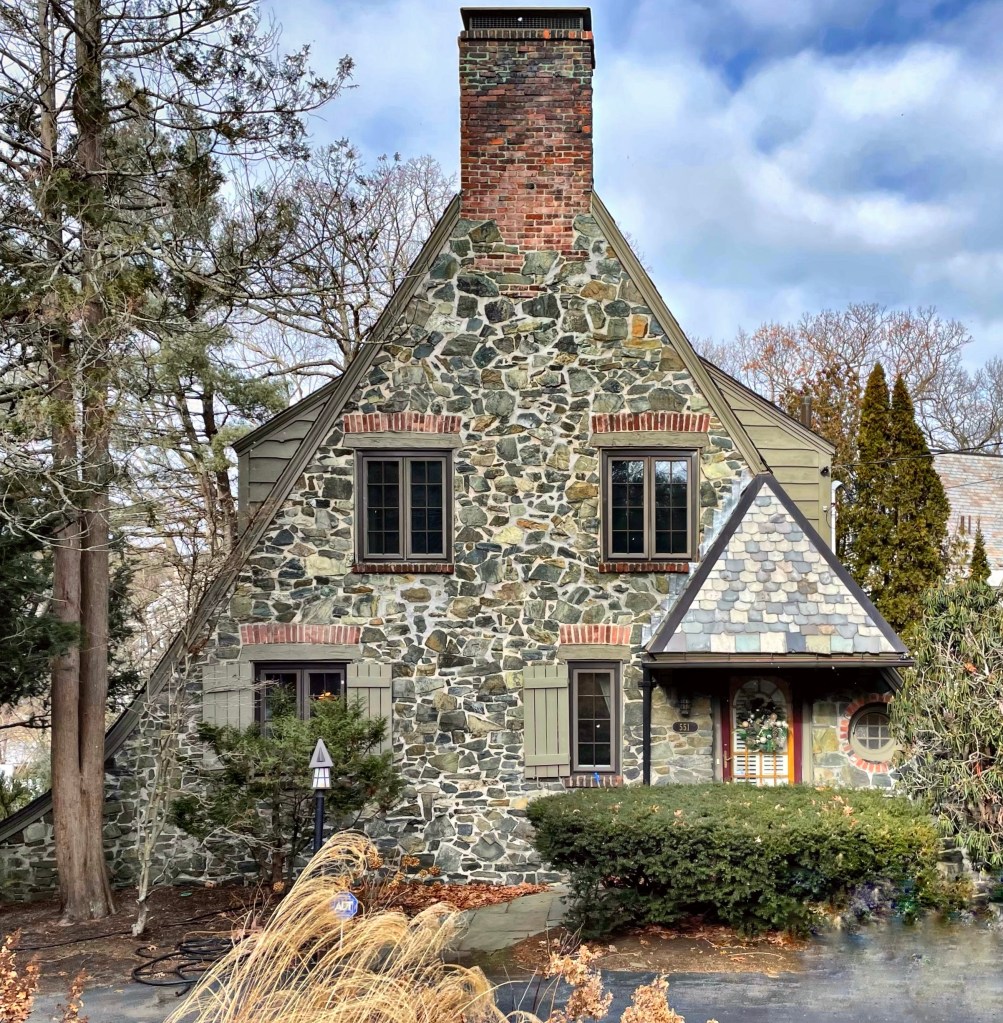
In the land of storybook Tudor houses, this one might just be the most magical of them all! Located on Chestnut Street in Waban Village of Newton, you’ll find this stone Tudor cottage set behind a circular drive. The house was built in 1926, in the interwar period (between WW1 and WW2), a period of rapid suburban development in this part of Newton. The house was first occupied by a Seymour Ellis, who according to newspapers, had a rabid dog! The house exhibits a strong gable to the street which incorporates a massive chimney inside. The gable also sweeps out to form a catslide roof, that incorporates an arched garden gate.
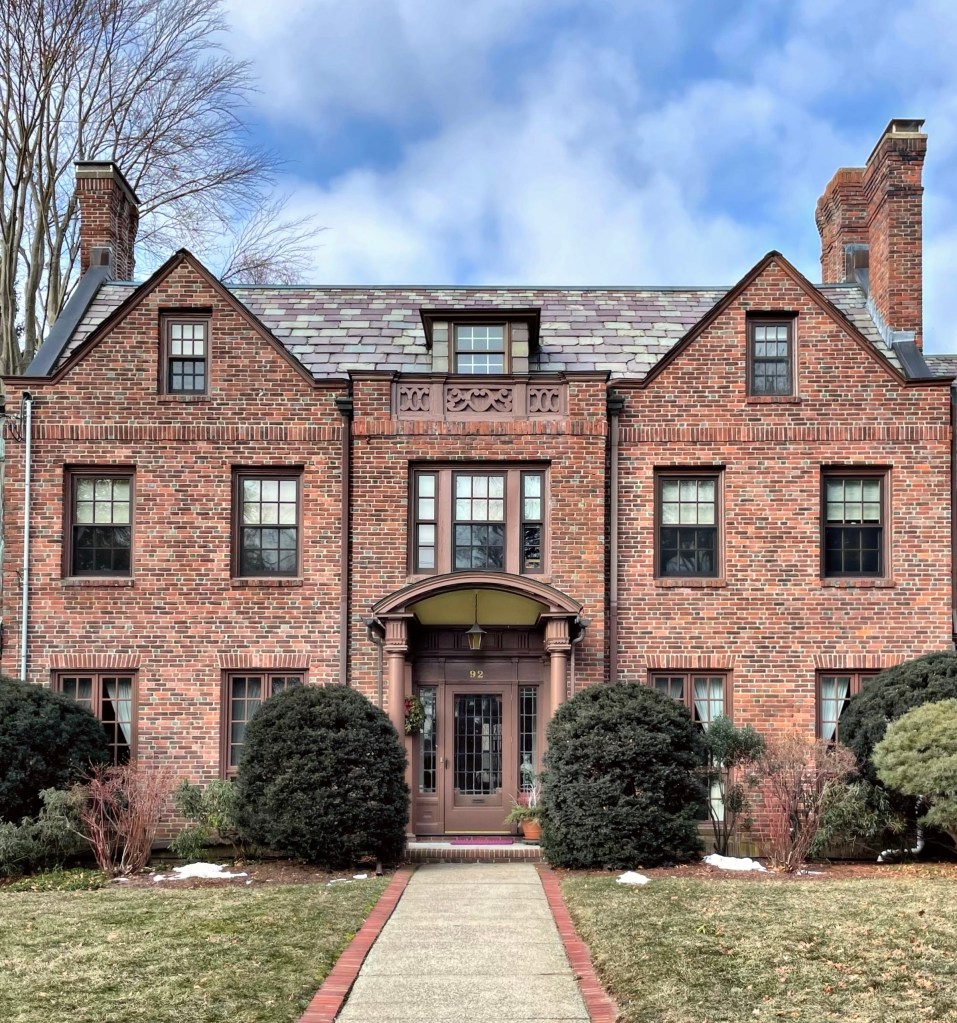
This refined brick Tudor Revival house in the Waban Village of Newton was built in 1917 for Lila and James Emmett. The couple hired Boston architect Edward B. Stratton to furnish plans for the home, which fits in to the early 20th century neighborhood. The symmetrical home has two gables at the facade which frame the central bay with a segmental pediment at the entrance.
In 1895, Waban Village was in the middle of its massive development period, when half of the homes in the neighborhood were built within 10 years. One of the earliest in this neighborhood was this investment property by John E. Parry, a businessman and major developer. This house appears to have been rented at first, but was listed as vacant for some time in the city directories. Eventually it was purchased and has been lovingly maintained to this day. The design is a regional take on the transitional Shingle and Colonial Revival styles, this one with a really unique cross gambrel roof.
Some really interesting history and architecture with this one! Located in Waban Village in Newton, Mass., this gorgeous Mission Revival style house is one of a few in the style in the Boston area. The Mission Revival style was popularized on the West Coast in California in the late 19th century. Rather than continuing to adopt imported East Coast architectural styles, these California architects recognized the value of their own historic surroundings, where the Spanish Colonial mission heritage of California and the Southwest, the beautiful mission chapels, with stucco walls, red tile roofs, and bell towers led to the new revival. The style never took off in New England, which followed its own Georgian and Federal Revival styles, emulating historic Colonial-era homes here. This Newton home was built around 1908 for Lawrence W. Luellen, an attorney and inventor, who made a big invention, disposable paper cups! It is true. Lawrence Luellen wanted to do away with the ubiquitous “tin dippers” he saw in public buildings and railway stations after realizing all that sharing might be transferring disease. In 1907, he took out a patent and create a new, clean and individual drinking cup. After his invention went global, he sold his Newton home and moved to New Jersey, inventing…cup dispensers!
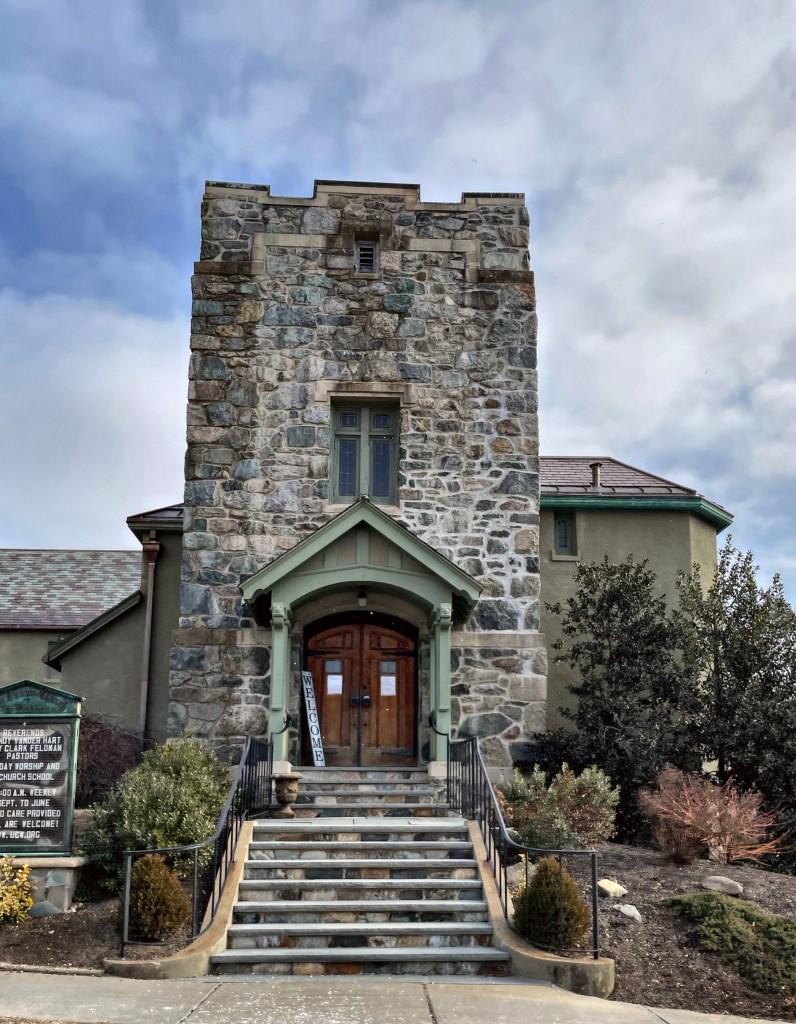
In 1904, residents of the newly established village of Waban in Newton, Mass., began meeting with the hope to establish a non-denominational church there. As the population of the village grew rapidly in the first decade of the 20th century, funding surged and it was determined that a place of worship was necessary. William C. Strong, a Waban resident and well-known horticulturist, donated the land from his large holdings, many of which was already being developed for house lots. The church building, designed by Boston architect James H. Ritchie, had its cornerstone laid in November 1911. Construction followed rapidly and the building was formally dedicated in September, 1912. The building follows the Arts and Crafts movement, especially Ralph Adams Cram’s revival of the English parish church.