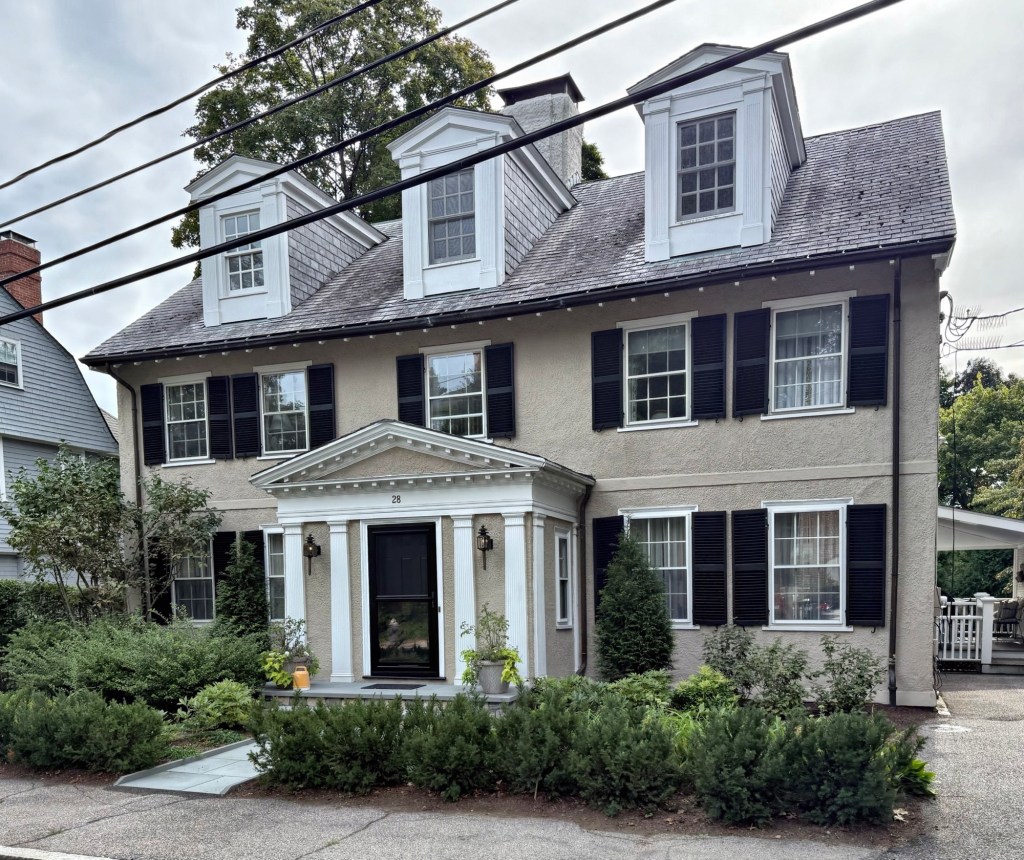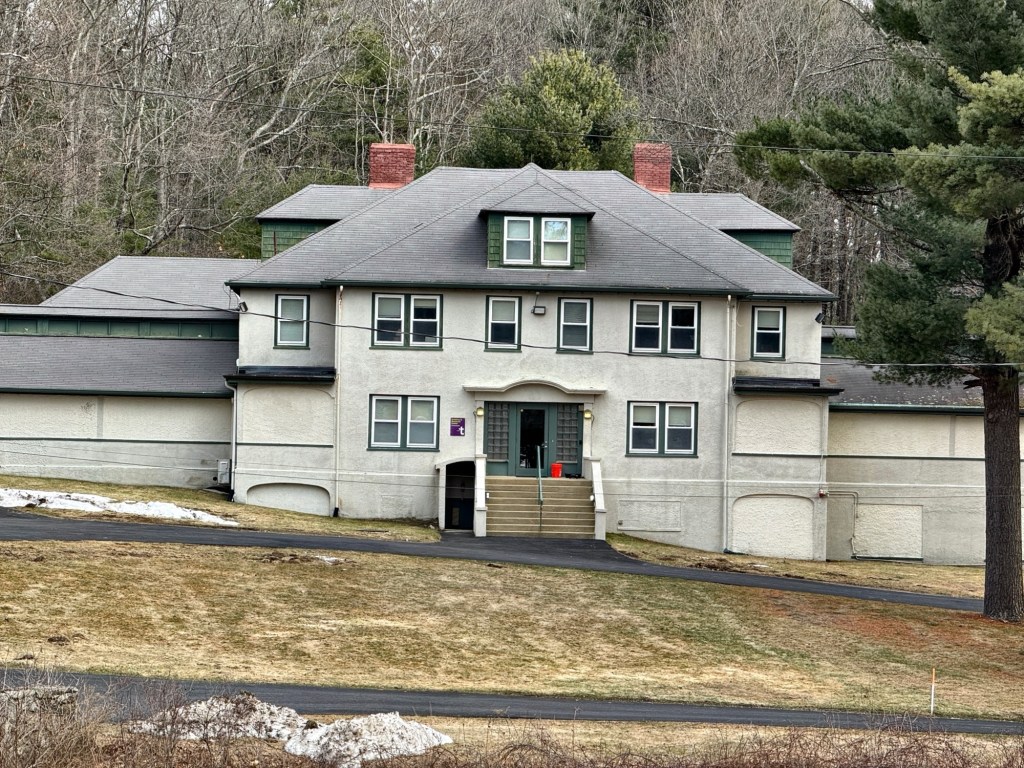
William & Sara Warren House // 1911

Built in 1911, this Colonial Revival style house rendered in stucco, is located at 28 Hawthorn Road in the Pill Hill neighborhood of Brookline, Massachusetts. The residence was built for William Marshall Warren (1865-1953) and his wife, Sara Shields Warren (1874-1964) from plans by the firm of Gay & Proctor. William M. Warren served on the faculty at Boston University as Professor of Philosophy and later as Dean of the College of Arts and Sciences, promoted by his father, William Fairfield Warren, who was President of the University. The Warren House features a symmetrical five-bay facade with central entrance within a projecting pedimented vestibule framed by four pilasters. The pilasters are replicated in the three dormers at the roof, set below the central chimney.

Old St. Stephen’s Church – Barker Playhouse // 1840

The old St. Stephen’s Episcopal Church in Providence’s Fox Point neighborhood is an architecturally distinctive Greek Revival style church building located on charming Benefit Street. The church had its beginnings in 1839, when the newly established congregation called on 29-year-old Francis Vinton to serve as their first pastor. The congregation funded this small church which broke ground in 1840, and before it was completed, Rev. Vinton resigned as Rector. The building, built of stone and covered in stucco, once had a spire and belfry above the main entrance. The congregation grew over the next decade and it was soon realized that a larger and more central church should be built for members, many of whom were wealthy residents with mansions surrounding Brown College. In 1860, the parish purchased a lot on George Street, and hired architect, Richard Upjohn to design the new church in the Gothic style. For reasons of location, and possibly social class, twenty-two men and women remained here at the less fashionable church and formed a new parish, the Church of the Saviour. The smaller, mission church with its stucco walls, remained until the property was sold in 1932 to house the Barker Playhouse, reputed to be the oldest continuously operating little theatre in the United States.


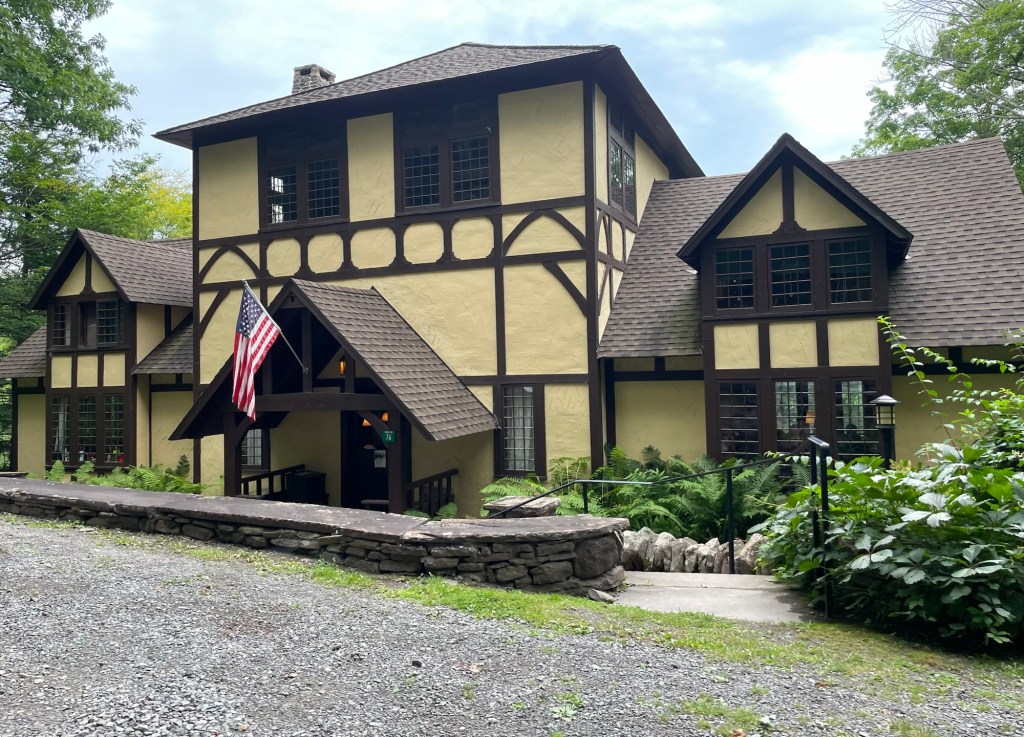
Onteora Park Library // 1906

Built in 1906, the Library at the Onteora Park summer colony in Hunter, New York, is one of the many architectural treasures in the development. Designed by George A. Reid, the Canadian artist, architect, and summer resident of Onteora Park, the Tudor-style Arts and Crafts building was constructed in 1906 and opened to a collection of over 1,500 books and a full-time librarian during the summer season. Built of wood-frame construction with stucco exterior finish and adorned by half-timbering, the building has been lovingly maintained and preserved by members of the community for over 120 years.

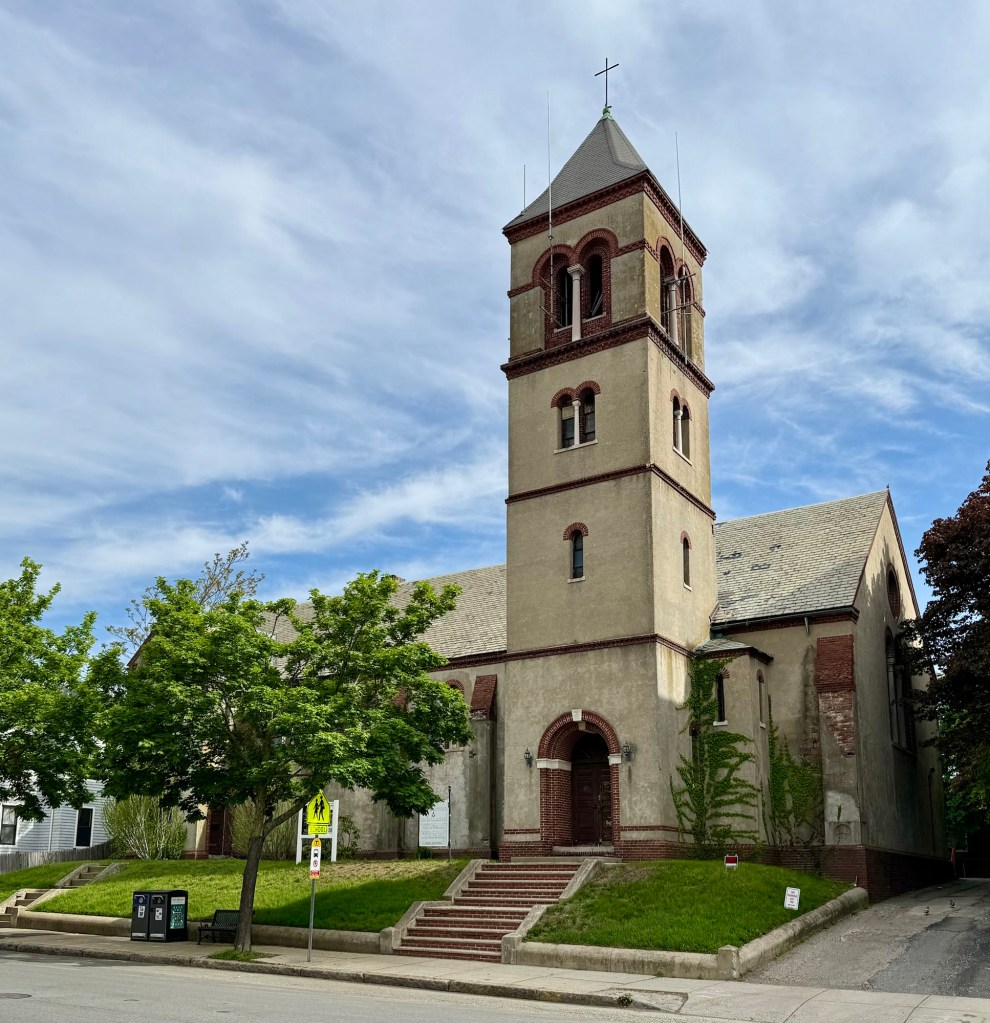
First Universalist Church of Somerville // 1917

The First Universalist Church of Somerville is located on the north side of Highland Avenue across from the First Unitarian Church of Somerville, in a completely different design. The congregation acquired this site in 1915, and the church was built from 1916 to 1923 to a design by the noted ecclesiastical architect Ralph Adams Cram, who produced a somewhat more Romanesque plan than the typical Gothical Revival work he is best known for. One of the key members of the building committee was Gilbert Henry Hood of the Hood Milk Company family. The new church was planned to house an “assembly room,” Sunday school classes, and a parish house. The church operated here for decades, but most recently was home to the Highland Masonic Building Association as the King Solomon’s Lodge. The lodge moved from the building and the property was purchased by a developer who hoped to demolish the building and erect a housing development. The building was deemed significant and “preferably preserved” by the Somerville Historical Commission, and landmark designation was initiated. The building was recently re-listed for sale, and would make a great adaptive reuse or even partial demolition for housing incorporated into the old church. Kudos to the Somerville Historical Commission for standing firm on this significant church by a nationally recognized architect.

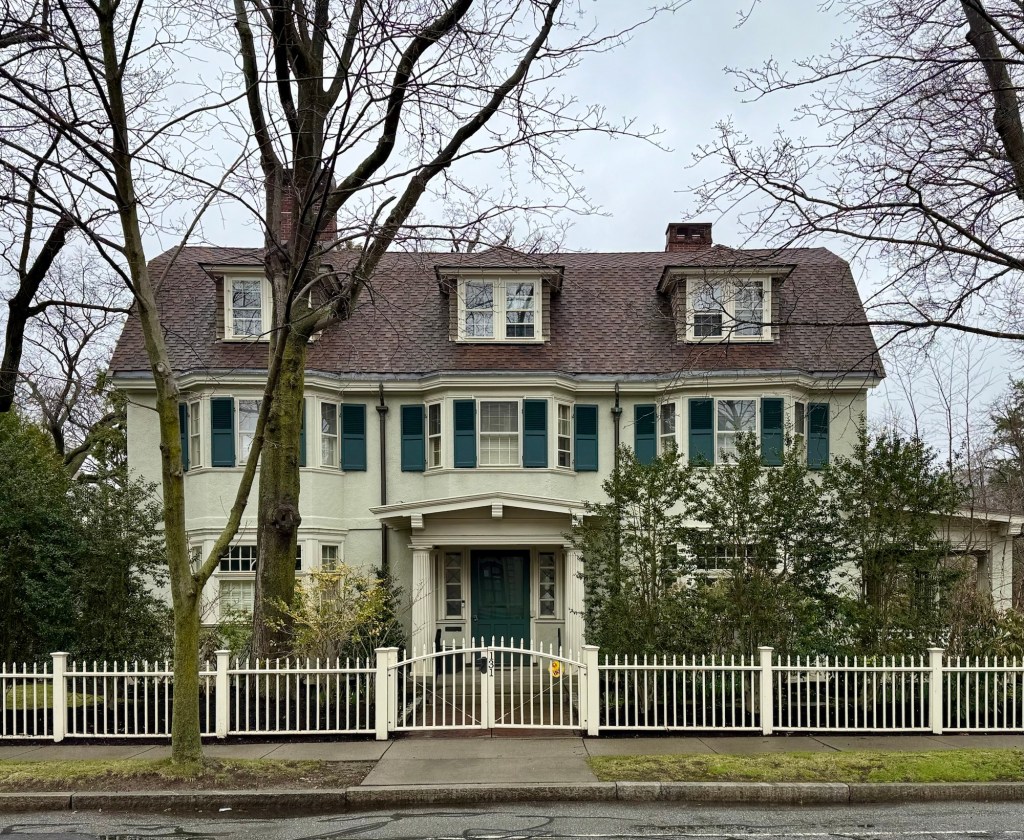
Francis B. Dana House // 1902

In 1902, Francis Bryden Dana (1865-1917) began construction on his home here in the Cottage Farm neighborhood of Brookline, Massachusetts. Francis was a member of the wealthy Dana Family and as a young man, attended the Boston Latin School and Harvard College. He became the president of the Dana Hardware Company of Boston. For his Brookline residence, Dana hired the exclusive architect, William Gibbons Rantoul to design the house which blends Arts and Crafts and Colonial Revival styles. The use of stucco siding, shed dormers, and portico with low sloped roof revealing exposed rafters falls squarely within the Arts and Crafts style; while the symmetrical facade, gambrel roof, and projecting octagonal bays are reminiscent of the more traditional New England Colonial Revival style.

John Endicott Peabody House – Ivy Street School // 1910

This stately mansion is located at 200 Ivy Street in the Cottage Farm neighborhood of Brookline and was built in 1910 for Martha and John Endicott Peabody. Designed in a Renaissance/Colonial Revival style by architect John Worthington Ames, the house has since been converted to institutional use, but retains much of its original character. John Endicott Peabody (1853-1921) was a businessman and later got involved with the arts in Boston. The building was acquired for institutional use beginning in the 1950’s and was occupied as the St. Dominic’s Institute and has been owned by the Massachusetts Association for the Blind since 1976, and today is occupied by the organization’s Ivy Street School, a special education residential and day high school for neurodivergent youth to help prepare pupils for adulthood with the tools they need to achieve their greatest independence. The brick house is covered in stucco and features an elaborate stone door surround, symmetrical facade, and massive chimneys.

Renton Whidden House // 1912

One of the finest Arts and Crafts style “cottages” in the Cottage Farm neighborhood of Brookline, Massachusetts, can be found on Ivy Street as the Whidden House. The property here was developed by Renton Whidden (1859-1942), a real estate developer and politician elected into the Massachusetts House of Representatives, who purchased a house lot from Thomas B. Hall, who owned a house next door. Renton Whidden hired architect, Arthur Hunnewell Bowditch, to furnish plans for the large home, which was completed in 1912. The stucco house features a brick entrance with projecting roof off the front, a unique twin gabled facade, segmental arched dormers, and a Palladianesque window and balconette above the front door.

Partridge House // c.1908

Located on Amory Street in Brookline, this handsome Arts and Crafts style residence dates to about 1908 and while clearly Craftsman in style, does appear to follow the horizontality and form of the Prairie School of architecture, popularized by famed architect, Frank Lloyd Wright. While the architect of this house is unclear, we do know that the first owners were Mr. Frank T. Partridge and his wife, Edith Stevens Partridge. The stucco house features a horizontal belt course, shallow hip roof with broad eaves supported by brackets, and elaborate entry and porches. The colors enhance the architecture of the home perfectly. 

George P. Fisher House // 1864

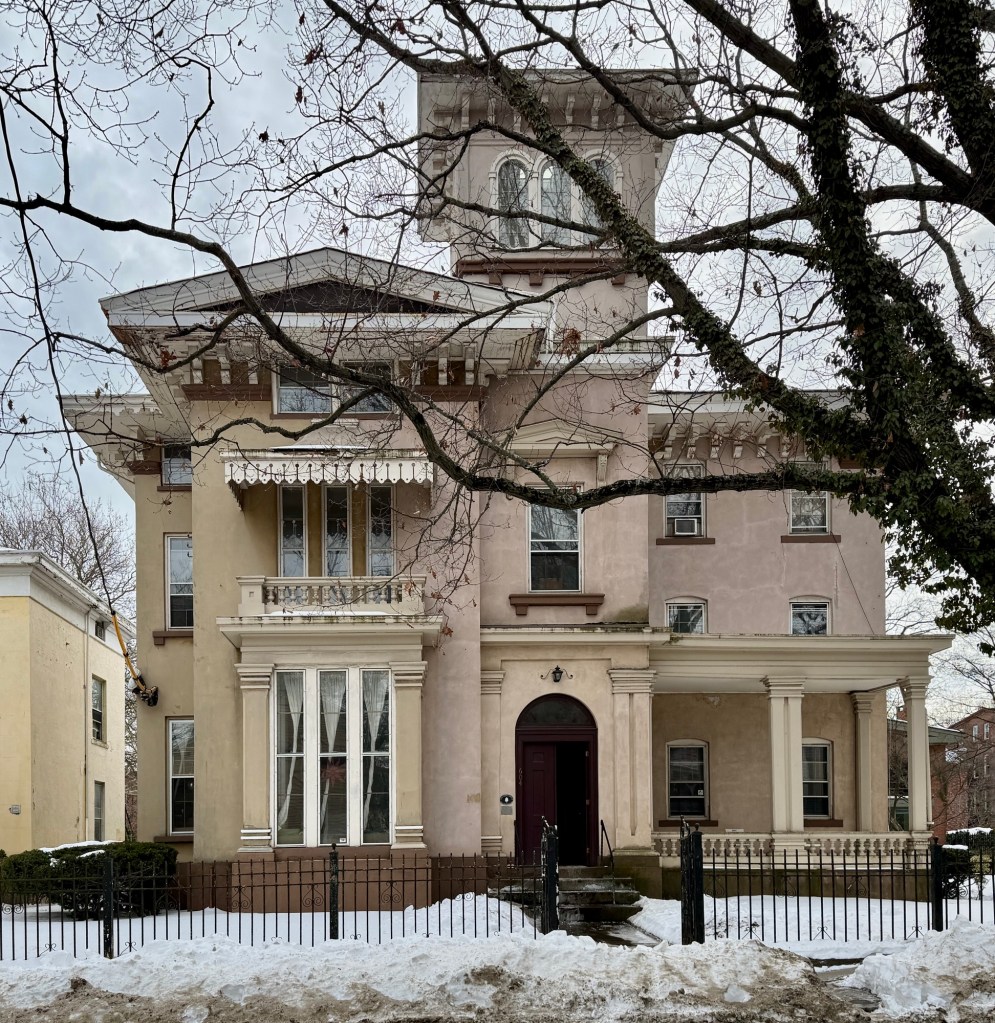
The George P. Fisher House is located at the corner of Hillhouse Avenue and Trumbull Street in Central New Haven, Connecticut. Built in 1864, the residence is one of the finest examples of the Italianate style in the state with its square, three-story form with gabled pediment, bracketed eaves, window hoods, and brick construction with stucco scored to resemble ashlar masonry. George Park Fisher (1827-1909) completed his education in Theology at Brown and Yale and would become a professor at the latter institution for much of his life. Additionally, Rev. Fisher was a frequent contributor to The New Englander (now the Yale Review) the oldest literary journal in the United States. Due to failing health at the turn of the 20th century, George Fisher relocated to Litchfield County for fresh air and relaxation for his health. The property was sold to John Wolcott Bristol, a wealthy attorney who never married. As with nearly all of the buildings on Hillhouse Avenue, the property was acquired by Yale in 1935 and is now occupied by the University’s Economic Growth Center.

Former St. Mary’s of the Bay Catholic Church // 1928

Catholic residents of Hull, Massachusetts surged in the early 20th century with many well-to-do Irish families settling in town as year-round or summer residents. As a result, the cramped original St. Mary’s of the Bay Catholic Church was deemed too cramped, and a site in Hull Village was selected for a new church. In 1927, ground was broken for the new stucco church, which was partially funded by the Kennedy Family, who had a summer house nearby. The first service took place in 1928 and the church was in use as a religious building until the 1990s when it was sold to a private owner. The church was converted to a single-family residence and recently sold to new owners, who preserve the significant Spanish Colonial Revival style edifice.