Yale University – Alpha Delta Phi Hall // 1895

Completed in 1895 for the Alpha Delta Phi fraternity at Yale, this stunning example of the Richardsonian Romanesque style on Hillhouse Avenue was such a treat to see in person. This building was designed by local architect William H. Allen who designed the building to provide student members dining and socialization space, but no dormitories. The group was active as a Junior Society, but disbanded by 1930, and the building was sold to Yale University. Yale has since occupied the building with the Morris Steinert Collection of Musical Instruments and it recently underwent a restoration. The longer I look at the building, the more amazing details I can find. The proportion of the Syrian arch with squat engaged columns is really remarkable.

St. Mary’s Roman Catholic Church Priory // 1907

Located next to the St. Mary’s Roman Catholic Church on Hillhouse Avenue in New Haven, Connecticut, you will find one of the finest Neo-Gothic style buildings in the city that was not built by Yale University. This structure was constructed in 1907 as the Priory for the Catholic Church next door. Historically, the church had been under the care of the Dominican friars of the Province of St. Joseph, based in New York City, and the church needed a residence for the friars (a Priory). Due to dwindling attendance at churches all over the country, area churches were consolidated under the Hartford Archdiocese, who replaced the friar residents of this building with Dioscesan priests in late 2021.

St. Mary’s Roman Catholic Church // 1870

The second oldest Roman Catholic parish in Connecticut can be found in New Haven, at the St. Mary’s Roman Catholic Church. The parish was originally established in 1832, largely by Irish immigrants who settled in the area for work. The current St. Mary’s church building, located on Hillhouse Avenue near Yale University, was designed in 1870 by ecclesiastical architect James Murphy, and it was dedicated in 1874. The construction of a Catholic church on Hillhouse Avenue was strongly opposed by the Protestant elite who lived in the area, but the congregation prevailed. The Victorian Gothic style church is constructed of local blue stone and granite and while plans by Murphy originally included a corner spire for the building, it was not built until 1982 when the building was restored courtesy of the Knights of Columbus. The Knights of Columbus fraternal organization was actually founded in 1882 in New Haven by Father Michael J. McGivney, who originally held meetings in the basement of this church.

Yale University – Kirtland Hall // 1902

Yale has such great architecture. Walking around the campus, you can find examples of buildings of every time period and architectural style, it is like a living museum of architecture in that sense. Located on Hillhouse Avenue, Kirtland Hall is arguably Yale’s best example of Beaux Arts/Neo-Classical architecture, but it stands out for its use of local East Haven and Longmeadow sandstone. The building was the first laboratory to be built at Yale in the 20th century and was named after Jared Potter Kirtland (1793-1877), the first medical student enrolled at Yale. After graduation, Dr. Kirtland practiced medicine throughout Connecticut until 1823, when his wife died and he moved to Ohio. During his life, Dr. Kirtland also developed an interest in natural history and assisted in the first geographical survey of Ohio. In the early 20th century, Lucy Hall Boardman, a philanthropist and niece of Dr. Kirtland, not only donated funds for scholarships at Yale, but also donated a building, Kirtland Hall. As part of her gift, Ms. Boardman stipulated that her nephew, architect Kirtland Cutter, would be commissioned to design the building, and of course, Yale obliged. The building originally housed the Geology Department and became an integral part of the Sheffield Scientific School.

St. Elmo Hall – Rosenfeld Hall // 1912

St. Elmo Society at Yale was founded in 1889 as a chapter of the national fraternity Delta Phi, and it is today one of the “ancient eight consortium” of secret societies at the university. The society’s original building was erected in 1895 and provided housing, meeting spaces, a library, smoking room, and other recreational spaces for the members. Just over a decade later, the group’s increasing wealth and membership necessitated a larger building. This building, named St. Elmo Hall was designed by architect Kenneth MacKenzie Murchison in an Elizabethan style and built in 1912 for the society, replacing its former residence hall. The society saw dwindling funding and during World War II, St. Elmo Hall became a convalescent hospital for soldiers who were out of the hospital but still need observation. After WWII, the group began leasing some rooms out to Yale University, who eventually purchased the building in 1962, renaming it Rosenfeld Hall after Richard Rosenfeld ’63. The L-shaped building is sited opening up to the corner lot and is Neo-Gothic in style, likely drawing inspiration from Yale’s established Gothic stylistic influence.

The Colony // 1898-1969

In 1898, before the Berzelius Society at Yale built their present “tomb” in New Haven, the organization funded one of the finest residence halls in town at the time. The building was known as “The Colony” and would house Seniors who were members of the secret society. Located on Hillhouse Avenue, the stately Colonial Revival/Neoclassical building was designed by architects Henry Bacon and James Brite. Bacon is best known for having designed the Lincoln Memorial on the National Mall. Yale purchased the Colony dormitory in 1933 for student housing, later using it for faculty offices before demolishing it in 1969 to facilitate construction of the Yale Health Services Center, one of the least inspiring buildings on the campus.

Berzelius Tomb // 1910

Yale, like other Ivy League colleges, has a long and complex history of secret societies. The secret societies all are headquartered at their own buildings, called “tombs”. These are massive, very impressive structures without windows or signage and all share an unmistakable message with their architecture: “Private; keep out.” One of the lesser-known tombs at Yale is the Berzelius Tomb, completed by 1910 from plans by architect Donn Barber. The Berzelius was established in 1848 as a secret society and formerly was located in Berzelius Hall, a Romanesque style building. The tomb is sited on an difficult lot at the convergence of three main roads but holds its own architecturally as a highly ornamented box. This austere tomb is built of limestone, with a balustrade and detailed cornice at the roof, but the main attraction is the entrance, which is a double brass door with floral panels, all surrounded by a Classical surround. Above the entrance, a limestone panel showcases the Society’s insignia with fruit and flower swags.

New Haven Museum // 1929

New Haven, Connecticut is known for its Gothic and Modernist architecture, but as it is located in New England, some good Colonial Revival architecture is not hard to find! The New Haven Museum building on Whitney Avenue was built for the New Haven Colony Historical Society, which was established in 1862 to collect, preserve, and publish historical matter related to the history of the greater New Haven community. The Society was housed in various locations around the city throughout the 19th century until 1929 when it relocated to its present building designed by J. Frederick Kelly, a noted colonial revival architect. The symmetrical building with its eleven-bay facade is notable for its arched recessed portico and rooftop cupola. The building remains occupied by the New Haven Museum to this day.

Sumner Stanley House // c.1850

One of the larger homes in Weare, New Hampshire is this sprawling mid-19th century residence, seemingly built around 1850 for Sumner Stanley and his wife, Ruth. Stanley and Ruth (née Dow) acquired land from Ruth’s family and they built their home here. By 1856, Stanley sold a small piece of land to town just to the east of his house for the construction of the North Weare Schoolhouse. The Italianate style house with its Stick style attached barn structure have some amazing detailing!

North Weare Schoolhouse // 1856

The Town of Weare, New Hampshire was first divided into thirteen school districts in 1805 as a result of a state law to divide each town into school districts to service all students equally. Over the years the number of school districts fluctuated and were periodically redefined based on population distribution and class sizes. The North Weare Schoolhouse was built in 1856 and was operated as a one-room school until 1952 when a consolidated school was built in town. Architecturally, the building blends multiple styles, most notably the Greek Revival and Italianate styles. The property was later occupied as a Grange Hall with a 1960s addition to the rear. It was purchased in 1985 by new owners who had spent years restoring the building as a residence before they sold it more recently. Today, the former schoolhouse has modern additions and windows, but maintains its charm and uniqueness.

Amos Chase House and Mill // 1836

The Amos Chase House and Mill are located in Weare, New Hampshire, on the banks of the Piscataquog River. The house is oriented facing the road, while the mill is behind it, on the bank of the river. The mill is the only surviving 19th-century mill building in Weare. The house was built about 1836 by Amos Chase, as was a mill. That mill burned in 1844; the present mill was built by Chase as a replacement a few years later. This mill was the only one in the town to survive the New England Hurricane of 1938, although its waterwheel was washed away. Amos Chase was a tool manufacturer and one of several members of a locally prominent family operating small mills in the town. His son later used the mill in the manufacture of baskets. The large Greek Revival style home has all the hallmarks of the style, from the pediment facing the street, to the pilasters at the entrance and corners.

Elijah Purington Homestead // 1768

One of the earlier settlers to Weare, New Hampshire was Elijah Purington, who purchased a lot in the center of town in 1768 and built this large farmhouse for his family. Elijah was one of the first Quakers to move to Weare, and the next year, he was elected a selectman in town. The farm remained in the ownership of his descendants through the end of the 19th century. A trotting park was built on a piece of the property covering an earlier pond, which seems to have since been restored back to a pond. After Elijah Purington III died in 1890, the property was purchased by Oliver Dennett Sawyer, who operated it as the Apple Tree Inn until his death in 1921. It has remained a private home ever since.

Weare Public Library // 1926

The Colonial Revival style Weare Public Library was built in 1926, being the second purpose-built library building for the town of Weare, New Hampshire. After the Neo-Classical style Stone Memorial Building was taken over as town offices following a fire of the old town hall, local resident Eben Paige saw the need for a new designated library building. Upon his death in 1923, he left his entire estate, over $30,000, to the town to build a new free library. The Boston architectural firm of Kreider and Peterson were selected to design the building, which is still in use today.

Stone Memorial Building // 1896

Designed by New Hampshire architect William Butterfield in 1896, the Stone Memorial building in Central Weare is a significant example of a Neo-Classical style structure in a village setting. The building was constructed with money donated by Joseph Stone in honor of his father, Phineas J. Stone, who was born in Weare and moved to Charlestown, MA, later serving as its seventh Mayor. The building would “provide suitable room for a public town library” and a room for memorials to the Civil War soldiers who fought and died for the Union. When the town hall burned, offices there were relocated to this building. Eventually, the library and town offices left this small building, and it has since been home to the Weare Historical Society.

Hadley Homestead // c.1776

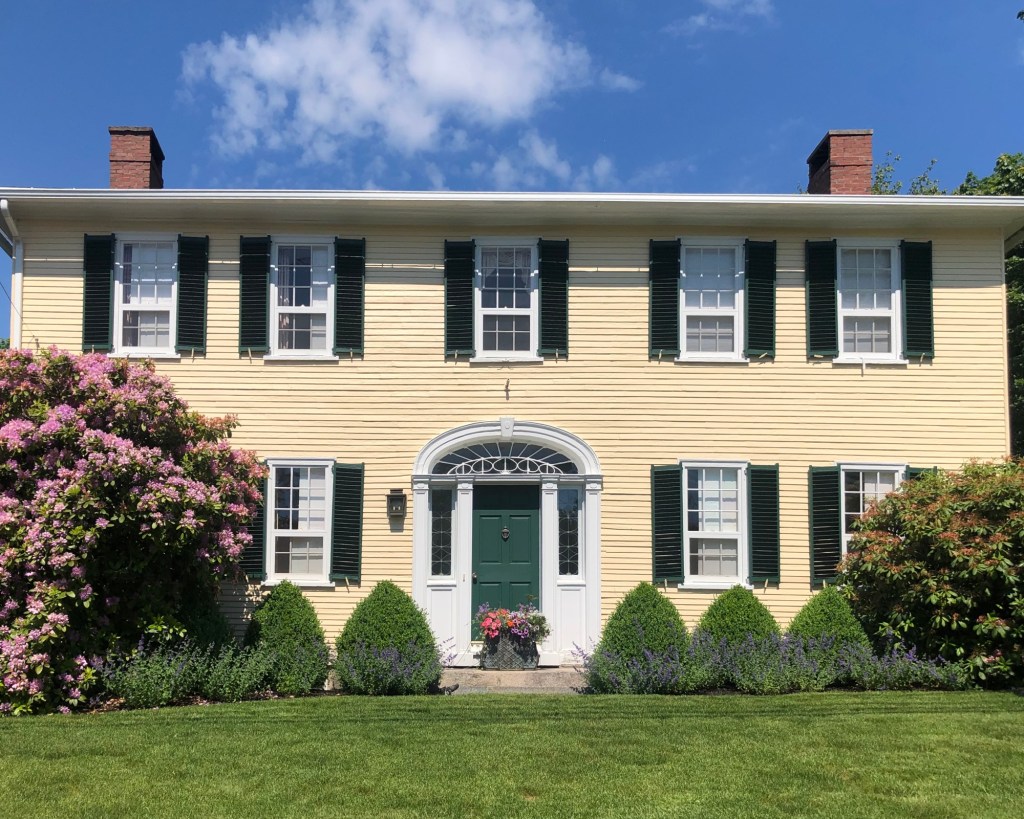
George Hadley (1740-1823) moved to Weare, NH in 1775, buying lot sixty-one in town from the proprietors. Captain Hadley served in the French and Indian War and later in the Revolutionary War, though he was not so eager to serve again. He built his home soon after, living here with his family. The original Hadley Homestead would have been a more traditional Georgian farmhouse with large central chimney and minimal glass/windows. Sometime in the early 19th century – after his wife’s death in 1806 or after his own death in 1823 – the house was modernized in the Federal style. The stunning home has a fan light transom over the door, narrow corner pilasters and twin chimneys projecting through the roof. It sits next door to the South Weare Union Church.