Joseph and Fanny Turner House & Stable // 1872

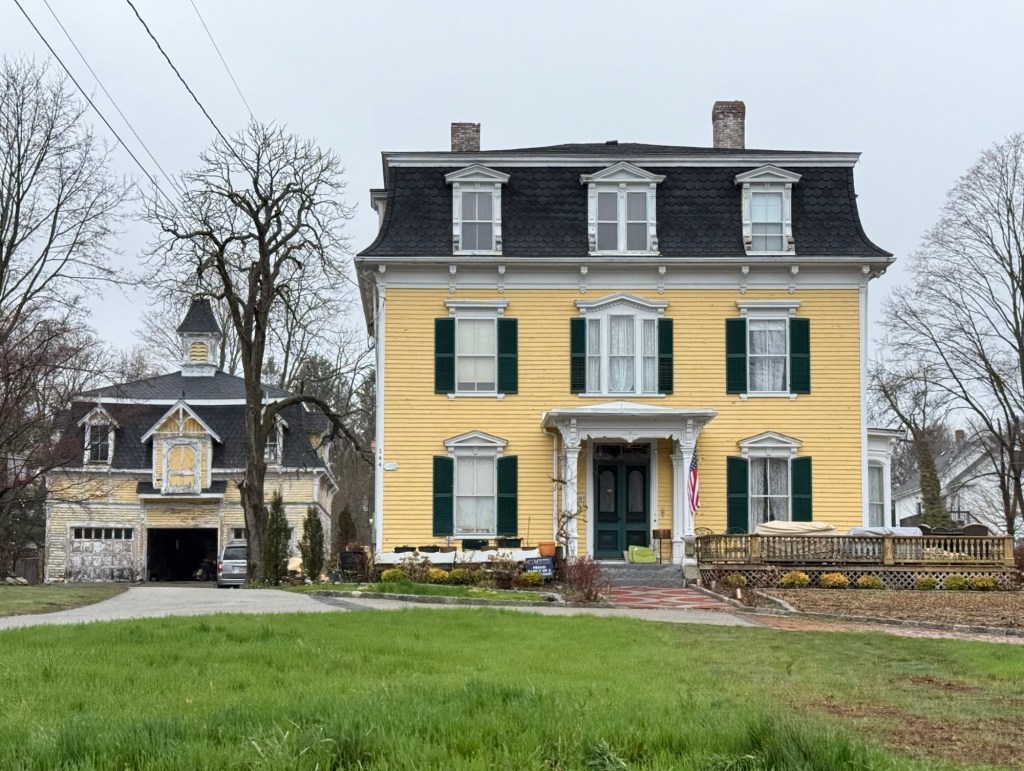
Joseph Stanley Turner (1841-1893) married Fannie Pratt (1849-1930) in 1871 and within a year, had this large, Second Empire style house built on Webster Street in Rockland, Massachusetts, for his family. Joseph Turner was a Civil War veteran and owned a shoe factory in town, making his fortune manufacturing shoes and boots which were sold all over the country. The main house is two-stories with a symmetrical plan with central entrance and projecting portico. An equally significant mansard-roofed stable sits behind and to the side of the main house, and can be classified as an example in the Stick style with applied stickwork at the siding and in the hay door, as well as the pedimented dormer with decorative truss.

Gallup Farm Carriage House // 1906

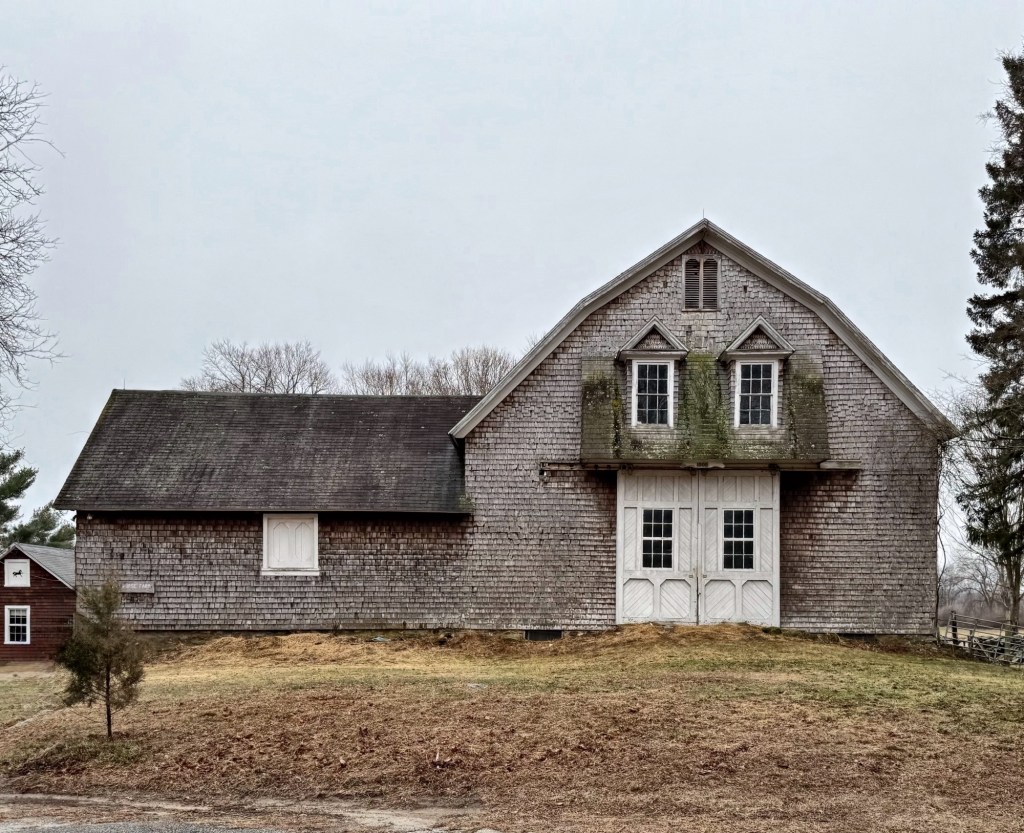
This handsome Shingle style building was constructed in 1906 as a carriage house of a larger farm property in Scotland, Connecticut. The barn is said to have been built for Archie Gallup, who purchased the old Manning farm just west of the town green in Scotland. The 1 1/2-story carriage-house with a gambrel-roof stands out for its principal entry of paneled wooden doors and above, a large, flared hood featuring two pedimented gable-dormers. The entire building is clad with varied shingles to add complexity to the design, catching the attention of all who drive by.

Roughwood Estate Cow Barn // 1892

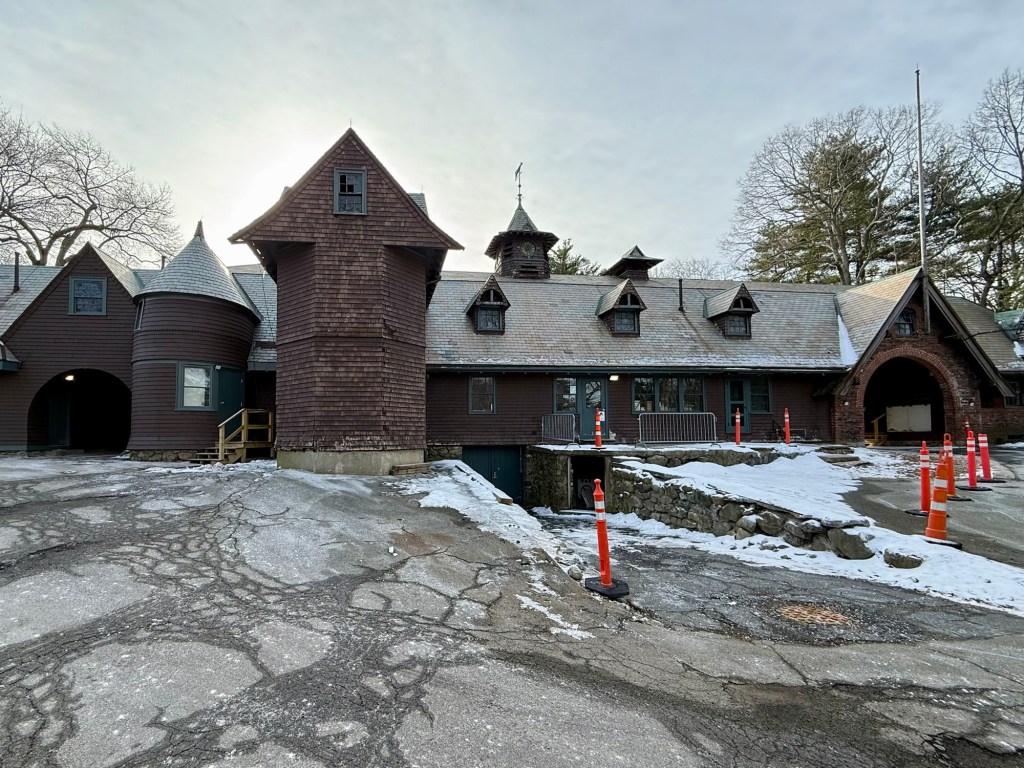
Like the Roughwood Mansion and carriage house, this building was designed and built in Brookline, Massachusetts, in the early 1890s as part of the “Roughwood” estate. Despite its high-style and ornate detailing, the building was actually constructed as a cow barn. Built in two phases for its two owners, William Cox and Ernest Dane, the large barn structure blends Victorian design into a use more reserved for vernacular detailing. The building was designed by Andrews, Jacques and Rantoul, and like the mansion and carriage house, blends Queen Anne and Shingle styles under one roof. Ever-since the estate became a college in the 1960s, the building has been used as a maintenance building. It appears that since it has been owned by Boston College as part of it’s Messina Campus, it is undergoing a thoughtful restoration!

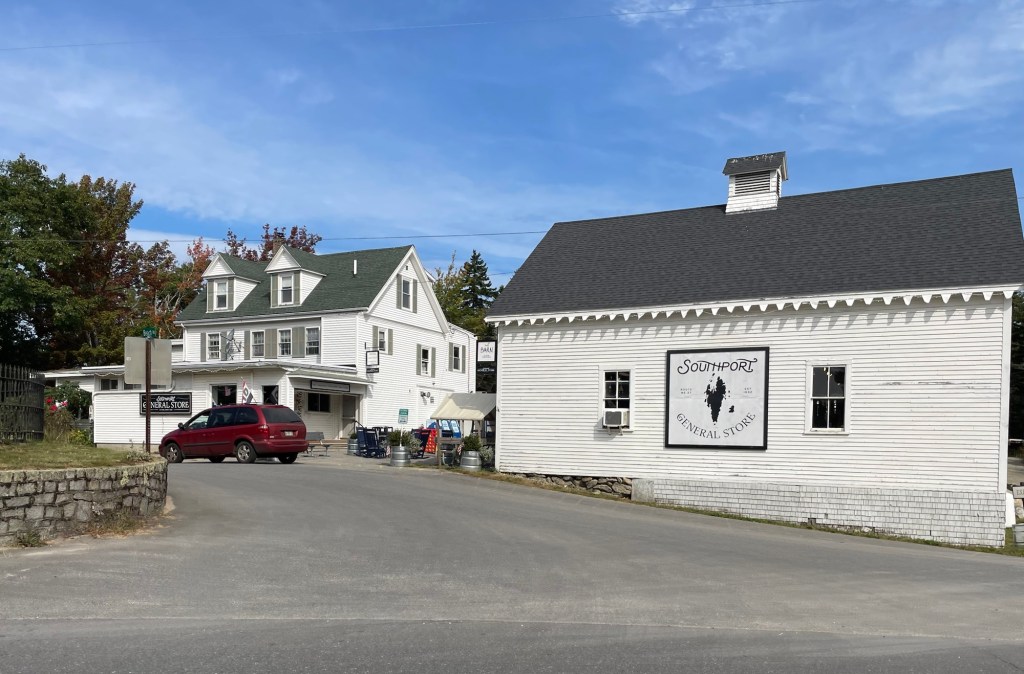
Southport General Store and Barn // 1895

In 1882, Edward Everett Pinkham, known as Everett, opened a new store in one side of his house on Hendrick Hill in the island community of Southport, Maine. The store was known for years as E. E. Pinkham and Son. Everett soon built a proper store adjacent to his house. He served the Town of Southport in many capacities: Postmaster, Town Clerk (1887-1905) Treasurer (1883), and Selectman (1888-1893). Sadly, on May 21, 1895, the store and house burned along with all of the old town records inside. The community helped Everett rebuild the present general store before the busy summer season. Edward’s son “Charlie”, would take over the business and the building has served as the town’s social center ever since. Year-round and summer residents bump into eachother at the store, catch up, and share local news, like every general store should be! Sadly, in so many communities, the “general store” has been replaced by big box retailers or convenience stores, removing the sense of community or place, so these businesses are more important than ever!

Weir Farm Barn // c.1820

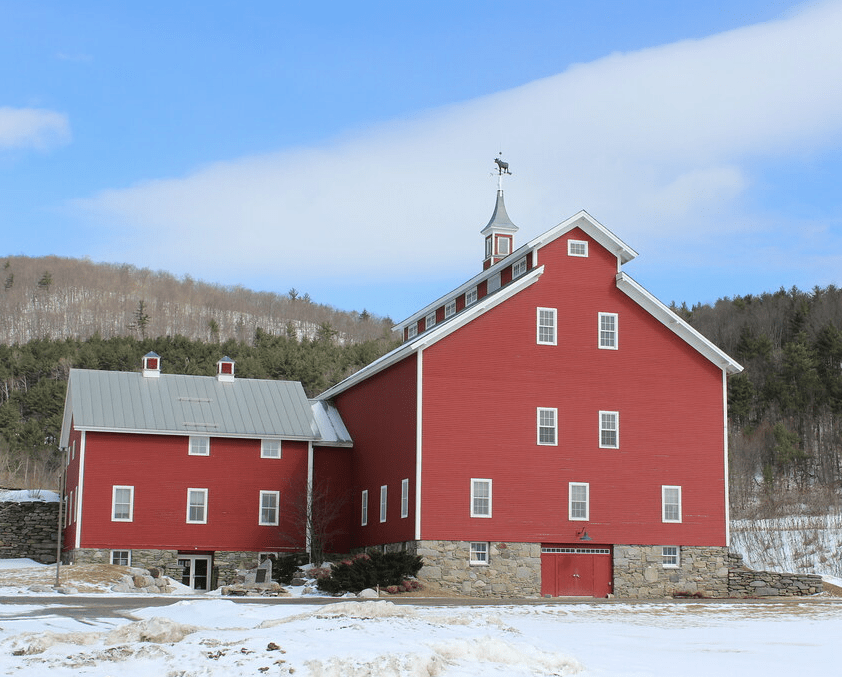
Weir Farm, later an artists retreat and studios, was once a fully operating farm, with horses, cows, oxen, chickens, vegetables, and numerous gardens. To artist Julian Alden Weir, farming was more of a hobby than an economic necessity, undertaken for aesthetic reasons. Weir’s romantic vision of the landscape extended to his use of oxen, carts, and hand tools instead of modern machinery available at the time. Over its long history the barn complex has housed a milking room, a carriage house/wagon shed, a garage, a tack room, an equipment and tool room, hay lofts, a corn crib, and stalls for donkeys, ponies and horses. The rustic barn is a typical “English-barn” built between 1815 and 1835 by The Beers’ family, who owned the property until 1880. Weir used the barn as a prominent feature in many of his paintings like “New England Barnyard” and “After the Ride.” It remains an important piece of agricultural and artistic significance to the now nationally recognized Historic Site.

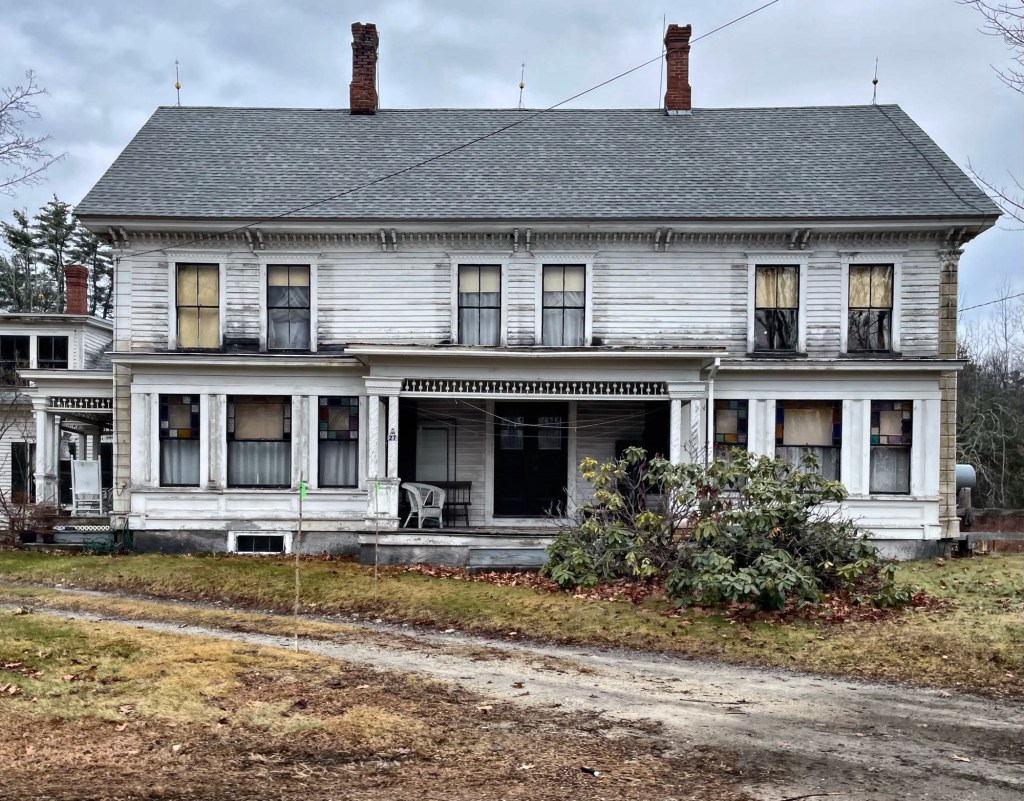
Sumner Stanley House // c.1850

One of the larger homes in Weare, New Hampshire is this sprawling mid-19th century residence, seemingly built around 1850 for Sumner Stanley and his wife, Ruth. Stanley and Ruth (née Dow) acquired land from Ruth’s family and they built their home here. By 1856, Stanley sold a small piece of land to town just to the east of his house for the construction of the North Weare Schoolhouse. The Italianate style house with its Stick style attached barn structure have some amazing detailing!

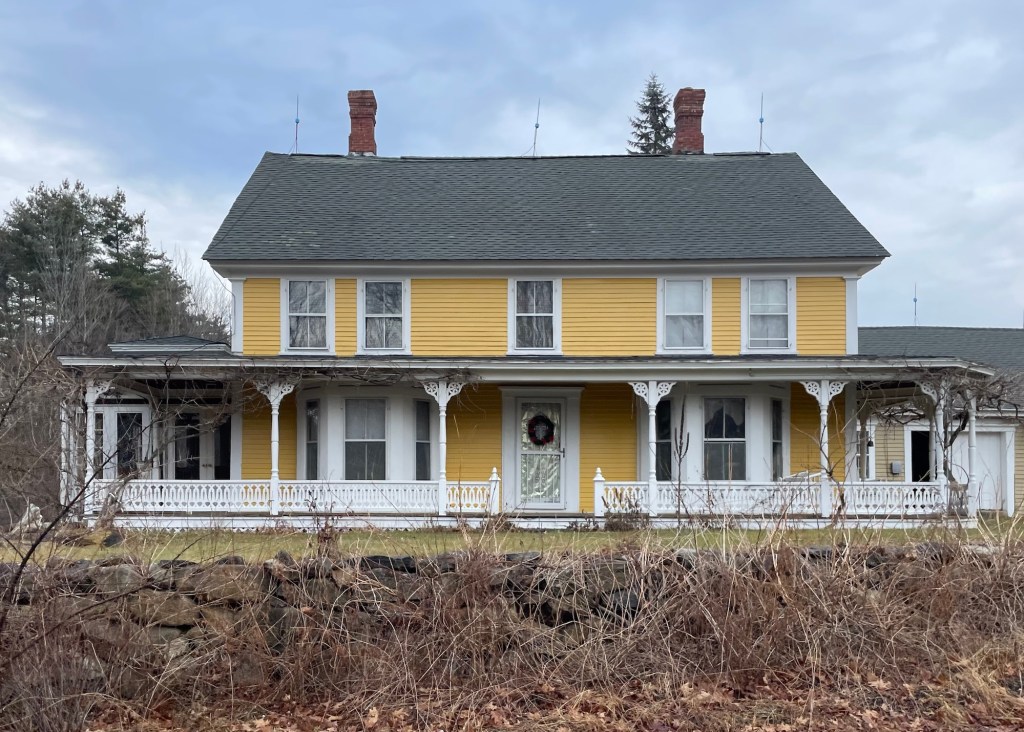
Cyrus Hazen House // c.1850

The backroads of New England always lead you to great discoveries! This time, driving around Weare, New Hampshire, I stumbled upon this large farmhouse on the side of the road. The home was owned by Cyrus Hazen by 1858 and due to its style, I would date it to be built in the 1850s. Cyrus Hazen married Louisa Bartlett (as her second marriage) in 1847 and they appear to have had this home built a few years later. The Hazen’s ran a farm from this home for decades. Sometime after the Civil War, the home would have gotten the full-length verandah (front porch) and a side tower, both Victorian-era additions. The home is now attached to the historic barn by an ell.

Frederic Bronson Barn // c.1895

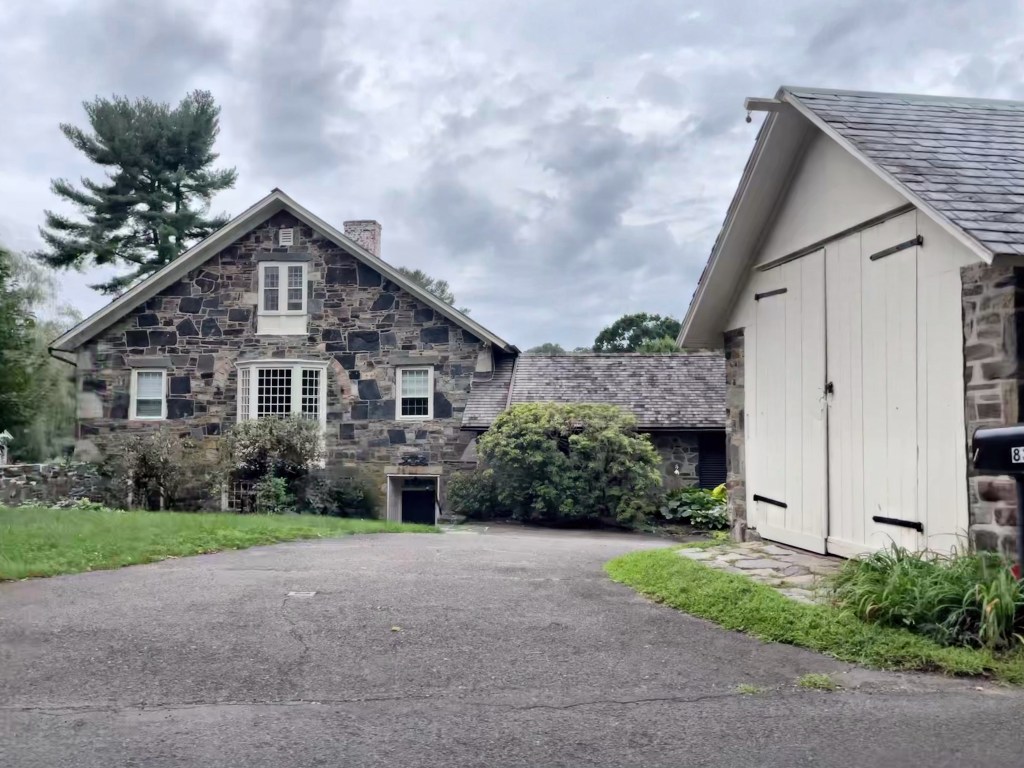
Not many buildings in Greenfield Hill, Fairfield, Connecticut showcase the neighborhood’s transition from farming community to affluent suburb quite as well as this stone barn turned house on Hillside Road. The stone barn was constructed around c.1895 for Frederic Bronson Jr. (1851-1900) a prominent New York attorney and treasurer of the New York Life and Trust Company which was founded by his grandfather, Isaac Bronson. In about 1892, Frederic demolished his ancestral home and hired architect Richard Morris Hunt to design a new country estate for his family. The house was called Verna and is also located in Fairfield. Today Verna is known best as the Fairfield County Day School. As with many wealthy men of the Gilded Age, Frederic wanted his rural retreat to also work as a gentleman’s farm, where he could have staff farm and tend to livestock on the expansive rolling hills bounded by historic stone walls. He appears to have had this barn built for his livestock shortly after the main house, Verna was completed nearby. Bronson died in 1900 and some of the property was later sold off. This property was acquired by a Charles Stillman in 1941 and it is likely him that converted the barn into a charming residence.

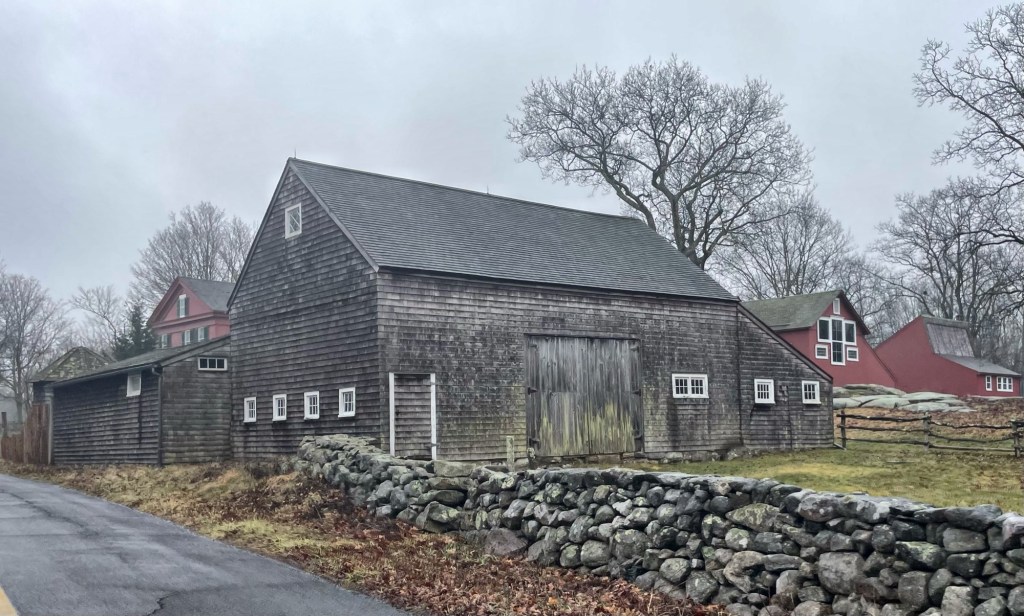
Tudor Barn // c.1845

Built in the 1840’s as a carriage barn, and once attached to a nearby mansion now gone, this barn sits near the eastern shores of Spot Pond, a major feature in the Middlesex Fells Reservation, just north of Boston. The barn sits in Stoneham, Massachusetts, and was a part of Frederic Tudor’s rural estate out in the “country”. Frederic Tudor is best known as Boston’s “Ice King”, he was the founder of the Tudor Ice Company and a pioneer of the international ice trade in the early 19th century. He made a fortune shipping ice cut from New England ponds to ports in the Caribbean, Europe, and as far away as India and Hong Kong. After the turn of the 20th century, many of the buildings surrounding Spot Pond were razed as to secure the watershed, protecting the surrounding town’s drinking water. Frederic Tudors large estate was razed, but the barn survived. Years of deferred maintenance and lack of preservation by the late 1990’s made the old barn threatened with demolition. This was exacerbated by a fire damaging the roof and in 2003, a wall collapsed. Local preservationists rallied together to acquire funding (both private and public grants) to restore the building. It remains a highlight on the walks around Spot Pond and Middlesex Fells Reservation, and is a visual link to the earlier days in what was once remote “Boston”.

Greater Light // c.1790

Located on the island of Nantucket, this barn, now known as Greater Light was built circa 1790. Although the exact date of construction is unknown, historic research indicates it was built sometime during the ownership of two early Macy family members who held the property between 1748 and 1814. The barn remained in the Macy family until 1866, when Zephaniah Macy (then in his eighties) sold the property with the barn to their neighbor David Folger. Folger most likely used the barn for his herd of milking cows. In the summer of 1929, Hanna and Gertrude Monaghan, two Quaker sisters, discovered the barn and saw it as a perfect structure to become their home and art studio when vacationing on the island. The sisters began working on the dilapidated building and set about transforming it into their own summer oasis, adorning it with cast-off architectural elements, decorative objects, and eclectic furniture. Hanna Monaghan, the surviving sister, bequeathed Greater Light and its contents to the Nantucket Historical Association in 1972. The building is open in the summers for visitors who can catch a glimpse at the spirit of Nantucket as an artist’s colony in the 1920s and beyond.