Walker Building // 1891

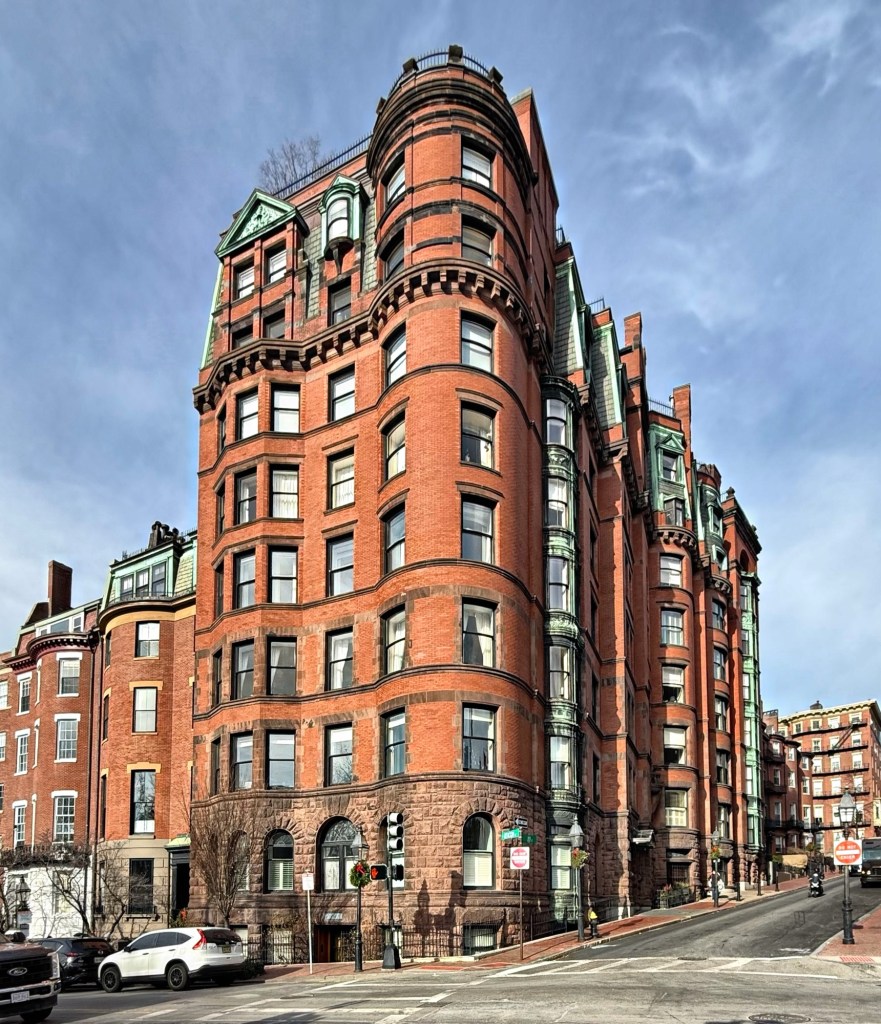
On Boylston Street overlooking the Boston Common, this historic building with two distinct parts is not photographed as much as some of its neighbors, but it is an important visual reminder of the period of growth and development in the city in the late 19th and early 20th centuries. This is the Walker Building, an early office building that was constructed beginning in 1891 in two phases by owner Joseph W. Walker. Mr. Walker hired the architectural firm of Winslow & Wetherell to design the building, which was finished in the Romanesque Revival style with a notable cornice with nine-bay arcade of arched windows and ornate wreath and swag motifs. A major tenant in the building was the Boston office of the S. S. White Dental Manufacturing Company, the largest dental manufacturing company in the world. Less than a decade after the six-story Walker Building opened, Joseph Walker purchased and razed the parcels nextdoor and again hired the same firm (at this time renamed Winslow & Bigelow), to expand the Walker Building, building a ten-story addition in a similar style. The second Walker building housed piano company showrooms and offices along with professional offices of numerous architects and professionals. The Walker Building is now owned by Emerson College, and is used as classrooms, computer labs, and study spots for students with the dining center and bookstore in the former retail spaces.

Steinert Building // 1894

The Steinert Building on Boylston Street in Boston is one of the city’s most iconic and mysterious buildings. The Beaux Arts style building was constructed in 1894 from plans by architects Winslow & Wetherell and contained three floors of display rooms, three floors of teaching studios and practice rooms. The building is arguably best-known for the 650-seat Steinert Hall, a basement concert hall constructed 35′ under ground and considered by some to be one of the most perfect concert halls, acoustically, in the U.S. The building was constructed as the national headquarters for the prestigious firm of M. Steinert & Sons, one of the largest and finest music stores in New England. Established in 1860 by Morris Steinert, a Bavarian musician, musical instrument collector and founder of the New Haven Symphony (originally Steinert’s Family Orchestra). The company was expanded under his second son, Alexander Steinert, who had the Steinert Building in Boston built, requiring a music hall to showcase musicians and their products. The subterranean concert hall closed in the 1940s, following the 1942 Cocoanut Grove fire, the third-deadliest building fire in American history, which resulted in deaths of 492 people. This tragedy inspired an entirely new set of building and fire codes throughout the city; which ultimately would close Steinert Hall, as it had only one means of egress, making it too cost-prohibitive to bring the theatre into compliance. The building was long-operated as a piano showroom, but closed in 2017 and has been vacant ever-since. The basement music hall remains frozen in time, awaiting a new life.

Federal Reserve Bank of Boston // 1972

Established by Congress in 1913, the Federal Reserve System is the nation’s quasi-public central bank. Its primary functions are to set monetary policy, supervise and regulate banking institutions, maintain a stable financial system, and provide financial services to the U.S. government, the public, and domestic and international financial institutions. Organized in 1914, the Federal Reserve Bank of Boston is one of 12 district banks across the country and serves the six New England states. Construction for the Boston Reserve’s Renaissance revival bank was begun in 1920 and finished in 1922, but was outgrown in the second half of the 20th century. The original building would be landmarked and is now known as the Langham, a luxury hotel. Planning began on a newer office and a site was acquired on waterfront land cleared from Urban Renewal in the late 1960s. The current building was constructed between 1972 and
1974, and occupied by the bank in 1977. Designed by the firm Hugh Stubbins & Associates, the complex occupies a full city block, with the 32-story tower and a 4-story section serving as the bulk of the mass. A 600-ton major steel structure called a “truss” marks the beginning of the tower’s offices above the breezeway. The exterior is natural anodized aluminum, which acts as a curtain wall and weatherproof facing. The aluminum spandrels or “eye-brows” shade the building interior from the sun in the summertime and allow more sunlight in the winter months. Love it or hate it, this building is extremely significant architecturally for its Modern design and materiality, and for its engineering. It has become a visual landmark and anchor into Boston’s dense Downtown.

South Street Building // 1899

One of the larger mercantile buildings in the Leather District of Boston is this turn-of-the-century block, historically known as the South Street Building. Bounded by three streets, this eight-story building was constructed in 1899 from plans by Winslow, Wetherill & Bigelow and is a great example of a Classical Revival style commercial block with Beaux Arts motifs to further decorate the facades. In 1901, as expected, the city directories list many leather and soft goods-related occupants in the building, including: The American Calfskin Leather Company, John F. Moore Co., leather dealer, and Charles D. French, leather remnants dealer. The building was renovated in 1990 and rebranded as Lincoln Plaza, becoming a major space for non-profit offices.

Lincoln Street Garage // 1956

Few buildings in Boston showcase the evolution of its neighborhood (or bring out the architectural critics) quite as well as the Lincoln Street Garage in the Leather District of Boston. This Post-WWII mixed use building was originally constructed in 1956, on the former site of the United States Hotel (1839), one of the first major hotels in the nation, which was razed in 1930. The original building was designed by architect Archie Riskin, and stood three stories high with parking on half of the second floor and on the 3rd floor and roof. A fifth floor of office space was designed and constructed by 1959 also by Riskin. Due to its site at the edge of a historic commercial/industrial district and adjacent to the Central Artery, a raised highway that snaked its way through Downtown Boston, the building was minimally visible and faded away to obscurity until the late 1990s when the highway was buried under the city as part of the “Big Dig”. The open scar and subsequent re-greening of much of the former highway spaces necessitated the owners to re-work the building, due to its newfound gateway presence into the neighborhood. Brian Healey Architects renovated the building, adding an additional floor of offices and reworked facades. The result is a Post-war mixed-use hodgepodge of a building that expresses its use visually on each floor in a no-nonsense way, making it a unique urban building. Additionally the building has long been rented to small businesses, almost all Asian-owned with direct ties to the Chinatown and Leather District neighborhoods. Recent plans have been approved for a new office tower on the site and supported by preservation groups stating that “the existing garage is historically significant or beneficial to the neighborhood”, but to me, the further erasure of quirky buildings for more out-of-context developments is not the way to go.

Albany Building // 1899

One of the last major 19th century buildings erected in Boston’s Leather District is also one of the finest examples of Beaux Arts architecture in the city. This is the Albany Building, built in 1899, and fills an entire city block. The Albany Building was designed by Peabody and Stearns and built by Norcross Brothers as the offices for the United Shoe Machinery Corporation. Its two-story base is adorned with swags and cartouches and its fifth floor is topped with a complex cornice. The use of beveled corners and ornate detailing break up the massing of the building which otherwise, would read like a box. The building today serves as an important visual gateway into the Leather District and its context of late 19th century commercial blocks centered around the leather and shoe manufacturing businesses.

Lincoln Building // 1894

Designed by a prominent architect, Willard T. Sears, the Lincoln Building at Lincoln and Essex streets, is a handsome example of a late 19th century mercantile structure consisting of stores, office & loft space, serving as an important visual anchor the almost uninterrupted neighborhood of the Leather District of Boston. The building is the second of its name, with the first Lincoln Building succumbing to the Lincoln Street Fire of 1893, which started as a small fire in a restroom of a toy wholesaler, eventually spreading to a storage room full of fireworks, which exploded, eventually killing at least five, and forced many others to jump from buildings to seek safety. The replacement building is Renaissance Revival in style with a stone base and classically decorated facades. The recessed entrances set within arches and the series of columned bays at the ground floor are truly special. The building was long-occupied by leather dealers and companies, but was converted to residential use in 2006 with condos on the upper floors and retail spaces on the street.

Hotel Essex – Plymouth Rock Building // 1900

The construction of a new South Station Terminal in 1899, prompted a development boom for the nearby area, which had for the previous decades been almost entirely mercantile and centered around the leather and woolen industries. Due to increased land values and an influx of travelers to the area, developers saw an opportunity to erect this building to serve as a hotel for visitors to Boston via South Station. Boston architect, Arthur H. Bowditch, furnished plans for this building in the Beaux Arts/Renaissance Revival style, with use of brick and limestone construction, ornate finishes at the façade including the fluted pilasters, arches and cartouches in the spandrels. The building was completed in 1900 and known as Hotel Essex and featured a long, storied history as a hotel until it closed in the second half of the 20th century. After years of deteriorating conditions, the building was adapted as the corporate offices for Plymouth Rock Assurance Corporation in 1982. The building was restored and has been known as the Plymouth Rock Building ever since.

Stone & Webster Office Building // 1975

Stone & Webster, established in 1893 by MIT graduates Charles Stone and Edwin Webster, was a national leader in electrification and power generation, and provided services in engineering, construction, environmental remediation, infrastructure, and plant operation for industrial clients. After the Boston Redevelopment Authority acquired and demolished sections of South Station for redevelopment, Stone & Webster decided to relocate their offices to this new site. Los Angeles-based architectural firm Welton Becket & Associates, designed the office building in a late International-style, which serves as a counter to the masonry and classically designed, South Station nearby. The steel frame with metal and glass skin and boxy form are effective at delineating the building from its neighbor, but is not pedestrian-friendly at the ground level as the raised ground floor is lined at the sidewalk by concrete steps. The building is now largely leased to Fidelity Investments.

South Station // 1899

When the railroads serving Boston were first laid out and built, each line stopped at its own terminal which created a dysfunctional and cumbersome travel experience for those entering or leaving the city. The Boston Terminal Company, established in 1897, was charged with the task of consolidating service from the four terminals at a single terminal, a union station (similar to North Station), for routes south of the city. South Station was designed by architects were Shepley, Rutan and Coolidge of Boston and quickly became New England’s busiest transportation center. The five-story Classical Revival style station built of stone is an architectural landmark with three-story Ionic colonnade crowned by a clock surmounted by an eagle, stands above the triple-arched brick masonry lower level corner entrance. While the station handled 125,000 passengers each day during World War II, post-war passenger rail traffic declined in the US. South Station was sold to the Boston Redevelopment Authority in 1965 and (surprise!) they demolished portions of the building and later developed plans to demolish the rest of the station and replace it with a multi-use development including a new train and bus station with large parking garage. Luckily for everyone, the BRA failed in this endeavor and the building remained to the point where public transportation is again invested in and beloved and the building has since been restored. Recently, a glass “crown”, known as South Station Tower, a 51-story designed by Pelli, Clarke & Partners, with new office space, luxury residences, and a redesigned, arched interior concourse (which in my opinion, is the best part). The redevelopment is a push towards transit-oriented development and blends new and old in an innovative way.

What do you think of it?