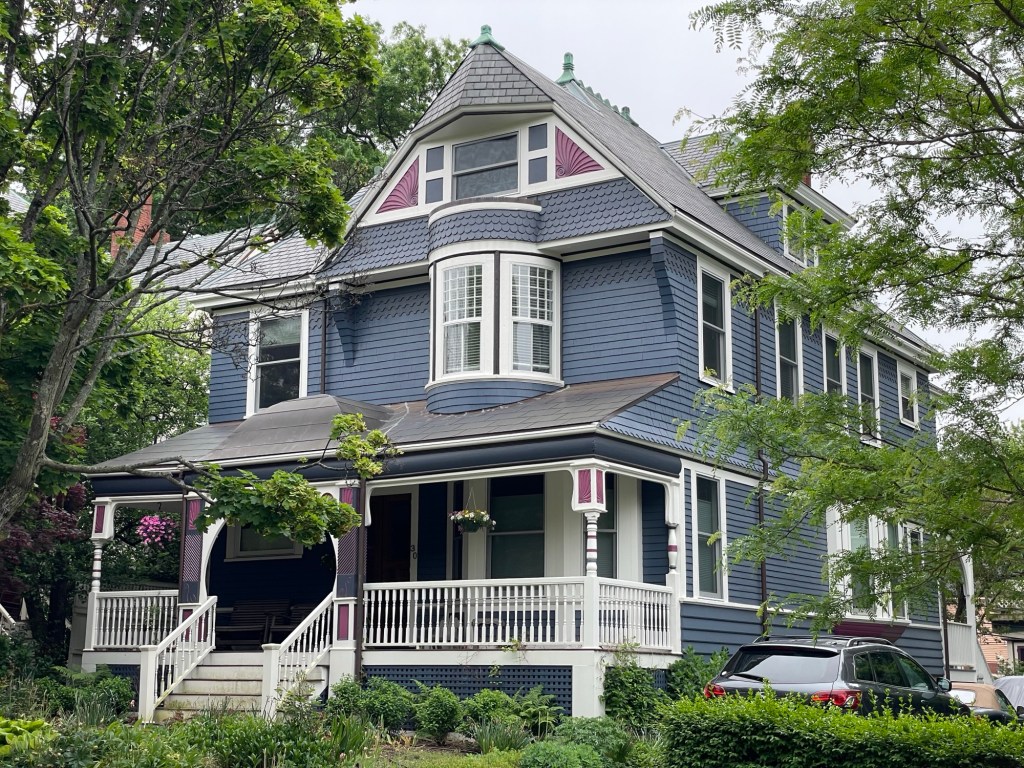
Francis Street in Brookline, Massachusetts, has some of the finest Queen Anne Victorian residences in the Boston area. This is the Potter-Leland House, built by 1888 by William Potter, a wealthy shoe manufacturer and businessman who developed rental housing in the neighborhood not far from his house on Kent Street. Various exterior wall textures, irregular massing, and turned posts on the front porch contribute to the Queen Anne character of this house, but the real showstopper is the rounded bay projection with three, 25-over-2 (yes you heard that right) curved sash windows! The property was later purchased by Herbert M. Leland, a broker.
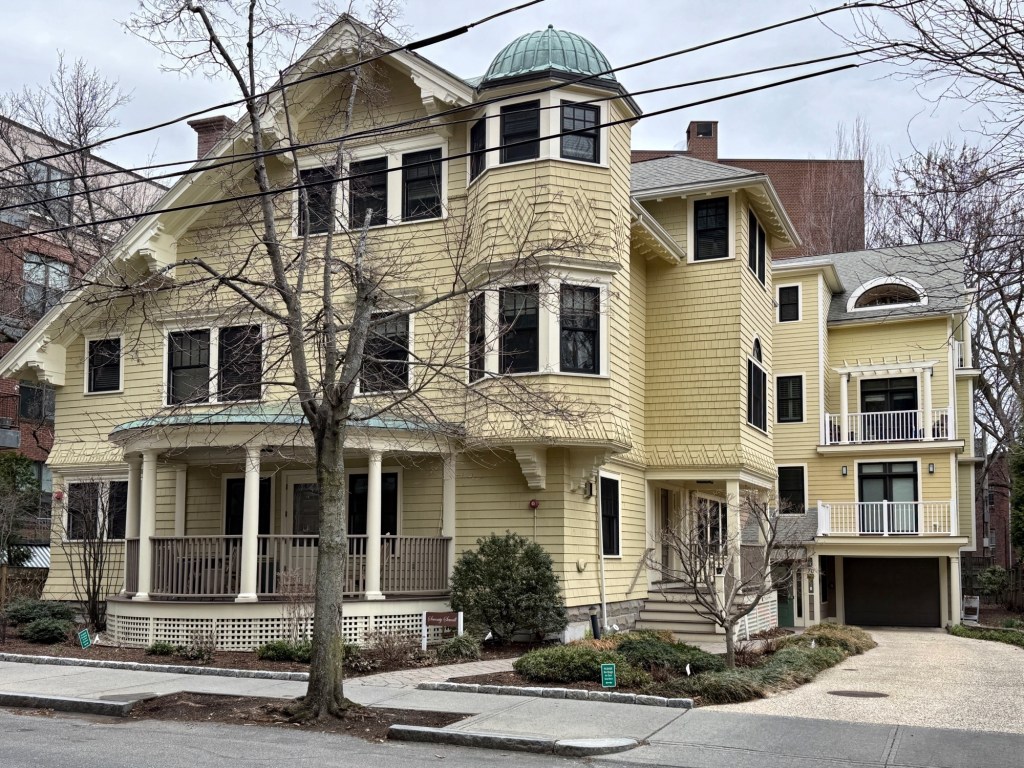
Located on Sewall Avenue in Brookline, Massachusetts, the Charles P. Flagg House exemplifies upper-class single-family housing built in the late 19th century that has been added onto and converted into multi-family housing to serve a growing city. Charles Partridge Flagg (1851-1911) was a real estate developer and head of the D. F. Flagg & Co., a wholesale liquor company his father started in Boston. He purchased the former Dexter property, subdivided the estate, and hired architect Julius A. Schweinfurth to design a home for his family. “Jule” Schweinfurth was long-associated with the firm of Peabody & Stearns of Boston, which in the late 19th century, was one of the premier architectural offices in the United States, but when he was not offered a partnership offer by his bosses, he established a new firm under his name. For the Flagg House, Schweinfurth blended the Shingle, Queen Anne, and Arts and Crafts architectural styles with a unique asymmetrical roofline, wide overhanging eaves with cross brackets and exposed rafter tails, consistent shingle siding, and a two-story polygonal oriel with domed roof at the corner. The Flagg House was moved forward on the lot to facilitate a rear addition and completely renovated in 2011, transforming it into a seven-unit condominium building with garage and elevator. This example of “gentle density” is exactly what communities should allow for, to preserve the character at the streetscape but provide additional housing.
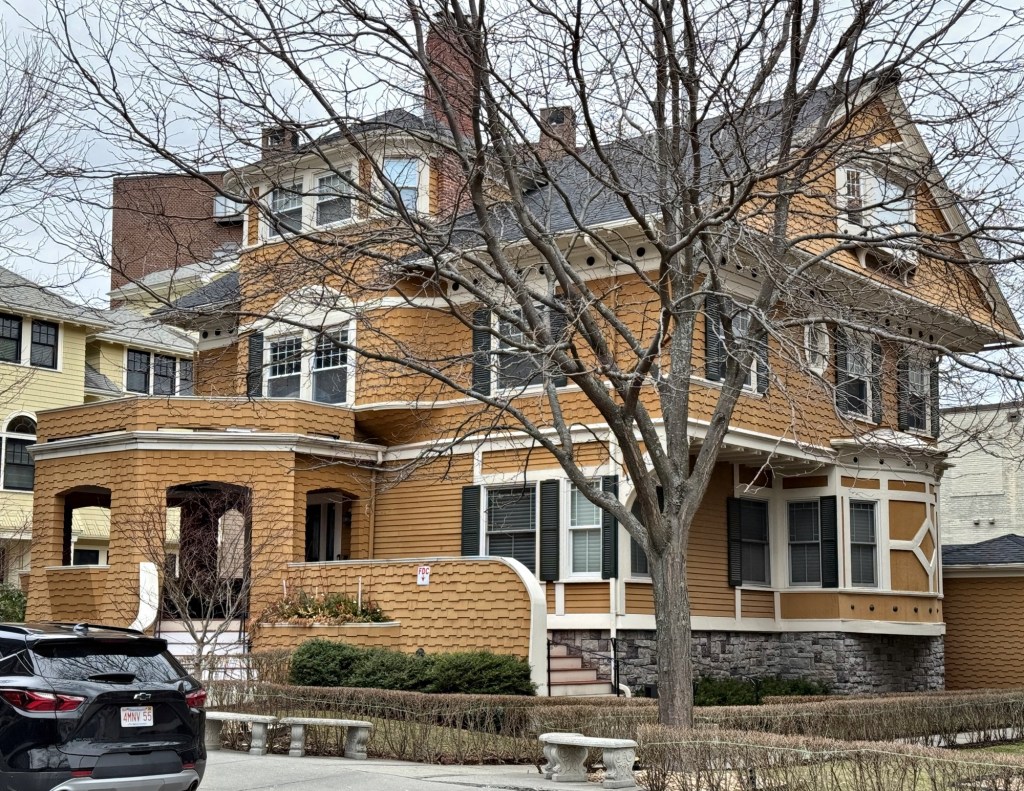
An expression of the Shingle style in all her beauty, the George B. Dexter House on Sewall Avenue in Brookline was built in 1885 both as a residence and a billboard advertising the owner’s business, really. The residence was built for George B. Dexter (1854-1935) a partner in the Dexter Brothers Company a paint and stain manufacturer that was a favorite of architects in the late 19th and early 20th centuries. For his Brookline residence, George Dexter hired architect S. Edwin Tobey to design this Shingled masterpiece with continuous shingle siding with rounded bays and a shingled piazza to showcase the stain products of his company. According to articles, Dexter also stained and painted the interior a variety of colors to showcase the wide range of options his company had. George Dexter would move to Pill Hill neighborhood in a new home just a decade after having this residence built, likely caused by the development of apartments and commercialization in the Coolidge Corner area by the turn of the century. The Dexter House was converted to a two-family in the 1920s and today has three condominium units, with owners clearly taking great pride in this significant residence.
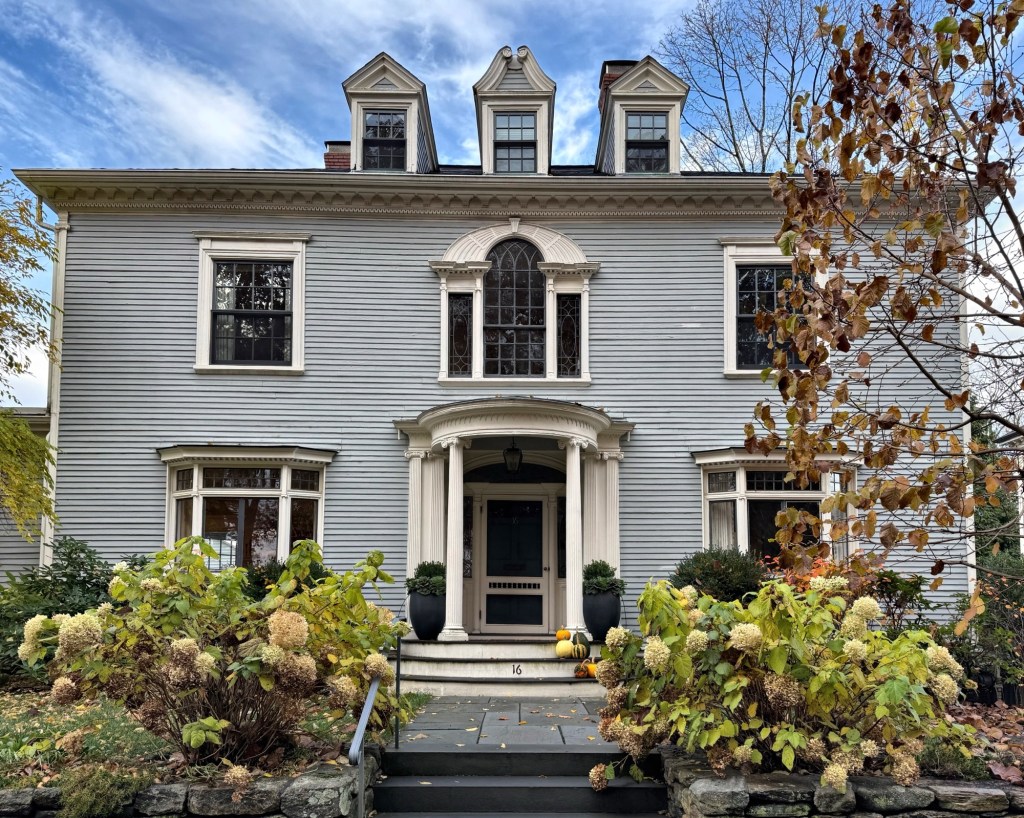
This Colonial Revival style single-family house on Emerson Street in Brookline Village, was built in 1893 on the former Emerson Estate, that was subdivided by the heirs of Elijah Emerson as Brookline Village filled in during the late 19th century. This house was seemingly built for Elijah’s daughter, Sarah C. Emerson Davis, and her husband, George Peabody Davis from plans by Boston architect, Olin Wesley Cutter. Of particular note, the Davis House features a symmetrical facade with round entry portico, Palladian stairhall window with leaded glass, and pedimented dormers, with the center dormer in a swan’s neck pediment. The oddly proportioned pilasters with tiny Ionic capital on the corners of the house were great to see as well!
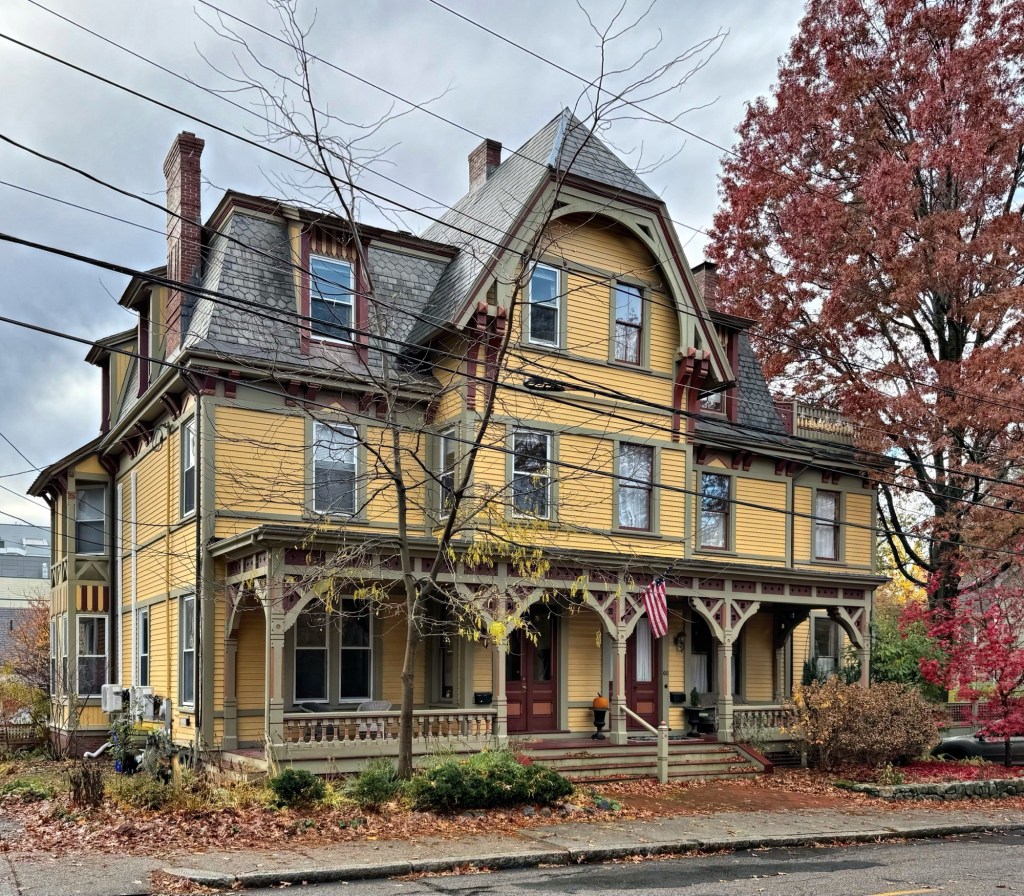
Elijah Carleton Emerson (1807-1888) was a wealthy Boston merchant, making his fortune as Director of the Second National Bank and President of the Middlesex Horse Railroad. In his late 30s, he purchased land in Brookline Village and established his estate on the land that is now Emerson Park in 1846. The bucolic setting of his estate included a pond, boathouse and adjacent cottage, but as the surrounding area continued to develop with easy access to Downtown Boston, Elijah Emerson began to develop his estate. Emerson began to build residences on his land for supplemental income. This handsome Stick style double-house was built around 1880 and rented by Mr. Emerson and was eventually occupied by his granddaughter, Tirzah and her husband, George Francis Arnold. The residence features a mansard roof, decorative brackets and applied stickwork, and a handsome porch with turned posts.
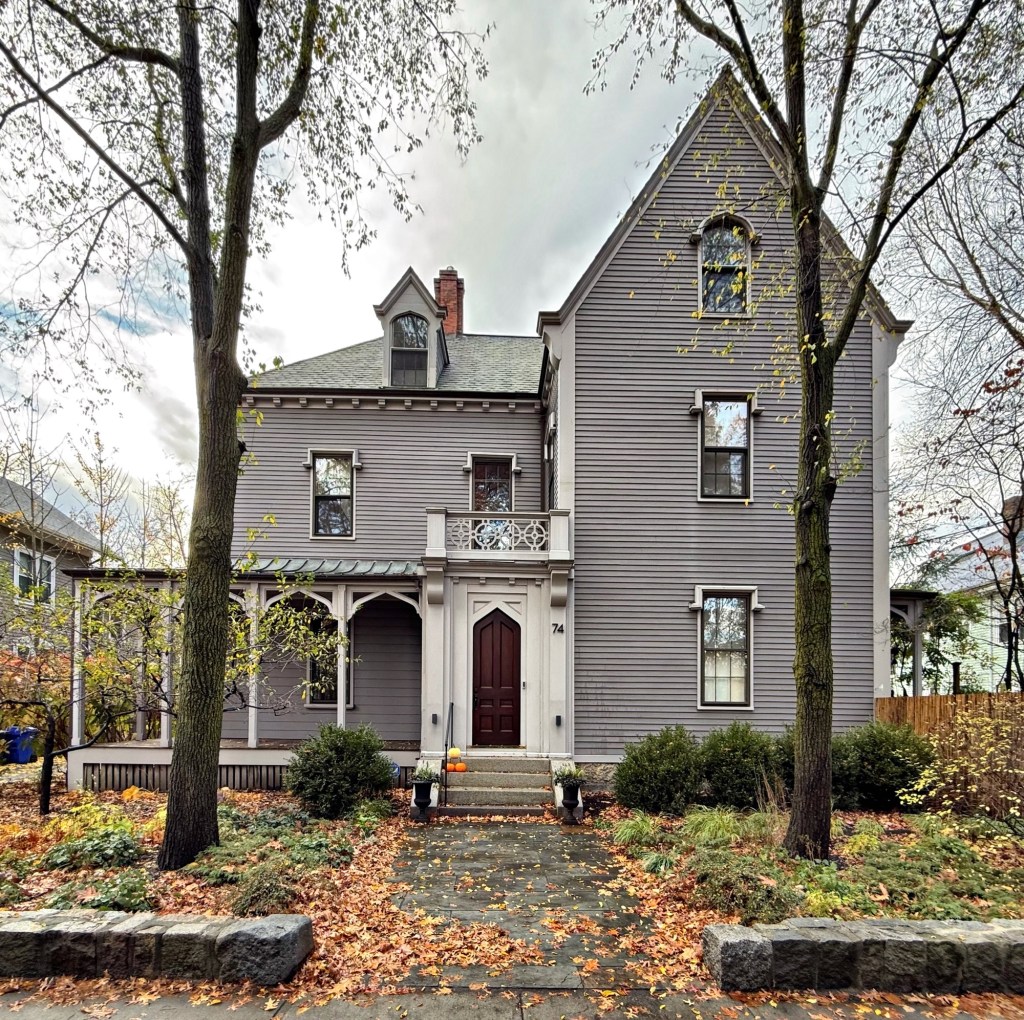
Elijah Carleton Emerson (1807-1888) was a wealthy Boston merchant, making his fortune as Director of the Second National Bank and President of the Middlesex Horse Railroad. In his late 30s, he purchased land in Brookline Village and established his estate on the land that is now Emerson Park in 1846. The bucolic setting of his estate included a pond, boathouse and adjacent cottage, but as the surrounding area continued to develop with easy access to Downtown Boston, Elijah Emerson began to develop his estate. Emerson began to build residences on his land for supplemental income. After his death in 1888, Emerson’s two daughters, Sarah Davis and Tirzah Snell Arnold, maintained the property but sold it to the Town of Brookline in 1907. Brookline officials originally sought to build a new library on the site, but ultimately built it on Washington Street in 1910. The Emerson house and carriage barn were moved across Davis Street from their original site and Emerson Park was established. Emerson’s granddaughter, Mrs.Katharine Snell and her husband, inventor, Cullen B. Snell moved into the relocated house. The Elijah Emerson House (and carriage house at the rear) is a great, well-preserved example of a suburban Boston residence designed in the Gothic Revival style.
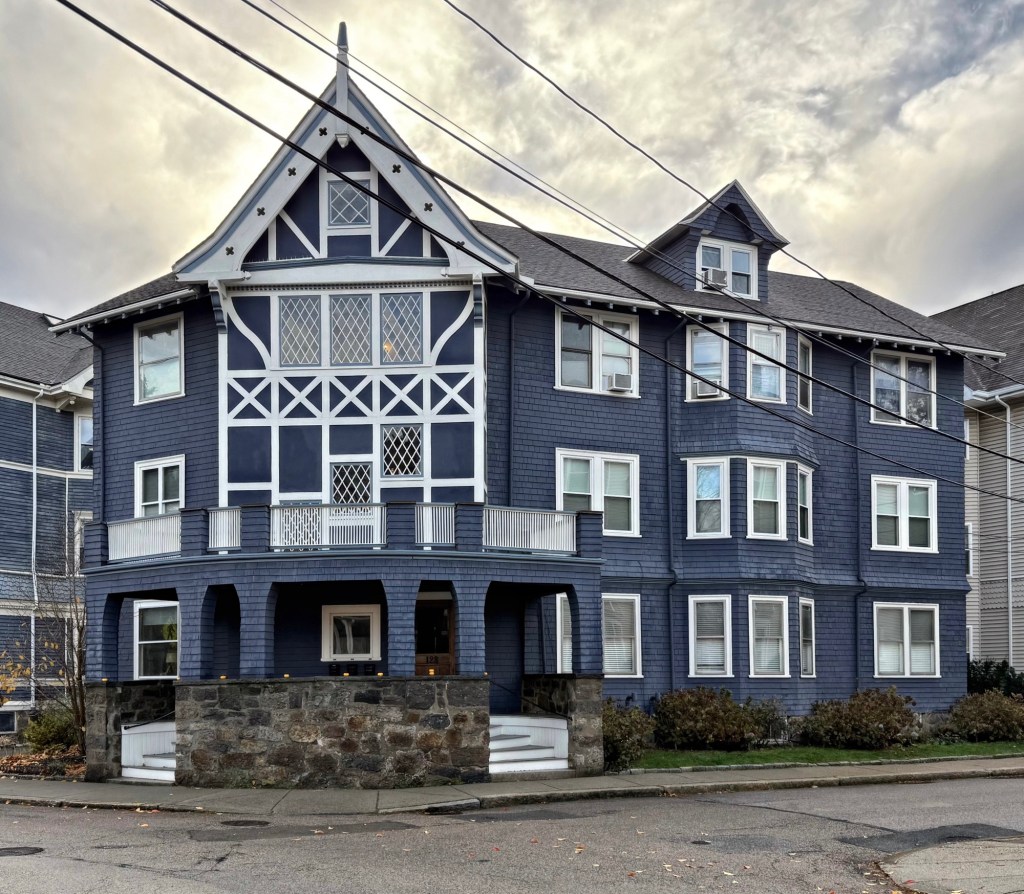
This handsome, and unique example of a three-decker in the English Revival style is located on a corner lot at 128 Davis Avenue in the Emerson/Brookline Village neighborhood of Brookline, Massachusetts. Built in 1904 from plans by architect and genealogist, J. Gardner Bartlett, whose work focused on colonial New England and the English origins of colonial families. Trained as an architect at MIT, he gave up architecture for genealogy, but still occasionally designed buildings in the Boston area. The building here was developed for Richard Graham, an Irish immigrant, who along with his wife, operated a laundry business in the village. The use of a shingle and stone entrance porch and entrance bay with stucco half-timbering and diamond-pane casement windows stand out architecturally as one of the few examples of a three-decker built in this style in New England.
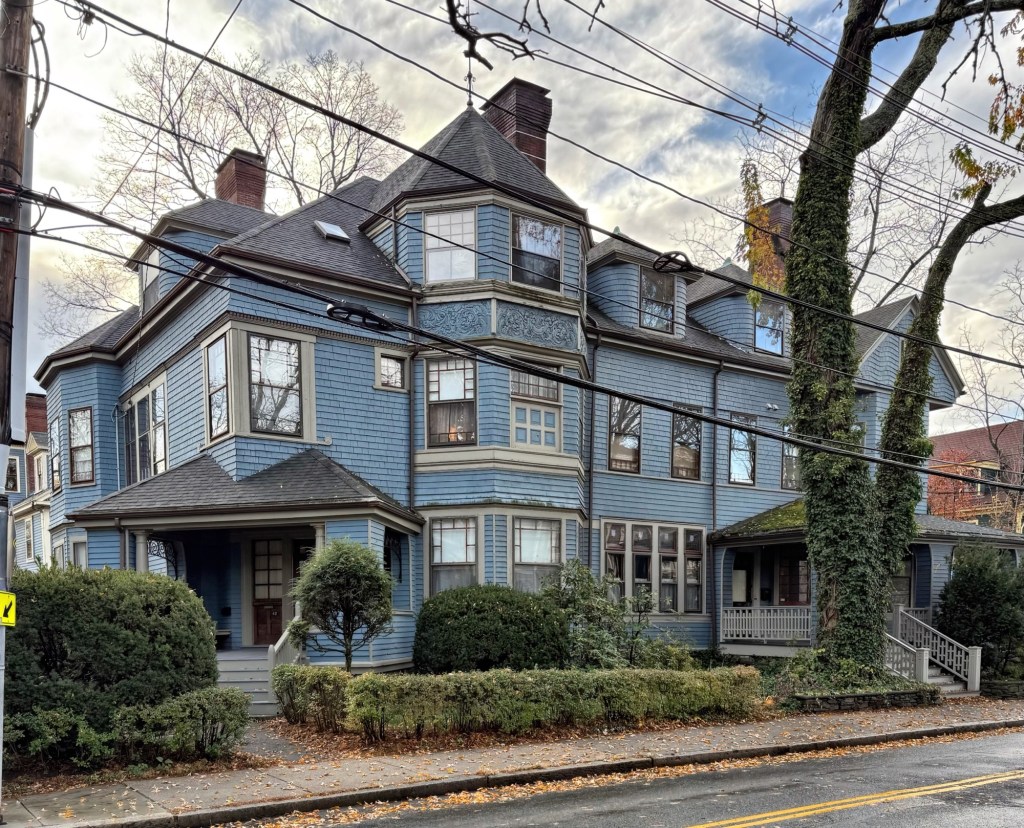
John Dean Sturtevant (1816-1889) was born in New Hampshire and became engaged there in local woolen mills, quickly growing into advanced management positions. He operated woolen mills in New Hampshire, Maine, Connecticut, and Massachusetts, and settled in Brookline where he had access to other states via excellent rail service. When he died in 1889, John’s heirs inherited their late-father’s properties, and began to develop them as Brookline filled out in the last decades of the 19th century. This handsome double-house at the corner of Cypress and Waverly streets was built in 1892 by the Sturtevant Estate, who rented the property to two families of wealthy residents. The Sturtevant Double-House is a landmark and exceptionally preserved example of the Queen Anne style, with varied siding, asymmetrical forms, complex roofline with dormers, and applied ornament in the form of carved panels.
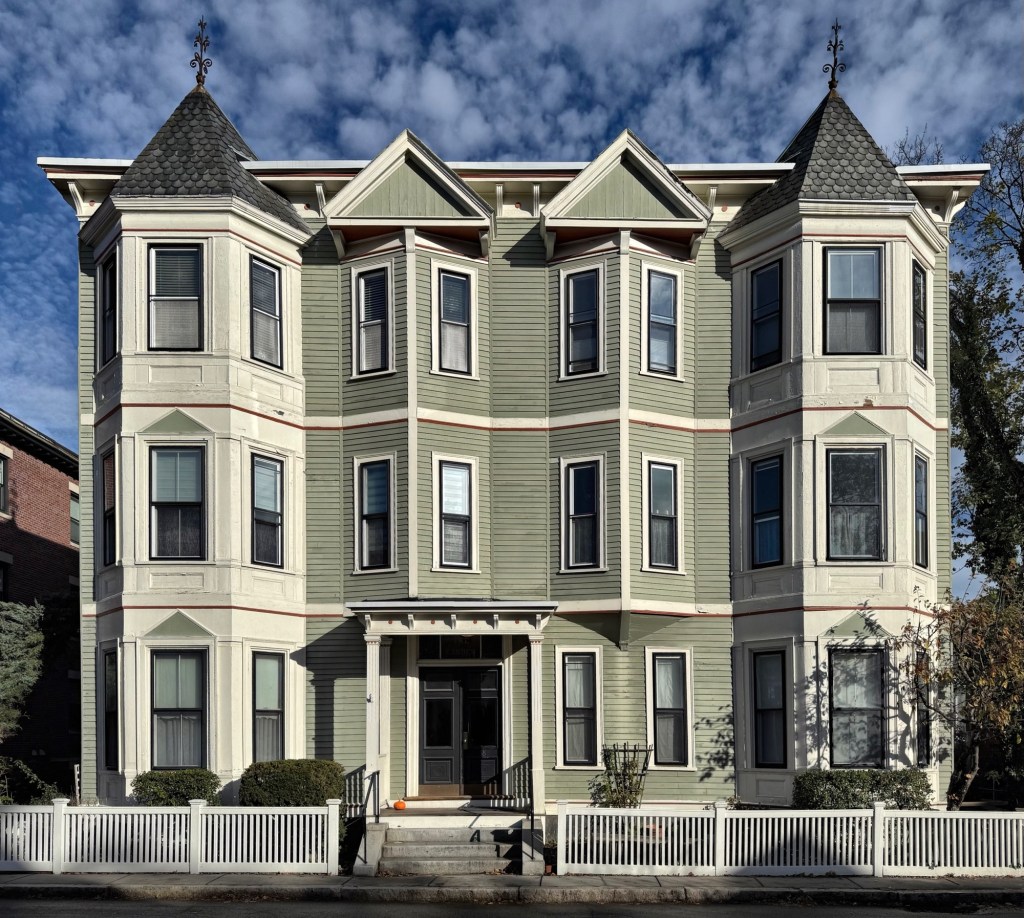
The Linden Apartments is an early multi-family apartment building in Brookline Village that shows how density can be done tastefully. The building is located at the center of Linden Place, Brookline’s first planned subdivision which was laid out in the 1840s. By the end of the 19th century, development pressure associated with the growth of Brookline Village lead to further subdivision of the original building lots and greater density of settlement in this neighborhood. The Lindens was constructed in 1885 by and for James W. Tobey (1830-1914), a local builder, as an income-generating property. Designed in the Queen Anne style, the Linden Apartments contained six suites, all with exceptional quality materials and finishes. The façade is embellished with two octagonal bays at the ends and two angled bay windows with gables which break up the otherwise rectangular form. The building has been lovingly maintained by residents and contributes to the rich history of Brookline Village from a sleepy village to a vibrant and dense “downtown”.
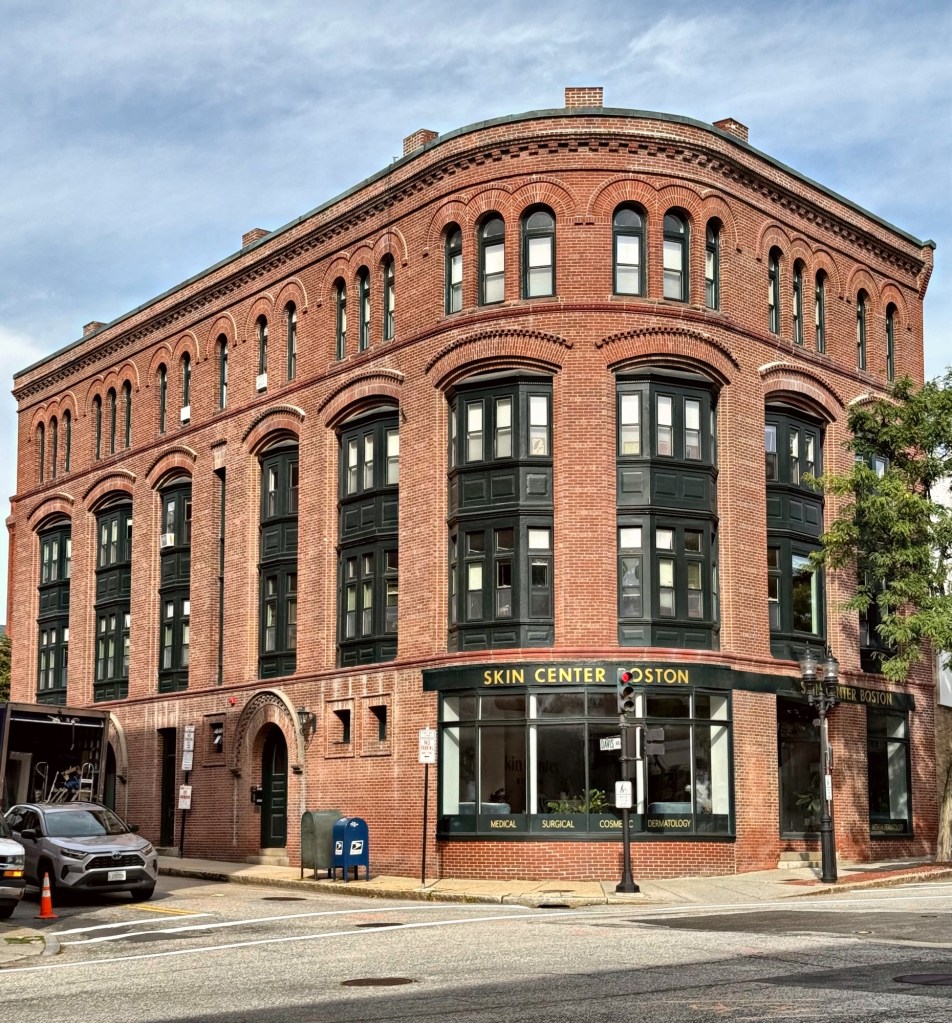
One of the more impressive commercial blocks in Brookline is located at the corner of Washington Street and Davis Avenue in Brookline Village. The Seamans Block was developed by its namesake, James Manning Seamans (1834-1908), a wealthy grocer who operated a store from the building. The handsome masonry block was built from designs by the firm of Shepley, Rutan and Coolidge, a successor firm to H.H. Richardson. As partner of the firm, Charles H. Rutan lived just down Davis Avenue, it is likely that he was in charge of this design. The structure follows the Richardsonian Romanesque style, popularized by Richardson through the rounded corner and heavy arches, but is done entirely in brick rather than adding brownstone or terracotta detailing. The building has long been an excellent example of a historic “mixed-use” block with ground floor retain and apartments above, something that many new developments try and emulate today.
 Buildings of New England