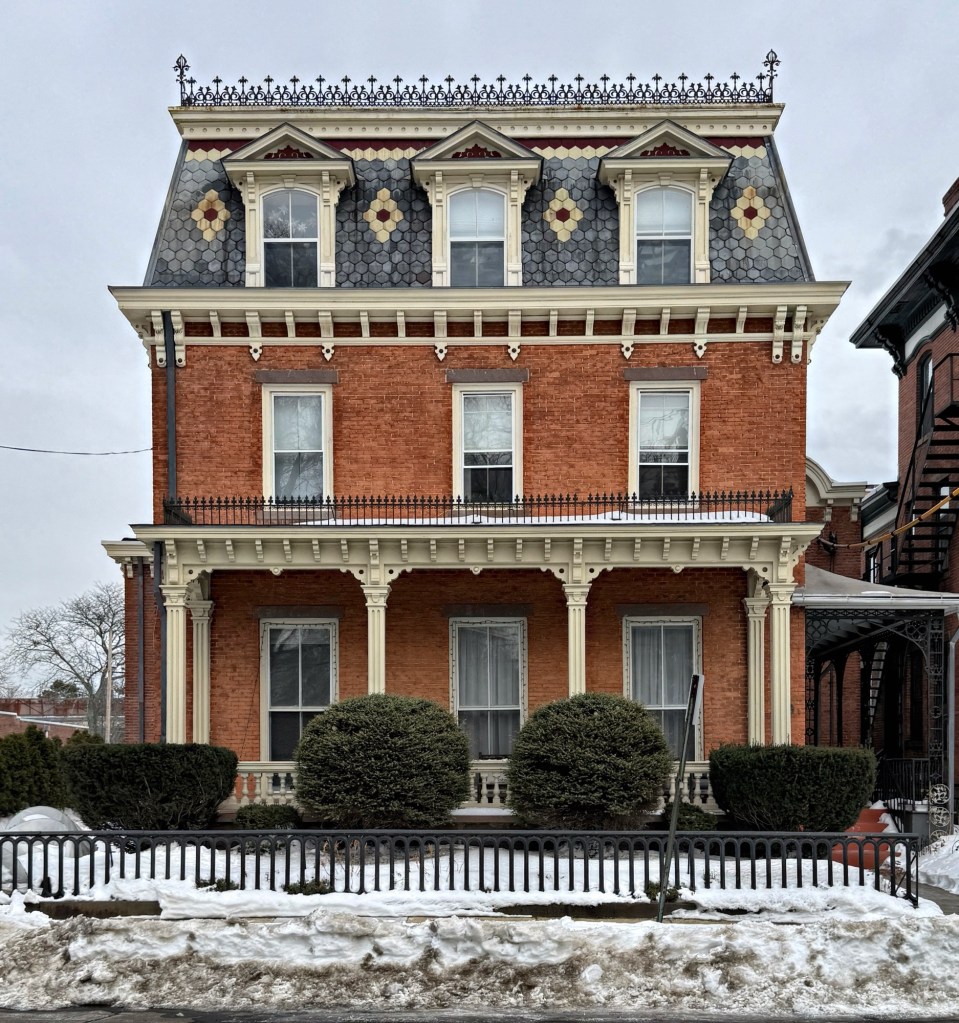
This handsome Second Empire style residence on Wooster Place in New Haven was built in 1833, but in the Greek Revival style and later renovated to its current appearance. The house was one of the earliest properties built fronting Wooster Square and constructed for merchant Theron Towner, who then sold it to Rev. Stephen Jewett (1783-1861), an Episcopal minister of a nearby church. The house was designed and constructed by James English, who later became a successful manufacturer and politician. It is unclear what the original house looked like, but after the Civil War, the house was renovated with the addition of the slate mansard roof with iron cresting and side porch.
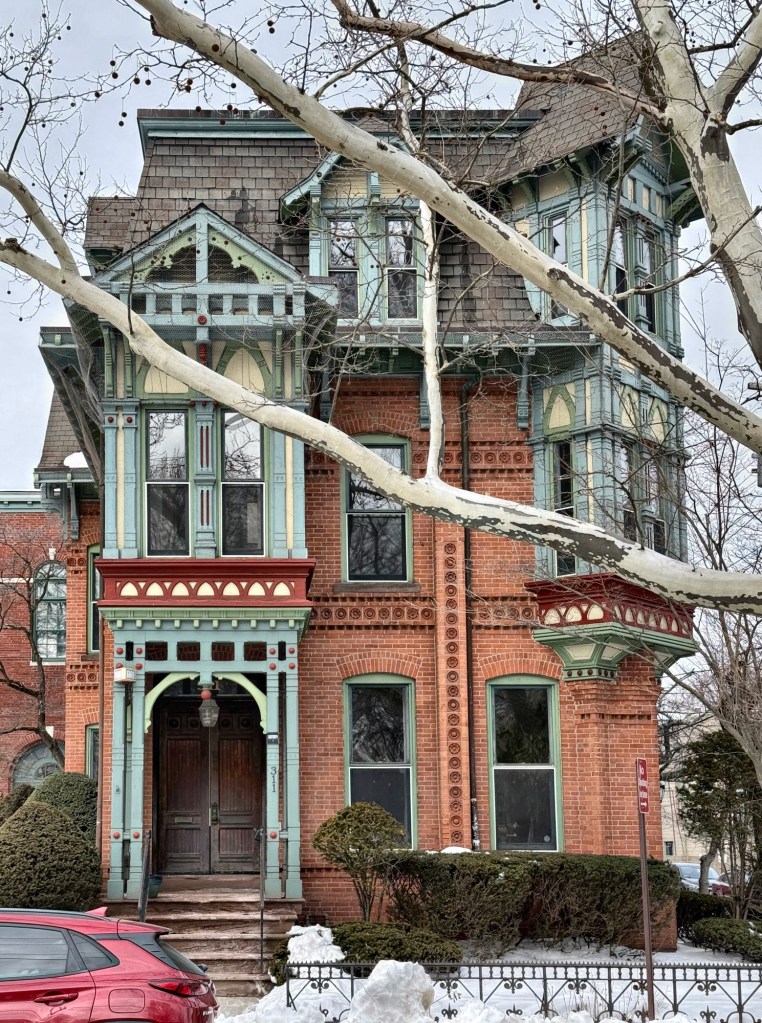
The Max Adler House on Greene Street in New Haven’s Wooster Square neighborhood is a flamboyant example of Victorian-era residential architecture that is hard to classify as an architectural style. The residence was constructed in 1879 for Max Adler (1841-1916) a German-born Jewish immigrant who grew up in New Haven and became a leader in industry at a young age. Max founded the Strouse & Adler Corset Company, which is said to be the first corset factory in the United States. The company did very well and he was able to erect this residence overlooking Wooster Square park for his family. Architecturally, the house has a mansard style roof, a feature of the Second Empire style; applied stickwork in the wooden bays, porch and dormers, a feature of the Stick style; and embroidered panel brickwork and terra cotta, elements of the emerging Queen Anne style. The Adler House has been lovingly preserved and is one of New Haven’s finest Victorian-era residences.
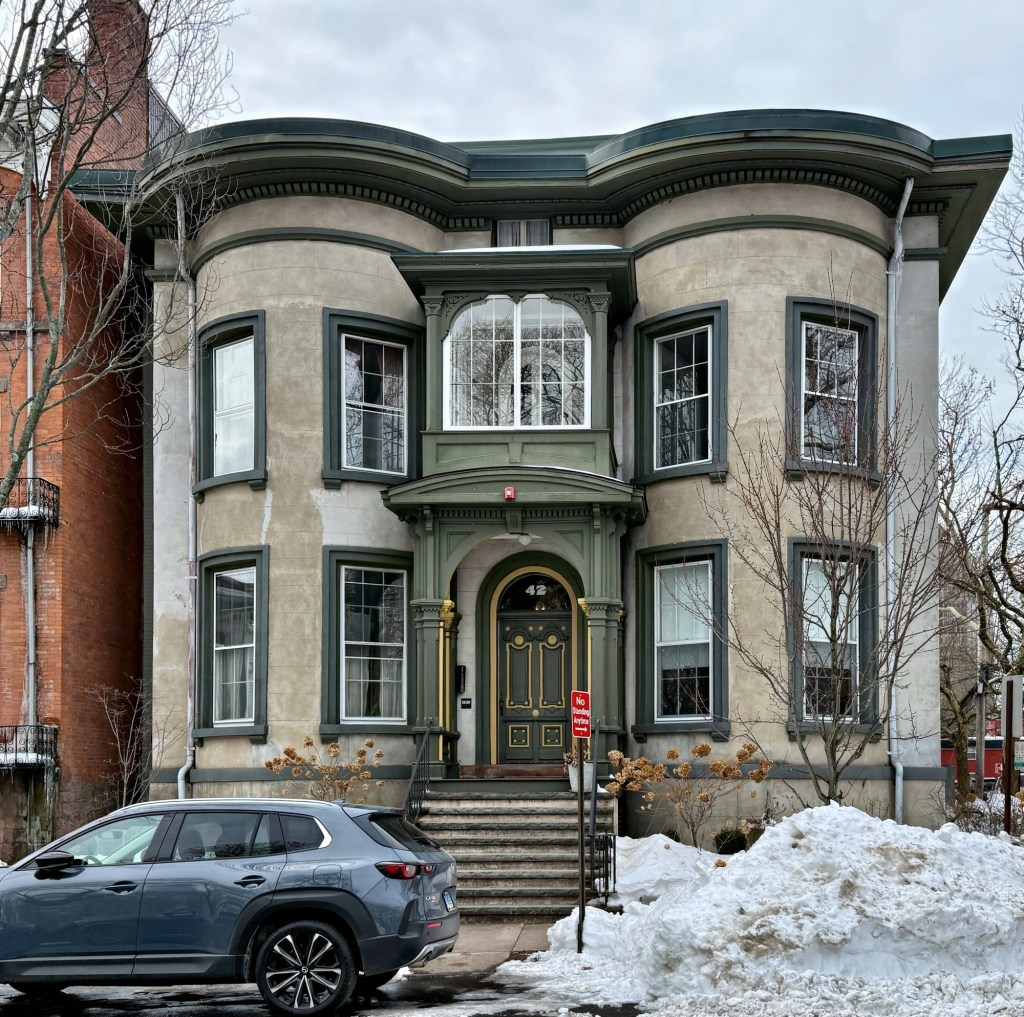
The Edward Rowland House on Academy Street in New Haven’s Wooster Square neighborhood is among the many great mid-19th century residences in the city and a rare example of a bowfront form. The residence was built for Edward Sherman Rowland (1812-1882), a prominent grocer, real estate developer, and Assistant U.S. Assessor and his family. The home is an example of the Italianate style with double-bow facade and is built of brick covered in stucco. The property was converted to condominium units and now houses six families.
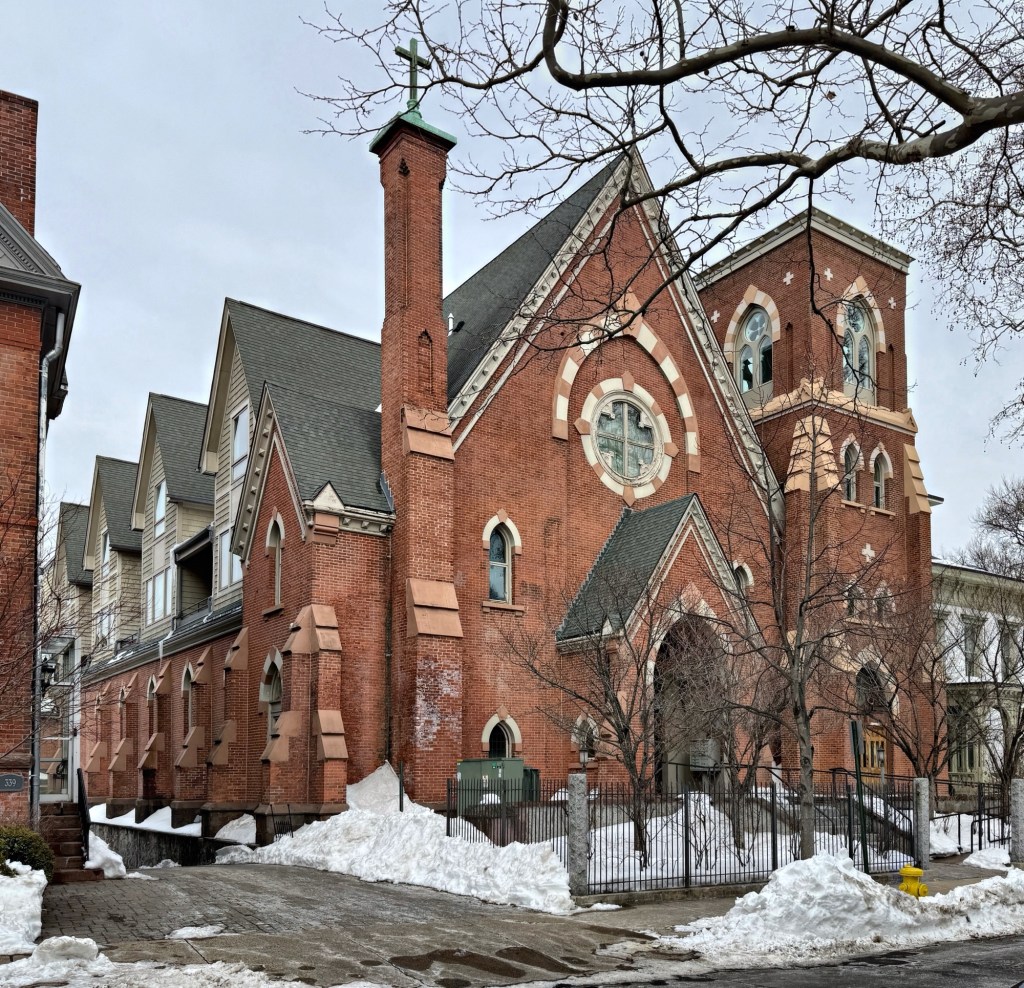
Built in 1872, this Victorian Gothic style church on Greene Street in the Wooster Square area of New Haven, Connecticut, has had a varied history that tells the full story of its neighborhood. The church was originally constructed as the Davenport Congregational Church and was designed by New Haven architect, Rufus G. Russell, who formerly worked many years for Henry Austin, the city’s leading architect, before opening his own firm. In the early 20th century, the neighborhood demographics shifted to a more diverse area of recently arriving immigrants who worked in nearby industry and the edifice was occupied by an Italian Baptist church. 1927, the church was purchased by a local Lithuanian congregation, who re-established the building as the St. Casimir Catholic Church. For nearly 100 years, the church remained an active use anchoring the iconic Wooster Square park until the congregation closed, leaving the building’s fate unclear. Luckily, developers purchased the property, which is located within a local historic district, and converted the church into residential units.
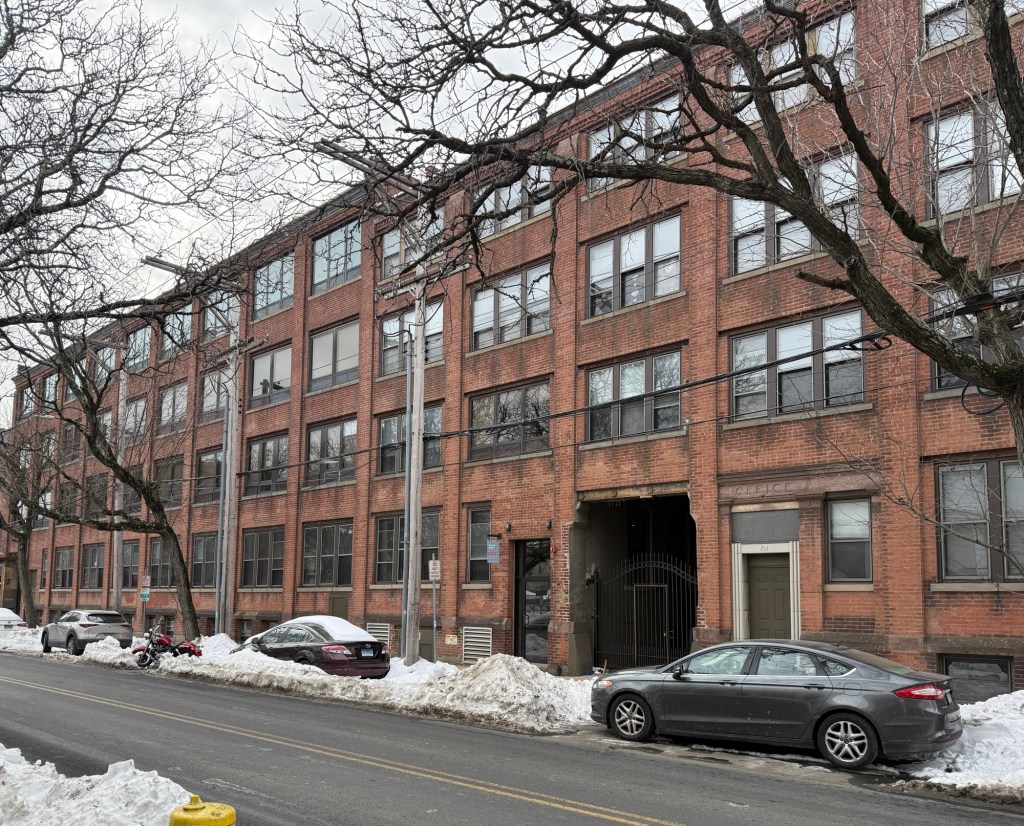
The Strouse, Adler Company Corset Factory is a historic factory complex at 78-84 Olive Street in New Haven, Connecticut that has been adaptively reused into apartments, serving an important second life. Developed between 1876 and 1923, the complex was the largest and oldest of New Haven’s several corset manufacturers, and remained in continuous operation for that purpose until 1998. The company was originally founded in 1861 as J.H. Smith and Company, and was the nation’s first manufacturer of corsets. The business was purchased the following year by Isaac Strouse, who took on Max Adler, a local dry goods retailer, as a partner. The company adopted the name Strouse, Adler in 1899 and was incorporated in 1927. The complex eventually closed and was converted to apartments, serving an important need for housing in the region.
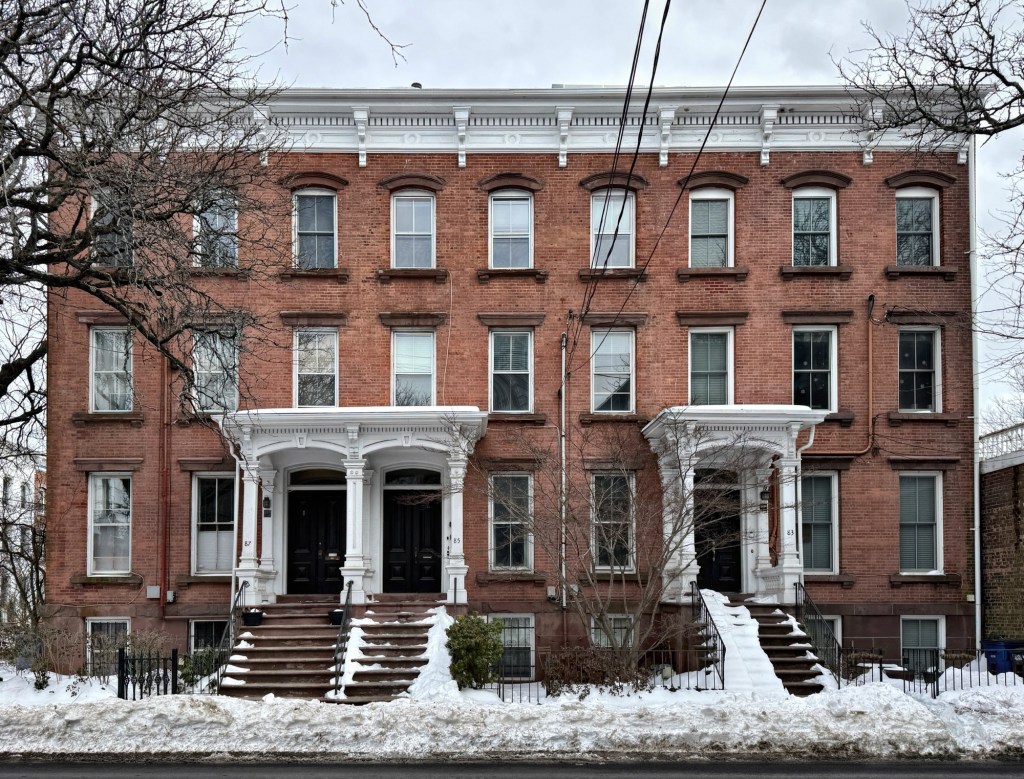
The Wooster Square area of New Haven, Connecticut, is comprised of a lovely collection of houses and institutional buildings from the 1830s through the late 19th century, showing the ever-changing taste of architectural styles from Greek Revival to Italianate to Second Empire and Queen Anne. These rowhouses on Olive Street serve as bookends to long rows of houses on Court Street, a narrow, one-way street radiating from Wooster Square. The buildings were developed by the Home Insurance Company, a fire insurance firm and developer that helped fuel the development of residential New Haven in the 1860s by investing in real estate, primarily with fireproof masonry buildings. These Italianate style rowhouses were built in the 1860s after the Civil War and were sold on speculation to middle-class families. All buildings retain the original bracketed cornices, brownstone sills, lintels, and basement facing, and projecting porticos at the entries.
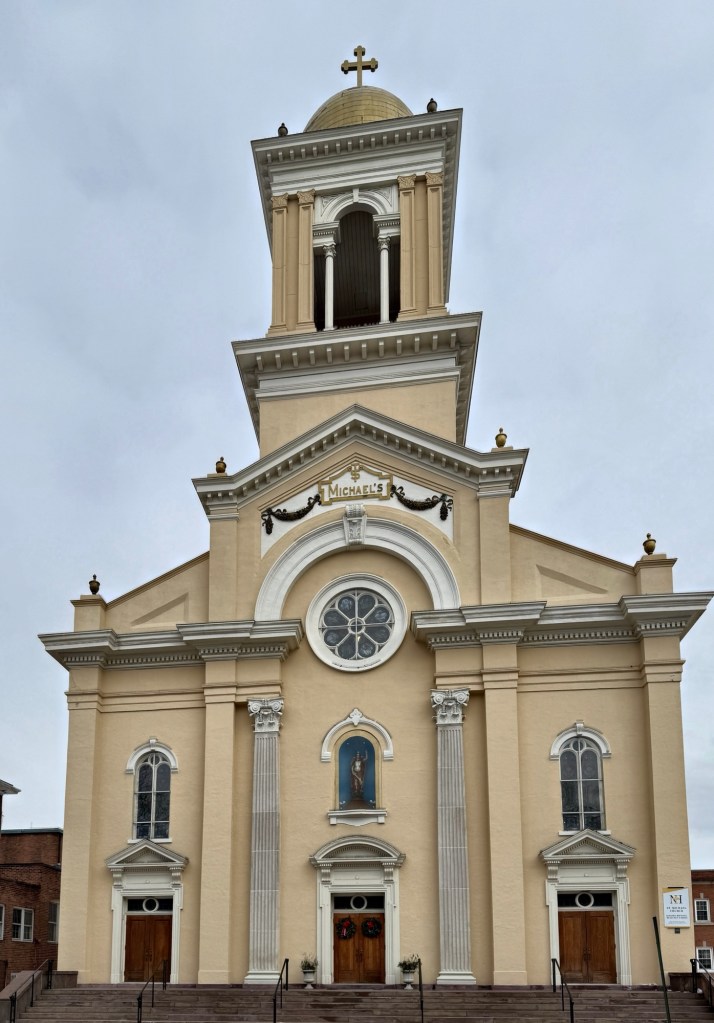
St. Michael’s Roman Catholic Church in Wooster Square, New Haven, Connecticut, was established in 1889 to serve a burgeoning community of Italian immigrants and is said to be the oldest Italian Catholic church in the state. New Haven’s census of 1870 listed just ten Italian residents and by 1900, the census listed more than 5,000 Italian-born residents. Most of these Italian immigrants were drawn to New Haven for employment in the growing industrial and railroad industries and the proximity to New York, where many arriving immigrants passed through. New Haven’s Italian community centered around Wooster Square, where many today know all about the many Italian groceries and nationally known pizzerias. The Italian Community acquired a c.1855 church here by 1899 and following a fire, rebuilt the church in the current form. The New Haven-based architectural firm of Brown and Von Beren furnished plans for the Italian Renaissance Revival style renovations, which was completed in 1904 with bold central tower and stucco walls, retaining many original Italianate windows. The church has served as an important cultural and institutional landmark in New Haven for over 120 years and the congregation remains active.
Known locally as the ‘Ye Olde Manse‘, this stunning Georgian cape house is located at the eastern edge of the town green in Willington, Connecticut. Thought to be the oldest extant house in the small, rural community, the gambrel-roofed homestead was possibly built by John Watson of Hartford, who was thought to have been an original proprietor of Willington, but was instead an assignee of George Clark who was. In the 19th century, the homestead operated as the congregational church parsonage. Today, the Georgian cape house with gambrel and saltbox roof is a single family home and has been lovingly preserved by centuries of stewards of this old manse.
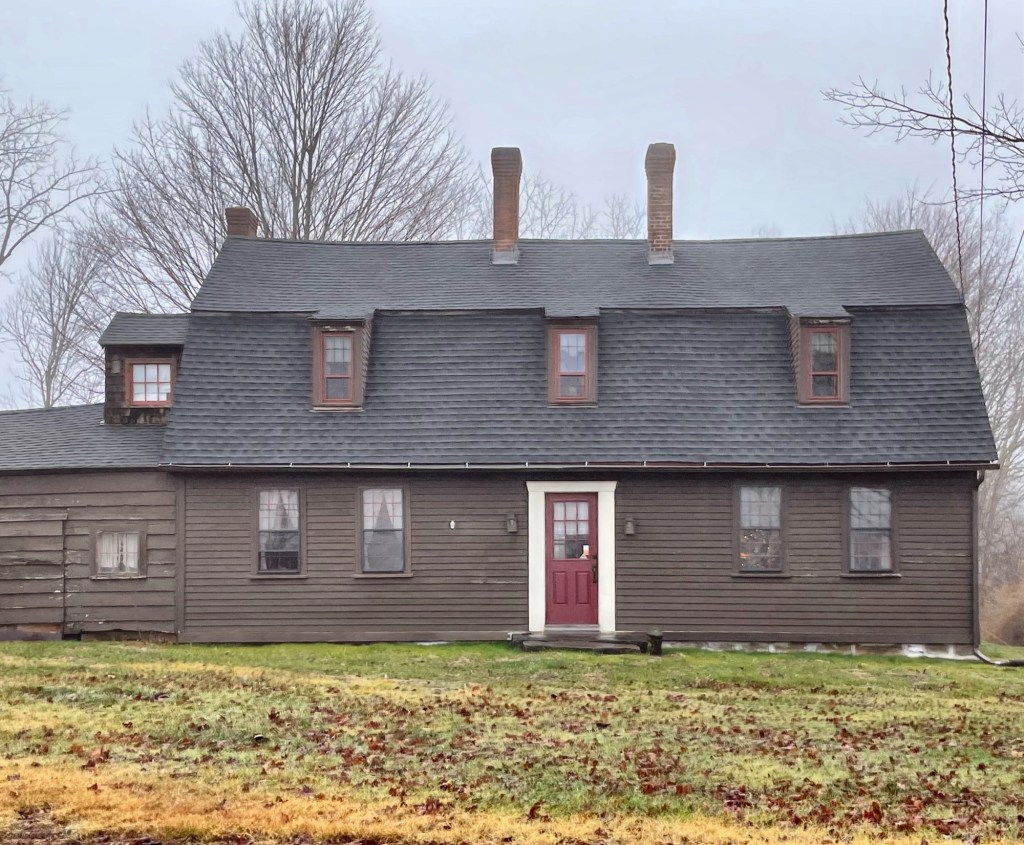
Located in northern Willington, CT, this farmhouse on a quiet, country road, dates to before the Revolutionary War! David Lillibridge (1744-1831) of Exeter, Rhode Island, served from 15 to 17 in the French and Indian War, and manned Fort Stanwix. In 1767, when he was a lieutenant in his local militia, he converted, and entered the Baptist ministry. In 1777, he purchased a farm from Moses Holmes, but it is unclear if this residence was existing or if he built this large farmhouse. In Willington, David Lillibridge became a farmer-preacher, establishing a Baptist ministry here. The home remained in the Lillibridge family at least until the 1870s, when it was owned by Burnham Lillibridge. The Georgian saltbox residence is set back from the street and sits upon the bucolic rolling fields of the property.
Located between his family factory and the memorial church built for his late sister, the William H. Hall House in South Willington, Connecticut, is among the community’s finest Victorian residences built for a wealthy industrialist. William Henry Hall (1867-1922) was the son of industrialist Gardiner Hall Jr., who established the business under his name, which manufactured thread and spools, hiring hundreds of employees. After the death of his father, William Hall became the head of the company, but clearly was successful long before this as he had this stately Queen Anne style mansion built in 1896. Beyond his work at his family’s business, William H. Hall served in the Connecticut House of Representatives in 1893–1897 and again in 1905, 1909, and 1911, and he was generous with his money throughout his life and in his will. Hall served on the board of trustees of his alma mater, Wesleyan University, from 1912 until his death, with his estate donating $175,000 to Wesleyan to construct a chemical laboratory named in his honor. Closer to his home, his heirs partially funded the the Hall Memorial School in South Willington in his honor. The property remained in the family after his death, and in the 1980s, it became an assisted living facility, with large additions constructed, but the Hall House remains a great architectural landmark for the mill village.


 Buildings of New England