An unknown builder erected this Portsmouth house during the 1790s. Thomas D. Bailey lived here in 1836 when his grandson, Thomas Bailey Aldrich, was born up the street in the Laighton House (featured previously). Thomas Bailey Aldrich (1836-1907) became a revered American poet and author. Although he grew up in New Orleans and New York City, some of his fondest childhood memories were of the years 1849 to 1852 when he lived with his grandfather in this house. Later, from 1877 to 1883, the Society for the Benefit of Orphan and Destitute Children ran their Children’s Home in this building. Thomas Bailey Aldrich died on March 19, 1907. A few months later, on August 1, 1907, the Thomas Bailey Aldrich Memorial Association purchased this building, restored it to the time period when Aldrich was a boy here, and opened it as a memorial museum. The Aldrich House was acquired by Strawbery Banke museum in 1979, and it remains a historic house museum.
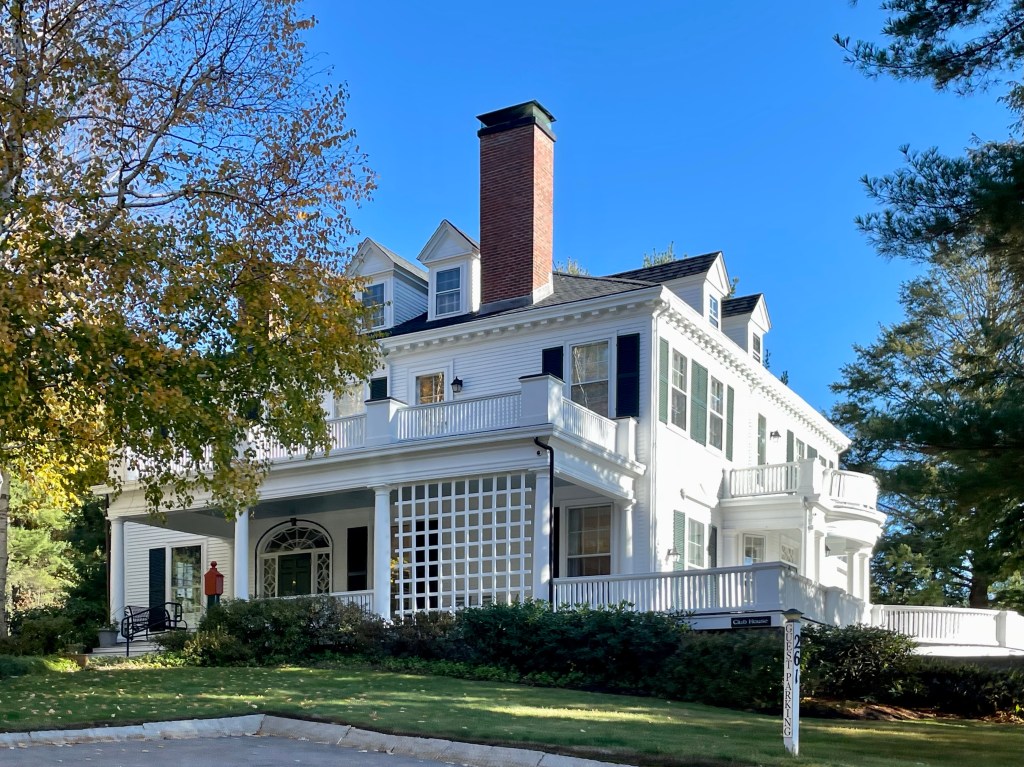
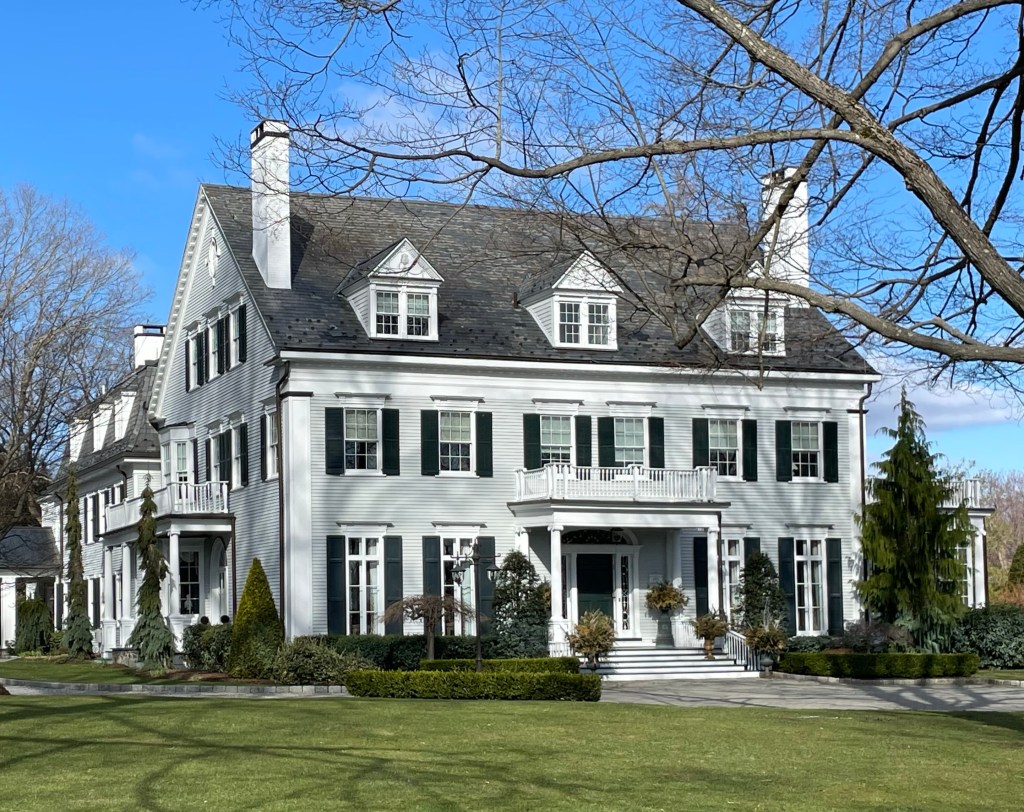
Ellen Banning Ayer (1853-1918) of Minnesota married Frederick Ayer in 1884 and her life completely changed. Frederick Ayer was one of the richest men in New England and he was involved in the patent medicine business, but is better known for his work in the textile industry. After buying the Tremont and Suffolk mills in Lowell, Massachusetts, he bought up many textile operations in nearby Lawrence, combining them in 1899 into the American Woolen Company, of which he was the first president. The couple had at least three houses in Lowell, Boston, Pride’s Crossing and had three children (one of whom Beatrice, later married the famed general George Patton). As the Ayer Mansion on Commonwealth Avenue was being built, the family was looking for a country house near the city. One year, Frederick asked Ellen what she wanted for a gift and she said “roses”. Frederick purchased an old farmhouse on Nahanton Street in Newton and had greenhouses and a stable built immediately, followed by a Colonial Revival country house for his wife Ellen. The mansion held lavish parties for the Ayers, who loved to entertain and it was passed down to their eldest daughter Katharine Ayer Merrill. The property was purchased in the 1920s by Clive and Mona Lacy for decades until it sold in the 1980s. The large site was eyed for redevelopment. The architectural firm of Dimella Shaffer was hired, and they restored the Ayer House, and designed forty residential units on the site, all tucked into the woods gently peering out here and there. The old Ayer House remains as the clubhouse of the Ledgebrook Condominiums Association.
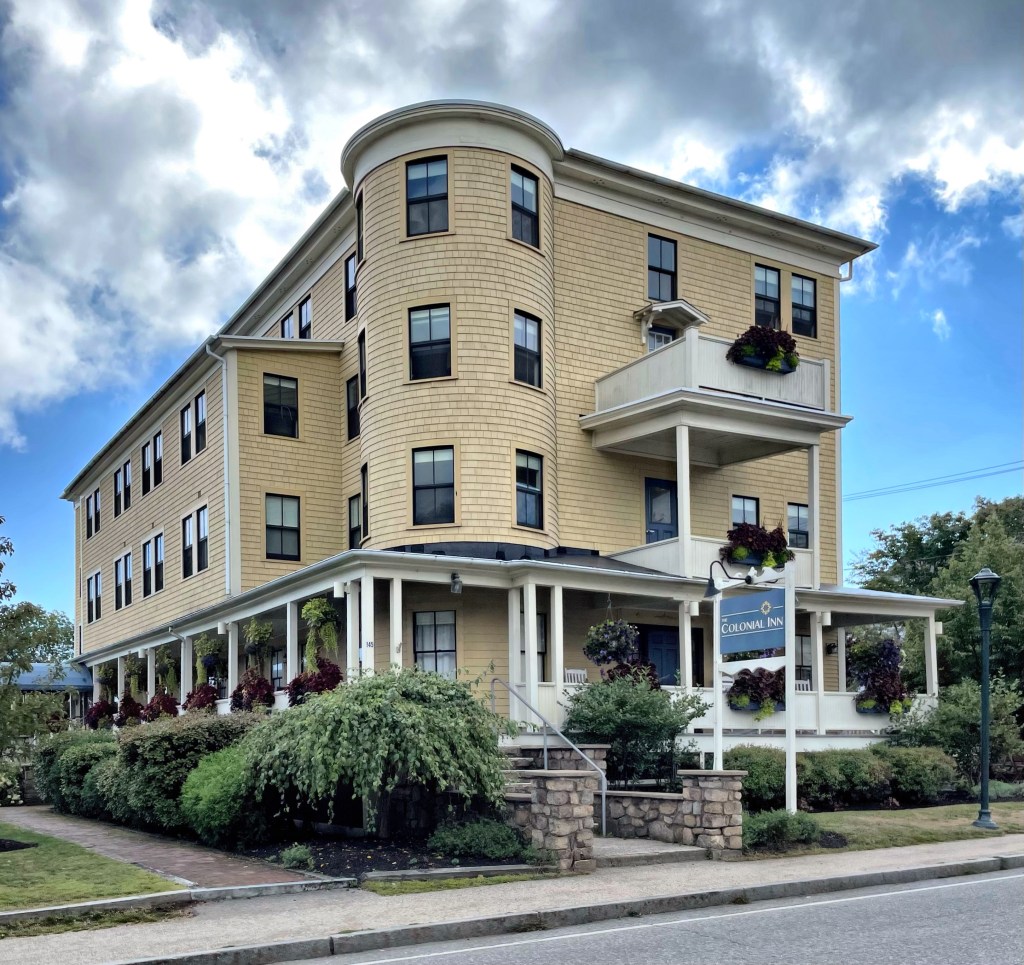
As Ogunquit surged in popularity as a coastal summer retreat in the late 19th century, the flocks of city-dwellers needed a places to rest their head after splashing in the crisp Maine ocean. The original structure began with a mid-19th century house, likely in the Greek Revival style. It was expanded in the 1880s when it opened as a hotel for tourists, equipped with a mansard roof. The hotel consistently sold out of rooms in the summer months and the proprietors decided to expand in about 1897 with a sizeable Queen Anne style addition. A fire in 1951 destroyed the rear wing of the building and the conical tower roofs were removed, resulting in the final form seen today. The hotel is historically significant because it is the only surviving 19th-century hotel in Ogunquit that still serves as a hotel and largely retains its historic appearance, enhanced following a 2013 restoration by the owners who worked with David Lloyd of Archetype Architects. Other hotels of the period have either been converted to condominiums or been engulfed by modern alterations. The hotel was thus placed on the National Register of Historic Places, a large, and worthy addition!
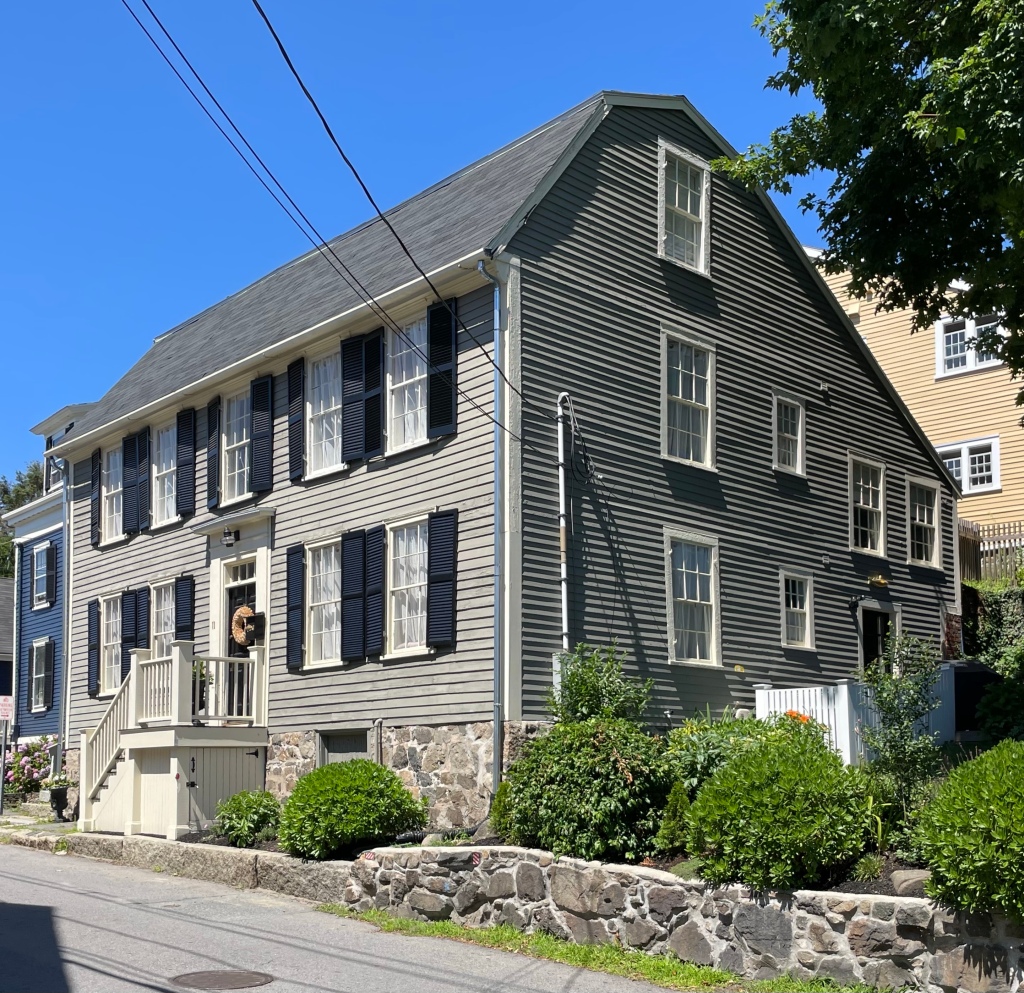
In 1748, Alexander Watts, a merchant and sea captain purchased land in Marblehead, building a dwelling house, shop, and barn. This home was likely built in the 1750s, not long after he purchased the lot from David LeGallais, a merchant and prominent landowner in town. The gambrel-roofed Georgian house with its elaborate entry stands out on the street for its large frontage, with many other period homes sited on narrow lots, with the side of the house facing the street. He likely lived in the shop nextdoor until he had enough money to build this separate, more elaborate dwelling. Captain Watts died in 1772, and the property was willed to his “wife Rachel for her widowhood, and at her decease, one-half was to descend to her heirs, and the other half to his kinsman, Alexander Watts of London, England”. By the 1780s, the property was noted as “much decayed” with his widow likely struggling to maintain the property, renting the shop to others for income. On April 13, 1795, the estate was divided, meaning Rachel, Alexander’s widow, likely died at the home.
In 1720, James Pearson acquired a house lot on Windmill Hill in Marblehead, and he soon after built a house in the bustling harbor town. He lived in the house until 1734, when it was sold to a Giles Irwin. After Mr. Irwin’s death, it was conveyed to John Patton and John Bailey, both mariners, who likely split up the home inside. From this, fireplaces were punched into the central chimney inside, totaling 10 fireplaces in the home! John Bailey also worked as the Captain of Fort Sewall during the War of 1812. His wife Mary, served as temporary commander of Ft. Sewell after his death until a successor was appointed. The house eventually came under the ownership of siblings Carrie Florence Bessom (1867-1944) and her brother Frank Lewis Bessom (1870-1952). Florence operated an antiques store in town and Frank worked as a welfare commissioner. The home is a great example of a Georgian, Colonial-era home with a gambrel roof and even has the two (what I believe to be) separate coal doors in the raised stone foundation when the home was occupied by two families.
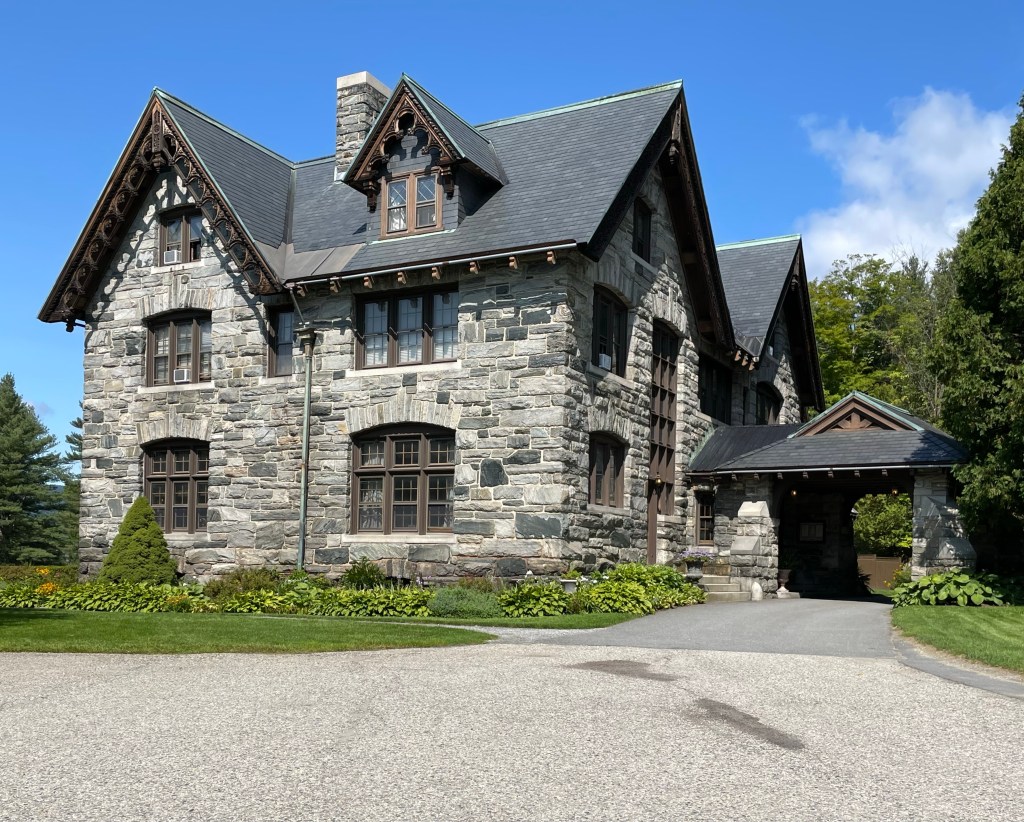
As Cavendish and other rural towns of Vermont became summer destinations for the rich of the urban centers of the northeast, large estates began to sprout up, replacing old family homesteads. Allen Miller Fletcher was born in Indianapolis, Indiana, the grandnephew of Josiah Fletcher, one of the original settlers of Cavendish in September 1853. He was the son of a successful banker and became a banker himself, building homes in Indianapolis and New York City. In 1881, he built a summer home in his ancestral home of Cavendish, taking the train up to relax and breathe in the clean air. While living most of the year in New York, Fletcher became involved in Vermont politics, winning the Republican nomination to serve in both the Vermont House of Representatives and the Vermont Senate in the early 1900s. During his time as a Vermont state senator, Fletcher commissioned architect Samuel Francis Page of the Boston-based firm, Fehmer and Page, to bring his vision to life. Page used English Cotswold-style architecture for his inspiration, and when completed in 1906, the home was the first in Vermont to be fully wired for electricity and equipped with an elevator! Fletcher also hiredFrederick Law Olmsted Jr. to design the landscaping on the property. Fletcher would spend the rest of his life at his country mansion, going on to work as the Governor of Vermont from 1912 to 1915. Today, Fletcher’s beautiful mansion now lives as a magnificent holiday retreat known as the Castle Hill Resort & Spa.
Another one of the Landmark Trust USA properties in Dummerston, Vermont is the Dutton Farmhouse, a meticulously restored Greek Revival farmhouse from around 1840. The gable-roof farmhouse was possibly an addition to an earlier dwelling built decades earlier as a one-and-a-half-story center-chimney home, seen at the rear today. The first known owner of the farmhouse was Asa Dutton who farmed off the large orchards. Generations later, the farmhouse served as a dormitory for migrant laborers who worked nearby, with the interior being altered. The property was eventually gifted to the Landmark Trust USA, who began a massive restoration project on the home, uncovering original detailing and even historic wallpaper! The house has since been meticulously restored and preserved and is available for short-term rentals! The charming interiors and near silence outside is a perfect getaway from city life.
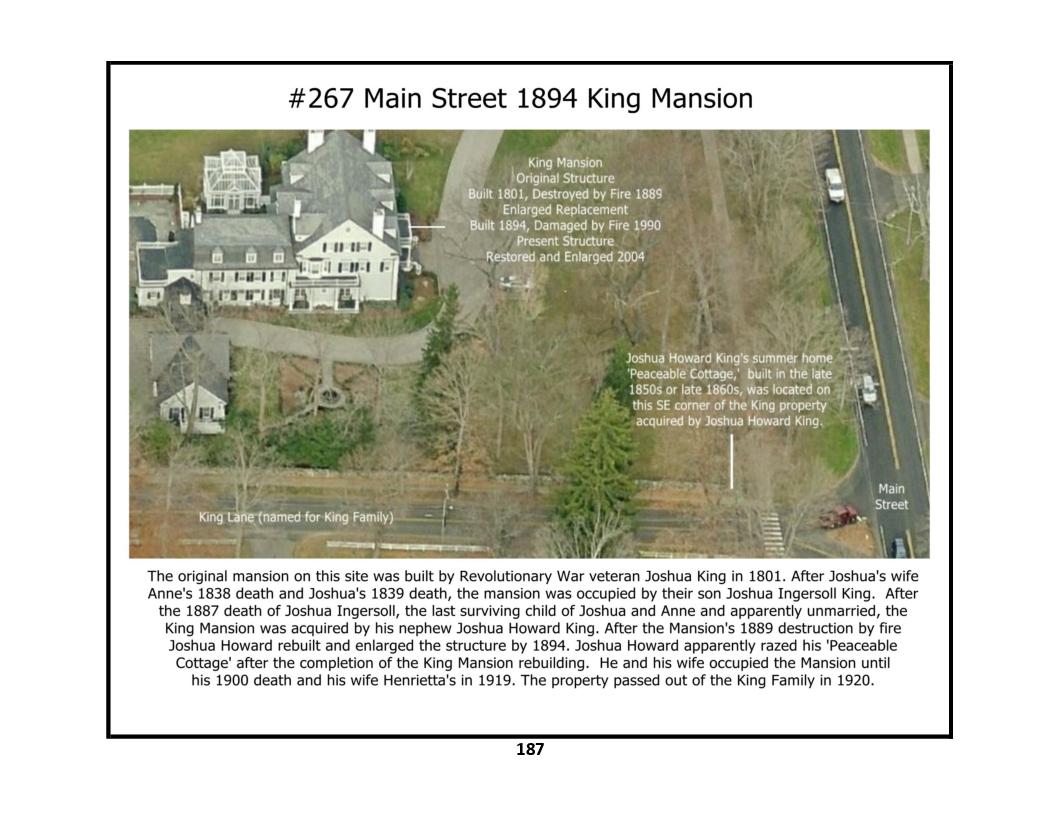
After the American Revolution, Lt. Joshua King settled in Ridgefield and built the King Mansion in 1801, a Federal style home that commanded the Main Street lot. King was born in Bridgewater, Massachusetts and fought in the Revolutionary War near the border of Connecticut and New York. After the war, he settled in Ridgefield and married one of the most eligible bachelorettes in town Anne Ingersoll. Anne was the daughter of the Rev. Jonathan Ingersoll, pastor of the Congregational Church of Ridgefield. After a long life running a store and raising a family, Joshua died in 1839, a year after his wife. The mansion was inherited by their son Joshua Jr. until his death in 1887. In 1889, a fire destroyed much of the house. When it burned down, The New York Times described it as “the grandest old mansion in the village.” It was quickly replaced by the current house, modeled after the original but larger, which was placed much farther back from the road in the Colonial Revival style. Fire damaged the house again in the 1990s, and the present structure was restored and enlarged from 2002-2004, its HUGE!
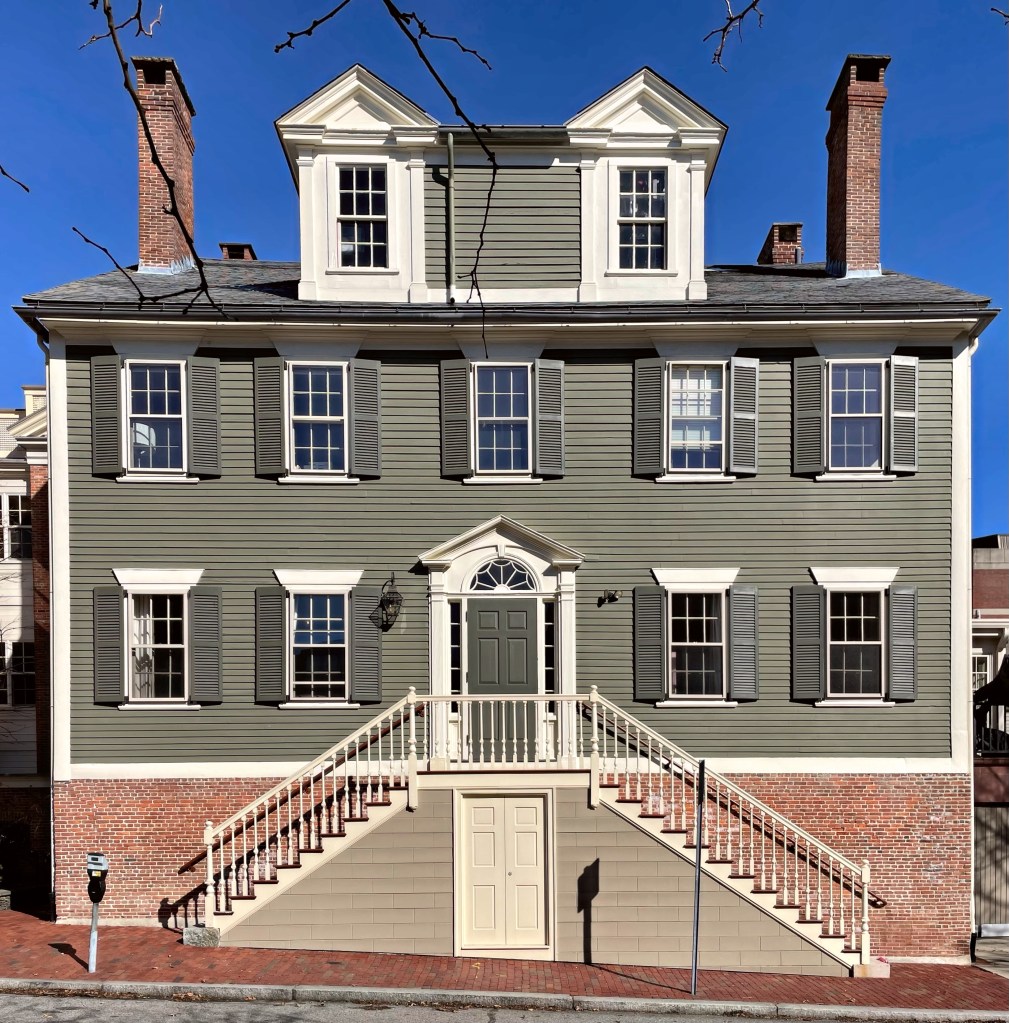
When visiting Downtown Providence, I couldn’t help myself but to cross the river into College Hill, a neighborhood of such architectural diversity I could run this entire page just featuring that area. This beautiful Federal style home was built onto the downward slope of the hill in 1798 for William Holroyd, a merchant and active Baptist in town. The home sits atop a raised basement with brick end walls and clapboard siding on the front and rear. The property exhibits a symmetrical facade, splayed lintels above the windows, and a perfect center entry with fluted pilasters and pediment containing a fanlight. The building today appears to be a part of the Brown-RISD Hillel.
The most iconic house in Norway, Maine has to be the Evans-Cummings House (also known locally as the Gingerbread House) on Main Street. The ornate Victorian era home was originally built in 1855 for Richard Evans, who was born in Portland in 1805 and after training as a carpenter, moved to Norway in 1833 for work. He and his wife, Mary Warren Hill, had eight children and they resided in the home until their death. In 1890, Charles B. Cummings bought the house in 1890 and hired local architect John B. Hazen to remodel the house. Hazen added the gingerbread adornments for which the house is now known colloquially. The home attracted a lot of attention in the region, and the later heirs continued that whimsical appeal. When the home was willed to Fred and Cora Cummings, they were said to have kept a stuffed peacock at the top of the stairs, which delighted children when they toured the home. The house eventually became used as storage by the owners of the local Advertiser Democrat newspaper, and its future was threatened. Since 2012, a local group, Friends of the Gingerbread House, have poured tens of thousands of dollars and an equal amount of time restoring the iconic home to her former glory! Preservation is important!
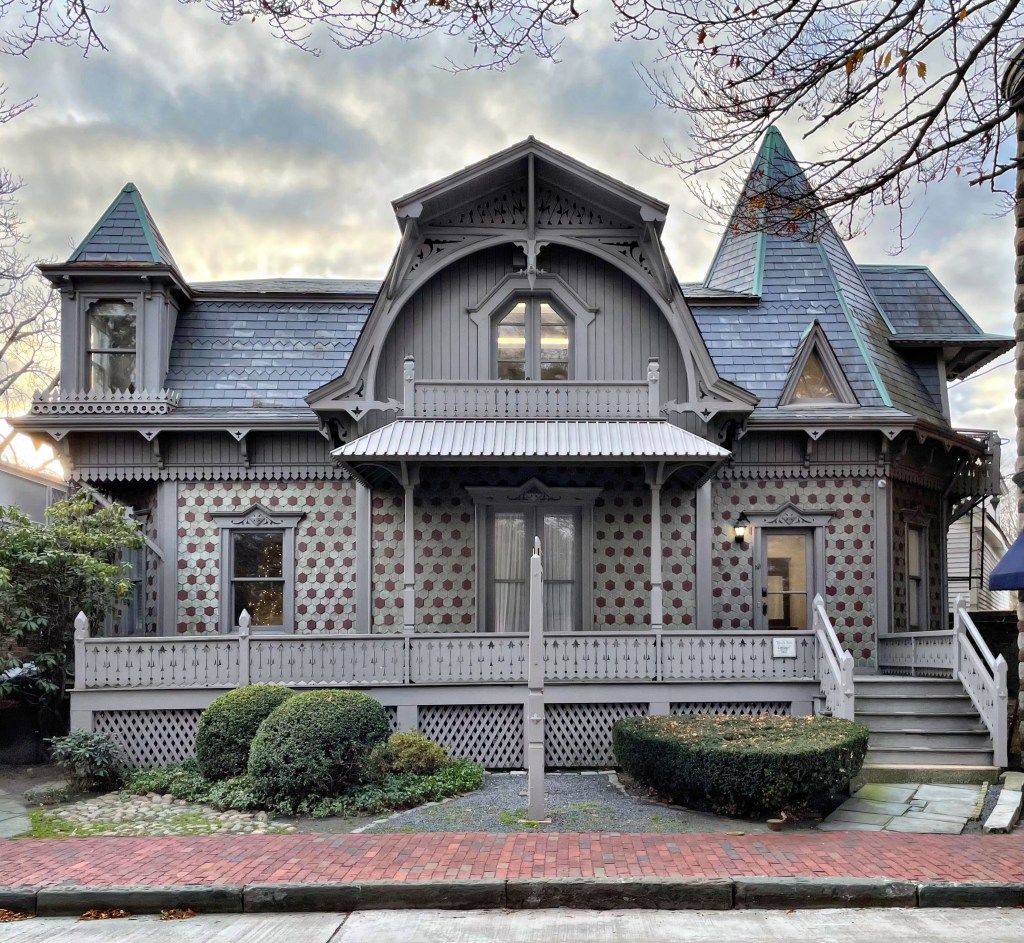
One of the more unique and relatively modest summer cottages in Newport, Rhode Island is Bird’s Nest Cottage on Bellevue Avenue. The cottage was built in 1871-2 for Samuel Freeman Pratt, who lived his early life in Boston. The son of a carpenter, Pratt was was working as a carver in Boston, where he saw success as an inventor with several patents to his credit. From the success of one of his inventions, a device for sewing machines, the invention gave him the financial freedom to explore other interests, namely architecture. In Boston, he likely learned his craft from partner John Stevens, before setting out on his own. He designed buildings in Oak Bluffs on Martha’s Vineyard, but decided to reside in Newport. While many state that this cottage for Pratt was designed by the Newport resident and star-chitect Richard Morris Hunt, the design and the fact that it was his own cottage lead me to believe it was designed by Pratt himself. The eclectic cottage features complex gable shapes, fancy stickwork under the eaves, projecting corner bays, and a wall covering of multicolored slate roof shingles. It is now a professional office.
On a little stretch of Kay Street in Newport, you can find four strikingly similar Italianate style houses, all neighbors. Upon further research, it turns out they were designed by the same man, Job Peckham. Job Almy Peckham (1807-1885) was a descendant of one of nearby Middletown’s “founding” families. He ran a lumberyard and began working as a housewright, building homes. He was a believer of the philosophy “if it ain’t broke, don’t fix it”, so he built many of his houses in a sort of cookie-cutter way, but each showcasing slight design changes. One of the most impressive features of these homes is the massive overhanging eaves with scrolled brackets. Peckham’s own house (bottom right) is included in the bunch. What do you think of these homes?
The Newhall-Lane House (could be the home of many wives) was built in 1809 by Pliny Newhall, a bricklayer. He purchased the land here at a prominent crossroads in Lancaster in 1808 from his employer who owned a brickyard across the street. At a previous home in town, Newhall’s wife Patty died giving birth to their son, at just 23 years old. Their son also died during childbirth. He remarried and had a full family to grow into the couple’s new house. They relocated to Lincoln and the home was sold to Captain Anthony Lane, who was the son of Deacon Jonas Lane, an important figure in Lancaster town history. Jonas had four wives, outliving three of them. Captain Lane himself, was married twice while living in this house; he had no children from either marriage. Although he was a talented craftsman and cabinetmaker, Captain Lane listed his occupation as farmer. The house is significant architecturally, as a fine example of Federal style architecture in Lancaster . Its sophisticated design is reflected in the graceful entrance. One of the unique features of the house is the pedimented gable of the facade which in combination with the narrow plan of the house, creates a delightful massing in this distinctive combination of Greek Revival and Federal styles.
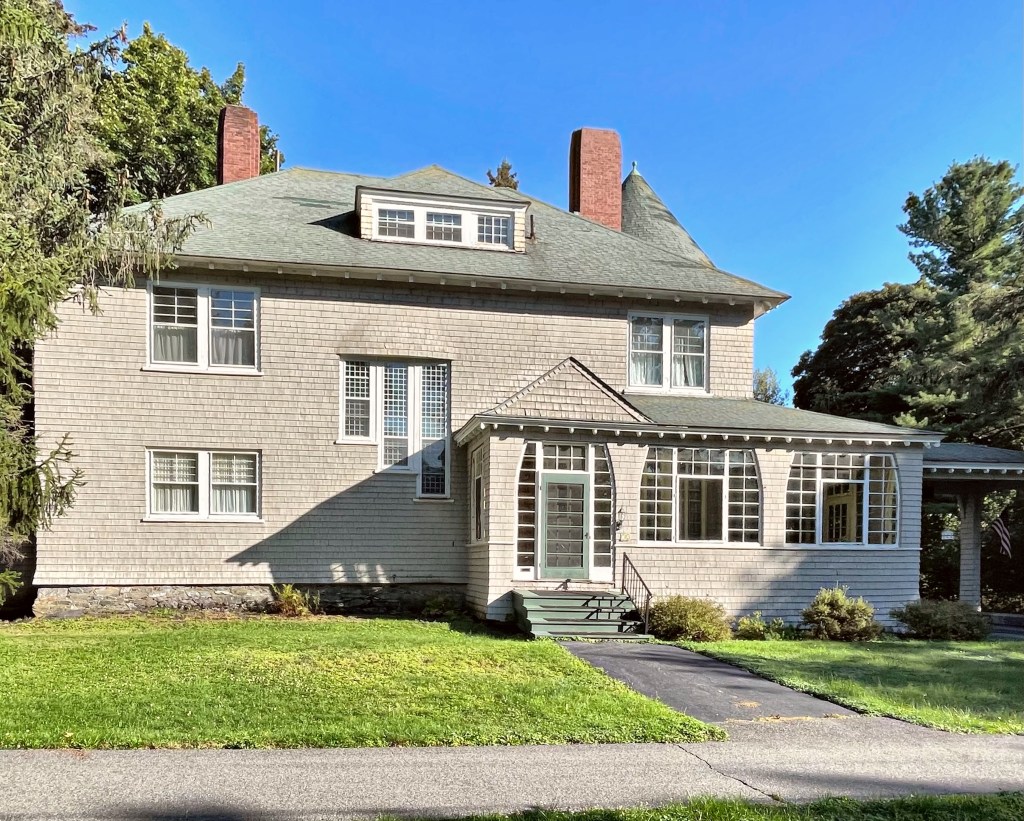
Frederick Parkhurst (1864-1921) was born in the small Maine town of Unity and attended local schools. He moved to New York to attend Columbia Law School, receiving his degree in 1887. Soon after, he was admitted to the Maine bar. Frederick moved back to Maine and joined his father in a leather goods business in Bangor, of which he later became president. He served on the Bangor City Council and later in the Maine House and State Senate. With his wealth and connections, he purchased a large house lot on West Broadway, then the most exclusive street in town, and hired local architect Wilfred Mansur, to design a Shingle style home for his family. During World War I he led the Liberty Loan effort and in 1920, was elected Governor with the largest margin in Maine history, moving to the State Capitol, Augusta soon after. Parkhurst served less than a month when he died on January 31, 1921.
This Greek Revival home with a one-story full-length porch was built in 1839 for Peter Wanton Snow, one of the unluckiest men in Providence. Born the son of a leading China trader and the son of a granddaughter of a former governor of Rhode Island, Peter W. Snow (1788-1843) was born into privilege and like many of such stature, could enter the family business with ease and make a lot of money. Peter first sailed for Canton (Guangzhou, China) with his father in 1803. Doubtless because of his father’s position and trading connections, young Snow became the partner of Edward Carrington who, within fewer than a dozen years, was to become one of the richest and best merchants dealing in Chinese goods in Rhode Island, if not in the entire country. Carrington wanted to retire and have Peter Snow take over his agency in China, but Peter did not seem to like it there and always wanted to go back home to the United States. He got the chance for a few years beginning in 1814, but upon returning home, he learned that his only son, Charles, had died a year earlier at the age of five years, and to compound his personal tragedy, Snow lost two baby daughters in the next three years. By 1816, he returned to China but never seemed to be able to get out of debt, while trying to provide for his last two remaining children. Tragedy struck again when his last living daughter died, while he was in China. Peter’s business partner and friend R. B. Forbes before letting Peter know the bad news wrote this.
While in debt, he somehow had this home built in Providence, likely from assistance from family and colleagues. The land here was purchased by Peter’s wife Jeanette, and the home was likely built soon after. Peter died in 1843, virtually penniless.