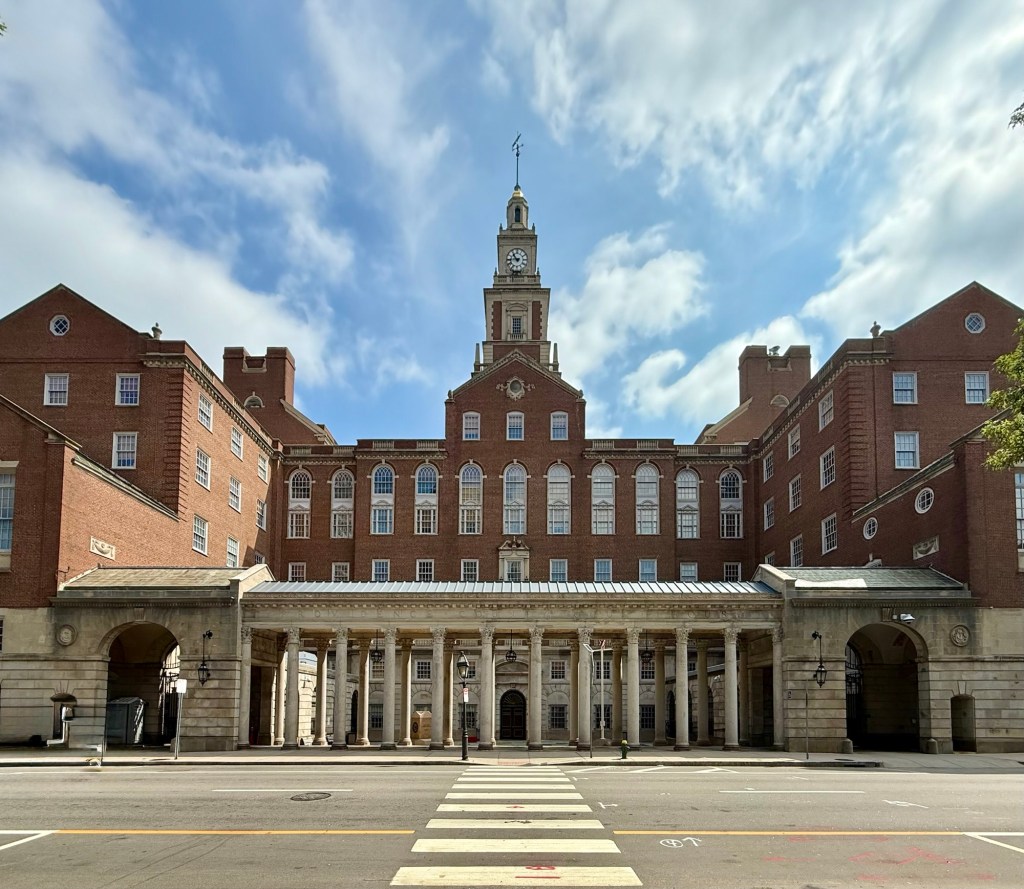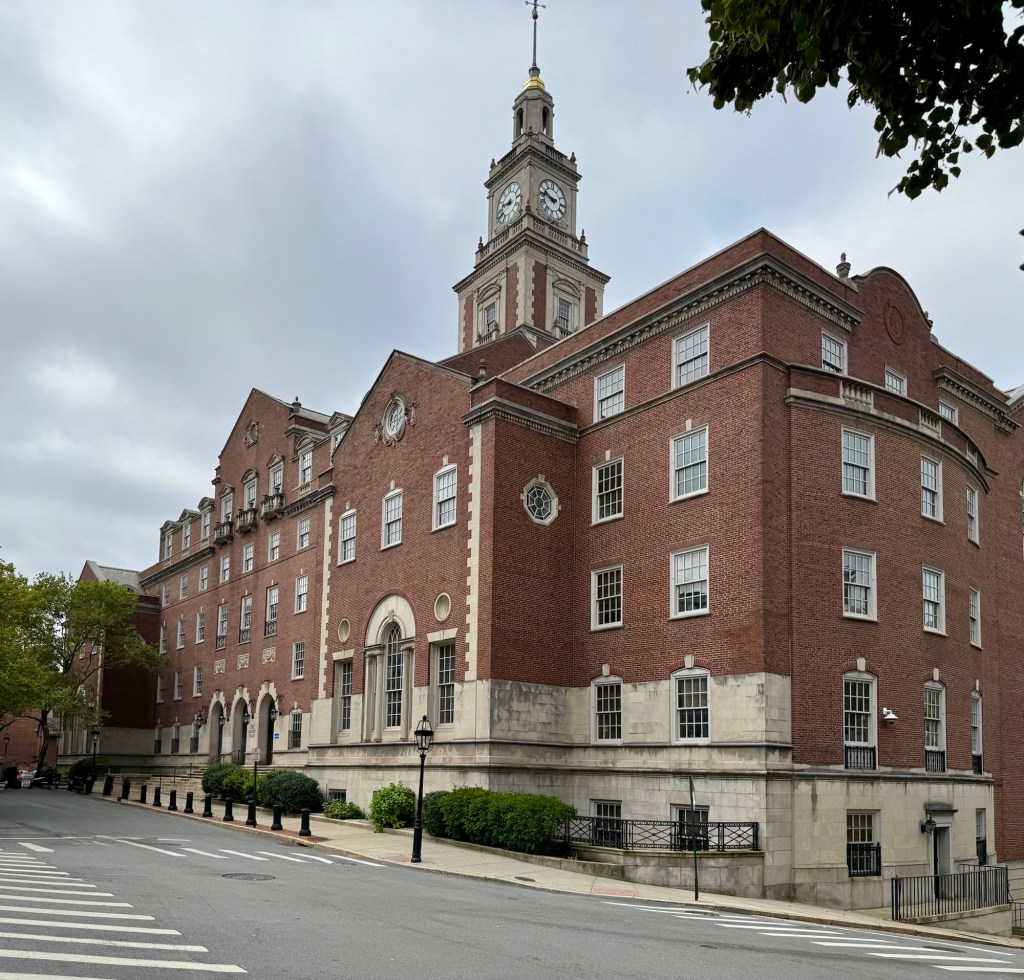
This monumental Georgian Revival bank building on Main Street in Warren, Rhode Island, and is one of the finest buildings of the style in the entire state. The Warren Industrial Trust in 1906 hired Edmund R. Willson of the Providence architectural firm of Stone, Carpenter & Willson to design the bank for the town after it had absorbed the town’s multiple banks, under one roof. It would be one of his final commissions before his death. On the facade, four Corinthian columns support a dentilled pediment over the entrance with the red brick walls enlivened with arched windows, oversized keystones, and pilasters with contrasting capitals and bases. The building shows that Colonial Revival architecture, while often seen as a refined, classical style, can be festive and ornate.
The only two-story temple-front Greek Revival style house in Warren, Rhode Island, the Judge Alfred Bosworth House on Federal Street, is believed to be the work of great architect Russell Warren. Alfred Bosworth (1812-1862) ran a law office in Warren and Providence and represented Warren in the General Assembly from 1839 until 1854 and then served as a justice on the Rhode Island Supreme Court. Bosworth was of counsel for Rhode Island in suits growing out of the boundary question between Rhode Island and Massachusetts, specifically around Fall River. Judge Bosworth died at home in 1862 and his widow, Anne, lived here afterwards. At the end of the century the Bosworth House was converted to an ice cream parlor, named Maxfield’s, which became a very popular attraction in town. The company, owned by Nathaniel and Julia Maxfield, attracted throngs of local residents every summer who would eat ice cream on the front yard of the house. Maxfield’s was even frequented by Providence writer, H. P. Lovecraft, when he was a young man. During the mid-1900s, the house served as a nursing home until 1988, when owners restored the house back to a residence and removed the asphalt siding that was added to the exterior around the time of the Great Depression.
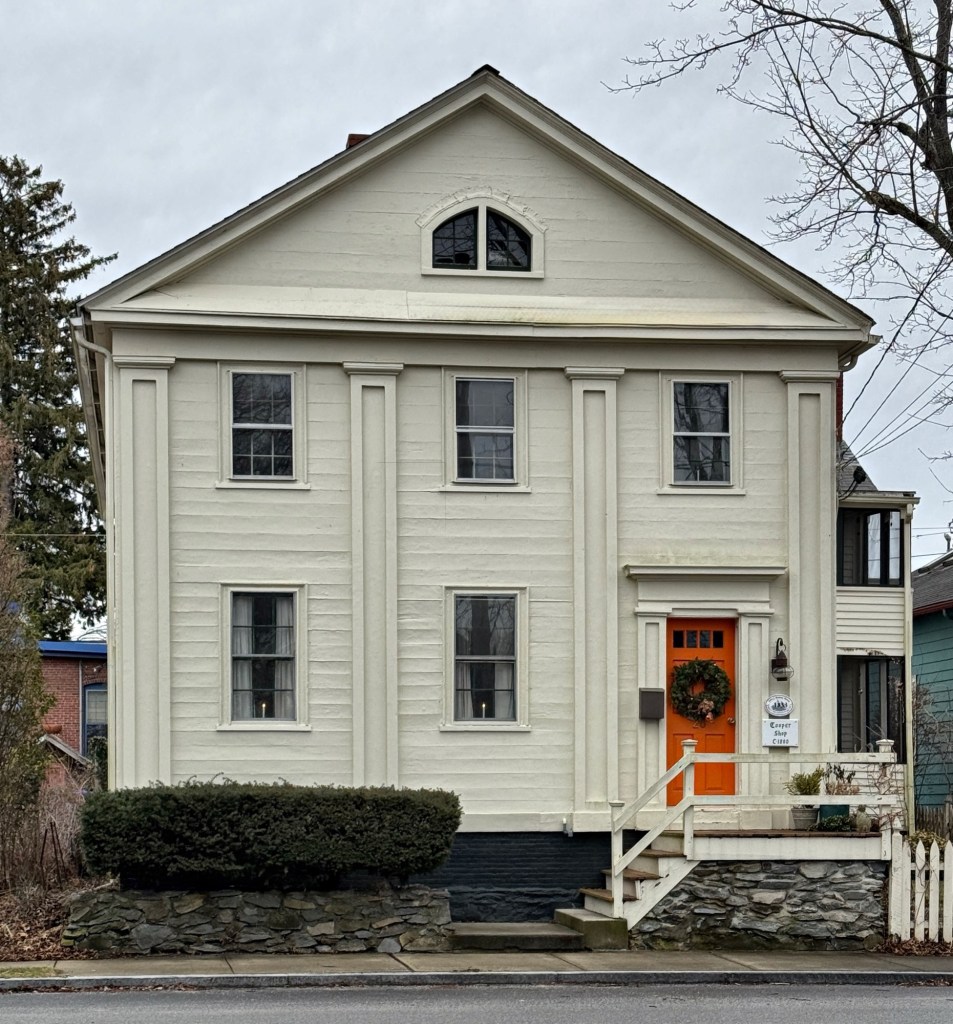
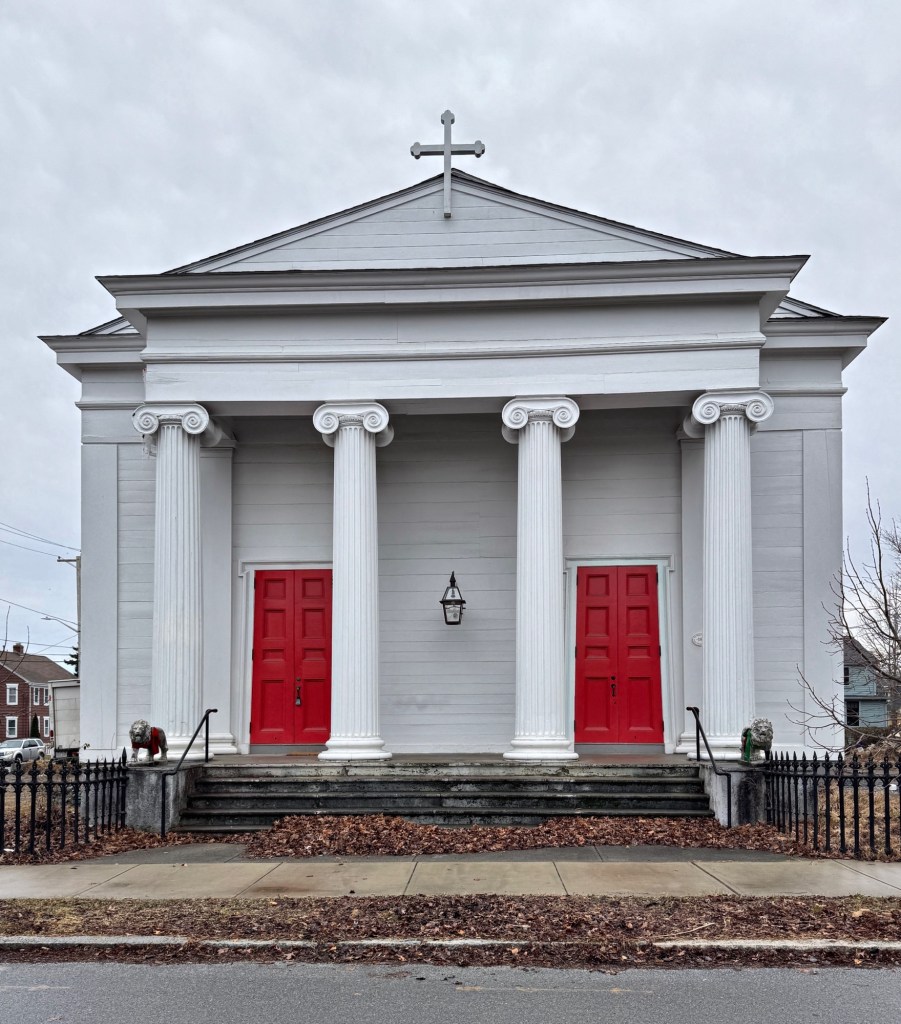
This stunning Greek Revival house on Lyndon Street in Warren, Rhode Island, was according to historians, built around the turn of the 19th century as a cooper shop! A cooper as a professional, would make wooden barrels, tubs, and casks from wooden staves, which were all made in this building before it was converted and renovated around 1830 in the Greek Revival style for Deacon John J. Bickner, who was likely affiliated with the Episcopal Church across the street, which was designed by architect, Russell Warren. Due to the connection, it is possible that the renovation for Bickner was undertaken by Russell Warren as well. On its facade, the house has two-story applied pilasters which break up the bays and smooth flushboard siding which makes the house even more stately!
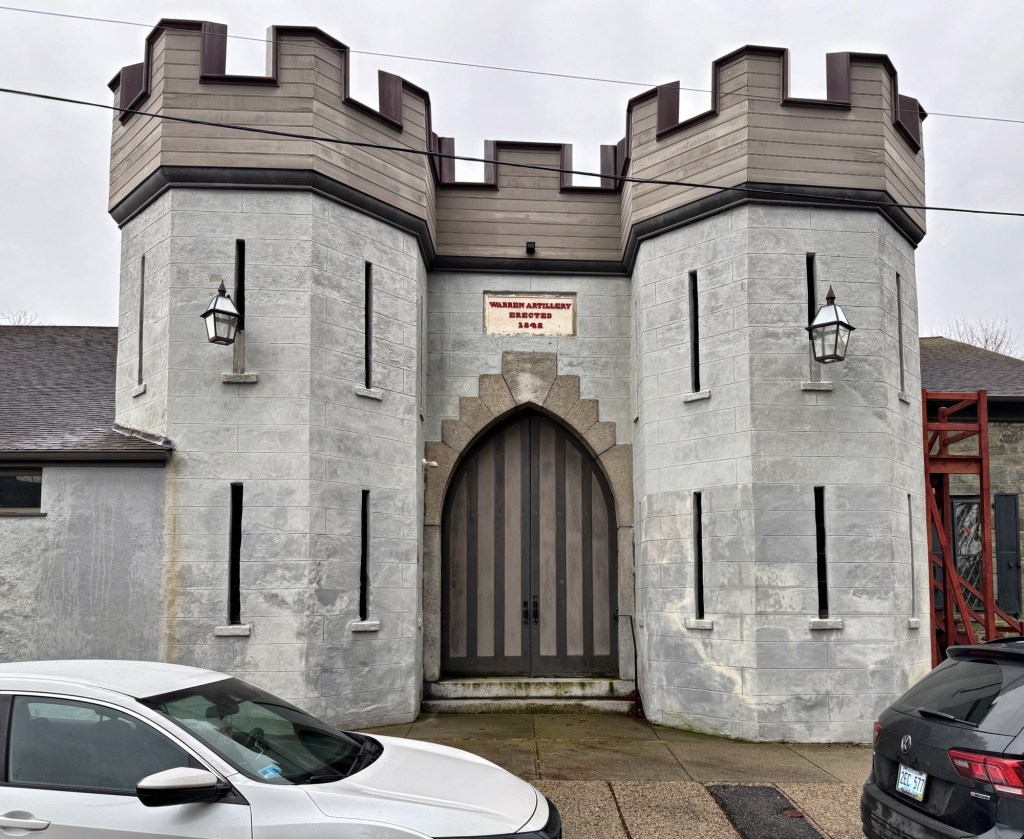
Although somewhat altered from its original appearance, the Warren Armory on Jefferson Street in Warren, Rhode Island, can easily be identified as a playful example of a Gothic Revival building, one of several Romantic styles that prevailed in the mid-19″ century. Here, the distinguishing features are its octagonal castellated towers, pointed arched central entry, and thin, long, slit-like, window openings set into the thick, stuccoed stone walls, important fire/blast-proof construction due to the storage of arms and gunpowder. Built in 1842 and formally opened in 1843, the building was used for social affairs by the local artillery company as well as citizens of the town for general entertainment for the public, including performances by Gen. Tom Thumb of P.T. Barnum’s travelling circus. In 1952, the property was conveyed to the Warren Post #11 of the American Legion.
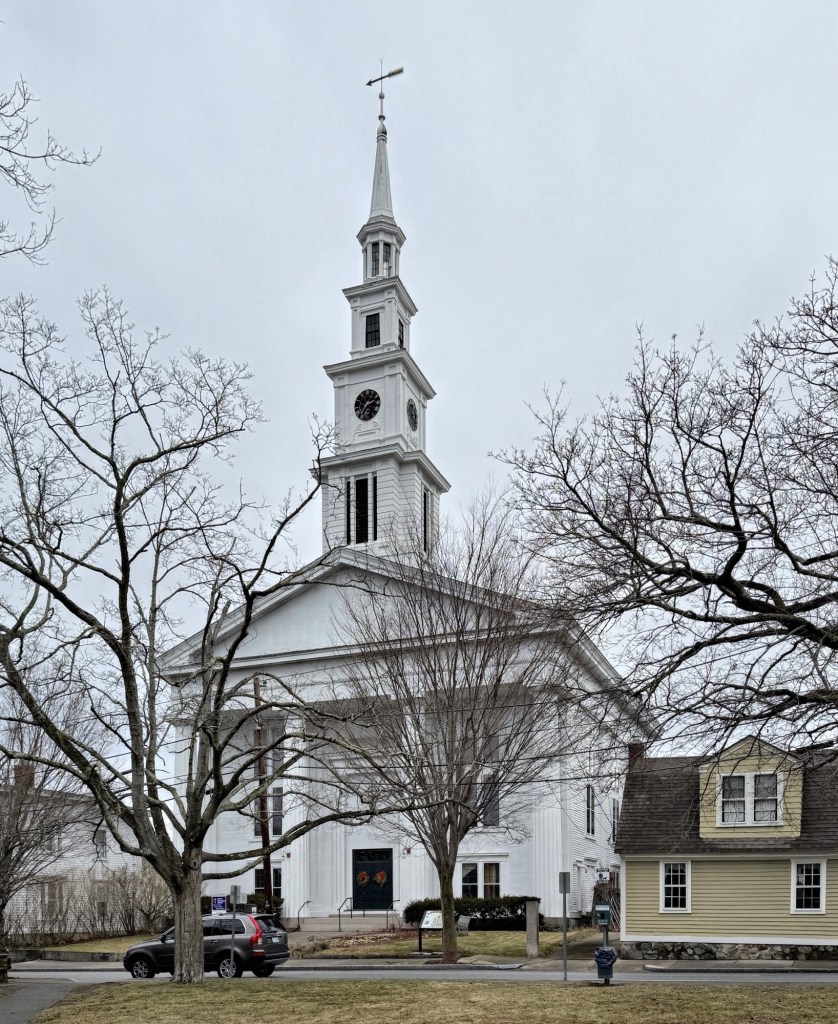
Located next door to the diminutive Easterbrooks Cottage on Church Street, the First Methodist Church of Warren, Rhode Island, stands as one of the community’s great 19th century buildings. Constructed in 1844 with its iconic steeple completed a year later, the Methodist Church is a great example of a vernacular, Greek Revival style with prominent, south-facing portico with four two-story Doric columns supporting the entablature and pediment above. Built by Perez Mason (1802-1881), a carpenter and later amateur architect, the church stands out for its iconic five-stage steeple, which has long served as a sort of landmark for sailors arriving into the harbor nearby.
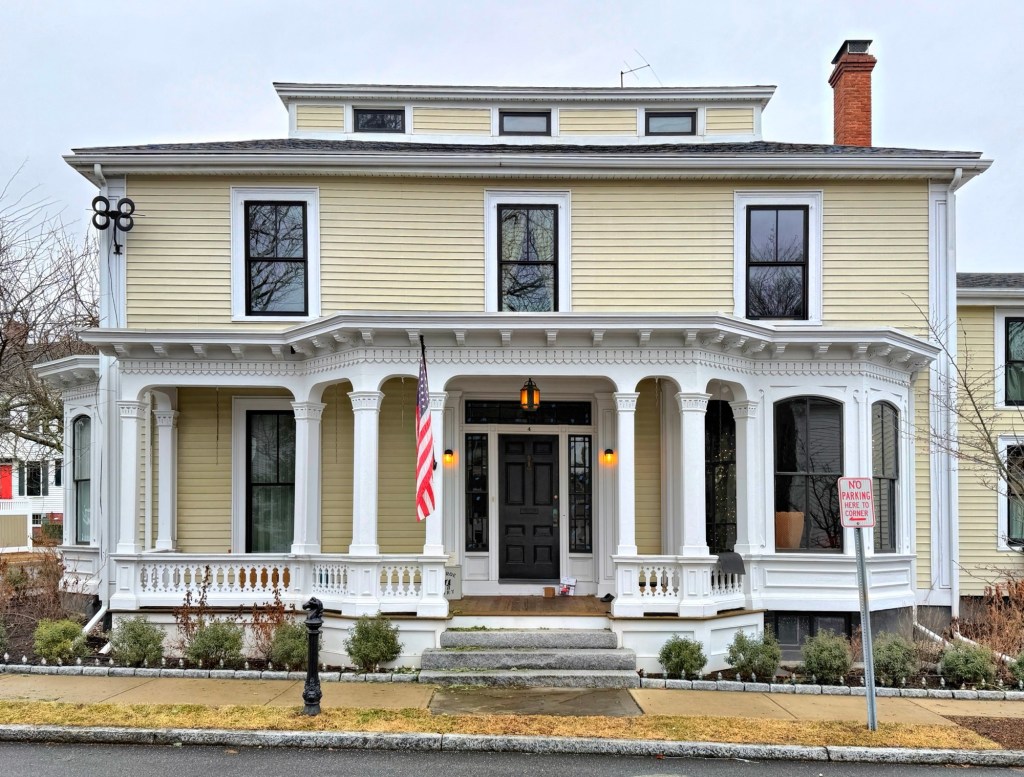
While a part of this Warren, Rhode Island, home may date from as early as the late 18th century, it was completely “modernized” in the mid-19th century by owner, Lewis T. Hoar, a successful housewright, giving us the playful design we see today. Lewis Thomas Hoar (1810-1881) worked in partnerships, building many of the stately Italianate style residences in the village of Warren before entering politics, where he was elected as a state representative. Rather than building his own home from scratch, Lewis updated an earlier Federal period house, retaining its Federal-era hipped roof with monitor, but added the more intricate bay windows and porch, embellished with carved balustrade, brackets and ornament. The large property even retains a Second Empire style stable or barn, which has been preserved by later owners.
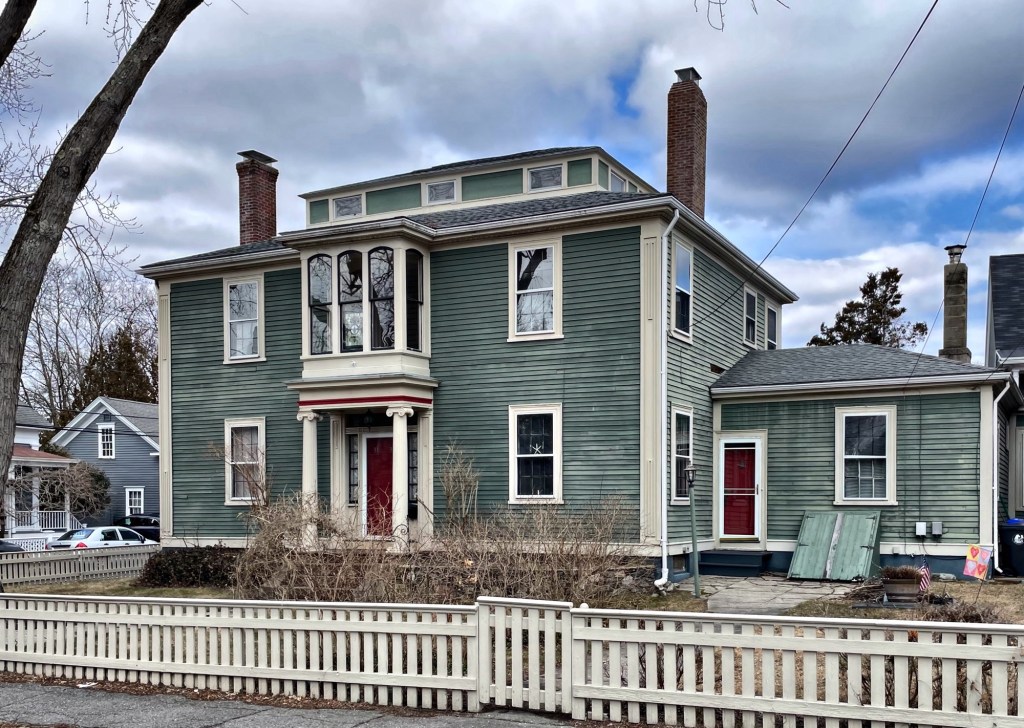
Charles Wheaton (1761-1863) enlisted in the his local militia at just 14 years old and served in Colonel Robert Elliott’s Regiment of Artillery to protect Narragansett Bay. After the war, Charles settled in Warren, Rhode Island, and married Abigail Miller. They would have at least nine children, with one of their children, Charles Wheaton, Jr., (1791-1863) marrying Abiah Goodwin Turner in 1815, the daughter of a wealthy sea captain. Around the time of their marriage, they built this house on Liberty Street in Warren in the Federal style with a three bay facade, monitor on hip roof, and portico at the entrance with Ionic columns. By the end of the 19th century, the house was enlarged and a bay window was added over the entry portico.
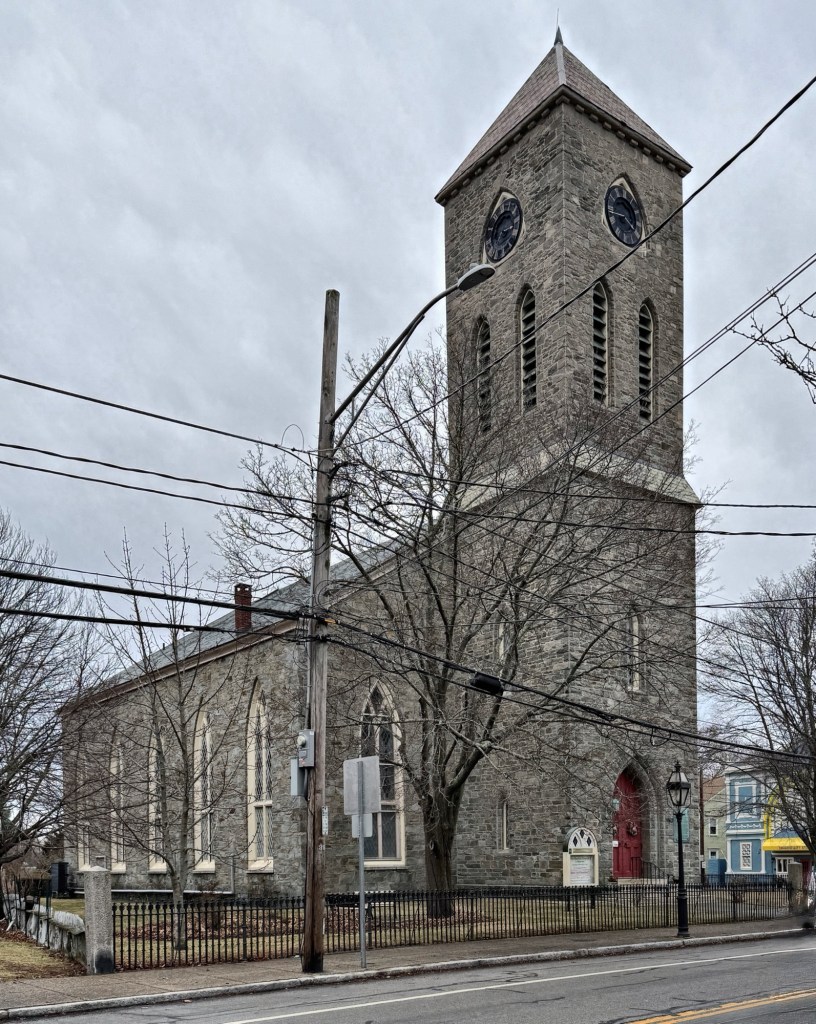
The Warren Baptist Church on Main Street in Warren, Rhode Island, is a landmark example of an ecclesiastical building in the Gothic Revival style completed in stone. Like many communities in Rhode Island, Baptists in Warren, were the first and largest denomination in the community, dating back to the 18th century. The congregation’s first purpose-built church was constructed in 1764 and was burned by the British in 1778 as they left Warren. Its replacement (1784) was demolished for the present building sixty years later. Interestingly, this site is significant additionally as the site of the founding of Brown University. as when Reverend James Manning was called in 1764 to take over the congregation and its new church building, he did so with the proviso that he could open a school for the training of Baptist ministers because all existing colonial colleges at the time provided for training only in the Congregational and Episcopal ministries. The school was located behind the present location of the church and it spent its first four years here in Warren, holding its first commencement in that church until the new school (and Reverend Manning as president) were lured to Providence, where Brown University has remained ever since. The present Warren Baptist Church was built in 1844 and was designed by famed Rhode Island architect, Russell Warren, who is best-known for his work in the Federal and Greek Revival styles, but here shows his expertise and skill in the Gothic mode. The building is notable for its lancet-arched windows and belfry with narrow lancet arched louvered windows set below the clock faces set in triangular trefoil tracery. The congregation also maintains Tiffany windows donated by members of the church.