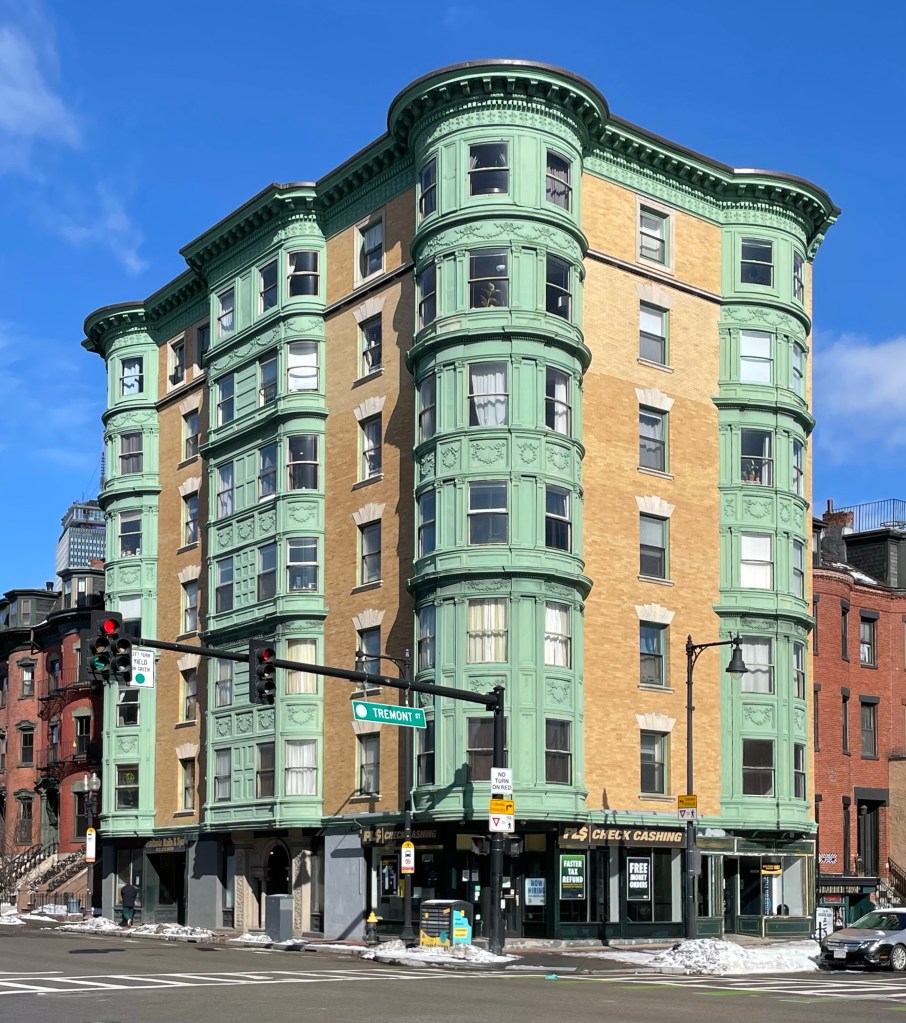
Located at the prominent corner of Mass Ave and Tremont Street in Boston’s South End neighborhood, this beautiful apartment building has long caught my eye, but I finally got around to looking up its history! The building was constructed in 1896-7 by Albert Geiger, a real estate developer who sold the completed building to a Josiah P. C. Marshall. The building is Classical Revival in style and had eleven suites for rental. The blond brick building with Indiana limestone trim are gorgeous, but the showstoppers are the metal bay windows with decorative wreaths and garlands.
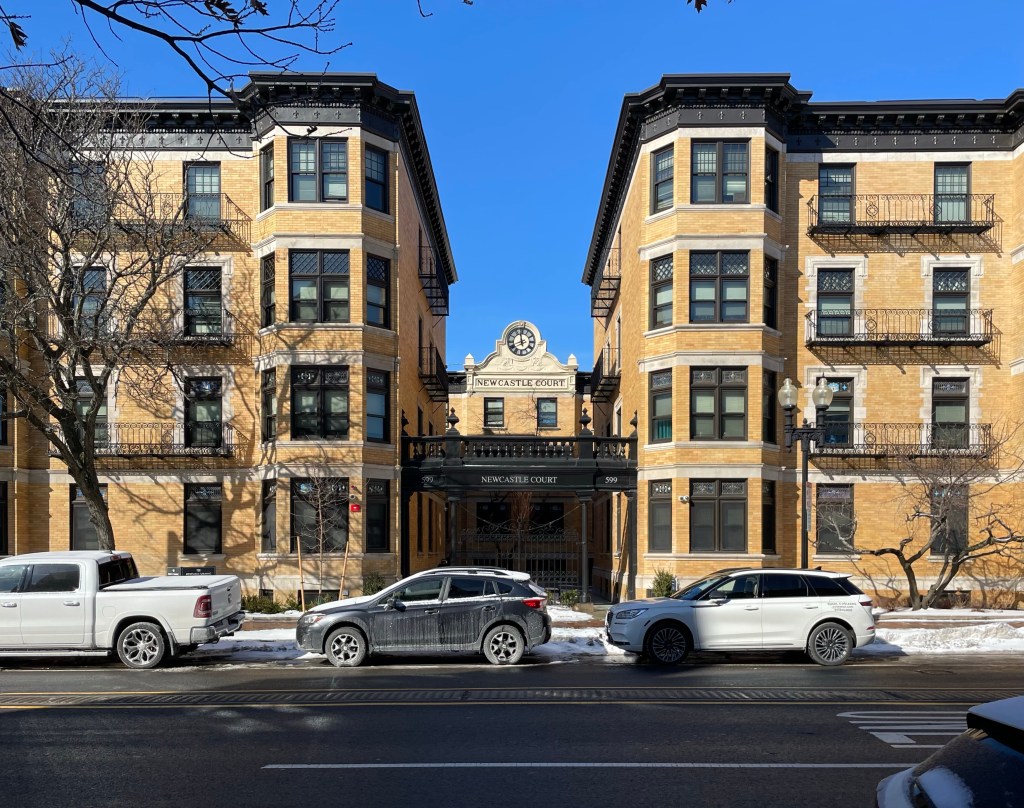
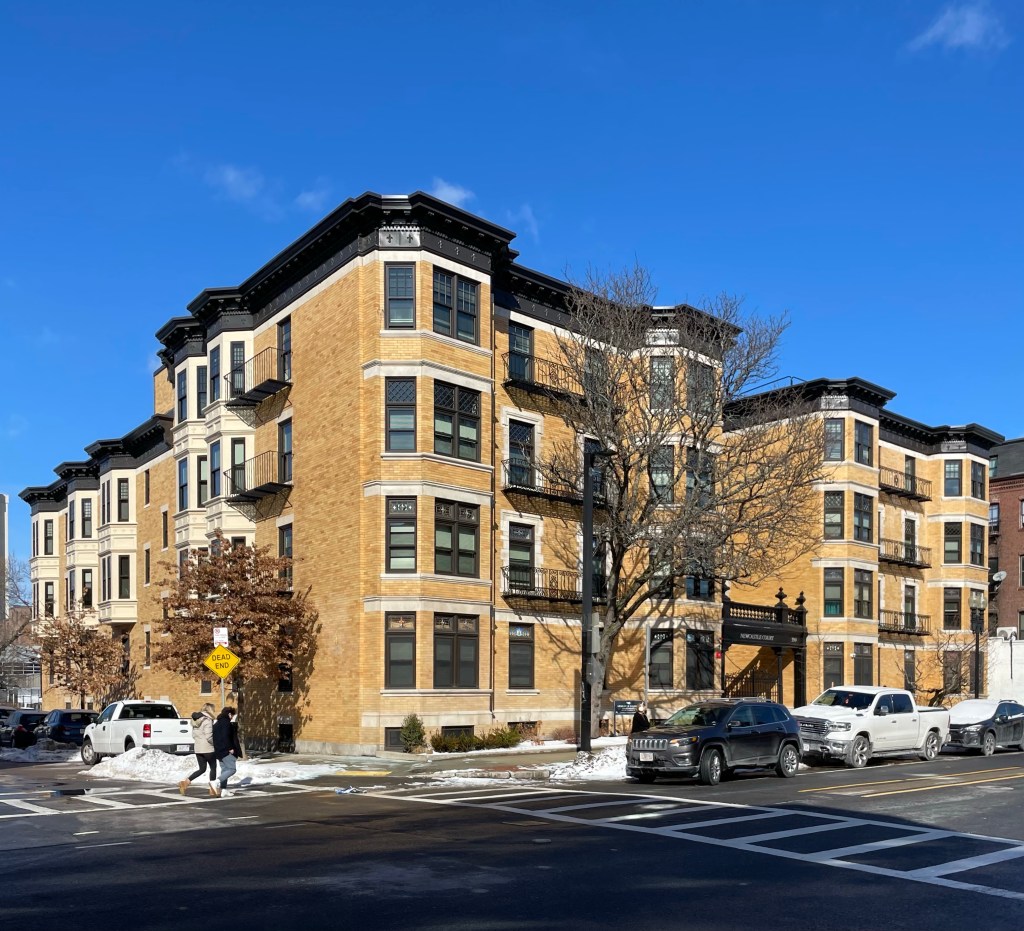
Newcastle Court in Boston’s South End/Lower Roxbury neighborhoods is one of the finest apartment buildings in the city built in the early 20th century. The complex is U-shaped with a central courtyard off Columbus Street, to provide air and natural light in all bedrooms and units of the building. Newcastle Court was built by builder/developer Israel Nesson, who was credited as building the first fireproof apartment building in the city. Nesson and his family built and owned apartment buildings all over Boston and Cambridge, and operated many of them as landlords with massive real estate holdings. Newcastle Court stands out for the garden courtyard set behind the gate. At the back of the courtyard, the building has a raised parapet at the roof, which encompasses a clock. Many of the units retain the original stained glass windows, which are AMAZING!
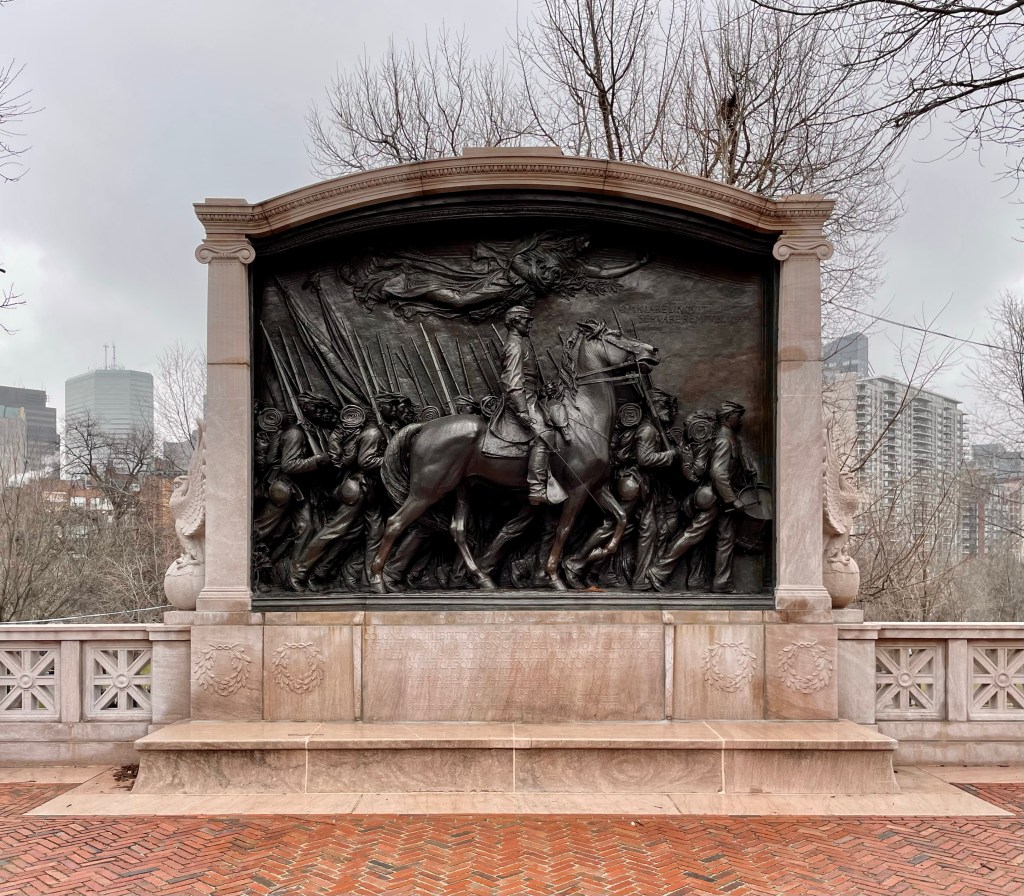
Commissioned from the celebrated American sculptor Augustus Saint-Gaudens in the early 1880s and dedicated in 1897, The Shaw 54th Regiment Memorial (aka the Robert Gould Shaw Memorial) has been acclaimed as the greatest American sculpture of the 19th century. The memorial was designed by famed artist Augustus Saint-Gaudens, and it is a stop on the Boston Black Heritage Trail, commemorating the valiant efforts of Colonel Robert Gould Shaw and the men of the 54th Massachusetts, one of the first Civil War regiments of African Americans enlisted in the North. In July 1863, the regiment was sent to South Carolina where an assault was planned on Fort Wagner guarding Charleston harbor. Shaw had asked to have 54th Regiment lead the attack. Of the 600 men in the attack that day, there were 285 casualties, and Col. Shaw was killed, but the men never wavered in the battle and demonstrated great courage and determination. Following this display of valor, other black regiments were formed, and by the end of the war, 10% of the union army was made up of African American soldiers.
The monument in Boston shows the 25-year-old Shaw seated on his horse, with his regiment as it marched down Beacon Street on May 28, 1863 to depart the city to fight in the South. The concept of Shaw on horseback with marching soldiers was inspired, at least in part, from a painting Saint-Gaudens saw in France, Campagne de France 1814, by Jean-Louis Ernest Meissonier, which depicts Napoleon on horseback with rows of infantry in the background.While Shaw is the centerpiece of the monument, the significance of the monument is the Shaw Memorial is the first civic monument to pay homage to the heroism of African American soldiers in the U.S.
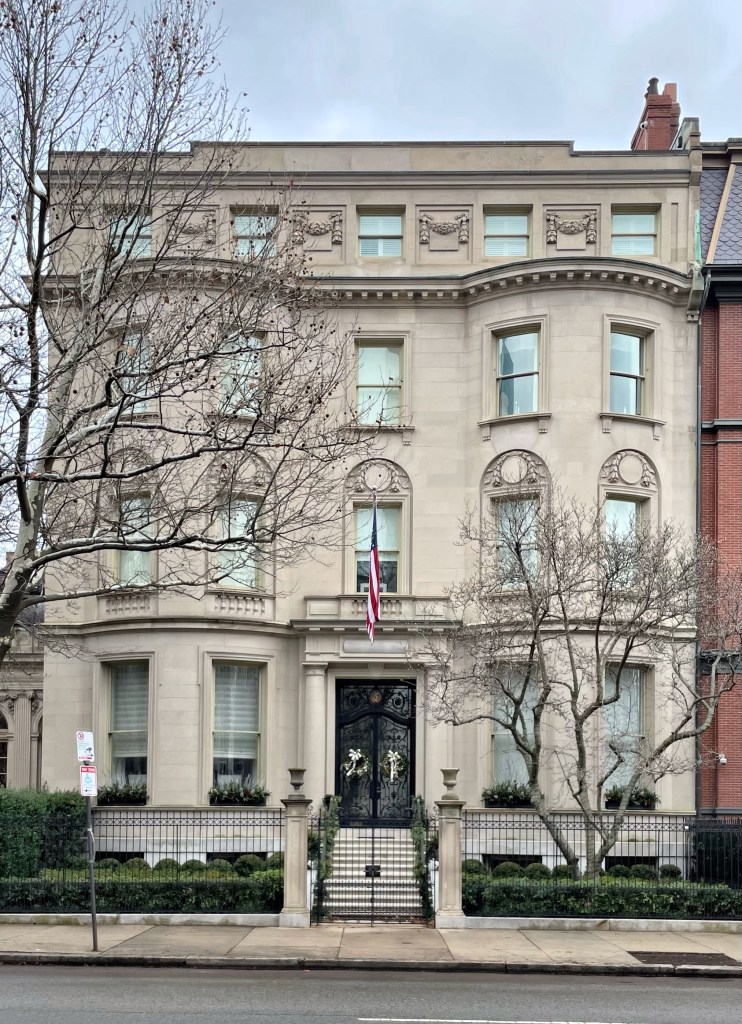
Commonwealth Avenue in Boston’s Back Bay neighborhood is a dream, no matter what time of year, though I am a huge fan of it in the winter so the leaves don’t obscure the architectural details! This home just steps from the Public Garden was built in 1903 for Walter Baylies (1862-1936) and his wife, Charlotte. The couple had purchased a c.1860 Second Empire mansion (basically a sister house or twin to the adjacent at 3 Commonwealth Ave), and demolished it for a more “modern” residence. Baylies was extremely wealthy with investments in nearly everything, and he wanted his city residence to stand out amongst the earlier, brick and brownstone townhouses on the eastern edge of the neighborhood. Architect Arthur Rice designed the house in the Renaissance Revival style, and it is finished with Indiana Limestone. Of particular note is the one-story ballroom, which was built to the side of the home, set back behind a small garden. An empty house lot, formerly occupied by a stable, was used simply for the Baylies’ ballroom, constructed in 1909 for their daughter. Talk about a status symbol! The home was purchased by Walter’s heirs in 1941 by the Boston Center for Adult Education. The home was again purchased in 2020, and is back to a single-family home! I can’t even imagine how stunning the interior is!
Built at the tail-end of the Gilded Age in Newport, this turn-of-the-century mansion evokes feelings of country estates in England. “Clarendon Court” was built in 1904 for Edward Collings Knight, Jr. (1863-1936) and his first wife, Clara W. Dwight (1862-1910). Edward C. Knight was a railroad executive and amateur artist who “exhibited more talent at spending money than making it”, which was evident from his architectural taste and timing for building such an expensive home in Newport, which was beginning to wane in popularity at the time. Clarendon Court was actually designed in the 18th century by Colen Campbell, a renowned Scottish architect. The country estate was never built, but Gilded Age architect Horace Trumbauer, found the design in one of Campbell’s old books, and except for removing the cupolas over the wings either side of the central block, he reproduced a perfect copy. Trumbauer had just a year before designed a townhouse for the couple in Philadelphia. Edward Knight originally named the mansion “Claradon Court” after his wife Clara. In 1930, Claradon Court was purchased by Maisie Caldwell (1878-1956) and her third husband, Colonel William Hayward (1877-1944), legendary commander of the “Harlem Hellfighters” during World War One. Maisie had inherited a fortune of $50 million from her second husband, Morton Freeman Plant, a railroad and steamship magnate. The couple renamed the mansion Clarendon Court, a more traditional name.
Clarendon Court was later purchased by Claus von Bülow and Martha Sharp Crawford, who was known as “Sunny von Bülow”. Sunny was worth over $75 million and updated the mansion and grounds to exceptionally elegant conditions. It was known that Sunny and Claus had a rough marriage, but it came to a head when on December 26, 1979, after the family had come together for Christmas at their mansion, she was found unresponsive and was rushed to the hospital where she slipped into coma but was revived. After days of testing, doctors determined the coma was the result of low blood sugar and diagnosed her as hypoglycemic, warning her against overindulging on sweets or going too long without eating. No foul play was suspected at the time. One year later, on the evening of December 21, 1980, while celebrating Christmas with her family at their mansion, she again displayed confusion. She was put to bed by her family, but in the morning she was discovered unconscious on the bathroom floor. She was taken to the hospital where it became clear that this time she had suffered severe enough brain injury to produce a persistent vegetative state. A hypodermic needle was found in a black bag in Bulow’s study and coupled with their maid’s testimony he was subsequently charged with her murder, accused of injecting his wife with insulin so he could live at Clarendon on her money with his mistress. His mistress was the actress Alexandra (Moltke) Isles, better known as “Victoria Winters” in Dark Shadows. In 1982, in a sensational case that gripped the country, Bülow was convicted. But, he appealed in 1985 and was acquitted. His stepchildren then filed a $56 million law suit against him, which was dropped two years later: Bülow agreed to divorce his comatose wife, relinquish all rights to her fortune, leave the country and never to profit from the story. Bülow moved to London where he kept a low profile for the rest of his life while Sunny remained in a vegetative state in New York until she eventually passed away in 2008.
Buildings of New England travels! Welcome to Schenectady, a great city in upstate New York, with an hard to spell and pronounce name! The name “Schenectady” is derived from the Mohawk word skahnéhtati, meaning “beyond the pines”. Schenectady was founded on the south side of the Mohawk River by Dutch colonists in the 17th century, many of whom were from the Albany area. In 1664 the English seized the Dutch New Netherland colony and renamed it New York. They established a monopoly on the fur trade around Albany, and issued orders to prohibit Schenectady from the trade through 1670 and later. The town grew mostly as an inland agricultural town until the Erie Canal was built in 1825, creating a navigable water route from New York City and the Atlantic Ocean to the Great Lakes, cutting through Schenectady. The town grew and became an industrial center, attracting a very diverse population of immigrants in the 19th century and African Americans as part of the Great Migration out of the rural South to northern cities for work. The community struggled (like many) in the mid 19th century but has seen a large resurgence as of late!
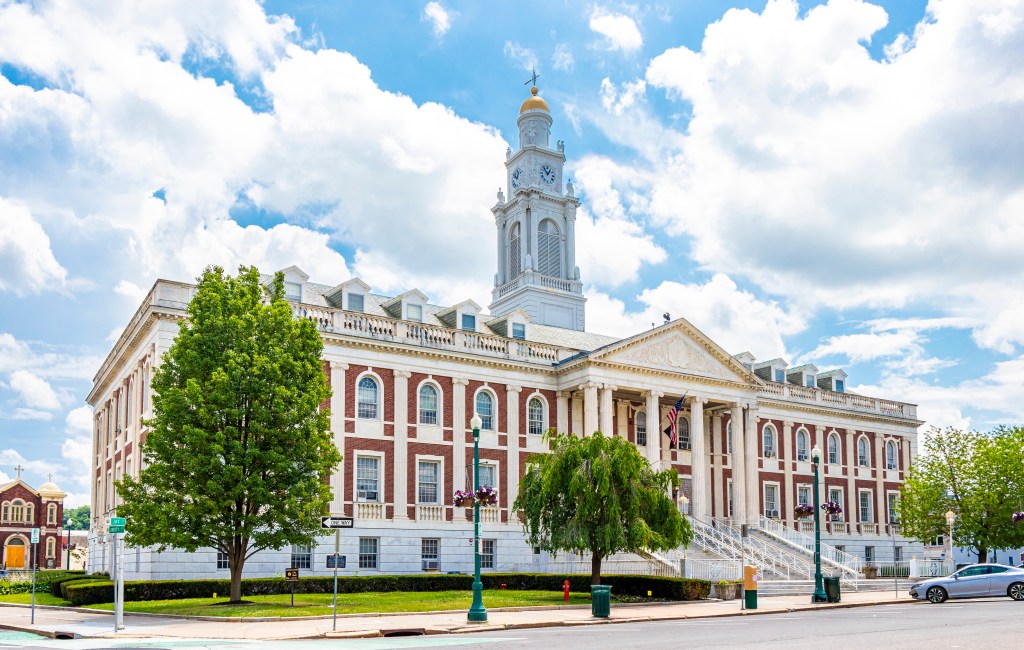
This building is the Schenectady City Hall, a massive architectural landmark which made my jaw drop when I saw it! The City of Schenectedy outgrew their old City Hall, and in the late 1920s, held a nationwide contest to select designs for a new City Hall. The contest was won by the prominent architectural firm McKim, Mead, and White. It appears that the designs were furnished by James Kellum Smith of the firm, the often overlooked genius of the MMW practice. The exorbitant cost of the project, which was undertaken during the Great Depression, caused the building to be dubbed “Fagal’s Folly” after Mayor Henry C. Fagal, who allowed all the cost increases while the city’s future was uncertain. He was not re-elected after this building was completed. The building is a pleasing mixture of Colonial and Classical Revival styles and features bold pilasters and a towering cupola
Located on Arlington Street between St. James and Stuart streets in Boston’s Back Bay, this gorgeous masonry commercial block stands as a testament to the amazing architecture built in Boston in the early 20th century. The Paine Furniture Building was constructed in 1914 to house the extensive showroom, offices, and manufacturing operations of the Paine Furniture Company. Founded in 1835, the company was at one time the largest furniture manufacturer and dealer in New England and had a nationwide business. The company was founded by Leonard Baker Shearer, who was joined in business in 1845 by John S. Paine. Upon the death of Shearer in 1864, the name of the firm was changed to Paine’s Furniture Company, a name which stuck until the company closed in 2000. The architects for the building, Densmore & LeClear, were very busy in the early decades of the 20th century and designed many iconic buildings nearby and in towns surrounding Boston through the 1940s.
The Boston Gas Light Company was incorporated in 1823 and for thirty years was the sole company producing coal gas in the City of Boston. In the second half of the 19th century, several additional gas light companies were formed in and around Boston to make loads of money with the booming industrial growth seen there. They continued until it was determined that with the proximity of competing pipelines and the overlap of service areas it would be more efficient to consolidate into a single company. The Boston Consolidated Gas Company was chartered in 1903 to to combine numerous smaller corporations operating in the City of Boston under one conglomerate. The organization had a small building in Downtown, which was outgrown decades later. The company hired the local firm of Parker, Thomas & Rice, to design the new mid-rise office building on the outskirts of the fashionable Back Bay neighborhood. The base of the Classical Revival building follows the base, shaft and capital form. The base is traditional with three stories of rustication, ornamental capitals, carved detail at the arches and the elegant bronze window frames. The central stories are clad in dressed limestone, streamlined with punched openings, emphasizing verticality. Stories 12 and 13 are framed by colossal engaged columns with arched windows and bas reliefs. The ground floor today is home to a recently opened restaurant, Nusr-Et Boston, which was created by the famous chef, Salt Bae.
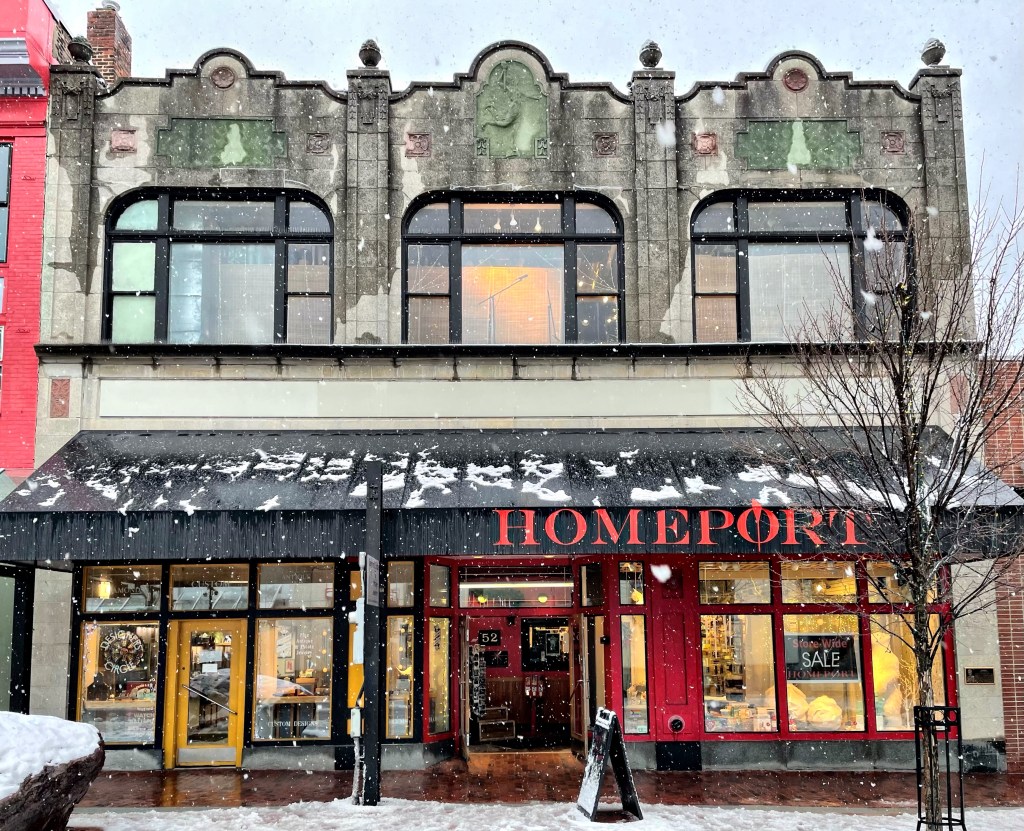
Montgomery Ward was founded by Aaron Montgomery Ward in 1872. Ward had conceived of the idea of a dry goods mail-order business in Chicago. The fledgling company often created catalogs of their items for sale, distributing the booklets in the streets of the city. In 1883, the company’s catalog, which became popularly known as the “Wish Book”, had grown to 240 pages and 10,000 items. In 1896, Wards encountered its first serious competition in the mail order business, when Richard Warren Sears introduced his first general catalog. In 1900, Wards had total sales of $8.7 million, compared to $10 million for Sears, beginning a rivalry that lasted decades. In 1926, the company broke with its mail-order-only tradition when it opened its first retail outlet store in Indiana. It continued to operate its catalog business while pursuing an aggressive campaign to build retail outlets in the late 1920s. In 1928, two years after opening its first outlet, it had opened 244 stores. By 1929, it had more than doubled its number of outlets to 531. This smaller retail expansion was in contrast to rival, Sears Roebuck Company, which was opening a chain of large retail stores on the outskirts of larger cities. The 515th Montgomery Ward store was this one in Burlington. The building is constructed of brick and faced with concrete with “Chicago-style” three-part windows with the three bays capped by concrete pilasters topped by urns. The Burlington Montgomery Ward store closed in 1961, and the building is now home to Homeport, a home goods store.
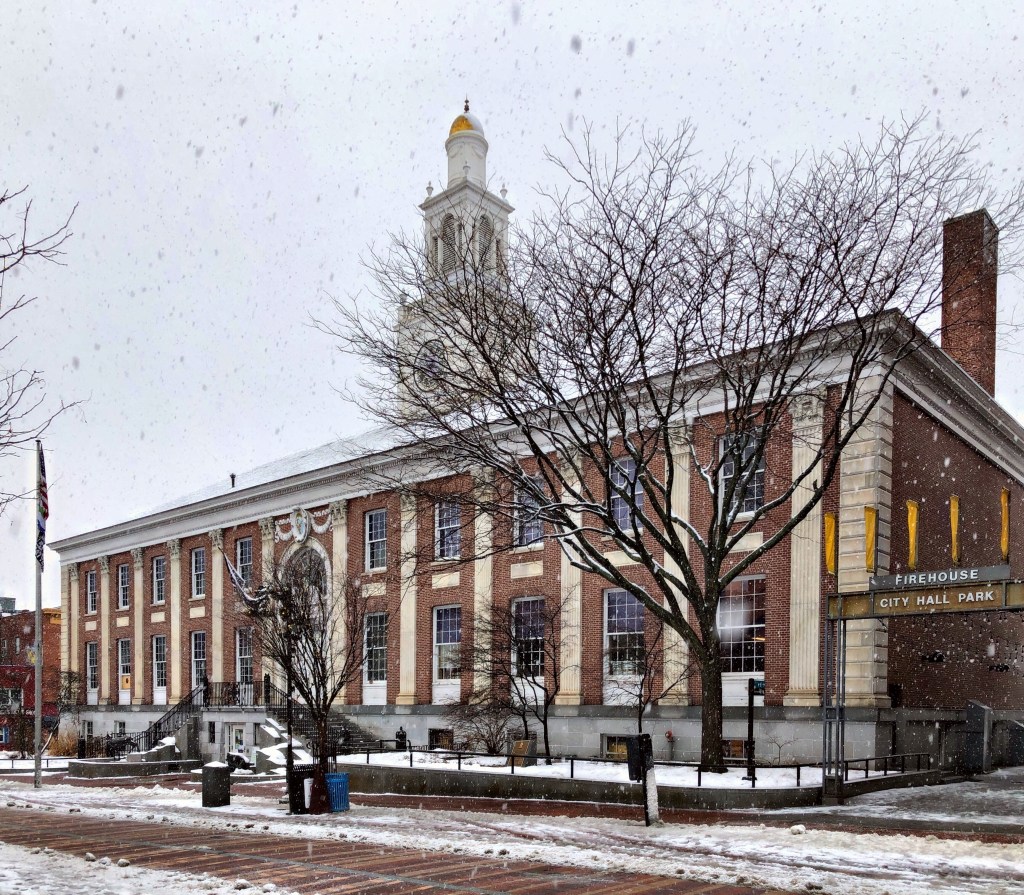
One of the largest, most grand buildings in Downtown Burlington, Vermont is its City Hall building, constructed in 1928, just before the Great Depression. The brick facade with extensive carved marble trim is Neo-classical in style, with virtually all the finish materials – brick, marble, roofing slate, and granite produced in Vermont. The building replaced the 1850s City Hall, which was poorly constructed and suffered from deterioration, exacerbated by an earthquake in 1925. Architect William M. Kendall was hired to complete the designs of the large, bold Classical building. Kendall spent his career with the New York firm of McKim, Mead & White, the leading American architectural practice at the turn of the century, and showcased the best of that firm with the design of this building.
This stunning townhouse on Beacon Street in the Back Bay neighborhood of Boston was constructed in 1913 for George Eddy Warren and his wife Frances Knowles Warren. The home, designed by Parker, Thomas & Rice, is one of the more elegant Classical Revival townhomes in the city, with its symmetrical, prominent bowfront, piano nobile with full-height windows, classical lintels, and thoughtful use of brick and stone construction. George E. Warren was a coal dealer, who was selected to head the U.S. Army’s Raw Materials Division during WWI for his expertise. During the war he was in charge of the fuel and forage division, overseeing an important aspect of 20th century warfare, petroleum manufacturing and distribution. His wife Frances was the daughter of Francis B. Knowles, a co-founder of Rollins College in Florida, the oldest institution of higher learning in the state of Florida. Frances volunteered her time in Boston as President of the YWCA, progressing women’s empowerment and social justice in the city. After successive ownership, the townhome was acquired by Emerson College and combined with its neighbor on the interior. In 2000, the home was reverted back to a residence and houses two condominium units.
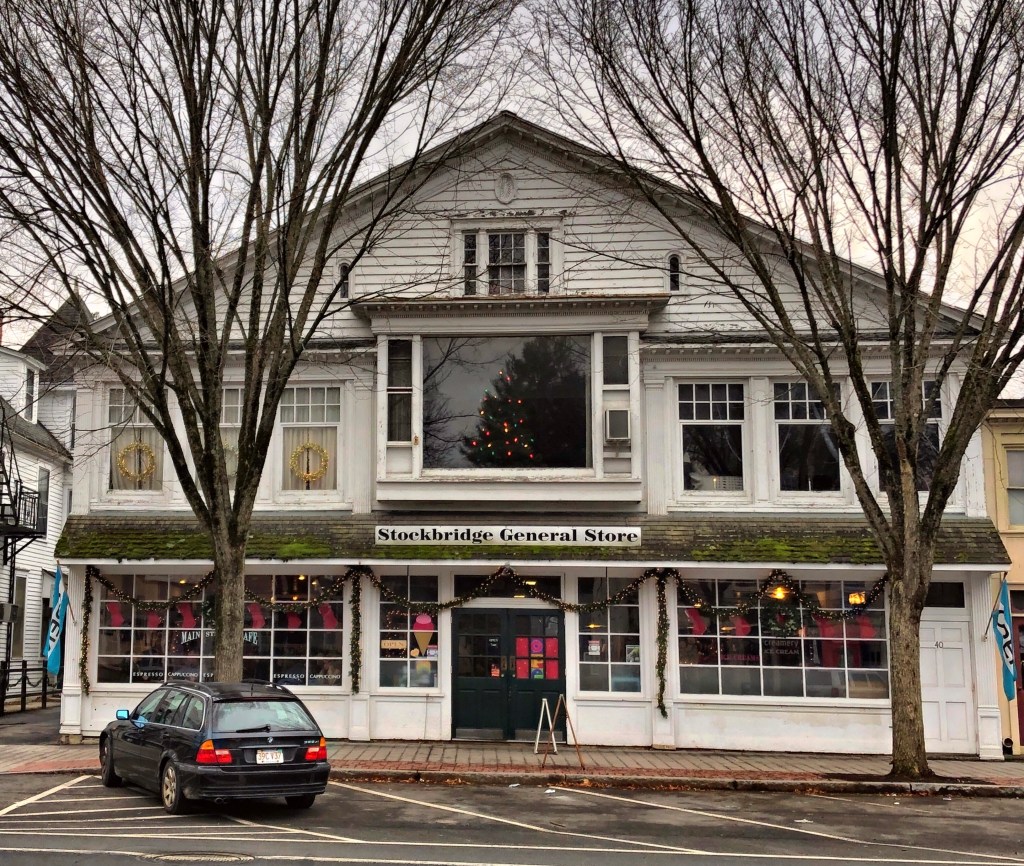
Norman Rockwell‘s ‘Home for Christmas’ painting in 1967 depicts the Main Street scene in Stockbridge, Massachusetts, and epitomizes the essence of Christmas in small towns across the country. In the iconic painting, you can find many landmarks (including the Town Offices building) that make up the quaint main street, that typifies many small New England towns. At the center of his painting, the Guerrieri Block can be seen with a Christmas tree lit up in the window on the second floor. The Guerrieri Block was built in 1921 by Antonio Guerrieri, a skilled woodworker who sold and repaired antiques in one of three street level shops in the block. He and his family lived in an apartment on the second floor. The next year he completed construction of a shop behind the block where he worked out of. In 1953, Norman Rockwell moved to Stockbridge and spoke with Antonio about using the second floor of his building as a studio. Antonio constructed a large central bay window with plate glass to flood the space with light and allow Rockwell to work while observing the street below. Rockwell used the space as his studio until 1957. The building has since been occupied as a general store.
An excellent example of Classical Revival architecture, the Hollis Social Library in Hollis, New Hampshire is a single-story building displaying an Ionic portico and capped by a copper dome. The building, which fronts the town green, was constructed in 1910 according to plans by architects Magee and Rowe of Boston. The building was dedicated on August 24, 1910. The Hollis Social Library is believed to be one of the oldest libraries established in the State of New Hampshire. An association was formed in 1851 and a small library was kept in the Congregational Church vestry. After the new Town Hall was built the library was located there until the construction of the current building.
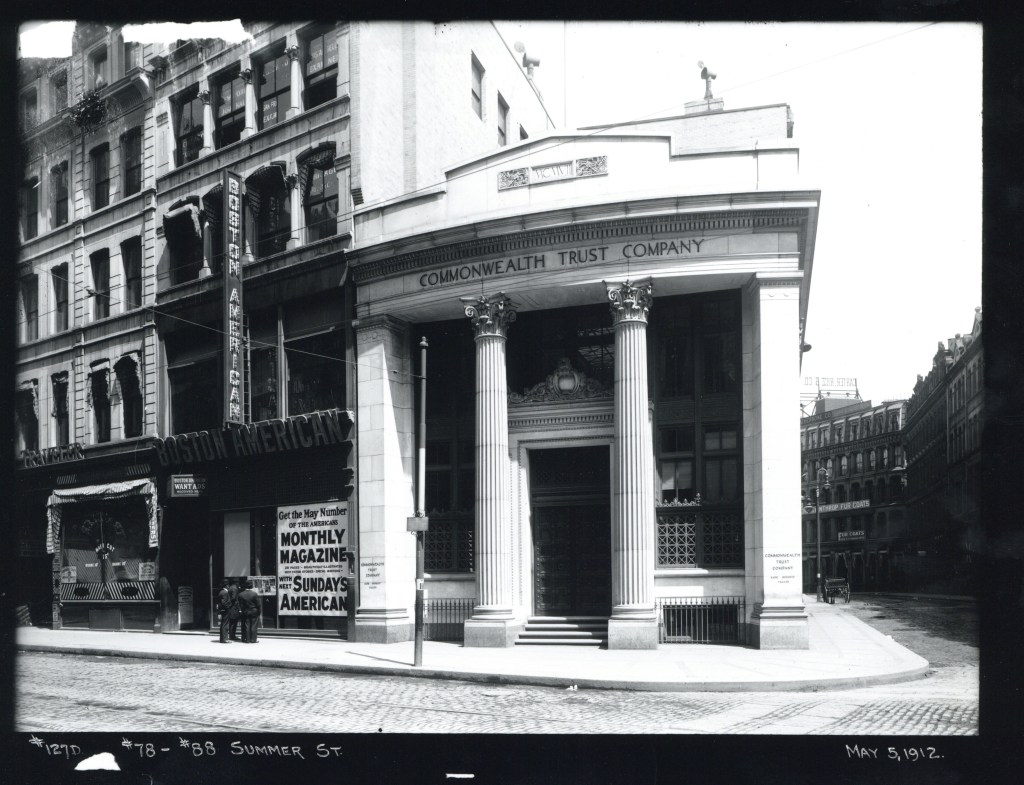
Ca. 1910 image courtesy of Boston Public Archives.
Located at the corner of Summer and Devonshire Streets in Downtown Boston, the Commonwealth Trust Company’s two-story marble banking house commanded the corner, despite its short stature. The building, completed in 1908, was constructed with Lee marble and decorated with ornate wrought and cast-iron grilles over windows. The building was designed by the architectural firm of Parker, Thomas & Rice in the Classical mode with large, fluted Corinthian columns and boxed corner pilasters framing the recessed center entrance, Corinthian pilasters ran along the side facade. At the inside, the building was coated with Cararra and Blanco marble with paneled oak offices. At the ground floor, offices and banking stations framed the outer walls, with the safety deposit boxes located on the second floor. The building was demolished by the 1970s and replaced with a one-story minimalist Modern building (I could not figure out why the former building was razed). The new building was demolished after a few decades with a larger building, better fitting the commercial district.
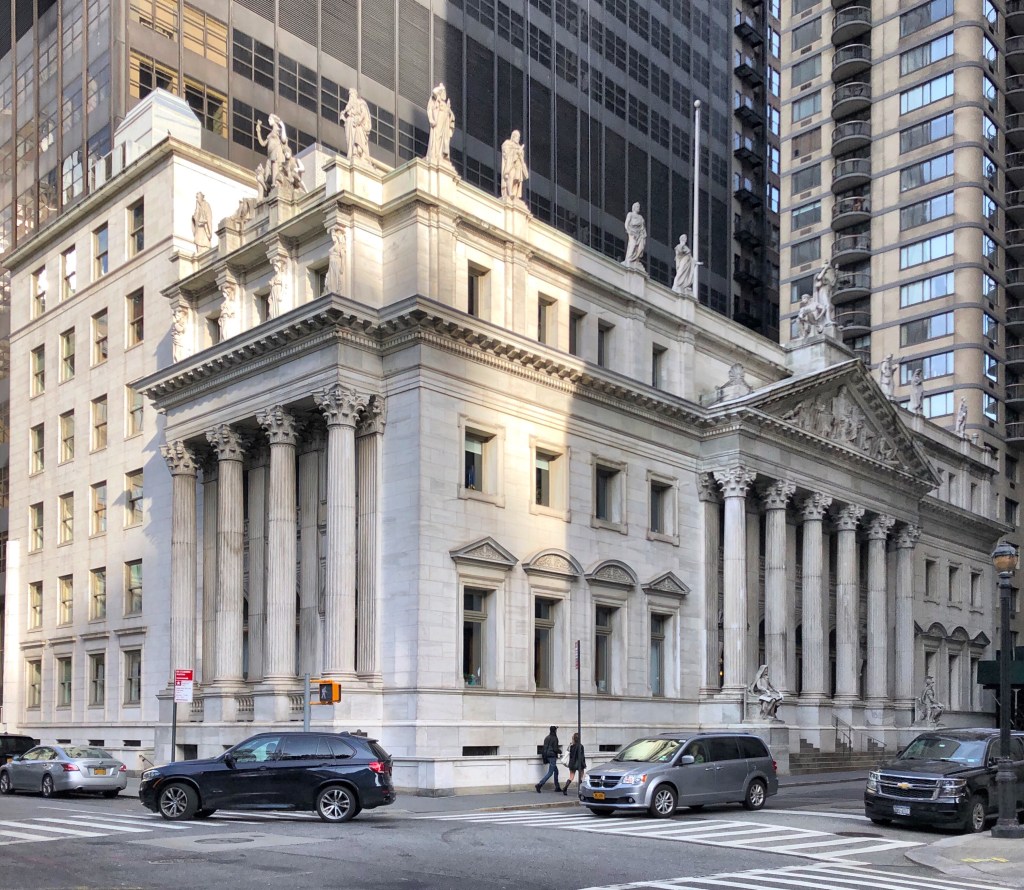
Distinguished for its classic beauty, this small marble courthouse expresses the best of Classical tradition, in its columned portico and fine sculptures adorning it. Located at the edge of Madison Square Park, the building was constructed between 1896 and 1899 to serve as a courthouse for the Appellate Division of the New York State Supreme Court. The marble Classically inspired Beaux-Arts courthouse, was designed by James Brown Lord and is considered to be an excellent example of the City Beautiful movement, which sought to introduce monuments and beautification to American cities. Of the nearly $650,000 spent on the building, 25 percent was spent on sculpture, a huge sum at the time. Sixteen sculptors – sponsored by the National Sculpture Society and among of the most esteemed of the day – worked on the thirty 12-foot marble statues on the facade, the most ever to work on a single building in the United States. Sculptures by Daniel Chester French, Charles Henry Niehaus, Karl Bitter, and more adorn the balustrade and entrance steps. Additionally, four caryatids sculpted by Thomas Shields Clarke on the Madison Avenue front, showcase a rare feature not typically seen in American architecture, representing the four seasons.
In 1953 a $1.2 million restoration of the facade was undertaken by the Department of Public Works during which the huge marble statues were removed and cleaned. It was at this time that the general public first realized one of the lawgivers was Mohammed. Representatives from Pakistan, Egypt and Indonesia petitioned the State Department to destroy the statue rather than restore it, citing Islamic canon that forbids the depiction of human beings in painting or sculpture.When the statues were replaced in 1955, each was moved over one spot to fill in the void where Mohammed had stood. Today one empty pedestal remains.





 Buildings of New England

