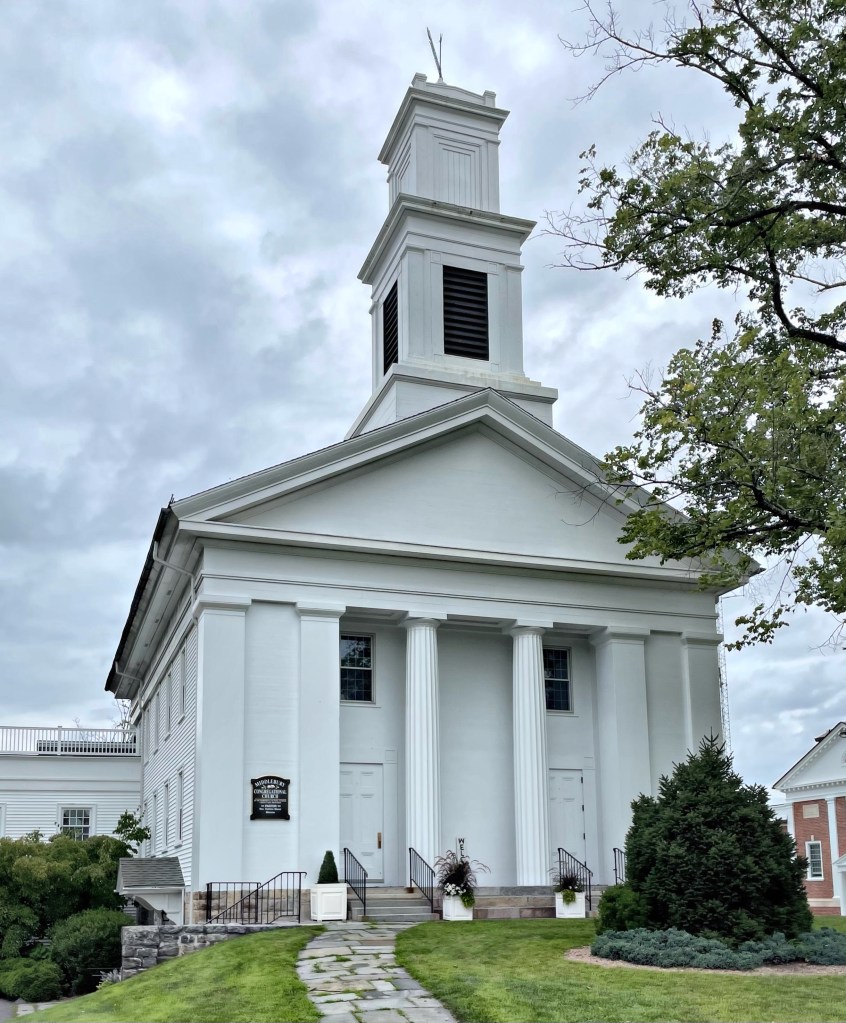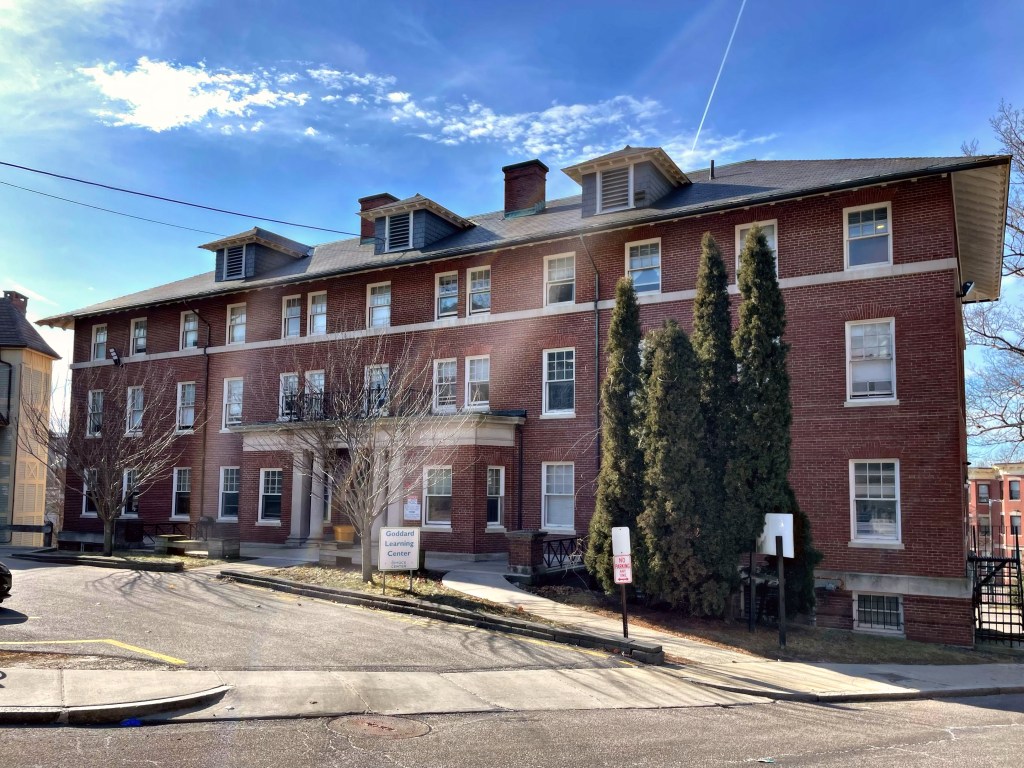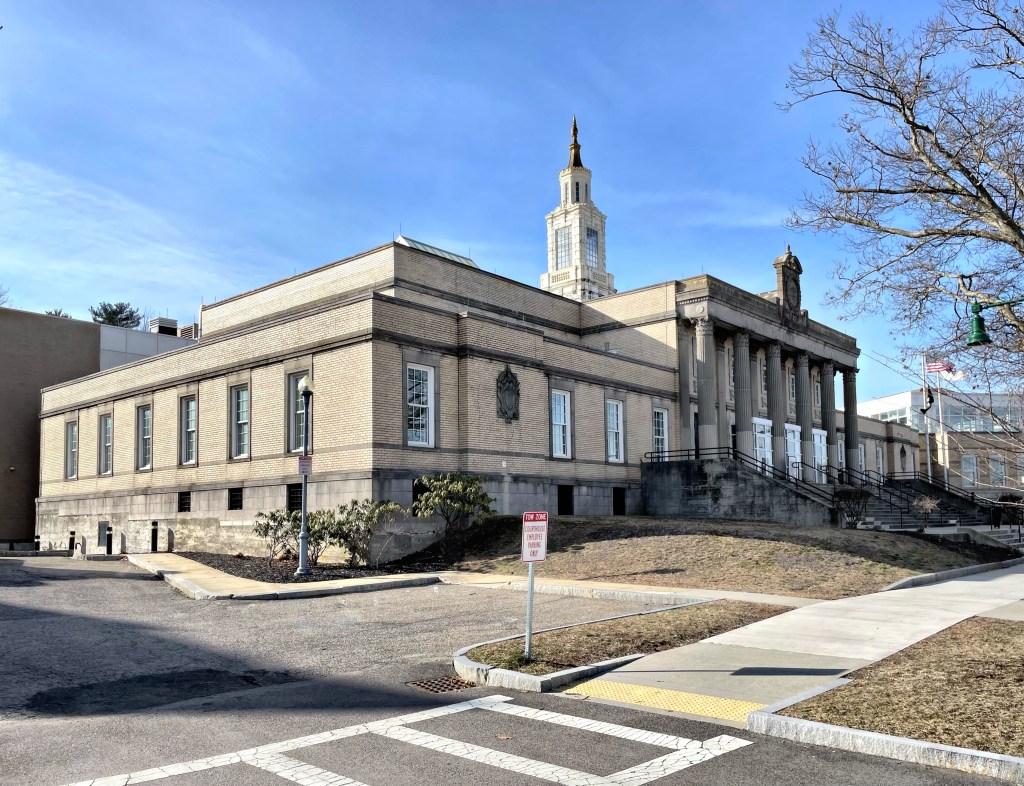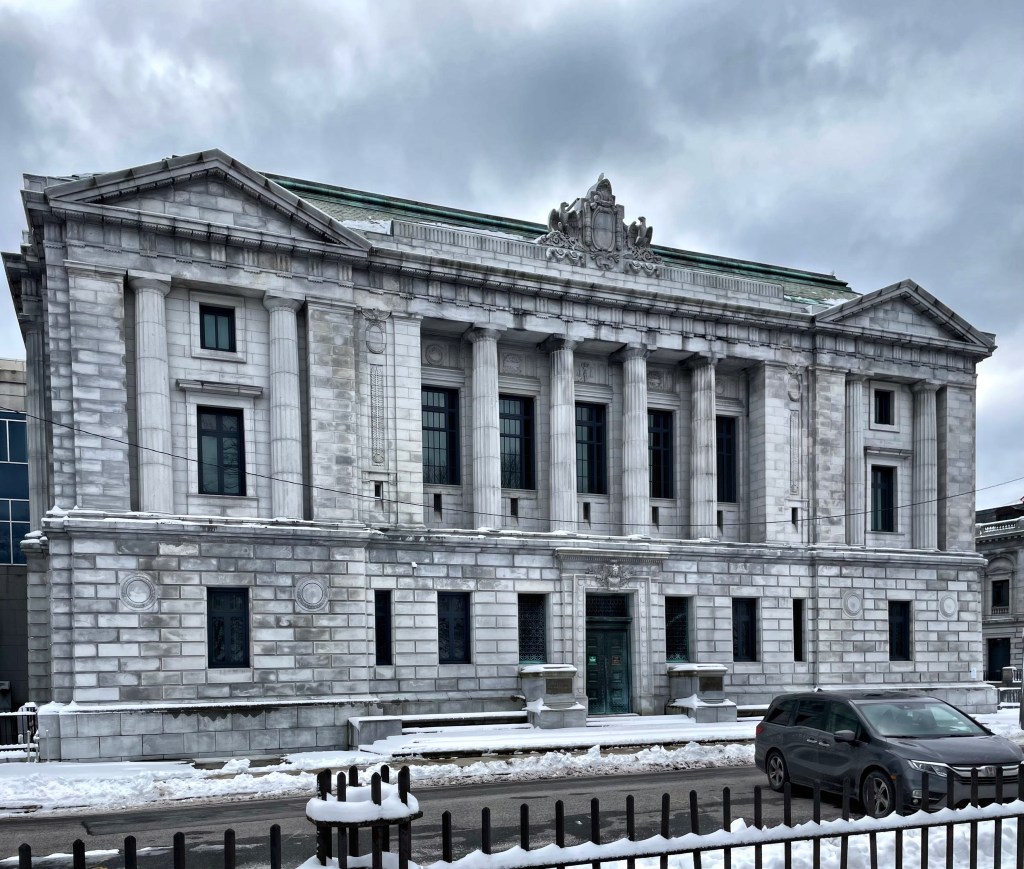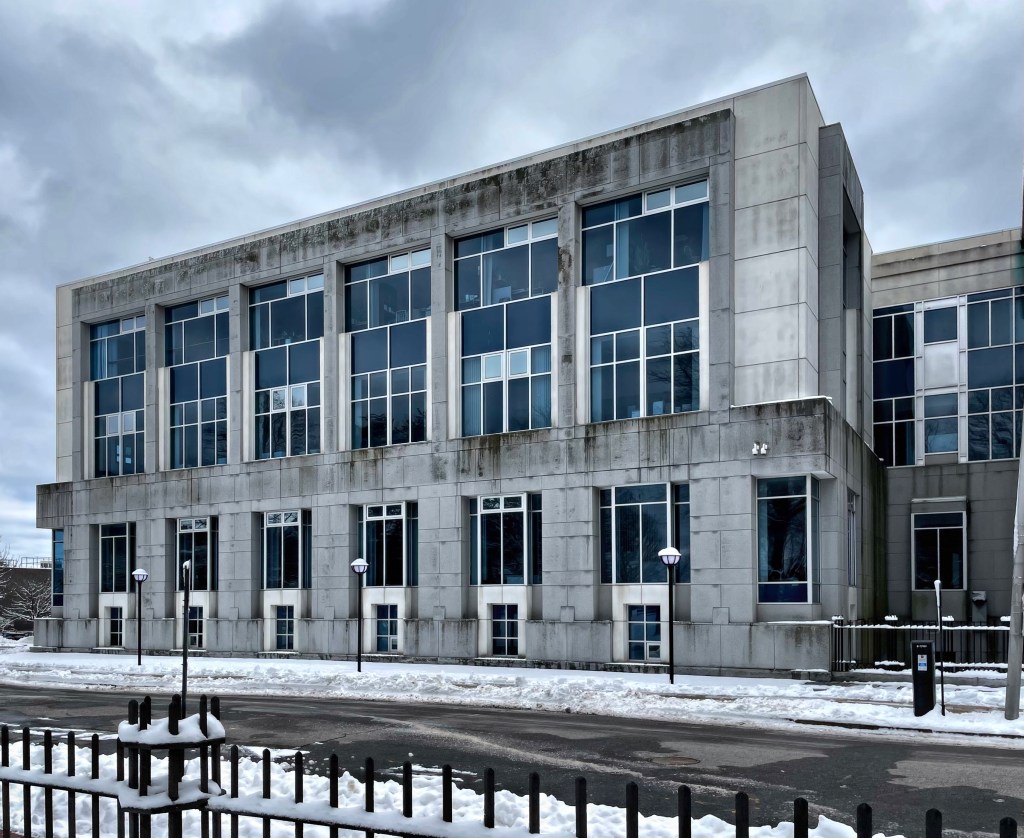
The Cumberland County Courthouse in Portland, Maine, designed by Guy Lowell, architect of Boston with local associate architect George Burnham was designed in 1906 and completed in 1910 and is the best in Classical Revival architecture. On the north and east sides is a three-story addition built between 1988 and 1991 by Terrien Architects Inc., showcases how Modern additions can be contextual and recessive, highlighting the historic buildings which they are attached to. What do you think of the original courthouse and its addition?
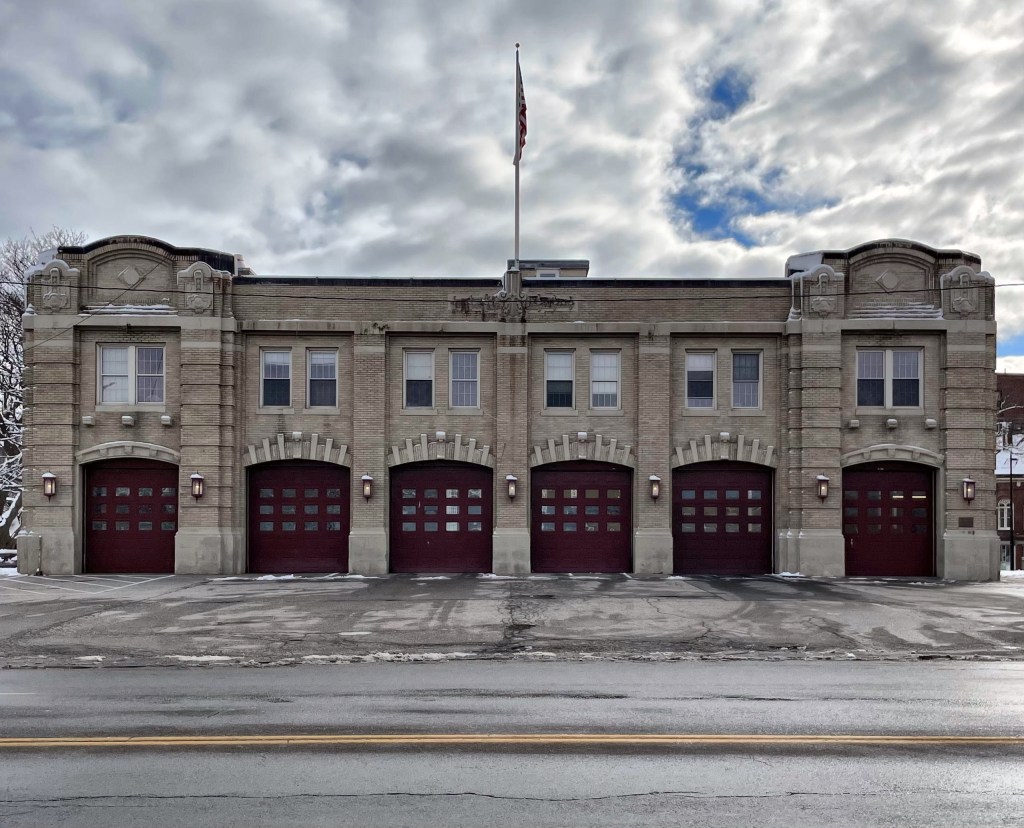
The Central Fire Station in Portland, Maine was built in 1924 and designed by William R. Miller & Raymond J. Mayo, architects located at 465 Congress. Lester I. Beal, a draftsman employed by Miller & Mayo, participated in the design. It was erected to contain the administrative offices of the Portland Fire Department, as well as to house fire engines and other apparatus of the inner city district. Portland has one of the oldest fire departments in the nation, 1768, when Falmouth appointed fire wardens to look for fires at night and alert the residents. In 1786, the citizens of Falmouth formed a separate town in Falmouth Neck and named it Portland, after the isle off the coast of Dorset, England. After the Great Fire of 1866 destroyed much of Downtown Portland, a new central station was built in 1867. The structure was deemed obsolete with new, large ladder trucks replacing smaller engines. The entire downtown block was demolished for the current Central Fire Station for the present building. The small building is at the center of a large lot, which is likely a candidate for redevelopment in the future (after some adjacent surface parking lots are developed).
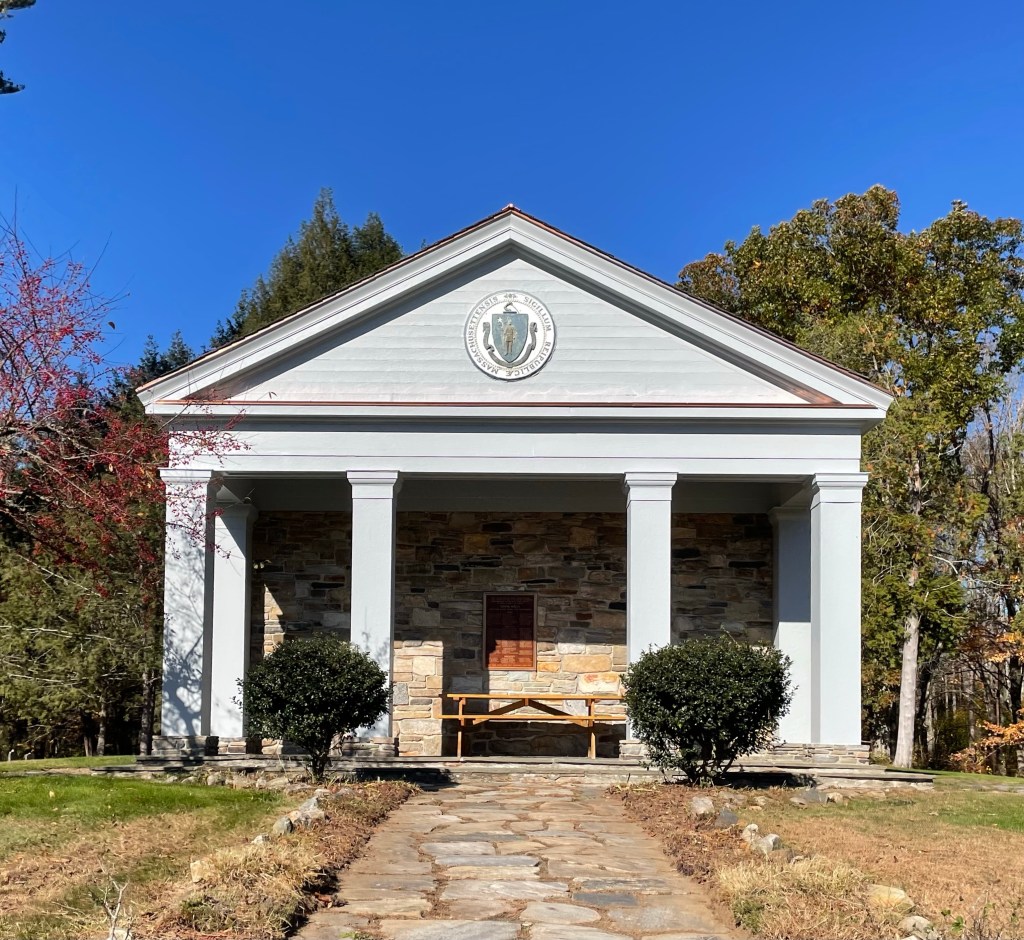
By the early 1900s, metropolitan Boston’s demands for freshwater began exceed its supply, causing the state legislature to look for other sources of water to supply the metro’s population growth. A 1922 study endorsed the Swift River Valley (Quabbin area) as the best location for a new reservoir that could supply Massachusetts with fresh water, but there was one issue, there were towns and people living there. To create the Quabbin Reservoir, the depressed land would need to be flooded, this required over 80,000 acres of land to be purchased or seized by eminent domain by 1938. Four towns: Dana, Enfield, Greenwich, and Prescott were disincorporated and their excess land not flooded was added to surrounding municipalities. In total, an estimated 2,500 residents lost their homes as part of the flooding. Not all elements of the towns were destroyed, however. Town memorials and cemeteries in the four towns were moved to Quabbin Park Cemetery, in Ware, a short distance from the Quabbin Reservoir. Many other public buildings were moved intact to other locations (like those in Dorset, Vermont featured previously). In the over 80,000 acres that were flooded, the Commonwealth had to relocate an estimated 7,500 burials in over 35 cemeteries in these flooded towns. Bodies were removed from their respective locations, and intered in the new Quabbin Park Cemetery, built by the Commission in 1932 with grounds designed by landscape architect Arthur A. Shurcliff. An area for unknown graves and a memorial area at the entrance to the cemetery also contains public war monuments from the abandoned towns. This service building was added to the cemetery from designs by architect Frederick Kingsbury who died during its construction.
Early in the 17th century, the Rev. John Lothrop and his followers left England for these shores seeking religious independence. They settled first in Scituate and a few years later came to Barnstable, arriving in 1639. They constructed their first meetinghouse in 1646 on Coggins Pond, about a mile west of this church. Lothrop’s second dwelling in Barnstable is the current Public Library in town (featured previously). In the early 19th century there was considerable theological debate in the “churches of the standing order” in New England. Many churches actually split over this debate, the traditionalists becoming Congregationalists and the liberals becoming Unitarians. The Eastern Parish in town was thus occupied by the Unitarians. In 1836 the original meeting house was removed and a new, larger one was constructed. It was destroyed by fire in 1905, and planning began for a new church. The present edifice was dedicated in 1907, and was designed by architect Guy Lowell, the architect of the Boston Museum of Fine Arts and the New York County Courthouse. His traditional, Classical designs were featured in publications all over the country. This church in the Classical Revival style is one of the finest on Cape Cod.
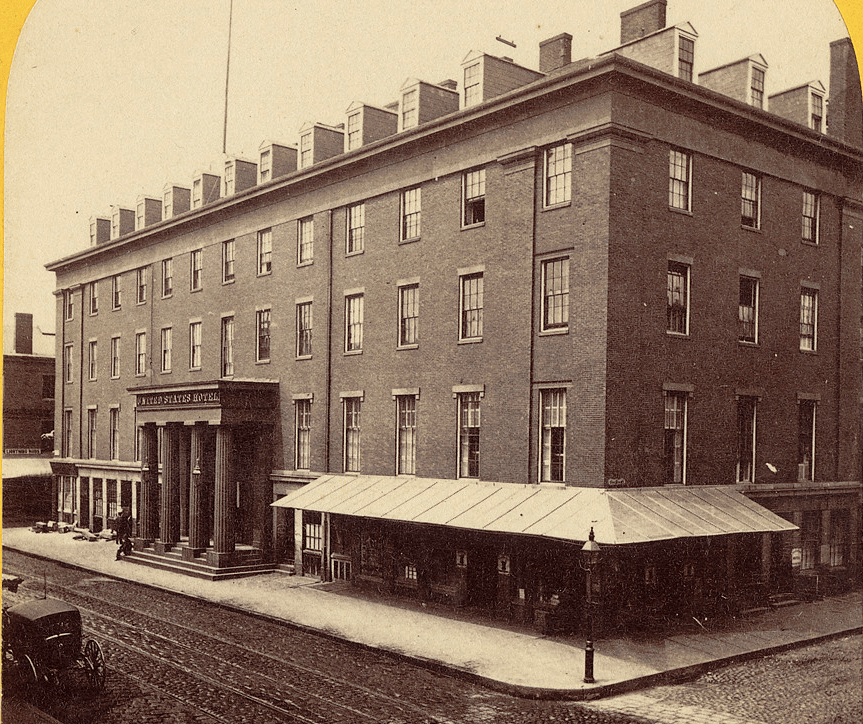
On August 18, 1929, the United States Hotel in Downtown Boston closed its doors for good. Once housing and feeding over 700 guests per night, the hotel saw severely declining numbers by the time of the Great Depression. Construction on the hotel commenced in 1837, and it was completed two years later in 1839. The hotel was operated by the Messrs. Holman and Clark, who saw an immediate success due to the hotel’s location central to Boston’s major train stations. The hotel (which first contained 300 rooms) did so well that the building was expanded numerous times with undulating additions to maximize light and air into the many rooms. At the hotel, over 150 employees served the guests at their rooms, the dining halls, bathing facilities or the stables which had drivers ready at a moments notice. The United States Hotel was one of the finest establishments in Boston and was thought to be the largest in the country by the middle of the 19th century. The size and amenities however was the downfall of the iconic hotel as Boston’s train stations saw fewer passengers in the early decades of the 20th century. Owners of the hotel sought to squeeze out every last dollar from the complex before they locked her up for good, hosting an auction on everything from beds to a chair said to have been sat on by Charles Dickens during his stay. The hotel was razed in 1930.
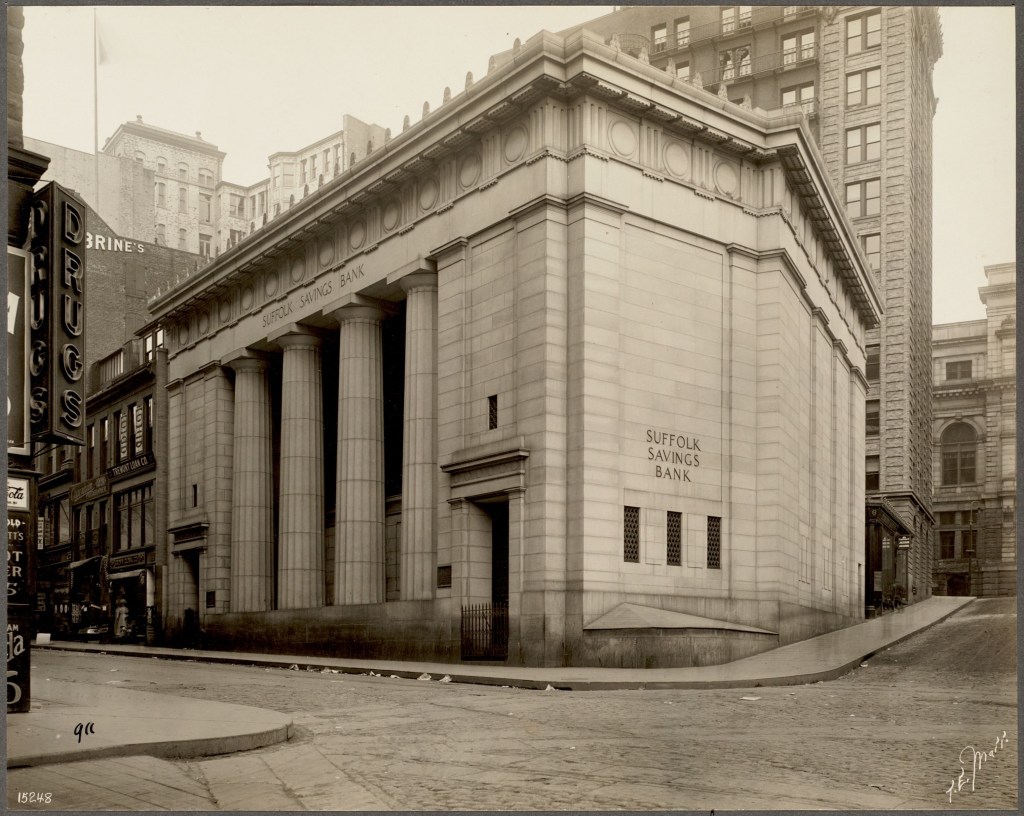
The Suffolk Savings Bank for Seamen and Others was incorporated in 1833 as a banking institution catered to seamen and merchants who received their earnings after a trip in cash, and wanted a secure place to store their funds. At the time, these men were among the richest in the city, and the bank did very well. It later became a national bank in 1865 and membership boomed. The bank grew and grew until the early 20th century, and it needed a new banking house that showcased their stability, but also provide a visual embodiment of the security their institution provides. The bank’s board hired world-renowned architect Cass Gilbert to design a new building, which would be located on one of the busiest corners in Downtown Boston at the corner of Tremont Street and Pemberton Square. The Classical Revival building was constructed of Hallowell Granite and featured four monumental columns recessed into the Tremont Street facade. Minimal windows allowed for security, while a domed skylight covered in a cap provided light into the rounded banking room below. Inside, the walls and floors were of marble with a tile coffered ceiling. The building lasted until 1965 when Urban Renewal brought the wrecking ball. The bank was demolished by 1967 for the present Center Plaza building in Government Center.
The Wilton Public and Gregg Free Library is the public library for the town of Wilton, New Hampshire and is among the town’s most grand architectural designs. The library was the gift of David Almus Gregg (1841-1928), a native of Wilton who owned a successful building parts business in Nashua manufacturing doors, window blinds, and window sashes with his father, David Sr., who lived in the home featured previously. Gregg was significantly involved in the design and construction of the building, providing the highest quality building materials and contractors to the project, which was estimated to cost $100,000 when completed in 1907. The architectural firm of McLean and Wright was commissioned to design the building, who completed it in the Classical Revival style, like many of their other library designs in New England.
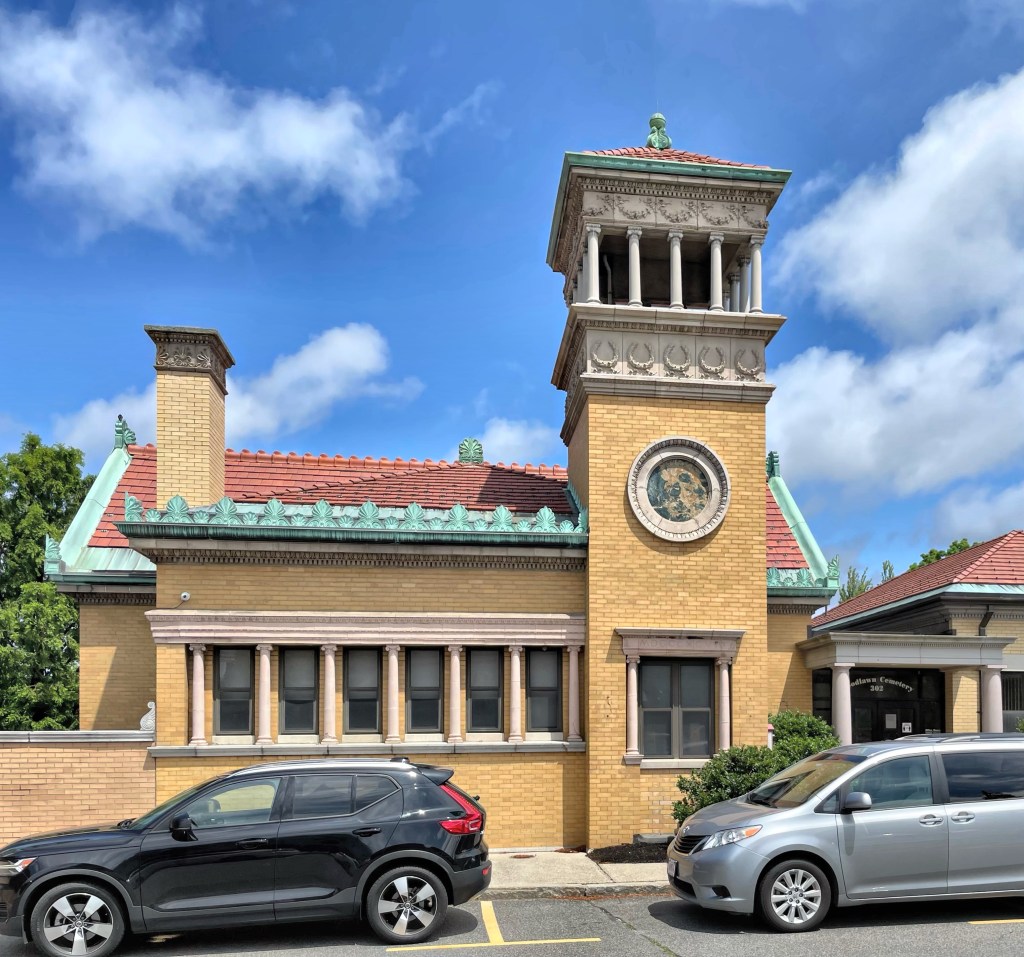
Woodlawn Cemetery in Everett, MA was established in 1850 as a rural, private cemetery in the tradition of Mount Auburn Cemetery in Cambridge. The story of Woodlawn Cemetery began in 1850 when a group of ten prominent Bostonians petitioned the Massachusetts General Court to organize a corporation “for the purpose of procuring, establishing and preparing a cemetery or burial place for the dead in Malden” (present-day Everett was established in 1870 from Malden). Adjacent to the Cemetery Gate and Tower (last post), the Woodlawn Cemetery Lodge replaced an 1850s lodge and office constructed of wood, in the Gothic-style, that was deemed unsatisfactory for later boards managing the cemetery. The group hired Boston architect William Hart Taylor to design the gate and lodge, the latter in the Classical Revival style. The buff brick building features terra-cotta trim and a red tile roof with dentil cornices and copper cresting along the ridges and eaves. The square entry tower has a columned belfry and incorporates additional Classically-inspired features including Ionic columns, moldings, swags, and wreaths, which looks like a Greek Temple plopped onto the top. Gorgeous!
In 1892, the growing municipality of Everett, Massachusetts incorporated as a city. While Everett’s population had remained small compared to nearby towns throughout much of the nineteenth century, its close proximity to Boston resulted in dramatic population growth between 1885 and 1915. During this late industrial period Everett’s population was one of the fastest growing in the state, doubling between 1870 and 1880, nearly tripling from 1880 to 1890 and doubling again between 1890-1900. This massive population growth put a strain on public facilities, necessitating new housing construction, new public utilities, and schools. By 1889, planning for the first purpose-built high school had begun. The resulting first Everett High School, first known as the Home School, in 1893, the year after Everett’s incorporation as a city. That building was almost immediately outgrown and the city acquired a new site for a school that was large enough to educate the ever-growing town’s students. The City of Everett selected the architectural firm of Ritchie, Parsons, and Taylor for the construction of the new high school. The firm was led by Scottish-born James H. Ritchie, who designed the Classical Revival building. In the early 2000s, the building was again deemed inadequate and a third high school was built about a mile away. The building is now occupied by the Everett Community Health and Wellness Center and the Webster School Extension.
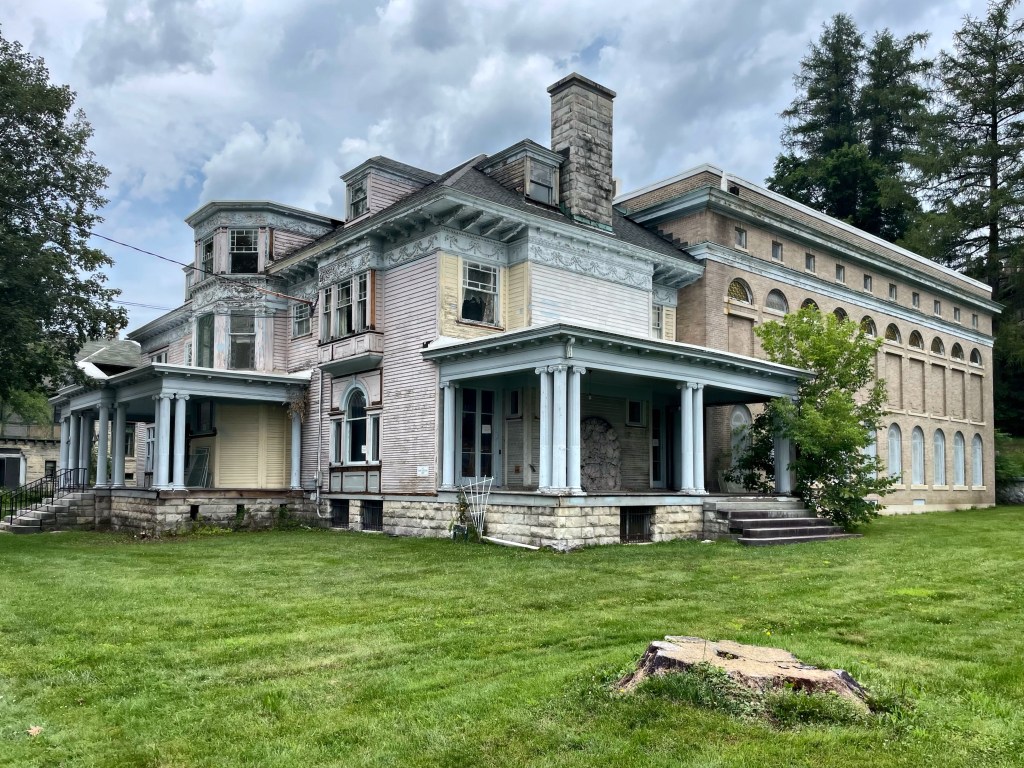
Further up Broadway from Everett City Hall, you’ll find the town’s Masonic Hall, a now-vacant institutional building which contributes to the diverse streetscape and character of Everett’s built environment. The local Palestine Lodge of the Masons in Everett originally met in its original lodge, built in 1870. A corporation known as the Everett Associates, which included only Masons, subsequently constructed the original Masonic Building. The property burned in a fire in 1908, leading to a new building campaign by members. A site was acquired further up Broadway, and the groundbreaking was held on June 11, 1910, led by Everett Mayor Charles Bruce, a past master of the Palestine Lodge. Mayor Bruce also served as the chair of the Building Committee. In his remarks at the groundbreaking, Bruce noted the membership of the lodge as over 500 men! Inside the cornerstone, members placed: original papers from the former Masonic Building, a history of the Palestine Lodge, a list of lodge members, photographs, news articles, and other ephemera. The Boston architectural firm Loring and Phipps was responsible for the design of the building, which is constructed of water-struck brick and is of the Classical Revival style. After WWII, membership declined sharply, and the organization sold the building in the 1980s. From the mid-1990s to 2019 the building was owned by the Islamic Association of Massachusetts, and suffered from deferred maintenance. The red “X” on the building is for firefighters not to enter the building in case of fire or emergency. Luckily, the building was purchased and the new owner hopes to convert the building into housing, preserving the structure and using Historic Preservation Tax Credits. Fingers crossed!!
Proctorsville Village (in present-day Cavendish, Vermont) was established in last decades of the 18th century along the Black River, where the slope allowed for suitable locations for small water-powered mills. The community grew slowly for the early part of the 19th century as farmers, craftsman and merchants established enterprises around the handful of small mills built along the river. The establishment of the Central Vermont Railroad through the village aided manufacturing expansion, and by the late 1800s, Proctorsville was home to many large mills. As employment in the mills grew, the local economy shifted from the barter economy of a farming community to a cash-based economy generated by wage employment. The general store was essential to this transition supplied the townspeople with essential goods via the railroad, and the major store in Proctorsville was the Pollard General Store. Don Carlos Pollard (1840-1921) was born in Plymouth, Vermont and opened his first store there under his father’s name. He moved to Proctorsville in 1860 and opened a general store in the village. The store was an immediate hit, and later managed by Don’s two eldest sons, Fred and Park out of a brick building. A fire destroyed the brick building in 1895, but construction began of a new building immediately that same year. The present wood-frame building exhibits the retail presence and early commerce in many small villages in New England. It blends Italianate and Classical Revival details with the bracketed eaves and one-story corner pilasters and dentils. Swoon!
When elevated train service from Boston extended to Forest Hills in Jamaica Plain in 1909, the residents of the surrounding neighborhoods and points south were ecstatic to realize the chance to enjoy quicker transit to the city. The station, which opened in 1909, was an architectural landmark and engineering feat, as the new terminal was the largest structure of its kind and the most costly in the country at the time. The large station was made of steel and reinforced concrete, finished in copper at the elevated section, and took nearly two years of construction. City architect Edmund M. Wheelwright designed the station, and upon its opening, it was called “the chef-d’œuvre of rapid transit development in Boston”. Like with many cities all over the country, shifting transportation planning and priorities and shrinking investment necessitated the once grand station to suffer the fate of the wreckingball. As part of the Southwest Corridor project, this station was to be demolished, with a modern station constructed to service the MBTA trains on the Orange Line. Also, plans were developed for a 12-lane highway along the railroad right-of-way between Boston through Cambridge. The residents of the affected areas, including Jamaica Plain, Roxbury, South End, Back Bay, and Cambridge, protested against the destruction of their neighborhoods by the planned highway, and won! The old Forest Hills Station was a casualty of the proposal, but a lasting reminder for neighborhood planning and advocacy, preserving character and people over cars.
Located at the prominent corner of Mass Ave and Tremont Street in Boston’s South End neighborhood, this beautiful apartment building has long caught my eye, but I finally got around to looking up its history! The building was constructed in 1896-7 by Albert Geiger, a real estate developer who sold the completed building to a Josiah P. C. Marshall. The building is Classical Revival in style and had eleven suites for rental. The blond brick building with Indiana limestone trim are gorgeous, but the showstoppers are the metal bay windows with decorative wreaths and garlands.
Newcastle Court in Boston’s South End/Lower Roxbury neighborhoods is one of the finest apartment buildings in the city built in the early 20th century. The complex is U-shaped with a central courtyard off Columbus Street, to provide air and natural light in all bedrooms and units of the building. Newcastle Court was built by builder/developer Israel Nesson, who was credited as building the first fireproof apartment building in the city. Nesson and his family built and owned apartment buildings all over Boston and Cambridge, and operated many of them as landlords with massive real estate holdings. Newcastle Court stands out for the garden courtyard set behind the gate. At the back of the courtyard, the building has a raised parapet at the roof, which encompasses a clock. Many of the units retain the original stained glass windows, which are AMAZING!
Commissioned from the celebrated American sculptor Augustus Saint-Gaudens in the early 1880s and dedicated in 1897, The Shaw 54th Regiment Memorial (aka the Robert Gould Shaw Memorial) has been acclaimed as the greatest American sculpture of the 19th century. The memorial was designed by famed artist Augustus Saint-Gaudens, and it is a stop on the Boston Black Heritage Trail, commemorating the valiant efforts of Colonel Robert Gould Shaw and the men of the 54th Massachusetts, one of the first Civil War regiments of African Americans enlisted in the North. In July 1863, the regiment was sent to South Carolina where an assault was planned on Fort Wagner guarding Charleston harbor. Shaw had asked to have 54th Regiment lead the attack. Of the 600 men in the attack that day, there were 285 casualties, and Col. Shaw was killed, but the men never wavered in the battle and demonstrated great courage and determination. Following this display of valor, other black regiments were formed, and by the end of the war, 10% of the union army was made up of African American soldiers.
The monument in Boston shows the 25-year-old Shaw seated on his horse, with his regiment as it marched down Beacon Street on May 28, 1863 to depart the city to fight in the South. The concept of Shaw on horseback with marching soldiers was inspired, at least in part, from a painting Saint-Gaudens saw in France, Campagne de France 1814, by Jean-Louis Ernest Meissonier, which depicts Napoleon on horseback with rows of infantry in the background.While Shaw is the centerpiece of the monument, the significance of the monument is the Shaw Memorial is the first civic monument to pay homage to the heroism of African American soldiers in the U.S.