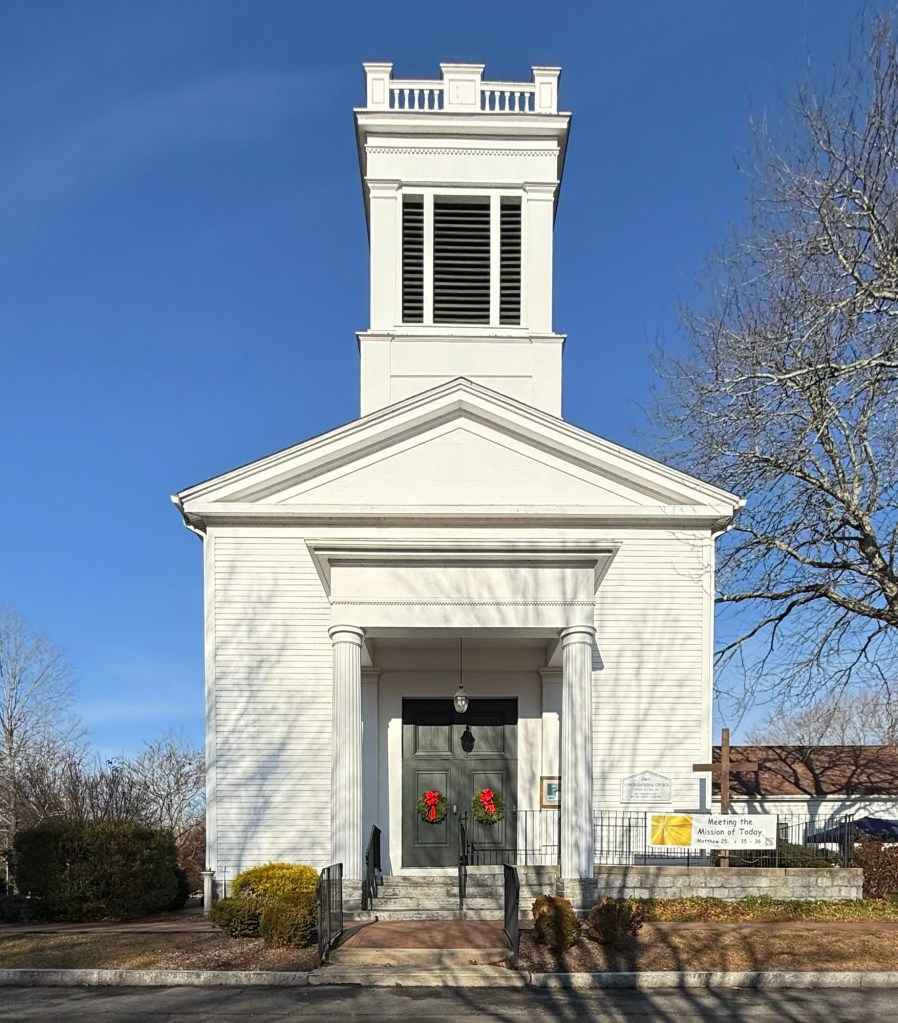
Second Congregational Church of Derby // 1845

The Second Congregational Church of Derby was built in 1845 by members of the Birmingham Congregational Society, who grew tired of travelling across the river to the First Congregational Church in town. The present “downtown” of Derby was originally known as Birmingham and grew as the industrial center in the city, which historically was much larger than it is today. The Birmingham Congregation had this edifice constructed in the Greek Revival style, and it was added onto in 1859, 1889, and underwent alterations in 1915, when the facade was altered with Colonial Revival flourishes. The additions to the facade include the Palladian window, elliptical leaded window in the pediment, and panels with swags and wreaths. The top of the steeple was damaged by Hurricane Gloria in 1985 and removed, and was replicated in 2021.

Bow Bog Meetinghouse // 1835

The Bow Bog Meetinghouse in Bow, New Hampshire, was built in 1835 for the First Methodist Episcopal Church and Society in town. Designed in the Greek and Gothic revival styles, the traditional form and paired entries with two stage belfry is adorned by finials and pilasters, showcasing an elegant blending of these two styles. built by George Washington Wheeler for the First Methodist Episcopal Church and Society of Bow in 1835. Mary Baker Eddy, founder of the Christian Science Church, mentioned Reverend Orlando Hinds as a contributor to her early religious teachings. She maintained close ties with this Church, donating funds for the bell in 1903. The Church provided religious instruction and social activities for 116 years and in 1951, the Church was closed and the Bow Bog Meeting House Society acquired the building. In 1970, they restored it to nearly its original condition, and it was acquired by the town in 1985.

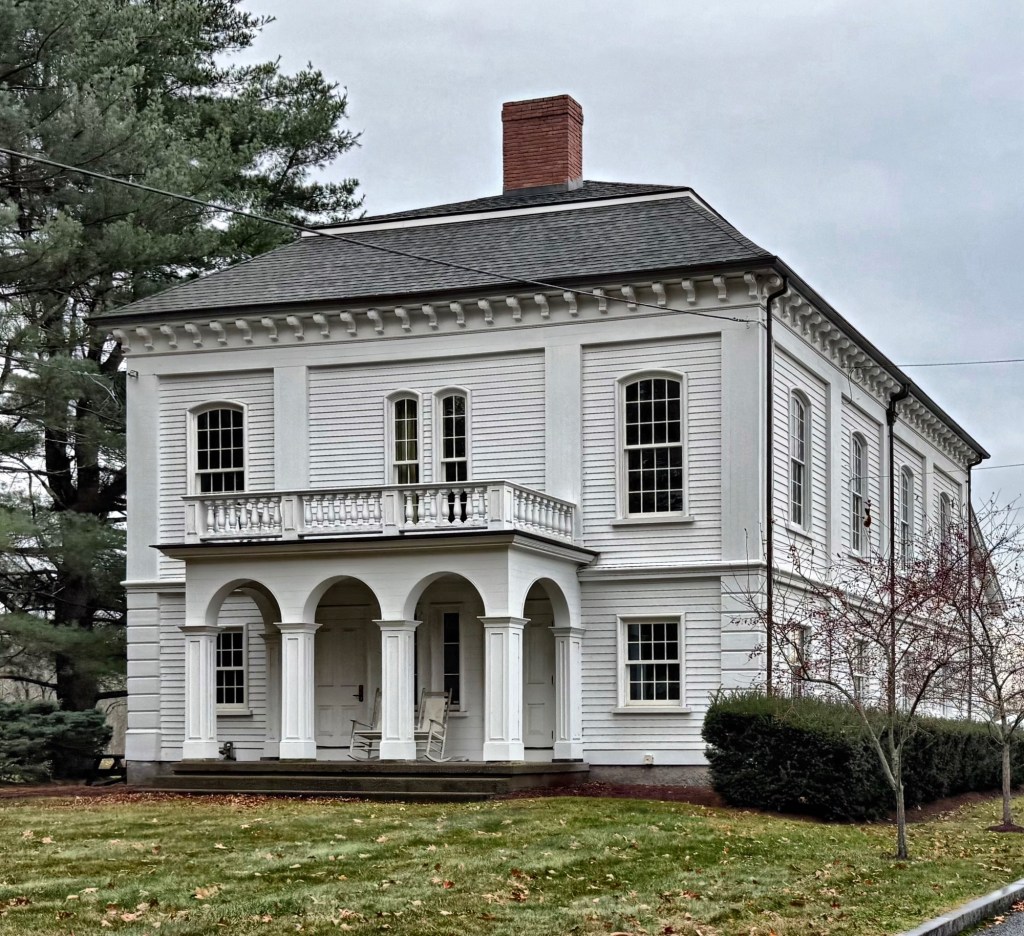
Old Houghton School // 1849

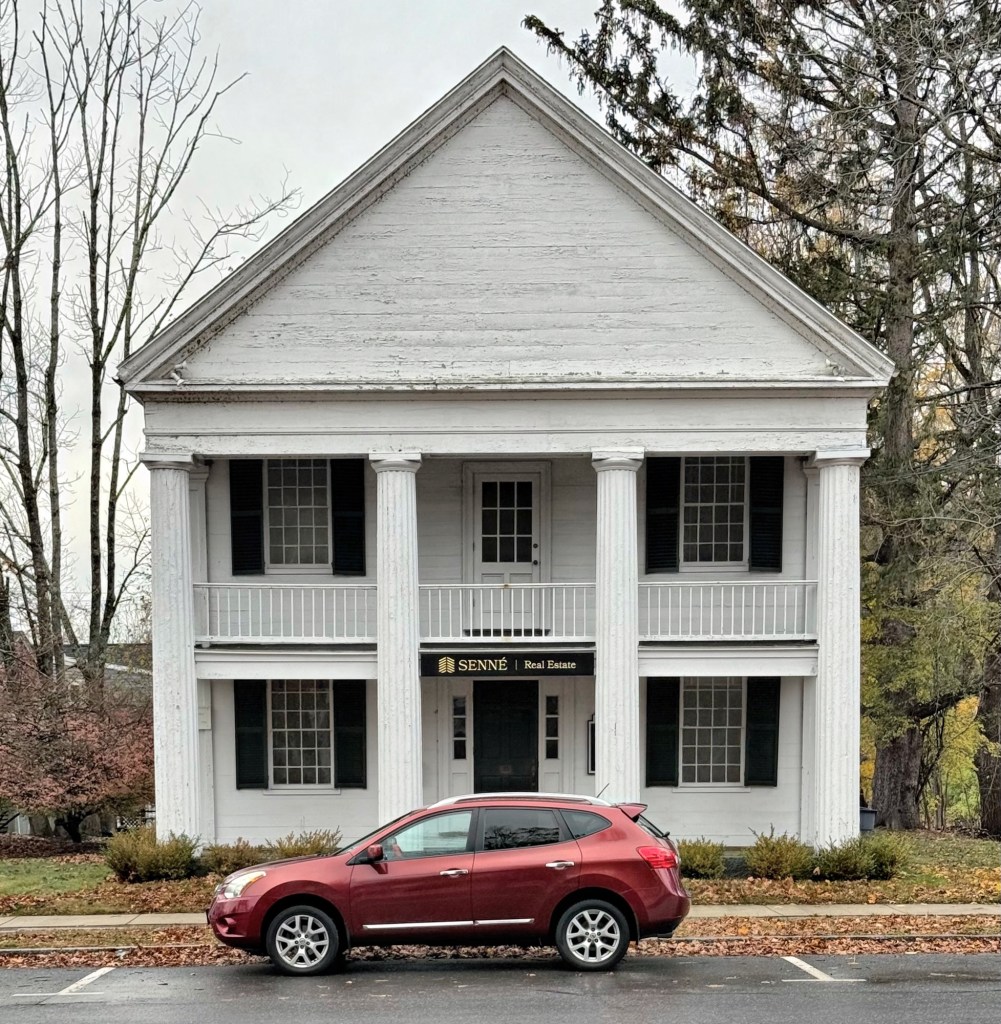
In 1849, the Town of Bolton, Massachusetts, built its first high school, the Houghton School at 697 Main Street in the town center. Blending Greek Revival and Italianate styles, similar to Bolton’s 1853 Town Hall, the Houghton School is a large, two-story, pedimented building of wood-frame construction. Interestingly, the school was largely funded privately by a local resident, Joseph Houghton (1772-1847), who in his will, bequeathed land and $12,000 for a public high school for the town. By the terms of the donation, nine men (all of whom had at one time served as a Bolton tax assessor) and their descendants, were barred from attending the school for a hundred years. Questions about the bequest were put before the Massachusetts Supreme Court, which disallowed this clause. An additional requirement, stipulated that no teacher could serve there longer than two years. That restriction was eventually put aside in the early 20th century. In 1917, the high school was discontinued. The fenestration was likely altered around this time. Bolton began sending its high-school students out of town to a school of their choice, and the Houghton School became the Bolton junior high school. In 1970-71, the building was converted to town offices, with the Town Clerk and Assessor on the first floor and the Police Department on the second. Since 2012, the building houses Bolton Access TV, as well as The Conservation Trust and Friends of the Bolton Library.


Bolton Town Hall // 1853

The Town Hall building in Bolton, Massachusetts, is significant as the hub of the town’s municipal activities for the past century and a half and architecturally as a mid-19th century town hall built in the transitional Greek Revival and Italianate styles. The structure was completed by the town in 1853 as a replacement for the former 1834 wood-frame town hall, which had burned down in 1851. The original wood-frame building was constructed at the time that municipal functions were being moved out of town meetinghouses across Massachusetts following the desire to separate church and government functions. Like many town halls of its era, the larger 1853 building was designed to accommodate multiple aspects of the community’s institutional and public life. The two-story building included a fireproof vault for town records, with town meetings held in the second floor meeting hall, with selectmen meeting in a room on the first floor. A small room was fitted for a library until the early 20th century when the town’s first purpose-built library was constructed farther down Main Street. The fairly unadorned Town Hall was modernized in around 1916 with the addition of the front portico and a rear addition. The Bolton Town Hall remains as a source of pride for the small, yet charming town of just under 6,000 residents.

Thomas Jones House // 1834

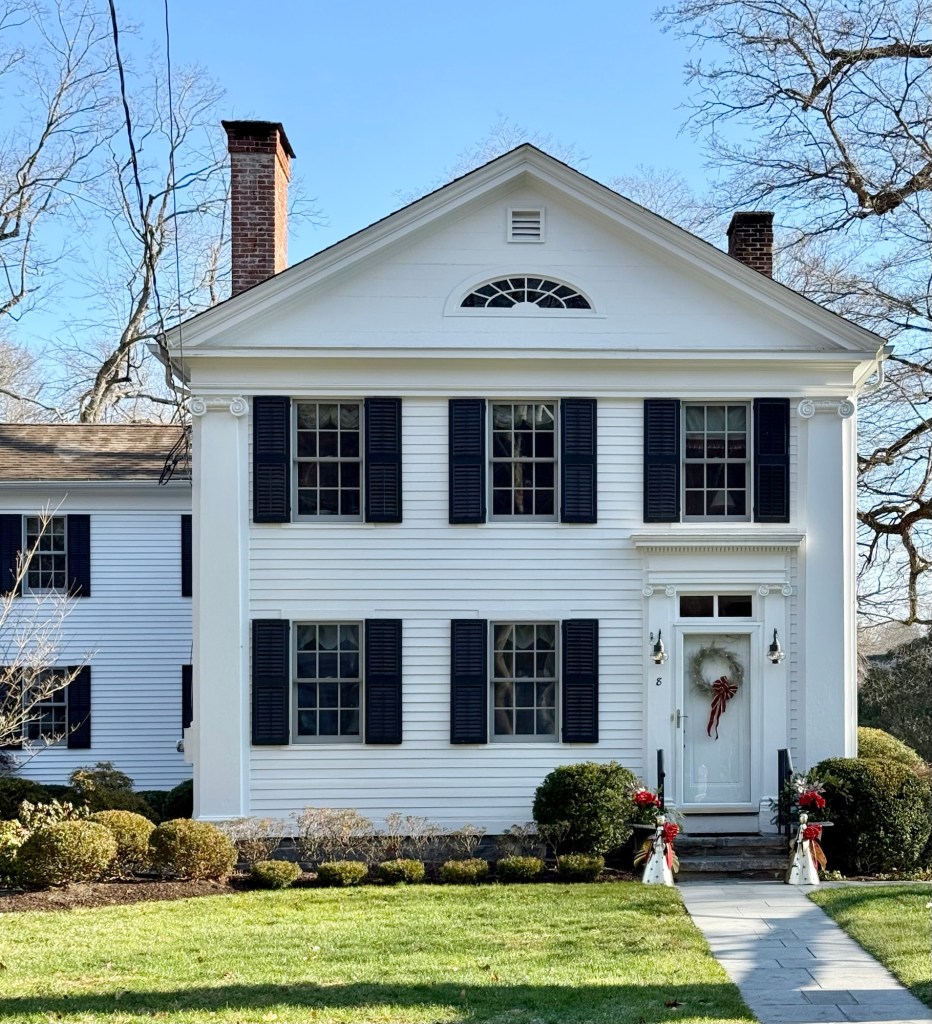
Thomas Jones of Lancaster married Mary Tweed of Lunenburg, Massachusetts, in June 1834 and immediately began building this house on Main Street in Lancaster for his new family. The Greek Revival style house is a refined example of brick with six-over-six sash double-hung windows and a Classical entry portico supported by Doric columns. The house was later owned by Sewell T. Rugg (1821-1892), a blacksmith who had a shop nearby.

Joseph Andrews House // 1831

This stately temple-front Greek Revival style house in Lancaster, Massachusetts, faces southward and when originally built, had sweeping views of fields and the Nashua River which abuts the property. The residence was built in 1831 for Joseph Andrews (1806-1873), a renowned 19th century artist who engraved portraits and landscapes, and was also an elder in the local Swedenborgian Church when it still met at residences. The Andrews House was likely a wedding gift to his wife, Thomazine Minot of Brookline, when they married. Tragically, Thomazine died just years later in 1834 at the age of 22. Joseph Andrews remarried soon after and would later move to Waltham. The house, which is listed on the National Register of Historic Places, features a full-length projecting porch with pediment supported by four, two-story fluted Ionic columns and a flush-board facade.

Sherwin-Goldsmith House // 1844

The Stone Village of Chester, Vermont, is said to be the largest collection of stone buildings in the state. Built around 1844, the Sherwin-Goldsmith House is one of a few dozen “snecked ashlar” buildings in the region, where rubblestone is laid up with mortar using long stones called “snecks” to tie an outer and an inner wall together. The construction method is said to have been brought to the area by masons from Scotland and Ireland which is known there as ‘Celtic Bond’. Oral tradition state that Scottish masons from Canada introduced the technique to local masons while erecting a mill in nearby Cavendish in 1832. Local Chester resident, Dr. Ptolemy Edson became such a fan of the building that in 1834, he had his home, the first stone building in Chester, built in this method. He then would influence the rest of the North Village of Chester, where many of his neighbors, as well as the church and schoolhouse, built their structures in snecked ashlar. The Sherwin House is one of three near-identical houses built around the same time that are colloquially known as the “Three Sisters” because they were built for members of the same family. The Greek Revival form is toned down in this smaller side-hall house, which playfully uses large blocks of schist and mica which read as quoins at the corners. Simeon Sherwin (1813-1874) was a farmer, postmaster, and justice of the peace in Chester. Later owner, Olivia Goldsmith, wrote her bestseller, First Wives Club when she lived here. 

Granville and Aurora Spaulding House // 1838

The Stone Village of Chester, Vermont, is said to be the largest collection of stone buildings in the state. Built around 1838, Granville and Aurora Spaulding House is one of a few dozen “snecked ashlar” buildings in the region, where rubblestone is laid up with mortar using small long stones called “snecks” to tie an outer and an inner wall together. The construction method is said to have been brought to the area by masons from Scotland and Ireland which is known there as ‘Celtic Bond’. Oral tradition state that Scottish masons from Canada introduced the technique to local masons while erecting a mill in nearby Cavendish in 1832. Local Chester resident, Dr. Ptolemy Edson became such a fan of the building that in 1834, he had his home, the first stone building in Chester, built in this method. He then would influence the rest of the North Village of Chester, where many of his neighbors, as well as the church and schoolhouse, built their structures in snecked ashlar. The Spaulding House is unique in that the main entrance does not face the street, as it fades the south east (side) facade. The couple married in 1839 and moved into this recently completed house to raise their family and work their farm. Like many other early stone houses built nearby in the 1830s, the Spaulding house blends Federal and Greek Revival motifs from the gable end facing the street and eaves returning to serve as a pediment as a nod to the emerging Greek Revival style, while retaining an arched entry off the street which echoes Federal period taste. 

Gideon M. Lee House // c.1836

The Stone Village of Chester, Vermont, is said to be the largest collection of stone buildings in the state. Built around 1836, the Gideon Lee House is one of a few dozen “snecked ashlar” buildings in the region, where rubblestone is laid up with mortar using small long stones called “snecks” to tie an outer and an inner wall together. The construction method is said to have been brought to the area by masons from Scotland and Ireland which is known there as ‘Celtic Bond’. Oral tradition state that Scottish masons from Canada introduced the technique to local masons while erecting a mill in nearby Cavendish in 1832. Local Chester resident, Dr. Ptolemy Edson became such a fan of the building that in 1834, he had his home, the first stone building in Chester, built in this method. He then would influence the rest of the North Village of Chester, where many of his neighbors, as well as the church and schoolhouse, built their structures in snecked ashlar. The first residence besides Dr. Edson’s home built this way in the village was this home, built nextdoor for Dr. Edson’s friend, Gideon Merrick Lee (1811-1880). Designed in a more vernacular version of the Federal style with emerging Greek Revival side-hall form, the Lee House features a charming entry with sidelights and a blind fan over the door.

Stone Village Unitarian Church // 1845

The Stone Village of Chester, Vermont, is said to be the largest collection of stone buildings in the state, and is anchored by its largest building, the Unitarian Church. Built in 1845, the Unitarian Universalist Church is one of a few dozen “snecked ashlar” buildings in the region, where rubblestone is laid up with mortar using small long stones called “snecks” to tie an outer and an inner wall together. The construction method is said to have been brought to the area by masons from Scotland and Ireland which is known there as ‘Celtic Bond’. Oral tradition state that Scottish masons from Canada introduced the technique to local masons while erecting a mill in nearby Cavendish in 1832. Local Chester resident, Dr. Ptolemy Edson became such a fan of the building that in 1834, he had his home, the first stone building in Chester, built in this method. Dr. Edson served on the building committee for the new village church, and likely pushed for a cohesive material and construction method for this church and other buildings soon after. The Stone Village Unitarian Church blends Greek Revival and Gothic Revival styles in a more vernacular way, typical in many rural Vermont communities. The building exhibits stained glass windows that were added sometime in the late 19th or early 20th century.