Pine Grove Cemetery Mausoleum & Chapel // c.1875 & 1904

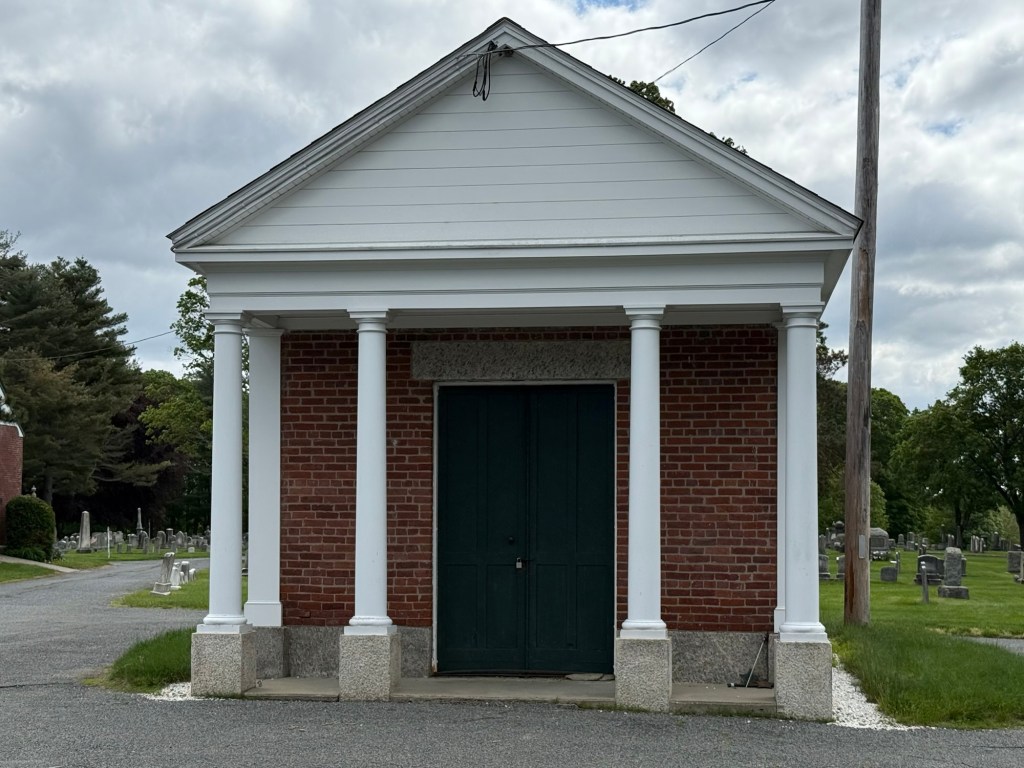
Mausoleum

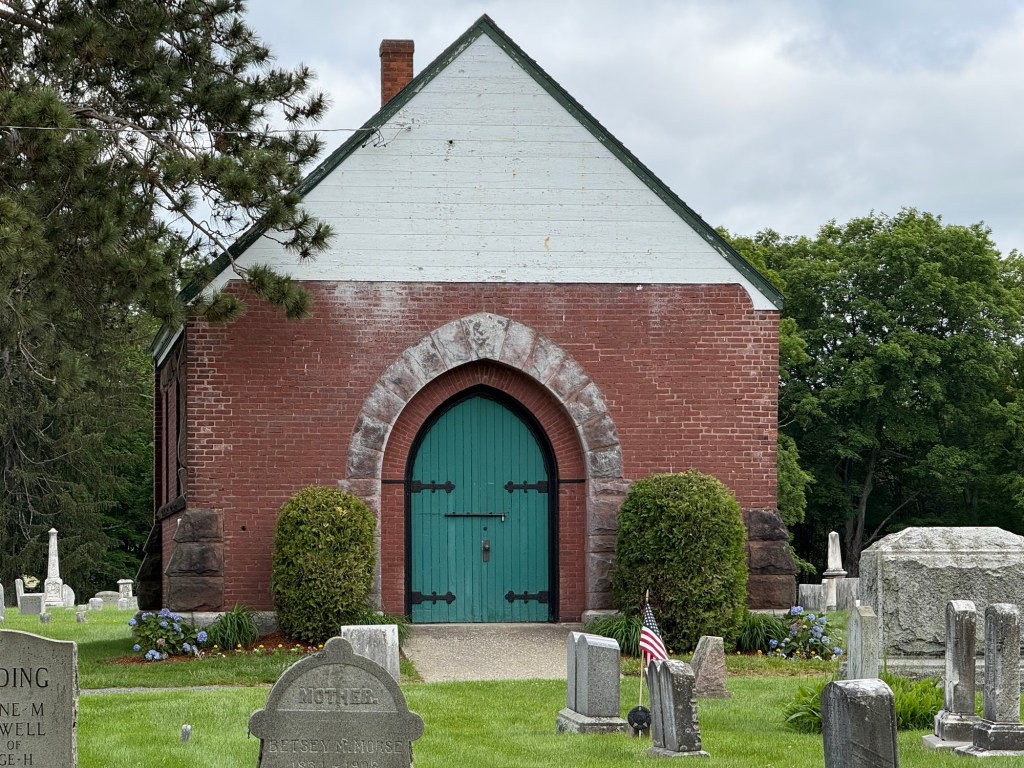
The mausoleum and the Jonas A. Stone Memorial Chapel are two historic structures located in the Pine Grove Cemetery of Westborough, Massachusetts. Land here was acquired in 1746 by the Reverend Ebenezer Parkman, and it comprised of a pine lot of sixteen acres on the road to Mendon (now South Street). Nearly 100 years later, in 1844, the lot was deeded to the town as a new cemetery, as the older cemeteries were quickly becoming crowded. It was named Pine Grove after the historic use of the grounds. Due to the rural cemetery movement, which sought to reimagine cemeteries as a beautiful park-like setting, not a simple burial ground, many Westborough families purchased plots here and some even moved their loved ones to the new family plot, in the “new” Pine Grove Cemetery.

Chapel

The Mausoleum was built sometime in the mid-19th century and is a modest, Greek Revival style structure of granite and brick construction. Four Doric columns support the portico and wooden roof which serves as a pediment above. The Jonas A. Stone Memorial Chapel was built in 1904 following a bequest to the town from the will of Jonas Adams Stone (1821-1900), and additional donation by his brother, Nymphas Stone. The Victorian Gothic chapel is built of brick and brownstone with a wooden gable and roof. The structure was damaged during the destructive 1938 New England Hurricane, but restored and is an important local landmark today.

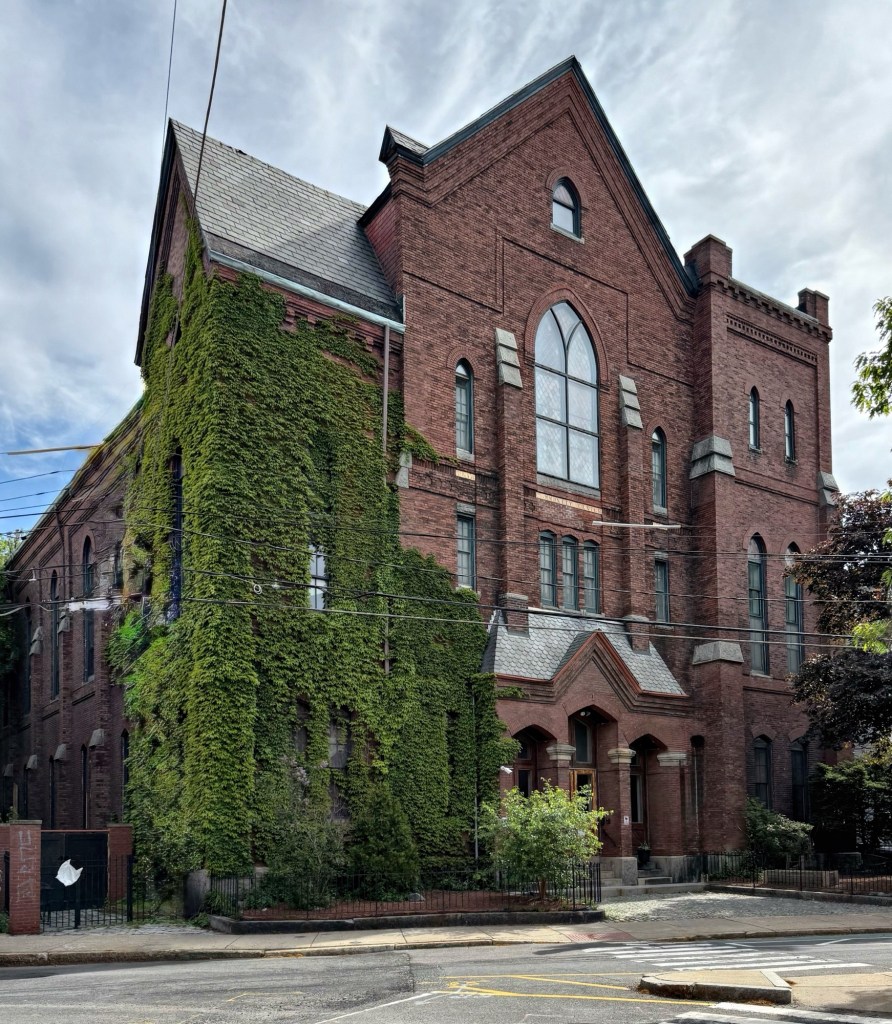
First United Methodist Church of Somerville // 1874

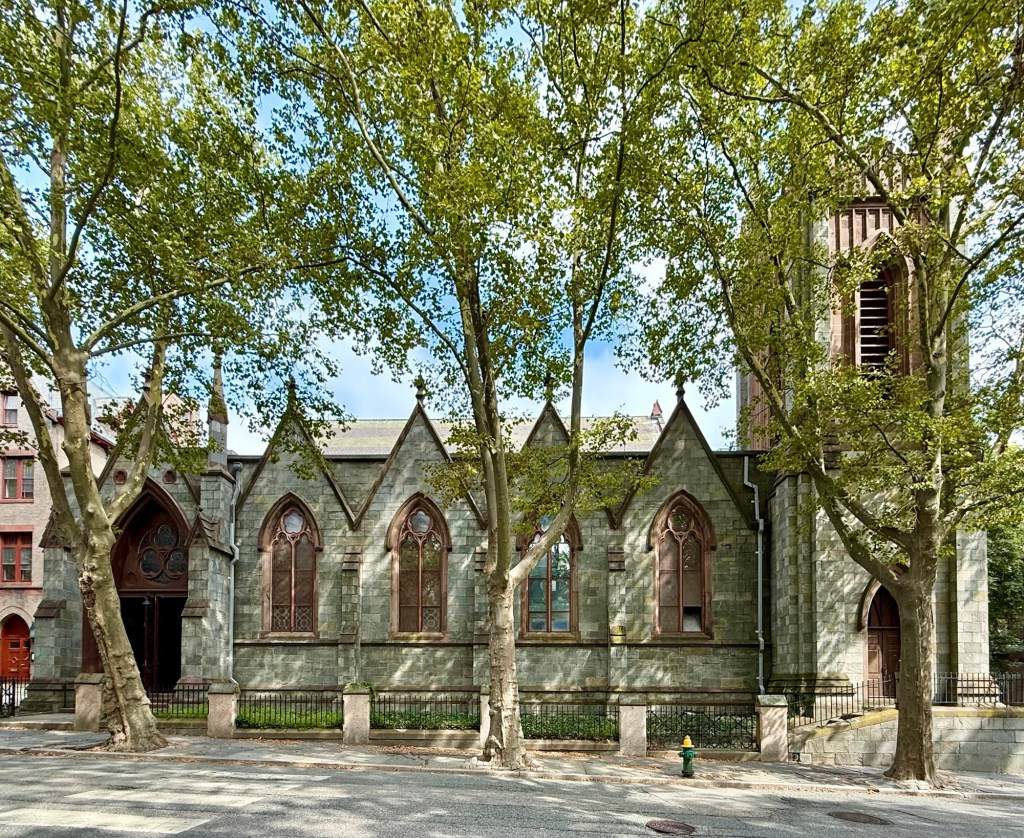
This handsome Victorian Gothic church sits on Summer Street in Somerville, defining the northern edge of the Union Square area. The church was built for the local Methodist congregation, which was established in 1855. The group would meet in local meeting halls and houses until this building was completed in 1874. The towering brick church was once even taller, but its steeple came down following the Great New England Hurricane of 1938. The church closed in the second half of the 20th century and the building was used by the Somerville Community News for years until it was purchased by a developer and converted to condominiums.

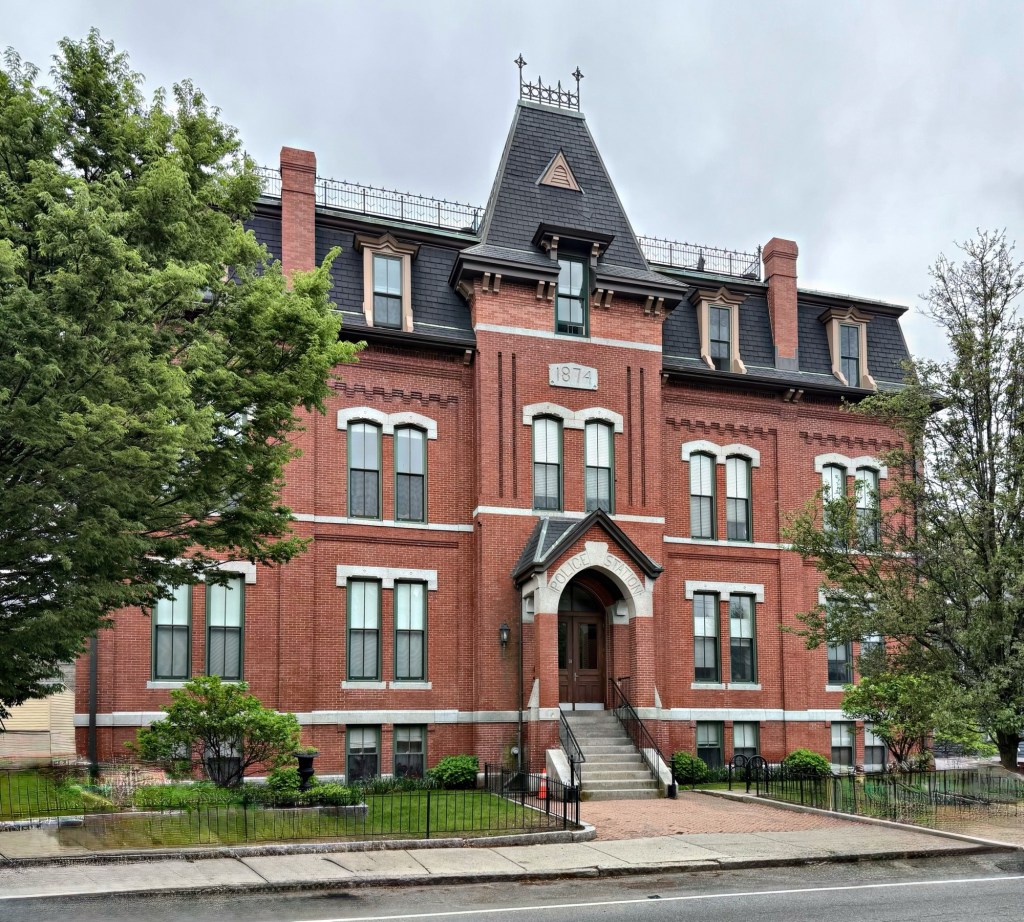
Former Somerville Police Station // 1874

Somerville, Massachusetts, was long part of Charlestown, until it incorporated as a separate town in 1842. From the 1840s until just after the Civil War, Somerville went from a sleepy farming village to manufacturing center, spurring a sharp influx of immigrants to the city, industry boomed and brick manufacturing became the predominant trade. The town of Somerville incorporated as a city in 1872, and one of the first civic buildings constructed as a new city, was this Victorian Gothic building on Bow Street in Union Square to house the growing Somerville Police Station. Built in 1874 from plans by architect, George Albert Clough, a prominent and busy local designer. The handsome station was in use until the new Police Headquarters further east in Union Square was built in 1932. This building was sold off by the city and became offices and housed meeting spaces for a local boy’s club and an American Legion Post until it was converted into housing in the late 20th century. 

Holy Family Parish Church // 1882

In 1872, due to industrialization and increased numbers of immigrants settling in the area for work, it was decided that a new Catholic parish should be established in East Abington. Two years later, the village of East Abington incorporated as Rockland. It would be a decade later, in 1882, until the Holy Family Parish would be established, beginning planning of a true house of worship for the growing number of Catholics here. When the Holy Family Church was constructed in 1882, only a quarter of the Rockland’s approximately 4000 residents were Catholic at that time. Most of the original congregation consisted of Irish immigrants who worked in the town’s boot and shoe manufacturing industry. As the industry continued to flourish in the 1890s and 1900s, new shoe factories were built, bringing more workers to Rockland, including: Canadians, Italians, and British to the area. The town’s Catholic community grew as a result. The Victorian Gothic style Catholic church was built in 1882, with no known architect at this time. A complex of other buildings, including a school, rectory, and community center.

Holyhood Cemetery Chapel // 1857

Holyhood Cemetery in Brookline, Massachusetts, was laid out in 1857 under the direction of Father Joseph M. Finotti, pastor of Assumption Parish , which included Brookline and Brighton. The cemetery reflects the mid-19th century influence of the Rural Cemetery movement and the romantic landscape cemetery planning begun at Cambridge’s Mount Auburn Cemetery in the 1830’s. A plan of the cemetery was drawn up by Shedd & Edson and published in August 1857. It shows curvilinear avenues and paths named after former bishops of Boston and Biblical figures. All were welcome to be buried except those who “died in a state of Drunkenness, Duel, or by self-destruction, unbaptized, non-Catholic, or otherwise opposed to the Catholic Church.” In the 1857 Shedd & Edson plan for Holyhood Catholic Cemetery, a chapel was located at the center on the hill shown in a small drawing on the edge of the plan. Known as St. Joseph’s Chapel, the stone building was designed by Patrick Keely, the successful and influential New York architect of many mid-19th century Catholic churches. The chapel would be dedicated in 1862. Decades later, a cemetery office was planned and built across Heath Street from the cemetery gates, but was demolished sometime in the 20th century. The cemetery grew and it along with the mid-19th century chapel, has been lovingly maintained to this day.  

Boston Young Men’s Christian Union Building // 1875

The Boston Young Men’s Christian Union was founded in 1851 by a group of Harvard students as a biblical and christian literature discussion group, which incorporated the following year. First located on School Street, the organization’s activities were to provide a focal point for the intellectual, religious, and social life of primarily middle-class, well-educated Christians. The organization grew to the point that a new building was needed, and in 1873, a site on Boylston Street was acquired as a perfect central location for the group. Architect Nathaniel J. Bradlee of Bradlee and Winslow was hired to design the structure, principally because Mr. Bradlee by then a prominent architect and public figure, was also a life member of the Union and the brother of one of its founders. The building was completed in 1875 and included ground floor retail with an auditorium, gymnasium, library, social and game rooms, and offices for the Union above and behind. Designed in the High Victorian/Ruskinian Gothic style, derived from a mixture of English, Italian, French, and some German Gothic precedents, the style emphasized complicated, asymmetrical massing, polychromy, ornate details, and lancet or Gothic arched openings, in this building a sandstone facade was used. The building became a City of Boston Landmark in 1977. In 2016, the building was converted to an affordable housing development by The Architectural Team Inc., and called “The Union”. The development provides 46 units of affordable housing, including 25 targeted to those who have experienced homelessness. What a great rebirth of the building. Historic Preservation and Affordable Housing can work together and create great projects.

Third Congregational Church of Chicopee // 1868

The Third Congregational Church of Chicopee was built on a prominent lot on Springfield Street in 1868, replacing the congregation’s first church there, which was outgrown. The present building was designed by Charles Edward Parker, a Boston-based architect, who was an expert in Gothic architecture. He would design the Chicopee City Hall just years later. The building is constructed of brick and atop a granite base and features lancet (pointed arch) doors and windows, a corner steeple, and steep gable end with large rose stained glass window. The interior is preserved as well. Due to shifting demographics in Chicopee in the early 20th century, the church merged in 1925 with the Central Methodist Episcopal Church, forming the Federated Church of Chicopee. The congregation eventually closed and the church has sat vacant in recent years, and was briefly listed for sale in 2024, 9,339 square feet for just $200,000.

Boston & Albany Depot // 1881-1958

Courtesy of Digital Commonwealth

When the Erie Canal opened in 1825, New York City’s advantageous water connection through the Hudson River threatened Boston’s dominance as a historic trade center. Since the topography of the Berkshires in Western Massachusetts made construction of a canal infeasible, Boston turned to the emerging railroad technology for a share of the freight to and from the Midwestern United States. The Boston and Worcester Railroad was chartered in 1831 and construction began the next year. Stations and rail lines were built westward of Boston and would eventually reach the Berkshires and the Hudson Valley with three existing lines merging in 1867 as the Boston and Albany Railroad, becoming the longest and most expensive point-to-point railroad yet constructed in the United States. The B&A undertook a significant program of improvement and beautification in the 1880s and 1890s, when the railroad hired architect Alexander Rice Esty to design this building, the Boston passenger station which was completed in 1881, the year of Esty’s death. That same year, the B&A hired architect Henry Hobson Richardson to design a series of passenger stations, connecting suburban villages west of Boston to the city. This station was located on Kneeland Street and serviced passenger service from Boston until the new South Station, a consolidated train station of various lines, was completed in 1899. This station later became a freight and storage warehouse for the railroad until the 1950s when the building was razed for the Central Artery, signaling the death of train travel as we knew it for decades to come. The site of the former station has remained undeveloped since then.

West Cornwall Congregational Church // 1877

One of the few Gothic style buildings in the enchanting town of Cornwall, Connecticut is this large church-turned-residence in West Cornwall village. As West Cornwall developed in the second half of the 19th century into the largest district in town, residents here began to discuss the idea of building their own Congregational church, rather than travel to the central village church to attend services. In the 1870s, West Cornwall congregationalists raised over $4,000 to acquire a building lot and erect this fine church. Dedicated in January 1878, the wood-frame church is a rare example of the Victorian Gothic/Stick styles with clapboard siding, lancet (pointed arched) windows, a corner tower with belfry, vertical sheathing in the gables, and ornamental applied stickwork. The church closed in the 20th century and was converted to a private residence, and is presently for sale!

Newport Old Fire Station Hose No. 8 // 1887

One of the charming converted old fire stations of Newport, Rhode Island, can be found tucked away on Prospect Hill Street. This is Hose No. 8 Fire Station, built in 1887 by the City of Newport as a neighborhood station to battle fires in the dense network of streets and homes Downtown. The design blends Romanesque Revival and Victorian Gothic elements into a compact, two-story brick building. The station was closed in 1912 as the structure no-longer was compatible with larger fire apparatus and gasoline-powered trucks. The building would suffer from neglect and was crumbling, before being reconstructed, brick-by-brick, and restored by Hacin Architects of Boston as a private residence. The structure is essentially new on the interior but provides a significant preserved exterior that was long part of the eclectic streetscape of Prospect Hill Street.