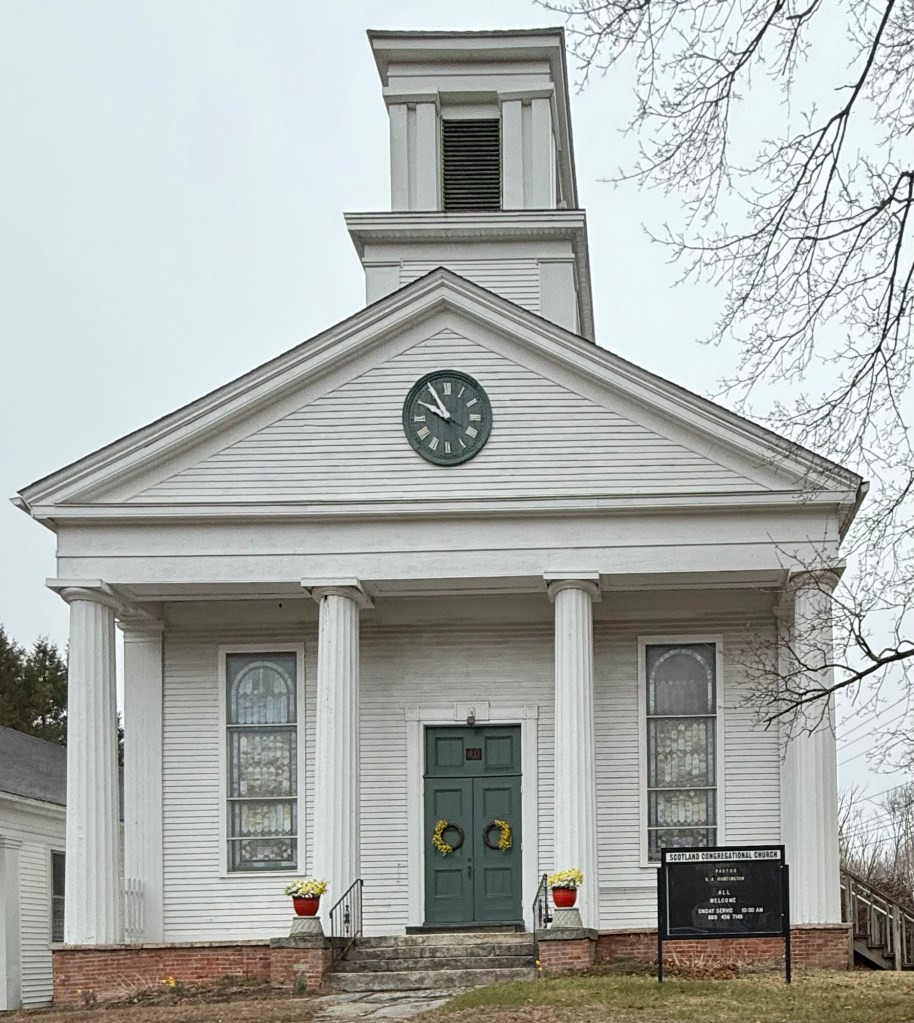
The main visual anchor of the charming town green of Scotland, Connecticut, is this building, the Scotland Congregational Church. Built in 1842 as the congregation’s third building, this Greek Revival style edifice features stately proportions, temple-front with four large Doric columns supporting the portico, and a two-stage belfry. The chapel (some say it was converted from the original town hall) was acquired by the congregation in 1867, and has remained in its new location ever since. Later alterations include the stained glass windows and clock in the pediment, which dates to the early 20th century.
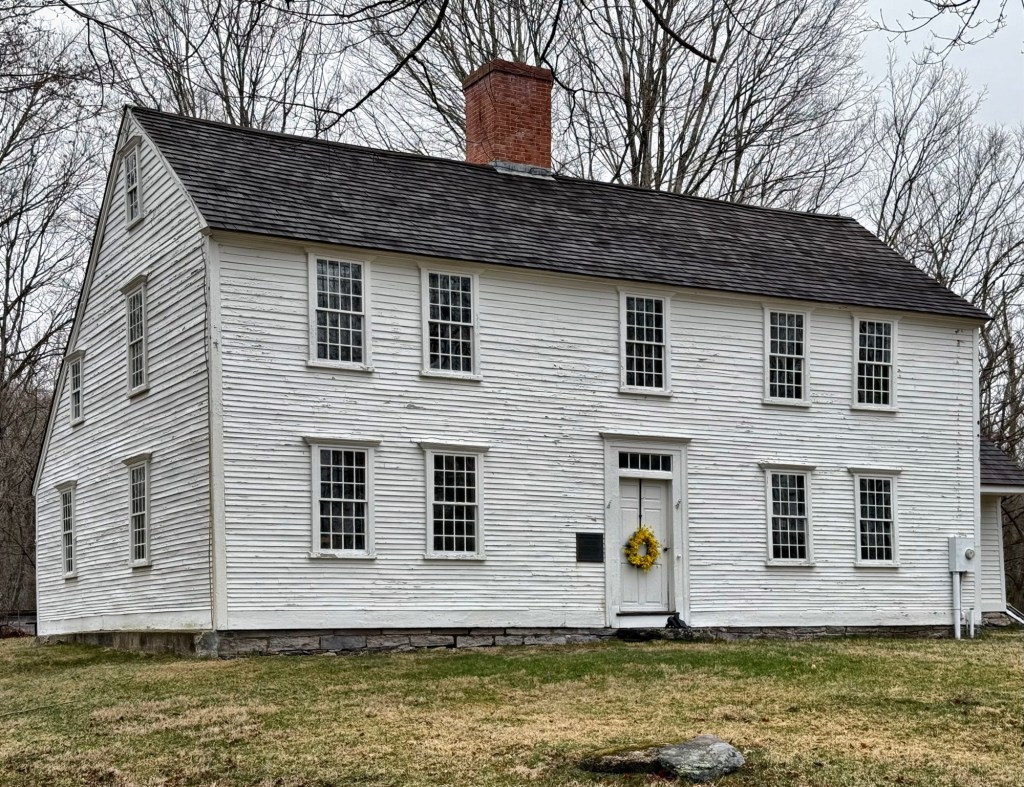
The Huntington Homestead in Scotland, Connecticut, was the birthplace and boyhood home of Samuel Huntington (1731–1796), a Founding Father, a signer of the Declaration of Independence and a distinguished statesman during the Revolutionary War and early Republic. The remarkably well-preserved site includes an eighteenth century house on its original foundation surrounded by acres of farmland and is now protected as a museum. The house was built sometime between the transfer of land in 1715 from Deacon Joseph Huntington to his son Nathaniel, and Nathaniel’s marriage in 1723 to Mehetabel Thurston. As originally constructed, the house consisted of a two-story structure with an end chimney on the west end and one large room on each floor. By the time of Nathanielís death in 1767, the house had been doubled in size with the addition of two rooms west of the chimney, giving the house its current five-bay form. The Georgian style Colonial-era home features a symmetrical facade, twelve-over-twelve windows, and a saltbox roof and is one of the finest Colonial-era homes in this part of the state.
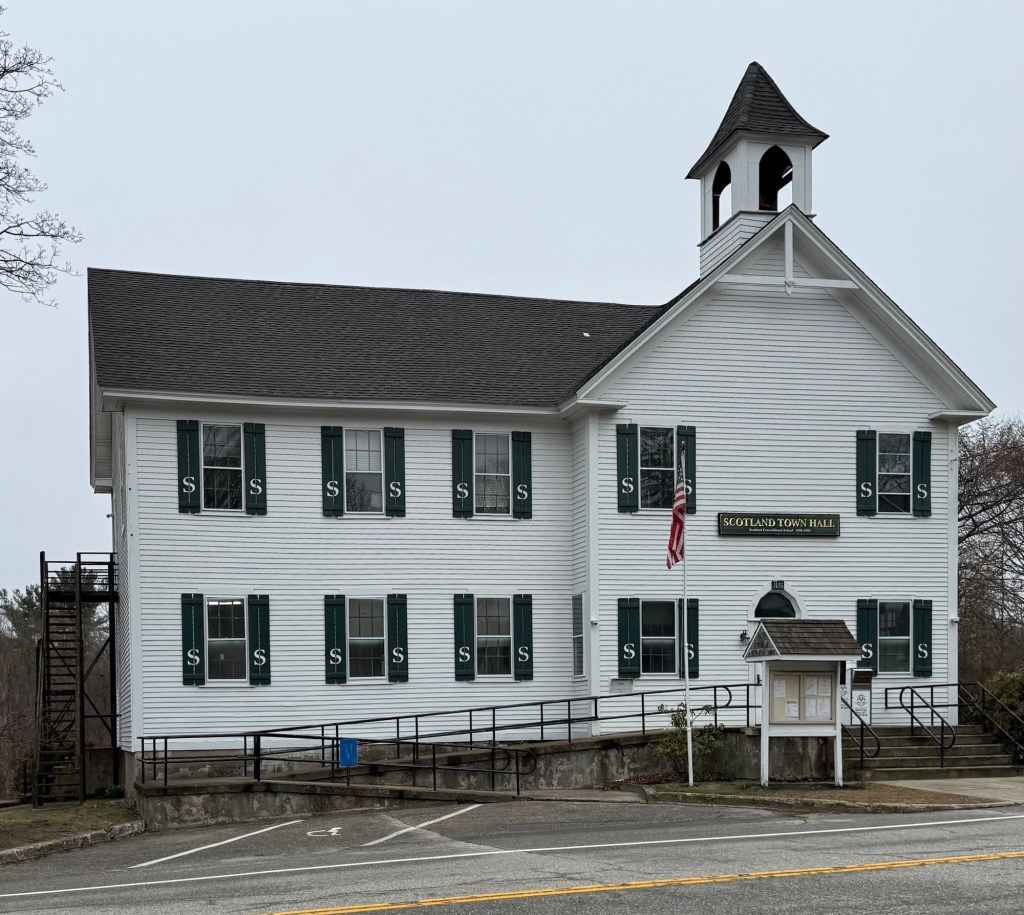
The town of Scotland, Connecticut, is a rural community centered around agriculture and is the smallest municipality in Windham County’s ‘Quiet Corner‘. European settlement began in earnest following the purchase of 1,950 acres of land from then Windham, by Isaac Magoon, a Scotsman, who named the new village after his ancestral home. The present-day town hall and offices of Scotland, was originally built in the 1840s as a one-room schoolhouse. In 1894, the town voted to consolidate all the school districts in a single building, and to expand the one-room village school to accommodate them. The present two-story structure was completed in 1896 and was added to the front of the old building. It is unclear if anything remains of the original schoolhouse. The vernacular, Stick style building served as the town’s consolidated school until a modern school building was constructed in the 1960s. This building became the town hall/offices and remains a significant visual anchor to the town’s common.
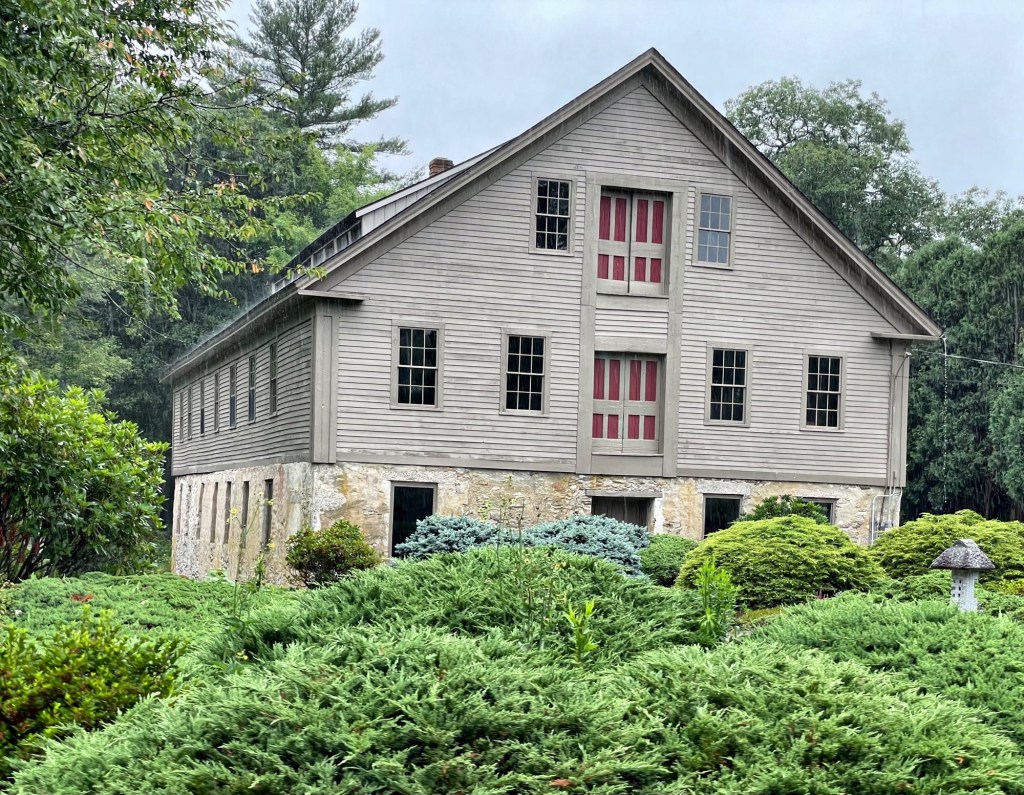
The Peep Toad Mill (also known as the Elliottville Lower Mill) was built in Killingly, Connecticut, around 1850 by the Elliottville Manufacturing Company, whose larger main mill was upstream from this complex. The Elliottville Manufacturing Company was formed in the 1830s and later acquired by Albert Elliott and Nelson Eddy, who expanded operations here. This structure, the lower Mill was used for spinning and preparing the warps for cotton sheetings, the firm’s principal product. In 1870, the two mills employed 18 women, 18 children and 13 men. The business closed in the 1880s, and the building was vacant for some time before being converted to a residence and artist studio. The old mill is a rare surviving example of a wood-frame textile mill, many of which were built but few of which survive, due to fires and/or later expansion of the premises. The present owners have done an amazing job restoring and maintaining this rare treasure!
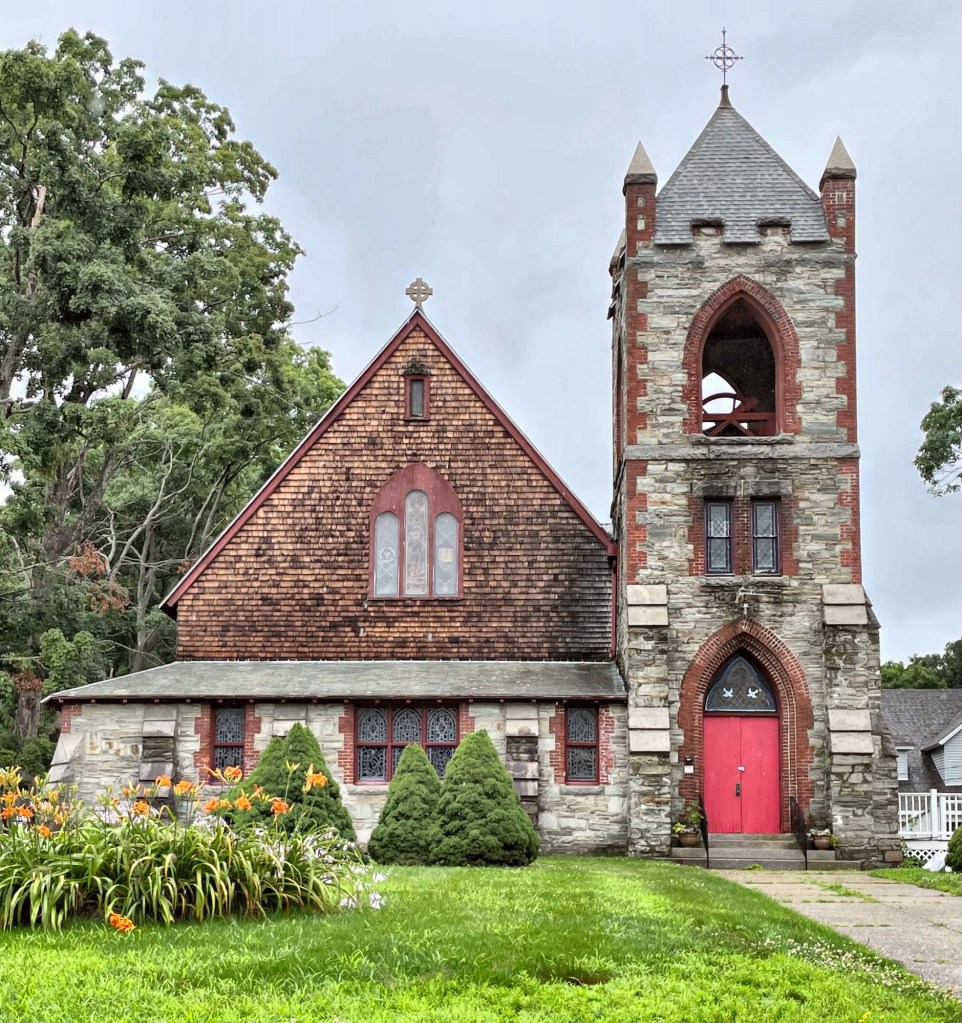
Tucked away off Broad Street in the Danielson village of Killingly, Connecticut, you will find this charming and eclectic church building, long-occupied by the St. Alban´s Episcopal Church. Episcopalians began congregating in the town in the 1860s, and it would be in 1865, when an old academy building on this site was acquired and converted for use as an Episcopal church. By 1891, the relative prosperity of members of the church made it so a new church building was to be built on the site. Worcester-based architect Stephen C. Earle was hired to furnish plans for the new edifice which is eclectic with Victorian Gothic and Shingle style elements. The congregation appears to have either disbanded or merged with a nearby church as the building does not appear to be occupied.
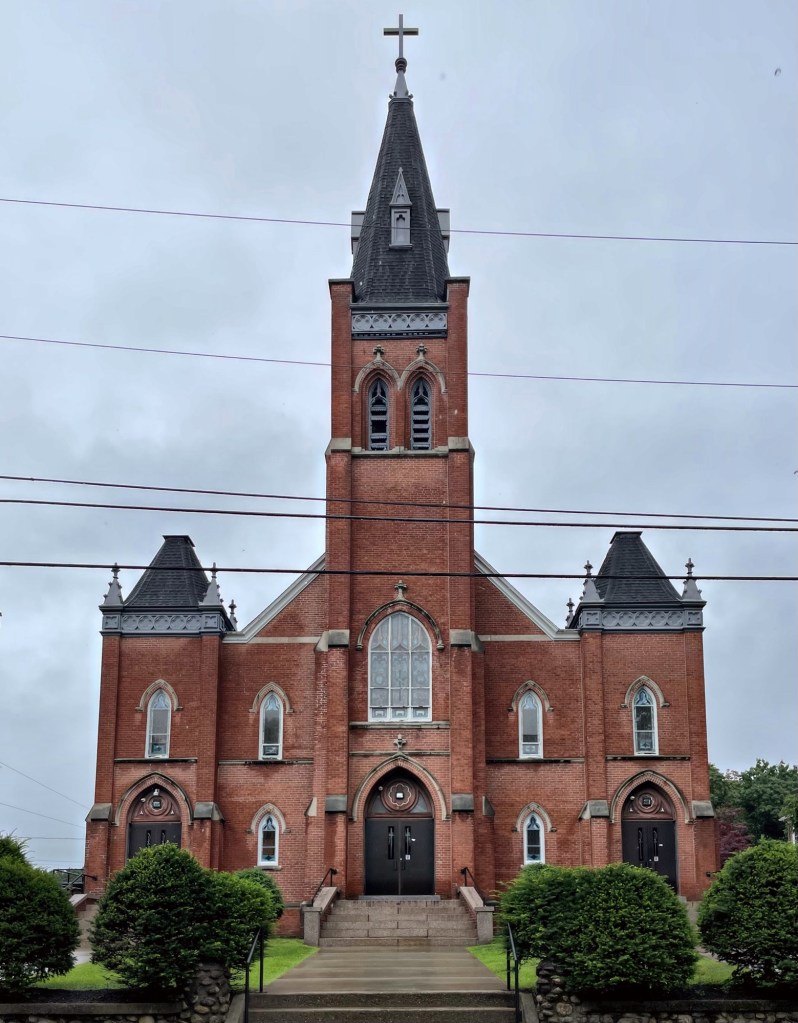
The St. James Catholic Church in Danielson, Connecticut, is an imposing and architecturally ornate example of a church built in the Victorian Gothic style. Catholics in town had their first Mass conducted by Rev. Michael McCabe, a Franciscan friar from Ireland, and the first service was held in a private home. They met in different halls until 1864 when they purchased the old Second Advent Chapel on Winter street and it became the first St. James Church. The congregation, largely of working-class Irish immigrants, eventually was able to afford a new church, this large brick structure, built in the form of a cross. A parish hall and school were also built next door and the campus serves as an important piece of the town´s immigrant and working-class history.
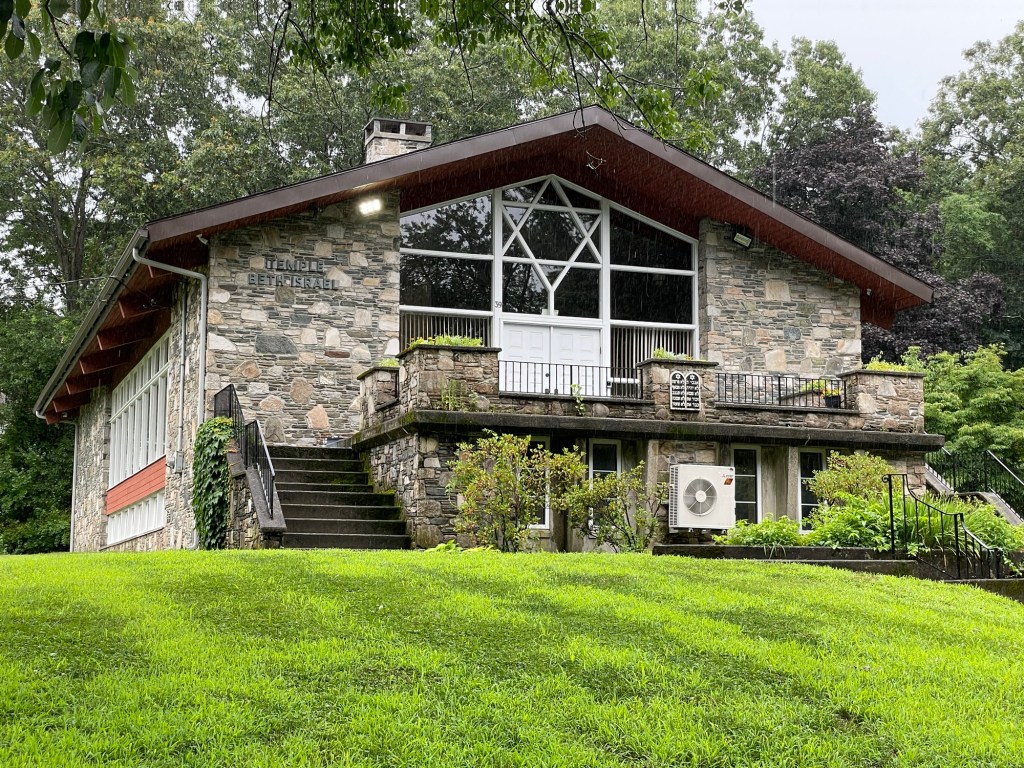
Temple Beth Israel is a unique, Mid-Century Modern former synagogue, that can be found in the village of Danielson, in the town of Killingly, Connecticut. Ground was broken on the temple in 1951 and the foundation and basement were completed soon-after. Funding was tight and the building remained unfinished for years. During the first years that the congregation used the unfinished synagogue, while continually striving for additional funds to complete the building. A congregation member Mary Riseman’ s son William Riseman, an architect, designed the building and the Riseman family donated the fieldstone for the building from a quarry on their farm. The building was eventually completed in 1961, ten years after its ground-breaking ceremony, with young, recently graduated architect, Maurice Finegold as designer of the interior of the main floor sanctuary and more, completing the project. The congregation, a blend of Orthodox and Conservative adherents, was generally served by itinerant rabbis, often religious students. Dwindling membership forced the congregation to merge with another in nearby Putnam, and the building was eventually sold. A secular preservation society was organized to keep it, which has transformed it into a cultural and historical center, dedicated to preserving the history of the Jewish experience in the area.
The Old Killingly High Schoolis located in a densely built residential neighborhood east of downtown Danielson, a village of Killingly, Connecticut. The building has served the community for well over 100 years, but through various uses. The school was built in 1908 and enlarged with side wings in 1927. It was considered state of the art for its time, with fireproof construction, wide hallways, and large bands of windows to maximize lighting of the classrooms. Clearly showcasing the village’s wealth and hope for future prosperity. The school was even designed by Hartwell, Richardson & Driver, a leading architectural firm based in Boston, Massachusetts. The building served as the community’s high school until 1965, and as its junior high school 1966–90 until it was converted to a community center and police station for the town. The Renaissance Revival style building is a gem and while tucked away off the main street, it shines through some great maintenance and restoration from the town.
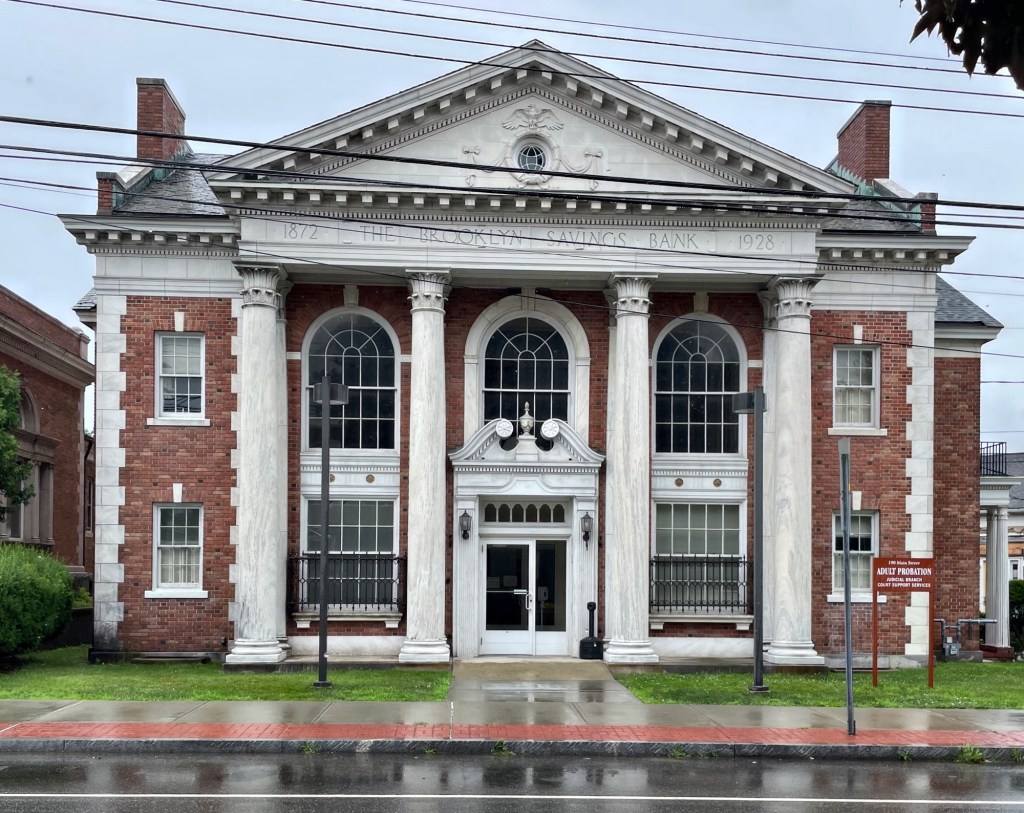
One of the most intact and architecturally significant buildings in Killingly is this stunning example of a bank built in the Georgian Revival style. Located on Main Street in the village of Danielson, the former Brooklyn Savings Bank was designed by the New Haven-based architectural firm of Norton & Townsend for the Brooklyn Savings Bank, which was founded in the adjacent town, Brooklyn, in 1872. The bank relocated to the economic center of the two towns, Danielson, in 1915, later building this landmark bank structure as its primary facility. The two-story bank is covered in red brick with elaborate limestone and marble trim and detailing, showcasing the wealth and stability of the banking institution for potential members. The façade features a two-story pedimented pavilion, round arched windows, and an elaborate swans neck pediment over the door. The structure has been very well-preserved in its nearly 100 year existence and now appears to be the home of a state judicial court.
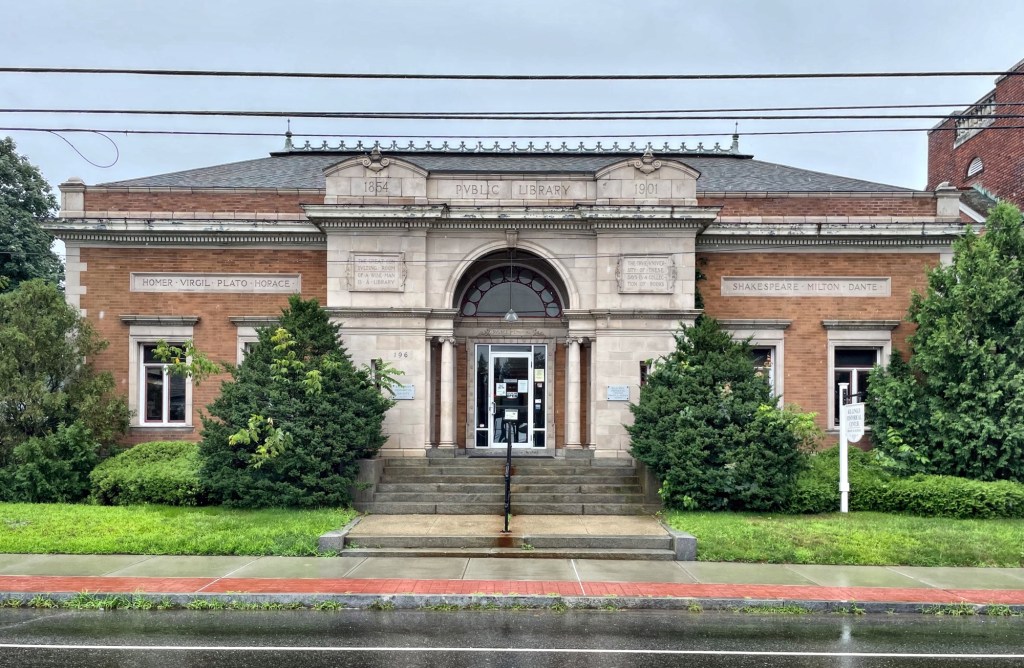
The Bugbee Memorial Library sits on Main Street in Danielson, the main village in the town of Killingly, Connecticut. The library was built in 1901 and financed by a bequest from Edwin Holmes Bugbee, who made his fortune at local mills. When Bugbee died in 1900, his estate left his entire collection of books along with funds for a new library for Danielson. Boston architect Walter Jefferson Paine designed the library building in the Classical Revival style with buff brick and stone construction. The names of Homer, Virgil, Plato and Horace, along with Shakespeare, Milton and Dante, are boldly emblazoned across the facade denoting the building as a house of learning. The library was outgrown, and a new library was built nearby in 1994. The old Bugbee Memorial Library has since been occupied by the Killingly Historical Society.

 Buildings of New England