Unitarian Universalist Association Headquarters // 1926

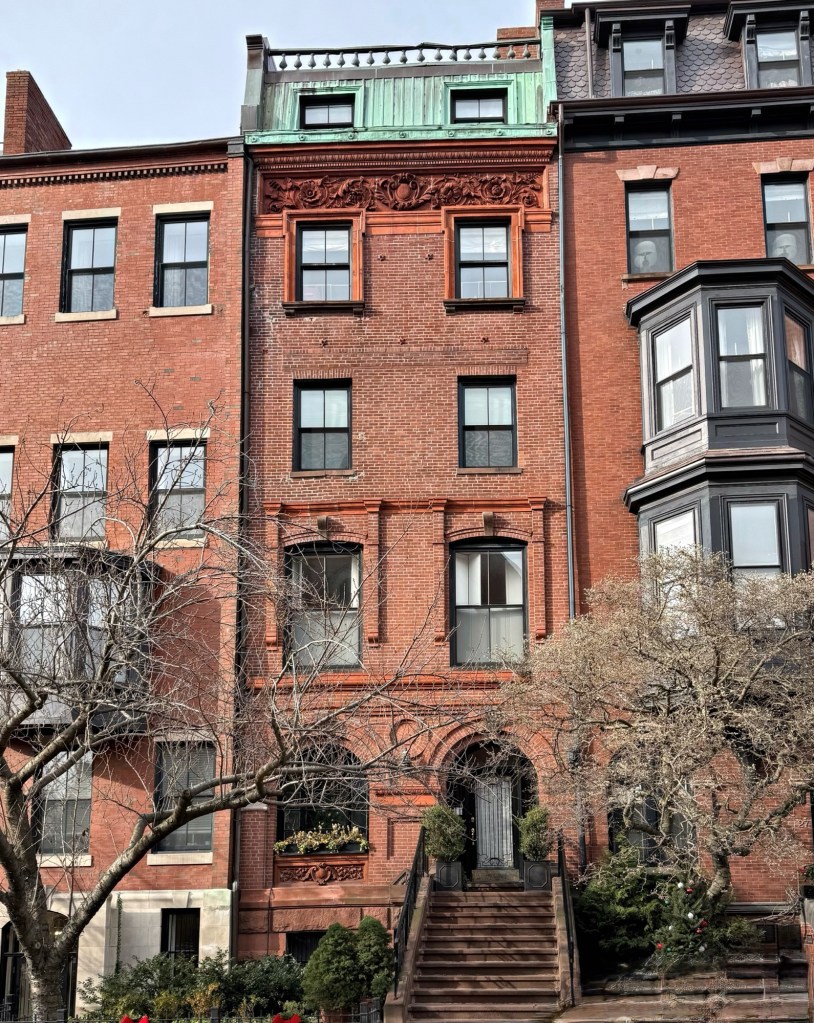
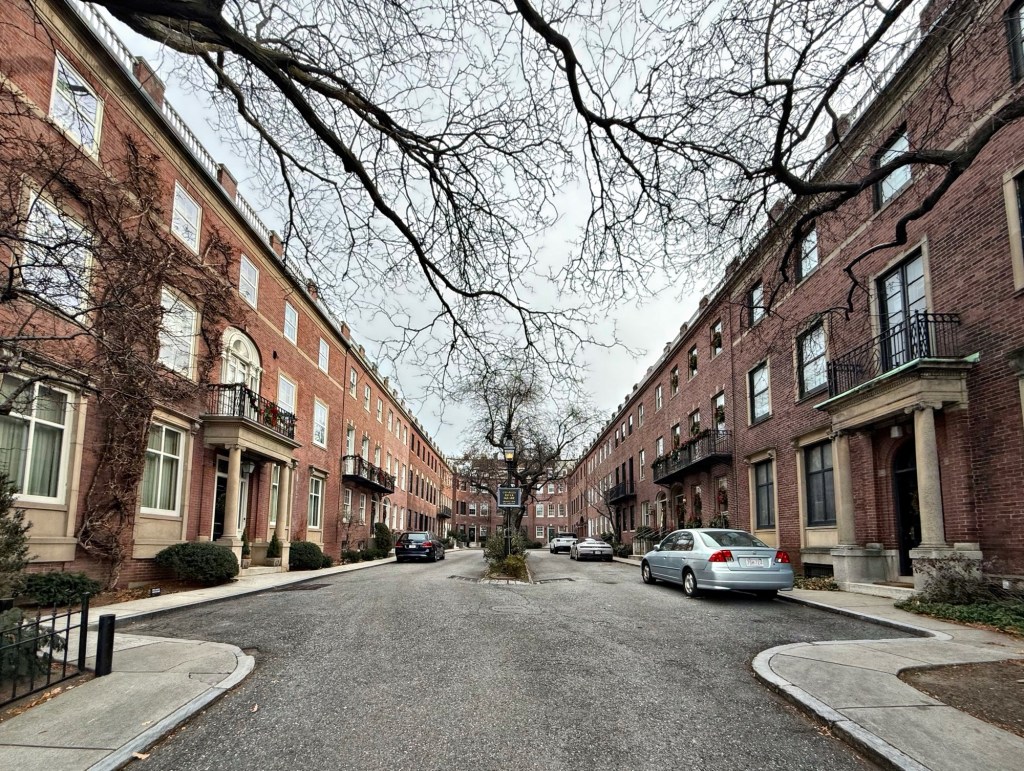
The American Unitarian Association (AUA) opened its first headquarters in Boston in 1865, forty years after the organization was founded. Since its founding in 1825, the AUA occupied several locations but eventually took residence in a Richardsonian Romanesque style building constructed in 1886 at the corner of Beacon and Bowdoin streets. The handsome structure, designed by Robert Swain Peabody of the firm, Peabody and Stearns, served as the headquarters for the association until it was demolished in the 1920s for the expansion of the Hotel Bellevue. In 1926, the AUA purchased an 1840s townhouse and demolished it, replacing the former residence with their new building to serve as a church headquarters office building. The American Unitarian Association hired the Boston architectural firm of Putnam and Cox to design their building, which employed architectural similarities to the adjacent 1820s townhouses designed by Cornelius Coolidge. The six-story building is constructed of red brick with a two-story granite base with piano nobile with a balcony, all under a mansard roof with dormers. The American Unitarian Association sold their Beacon Street building and relocated to a new headquarters on Farnsworth Street in the Seaport/Fort Point area of Boston in 2014. The 1926 building was converted to high-end luxury condominiums.

Tuckerman-Parkman Mansion // 1825

The Tuckerman-Parkman Mansion at 33 Beacon Street, like its neighbor, was built in 1825 from plans by architect, Cornelius Coolidge, in the Greek Revival style. The residence was originally purchased by Edward Tuckerman, a wealthy merchant and father of Professor Edward Tuckerman, a prominent lichenologist for whom Tuckerman Ravine on Mount Washington was named. Tuckerman Sr. lived here at 33 Beacon Street until his death. The next owners, Mrs. Eliza Parkman and her son, George Francis Parkman (1823-1908) moved here after the brutal murder and following sensational trial of her husband, Dr. George Parkman (1790-1849). The 1849 trial of Parkman’s murderer, Professor John White Webster of the Harvard Medical School, was called the “case of the century”. Professor Webster owed Dr. Parkman a substantial sum of money. The professor lost patience with Parkman’s constant reminders that his payment was long overdue and killed Parkman in a rage, dismembered his tall, lanky frame and concealed the body parts in a wall of a Harvard Medical School laboratory. With the help of a janitor, Dr. Parkman’s body was discovered. A murder trial ensued, and Professor White was found guilty and subsequently hung. The murder trial has been widely cited as one of the earliest uses of forensic evidence to identify a body. Seeking refuge from the attention and pain from the loss of the family patriarch and trial, Ms. Parkman and her son, George, moved to this home in 1853. Widow, Eliza Parkman died in 1877 and George F. Parkman lived in this home until 1908. In his will, Mr. Parkman bequeathed his mansion and over $5 Million to the City of Boston for the maintenance of the Boston Common. The Tuckerman-Parkman Mansion was restored by the City of Boston in 1972 and used almost exclusively as the Mayor’s residence until 1984. The house is now the official reception hall of the Mayor’s office and appears much as it did when built 200 years ago.

Russell-Bradlee Mansion // 1825

The land at the corner of Beacon and Joy streets in Boston’s Beacon Hill neighborhood was once John Hancock’s west pasture for his grand manor (razed in 1863) until 1819, when subdivision of the Hancock estate began following his death. In 1821, Israel Thorndike, one of the leading land speculators of early nineteenth-century Boston, began buying out the Hancock heirs and house lots overlooking the Boston Common were sold to John Hubbard and George Williams Lyman, who hired architect Cornelius Coolidge, to build some stately Greek Revival townhomes for wealthy Boston elites. The house at the corner of Beacon and Joy streets, 34 Beacon Street, was built in 1825 for Nathaniel Pope Russell, a leading Federal period China Trade merchant. By 1850, James B. Bradlee, a wealthy merchant, had acquired the property. Bradlee’s grandson Ogden Codman Jr., the influential late nineteenth- and early twentieth-century architect and interior decorator, was born in this house in 1863. Codman later collaborated with novelist and tastemaker Edith Wharton on ‘The Decoration of Houses‘, a book that had an enormous impact on the direction of interior design when it was published in the 1890s. Little, Brown and Company, a publishing company founded in 1837, purchased the former residence and moved their headquarters here in 1909. The publishing company sold the property in 1997, and it converted to a single-family home. In 2007, the residence was purchased by Northeastern University and has since been the President’s House.

Joseph Royall House // c.1770

This is one of the oldest buildings in Boston! The Joseph Royall House is located at 770 Washington Street in the Ashmont section of Dorchester, set back from the street and passed by thousands who likely do not know its history and significance. The house dates to around 1770 and was built by Joseph Royall, of the infamous Royall Family of Cambridge, Medford, and Antigua, who made much of their money through sugar plantations in the Caribbean and enslaved Africans. Joseph was a nephew of Isaac Royal Jr., the patriarch of the family who resided at what is now the Royall House and Slave Quarters in Medford. Upon the outbreak of the American Revolution, the Tory Royalls were forced to flee for protection, Joseph would move to England. Isaac’s daughter (and Joseph’s cousin), Penelope Royall Vassall had her Cambridge home confiscated as a Tory property during the Revolution, causing her to flee to Antigua. When she returned to Boston after the war she was a widow and lived in poverty. Her cousin, Joseph, would sell her this Dorchester estate in 1782 nearly for free, allowing her to sell the property for money to survive in Boston. The house would remain here for another two-and-a-quarter centuries, as Ashmont grew around it. One-story stores were built in the front yard, completely obscuring the Georgian residence until later owners, Bob and Vicki Rugo, restored the house and demolished the stores in front, preserving this house for centuries to come. While the house is one of the oldest in Boston, it is not a landmark or listed on the National Register of Historic Places.

Lynch House // 1889

One of the most unique and enchanting houses in the Ashmont Hill neighborhood of Dorchester is the Lynch House (aka the Sunflower House) at 102 Ocean Street, a landmark example of the Queen Anne architectural style. This residence was designed in 1889 by architect Samuel J. Brown, who worked in the firm of Cummings and Sears before opening his own office in Boston, where he specialized in residential designs. The first owners were Edward C. Lynch, a stair builder, and his wife, Petronella P. Lynch, who was born in Sweden and emigrated to the United States. Architecturally, the Lynch House features a prominent gambrel roof that swells out over the second-floor inset windows, clapboard and shingle siding, sawtooth shingled details over the windows, and the sunflower motif in a panel at the third floor.

George A. Eastman House and Stable // 1889

Built between 1889-1891, the house and stable at 60 Ocean Street in the Ashmont Hill neighborhood of Dorchester was commissioned by George A. Eastman, a Harvard graduate and insurance executive. George Augustine Eastman married Anna C. Winsor in 1870, and the family would remain in this house for nearly 100 years. George Eastman worked as an insurance executive at the Boston office of the Liverpool & London & Globe Insurance Company of England for over 50 years, and built his home next-door to his brother’s at 42 Ocean Street. It is believed that the Eastman House and Stable were designed by local architect Edwin J. Lewis, who designed about a dozen other residences in the surrounding area at the same time. The old stable has been converted to residential use, a great way to adaptively reuse these old, well-built structures.

Clark-Cottle House // 1890

One of the most sumptuous Victorian-era homes in Dorchester can be found at 94 Ocean Street, this is the Clark-Cottie House. The residence (and rear stable) was built in 1890 from plans by famed architect Arthur H. Vinal, who designed many other Shingle style and Queen Anne homes in the surrounding neighborhood. The first owners of the mansion were Evelyn and Edward Clark, who after a few years, sold the property to Edgar Cottle, president of the Curtis & Pope Lumber Company. The three-story Queen Anne style mansion features a rounded corner tower, varied shingle siding, shingled porch, and the intact, charming stable at the rear.

Frank and Laura Carter House // 1889

Effortlessly blending the Shingle and Queen Anne architectural styles, the Frank and Laura Carter House at 107 Ocean Street in Ashmont, Dorchester, Massachusetts, is one of the finest Victorian residences in the neighborhood. The house was designed by famed local architect Arthur Vinal, who also furnished plans for the Dorchester Temple Baptist Church nearby that same year. The house was built for Frank Carter (1859-1950), treasurer of the Bay State Belting Company, and his new wife, Laura. Special details on the house include the polygonal bay capped by pyramidal roof, belt-course of shingles breaking up the facades, and stunning two-bay eyebrow dormer facing the street with shingled returns.

Hotel Mellen // 1894

While Ashmont Hill in Dorchester is known for large, single-family Victorian houses, there are a number of grand apartment houses and three-deckers dispersed throughout the area, showing the evolution of housing in desirable neighborhoods in the late 19th and early 20th centuries. This is the Hotel Mellen, located at 18-20 Mellen Street, a multi-family building that architecturally blends in with its surroundings, not like many uninspiring boxes being built all over the region today. The property was developed by Louis Pfingst, a German streetcar designer and mechanic who was also active in the local Dorchester Gentlemen’s Driving Club. The building was designed by local architect Alexander B. Pinkham, who specialized in multi-family housing designs around Boston. The rounded bays, recessed porch in the gable, varied siding, and applied ornament, make the building stand out, while fitting well within its context of surrounding homes.

Reed-Fitzgerald House // 1891

The Reed-Fitzgerald House at 75 Ocean Street in Ashmont Hill, Dorchester, stands out as a simple, yet beautiful example of the Shingle style of architecture for residential purposes. The house here was built in 1891 from plans by Edwin J. Lewis, Jr., a Boston-born architect who worked at the office of Peabody and Stearns before he opened his own firm in 1887, specializing in suburban houses and churches. The first owner of this residence was George Reed, a Boston insurance executive. Years later, the house was owned by Henry Fitzgerald, possibly Henry S. Fitzgerald, the brother of John “Honey Fitz” Fitzgerald (1863-1950), the Mayor of Boston who resided in a since demolished house in the neighborhood. Mayor John Fitzgerald was the father of Rose Fitzgerald and maternal grandfather of her sons President John F. Kennedy, Attorney General Robert F. Kennedy, and Senator Ted Kennedy. Recently, the owners of the Reed-Fitzgerald House have restored the exterior, and stained the shingles the lovely rust color.