Toussaint House // 1879

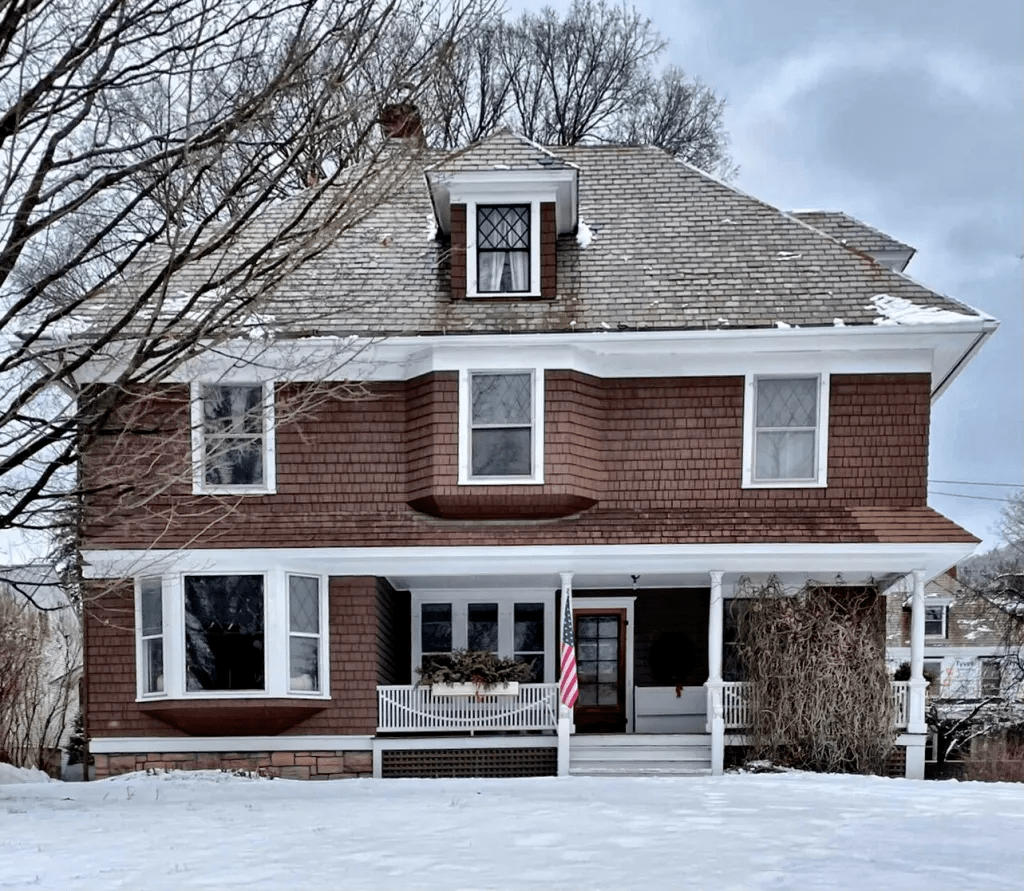
In 1879, furniture-maker and amateur architect, Winand Toussaint (1826-1904), built this unique mansard roofed house at 203 Aspinwall Avenue in Brookline Village. Toussaint was born in Belgium, and immigrated to the United States about 1841, where he originally settled in Roxbury and operated a cabinetmaking business. Toussaint moved from Roxbury to Brookline about 1873, but lost his fortune in the Panic of 1874. After a few years, he found work and eventually purchased a house lot here, and designed and built this home in 1879. Winand was born into a family of architects and engineers in Europe with his grandfather being Jean Lambert Toussaint of Liege, an architect who reportedly built the first railway introduced in Belgium. He is said to have studied in France and Italy before working in furniture-making in the United States. He maintained a professional office from his Brookline house until his death in 1904. After his death, the family home was inherited by daughter, Emma Toussaint, who was unmarried and worked as a linguist and writer under the name “Portia”. The charming Toussaint House blends Second Empire and Stick styles with unique beveled corners, one of which contains the main entrance, and a belvedere at the crest of the mansard roof. Due to its unique architecture, the Toussaint House was individually listed in the National Register of Historic Places in 1985.

Dr. Tappan Eustis Francis House // 1879

Located on Davis Avenue, a narrow residential street in Brookline Village, the Dr. Tappan Eustis Francis House is an unusual work by an architect that differs from the style they became best-known and sought after. Dr. Tappan Eustis Francis (1823-1909) graduated from Harvard College in 1844 and Harvard Medical School in 1847 and moved to Brookline where he practiced medicine for over 50 years. For his Brookline residence, Dr. Francis hired William Ralph Emerson, who has become best-known for his Shingle style designs and summer cottages that lined the New England coastline and in Boston suburbs, to furnish plans for his suburban residence. For Dr. Francis’ home, Emerson envisioned a brick house in the English Queen Anne style. The tall chimneys with panel brick designs, corbeled brick brackets and terra-cotta decorations in the gable peaks, and the massive slate-roofed entry porch are all stunning features on the house; but the most intriguing has to be the bracketed hood on the corner of the house which originally sheltered a wooden bench, as depicted in an 1879 drawing.

Saint Mary of the Assumption Rectory // 1882

Located adjacent to the St. Mary of the Assumption Catholic Church in Brookline Village, this handsome three-and-a-half-story brick structure has served as the Rectory of the congregation since it was built in 1882. Complimenting the Victorian Gothic style of the church next door, the Rectory was also designed by the firm of Peabody and Stearns, and was the home of the priest and other high-ranking clergy men. The rectory stands out architecturally for its panel brick corbelling at the eaves, steeply pitched slate roof and copper-coated gables.

St. Mary of the Assumption Catholic Church, Brookline Village // 1880

St. Mary of the Assumption church was the first Catholic Church established in Brookline, Massachusetts, in 1852 when a congregation of Catholics began to congregate to worship together at the old Lyceum Hall. The congregation primarily consisted of Irish immigrants who settled in Brookline, where they often found work at the many large estates and building the new branch railroad in town, but desired a true house of worship close to their homes. By 1853, a modest wood-frame Gothic Revival style church was built in the Village, but was quickly outgrown. In 1873, the pastor of the congregation, Irish-born Rev. Lawrence Morris (1845-1900) began purchasing land at the corner of Harvard Street and Linden Place to establish a new church, large enough to comfortably fit the congregation and various church-related buildings. In 1880, the firm of Peabody & Stearns was hired to furnish plans for the Victorian Gothic edifice in brick and brownstone. Although the church was designed in 1880, it was not dedicated until 1886, and at this time, Pope Leo XIII sent a chalice to the Parish in honor of the completion of this church, the first in America to be named Saint Mary of the Assumption.

Former Brookline Savings Bank // 1898

The diminutive former Brookline Savings Bank building on Washington Street in Brookline Village is in stark contrast in scale and design from the 1965 Brookline Town Hall down the street. The building committee hired Franz Joseph Untersee, a Swiss-born architect who settled in Brookline, to furnish designs for their new bank, which opened in November 1898. Covered in Indiana limestone, the Beaux Arts style bank building features a modest, three-bay facade that is adorned by large round arched windows surrounded by an egg-and-dart motif, and an elaborate pediment with acanthus leaf and a central eagle in copper. Like many local banks, the Brookline Savings Bank saw a series of acquisitions and mergers throughout the 20th century, and this small bank building was sold. Today, the former Brookline Savings Bank on Washington Street is occupied by a church.

Brookline Town Hall // 1965

The modernist Brookline Town Hall building stands in stark contrast to the many historic buildings in Brookline Village, and even more-so from the town’s third Town Hall, a Victorian Gothic design by architect Samuel J. F. Thayer. Completed in 1965 as a six-story municipal “skyscraper”, the structure was designed by Anderson, Beckwith, and Haible, architects who specialized in sleek, clean, Modernist designs, primarily in office parks and college campuses. The unadorned box is broken up only by the rows of identical windows and slightly projecting fins, which break up the bays in their own monotony. Like many such municipal and office buildings of the time, the structure is set back from the street and surrounded by landscaping, with surface parking behind. While the building was lauded when it opened in 1965, tastes shifted and like in many communities, a majority of the public (and likely the employees who work here) would have preferred its predecessor.

Gleason-Patterson House // 1803

Another stately old home on Glezen Lane in Wayland is this brick, Federal style country mansion located across from the town Training Field. This residence is said to have been built by a Nathaniel Gleason (Glezen) and later inherited by a family member, Abel Glezen (1803-1890) who farmed the 55 acres of land and was a local politician. In 1900, as Wayland shifted from rural community to a desirable Boston suburb for summer residences, the Gleason House was purchased by Henry W. Patterson, who was in his late 20s when he bought this country house. Henry inherited his father’s estate and married Jane Harrington Adams from Massachusetts. The couple spent only a couple years here until Henry died in 1907 at just 35 years old. Jane, his widow, remained here until her death in 1950. The estate was subsequently subdivided and remains one of the finest homes in the community.

Isaac Gleason House // 1805

Built in 1805 by Isaac Gleason (Glezen), this Federal style mansion was later expanded in the early 20th century in the Colonial Revival style as Wayland became more of a wealthy Boston suburb. Located on the appropriately named Glezen Lane, this house was constructed for Isaac Glezen (1769-1843), who farmed the land here. Other family members built homes nearby. As Wayland shifted from rural community to a wealthy Boston suburb in the early 20th century, the property was purchased by Charles Ashley Hardy and his wife, Alice. The couple would sell the property in 1918, which comprised of 89-acres of land and a chauffeur’s residence, was purchased by Albert H. Beck, a New York banker. The property was later subdivided and consists of many other large, single-family homes.

Chamberlain Cottage // 1940

Nestled into the forests of Wayland, Massachusetts, one of the most significant examples of early Modernist architecture, the Chamberlain Cottage, represents the European Bauhaus style adapted to the American landscape and New England vernacular. Designed in 1940 and completed in 1941, the house was commissioned by Harvard Economics professor, Henry Chamberlain and his wife, Margareth, as a weekend retreat from Cambridge. Professor Chamberlain commissioned Marcel Breuer and his mentor, Walter Gropius, then Dean of the Harvard Graduate School of Design, to design a home with a specific request for a screened porch similar to Gropius’ residence in nearby Lincoln. For the Chamberlain Cottage, the design responds to the uneven terrain and the potential for river flooding by two distinct parts: a grounded stone base and a cantilevered wooden volume above. The lower stone level functioned as a foundation while providing storage for a canoe and housing a fireplace that extends vertically through the structure; with the upper wooden volume containing living spaces. Despite its compact size for weekend visits, the upper level is well planned and includes a living space, kitchen, a single bedroom, and the porch. Due to its small scale and siting, the one-bedroom cottage was not easily adaptable for modern living. After falling into disrepair in the 1980s and ’90s, the home was purchased by architects Sidney R. Bowen and Angela Watson, who expanded the structure over the course of a decade to its current size of 3,742 square feet. It has been occupied and lovingly maintained by later owners. It remains a private residence.

Griffin-Malloy House // 1720

This First Period Home on in Wayland, Massachusetts, can be found at 184 Glezen Lane and is one of the community’s oldest residences. The Griffin-Malloy Homestead dates to about 1720 and is a large, single-family farmhouse that is just over 300 years old! Records state that the house was built by early settler, Samuel Griffin and possibly expanded later by his son, Deacon Jonathan Griffin. After generations of Griffin Family ownership, the old farmhouse was purchased in 1877 by Timothy Malloy (1839-1909) an Irish immigrant who settled in Wayland and operated a farm here. The house as of the 20th century, retained much of its original wood paneled walls and fireplaces, and has been lovingly preserved by generations of great stewards.