Clark-Cottle House // 1890

One of the most sumptuous Victorian-era homes in Dorchester can be found at 94 Ocean Street, this is the Clark-Cottie House. The residence (and rear stable) was built in 1890 from plans by famed architect Arthur H. Vinal, who designed many other Shingle style and Queen Anne homes in the surrounding neighborhood. The first owners of the mansion were Evelyn and Edward Clark, who after a few years, sold the property to Edgar Cottle, president of the Curtis & Pope Lumber Company. The three-story Queen Anne style mansion features a rounded corner tower, varied shingle siding, shingled porch, and the intact, charming stable at the rear.

Chansonetta Stanley Emmons House // 1893

Chansonetta Stanley Emmons (1858-1937) was born in Kingfield, Maine, and was one of the great women photographers in the 19th and early 20th century, often depicting domestic life and New England scenes. The young Chansonetta Stanley grew interested in photography after her brothers’ (Francis E. and Freelan O. Stanley) dry-plate printing invention, they also invented the steam-powered automobile known as the Stanley Steamer. She married James Nathaniel Whitman Emmons in 1887 and in 1894, James hired architect Henry McLean, to design a residence for him and Chansonetta, this lovely home on Harley Street on Ashmont Hill. The couple occupied the house until 1898, when James died of blood poisoning at the age of 41. Chansonetta sold the home and moved to Newton, where her two brothers lived and operated their business. The house blends Queen Anne and Colonial Revival styles and originally had a conical roof over the corner rounded bay. The roof was replaced with a flat roof at about the time of the large balcony and extended dormer.

Hilt-Rayner Houses // 1844

This is your reminder to get lost and explore your city or town. Tucked off Boylston Street sits Boylston Place, a short, dead-end way that is passed by thousands every day, many not knowing about the little enclave of surviving 19th century buildings there. At the end of the street, the Hilt-Rayner Double House remains in great condition and a reminder as to the residential character of the area in the first half of the 19th century. The houses were built by Henry Hilt, a housewright who owned one unit after completion. The other unit was owned by Thomas L. Rayner, who appears to have rented the unit out. The late example of the Greek Revival style in the rowhouse form is well preserved through nearly 200 years of use. Beginning in the 1920s, the two homes were acquired by the Tavern Club, a private social club established in 1884 in the house next door. It remains owned by the Tavern Club today.

Tavern Club // c.1819

This is your reminder to get lost and explore your city or town. Tucked off Boylston Street sits Boylston Place, a short, dead-end way that is passed by thousands every day, many not knowing about the little enclave of surviving 19th century buildings there. This Federal period house was built in the 1810s for Beza Tucker (1771-1820), who rented the home to boarders until his death in 1820. Tucker bequeathed the house to the American Society for Educating Pious Youth for Gospel Ministry, a nationwide association formed in 1815 with the goal of providing financial support to men seeking a theological education. The Society sold the house in 1834 to Reverend Nehemiah Adams, when he became pastor of the Essex Street Church in Boston. Since 1887, the building has been the home to the Tavern Club, a venerable Boston social and dining club that was invite-only. Presidents in the early years included William Dean Howells, Charles Elliot Norton, Henry Lee Higginson. Inside, the eclectic English pub/Colonial interior with its cozy atmosphere included dining rooms, sleeping accommodations for guests, and a small theatre for annual club productions. The Tavern Club is still in operation and maintains the building today. I can only imagine how great the interior is!

Edgar Allan Poe Birthplace // c.1805-1965

Courtesy of BPL archives

Famed author Edgar Allan Poe was born in this house on Carver Street in Boston, Massachusetts, on January 19, 1809, the second child of American actor David Poe Jr. and English-born actress Elizabeth Arnold Hopkins Poe. His father abandoned the family in 1810 and his mother died a year later from pulmonary tuberculosis. He would be adopted by John Allan, a merchant and slaver in Richmond, Virginia, his adopted family gave him the name “Edgar Allan Poe”. He would live a somewhat nomadic life, moving around often to cities all over the East Coast until his death in 1849 in Baltimore. Although it was his birthplace, Poe’s troubled early childhood likely contributed to his disdain for Boston, where he often referred to Bostonians as “Frogpondians,” after the frog pond on Boston Common, though as an insult. The poet’s seminal work The Raven was published in January 1845 to widespread success. Several months later, Poe was invited to read at the Boston Lyceum with the support of James Russell Lowell, a Harvard professor and editor of The Atlantic Monthly. It did not go well. His childhood home on Carver Street would be razed by 1962 and is presently a surface parking lot for an electrical substation. The city would honor its macabre author by renaming an alley off Boylston Street, Edgar Allan Poe Way, and in 2014, the City commissioned a public statue titled, “Poe Returning to Boston“. Designed by Stefanie Rocknak, the statue depicts Poe walking, facing away from the Boston Common. His figure is accompanied by an oversized flying raven; his suitcase lid has fallen open, leaving a “paper trail” of literary works embedded in the sidewalk behind him.

The Last Tenement // c.1870s

Originally built in the 1870s, and largely remodeled in the early 1900s, this charming building has been known locally as “The Last Tenement” of the old West End of Boston. Once part of an unbroken a row of 30 brick tenements along the east side of Lowell Street, this building typified much of the West End of Boston, a vibrant and dynamic immigrant neighborhood. Dwarfed by larger, modern apartment towers and highway off-ramps, this stand-alone building is a survivor, and should really be preserved! Here is a little history on The Last Tenement that I found. The building was originally built as a three-story residence just after the Civil War by furniture dealer, George M. Rogers. The building was rented to four families in the 1880 census, showing the diversity of the region with 20 people residing in the building of Irish, English, and German-Jewish backgrounds. At the turn of the century, an elevated rail line was laid out down Lowell Street. After WWII, the neighborhood would see a terrible demise, that has been widely told. City leaders effectively considered the vibrant immigrant neighborhood a slum, and in an effort to redevelop it to bring back middle-class families (and their tax dollars) handed much of the neighborhood to developers to start over, with little more than lip service for the displaced. This building, now with an address of 42 Lomasney Way, was occupied for some time by “Skinny” Kazonis, a low-level Mafia associate of the Angiulo Brothers, which was a leading gang in the North End until the Winter Hill Gang decided to run rackets in the area. The property sold, and residential units have been rented and the building maintained, with the assistance of a billboard for additional income for the owner. The Last Tenement showcases the strength and resilience of the old West End and will hopefully remain as a reminder of the vibrant neighborhood that was razed and replaced with mediocrity.

Hutchings-Pfaff Gatehouse // c.1884

Once located at the entrance to the Hutchings-Pfaff Mansion, this small stone gatehouse is all that remains of a great Roxbury estate. Built of locally quarried Roxbury Puddingstone decades after the main house was completed, the Victorian Gothic style cottage surprisingly survived the subdividing of the large property and was sold as a private home in the early 20th century. It is uncommon to see these types of outbuildings survive into the 21st century, so I hope to see this charming cottage survive another 150 years!

H. H. Fitch House // c.1870

Henry Hubbard Fitch (1833-1888) was born in Cornish, New Hampshire, but made Roxbury, Massachusetts his home. He moved to Boston at an early age and later entered into business with Francis V. B. Kern under the firm Kern & Fitch, working as a conveyancer. By 1873, he was also a justice of the peace, notary public, and was Boston manager of the Equitable Mortgage Company. In about 1870, he and his wife, Eliza Anne, had this charming Second Empire style cottage built in the Washington Park neighborhood of Roxbury, a fashionable part of the “suburbs” at the time. They would later relocate, before Henry died in 1888 at the age of 55. The house is one of the best preserved in the neighborhood and a survivor from the wrecking ball that destroyed much of Washington Park.

Hooper Mansion // 1889

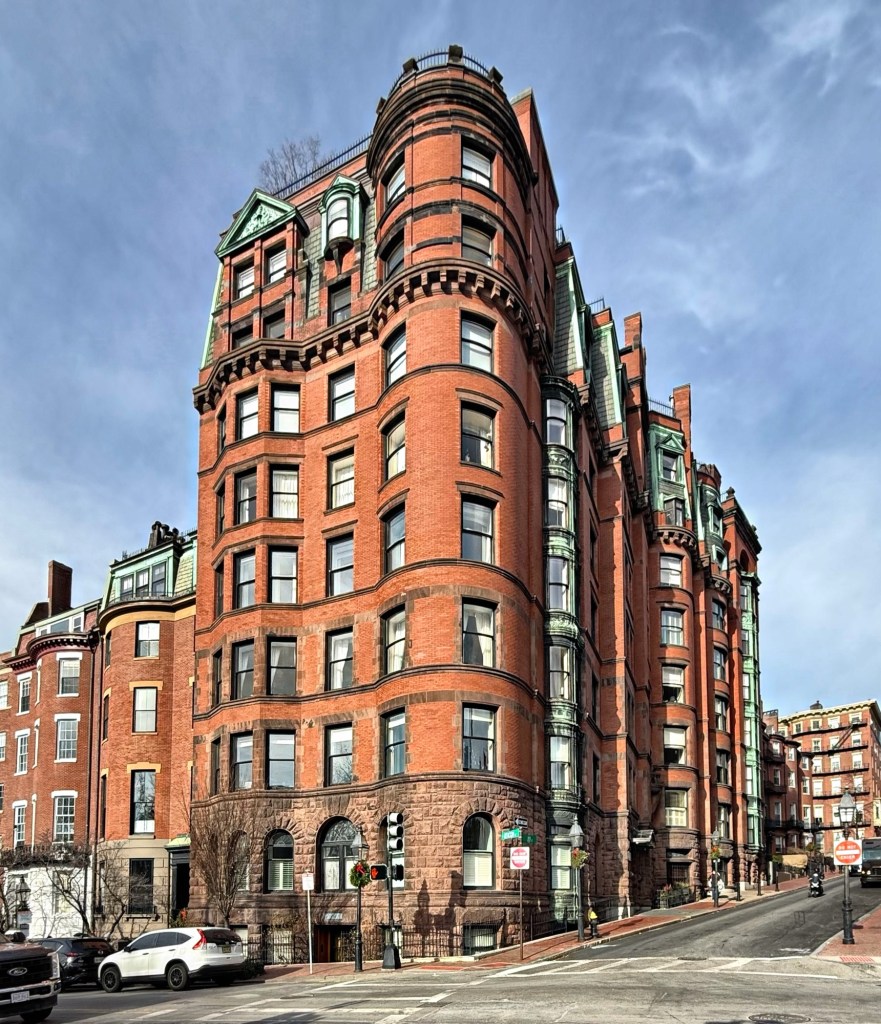
One of the finest Richardsonian Romanesque style mansions in America is this stunner at the corner of Beacon and Hereford streets in Boston’s Back Bay neighborhood. Built in 1889, the mansion was commissioned as a private residence for Robert Chamblet Hooper (1849-1908) and his wife, Helen Angier Ames Hooper. Helen’s father, Frederick Lothrop Ames one of the wealthiest men in Massachusetts and major benefactor to in the town of Easton, funded and oversaw construction of the Ames Free Library and the Easton Town Hall both by H. H. Richardson in his namesake Romanesque style. It was likely her family’s prevalence for the style that led to her own home in Boston’s Back Bay to follow suit. The firm of Andrews and Jacques are credited with designing the stately mansion which in 1889, cost over $100,000 to build. Robert Chamblet Hooper was treasurer and later president of the Constitution Wharf Company. A noted dog fancier, he was owner of “Judge” (also known as “Hooper’s Judge”), credited as the ancestor of the Boston Terrier breed. So we have the Hooper’s to thank for Boston’s iconic mascot! In 1913, the building transferred from the Hoopers to Mabel Slater, daughter of painter William Morris Hunt (and niece of architect Richard Morris Hunt) an eccentric widow and inventor. Mrs. Slater is credited with developing an ice-cooled refrigerator, a sleeping bag that doubled as a garment used by soldiers in World War I, and a doll head with movable eyes. Mabel routinely left open a rear door of the mansion in order to encourage the poor to find their way into the kitchen for shelter and food. She had a one-story ballroom built at the rear of the mansion in 1914. The house was converted into 6 condominium units in 2016 and restored at the exterior thanks to the architecture and design studio, Hacin.