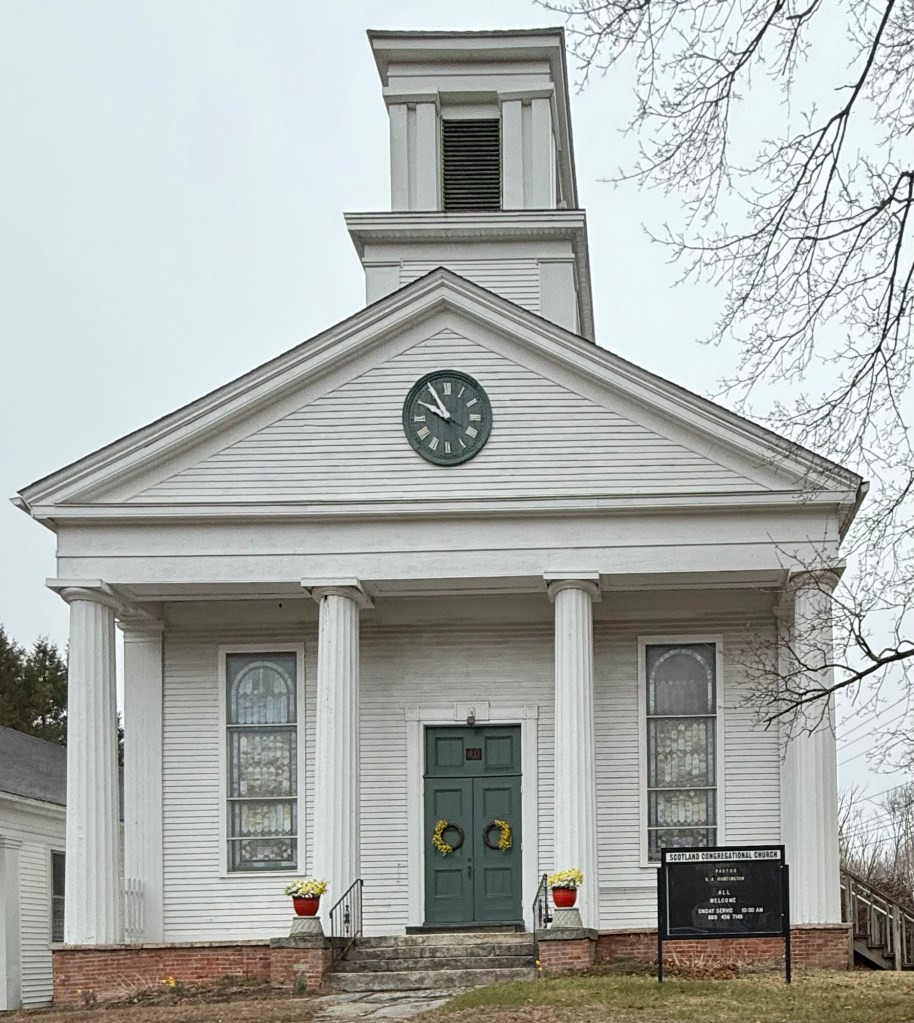
The main visual anchor of the charming town green of Scotland, Connecticut, is this building, the Scotland Congregational Church. Built in 1842 as the congregation’s third building, this Greek Revival style edifice features stately proportions, temple-front with four large Doric columns supporting the portico, and a two-stage belfry. The chapel (some say it was converted from the original town hall) was acquired by the congregation in 1867, and has remained in its new location ever since. Later alterations include the stained glass windows and clock in the pediment, which dates to the early 20th century.
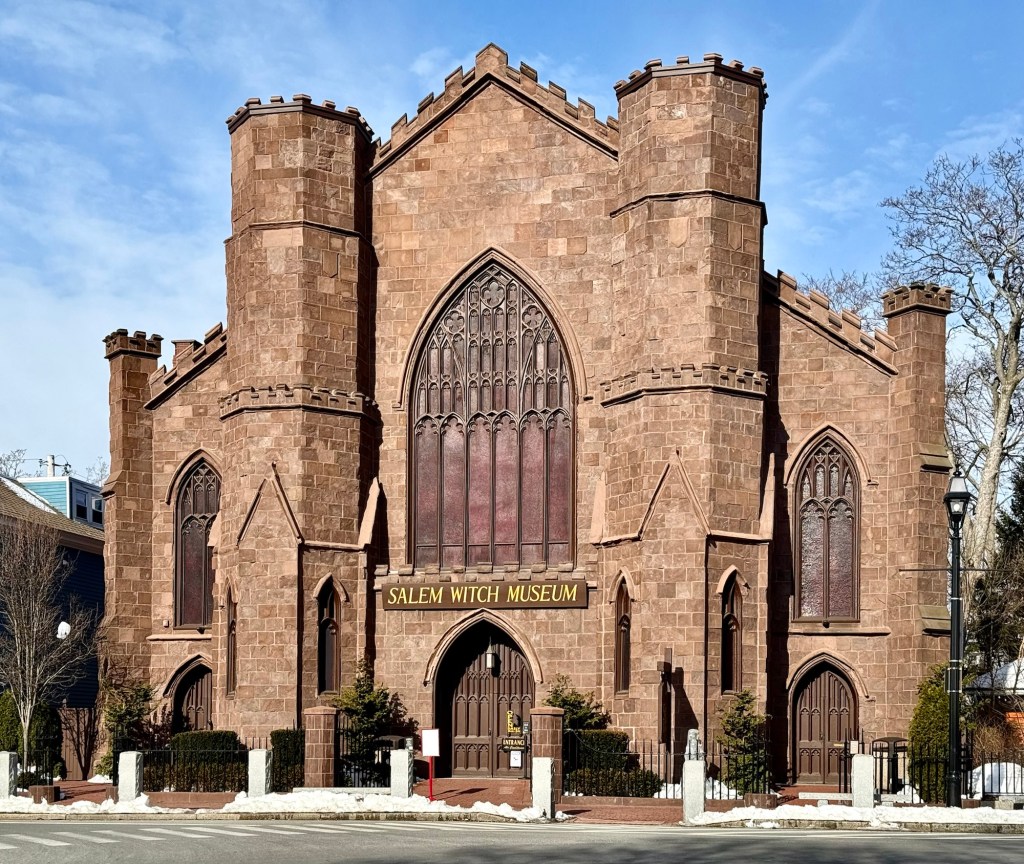
One of the most recognizable buildings in Salem is the former East Church, now occupied by the Salem Witch Museum. The East Church was constructed between 1844 and 1846 for the oldest branch of the First Church of Salem, which originally organized in 1718. The stunning Gothic Revival church has been credited to architect Minard Lafever (1798-1854), a prominent New York architect known for his Gothic, Greek and other Exotic Revival style buildings. Constructed of brownstone, a material Lafever utilized for his New York City churches built at the same time, the East Church exhibited pointed arch stained glass windows, crenellation resembling battlements, and once featured two, four-stage octagonal towers, which were cut down in the 1920s to their current height. The church suffered from a massive fire in the early 20th century and the church eventually moved out in the 1950s. The building was occupied by the Salem Auto Museum until another fire in 1969. In 1972, the Salem Witch Museum moved in and completely updated the interior.
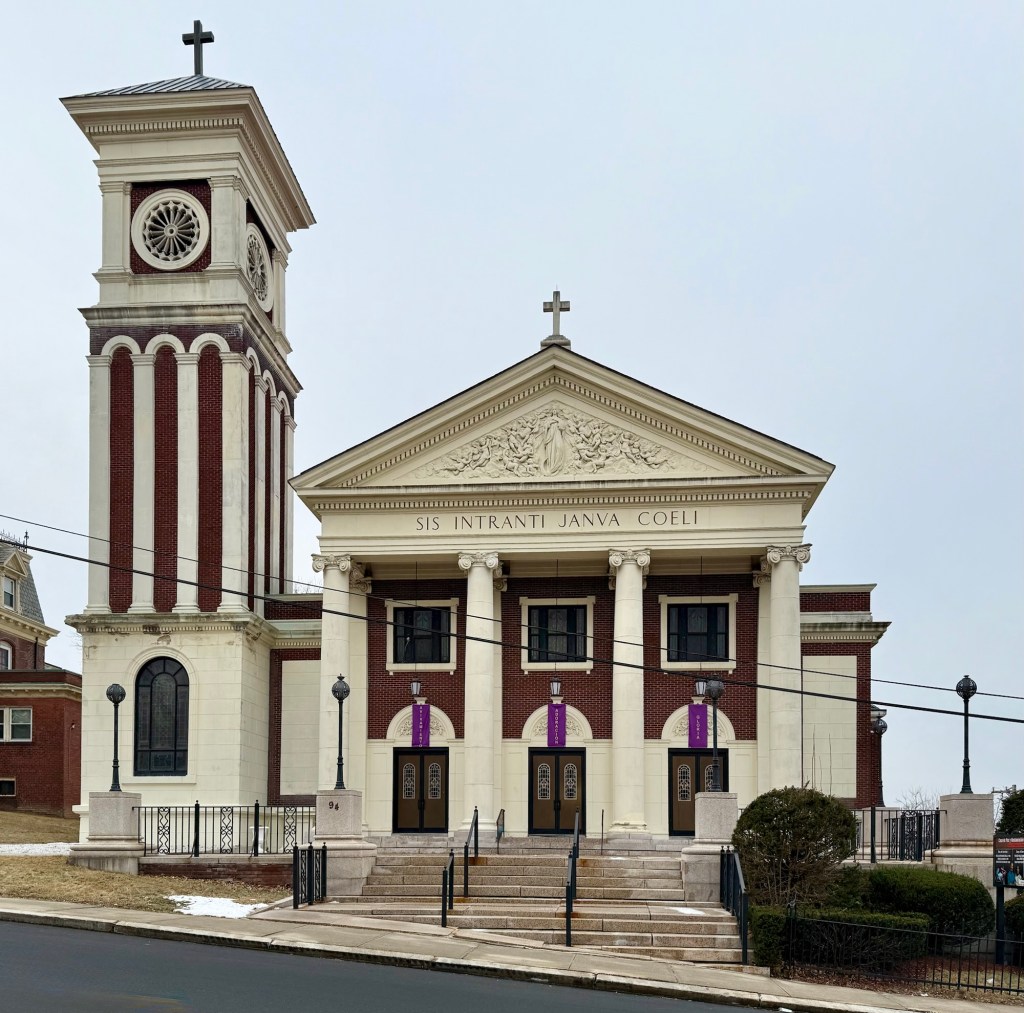
As Chicopee developed into one of the major industrial cities in Western Massachusetts, immigrant groups moved there, finding work at some of the major manufacturing companies. Irish and Polish churches were built and French and French Canadian residents too built their own church, where they could gather and worship in their native language. A wood-frame church was first built in the 1870s and used until it was destroyed by fire in 1912. It took a decade for the congregation to gather enough funds to purchase a new lot and build a new church, but patience was a virtue as their church is a stunner! The cornerstone for the church was laid in 1922 and the building was designed by local architect, George P. Dion, and constructed at the cost of $200,000. The building was dedicated in 1925 and is one of the finest, and most unique churches in the state. Italian Renaissance Revival in style, the church stands out for its 85-foot-tall campanile and cast-stone high-relief in the pediment at the facade. It is believed that within the relief, that depicts the figure of Mary surrounded by Cherubs, depicting the “Assumption of the Virgin,” George P. Dion used the likeness of his granddaughter as a face of one of the cherubs. The congregation moved out of the building but has been recently mortgaged to a new church, Iglesia Cristiana Casa De Paz y Restauración, showcasing the ever-changing demographics that keep our cities vibrant and stewards that do right by our collective history and buildings.
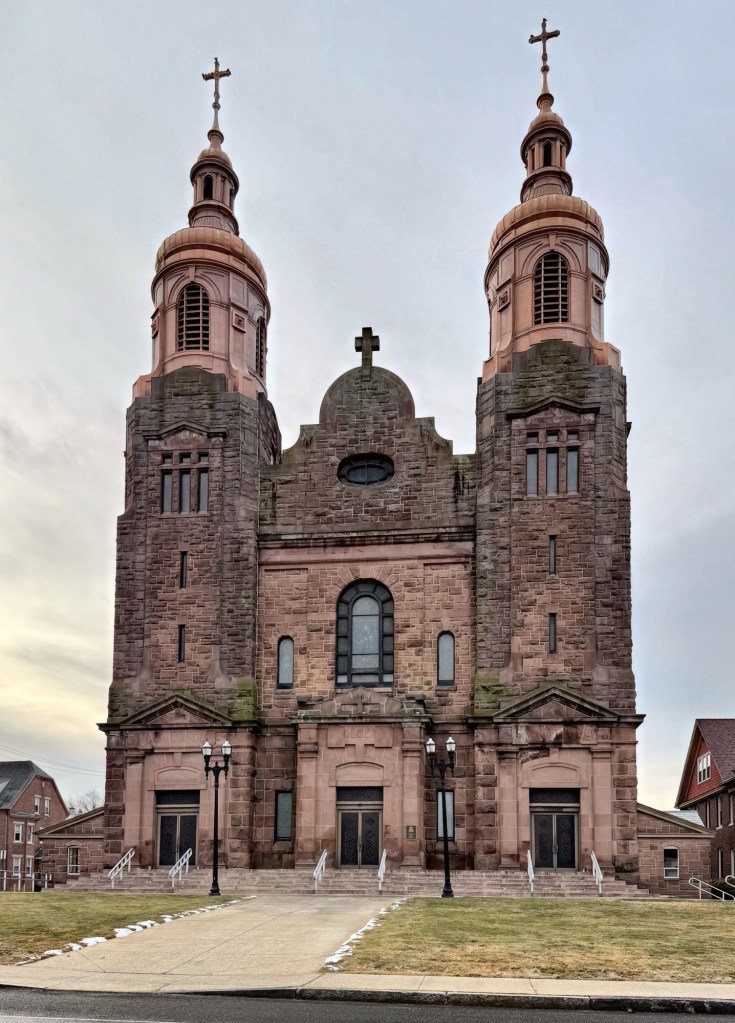
The Basilica of St. Stanislaus is a landmark church building in Chicopee, Massachusetts, with strong ties to the city’s industrial and immigrant past as well as a landmark of the city’s rebirth and growth. The congregation was founded and financed by Polish immigrants who had arrived in Chicopee, beginning in the 1880’s. The young Poles were determined to establish and finance their own church in which they could worship in their own native language and espouse their Polish customs and traditions with a sense of community. The church was founded at a time where Polish immigrants were settling in Chicopee, finding work at local factories. The Polish population of Chicopee surged in the late 19th into the early 20th centuries from just 200 residents in 1885 to over 9,000 in 1914. The first St. Stanislaus Church was a small frame structure built on this site in 1891. The present church was built in 1908 from the designs of architects Robert J. Reiley and Gustave E. Steinback and is Byzantine Revival in style. Constructed of brownstone with cathedral-like qualities, the facade is dominated by a pair of monumental masonry towers. Its spires are composed of copper drums which are surmounted by graceful belvederes and are pierced by arched openings. In 1991, Pope John Paul II raised the status of the church to a “minor basilica“, a classification that remains to today, one of just a handful in New England.
With crop failure a common occurrence in 1830s Ireland, immigration from Irish to New England surged with workers and families looking for a better life. Labor opportunities were abundant in the newly established mill town of Chicopee, with the Irish flocking here to dig canals, build dams and mills and later work in those same buildings. Their wives and daughters would work as cooks and maids, but later as operatives in those same mills. As many Irish were Catholic, it became apparent that a Catholic congregation should be established, St. Matthew’s was first organized in Chicopee in 1838. An earlier wood-frame church was built and used for a number of years until a large site on South Street was purchased by the Diocese for a new campus. Irish-born ecclesiastical architect Patrick Keely designed the church building which was constructed between 1857-1859 in the Gothic Revival style. The church was dedicated the “Holy Name of Jesus” church and exhibited sandstone-topped buttresses, rows of pointed dormers running down the clerestory on the sides, and a prominent central steeple. In 1910, the present copper spire replaced the original steeple which was damaged and burned in a lightning strike. The complex grew throughout the 19th and 20th centuries, with a rectory, schools, convent and monastery built on the site. Sadly, due to dwindling membership and fiscal considerations, many of these buildings were demolished in the past decades. The church appears now to be closed and is still owned by the Archdiocese of Springfield. I hope something can be done to preserve this landmark structure and the remaining buildings on the site.
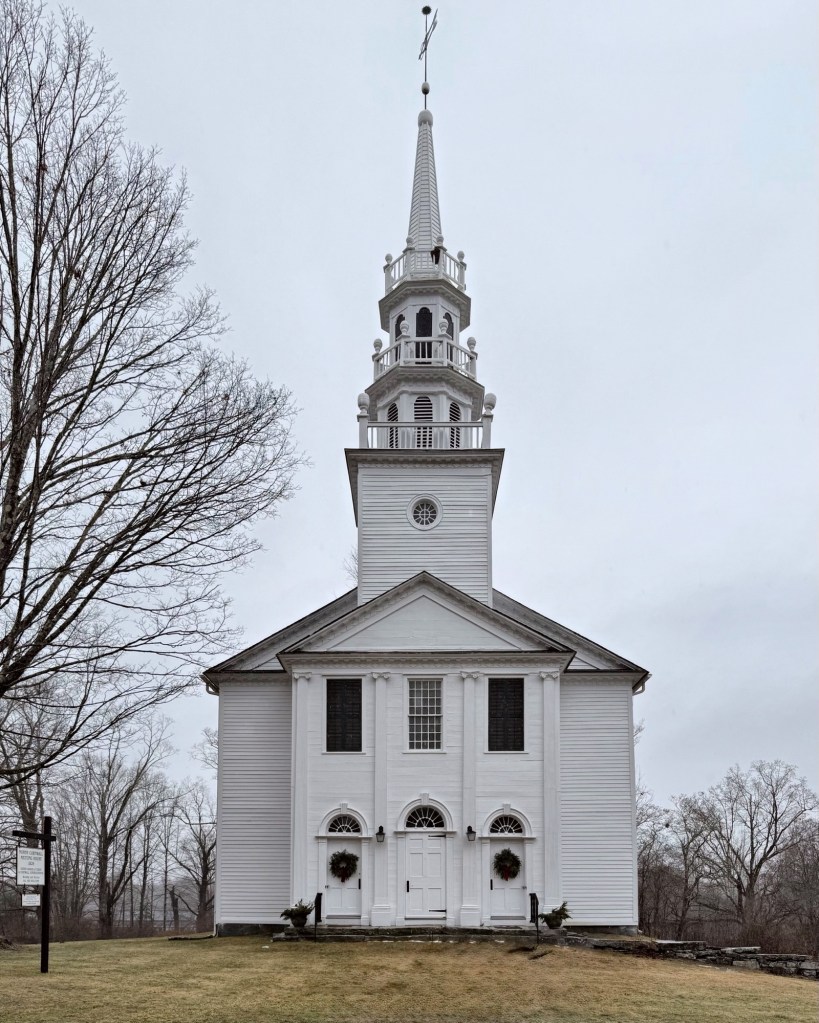
During the nineteenth century several small rural settlements dotted the landscape in Cornwall, Connecticut. In 1782, a group of “strict Congregationalists” seceded from the established Congregational church in town and constructed a “second” church in Cornwall Center. Following this, the town was divided into north and south parishes, with First Church built on the town center and the Second Church, this building, constructed in North Cornwall village in 1826. The North Congregational church is among the town’s finest Federal style buildings in the region and features three entrances with fanlight transoms and the bays of the facade are broken up by two-story fluted pilasters.
The Byfield Parish Church at 84 Warren Street in Georgetown, Massachusetts, was built in 1931 and is the fourth meetinghouse to occupy the site. The congregation dates to 1701, when sixteen families in this section of Rowley (now Georgetown) near Newbury were set off separate from the Rowley First Parish. Travel for religious services became too arduous, so the local residents petitioned to create their own parish, Byfield. Some accounts state that the first meetinghouse was built in 1702 and it is said to have been razed by 1746 to make way for a new wood frame church with a steeple, a spire, and a weathervane. This church burned in 1833, and it was replaced by a new meetinghouse soon after. The 1833 church was used for almost a century until, in March 1930, it was struck by lightning and burned to the ground. The congregation banded together and had this brick church built, its fourth. Completed in 1931, the Colonial Revival style building was designed by architect, George M. Champney, partner in the Boston office of Derby, Barnes & Champney. The church is sited within a historic cemetery containing the remains of many of the churches members, dating back to 1670. The Byfield Parish Church moved to a new building (its fifth) nearby in 1987, and in 1993, sold this church building to a private owner (retaining and maintaining the cemetery themselves) with the 1931 church converted to a single-family dwelling. How cool!
Completed in 1811, the First Parish Congregational Church of Pownal, Maine, is an excellent and well-preserved example of a vernacular Federal-period church in a rural setting. Located across from Mallett Hall and built at the foot of Bradbury Mountain, the church was built by a crew headed by master-carpenter Uriel Whitney, a Revolutionary War veteran who moved to the area after the war. He was active in this church and is buried in the church cemetery. Little remains of the original Federal Style architecture, as its current Greek Revival Style (architects unknown) dates from remodeling apparently undertaken in 1838 and 1857.
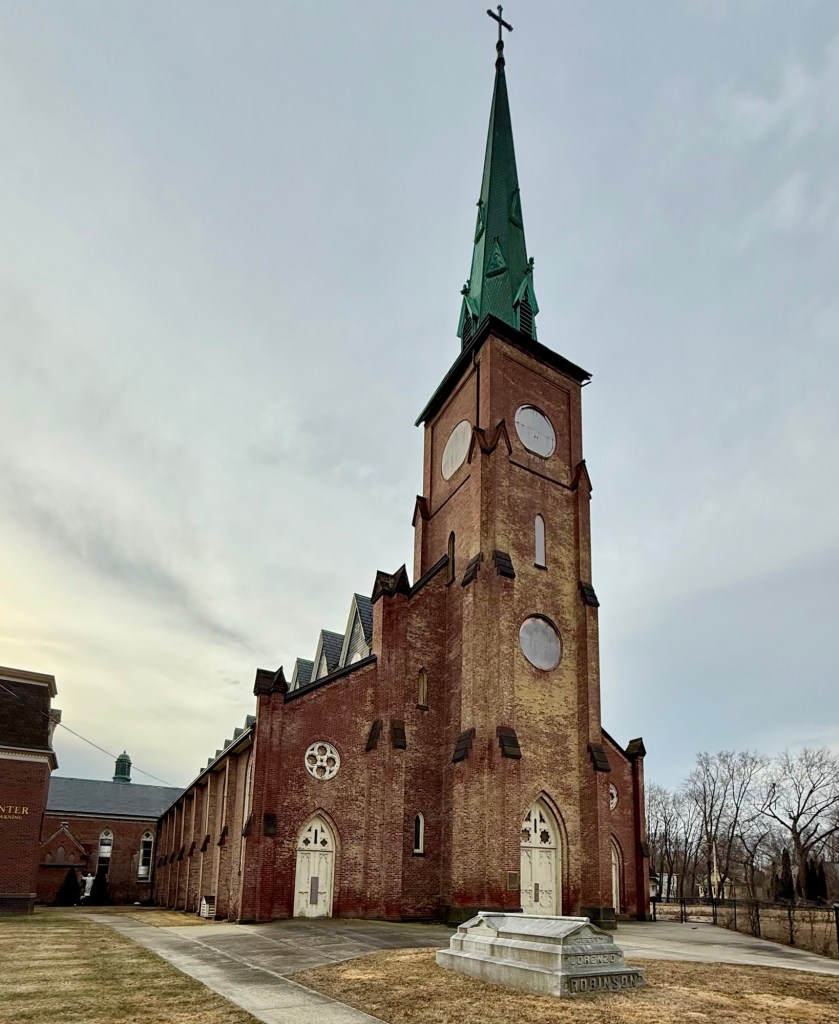
Located across from the church-like Norwood Town Hall, the United Church of Norwood is a landmark example of the Victorian Gothic architecture style and an important historical landmark for the town. The cornerstone of this present church was laid in 1885 and was completed and consecrated by December of 1886. Boston architect J. Williams Beal, got his start at the firm of McKim, Mead & White, designed the church here for the local Universalists, who lost their previous church to fire in 1884. In 1934, the town’s Universalist and Methodist congregations merged and they joined together in this, as a Union Church. Built of Milford granite and pressed brick, the United Church of Norwood features a side chapel and clock in its steeple which are unique and add charm to the historic church.
The Baptist church in Westford (a village in northern Ashford, yes it’s a little confusing) was formed in 1780. Its growth in the town can largely be attributed to Reverend John Rathburn, who had moved to town from Stonington, and was ordained as its pastor in 1781. A membership of fifty-four was reported in 1795. By the late 1830s, the village thrived due to the success of local businessmen and later, thanks to the Westford Glass Company, located nearby. Members donated to build this Greek Revival style church on a prominent corner in town, replacing the former meetinghouse. By the late 20th century, the church saw dwindling membership and merged with another in town. This church was sold to a neighboring property and is privately owned today.
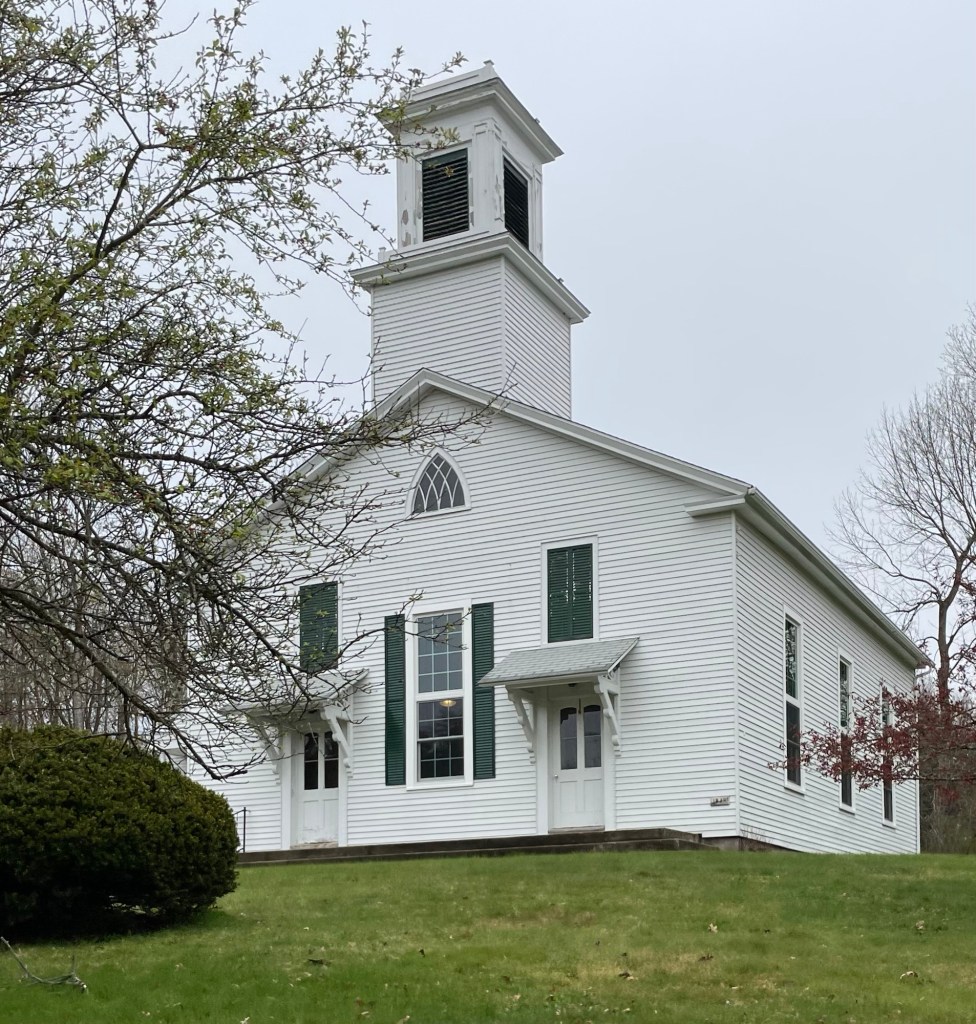
The small town of Union, Connecticut was established in 1734 and as with many towns at the time, religion and community were some of the first things to be codified when settling in a new area. The town’s publicly supported religion, Congregationalism permeated everyday life in Union. Even after disestablishment in 1818, the Congregational church continued as Union’s predominant religious organization well into the twentieth century. By 1841, the members built this edifice, the congregations second, on a hill overlooking the town’s modest green. The vernacular church features a Gothic lancet window, classical belfry, and later pent roof porches over the entrances on the primary facade.
The Second Baptist Church of Jefferson, Maine, was organized in 1808 and originally rented a schoolhouse for its services. After eighty years of cramped-quarters, the members of the church had enough funds to erect their own purpose-built church, this stunning edifice on Bunker Hill Road, in West Jefferson. The congregation broke ground in 1889 and the church was dedicated in January of 1890. Apparently, the belfry was originally at the center of the roof, but the heavy bell required a new steeple to be built at the corner, in its present configuration. This well-preserved church building was a treat to stumble upon when driving through the town.
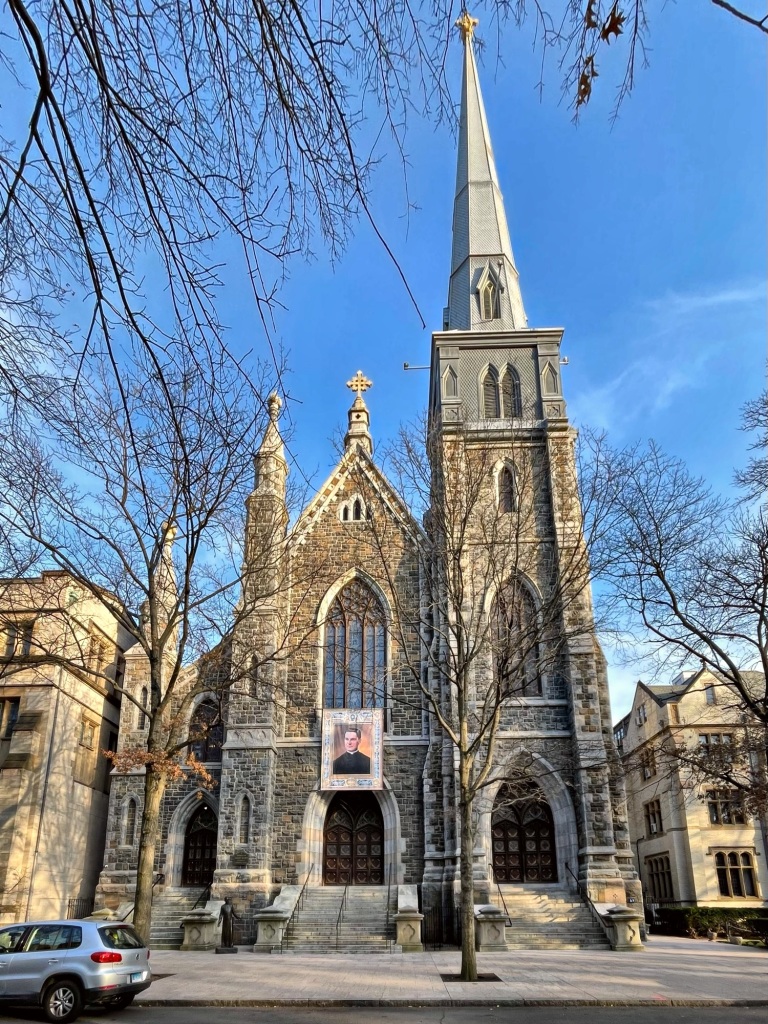
The second oldest Roman Catholic parish in Connecticut can be found in New Haven, at the St. Mary’s Roman Catholic Church. The parish was originally established in 1832, largely by Irish immigrants who settled in the area for work. The current St. Mary’s church building, located on Hillhouse Avenue near Yale University, was designed in 1870 by ecclesiastical architect James Murphy, and it was dedicated in 1874. The construction of a Catholic church on Hillhouse Avenue was strongly opposed by the Protestant elite who lived in the area, but the congregation prevailed. The Victorian Gothic style church is constructed of local blue stone and granite and while plans by Murphy originally included a corner spire for the building, it was not built until 1982 when the building was restored courtesy of the Knights of Columbus. The Knights of Columbus fraternal organization was actually founded in 1882 in New Haven by Father Michael J. McGivney, who originally held meetings in the basement of this church.
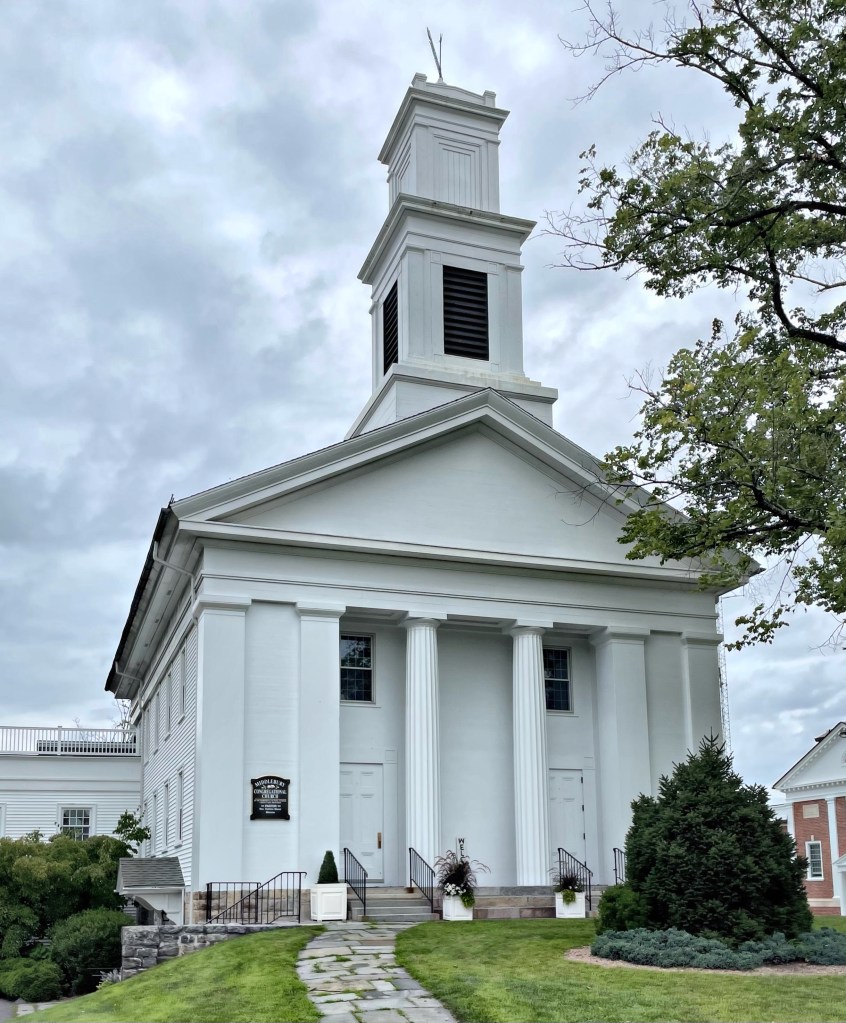
Located next door to the Middlebury Town Hall, the Middlebury Congregational Church has a very similar history to its Classically inspired counterpart. The congregational church here was established in 1791, less than a year after a separate Middlebury ecclesiastical society was granted and the first church here was erected in 1794. Decades later, a more traditional and larger church was desired by the congregation, so they had a Greek Revival style church built in 1839. Nearly 100 years later, the church (and adjacent original town hall building) burned in a large fire in April 1935. Undeterred, the congregation hired architect Elbert G. Richmond, AIA (1886-1965), who as a young man worked in the New Haven office of J. Frederick Kelly, Connecticut’s first and most famous restoration architect. The present building is a near-replica of the mid-19th century church building, and even has a bell that was recast from pieces of the old bell that crashed through the building during the earlier fire. Talk about rebirth!
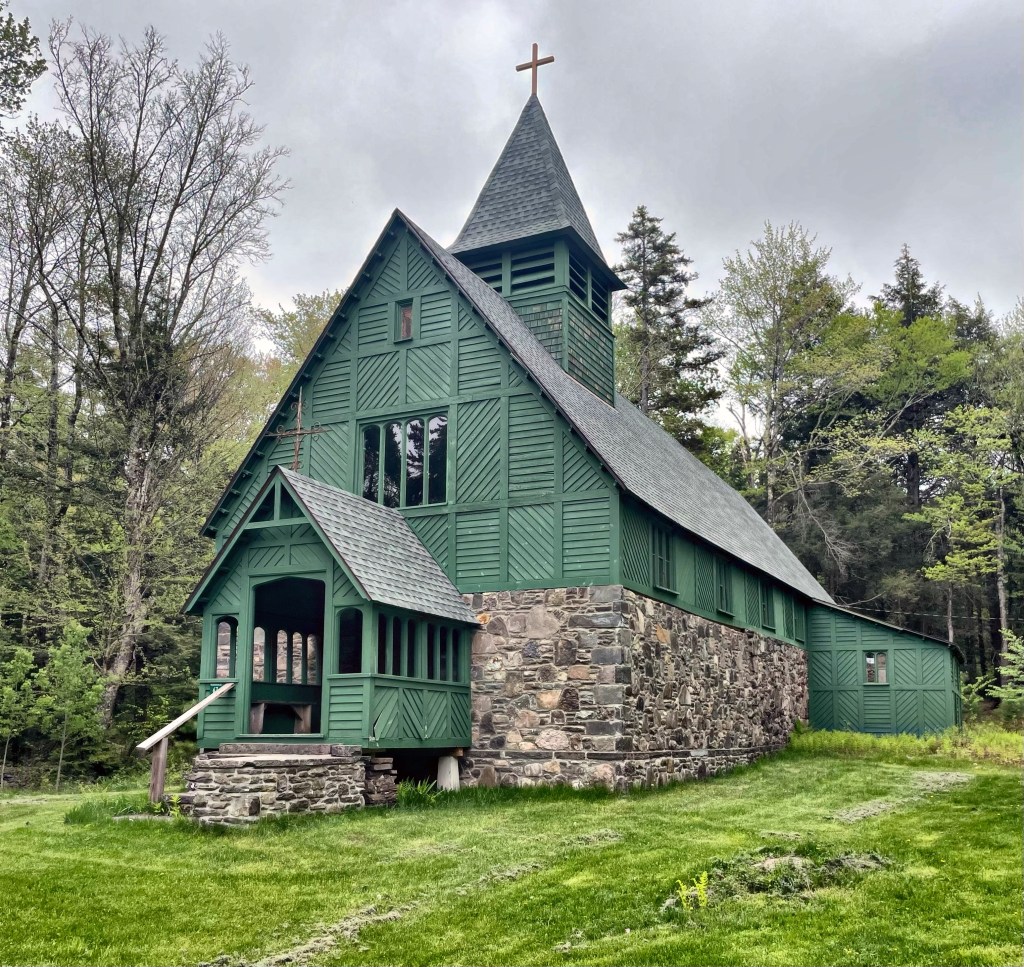
One of the most bucolic and beautiful buildings I have ever seen is this church in the Catskills, just outside of Elka Park, NY. Wow I wish New England could claim this one! The St. John the Evangelist Chapel was developed as part of a smaller enclave of summer cottages for rusticators from the Philadelphia-area, which was largely established by Mr. Alexander Hemsley (1834-1904) a chemist from Philadelphia who would later die from anaccidental chemical explosion at his factory. In 1883, Hemsley sold cottage lots to friends and family to erect summer houses in the Catskills and in 1884, decided to develop a lot for an Episcopal summer chapel. In that same year, Hemsley hired his future son-in-law, William Halsey Wood, to design the chapel. The Stick-style Victorian chapel blends the rustic use of natural materials found on the property with an elegant siting and attention to detail, not typically found in rural chapels. The native stone and stylized half-timbering really stood out to me. The church is used still in the summer with regular services on Sundays in July and August.