Larkin-Ladd House // c.1813

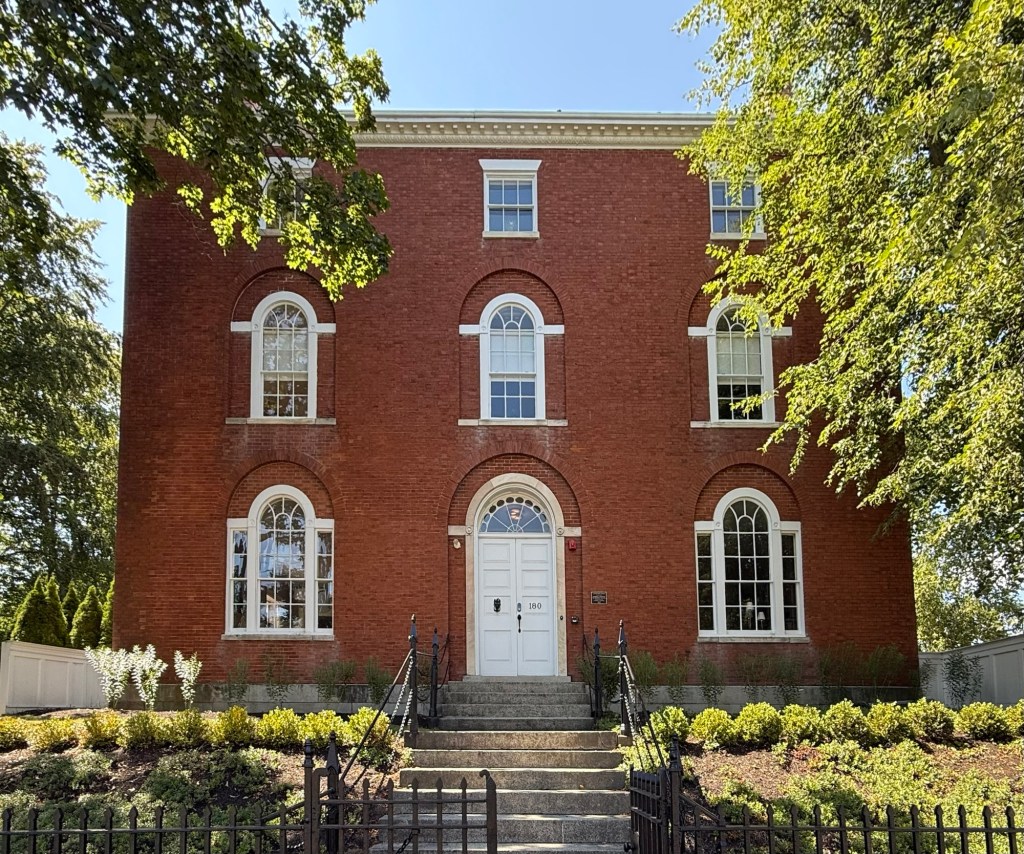
The Larkin-Ladd House at 180 Middle Street in Portsmouth, New Hampshire, is a three-story, masonry Federal-style residence with symmetrical facade, built for one of the city’s wealthiest merchants. Samuel Larkin (1773-1849) was born in Charlestown and moved to Portsmouth, marrying Ann Jaffrey Wentworth, a daughter of Col. Joshua Wentworth. During the War of 1812, Samuel Larkin made his fortune as an auctioneer, selling the contents of English ships captured by local privateers. It is believed that fourteen privateers and their crews worked out of Portsmouth Harbor and are said to have captured an estimated 419 British ships! With the profits from stolen goods from these British ships, Larkin purchased lots on Middle Street and began construction of this stately residence. He (and mostly his wife), had twenty-two children, although roughly half of them died before reaching adulthood. By the late 1820s, financial hardship fell on Larkin and he sold this property, moving into his house next door, which before this was his original residence and later rented to boarders. The Federal style mansion was later owned by Henry H. Ladd, a prosperous Portsmouth shipping merchant, who also served as President of New Hampshire Bank and Portsmouth Savings Bank. The Larkin-Ladd House is undoubtedly one of the finest Federal style residences in New England, and stands out for its entrance, flanked by Palladian windows and the slightly recessed elliptical surrounds at the first and second floor windows. Additionally, the historic stable, also from the 1810s, maintains much of its architectural integrity.
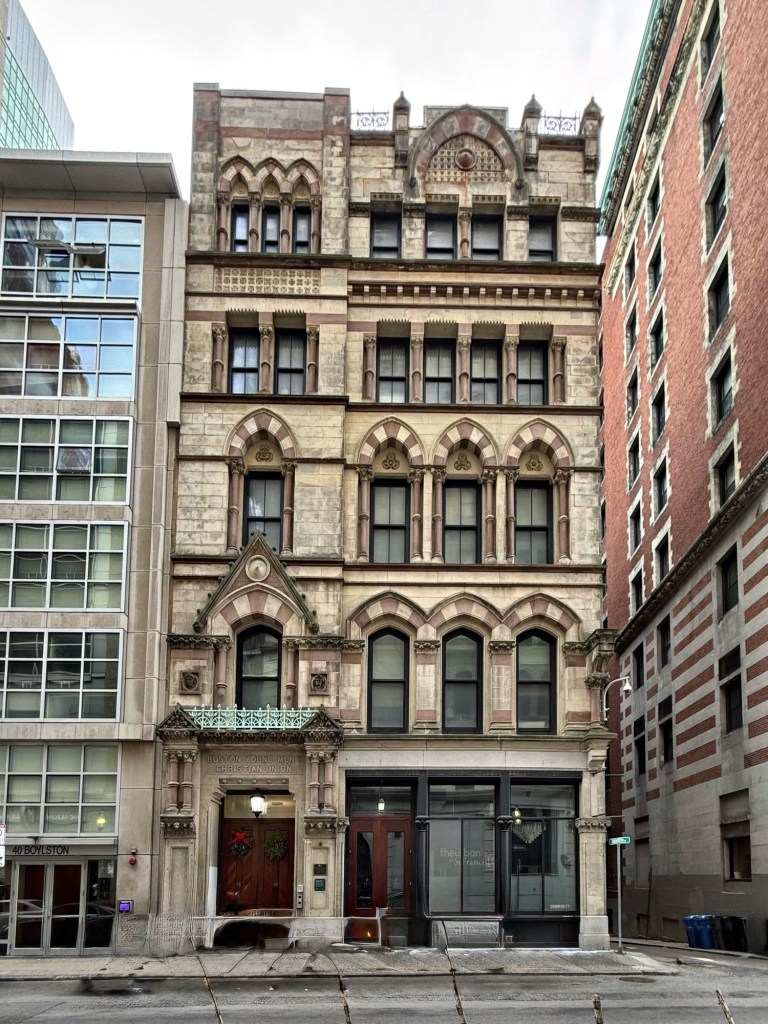
Boston Young Men’s Christian Union Building // 1875

The Boston Young Men’s Christian Union was founded in 1851 by a group of Harvard students as a biblical and christian literature discussion group, which incorporated the following year. First located on School Street, the organization’s activities were to provide a focal point for the intellectual, religious, and social life of primarily middle-class, well-educated Christians. The organization grew to the point that a new building was needed, and in 1873, a site on Boylston Street was acquired as a perfect central location for the group. Architect Nathaniel J. Bradlee of Bradlee and Winslow was hired to design the structure, principally because Mr. Bradlee by then a prominent architect and public figure, was also a life member of the Union and the brother of one of its founders. The building was completed in 1875 and included ground floor retail with an auditorium, gymnasium, library, social and game rooms, and offices for the Union above and behind. Designed in the High Victorian/Ruskinian Gothic style, derived from a mixture of English, Italian, French, and some German Gothic precedents, the style emphasized complicated, asymmetrical massing, polychromy, ornate details, and lancet or Gothic arched openings, in this building a sandstone facade was used. The building became a City of Boston Landmark in 1977. In 2016, the building was converted to an affordable housing development by The Architectural Team Inc., and called “The Union”. The development provides 46 units of affordable housing, including 25 targeted to those who have experienced homelessness. What a great rebirth of the building. Historic Preservation and Affordable Housing can work together and create great projects.

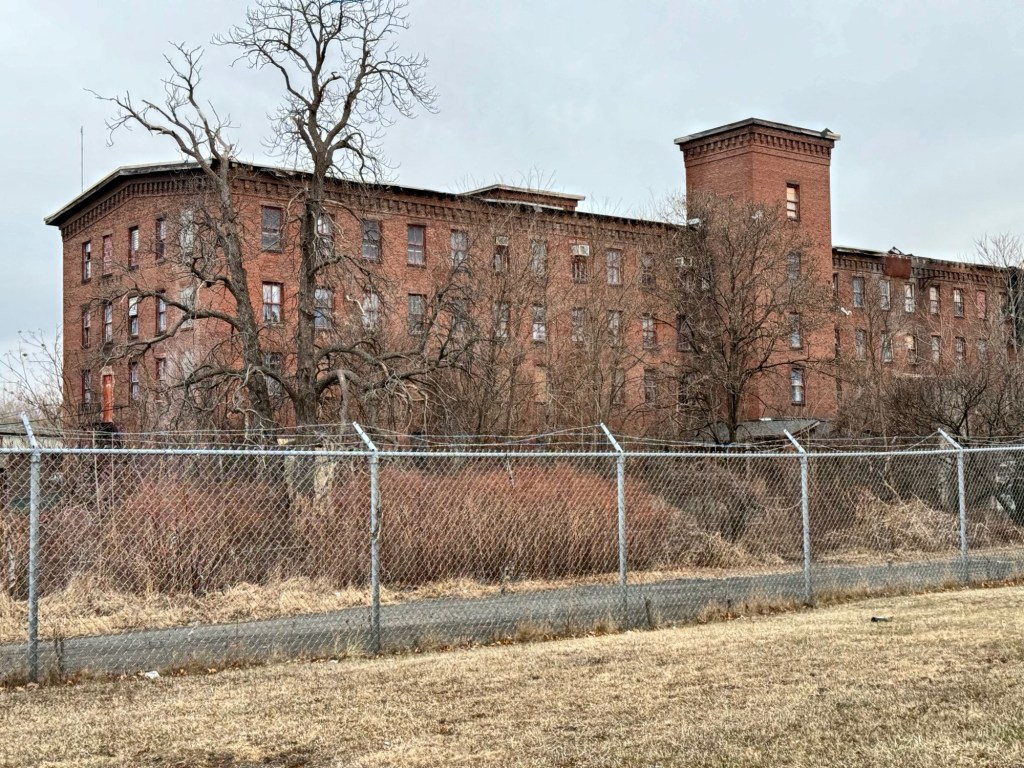
Dwight Manufacturing Company Complex // 1841+

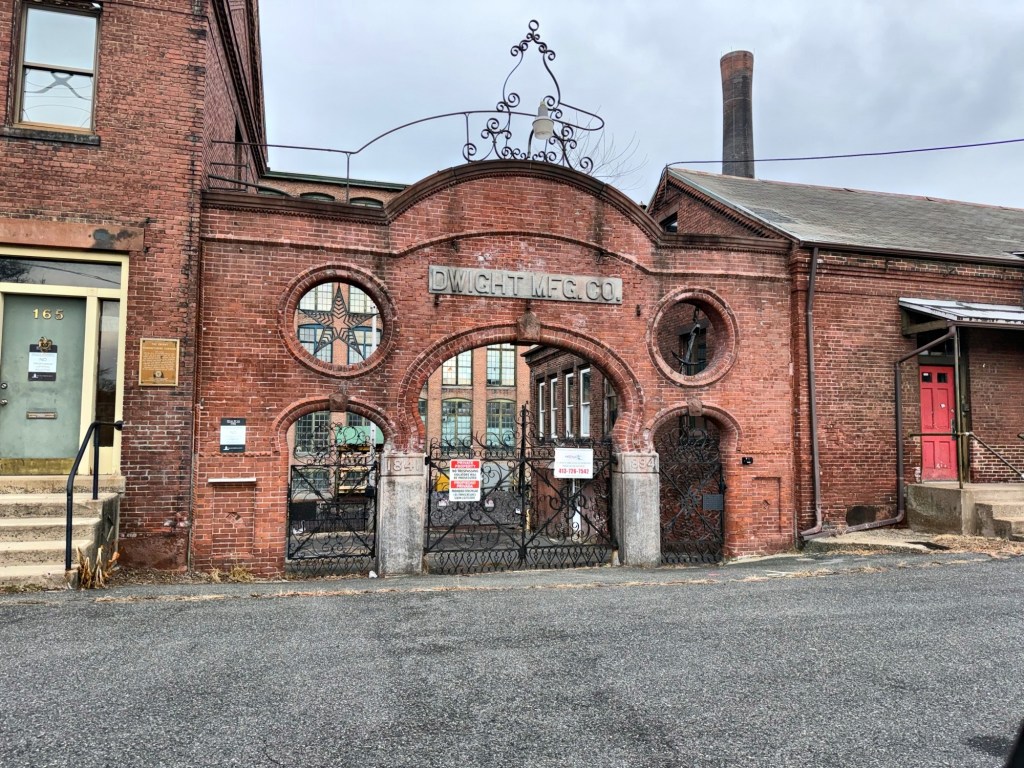
The Dwight Manufacturing Company is named for Edmund Dwight (1780-1849) of Boston, an industrialist who envisioned an industrial town on the Chicopee River. Dwight, having a country home in Chicopee, had begun a venture with his brother, Jonathan, at Chicopee Falls creating the Chicopee Manufacturing Company, to produce cotton cloth. Due to the company’s immediate success, the Dwights along with other investors formed the Springfield Canal Company in 1831, with the goal to create the “new Lowell”, an industrial community in what is now Chicopee Center. In 1856, the Dwight Mills purchased some earlier mill complexes, creating the Dwight Manufacturing Company and consolidating all their cotton cloth manufacturing into one organization. In addition to the mills, the Company also built employee housing
along Depot and Dwight Streets, a stone’s throw from the mills. The creation of employee housing allowed the Company to attract new employees in particular women and children, nearly all immigrants, who could be housed together. My favorite part of the complex is the entrance gate, built in 1894, connecting the Office and Cloth Building. It is amazing to think of all of the people who passed through this portal, working long hours for a better life. Overtime as production methods changed and technology evolved, nearly all the original mills would be replaced or retrofitted. Despite the changes, the Company could not remain profitable and shut down production in 1927 and ultimately selling the land and equipment in 1930. Some smaller manufacturing has since occupied some of these buildings, but they remain largely (if not entirely) vacant, awaiting a new life.

Woodlawn Cemetery Lodge // 1897

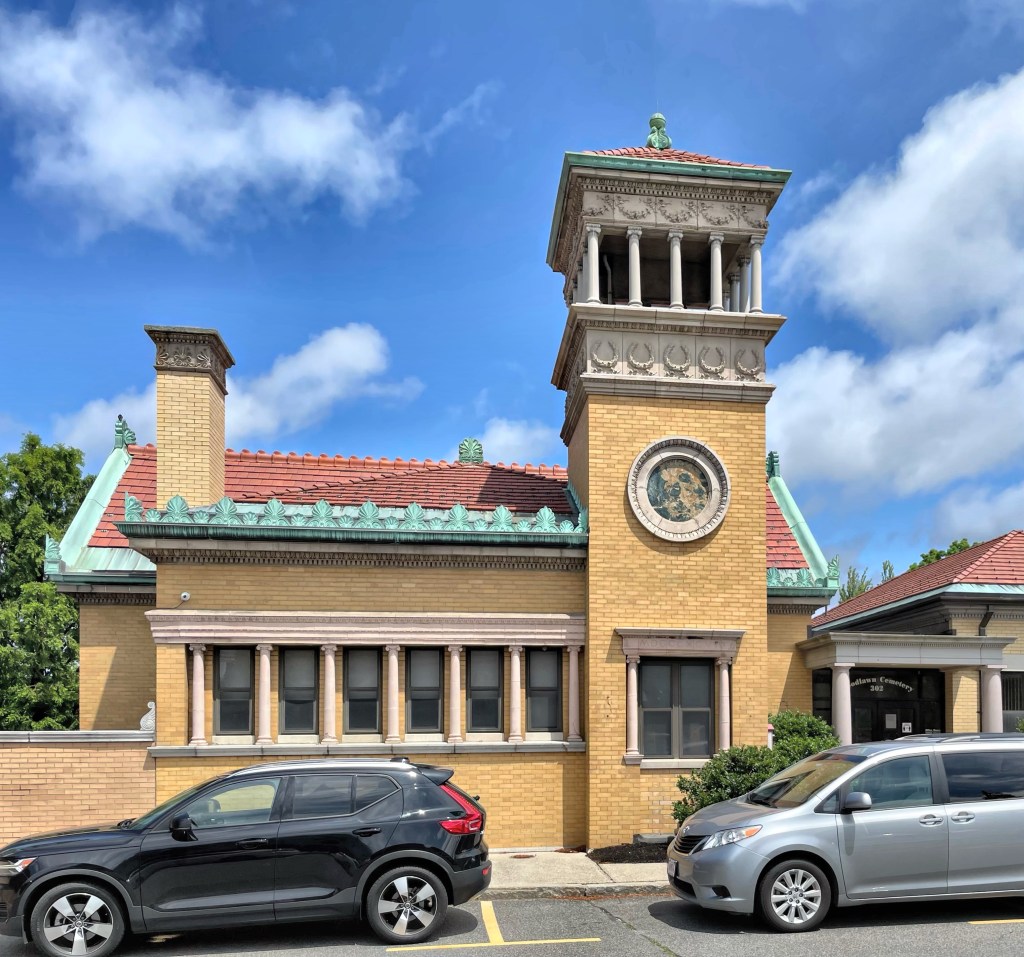
Woodlawn Cemetery in Everett, MA was established in 1850 as a rural, private cemetery in the tradition of Mount Auburn Cemetery in Cambridge. The story of Woodlawn Cemetery began in 1850 when a group of ten prominent Bostonians petitioned the Massachusetts General Court to organize a corporation “for the purpose of procuring, establishing and preparing a cemetery or burial place for the dead in Malden” (present-day Everett was established in 1870 from Malden). Adjacent to the Cemetery Gate and Tower (last post), the Woodlawn Cemetery Lodge replaced an 1850s lodge and office constructed of wood, in the Gothic-style, that was deemed unsatisfactory for later boards managing the cemetery. The group hired Boston architect William Hart Taylor to design the gate and lodge, the latter in the Classical Revival style. The buff brick building features terra-cotta trim and a red tile roof with dentil cornices and copper cresting along the ridges and eaves. The square entry tower has a columned belfry and incorporates additional Classically-inspired features including Ionic columns, moldings, swags, and wreaths, which looks like a Greek Temple plopped onto the top. Gorgeous!

Scott Farm – Cow Barn // 1862

Historic barns really are the most charming buildings, and luckily, Vermont is home to soooo many great examples. The Cow Barn at Scott Farm in Dummerston, VT was built in 1862 and constructed into the slope of the land. The barn has a brick and stone foundation, barn board siding, and a roof sheathed with small dark slate. It is built into the slope of the land and has a single-story shed roof addition (c.1915) off the west facade to give the building a saltbox form, and a single story gable roof milk house addition off the east facade. The rear facade has a more rustic appearance and has a large entrance to the space inside which is occupied by The Stone Trust, with the mission to preserve and advance the art and craft of dry stone walling. The organization holds classes and trainings where people can learn how to build a traditional or modern stone wall and more! The barn (and the rest of the buildings on the Scott Farm property) is owned by the Landmark Trust USA.

Dutton Farmhouse // c.1840

Another one of the Landmark Trust USA properties in Dummerston, Vermont is the Dutton Farmhouse, a meticulously restored Greek Revival farmhouse from around 1840. The gable-roof farmhouse was possibly an addition to an earlier dwelling built decades earlier as a one-and-a-half-story center-chimney home, seen at the rear today. The first known owner of the farmhouse was Asa Dutton who farmed off the large orchards. Generations later, the farmhouse served as a dormitory for migrant laborers who worked nearby, with the interior being altered. The property was eventually gifted to the Landmark Trust USA, who began a massive restoration project on the home, uncovering original detailing and even historic wallpaper! The house has since been meticulously restored and preserved and is available for short-term rentals! The charming interiors and near silence outside is a perfect getaway from city life.

Burbank Homestead // c.1800

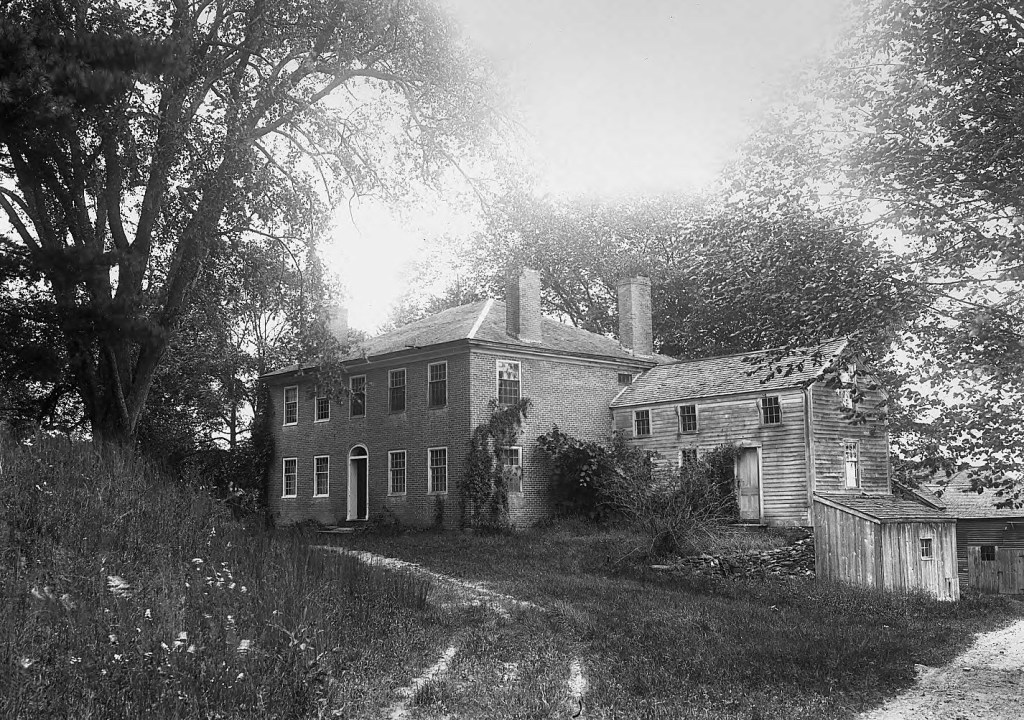
Do you like McDonalds french fries? If you do, you can thank Luther Burbank, who was born in this house!

Image courtesy of Lancaster Historical Society

This Federal style home formerly in Lancaster, MA, was built around 1800 by housewright Simon Willard. The brick farmhouse saw generations of the Burbank Family live, marry, and die here. In 1849, Luther Burbank was born in an upstairs bedroom, as the 13th of 15 children of Samuel Walton Burbank and his three wives (not at the same time). Growing up on the farm, Luther enjoyed the plants in his mother’s large garden. When his father died when he was 18 years old, Burbank used his inheritance to buy a 17-acre plot of land in nearby Lunenburg. There, he developed the Burbank potato. He soon after sold the rights to the Burbank potato for $150 and moved to California, where he spend the remainder of his life. Today, the Russet Burbank potato is the most widely cultivated potato in the United States. The potato is popular because it doesn’t expire as easily as other types of potatoes, and it is the most commonly used potato for McDonalds iconic fries. In his life, Burbank created hundreds of new varieties of fruits (plum, pear, prune, peach, blackberry, raspberry); potato, tomato; ornamental flowers and other plants. He did more than I could possibly list, I highly suggest reading about him online. He was even so inspiring that Frida Kahlo painted Burbank as a tree/human hybrid, sprouting out of his corpse underground (seriously). In the 1930s, Henry Ford came to Lancaster and negotiated with the Dexter family, who then owned the house, to move the wood-frame ell to his museum in Dearborn, Michigan, where it remains to this day. The brick house was demolished by the Federal Government when the nearby U.S. Army Base at Fort Devens was expanded in the site.