The New Ipswich Public Library is a one-story Shingle style building on Main Street in the charming village of New Ipswich, New Hampshire. The library building was likely designed by Ernest M. A. Machado, one of the best, and relatively unknown architects of the late 19th and early 20th century in Salem. The entrance which faces the side, is flanked by two diamond-pane windows, which can also be found on the primary facade. A special ten-light vertical window is recessed within a shingled depression in the gable, which adds some complexity to the design.
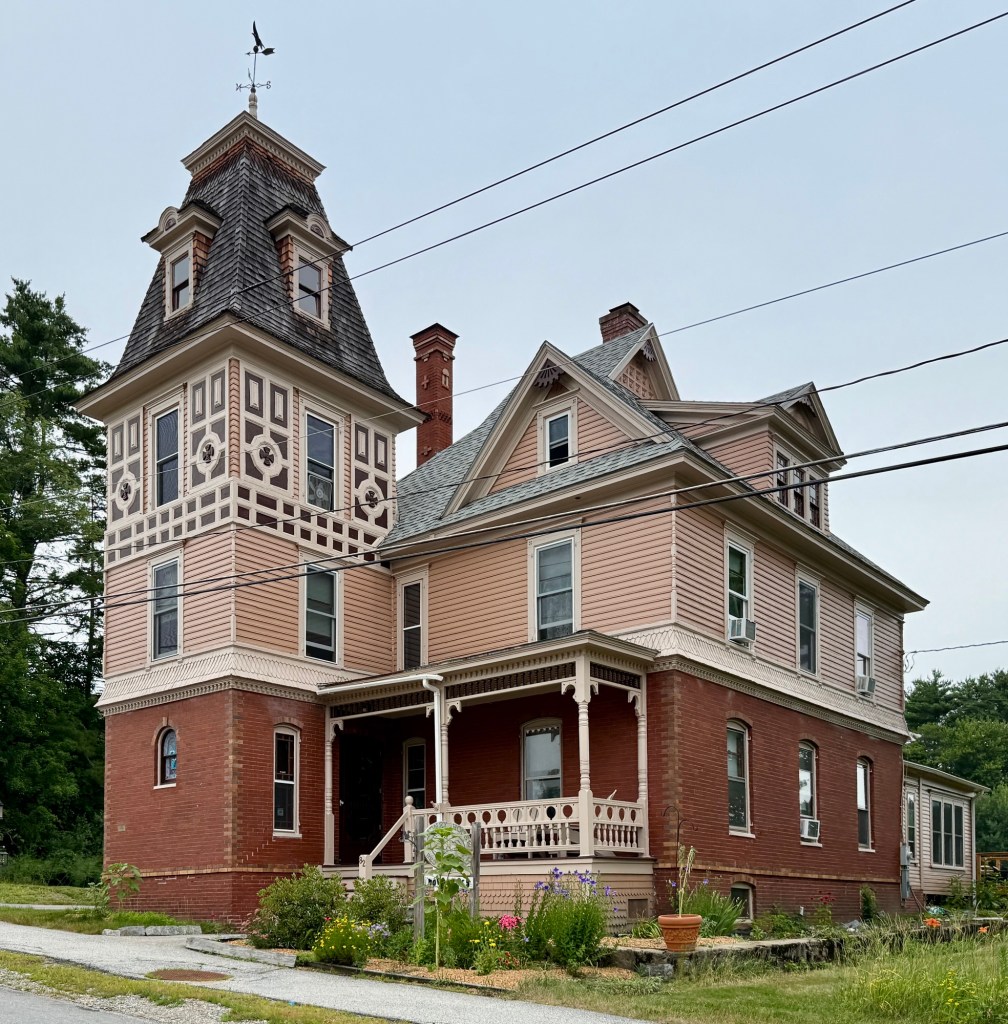
The Samuel Tarbell Ames House is a large, gambrel-roofed house located in New Ipswich, New Hampshire. The residence was built in 1890 for its namesake, Samuel Tarbell Ames (1810-1897), who was eighty years old when it was completed. Mr. Ames was a Boston businessman who summered in New Ipswich, as his wife was Mary Hartwell Barr, a daughter of Dr. James Barr, who lived in town. The house then passed to Samuel’s son, James Barr Ames (1846-1910), who was an Assistant Professor and Dean of the Harvard Law School, who took a great interest in Appleton Academy, serving as Trustee, and his widow donated this house to the Academy in 1912, after his death. The Ames House then served as a boarding house for teachers and students until it reverted to private ownership.
Appleton Academy (aka the New Ipswich Academy) was established in New Ipswich, New Hampshire, in 1789, being the second oldest private academy in the state. The school was named after benefactor Samuel Appleton, the largest early donor, who grew up in town at his father, Isaac Appleton’s homestead. This is the fourth Academy building in New Ipswich. The original 1789 frame building was outgrown and in 1816, it was decided that the academy would be shared with the new town hall building, occupying the second floor. Sharing a prestigious academy building with the town functions was deemed insufficient, and a new prominent site near Appleton Common was acquired, with a new brick academy building constructed there in 1853. The Italianate style structure was funded by the Appleton Family, and was designed by Boston architect, William Washburn. In January 1941, the main Academy building was destroyed by fire. The next year it was rebuilt, closely following the design of the earlier brick structure. The school closed in 1974 and was used by a non-profit and schools until it sold in 2018 and appears to be a residence now.
The Preston-King House of New Ipswich, New Hampshire, is a 2 1/2-story wood frame Georgian house and unique for its asymmetrical six-bay facade. John Preston I (1739-1803) built this house in 1764. Preston was a doctor, a profession followed by his son of the same name. As well as being the town’s leading physician, he was a member of the first Board of Selectmen and a member of the Convention for framing the State Constitution, also holding many local offices. Following his death, the house passed to his youngest daughter Anna, and her husband, Seth King, a manufacturer, in 1808. The house has been restored to its Colonial appearance and makes a statement without the frills and detailing of the Victorian style.
Built on a terraced knoll on Main Street in the enchanting village of New Ipswich, New Hampshire, the Charles Barrett House is a stunning late-Georgian residence that was restored in the 20th century. Charles Barrett (1739-1808) moved to the town from Concord, Massachusetts, and did quite well for himself, as just decades later, he would build his son one of the finest homes in the state, the Barrett House, next door. The house’s current appearance reflects a restoration circa 1960. Like many 18th century houses, it was altered in the 19th century with Victorian-era embellishments, including a Mansard roof, 2/2 sash, and a matching carriage house. Under the direction of Historic New England, the house was returned to its more simple, original, Georgian design.
The Barrett House (also known as Forest Hall) is a Federal style mansion located in New Ipswich, New Hampshire and one of the finest buildings in the entire state. The mansion was built around 1800 by Charles Barrett Sr. for his son Charles Jr. and daughter-in-law Martha Minot as a wedding gift. Its grand scale was encouraged by Martha’s father, who promised to furnish the house in as lavish a manner as Barrett Sr. could build it. The interiors are elegantly furnished, and numerous reception rooms were designed for entertaining in a cosmopolitan manner. An elaborate allée was later added to the landscape, with a flight of stone steps flanked by maples rising up the hillside behind the house and leading to an elegant summerhouse. After Charles and Martha died, the estate remained in the family. However, after the railroad bypassed New Ipswich, the town entered into a decline. Charles Barrett’s descendants stayed on, but today Forest Hall remains essentially a relic of the Federal era. After 1887, the family used the house only in the summer-time. It was donated to Historic New England in 1948. Historic New England has ever-since opened up the property to those who want to see one of the best examples of a rural, Federal style estate in New England and its well preserved interior and grounds.
This house on Main Street in New Ipswich, New Hampshire, was built for Mrs. Dorothy “Dolly” Everett, (1770-1859), a sister of Samuel and Nathan Appleton, who returned to New Ipswich after her husband’s death. Her husband was David Everett (1769-1813), who had been a student at New Ipswich Academy, then attended Dartmouth, after which he studied law and practiced in Boston where he founded the Boston Patriot in 1809, and published works of drama and poetry, as well as political writings and died while on a trip to Ohio. Dolly’s house in New Ipswich is a unique, high-style blending of Federal and Greek Revival styles, with a notable entry with its recessed paneled entry, narrow paneled doorway surround with small corner blocks and paneled door. The wide, molded outer surround with its pateras and corner blocks, faceted tablet over the door and partial sidelights show the influence of architectural plan books of the period. In her will, Dolly Appleton Everett left her home to the local Congregational Church, who used the property as a parsonage into the 20th century. It was purchased in the mid-20th century as a summer residence and has remained a private home ever since.
One of the oldest (if not the oldest) extant houses in Ipswich, New Hampshire is this Colonial home on Appleton Road, which gets its name from the first owner, Isaac Appleton. Deacon Isaac Appleton III (1731-1806) was one of the town’s original settlers who came to New Ipswich from Ipswich, Massachusetts. He held the office of town clerk and of selectman and was a deacon for thirty years. He responded to the call to arms from Concord to fight in the American Revolution. Deacon Isaac Appleton III was the father of Samuel Appleton, a wealthy Boston merchant; and Nathan Appleton, a merchant and politician in Boston and head of the famous Appleton Family which would influence Boston business and politics for generations. Samuel Appleton would fund and establish the Appleton Academy in New Ipswich, the second oldest in New Hampshire after Phillips Exeter Academy. The Isaac Appleton Homestead remains in a great state of preservation and sits just outside the town center.
New Ipswich, New Hampshire, is a town that oozes New England charm! Winding back roads are lined with Colonial-era homes and buildings, lovingly maintained by stewards and neighbors to create the quintessential small town feeling. New Ipswich was granted in 1735 to 60 inhabitants of Ipswich, Massachusetts, where the name is derived, by colonial Governor Jonathan Belcher and the General Court of Massachusetts. European settlement began here in 1738, when Abijah Foster arrived to the area with his wife and infant daughter. At the center of town, a new Town Hall was built in 1817 as a combination town hall and private academy with funds provided by the town government and by the trustees of New Ipswich Academy. The building was constructed under the direction of Deacon Nathaniel Gould, using materials salvaged from a disused meetinghouse of 1770. The arched gable window is reputed to have been taken from the meeting house, as are twisted balusters on the gallery stairway inside. As completed in 1817, the building had a full second floor which provided the academy with a lecture room, a small library, and a laboratory, but that was taken over by 1869 when the Town renovated the building, removing a tower and belfry, and occupied the second floor spaces. The building is still owned by the town, and is used occasionally for civic functions, with town offices in a mundane, newer building a short distance away.
Isaac Lord (1772-1838) was born in Maine, but would spend much of his time transforming the small town of Effingham, New Hampshire. Isaac married the love of his life, Susanna Leavitt in Exeter in 1793 and the couple moved to Effingham, living and working in a tavern he built. Isaac prospered as an innkeeper, merchant, farmer, and entrepreneur, becoming Effingham’s wealthiest citizen, making the village he owned buildings to be called Lord’s Hill in his name. From 1818 to 1822, Isaac and Susanna lived in Portland, but he was ridiculed for “having money but no culture”. Growing tired of the city, he decided to return to Effingham. Mrs. Lord found the village too quiet and longed for the social life to be had in Portland, Maine. To convince his wife to remain with him, Isaac promised her a mansion that rivaled the homes in wealthy seaports like Portland and Portsmouth and began working on his mansion in Effingham in 1822. After years, the massive estate was completed, but Susanna remained in Portland. A heartbroken Isaac moved into the large mansion and continued business until his death in 1838. The Isaac Lord House consists of a three-story main block with a grand cupola on its roof and a three story ell to its rear. Stables and a carriage house are also on the lot today. I would do anything to see the inside of this beauty!
The small town of Effingham, New Hampshire, is the home to the state’s first Normal School. This building was originally constructed in 1819 as a vernacular, Federal period academy for the youth in the rural town of Effingham on land formerly owned by wealthy resident Isaac Lord. A normal school for the training of teachers was established on the school building’s second floor in 1830 with James W. Bradbury, a Bowdoin College graduate, to head it. Bradbury, later a United States Senator, took the position only on condition that it should be for the instruction and training of teachers, a novel idea at the time. The school, like many small academy buildings of the period, eventually closed. The building is now managed by the Effingham Historical Society.
The location of the Effingham meetinghouse in New Hampshire was a controversial question in the 1790’s, with the villages of Lord’s Hill and Drake’s Corner both vying for the town’s most important public building. After several votes and repeals of votes, the Town’s voters in 1798, chose a committee of hopefully disinterested men from other towns and instructed them to settle on the location. The committee recommended Lord’s Hill, and in June, the Town voted to accept that location. The contract for the meetinghouse was awarded to Isaac Lord, a local landowner and operator of a tavern and store, who promptly erected the building the same year. In its original form, the building had the traditional meetinghouse plan, with its main entry in the long southeast side and a belfry at the northeast end. In 1845, the meetinghouse, by then the property of the Congregational Church, was thoroughly remodeled in the Greek Revival style, what we see preserved today.
The Drake Store is a vernacular, early 19th century commercial building located in the center of Effingham, New Hampshire. According to local sources, the building was erected around 1816 by Weare Drake, an original settler of the town at age 78, and his 23-year-old grandson, Thomas Parsons Drake. The store sold provisions and was home to a post office, when Thomas Drake served as the town’s postmaster. Within a few years, the store fell into disuse and the building was fitted up as an academy known as the Carroll Literary Institute. Due to insufficient enrollment, in the 1850’s, it was again occupied as a store by Alexander Mellen Drake (hence the sign) and changed hands several times before being purchased by Grange No. 313 in 1913, operating as a grange hall for local farmers. The building was given by the Grange to the Town in 1994 and purchased from the Town for $1 by the Preservation Society in 2002. The Preservation Society has been restoring the building through capital campaigns and grants and the old store shines once again!
The New England Masonic Charitable Institute building is located in Center Effingham, New Hampshire, and is among the rural town’s most impressive structures. The structure was built in 1858 by the Charter Oak Lodge No. 58 of Free and Accepted Masons as a school to educate orphans of Masonic members, but they also admitted local students. It is the only known school building purposely constructed by Masons in the United States. Classes were conducted from 1861 to roughly 1882 with students boarding with local families. The impressive Italianate style building is dominated by a six-story bell tower supporting an octagonal cupola, and exhibits many architectural details including the corner quoins, paired eave brackets, and dentilled cornice. Charter Oak Lodge No. 58 sold the building to the Town of Effingham in 1891 for one dollar but retained rights to the second floor temple room in perpetuity. The walls and ceilings of the Lodge’s temple space are covered with trompe l’oeil murals attributed to Massachusetts painter Philip A. Butler. Images of classic sculptures, architectural details and Masonic symbols, including the All-Seeing Eye, are incorporated into the paintings. Heavily water-damaged in the late 1980s, they have since been restored. The building remains occupied by the Effingham Public Library, what a library building for a town of just 1,700 residents!
One of the larger homes in Weare, New Hampshire is this sprawling mid-19th century residence, seemingly built around 1850 for Sumner Stanley and his wife, Ruth. Stanley and Ruth (née Dow) acquired land from Ruth’s family and they built their home here. By 1856, Stanley sold a small piece of land to town just to the east of his house for the construction of the North Weare Schoolhouse. The Italianate style house with its Stick style attached barn structure have some amazing detailing!