Atlantic Hall // 1920

Atlantic Hall is one of the most iconic buildings in the well-visited town of Kennebunkport, Maine. The landmark structure was completed in 1920 as a volunteer fire station, by the Atlantic Hose Company. The volunteer fire-fighting company was founded in April 1906, and different members kept different parts of fire fighting equipment in each of their barns without a consolidated station. With the advent of the automobile, the community raised funds and purchased a Chevrolet hose truck, but had no station to put it. Without having the town pitch in money, residents (both permanent and summer “rusticators”) donated funds and a central location in Cape Porpoise was selected as a site for the new station. Construction started on a modest building in 1914, but was halted during WWI. After the war, local resident, Marion Goodall Marland hired the well known firm of Kilham, Hopkins and Greeley to furnish updated designs for the station, in a more elaborate version of the Colonial Revival style, fitting for the charming town. The building opened in 1920 with an engine room at the first floor and a meeting hall on the second floor. It was in 1958 that the Atlantic Hose Company outgrew its station at Atlantic Hall, and a new fire house was built across the street. Atlantic Hall was renovated for library and event use and has remained a significant piece of Cape Porpoise ever since!

New England Masonic Charitable Institute // 1858

The New England Masonic Charitable Institute building is located in Center Effingham, New Hampshire, and is among the rural town’s most impressive structures. The structure was built in 1858 by the Charter Oak Lodge No. 58 of Free and Accepted Masons as a school to educate orphans of Masonic members, but they also admitted local students. It is the only known school building purposely constructed by Masons in the United States. Classes were conducted from 1861 to roughly 1882 with students boarding with local families. The impressive Italianate style building is dominated by a six-story bell tower supporting an octagonal cupola, and exhibits many architectural details including the corner quoins, paired eave brackets, and dentilled cornice. Charter Oak Lodge No. 58 sold the building to the Town of Effingham in 1891 for one dollar but retained rights to the second floor temple room in perpetuity. The walls and ceilings of the Lodge’s temple space are covered with trompe l’oeil murals attributed to Massachusetts painter Philip A. Butler. Images of classic sculptures, architectural details and Masonic symbols, including the All-Seeing Eye, are incorporated into the paintings. Heavily water-damaged in the late 1980s, they have since been restored. The building remains occupied by the Effingham Public Library, what a library building for a town of just 1,700 residents!

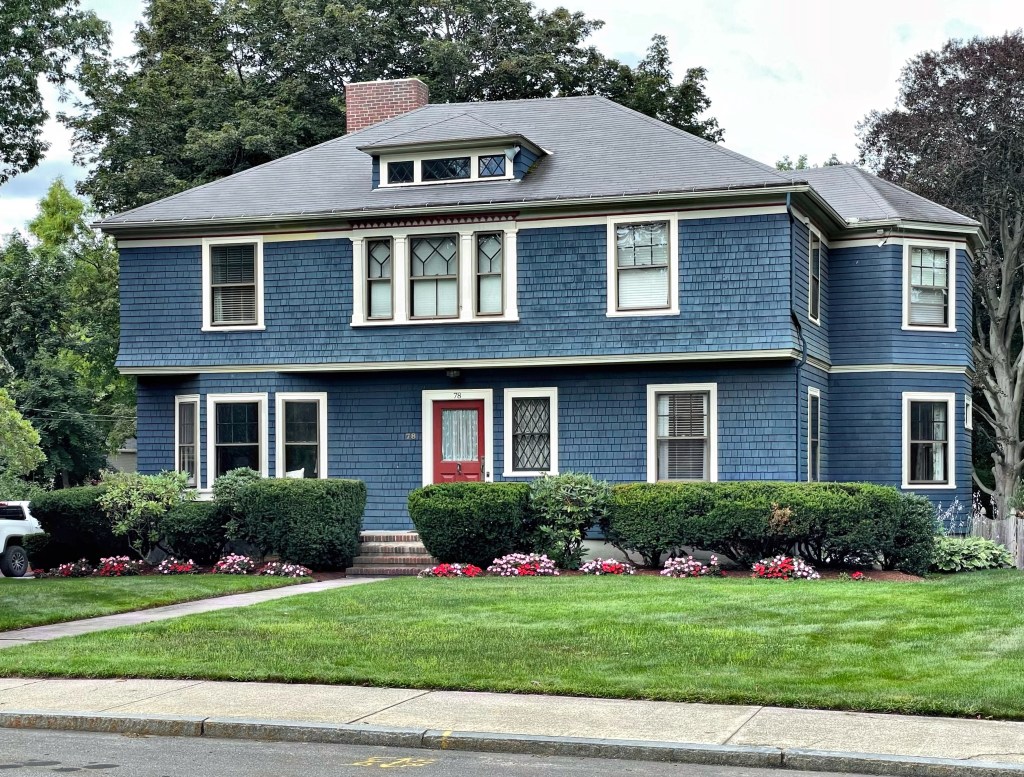
Phinney-Bigelow House // c.1899

Before the turn of the 20th century, William L. and Elizabeth G. Phinney purchased a narrow house lot at the corner of Hawes and Chatham streets in the desirable Longwood neighborhood of Brookline. They then retained the young architect Thomas Marriott James, to design this massive Federal Revival style mansion. After William died in 1911, Elizabeth remained in the house until 1920, when it sold to C. Willard Bigelow a wool dealer and his wife, Ruth. The Phinney-Bigelow House is an exemplary Federal Revival style house on a narrow lot which takes full advantage of its boxy form. The slightly asymmetrical facade with Palladian window, limestone trimmings, and bold entrance are all great additions to the design.

A. M. Donna end House // 1928

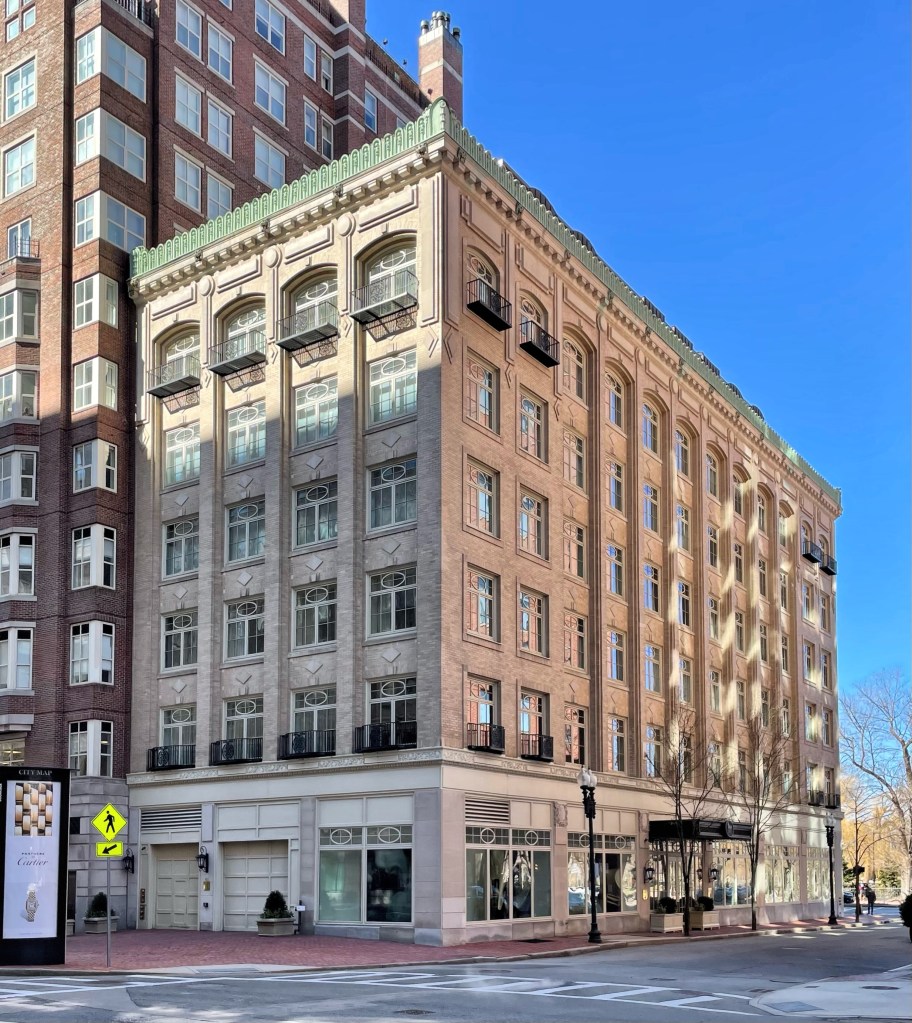
Abraham Malcolm Sonnabend was born in Boston on December 8, 1896, the son of Esther and Joseph Sonnabend. Sonnabend graduated from Harvard College in 1917 in order to enlist at the outbreak of the Great War. At the end of World War I, Sonnabend joined his father’s real estate organization. He married Esther Lewitt in 1920, and by 1927, he had increased his real estate holdings to a net worth of $350,000. Just before the 1929 stock market crash, Sonnabend hired Boston architect Sumner Schein to design this Tudor Revival style home, on a site formerly occupied by a larger Queen Anne style residence. Built in 1928, the Tudor Revival house features clinker brick walls with cast stone trim and a two-story castellated bay all capped by a slate roof. The enterprising A. M. Sonnabend would eventually outgrow this modest Tudor home after he got into hotels as investments. In 1944, Sonnabend (with seven partners) acquired a package of Palm Beach, Florida hotels for $2.4 million including the Biltmore, Whitehall and the Palm Beach Country Club. He would sell the Biltmore to Conrad Hilton for a massive profit. In 1956, Sonnabend created the Hotel Corporation of America (HCA) and grew the business to new heights. The 1928 Sonnabend House is significant architecturally and as the first purpose-built property by the late-developer.

Benjamin Bosworth House // 1800

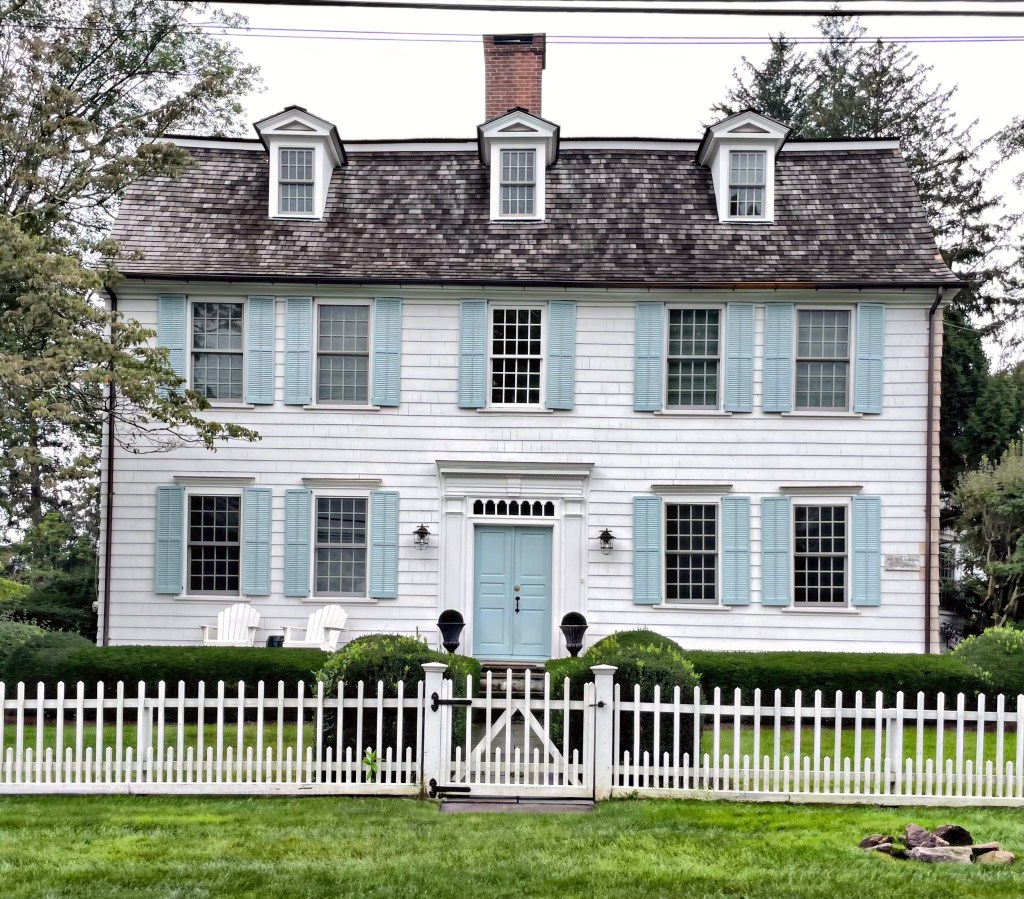
One of the most unique houses in Connecticut is this massive Federal style residence located in the small town of Eastford. Built next to the Congregational Church of Eastford (1829-2023), which burned down in 2023 by arson, the massive house has been known as both the Benjamin Bosworth House and Squire Bosworth’s Castle due to its first owner, Benjamin Bosworth (1762-1850). According to the Bosworth Family, the house was built in 1800 by Bosworth was a wealthy merchant, who hired Vini Goodell, a local carpenter to design and build the large Federal home. The house was completed by 1801 when the local Masonic group met in the building. As Bosworth was also a merchant, he used the basement as a storeroom. The house is also unusual for its monitor roof, a rarity in Federal period construction, which reads like a second structure on the house, due to the building’s size. After Bosworth’s death, the house was occupied by his niece, and was later purchased by Elisha Grant Trowbridge in 1897. Trowbridge was a grand-nephew of General Nathaniel Lyon (1818-1861), a local hero who was the first Union general killed during the Civil War. Trowbridge, an engineer, lived here until he died in 1963 at the age of 96. Later owners have had the monumental task of restoring and maintaining this behemoth of a house, to great success.

Mathewson-Dunn Residence // c.1815

This Federal-style house sits on the heavily trafficked Pompey Hollow Road in the center of Ashford, Connecticut. Early history of the residence is sparse, but by the 1860s, it was the home to Charles Mathewson (1812-1880), who came to Ashford from Woodstock in 1850 and bought a saw and grist mill nearby. The mills were operated here until 1865, when he was succeeded by the firm of Lombard & Mathewson, manufacturers of fertilizers and wholesale dealers in agricultural implements. After successive ownership, the property, which included a 135-acre farm, was purchased by the Catholic Diocese of Hartford in 1921 with the intention of establishing a new parish in the Ashford area. The Diocese assigned Father William J. Dunn, a Connecticut native and son of Irish Immigrants, to this daunting task. Since they had no church building, he partitioned off a section of his own home to serve as a chapel for about 100 worshipers, until the purpose-built St. Philip the Apostle Church was built in the 1930s. The Federal style house here has an elaborated center bay which includes the entrance on the first story and a Palladian window on the second story. The main entrance is flanked by pilasters with Doric capitals which are replicated at the corners of the residence as well.

Stebbins-Tremko House // 1773

Ashford, Connecticut is located in a part of Windham County at the northeast part of the state which is sometimes referred to as the Quiet Corner, due to its limited access to larger cities and more bucolic scenery. Formerly known as New Scituate, Ashford was settled in 1710 and incorporated as a town in October of 1714. One of the town’s early houses is this cape style dwelling, built around 1773 for Thomas Stebbins (1748-1826). By the 20th century, the small house was owned by George Tremko (1907-1981) who worked as the town’s postmaster for some years in the post office just nextdoor. After Tremko’s death, the town acquired the property through eminent domain, with the hopes of redeveloping the prominent site for a new library. Luckily, the local historical society advocated for its preservation, and grants were acquired, which helped to restore the 1770s house.

Bailey Cottage // 1896

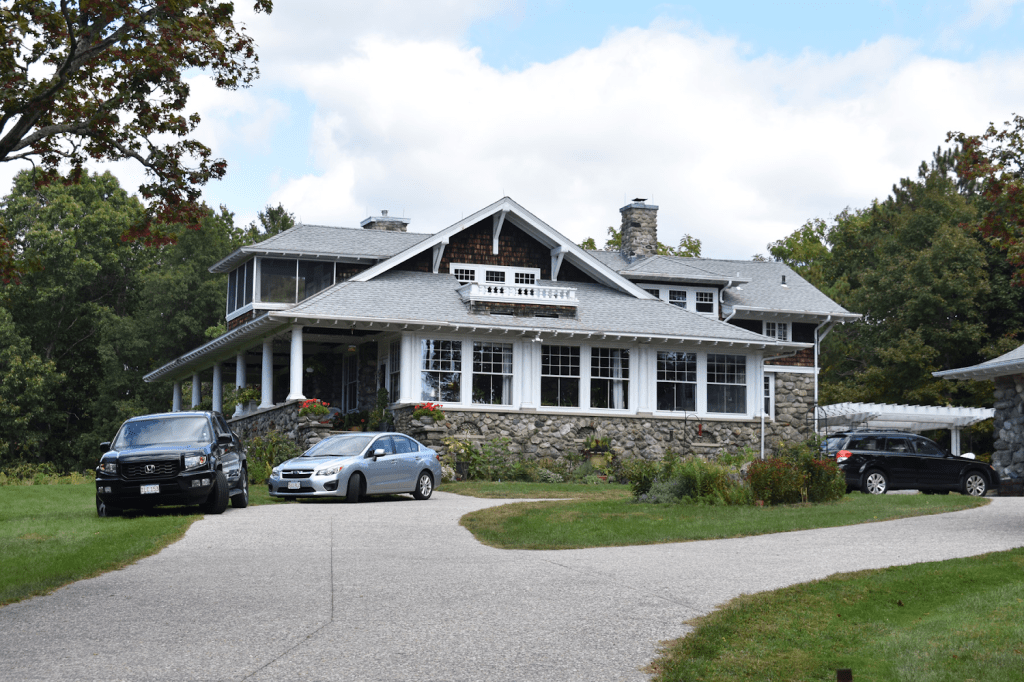
In 1896, Edward L. Bailey, a carpenter and housebuilder, erected this cottage on Haven Avenue in Rockport, Massachusetts. Bailey resided in the house, likely year-round and ran a store on the nearby main street. His cottage served as both a residence and an advertisement for his skilled carpentry, which likely offered him commissions for other cottages nearby. Bailey was also selected as the builder for the town’s Carnegie Library in 1907. The cottage blends Queen Anne and Shingle styles effectively under one roof.

Eben Phillips Cottage // c.1877

In the mid-1800s, Rockport, Massachusetts was best-known as one of the main ports for the quarrying and shipping of fine granite up and down the east coast of the United States. While the rocky coastline made granite a prime industry, the natural scenery also made the coastal areas desirable for residential development. While many of the coastal developments here never took-off as they did in nearby Gloucester, Magnolia, and Beverly, there are some notable summer colonies that sprouted up! In 1855, Eben B. Phillips an oil dealer in Boston, purchased undeveloped wooded lots and pastures, and slowly began to lay out roads and survey for developable lots for summer cottages on a peninsula near Pigeon Cove. The development was named “Oceanview” and it was marketed as the extreme point of Cape Ann. Development was very slow to materialize, and started in earnest in the 1870s. Eben Phillips built this summer cottage before 1877 (possibly as early as 1850), where he would spend summers until his death in 1879. The cottage retains much of its original character and is a rare survivor of the rustic style cottages which were built before the phase of larger Shingle and Queen Anne residences were built in later decades.

Gott House // 1702

Halibut Point State Park in Rockport is one of the most enchanting places in Massachusetts and it has so many layers of history! Before white settlement, Halibut Point was used seasonally by the Pawtucket people who came to harvest its wild fruits, fish and game on the land. In 1702, Samuel Gott (1677-1748) purchased eight of the 6-acre lots on Halibut Point. At the time, there were no roads to Halibut Point, but Samuel built this house on the land, and he began to farm here. The property passed down the family line and was later owned by Joshua (1754-1846), who came of age just as the War for Independence began. Joshua enlisted with the Revolutionary Army as it was being formed in Boston, and in 1776, he joined General Washington’s forces in the unsuccessful defense of New York. He returned home to lead a long and useful life as farmer and fisherman and was known as Captain Gott. As of the 2010s, the property remained in the same family, handed down through the generations from Samuel Gott over 320 years to today. How cool!