In 1896, Edward L. Bailey, a carpenter and housebuilder, erected this cottage on Haven Avenue in Rockport, Massachusetts. Bailey resided in the house, likely year-round and ran a store on the nearby main street. His cottage served as both a residence and an advertisement for his skilled carpentry, which likely offered him commissions for other cottages nearby. Bailey was also selected as the builder for the town’s Carnegie Library in 1907. The cottage blends Queen Anne and Shingle styles effectively under one roof.
In the mid-1800s, Rockport, Massachusetts was best-known as one of the main ports for the quarrying and shipping of fine granite up and down the east coast of the United States. While the rocky coastline made granite a prime industry, the natural scenery also made the coastal areas desirable for residential development. While many of the coastal developments here never took-off as they did in nearby Gloucester, Magnolia, and Beverly, there are some notable summer colonies that sprouted up! In 1855, Eben B. Phillips an oil dealer in Boston, purchased undeveloped wooded lots and pastures, and slowly began to lay out roads and survey for developable lots for summer cottages on a peninsula near Pigeon Cove. The development was named “Oceanview” and it was marketed as the extreme point of Cape Ann. Development was very slow to materialize, and started in earnest in the 1870s. Eben Phillips built this summer cottage before 1877 (possibly as early as 1850), where he would spend summers until his death in 1879. The cottage retains much of its original character and is a rare survivor of the rustic style cottages which were built before the phase of larger Shingle and Queen Anne residences were built in later decades.
Halibut Point State Park in Rockport is one of the most enchanting places in Massachusetts and it has so many layers of history! Before white settlement, Halibut Point was used seasonally by the Pawtucket people who came to harvest its wild fruits, fish and game on the land. In 1702, Samuel Gott (1677-1748) purchased eight of the 6-acre lots on Halibut Point. At the time, there were no roads to Halibut Point, but Samuel built this house on the land, and he began to farm here. The property passed down the family line and was later owned by Joshua (1754-1846), who came of age just as the War for Independence began. Joshua enlisted with the Revolutionary Army as it was being formed in Boston, and in 1776, he joined General Washington’s forces in the unsuccessful defense of New York. He returned home to lead a long and useful life as farmer and fisherman and was known as Captain Gott. As of the 2010s, the property remained in the same family, handed down through the generations from Samuel Gott over 320 years to today. How cool!
This charming commercial store was built in 1879 as one of five similar commercial buildings constructed on Nantucket as investment properties by Robert McCleave (1809-1878), a retired whaling captain. Located on Orange Street, this store was long occupied as a neighborhood grocery store, before the days of supermarkets with seas of parking. Antoine Sylvia Jr. (1835-1906), an Azorian-born merchant on the island purchased the property 1879 from McCleave and operated a grocery store at this location until his death in 1906. His wife, Elizabeth C. “Lizzie” Sylvia (1850-1929), retained the property and operated a shop where she sold wallpaper. In 2015-16, the façade was restored with the installation of a salvaged façade of nearly identical detail and dimensions built at 106 Main Street in 1869 also by McCleave. This façade was salvaged for re-installation here when that building was demolished in 2001. The Sylvia Store was given a preservation easement after the restoration, preserving it for another 150+ years to come!
Once located at the entrance to the Hutchings-Pfaff Mansion, this small stone gatehouse is all that remains of a great Roxbury estate. Built of locally quarried Roxbury Puddingstone decades after the main house was completed, the Victorian Gothic style cottage surprisingly survived the subdividing of the large property and was sold as a private home in the early 20th century. It is uncommon to see these types of outbuildings survive into the 21st century, so I hope to see this charming cottage survive another 150 years!
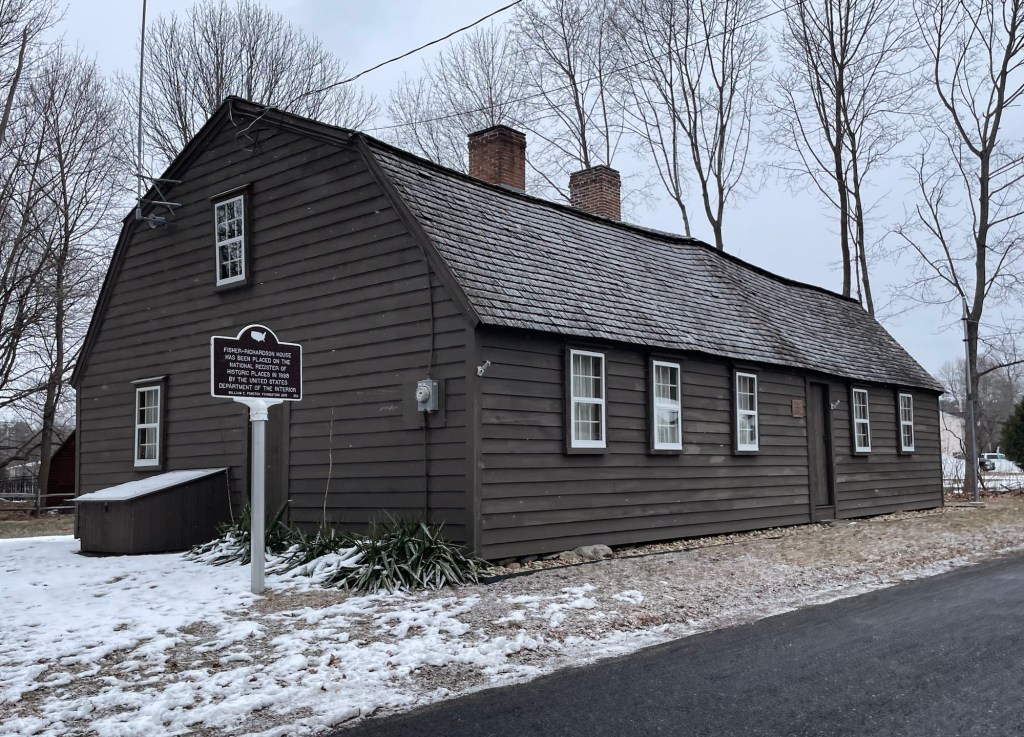
The Fisher-Richardson House in Mansfield, Massachusetts is considered to be one of the oldest buildings in the suburban town. The home dates to sometime between 1743 and 1751 and was built for its original owner Ebenezer Wellman (1720-1776). The property was eventually owned by Lemuel Fisher, who in about 1800, doubled the size of the house adding its western half. When Lemuel died in 1820, the property was inherited by his youngest son, Daniel, a farmer and blacksmith who also built a gristmill nearby. The home was later inherited by Daniel’s daughter, Evelina and her husband, Captain Ira Richardson. By 1930, the gambrel-roofed Georgian house was in disrepair, and the owner at the time contacted SPNEA (now Historic New England) who drafted an agreement to acquire and restore the house. However, as local interest in the property increased, the owner deeded the property to the town, and the town took on the costs of restoration. The property is now managed by the Mansfield Historical Society.
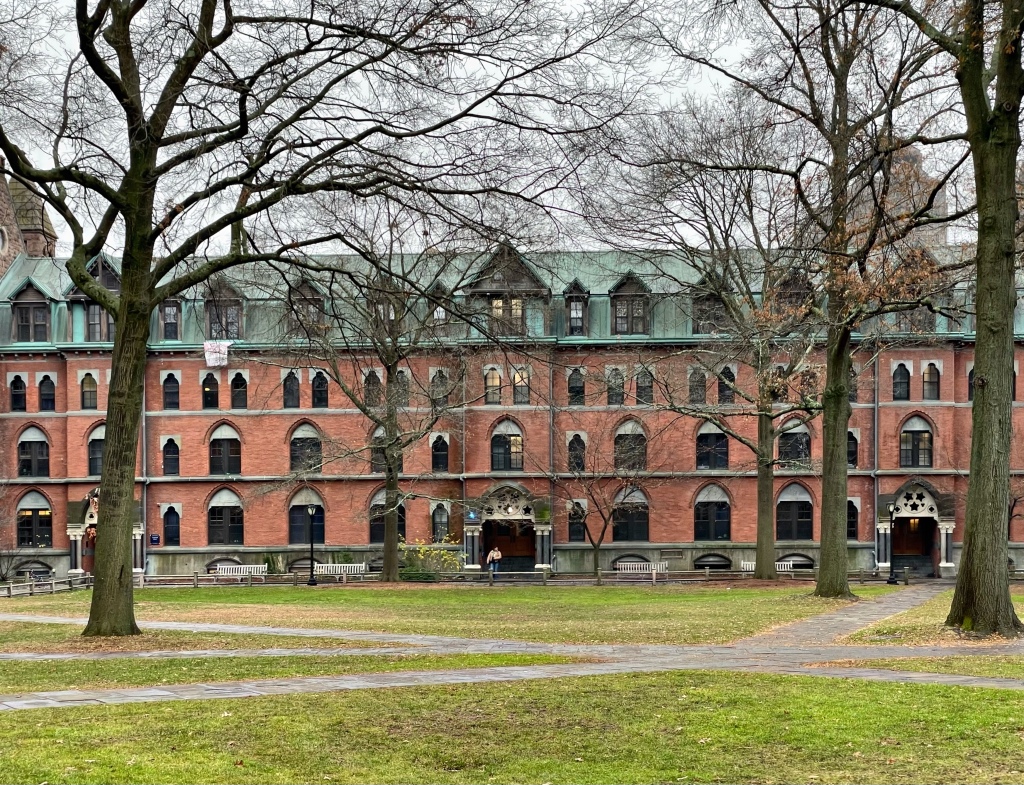
Farnam Hall is Yale University’s oldest dormitory still in use. Designed by New York architect Russell Sturgis in a Ruskinian High Victorian Gothic style, Farnam Hall is considered Sturgis’s most important work and was completed in 1871, marking a new direction toward an enclosed campus, shielded off from the surrounding downtown district of New Haven. Named for Henry Farnam, its construction required the removal of the Second President’s House and a section of the Yale Fence, which was met with some trepidation. The red brick, four-story building originally consisted of twenty suites and ten common rooms on each floor. Sturgis, who was influenced by John Ruskin’s ideals put forward in his Seven Lamps of Architecture, used a variety of brick and stone on the facade all with hand carved detailing. Farnam Hall was renovated in 1977 by architect Edward Larrabee Barnes and today serves as a dormitory for first-year students belonging to Yale’s Jonathan Edwards College.
As Yale’s 1842 Old Library was outgrown by larger class sizes and a growing college library collection, overseers began planning for a new library annex which could support the programming. Architect J. Cleaveland Cady was commissioned to design the Chittenden Memorial Library, this underappreciated structure, which is today hemmed into a cramped space in the yard between a later addition (Linsly Hall) and McClennan Hall. The Chittenden Memorial Library was a gift to the college by U.S. Representative Simeon Baldwin Chittenden in memory of his only daughter, Mary Chittenden Lusk (1840-1871) nearly two decades following her untimely death. The handsome Richardsonian Romanesque style library building also retains its original stained glass window titled, “Education” by Louis Tiffany which today is in the building’s former reading room, now a large classroom. When the library moved to a new building in the 1930s, Chittenden Memorial Library became Chittenden Hall and is classroom space.
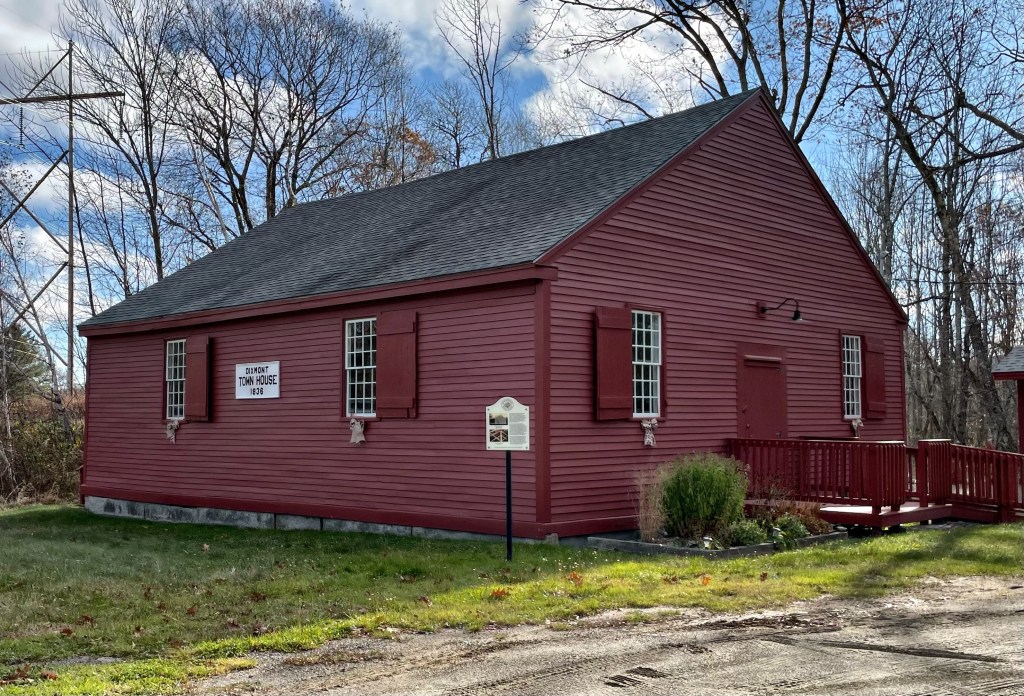
Dixmont, a small rural town in central Maine was originally originally a land grant by the Commonwealth of Massachusetts (of which Maine was then a part) to Bowdoin College, which sold the first settlers their land for profit to build on their campus. As a result, the town was originally called “Collegetown”, which was obviously short-lived. Dr. Elijah Dix (1747-1809) of Boston, who never lived there but took an interest in its settlement, encouraged others to settle there, and when the town was officially incorporated in 1807, it named itself after Dix, as Dixmont. A “malignant fever” broke out among the settlers in the early years, also killing Elijah Dix while in Dixmont on a trip there in 1809, he was buried in the Dixmont Corner Cemetery. Elijah was the grandfather of reformer and nurse Dorothea Dix. The early settlers had this Town House built in the center of the township around 1836 as a vernacular structure. The building (like many early town houses) was used for both secular and religious purposes. This small structure is one of the oldest surviving town houses in the state and served as the town government center until 1952 when it hosted its last town meeting. It was restored in the early 2000s and looks great!
Dixmont, a small rural town in central Maine was originally originally a land grant by the Commonwealth of Massachusetts (of which Maine was then a part) to Bowdoin College, which sold the first settlers their land for profit to build on their campus. As a result, the town was originally called “Collegetown”, which was obviously short-lived. Dr. Elijah Dix (1747-1809) of Boston, who never lived there but took an interest in its settlement, encouraged others to settle there, and when the town was officially incorporated in 1807, it named itself after Dix, as Dixmont. A “malignant fever” broke out among the settlers in the early years, also killing Elijah Dix while in Dixmont on a trip there in 1809, he was buried in the Dixmont Corner Cemetery. Elijah was the grandfather of reformer and nurse Dorothea Dix. The early settlers had this church built by 1834 by Rowland Tyler, a local master builder whose only other documented work is the 1812 City Hall of Bangor. The Dixmont Corner Church is one of Penobscot County’s oldest Gothic churches and also exhibits some Greek/Classical elements.
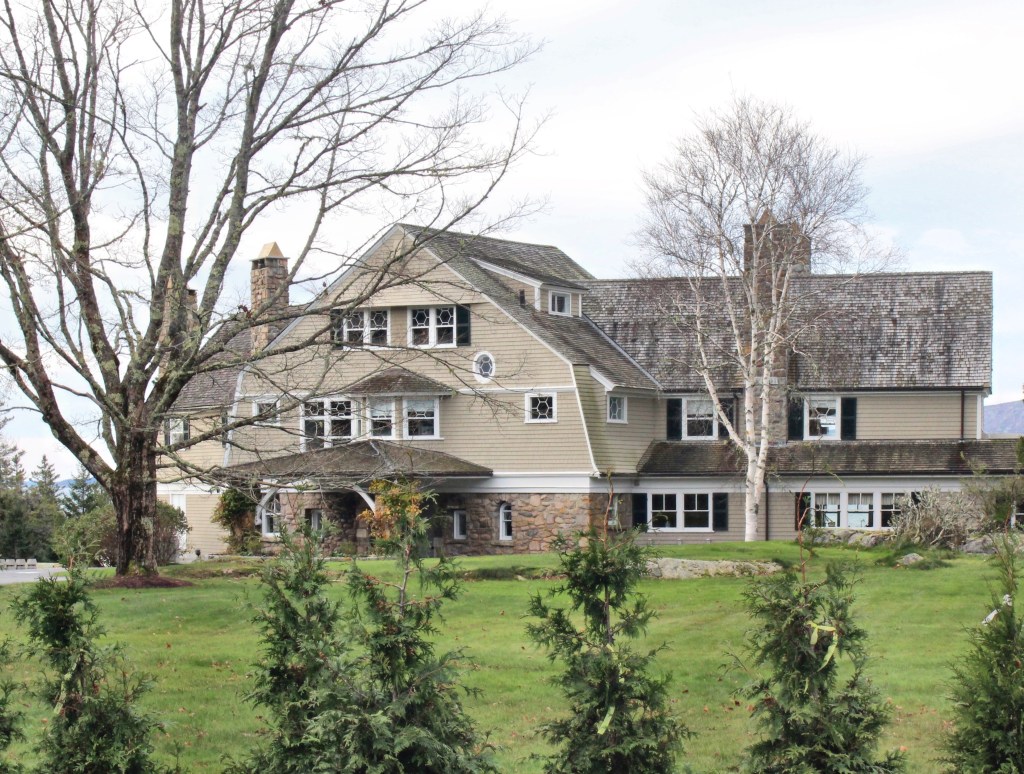
One of the two largest summer “cottages” on Grindstone Neck, Winter Harbor, Maine is this massive Shingled mansion overlooking Frenchman’s Bay. Due to its scale and design, the house possibly replaced a more modest cottage in the early 20th century. The “cottage” was owned by Samuel Price Wetherill, a Philadelphia-based manufacturer and businessman. Wetherill spent most of his time at a Rittenhouse Square Beaux Arts mansion in Philadelphia, which after his death, was purchased by the Philadelphia Art Alliance. The Wetherills hosted lavish events in the mansion and clearly wanted to make a statement with their summer home, which rivals almost any “cottage” in the more prestigious Bar Harbor over the bay.
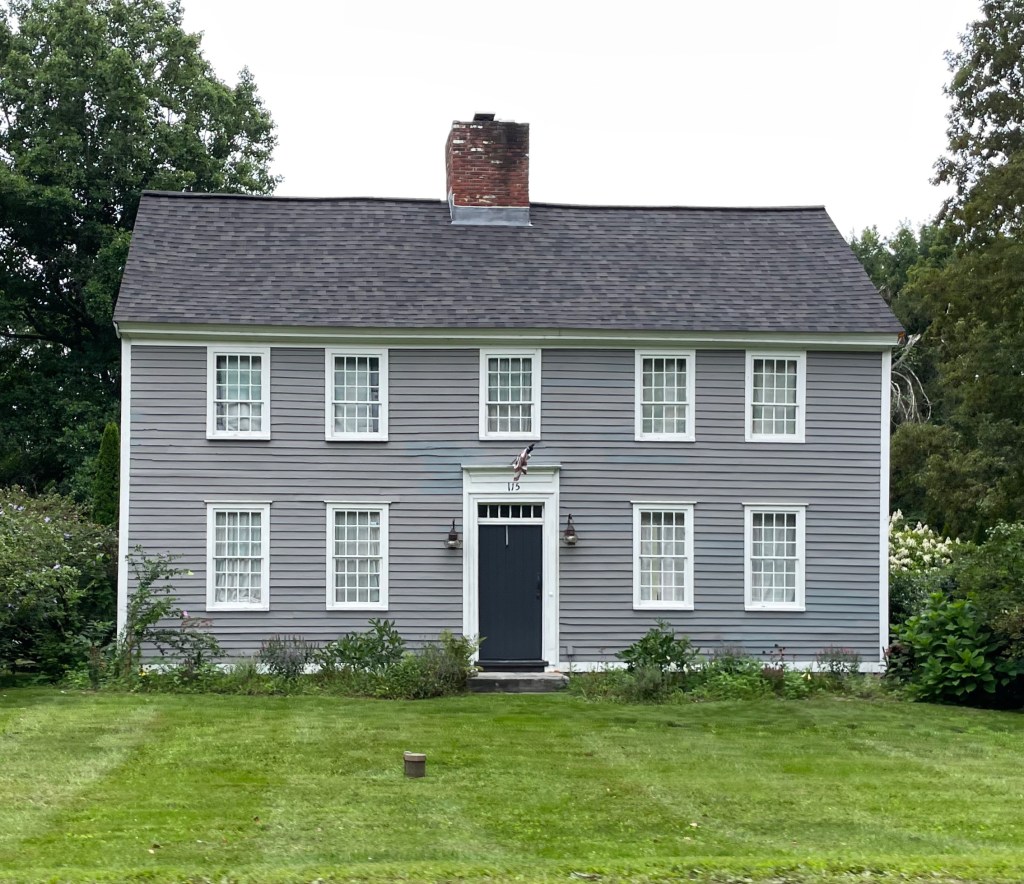
Less is definitely more when it comes to old Colonial houses! One of several pre-Revolutionary buildings in the South Britain Historic District is this residence, which was the home of South Britain’s first physician, Dr. Wheeler, in around 1750. From 1807-1822 the property was owned by Rev. Bennett Tyler, who would later become the fifth President of Dartmouth College. The house is a classic 18th century homestead of wood-frame construction with a side gable-roof, symmetrical five-bay façade, simple paneled entry door with a rectangular transom, and a central chimney. This is a beauty!
Built for Revolutionary War veteran and local lawyer Benjamin Stiles, this stunning Georgian mansion is unique for its use of brick in construction, a material not too common for some of Southbury’s earliest homes. Local tradition holds that a French engineer in General Rochambeau’s army provided assistance in designing the building, using the metric system, likely on the march from Newport to Yorktown. Benjamin’s father was one of the original settlers who migrated from present-day Stratford to the un-developed Southbury. The hip-on-hip roof with pedimented dormers is really a stunner, and unique for the town!
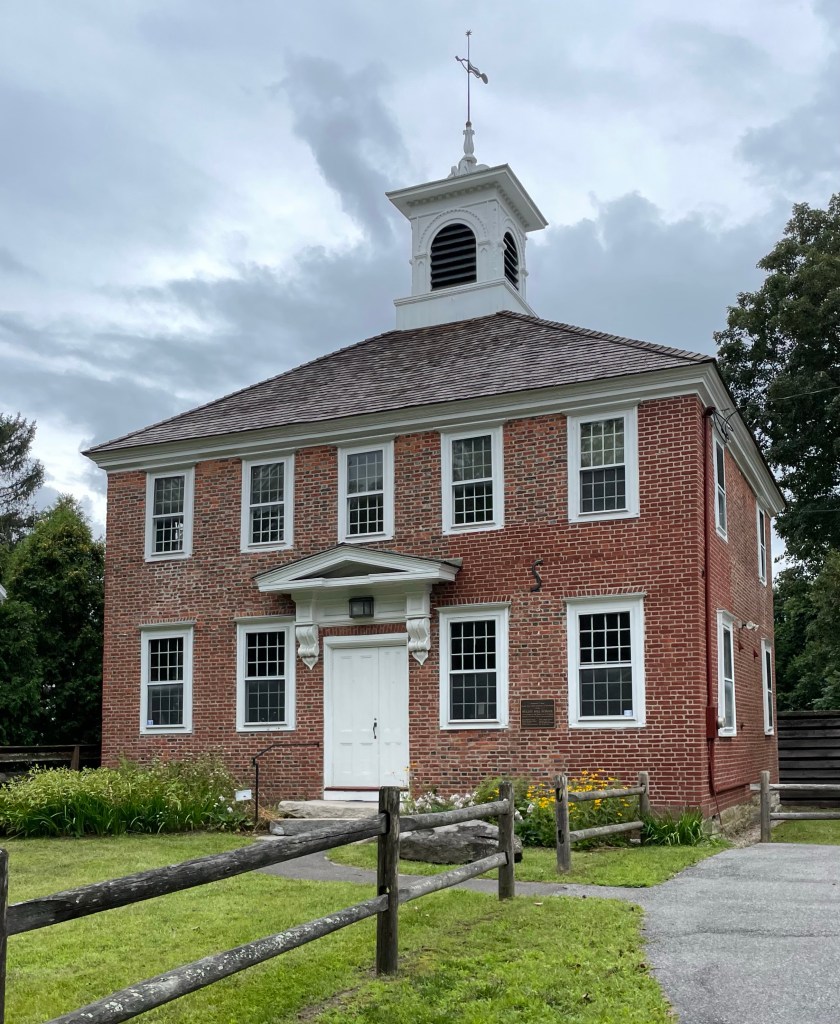
The Bullet Hill School, formerly known as the Brick School, is the oldest public building in Southbury, Connecticut and one of the oldest schoolhouses in America. Originally built in 1762 of locally made bricks, the two-story structure is a well-preserved example of a Colonial-era school building. Some sources date the building to 1790. The building remained in operation as a school for 179 years until December 1941 when the new Southbury Consolidated School, now Gainfield Elementary School, opened in January 1942. The Bullet Hill school is distinguished by its near-square proportions, locally made bricks laid up in Flemish bond, generous window sizes, and a hipped roof. The original cupola, now replaced, served as the model for Southbury’s 1977 Town Hall and other public buildings in town. Today, the former schoolhouse is maintained by the town and operated by the Historical Society as a living museum that is open for class visits and tours.
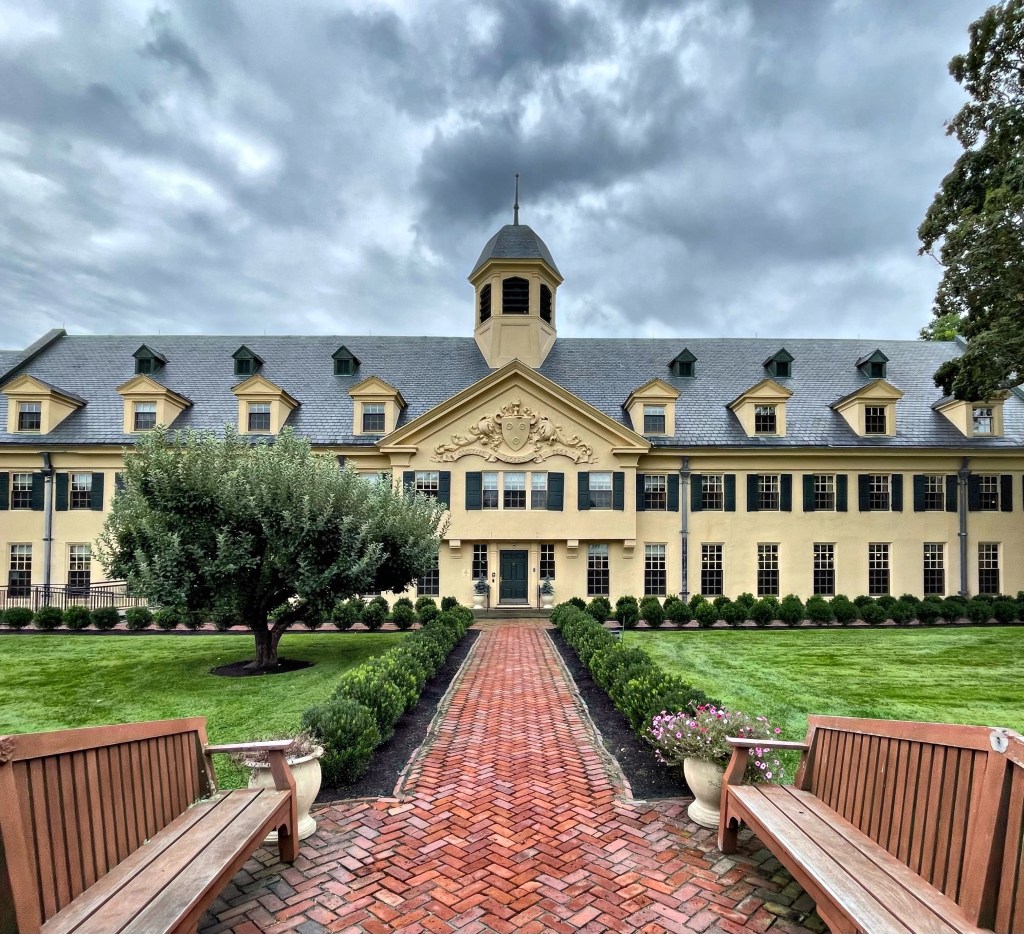
At the heart of the rural community of Middlebury, comprised largely of Connecticut farmers, far from the hustle and bustle of the world, Mary Robbins Hillard (1862-1932) sought to create a girls school to “provide young women with a liberal education in a community which would contribute to the development of their character, independence and sense of responsibility.” To accomplish this, they needed a school, and Mary hired her good friend (and architect) Theodate Pope Riddle to design the private girl’s school campus and main buildings on a site fronting the town green. The school opened in 1909 with125 pupils, slightly over capacity. For the design Theodate Pope Riddle – who was one of the first American women architects and a survivor of the sinking of the RMS Lusitania – took inspiration from English Arts and Crafts and historical precedence in English schools with large open courtyard plans. Originally finished in a gray stucco, the building enclosed a quadrangle at the rear. Inside, administration offices, reception rooms, living rooms, a library, gymnasium, chapel, dining rooms, infirmary, and (of course) classrooms lined the interiors on a closed loop to allow students and teachers access to all parts of the building without ever stepping outside in the cold New England winters. The Westover School remains active and one of the highest ranked private schools in the area today, and with a more cheery yellow coat!