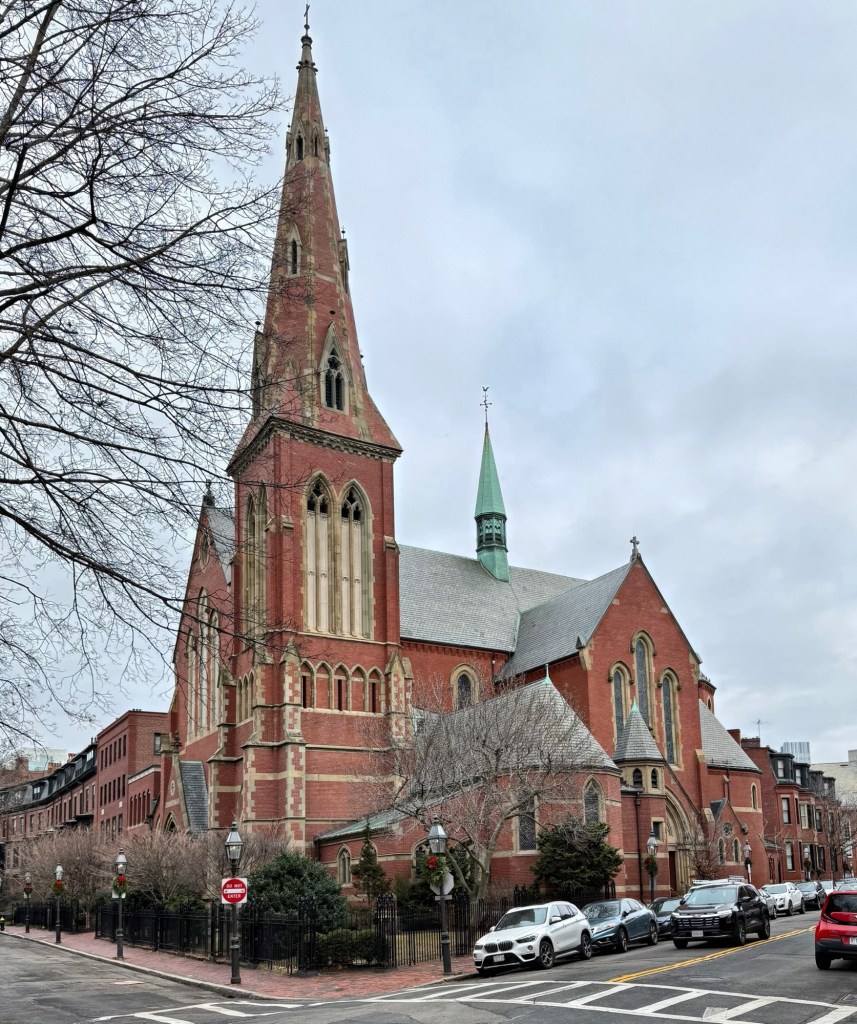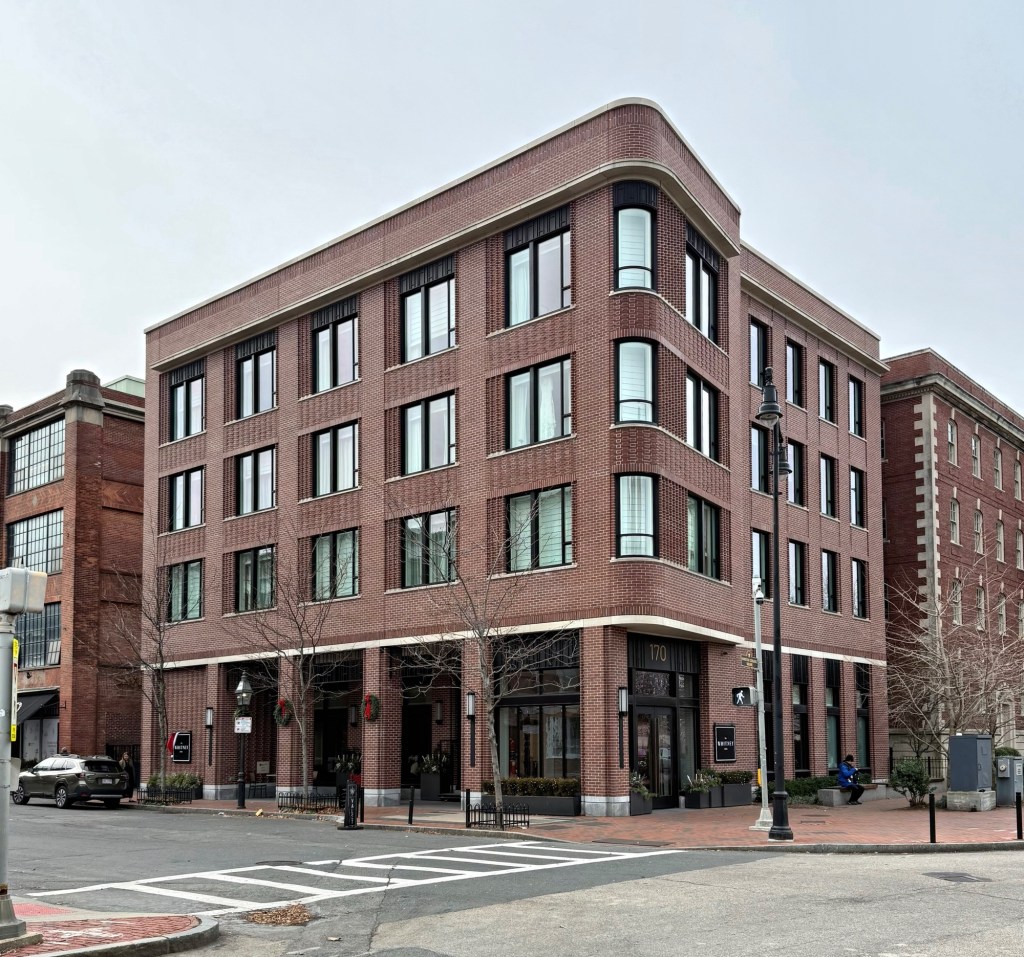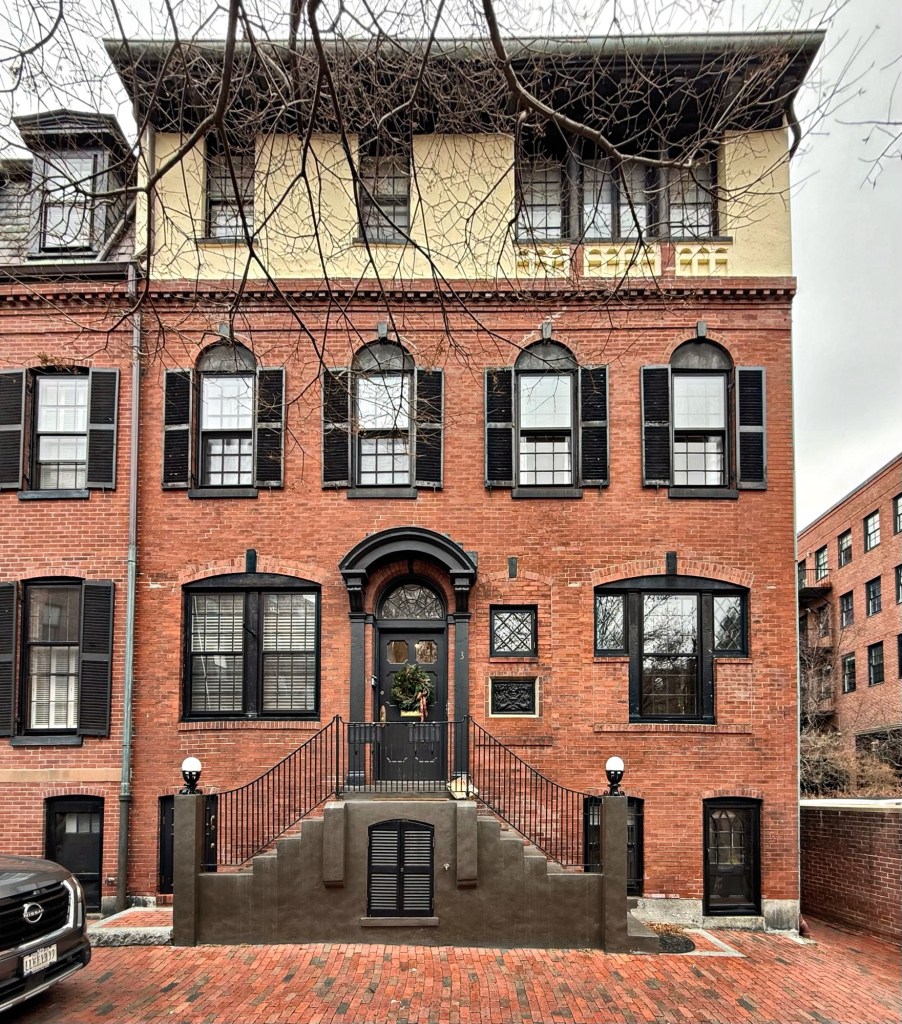
Callender-Sedgwick House // 1802

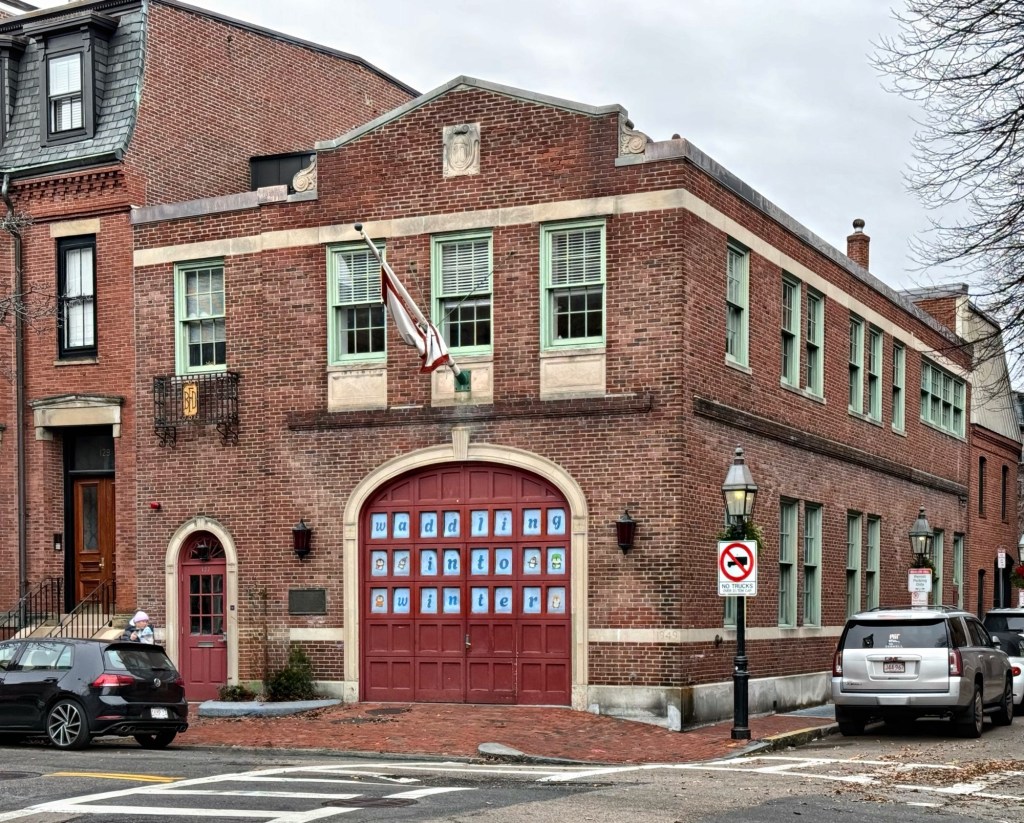
Built in 1802, this large residence at 14 Walnut Street is among the oldest extant mansions on the South Slope of Beacon Hill and includes a large hidden garden behind a granite block retaining wall. John Callender, Clerk of the Supreme Judicial Court of the Commonwealth, purchased land at the corner of Mount Vemon and Walnut streets for $2,000 and immediately started construction on his requested “small house finished for little money $5,000-$7,000”, but this was anything but modest. The house originally had its primary facade facing Mount Vernon Street, but in 1821, Walnut Street was lowered by city officials, so Callender had the granite retaining wall built for the garden and new entry built on Walnut Street. Mr. Callender lived here until his death in 1833 and the property was purchased by members of the Lyman family and later by Harriot Curtis (1881-1974) an early amateur female skier and golfer who used her fortune as a philanthropist, funding medical facilities in Boston for impoverished immigrants and served as dean of women in Hampton Institute in Virginia, an HBCU from 1927-1931. The most significant owner, Ellery Sedgwick (1872-1960), lived here from 1908 until his death in 1960. Sedgwick worked as editor of the Atlantic Monthly (now known as The Atlantic), and under his ownership, the magazine became one of the most circulated magazines in the world. The Callender-Sedgwick House features unique flushboard siding, providing a seamless surface that resembles a masonry wall when painted earth tones and a 19th century oriel window. The brick end elevation is punctuated with bays of hung windows and the recessed entry with a long, granite garden wall which has been well-preserved by owners.


Lyman-Gray House // 1834

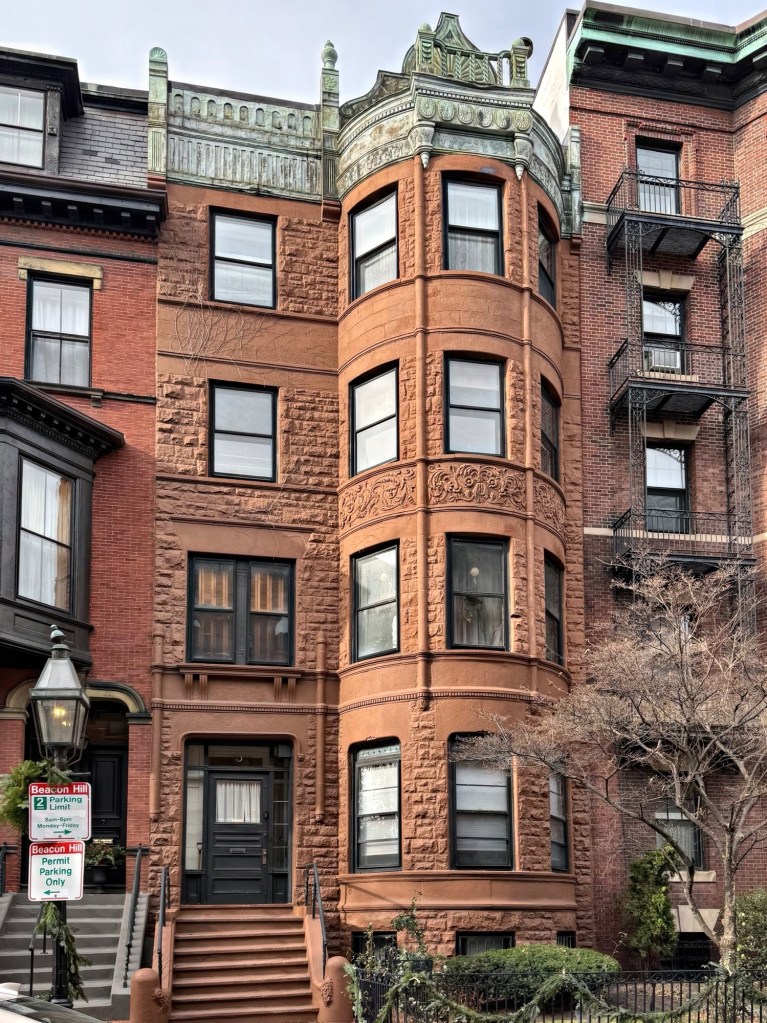
Mount Vernon Place is a short, dead-end street in Boston’s Beacon Hill neighborhood. The street was once an entire block of eight rowhouses, and was developed in the 1830s on land formerly owned by John Hancock and his family. The residences numbered 1-5 Mount Vernon Place were torn down during the 1910s to accommodate the expansion of the landscaped grounds of the State House, leaving just 6, 7, and 8 Mount Vernon Place. The center rowhouse, 7 Mount Vernon Place, was built in 1834 and is believed to have been designed by Alexander Parris, a prominent local architect who designed Quincy Market and mastered the Federal and Greek Revival architectural styles with many notable buildings all over the east coast. The residence has a three bay facade and brownstone sills, lintels, and door surround and has been preserved for nearly two centuries. The house was long-owned by George W. Lyman, an industrialist who lived nearby on Joy Street. The residence was rented for decades until it was purchased by Francis C. Gray a physician, and inherited by his grandson, Ralph Weld Gray, an architect through the 1940s.

Cutler-Paine House // 1834

Mount Vernon Place is a short, dead-end street in Boston’s Beacon Hill neighborhood. The street was once an entire block of eight rowhouses, and was developed in the 1830s on land formerly owned by John Hancock and his family. The residences numbered 1-5 Mount Vernon Place were torn down during the 1910s to accommodate the expansion of the landscaped grounds of the State House, leaving just 6, 7, and 8 Mount Vernon Place. The easternmost rowhouse, 6 Mount Vernon Place, was built in 1834 and is believed to have been designed by Alexander Parris, a prominent local architect who designed Quincy Market and mastered the Federal and Greek Revival architectural styles with many notable buildings all over the east coast. This house was purchased in 1834, when still unfinished, by William Savage, a merchant, who sold the property to Pliny Cutler, president of the Atlantic National Bank, who appears to have bought it for his son, Dr. William Ward Cutler (1812-1870). The property was owned in the early 20th century by Robert Treat Paine Jr., who likely rented the home to boarders. The residence has a three bay facade and brownstone sills, lintels, and door surround.

Unitarian Universalist Association Headquarters // 1926

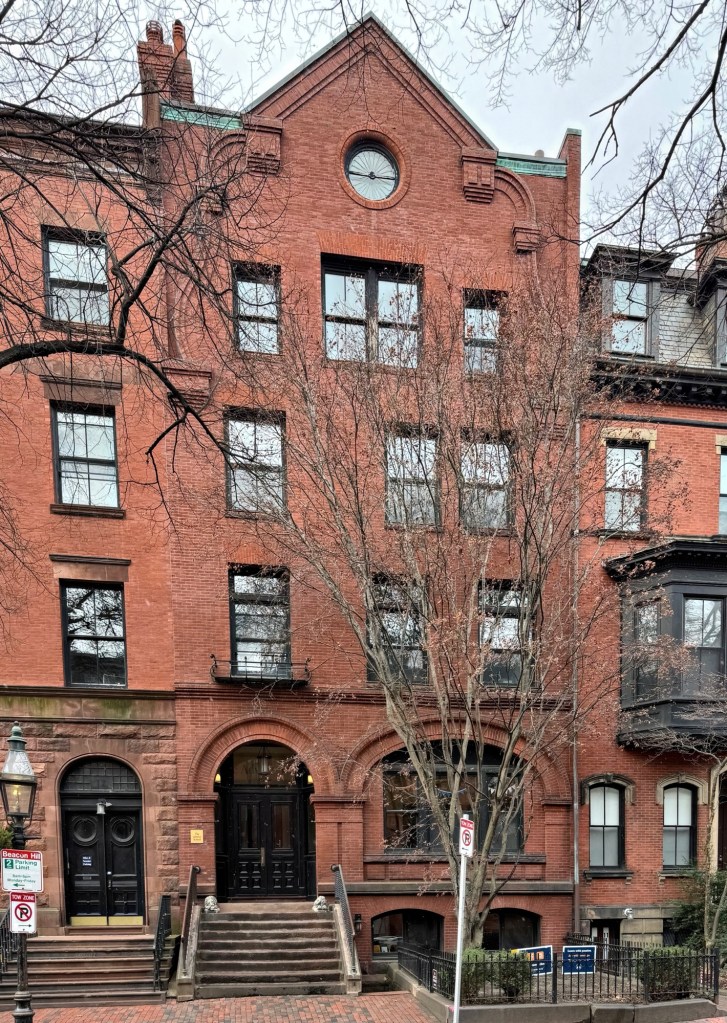
The American Unitarian Association (AUA) opened its first headquarters in Boston in 1865, forty years after the organization was founded. Since its founding in 1825, the AUA occupied several locations but eventually took residence in a Richardsonian Romanesque style building constructed in 1886 at the corner of Beacon and Bowdoin streets. The handsome structure, designed by Robert Swain Peabody of the firm, Peabody and Stearns, served as the headquarters for the association until it was demolished in the 1920s for the expansion of the Hotel Bellevue. In 1926, the AUA purchased an 1840s townhouse and demolished it, replacing the former residence with their new building to serve as a church headquarters office building. The American Unitarian Association hired the Boston architectural firm of Putnam and Cox to design their building, which employed architectural similarities to the adjacent 1820s townhouses designed by Cornelius Coolidge. The six-story building is constructed of red brick with a two-story granite base with piano nobile with a balcony, all under a mansard roof with dormers. The American Unitarian Association sold their Beacon Street building and relocated to a new headquarters on Farnsworth Street in the Seaport/Fort Point area of Boston in 2014. The 1926 building was converted to high-end luxury condominiums.

Tuckerman-Parkman Mansion // 1825

The Tuckerman-Parkman Mansion at 33 Beacon Street, like its neighbor, was built in 1825 from plans by architect, Cornelius Coolidge, in the Greek Revival style. The residence was originally purchased by Edward Tuckerman, a wealthy merchant and father of Professor Edward Tuckerman, a prominent lichenologist for whom Tuckerman Ravine on Mount Washington was named. Tuckerman Sr. lived here at 33 Beacon Street until his death. The next owners, Mrs. Eliza Parkman and her son, George Francis Parkman (1823-1908) moved here after the brutal murder and following sensational trial of her husband, Dr. George Parkman (1790-1849). The 1849 trial of Parkman’s murderer, Professor John White Webster of the Harvard Medical School, was called the “case of the century”. Professor Webster owed Dr. Parkman a substantial sum of money. The professor lost patience with Parkman’s constant reminders that his payment was long overdue and killed Parkman in a rage, dismembered his tall, lanky frame and concealed the body parts in a wall of a Harvard Medical School laboratory. With the help of a janitor, Dr. Parkman’s body was discovered. A murder trial ensued, and Professor White was found guilty and subsequently hung. The murder trial has been widely cited as one of the earliest uses of forensic evidence to identify a body. Seeking refuge from the attention and pain from the loss of the family patriarch and trial, Ms. Parkman and her son, George, moved to this home in 1853. Widow, Eliza Parkman died in 1877 and George F. Parkman lived in this home until 1908. In his will, Mr. Parkman bequeathed his mansion and over $5 Million to the City of Boston for the maintenance of the Boston Common. The Tuckerman-Parkman Mansion was restored by the City of Boston in 1972 and used almost exclusively as the Mayor’s residence until 1984. The house is now the official reception hall of the Mayor’s office and appears much as it did when built 200 years ago.

Russell-Bradlee Mansion // 1825

The land at the corner of Beacon and Joy streets in Boston’s Beacon Hill neighborhood was once John Hancock’s west pasture for his grand manor (razed in 1863) until 1819, when subdivision of the Hancock estate began following his death. In 1821, Israel Thorndike, one of the leading land speculators of early nineteenth-century Boston, began buying out the Hancock heirs and house lots overlooking the Boston Common were sold to John Hubbard and George Williams Lyman, who hired architect Cornelius Coolidge, to build some stately Greek Revival townhomes for wealthy Boston elites. The house at the corner of Beacon and Joy streets, 34 Beacon Street, was built in 1825 for Nathaniel Pope Russell, a leading Federal period China Trade merchant. By 1850, James B. Bradlee, a wealthy merchant, had acquired the property. Bradlee’s grandson Ogden Codman Jr., the influential late nineteenth- and early twentieth-century architect and interior decorator, was born in this house in 1863. Codman later collaborated with novelist and tastemaker Edith Wharton on ‘The Decoration of Houses‘, a book that had an enormous impact on the direction of interior design when it was published in the 1890s. Little, Brown and Company, a publishing company founded in 1837, purchased the former residence and moved their headquarters here in 1909. The publishing company sold the property in 1997, and it converted to a single-family home. In 2007, the residence was purchased by Northeastern University and has since been the President’s House.

Hotel Mellen // 1894

While Ashmont Hill in Dorchester is known for large, single-family Victorian houses, there are a number of grand apartment houses and three-deckers dispersed throughout the area, showing the evolution of housing in desirable neighborhoods in the late 19th and early 20th centuries. This is the Hotel Mellen, located at 18-20 Mellen Street, a multi-family building that architecturally blends in with its surroundings, not like many uninspiring boxes being built all over the region today. The property was developed by Louis Pfingst, a German streetcar designer and mechanic who was also active in the local Dorchester Gentlemen’s Driving Club. The building was designed by local architect Alexander B. Pinkham, who specialized in multi-family housing designs around Boston. The rounded bays, recessed porch in the gable, varied siding, and applied ornament, make the building stand out, while fitting well within its context of surrounding homes.

Woodrow Wilson School // 1932

The Woodrow Wilson School, now Dr. William W. Henderson K-12 Inclusion School, is located at 18 Croftland Avenue in the Ashmont neighborhood of Dorchester. The school was built in 1932 to accommodate increased development and population growth in the immediate area in the interwar period and was designed in a blending of Classical Revival and Art Deco styles, both popular at the time for such academic buildings. The building was named for Woodrow Wilson (1856–1924), the 28th President of the United States and was designed to comfortably accommodate 1,600 students. Architect, John Matthew Gray designed the building to conform to a plan drafted by the City of Boston in 1923 to standardize all new school construction down to the precise dimensions of windows and hallways. The permitted flexibility for hired architects was strictly on the exterior, where architects were free to create individual character in the designs of entryways, auditoriums, and exterior architectural styles and decoration. The entry of the Woodrow Wilson School depicts Art Deco motifs including lettering and inlaid carved panels over the door of a child reading and a child holding a globe. The school was renamed the Dr. William W. Henderson K-12 Inclusion School after the innovative educator of the same name.


King-Murdock House // c.1894

Located on Ashmont Street in the Ashmont Hill neighborhood of Dorchester in Boston, this handsome Colonial Revival style residence was one of many large homes constructed here at the end of the 19th century. This house was built by 1894 for owner Franklin King and rented to tenants for supplemental income. Franklin King was part owner of the E & F King Company, a major paint and stain manufacturer in Boston. Franklin died in 1898 and the property was inherited by his son, Samuel Gelston King, who continued to rent the home. A notable renter of the house was Harold Murdock, a cashier and amateur historian and author who wrote various books of everything from the American Revolution to the Reconstruction of Europe. The architect is said to be Clarence Blackall of Cambridge, which makes sense as this house is clearly the work of a trained architect. Symmetrical in plan, the center-hall residence features a preserved entry portico, hipped roof, and detailed dormers.

Chansonetta Stanley Emmons House // 1893

Chansonetta Stanley Emmons (1858-1937) was born in Kingfield, Maine, and was one of the great women photographers in the 19th and early 20th century, often depicting domestic life and New England scenes. The young Chansonetta Stanley grew interested in photography after her brothers’ (Francis E. and Freelan O. Stanley) dry-plate printing invention, they also invented the steam-powered automobile known as the Stanley Steamer. She married James Nathaniel Whitman Emmons in 1887 and in 1894, James hired architect Henry McLean, to design a residence for him and Chansonetta, this lovely home on Harley Street on Ashmont Hill. The couple occupied the house until 1898, when James died of blood poisoning at the age of 41. Chansonetta sold the home and moved to Newton, where her two brothers lived and operated their business. The house blends Queen Anne and Colonial Revival styles and originally had a conical roof over the corner rounded bay. The roof was replaced with a flat roof at about the time of the large balcony and extended dormer.