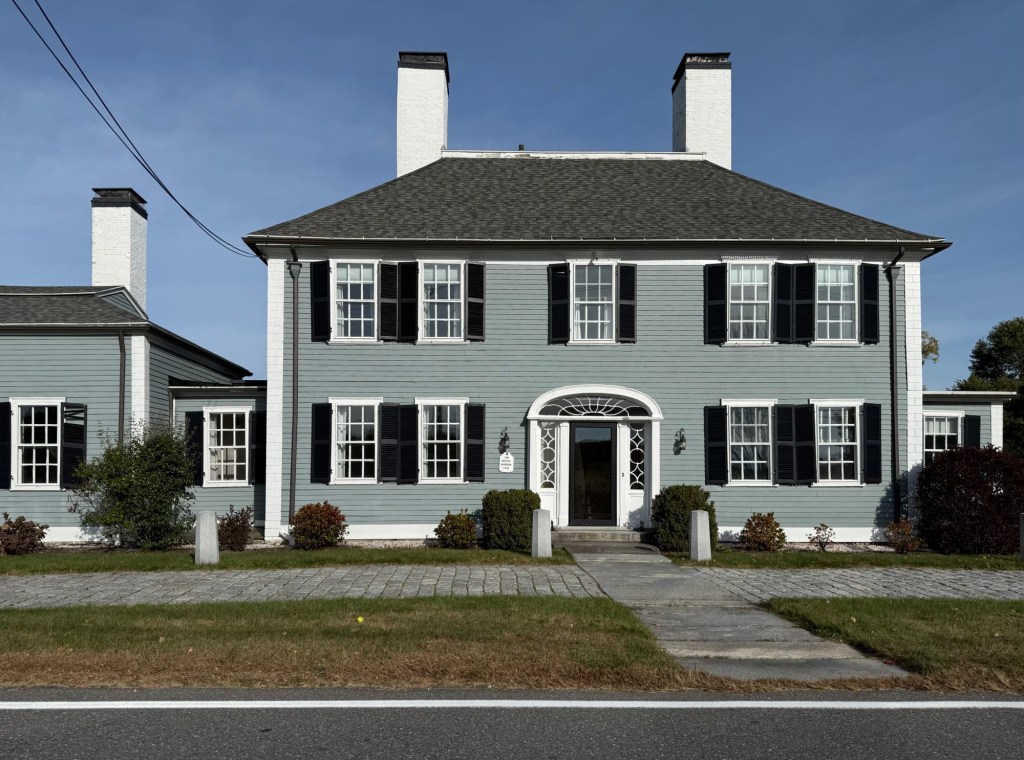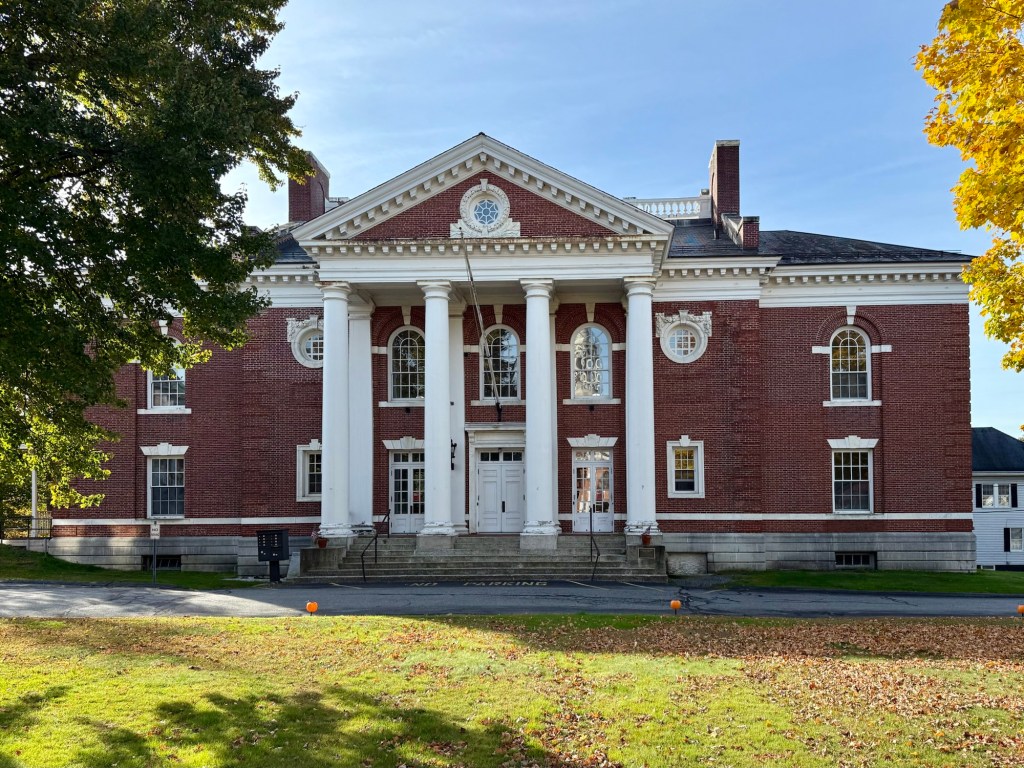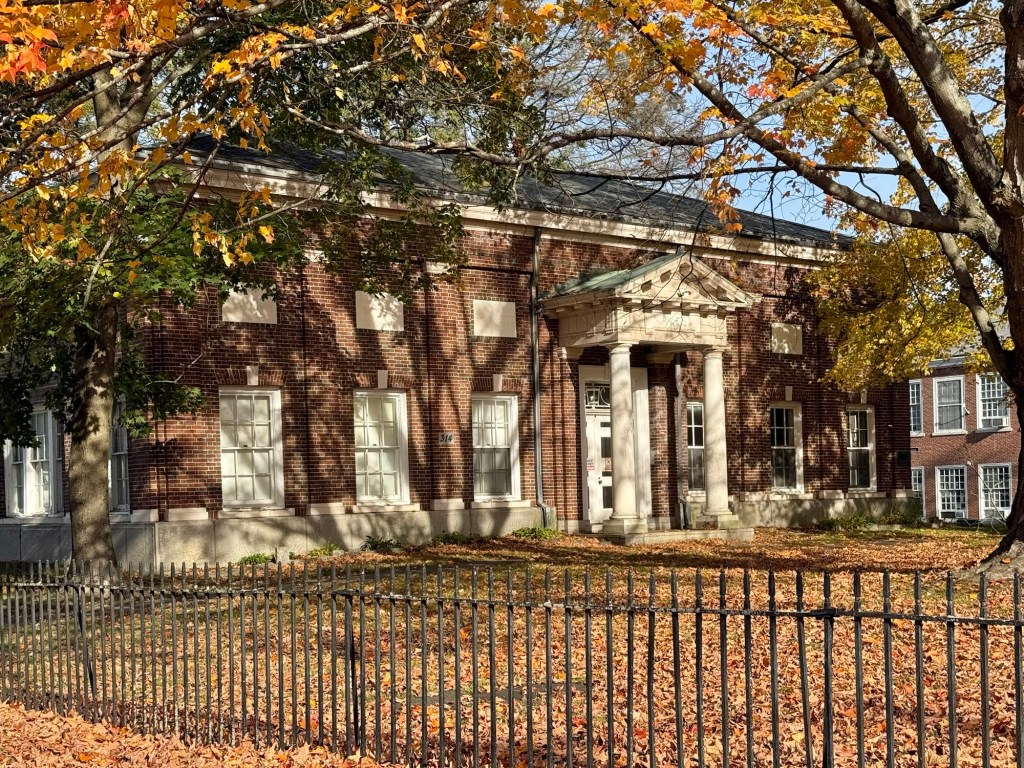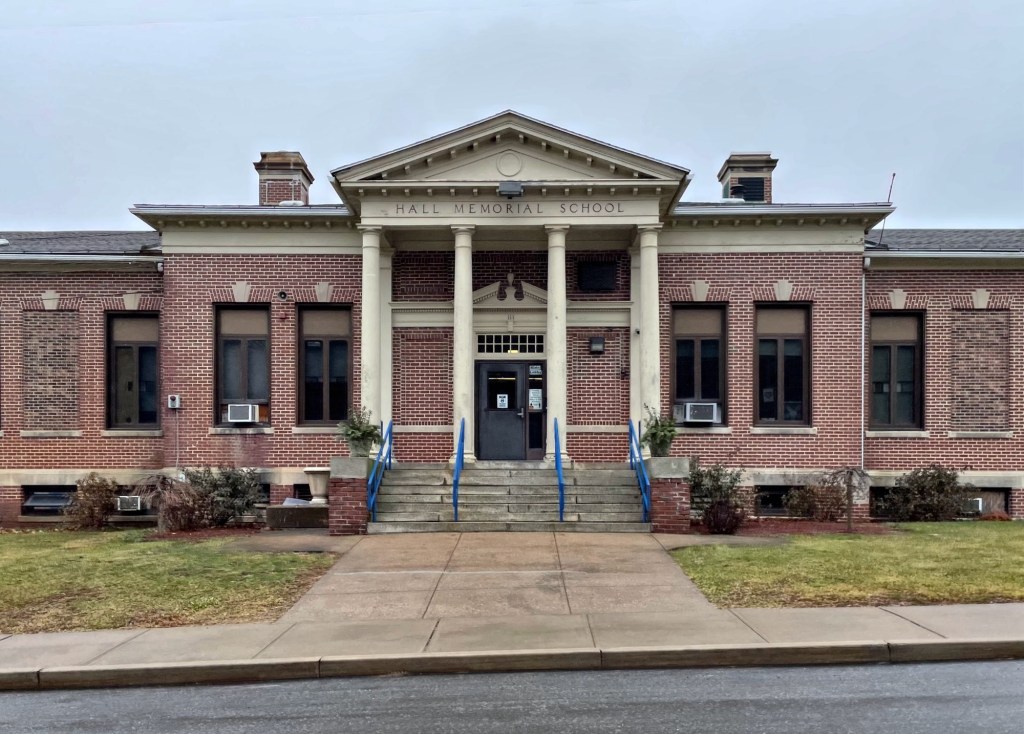
Chester Masonic Temple // 1907

Built in 1907, this handsome building on Main Street in Chester, Vermont, has long been the home to the Olive Branch Lodge 64 of the Freemasons, an international fraternal organization. Colonial Revival in style, the building features corner pilasters that support a denticulated entablature along the eaves of the slate hip roof. A projecting portico over the front entrance is supported by classical Ionic columns. The 1920s marked a heyday for Freemasonry, especially in the United States. By 1930, over 12% of the adult male population of the United States were members of the fraternity. Following the Great Depression and WWII, membership sharply declined in fraternal organizations, like the Masonic Temple. A number of years ago, the Lodge here moved to a new building in a nearby town, and a local law firm purchased the building and spent 18 months renovating the building for use. Today, the historic character and even symbology remain on the building, while it houses a local business. 

Thomas Aspinwall House // 1896

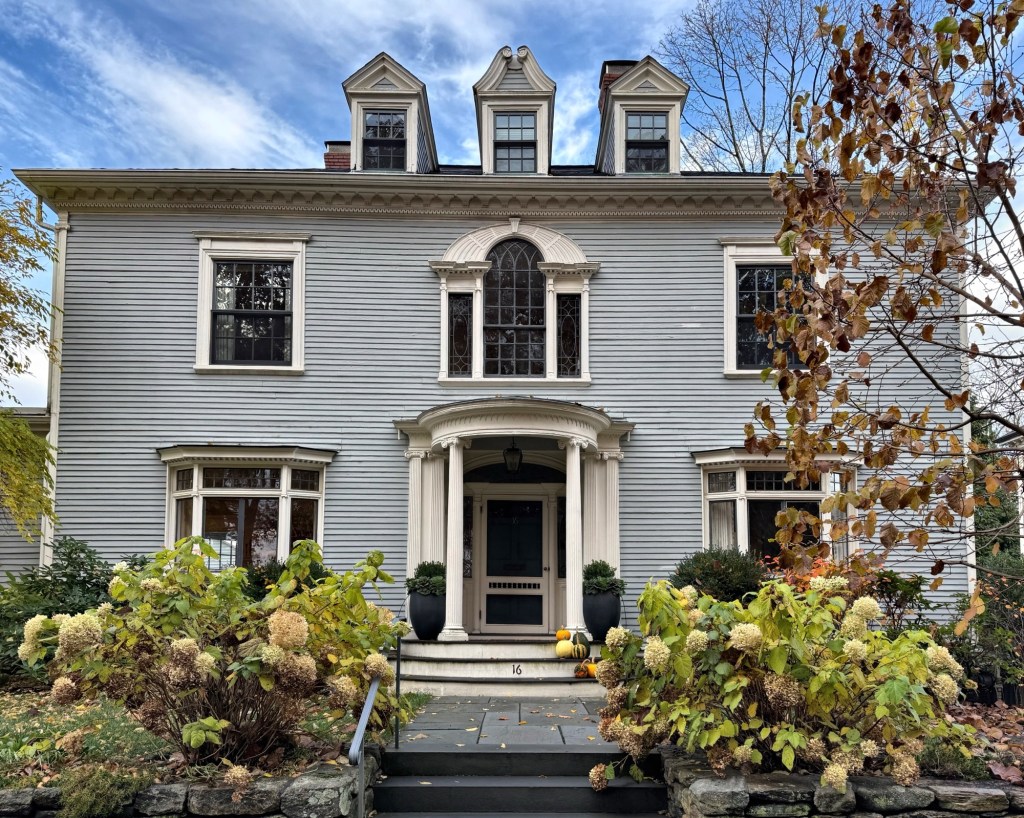
The Thomas Aspinwall House at 14 Hawthorn Road in Brookline was constructed in 1896 by architects, Ball & Dabney. The stately home was built for Thomas Aspinwall as a near copy of his great-grandfather’s 1803 Federal style house on Aspinwall Hill, the William Aspinwall House. Both residences feature a four-tier central bay with Palladian and lunette windows with a columned portico at the entrance. His grandfather, Dr. William Aspinwall graduated from Harvard in 1764 and studied medicine in Connecticut and in Philadelphia before beginning his medical practice in his hometown. He was one of the Brookline men who marched west and fought British troops as they retreated from Lexington and Concord in April 1775. He was put in charge of a hospital in Jamaica Plain during the Revolutionary War and later ran a hospital for smallpox victims in Brookline. His 1803 Federal style home was demolished in 1900 as the Aspinwall Hill area of Brookline was developed, but luckily, a replica remains on the other side of town, here on Hawthorn Road!

William & Sara Warren House // 1911

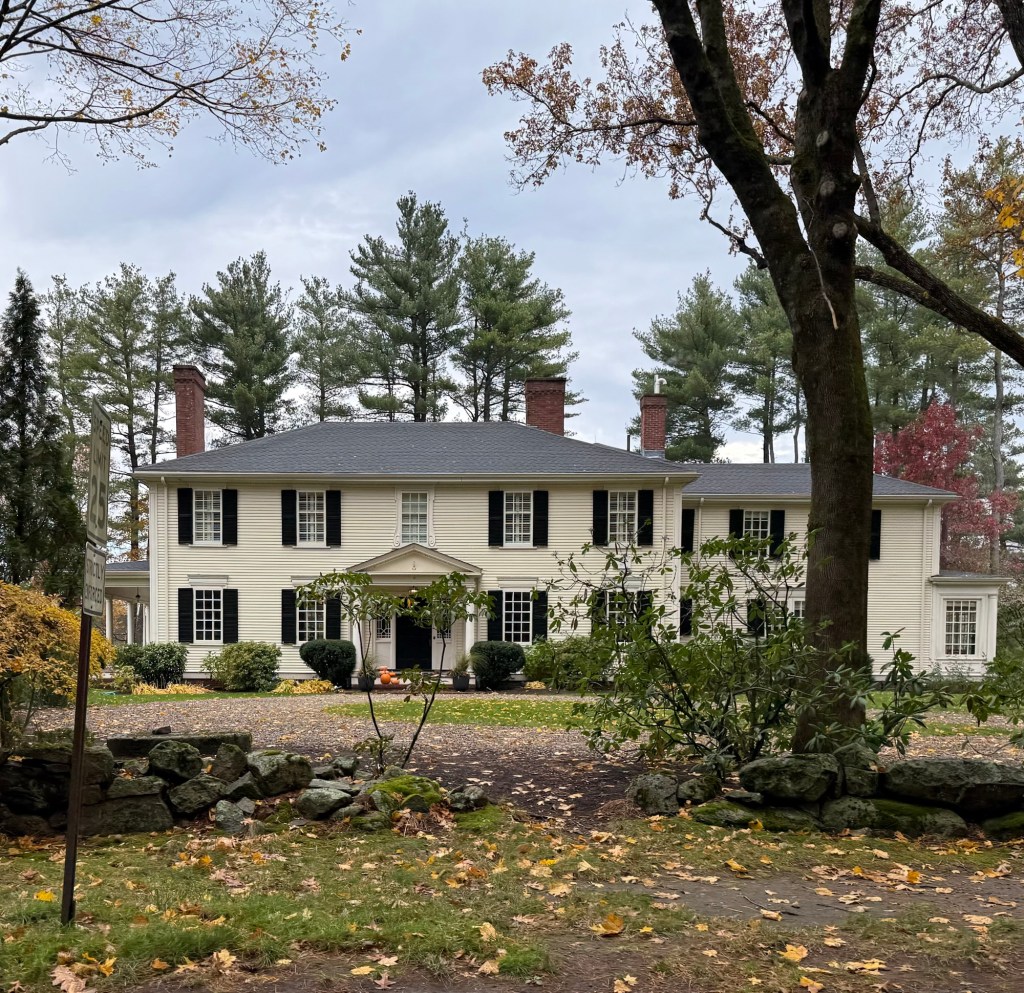
Built in 1911, this Colonial Revival style house rendered in stucco, is located at 28 Hawthorn Road in the Pill Hill neighborhood of Brookline, Massachusetts. The residence was built for William Marshall Warren (1865-1953) and his wife, Sara Shields Warren (1874-1964) from plans by the firm of Gay & Proctor. William M. Warren served on the faculty at Boston University as Professor of Philosophy and later as Dean of the College of Arts and Sciences, promoted by his father, William Fairfield Warren, who was President of the University. The Warren House features a symmetrical five-bay facade with central entrance within a projecting pedimented vestibule framed by four pilasters. The pilasters are replicated in the three dormers at the roof, set below the central chimney.

Codman-Gillet House // 1928

Built in 1928 as an accurate reproduction of an 18th-century residence the Codman-Gillet House at 60 High Street in Brookline is significant architecturally in the Colonial Revival style but also as a preserved house by the architectural firm of Howe, Manny and Almy. Lois Lilley Howe and Eleanor Manning were among the first women graduates of the M.I.T. School of Architecture, and the firm was joined in 1926 by Mary Almy. Their firm was the first all-woman architecture practice in Boston and the second in the U.S. Howe was the first woman elected a Fellow of the American Institute of Architects. The house was built for William Coombs Codman, a trustee of various real estate trusts, and was likely rented or sold for investment. The first long-time owner/occupants of the residence were Mr. and Mrs. Fernand Gillet and who both taught at the New England Conservatory of Music. Fernand was the principal oboist of the Boston Symphony Orchestra from 1925 to 1946. The Codman-Gillet House features many traditional Colonial Revival elements including: the corner quoining, window trim, a pedimented projecting entrance, and hipped roof with large central chimney.

Dana House // 1896

The Dana House at 41 Allerton Street in Brookline, Massachusetts, is one of many stately suburban residences designed in the Colonial Revival style here. Built in 1896 for Ms. Julia Hurd Dana (1825-1914), a widow of James Dana, who was a Mayor of Charlestown between 1858-1860, before it was annexed to Boston. The Dana House was designed by the important architectural firm of Chapman & Frazer, who specialized in higher-end suburban housing at the turn of the 20th century. Julia Hurd Dana was the daughter of William Hurd of Charlestown, and after her husband’s death, moved to Brookline in this new home with her daughter, Mary. The residence is notable for its ample setback from the street, providing a front yard garden, hipped roof of slate with pedimented dormers, and palladian window over the portico which is now covered in crawling ivy.

Russell-Hayes House // 1899

The Russell-Hayes House at 58 Allerton Street in Brookline, Massachusetts, was built in 1899 in the highly popular Colonial Revival style for Mr. and Mrs. Russell. Francis Henry Russell (1832-1919) was born in Plymouth and married Elizabeth Stevens (1835-1922) of Lawrence, and had one daughter together. Francis attended Harvard College and eventually worked as the Treasurer of the Bates Manufacturing Company, doing well enough to purchase a house lot in the fashionable “Pill Hill” neighborhood of Brookline to build his home here. Mr. Russell hired Plymouth-born architect, Joseph Everett Chandler, to design his suburban residence for himself, his wife, and daughter. After the death’s of Francis (1919), Elizabeth (1922) and their unmarried daughter, Mary (1926), the property was purchased in 1927 by African American musician, Roland Hayes. Just years prior to purchasing this stately home in Brookline, Roland Hayes performed abroad in Europe, even a private performance for King George V and Queen Mary at Buckingham Palace. He returned to the United States of America in 1923 and made his official debut on November 16, 1923, in Boston’s Symphony Hall, which received critical acclaim. He was the first African-American soloist to appear with the Boston Symphony Orchestra, who would later hire him, with a reported salary of $100,000 a year. Roland and his family lived in this house for 50 years until his death in 1977. His legacy lives on here with a plaque in front of the home, and a public school named after him.

Providence County Courthouse // 1926

S. Main Street Elevation

The Providence County Courthouse complex occupies an entire city block running between Benefit Street and South Main Street and while of immense scale, is broken up into more human-scaled wings and masses that make the building one of the finest and contextual designs in a city full of amazing architecture. The courthouse here replaced the first courthouse, a stunning palace of justice designed by Stone & Carpenter in the High Victorian Gothic style, that was completed in 1877. The old courthouse was soon outgrown and a larger building was planned following WWI. The present courthouse was built between 1926 and 1930 following a design by Jackson, Robertson & Adams in the Georgian Revival style, fitting of its context amongst some of the finest Colonial-era houses and buildings in New England. The building today contains the Rhode Island Supreme Court, Providence County Superior Court, and the local trial court. The South Main Street facade is my favorite with the Guastavino tile roof entry and stunning colonnade at the street level. A multi-stage clocktower emerges from the center of the building, at a height of 216-feet, making the courthouse the 11th tallest building in Providence.

Benefit Street Elevation

Walker House // c.1857

The Walker House at 171 Middle Street in Portsmouth is a wood-frame Italianate-style residence that was greatly modernized at the turn of the 20th century into the Colonial Revival style, showcasing how differing styles can actually blend together fairly harmoniously. The house was built around 1857 for Nathaniel Kennard Walker (1807-1880), a ship owner who operated a hat shop in town. After his death in 1880, Nathaniel’s youngest son, Arthur Willard Walker (1855-1906), inherited the home, and some time after his marriage in 1886, modernized the family home in the then fashionable Colonial Revival style, popular in many New England towns as a callback to historical designs. Original details of the Italianate style that remain include: the overhanging bracketed eaves, wide cornice, centered gable at the roof, and the window trim. Colonial Revival additions to the Walker House include: the entrance with leaded glass fanlight transom and sidelights, entry portico, two-story fluted pilasters at the facade, and Palladian window at the second floor stairhall.

Frederic C. Adams Library // 1898

Built in 1898 in the heart of Kingston’s village center, the Frederic C. Adams Library was designed by renowned architect Joseph Everett Chandler and is one of the finest Colonial Revival style libraries in New England. Chandler, famed for his dedication to historic forms, created a one-and-a-half-story masonry gem, complete with a gabled roof, dentilled cornice, and a grand four-column Corinthian portico at the entry. The building’s story began with a bequest from Frederic  C. Adams, a Kingston native whose $5,000 gift in 1874 helped break ground on a dedicated library. Its elegant Colonial Revival look recessed panel windows, stone keystones, and symbolic half-round arches, echoes America’s early architectural traditions with a refined late‑19th‑century flourish. The library was eventually outgrown, and relocated across the street, to a contemporary building. After an award‑winning restoration, the building reopened in 2012 as the Adams Center, now housing Kingston’s Local History Collections in a climate‑controlled room and hosting community events upstairs. The Contemporary addition, paired with the restoration work all by Spencer Preservation Group, blends old with new in a pleasing way. 

King-Murdock House // c.1894

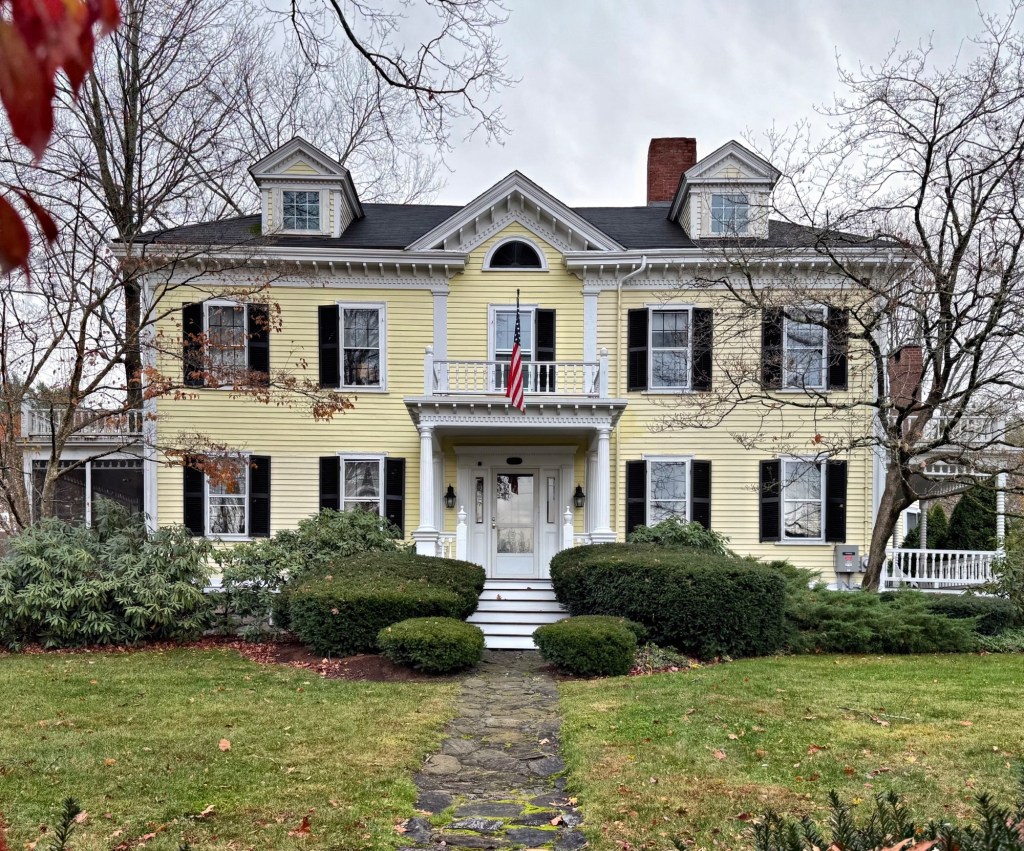
Located on Ashmont Street in the Ashmont Hill neighborhood of Dorchester in Boston, this handsome Colonial Revival style residence was one of many large homes constructed here at the end of the 19th century. This house was built by 1894 for owner Franklin King and rented to tenants for supplemental income. Franklin King was part owner of the E & F King Company, a major paint and stain manufacturer in Boston. Franklin died in 1898 and the property was inherited by his son, Samuel Gelston King, who continued to rent the home. A notable renter of the house was Harold Murdock, a cashier and amateur historian and author who wrote various books of everything from the American Revolution to the Reconstruction of Europe. The architect is said to be Clarence Blackall of Cambridge, which makes sense as this house is clearly the work of a trained architect. Symmetrical in plan, the center-hall residence features a preserved entry portico, hipped roof, and detailed dormers.