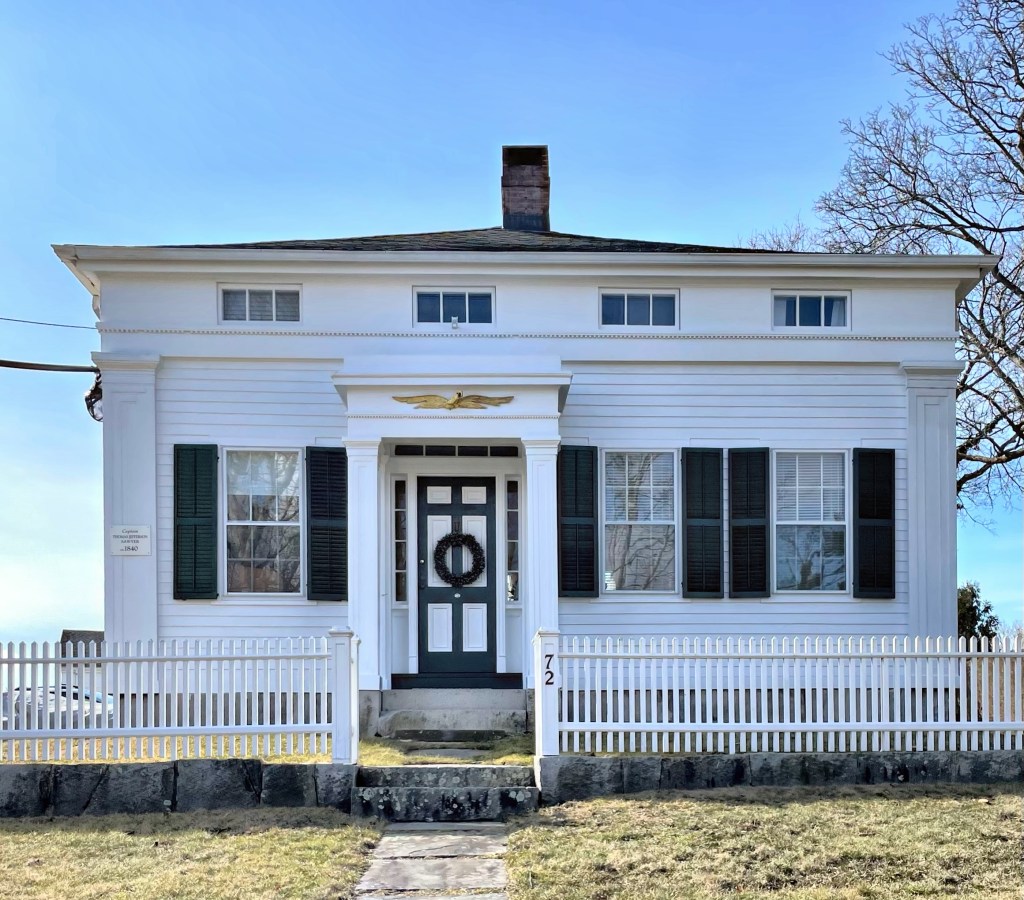
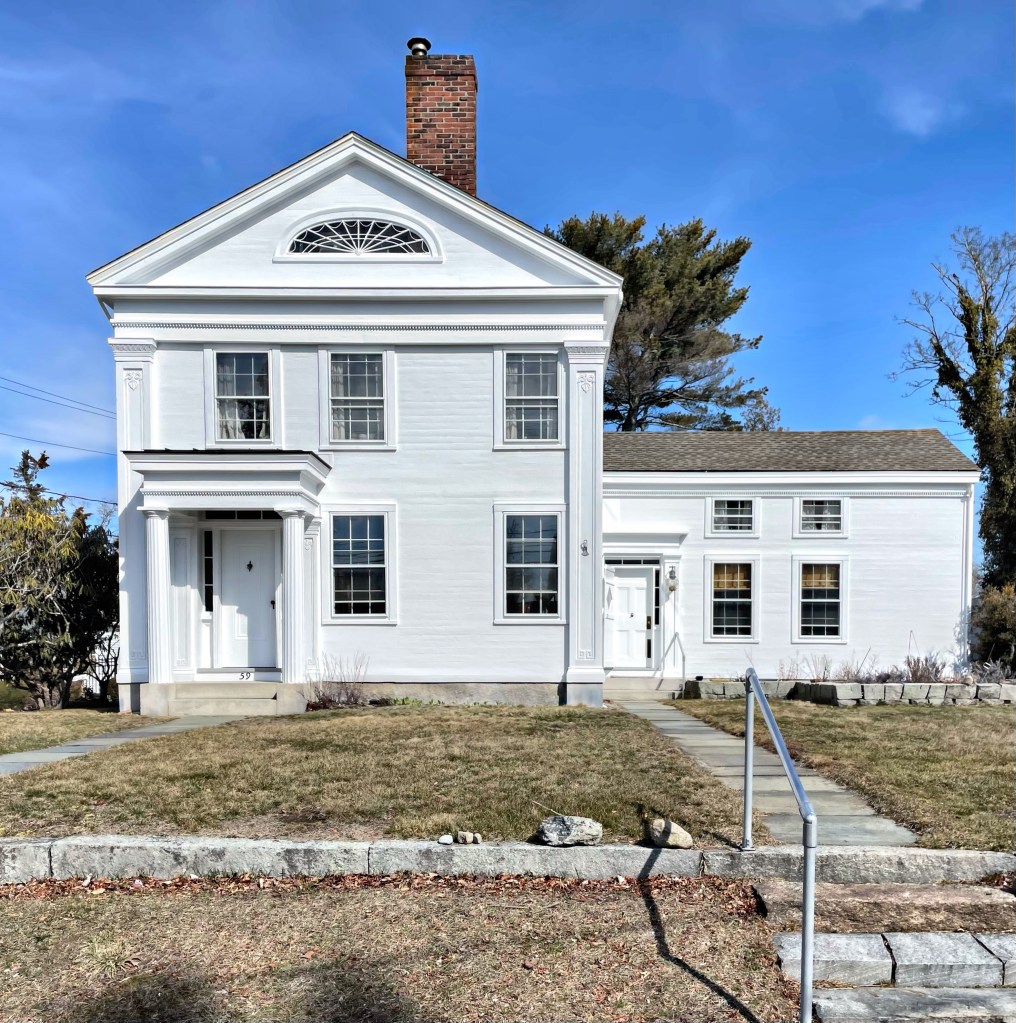
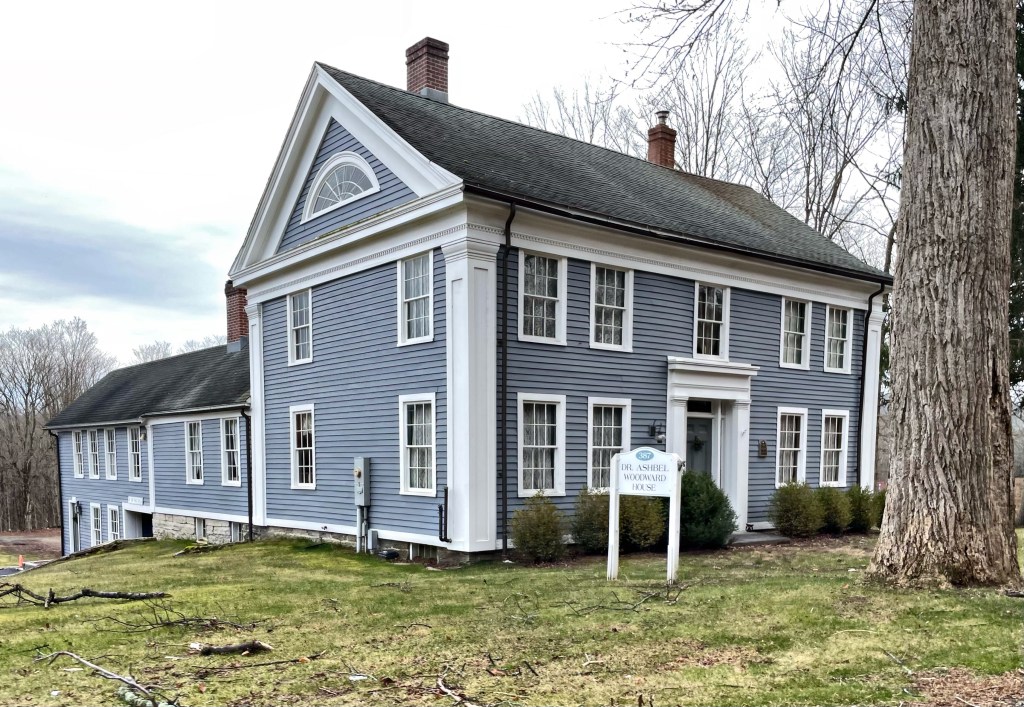
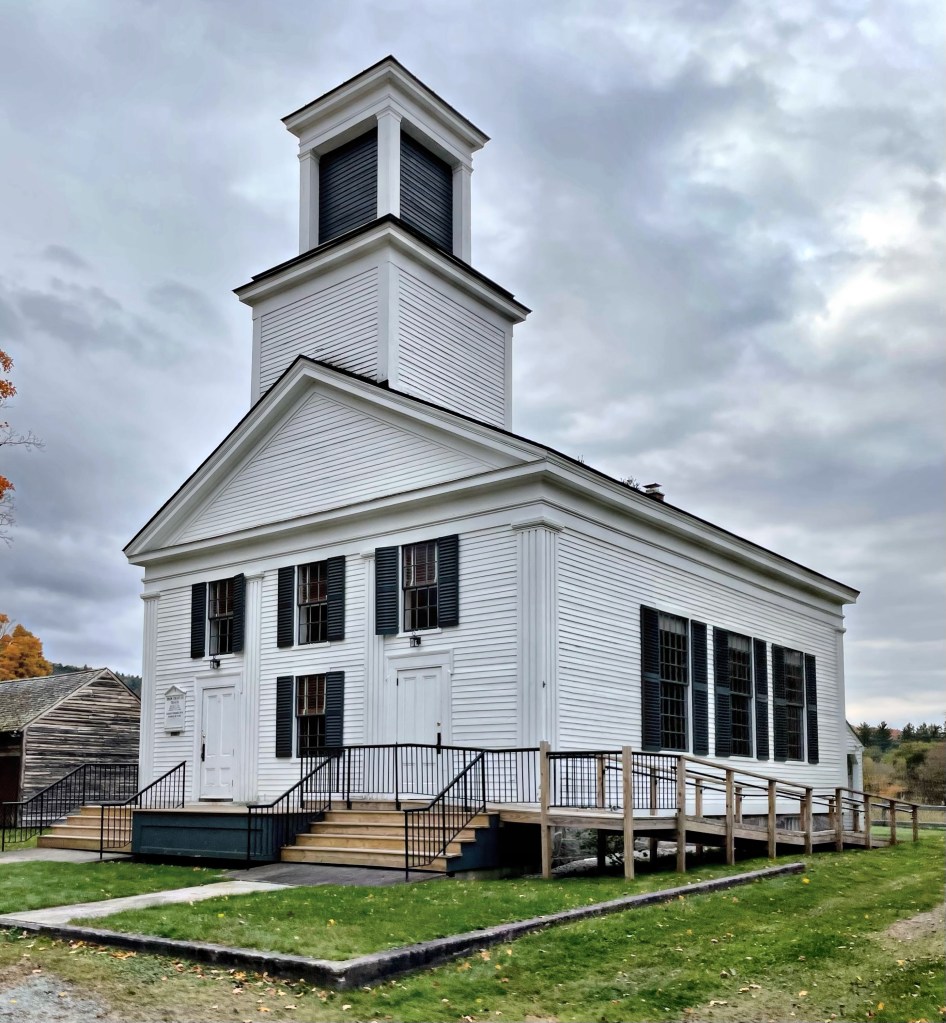
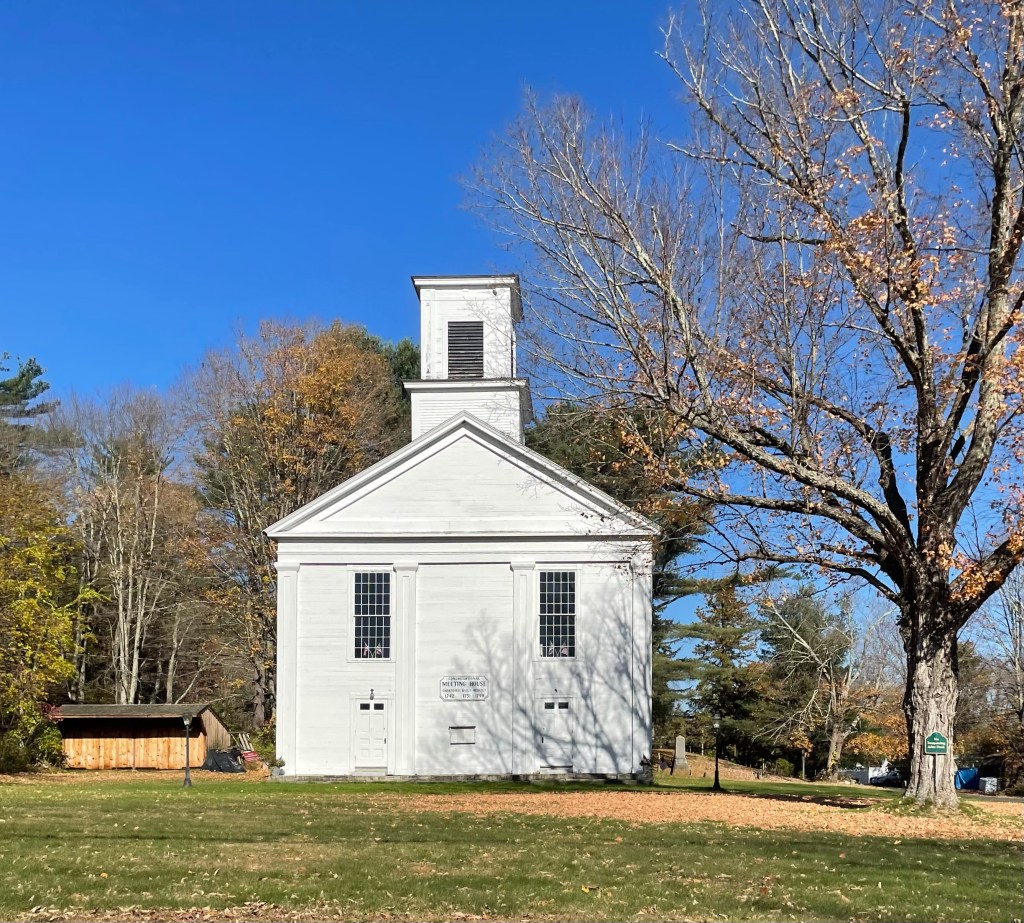
Built in 1857 as the Landgrove Methodist Church, this absolutely charming church sits in the middle of Landgrove, a town with a population of just 177. The town’s small population acquired funds to erect a church in their town, opting to not make the trip by horseback or foot to the churches in surrounding towns. The vernacular Greek Revival building was likely constructed by the members of the congregation and possibly the work of a local builder. Methodists commissioned the 30 × 40–foot building to attract a regular circuit rider, and by 1870 it had become a Union church with other denominations. There is something so enchanting about these old white churches in small New England towns!
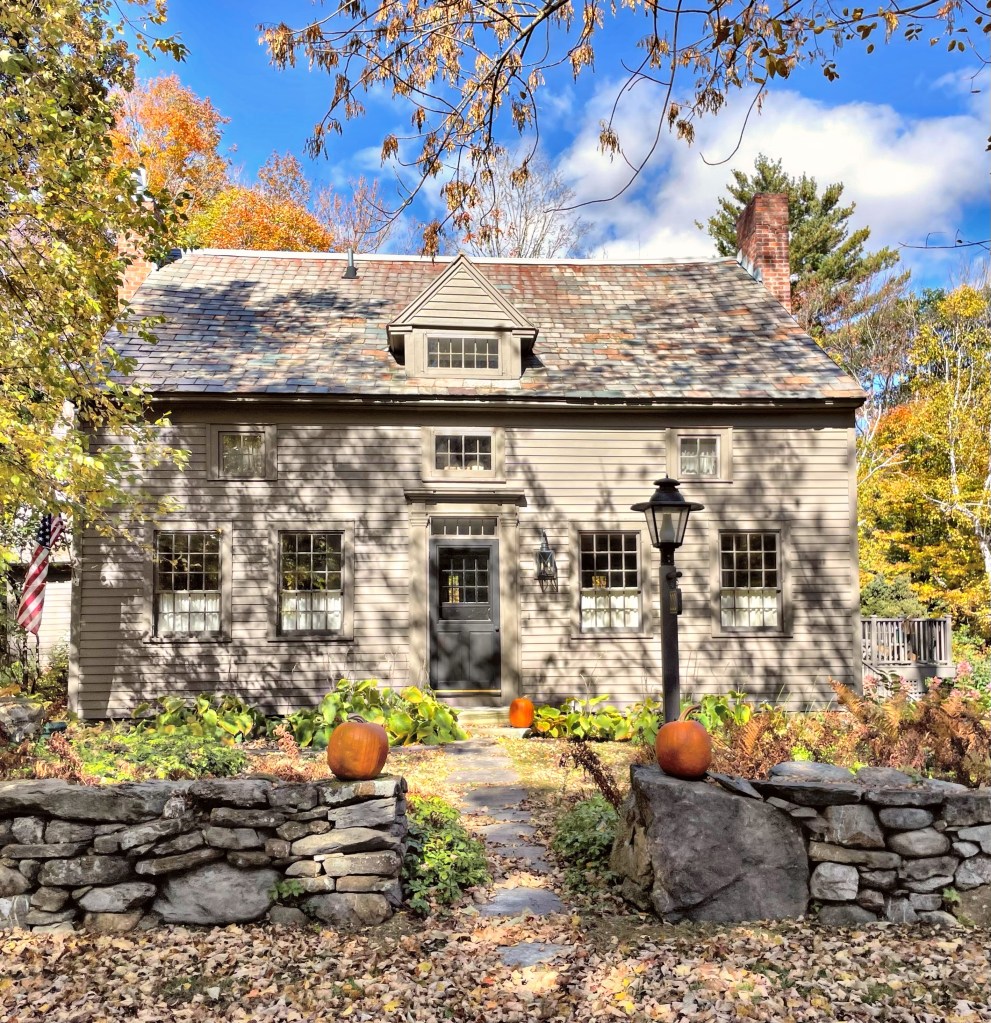
I stumbled upon this Greek Revival farmhouse located on one of many dirt roads in Landgrove, Vermont and had to snap a few photos! I couldn’t find much on the history of the house besides the fact it was listed on an 1869 atlas as the property of an “I. Cory”. The five-bay farmhouse has an elaborate door treatment and bold corner pilasters all perched behind a historic stone wall. The house telescoped outward with additions, eventually connecting it to what is now a garage. This farmhouse purchased in the 20th century by John A. Brown, who worked as Dean of Students at Princeton University.
In 1807 Hezekiah Doane(1768-1834), a shipwright, purchased land on Main Street in Barnstable Village, building a family home. The house was built in the Federal period, likely with a side gable or hipped roof. Hezekiah and his small family lived here until his death in 1834. After successive ownership, the property was purchased in 1846 by sea captain Heman Foster (1812-1867). Foster renovated the house, raising the roof and adding the Greek Revival detailing with the pedimented roof and pilasters, and the gothic lancet window in the gable for some Gothic Revival flair.
Perched atop a hill in Barnstable Village, the old town center of the historic Cape Cod town, the Barnstable County Courthouse sits proudly as a well-preserved example of the Greek Revival architectural style in a civic building. The building was constructed in 1831 from plans by renowned architect Alexander Parris, who designed the iconic Quincy Market in Boston just years earlier in the same style. Due to its highly visible location along the Old King’s Highway and public function, the courthouse was likely instrumental in popularizing the Greek Revival style on the Cape. The building was constructed of Quincy granite with a portico and fluted Doric columns made of wood fashioned to look like stone (which fooled me from the street). The building has been expanded five times between 1879 and 1971, with each addition made cognizant of the architectural significance of the building. At the front of the building, two bronze statues of Mercy Otis Warren and James Otis, Jr frame the building. The Barnstable Superior Court is located in the building today.
Just steps from the iconic Louisburg Square in Boston’s exclusive Beacon Hill neighborhood, a man named Joshua Bennett in 1834, purchased two recently completed townhouses built by housewrights Samuel H. Mitchell and Loring Dunbar. Joshua Holden Bennett (1792-1865) was born in Billerica, Massachusetts and split his time between his hometown and Boston. Bennett and his family owned the two identical bowfront houses until about 1930, likely renting them out to middle-upper class families. The home on the right (pictured) was later purchased by Benjamin B. Gillette an organist at a local church. After WWII, property values in Beacon Hill began to falter and this property and its neighbor became lodging houses of rented rooms to a more wealthy clientele than those on the North Slope of the hill. The home last sold in 1989 for $753,000 and is estimated at a value today at over $4,000,000!
From about 1670 to 1801, the villagers of Hurley were associated with the Kingston Reformed Church, about three miles away. In those years, the minister of the Kingston Church met with the Hurley parishioners at least once every six weeks and conducted a Sunday service in one of the local homes. In 1801, they grew tired of not having their own place of worship, and they petitioned to establish their own church in Hurley, and succeeded. The original church building was a large, single room, stone building that seated over 250 people on the main floor and in three galleries around the side and back walls. A tall steeple atop the building boasted a large brass globe surmounted by a wrought iron weathervane in the shape of a crowing rooster. A large crack in the building was unrepairable and the structure began to shift, leading to its replacement with the current building in 1854. The old white church has been occupied by the congregation ever since.
When Dutch and German colonists began to settle along the Hudson River Valley, they brought with them their own religious beliefs and desire for community in a new home. In the Village of Woodstock in Ulster County in 1799, the Dutch settlers began meeting in homes to worship establishing a church. By 1805, they petitioned the denomination for an organized church and purchased land, which is now known as the Village Green. In the heart of Woodstock, they built the first church structure. In 1844, that building was torn down for a new, Greek Revival place of worship on the outskirts of the Green. Architecturally, the church exhibits a prominent temple front with pedimented gable and Doric portico capped by an octagonal steeple. Inside, the sanctuary is lined on the walls and ceiling with decorative, pressed tin, which is apparently from the mid-19th century. The church remains very active in local and current events.
Toward the middle of the 19th-century, the Newton Lower Falls Village developed into a premier paper-manufacturing center of eastern Massachusetts, largely due water power supplied by the Charles River. One of the most successful paper mills in the area was owned by Lemuel Crehore (1791-1868), who with his success, built workers cottages for his employees and their families (imagine if businesses did that today)! This Greek Revival workers cottage was occupied by employees of the mill, and was sold off after the mill shut down. The house features a deep piazza with three Tuscan columns across the front and scroll-sawn bargeboards at the porch and hanging along the roof, giving it a slight Gothic Revival element.
In 1841, Dr. Edward Warren (1805-1878) purchased land, a dwelling house, and outbuildings in the Lower Mills village of Newton for his own property. Edward was the son of Dr. John Warren, a Continental Army surgeon during the American Revolutionary War, founder of the Harvard Medical School, and the younger brother of Dr. Joseph Warren, also a physician and Patriot during the early days of the American Revolution, eventually serving as President of the revolutionary Massachusetts Provincial Congress and dying at the Battle of Bunker Hill. Edward, a much less renowned figure practiced medicine in Boston and Newton and married Caroline Rebecca Ware, the half-sister of Henry Ware, a prominent Harvard professor. The house was likely modernized during Warren’s ownership and is largely Greek Revival in style, but much more modest than one would think given the family connections of the two owners!
On August 18, 1929, the United States Hotel in Downtown Boston closed its doors for good. Once housing and feeding over 700 guests per night, the hotel saw severely declining numbers by the time of the Great Depression. Construction on the hotel commenced in 1837, and it was completed two years later in 1839. The hotel was operated by the Messrs. Holman and Clark, who saw an immediate success due to the hotel’s location central to Boston’s major train stations. The hotel (which first contained 300 rooms) did so well that the building was expanded numerous times with undulating additions to maximize light and air into the many rooms. At the hotel, over 150 employees served the guests at their rooms, the dining halls, bathing facilities or the stables which had drivers ready at a moments notice. The United States Hotel was one of the finest establishments in Boston and was thought to be the largest in the country by the middle of the 19th century. The size and amenities however was the downfall of the iconic hotel as Boston’s train stations saw fewer passengers in the early decades of the 20th century. Owners of the hotel sought to squeeze out every last dollar from the complex before they locked her up for good, hosting an auction on everything from beds to a chair said to have been sat on by Charles Dickens during his stay. The hotel was razed in 1930.
This past weekend, I took a little “stay-cation” in Cambridge, and I am so glad I did! I stayed at the Prentiss House, a highly significant Greek Revival house near Porter Square. The Inn is operated by Thatch, a company that offers short-term hotel stays, long-term apartments, and co-living arrangements in the Boston area. They recently acquired and renovated this amazing old house and its a great place to stay!
The home was built in 1843 by William Saunders a well-known housewright for his son, William Augustus Saunders about the same time as his first child, Mary was born. Sadly, Mary died at just six years old and was buried at Mount Auburn Cemetery with her grave guarded by a tiny stone dog. The Saunders Family resided at the home for over 50 years until William and his wife’s death at the end of the 19th century. The original location of the mansion on Massachusetts Avenue necessitated its move to the newly laid out Prentiss Street to save it from commercial development pressure and the wrecking ball. The home was moved to its present site in 1925 for the erection of a one-story block of stores on Mass. Ave. In 1992, the home was purchased by local artist, Charlotte Forsythe and she began the journey of transforming the home into the Mary Prentiss Inn. An addition by Bell/Fandetti added rooms and subterranean parking to the building at that time. The Inn was purchased by Thatch in 2021, who modernized the rooms.
The house reads like a Greek Temple, not with a full portico, but by using colossal applied pilasters and an entablature carried across the gable, suggesting a classical pediment. Ornamental wreaths adorn the full-length porch and interior mouldings.
When Wilton, New Hampshire was settled and incorporated, a log structure was built to serve as a town meeting house. The structure in the center of town was deemed insufficient and was torn down and replaced with a larger meeting house in 1775. The second meeting house served the town for 80 years until it burned down in 1859. The town voted to build a third meeting house (this building) on the same spot, at a cost and the building was completed in 1860. The vernacular Greek Revival building was used as the town hall for just a couple decades, until the 1880s when East Wilton became the population and economic center of town, facilitating the move of the town hall there into a new building. The building would later serve various uses from a community hall to a grange hall, and it is now home to Andy’s Summer Playhouse, a youth theater and cultural hub for the region.
One of the best examples of a temple-front Greek Revival house in the state of Vermont is this stunner, found in Newfane Village. The house was constructed in 1832 for General Pardon T. Kimball (1797-1873), a cattle-broker, general of the state militia and later, a state senator. Kimball made a name for himself locally as he donated much of his money to social causes, from a local almshouse to other charitable organizations. Kimball died in 1873 after falling from his carriage. The house was converted to an inn in 1965-6 and has since been known as the Four Columns Inn, so-named after the four monumental Ionic columns that dominate the house’s facade.
When the Windham County courts were transferred from Westminster in 1787, they were housed in the village known as Newfane on the Hill. Four decades later, influential residents convinced their townsmen to shift the village down to their land in a flat part of town, a location better suited for waterpower and commerce and ease of travel in the winter months. The first two buildings constructed were the courthouse and jail on a common. The village center grew rapidly as people moved old buildings down the hill and remodeled them or built anew, establishing a particularly unified townscape. This courthouse building is very stately for such a small town and packs an architectural punch. The two-story building is capped with a belfry and was designed in the Federal style with fan motifs over the windows and door. In the 1850s, nearby Brattleboro tried to usurp Newfane’s county seat status, so they in turn expanded the courthouse, raising the ceiling on the upper floor and adding the monumental Doric portico and pediment to give the building a decidedly Greek Revival appearance.
Another one of the Landmark Trust USA properties in Dummerston, Vermont is the Dutton Farmhouse, a meticulously restored Greek Revival farmhouse from around 1840. The gable-roof farmhouse was possibly an addition to an earlier dwelling built decades earlier as a one-and-a-half-story center-chimney home, seen at the rear today. The first known owner of the farmhouse was Asa Dutton who farmed off the large orchards. Generations later, the farmhouse served as a dormitory for migrant laborers who worked nearby, with the interior being altered. The property was eventually gifted to the Landmark Trust USA, who began a massive restoration project on the home, uncovering original detailing and even historic wallpaper! The house has since been meticulously restored and preserved and is available for short-term rentals! The charming interiors and near silence outside is a perfect getaway from city life.