St. Peter’s Episcopal Church // 1833

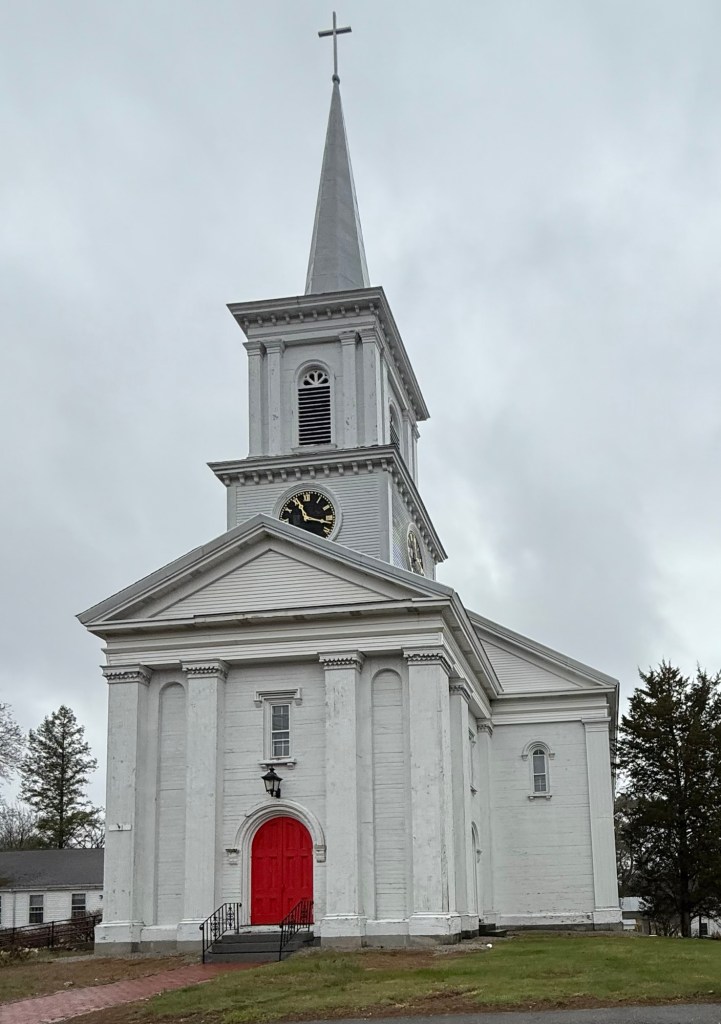
The St. Peter’s Episcopal Church of Salem, is a landmark example of a granite, Gothic Revival church of the 19th century. The present church, which is constructed of Cape Ann granite, was the second church on the site built for local Episcopalians, replacing a wood-frame building constructed there 100 years prior. Designed by architect Isaiah Rogers, the Gothic church features a prominent entry tower with a quatrefoil window in each elevation, large lancet-arched windows in the tower and lining the sanctuary, and a crenelated parapet. When completed, St. Peter’s had Salem’s first church bell, an 1740 English bell that supposedly still graces the tower today and is said to be the oldest church bell in the United States! In 1871, the rear chapel was added to the building, from plans by George E. Harney. The chapel was built directly over the old parish cemetery, requiring some of the tombstones to be placed inside the chapel walls, while others were moved to the front of the church, creating a really unique “garden cemetery” in front of the church.

George Clark Cottage // 1847

In 1847, George Clark (1815-1890), a Salem carpenter, purchased a house lot on Oliver Street, a block away from the Salem Common. That year he began constructing this cottage for his family. The Clark Family resided here for just a year until 1849, when George got caught up in the California Gold Rush, selling the property and moving west to make his fortune. Since Mr. Clark was back in Salem by 1850 (according to the federal census), he was likely one of the thousands of forty-niners who did not strike it rich. The Greek Revival style house is unique for its more Gothic style gable, brackets, and segmental arched windows.

Edgerly-Hawthorne House // 1824

The Edgerly-Hawthorne House on Mall Street, near the Salem Common, is one of the most significant residences in Salem, Massachusetts. The Federal style residence was built in 1824 for Peter Edgerly, who ran a teamster/trucker or distribution company in Downtown Salem. After a decade, Peter became insolvent and the property was sold to Joseph Leavitt, a wealthy property owner in Salem. This house is best-known as the place where Salem-born Nathaniel Hawthorne and his family, lived from 1847 to 1850, and where he wrote The Scarlet Letter. It was in the room closest to the street, on the third floor, that Hawthorne sat at his desk and wrote the American masterpiece of fiction. After publishing The Scarlet Letter, Hawthorne moved to the Berkshires and then back to Concord, Massachusetts, never to live in Salem again. In c.1906, the Edgerly-Hawthorne House was photographed by the Detroit Publishing Company highlighting some landmarks in town. The house looks nearly identical from when it was built over 200 years ago!

Essex County Registry of Deeds // 1909

The Essex County Registry of Deeds and Probate Courthouse on Federal Street in Salem, Massachusetts, was built in 1909 from plans by Boston architect, Clarence Blackall. The Neo-Classical courthouse adds to the rich tapestry of Civic buildings there, showcasing the ever-evolving tastes in architecture as the buildings become more contemporary as you move westward down the street. The two-story granite and cast-stone faced brick masonry building is cross-shaped in plan, consisting of a three-bay wide gable-end entrance with Ionic porch of six fluted columns supporting a dentilled entablature and pediment. The central bay within the entry porch contains a large double-door entrance with elaborate architrave and a scrolling pediment incorporating Classical motifs and a Greek god bust. The building underwent a massive restoration in 2017, and was renamed the Thaddeus Buczko Building after retired First Justice Thaddeus M. Buczko.

Old Essex County Superior Courthouse // 1861

Located to the west of the Old Granite Courthouse on Federal Street in Salem, the Old Essex County Superior Courthouse is a visual depiction of the emergence of the Victorian styles from the more Classical Greek mode. Originally built in 1861 from plans by Salem architect, Enoch Fuller, the building was distinctly Italianate in style and built of brick until a major renovation in 1889 gave the building its present Richardsonian Romanesque appearance. The building was enlarged and renovated by architects Holman K. Wheeler and W. Wheelwright Northend which includes: changes to the roof line, creation of dormers, alterations to the window surrounds to create Romanesque arches and more. A three-story projecting pavilion, whose first floor is finished with rusticated brownstone, contains a recessed entry with a large semicircular arch supported on three columns with carved capitals at each end. The central pavilion resolves into a gable with corner pilasters with carved finials centering a blind arch containing the full date span of the complex, “1861-1891” in a field of square rusticated brownstone blocks. The courthouse remained in use until the J Michael Ruane Judicial Center at the end of the block was completed in 2012. The Old Granite Courthouse and adjacent Old Superior Courthouse were both vacated and have been essentially mothballed ever-since under the ownership of the Division of Capital Asset Management and Maintenance as surplus. The fate of the two buildings remains undetermined.

Essex County Old Granite Courthouse // 1841

Aligned in a row on the north side of Federal Street in Salem, the Essex County Court complex is a tour de force of the evolving architectural tastes of three centuries. At the eastern edge of the complex, the Old Granite Courthouse stands as the oldest of the group. The two-story temple-form building is of rectangular plan with gabled roof oriented towards the street. The facade features a recessed porch with paired columns surmounted by Greek Corinthian capitals which are set between broad, squared Doric corner pilasters. The granite building was designed by architect, Richard Bond (1797-1861) of Boston, and the structure is often referred to as one of the finest Greek Revival-style Civic buildings in New England. The courthouse remained in use until the J Michael Ruane Judicial Center at the end of the block was completed in 2012. The Old Granite Courthouse and adjacent Old Superior Courthouse were both vacated and have been essentially mothballed ever-since under the ownership of the Division of Capital Asset Management and Maintenance as surplus. The fate of the two buildings remains undetermined.

First Baptist Church of Salem – Essex Law Library // 1805

The First Baptist Church of Salem was built in 1805 on Federal Street and is the oldest brick meetinghouse in Salem. The local Baptist congregation was established in 1804 when 24 parishioners formed the First Baptist Church, and began gathering funds to elect a pastor and build a house of worship. At the time, Baptists were a religious minority in Massachusetts, where nearly all churches were Congregational, so against large odds, the parishioners funded a brick building and lot on the prominent Federal Street in Salem. The structure was completed by 1805 and is said to have been one of only fifty brick structures that stood in the city at the time. A major renovation to the building occurred in 1850, when the church was renovated in the Italianate style. Its three bays are articulated as an English basement containing three identical entrances framed in heavy rusticated brownstone. A belt course separates this basement from a principal story composed of tall arched windows capped by drip-molded brownstone. A lunette window is the centerpiece of the strongly projecting modillioned pediment. The entire composition is very pleasing and showcases the ever-evolving architectural tastes in the 19th century. A tower was later removed due to structural issues. In the early 21st century, the site of the church was needed for an expansion of the Essex County Courts. The congregation sold the property and in the following year, the old brick church was moved a couple hundred feet to the west and restored and was converted into a law library for the new courthouse. Talk about historic preservation at work!

Temple Court Apartments // 1912

Constructed in 1912, Temple Court at 15 Lynde Street was erected on the site of two earlier buildings during a period of great population growth in Salem. The parcels here were acquired by Aroline C. Gove (1857-1939), a prominent local property-owner and developer between 1908 and 1911. Ms. Gove was a prominent Salem citizen and daughter of notable inventor and businesswoman Lydia Pinkham. With a business-oriented mindset like her mother, Aroline hired architect Harry Prescott Graves of Lowell to furnish plans for an apartment building on this site. Completed in 1912, the apartment building, known as Temple Court, included 36 units with two-, three-, and four-room suites with a live-in janitor. The building is unique for Salem as a courtyard style building, more common in Boston and Brookline. The building’s large mass is broken up by its setback with the U-shaped form and central landscaped courtyard, series of projecting octagonal bays, and multiple entrances. Temple Court was converted to condominiums in the 1980s.

Salem Water Company Offices // 1879

Salem, Massachusetts, was first settled by Europeans in 1626, and it would take 170 years until in 1796, an organization of citizens was established for the purpose of supplying the inhabitants generally of Salem and Danvers with pure spring water. The Salem and Danvers Aqueduct Company was incorporated in 1797  “for the purpose of conveying fresh water by subterraneous pipes into the towns of Salem & Danvers.” As Salem grew, the need for a more central water district and distribution network became a necessity for the health and prosperity of the city. A 1864 law allowed Salem to construct its own water works, and it formed a Board of Water Commissioners who designed and constructed the system. From this, funding was acquired and paid for the laying of tens of thousands of feet of subterranean water distribution pipes connecting the reservoir to buildings and hydrants in Salem. Offices of the Waterworks were scattered and obsolete until 1877, when funds for the construction of this structure at 32-34 Church Street were set aside as the new Water Department Offices. Completed by 1879, the building is a great example of a Romanesque/Italianate style masonry structure with corbelled cornice and arched openings. According to the city directories, this building continued to operate as the Salem Water Works into the late 1930s. By 1945, it was the headquarters of the United States War Price & Rationing Board. In 1964, it held a number of city offices including: Civil Defense headquarters, Fire Department headquarters, Licensing Board, Planning Board, and the City Veterans Service, before being sold by the City of Salem to private ownership in 1976.

Holyhood Cemetery Chapel // 1857

Holyhood Cemetery in Brookline, Massachusetts, was laid out in 1857 under the direction of Father Joseph M. Finotti, pastor of Assumption Parish , which included Brookline and Brighton. The cemetery reflects the mid-19th century influence of the Rural Cemetery movement and the romantic landscape cemetery planning begun at Cambridge’s Mount Auburn Cemetery in the 1830’s. A plan of the cemetery was drawn up by Shedd & Edson and published in August 1857. It shows curvilinear avenues and paths named after former bishops of Boston and Biblical figures. All were welcome to be buried except those who “died in a state of Drunkenness, Duel, or by self-destruction, unbaptized, non-Catholic, or otherwise opposed to the Catholic Church.” In the 1857 Shedd & Edson plan for Holyhood Catholic Cemetery, a chapel was located at the center on the hill shown in a small drawing on the edge of the plan. Known as St. Joseph’s Chapel, the stone building was designed by Patrick Keely, the successful and influential New York architect of many mid-19th century Catholic churches. The chapel would be dedicated in 1862. Decades later, a cemetery office was planned and built across Heath Street from the cemetery gates, but was demolished sometime in the 20th century. The cemetery grew and it along with the mid-19th century chapel, has been lovingly maintained to this day.