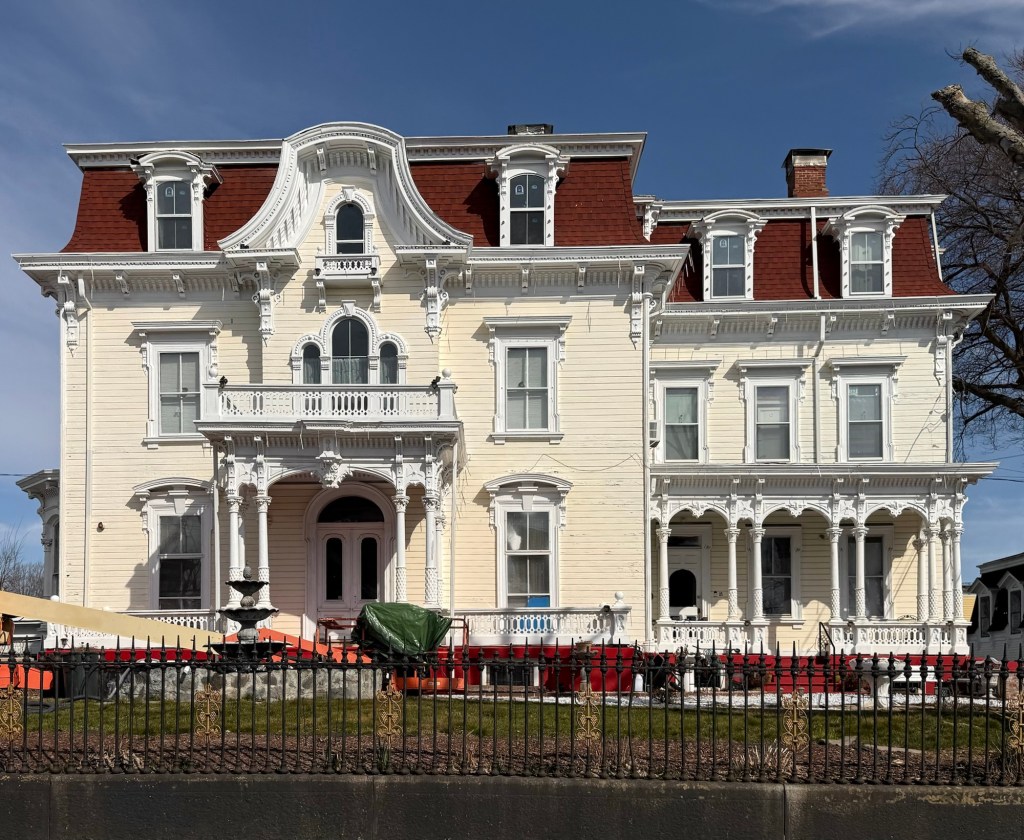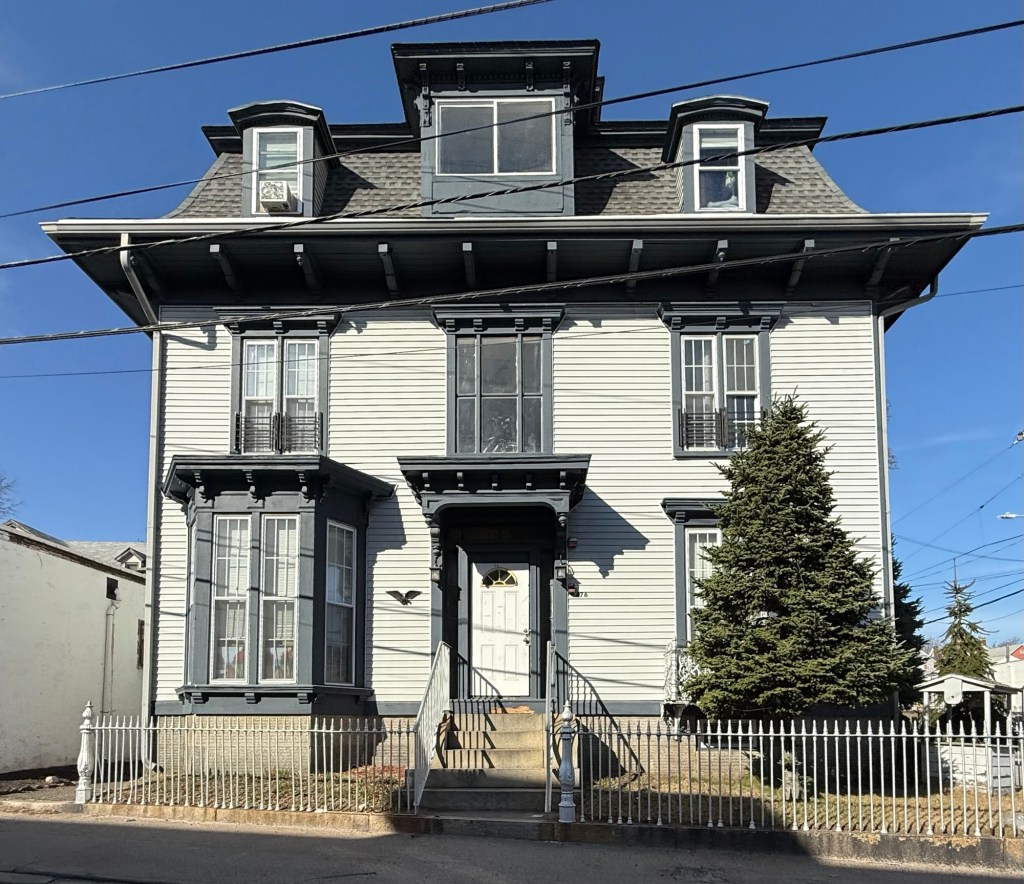
Oakwold Cottage // 1883

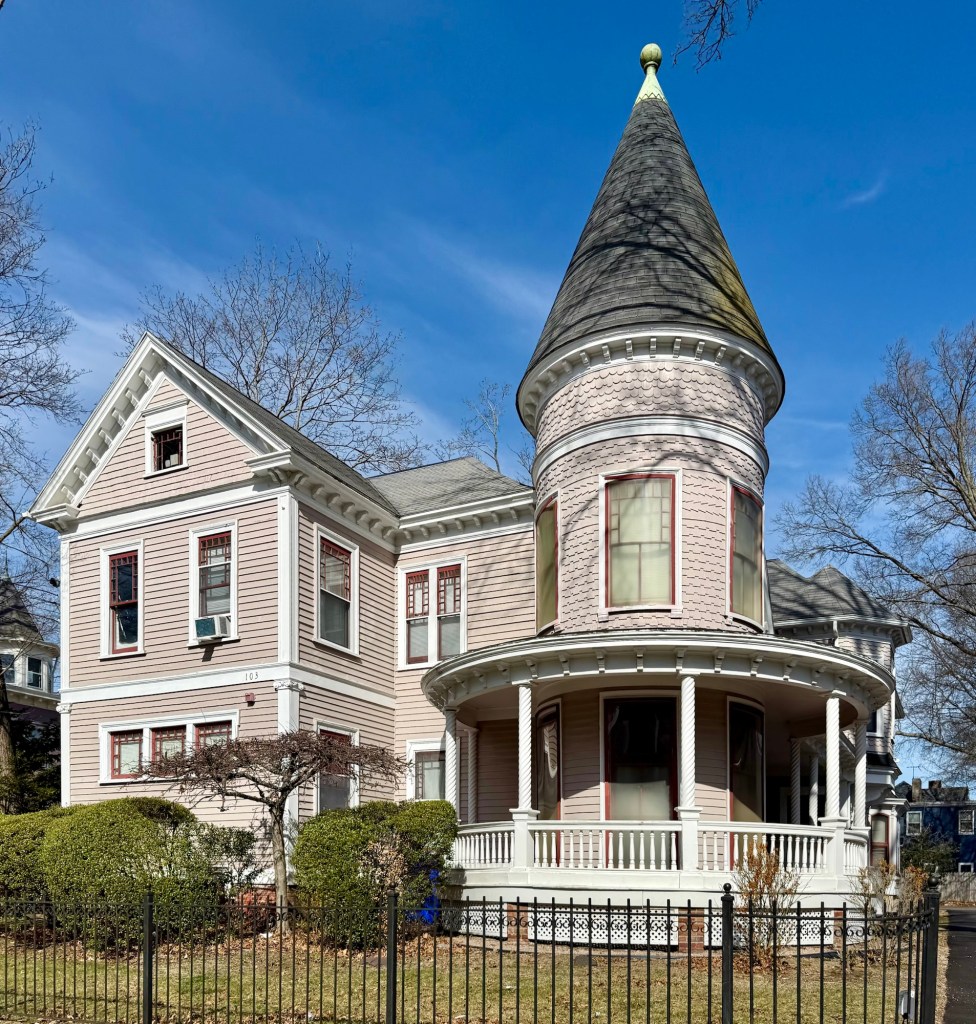
Oakwold, a stunning Queen Anne residence on Old Beach Road in Newport, Rhode Island was supposedly built on speculation and purchased by Augustus Jay (1850-1919). Mr. Jay was born in Washington, D. C., the son of Peter Augustus Jay and Josephine Pearson Jay. Augustus Jay graduated from Harvard College in 1871 and from the Columbia Law School in 1876, and worked as a diplomat. His wife was Emily Astor Kane (1854–1932), a daughter of DeLancey Kane and Louisa Dorothea (née Langdon) Kane. Emily was a descendant of John Jacob Astor. The “cottage” was named Oakwold, and was designed by architect Clarence Sumner Luce, who designed many summer residences in Newport, and specialized in the Queen Anne style. Particularly noteworthy in the design of Oakwold are the brick first floor with entrance within a recessed arched opening and pebble-dashed and half-timbered gable ends.

Atlantic House Hotel // 1844-1877

Prior to the present Park Gate Cottage at the corner of Bellevue and Pelham streets in Newport, this was the location of the stunning Atlantic House Hotel. Proprietor William T. Potter purchased this land in 1844 and built the Atlantic House Hotel, a massive Greek Revival style structure designed by Rhode Island architect Russell Warren. The Atlantic House faced Touro Park and the Old Mill and took the form of a large temple with a central two-story Ionic portico and hipped roof side wings. The building was constructed of wood and clad with smooth finish siding that was scored to resemble granite blocks to give it more stature. During the Civil War, the Atlantic House was home to the U.S. Naval Academy (1861-1865) when it was moved here to protect it from attack by the confederate forces at its location in Annapolis, Maryland. After the war, the Navy returned to Newport to establish three major facilities–the United States Naval Torpedo Station, the Naval Training Station and the Naval War College. The aged hotel saw dwindling numbers of visitors as newer, modern hotels were built after the Civil War. The hotel was demolished in 1877, just 33 years after completion, to make way for the Park Gate Cottage presently on the site.

Smith-Cottrell House // 1887

Located next to the Channing Memorial Church and the Derby Cottage on Pelham Street, this Queen Anne style cottage stands as a significant Victorian era residence on the street dominated by Greek Revival homes. Built in 1878 for a William H. Smith for his residence and office. The home is an excellent example of the Queen Anne style with asymmetrical form and massing, complex roofline with multiple gables and towers, varied siding, and intricate millwork. By the early 20th century, the property was owned by John and Mary Cottrell, and later purchased by the Channing Memorial Church as “Channing House”.

Derby Cottage // c.1848

Located off Touro Park in Newport, you may be surprised to find an early Gothic Revival style cottage obscured from view by the towering stone Channing Memorial Church. Newport has so many hidden treasures! Very little is written about this cottage, but it appears to have been built c.1848 for Richard Crowninshield Derby (1777-1854) of the famous Derby Family of Salem, Massachusetts. Richard Derby would move to Philadelphia and split his time between there, Boston, and his newly built summer cottage in Newport, Rhode Island. He did not get to fully appreciate the home as he died in 1854. The Gothic Revival cottage was inherited by his widow, Louisa S. Bomford Derby until her death and later by the couple’s two children (from both of their first marriages), Richard Catton Derby and Louisa Lincoln Lear Eyre, the mother of famed architect Wilson Eyre. The property was eventually sold by the half-siblings and the site became home to the 1880 Channing Memorial Church, which now dominates the site. Luckily for us, the cottage was spared and moved to the extreme rear of the lot and converted to the parish hall for the church.

Old Swedish Lutheran Church, Newport // 1896

By the end of the 19th century, the summer colony of Newport, Rhode Island continued to see the erection of large summer cottages which required large staffs to maintain them. Scandinavian girls were preferred by the wealthy residents for maids and drivers, and beginning in the 1870s; they joined other ethnic groups, such as the Irish in establishing their own communities in the coastal city. In 1892, organized under the New York Conference of the Augustana Synod, a Lutheran Church for Swedish-speaking residents was established. A small lot on Corne Street was purchased and work began on this small wood-framed church. Completed in 1896, the church was designed by by architect James W. Smith in the Gothic Revival style. It has a central bell tower and a spire and the interior of the church originally had an hourglass pulpit. Gold and white decorations surrounded an oil painting of the risen and ascending Christ. In the 1950s, the congregation purchased land on Broadway in the north end of Newport and built St. Peter’s Lutheran Church. The Corne Street church was sold and is now a private residence.

John Banister House // 1751

This deep, gambrel-roofed house is among my favorites in Newport. The house was built in 1751 for John Banister (1707-1767), a Boston-born merchant who moved to Newport in 1736, marrying Hermoine Pelham (1718-1765), a granddaughter of Gov. Benedict Arnold, that next year. Banister quickly established himself as a leading Newport merchant, trading with England, the West Indies, engaging in privateering and the slave trade. In 1752, he held one of the last public slave auctions in Rhode Island at his store, describing them in advertisements as “the finest cargo of slaves ever brought into New England”. The couple also built a country estate in Middletown, Rhode Island. John and Hermione had two sons, John and Thomas, who grew up in this home. John inherited the house after his father’s death in 1767, but the two brothers would soon find themselves on opposite sides of the battle for independence. Thomas was a loyalist, and even enlisted in the British army during the occupation of Newport, while John supported American independence. In retaliation for his patriot views, the occupying British forces seized this house, along with John’s farm in nearby Middletown. The house became the headquarters of General Richard Prescott during the occupation, although John later reclaimed his property following the British evacuation of Newport in 1779. The house has a later Federal entry, but otherwise is one of the best-preserved Colonial homes in Newport. It is a single-family home.

Harkness House // c.1730

The award for the cutest house in Newport goes to this c.1730 beauty on Green Street! This charming Georgian cape house sits just one-and-a-half stories tall under a squat gambrel roof. The house was originally located at the corner of Thames Street and was moved at least twice until it was placed on its present site by the Newport Restoration Foundation, after they acquired it in 1983, restoring it soon after. The center-hall house has just two rooms on each floor with a central staircase and chimney. The small dormers add some light to the second floor without compromising the historic and architectural integrity of the cottage.

Bowen-Newton-Tobin House // c.1825

Who would have ever imagined that the Federal and Second Empire architectural styles could work so well together?! This is the Bowen-Tobin House on Spring Street in Newport, Rhode Island. The house was originally built around 1825 by Stephen Bowen as a typical two-story Federal style house with five-bay facade and entry with pedimented fanlight above. The property and it remained in the Bowen Family until 1892, when it was sold by his heirs to Mary Bailey Newton, the wife of Dudley Newton, a prominent local architect who designed dozens of summer cottages for wealthy residents in Newport. Dudley Newton “modernized” this house, adding a towered mansard roof, bracketed cornice, new two-over-two windows, and a full-length front porch wrapping around the side. The couple later moved the house, which was formerly set back behind a front garden, to the side and at the sidewalk to lay out Green Place (originally Bowen Ct.) and house lots behind this home, removing the front porch in the process. The house was later sold to the Tobin Family.

Stephen S. Albro House // 1876

Stephen Stedman Albro (1817-1895) was born in Newport, Rhode Island, the son of James and Rhoda Albro. After attending local schools, he entered into a mason’s trade, eventually starting his own contracting business. He split his time as a contractor and as a Deacon of a local Baptist Church. He was engaged in local politics, serving as a alderman for Newport and even was a director of the National Exchange Bank in Newport for some years. He built this home on Green Street after his marriage to his second wife, Emma, possibly designing and constructing the house himself. The Albro House is a stunning example of a late-Italianate style dwelling with later Queen Anne/Colonial Revival embellishments. This is a special house!

Theodore Helme Block // 1875

One of the finest commercial blocks in Newport is this building, the Theodore Helme Block, located on Spring Street, just behind Trinity Church. The block was built for Helme by 1875 and was possibly an early design by Dudley Newton, a local architect. The Second Empire style block has a slate roof with rare intact iron cresting and small dormers. The building was restored by Federico Santi & John Gacher, who operate The Drawing Room Antiques here.