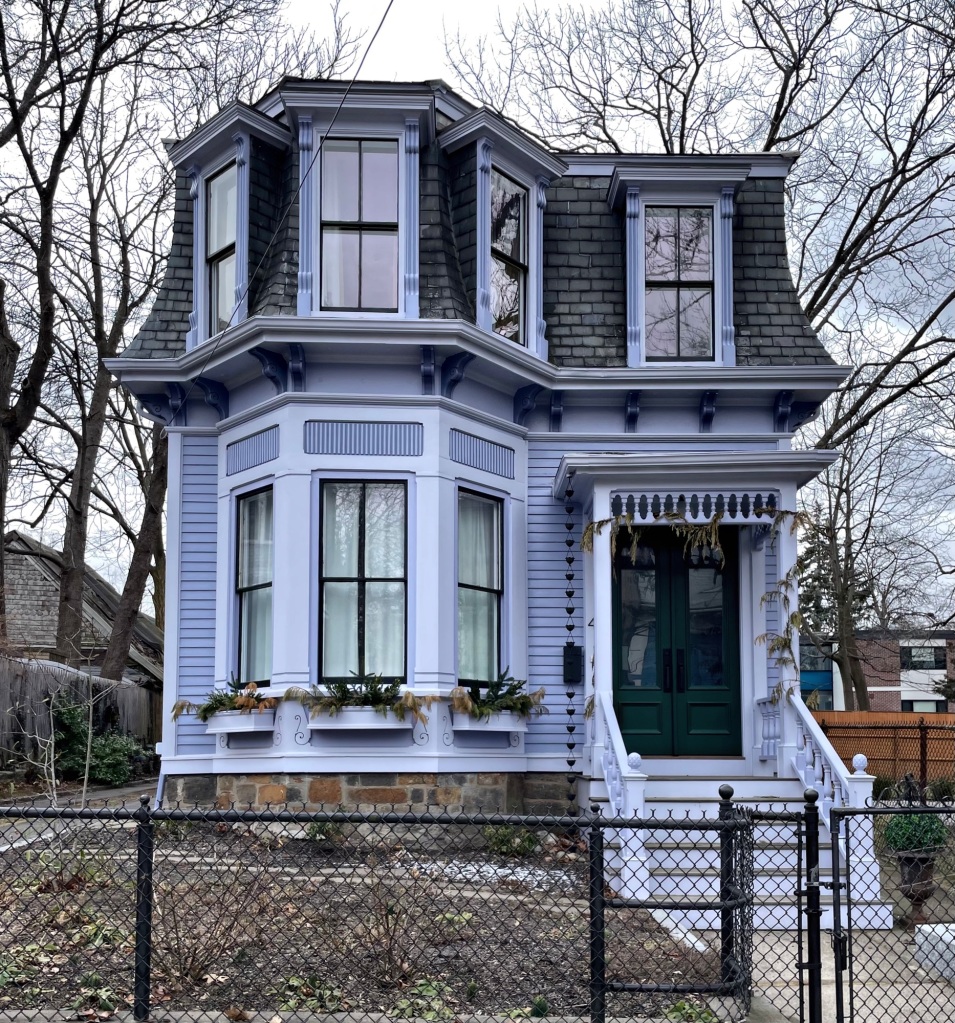
Albert Cabot Betteley (1816-1893) was an inventor and coal dealer in Boston. He invented an elevator to hoist goods into a warehouse, a peat grinder for the speedy drying of peat for fuel, and even patented wooden pavement…seriously. He eventually would build this home on Cobden Street in Roxbury where he and his wife Mary Jane would live out their retirement. While he didn’t “make it big” persay with his inventions, he exemplified the typical middle-class resident of Roxbury at the time and built this modest home, with its two-story form with octagonal bay, bracketed cornice, and mansard roof. The cottage was recently repainted the purple color, which I really enjoy!
As the Old Campus of Yale was being enclosed at its north and east by Farnam and Durfee halls, architect Russell Sturgis was again tasked to design a new building, but for a corner site; though this time, he would design a college chapel. Built between 1874–76, it was funded primarily with gifts from Joseph Battell. Succeeding two previous chapel buildings on Yale’s Old Campus, it provided space for daily chapel services, which were mandatory for Yale students until 1926, which were all-male and mostly Protestant. The large stone chapel is constructed of New Jersey brownstone with decorative elements in sandstone. The design of the Victorian Gothic chapel is great, but how it sits with the entrance unceremoniously dumping out to the end wall of Durfee Hall leaves much to be desired.
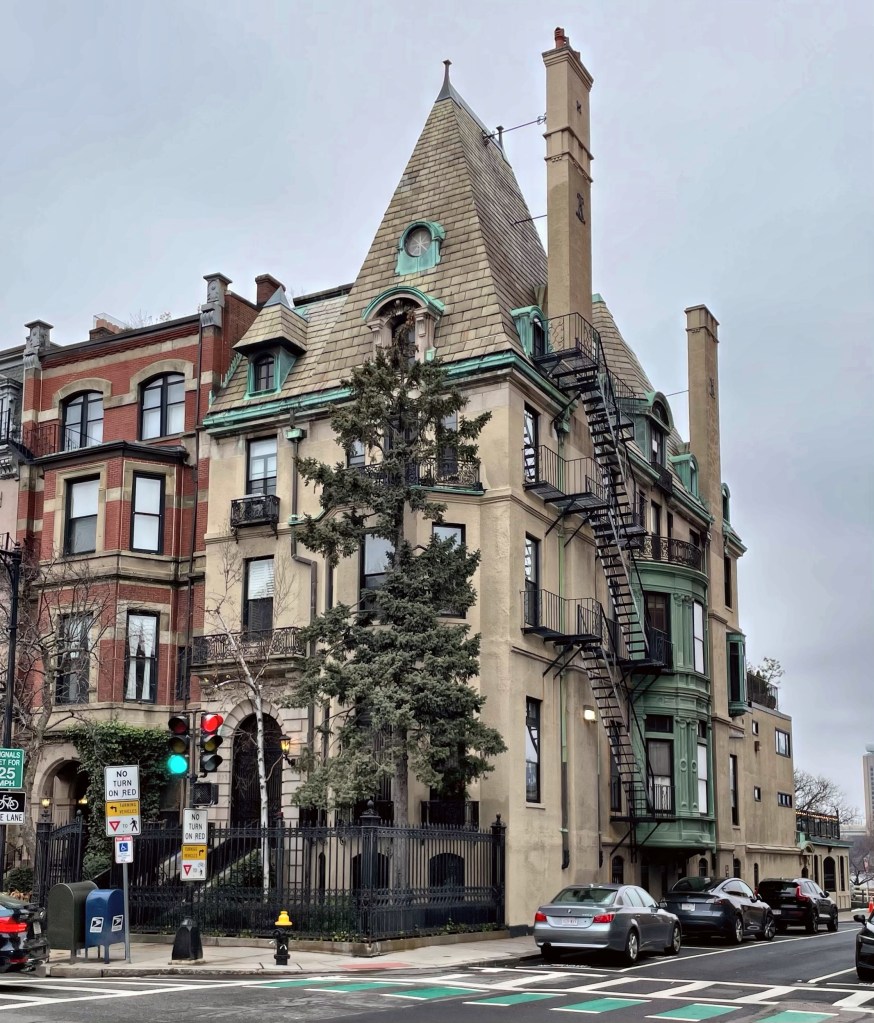
Merry Christmas to those who celebrate! As there is no snow on the ground in Boston, I wanted to share a house with a prominent pine tree, which resembles an oversized urban Christmas tree on Beacon Street. This house at the corner of Beacon and Fairfield streets was built in 1871 by architect and builder Frederick B. Pope on speculation. It did not sell as quickly as he would have hoped, and it took two years for it to finally sell at public auction in 1873. The relatively modest brick Second Empire style house was bought and sold numerous times until March 1905, when the residence was purchased by Clarence Walker Barron, a prominent publisher and journalist. In 1903, he purchased Dow Jones & Company and from 1912 until his death in 1928, he was its president. During this period, he was also de facto manager of The Wall Street Journal, he expanded its daily circulation, modernized its printing press operations, and deepened its reporting capabilities. In 1921, he founded Barron’s National Financial Weekly, later renamed Barron’s Magazine. Barron pushed for the intense scrutiny of corporate financial records, and for this reason is considered by many to be the founder of modern financial journalism. In 1920, he investigated Charles Ponzi, inventor of the “Ponzi scheme”. His aggressive questioning and common-sense analysis helped lead to Ponzi’s arrest and conviction. For his Boston townhouse, Barron hired the firm of Cram, Goodhue & Ferguson to completely renovate the dwelling with an extra floor, limestone facades, and more bold roof design.
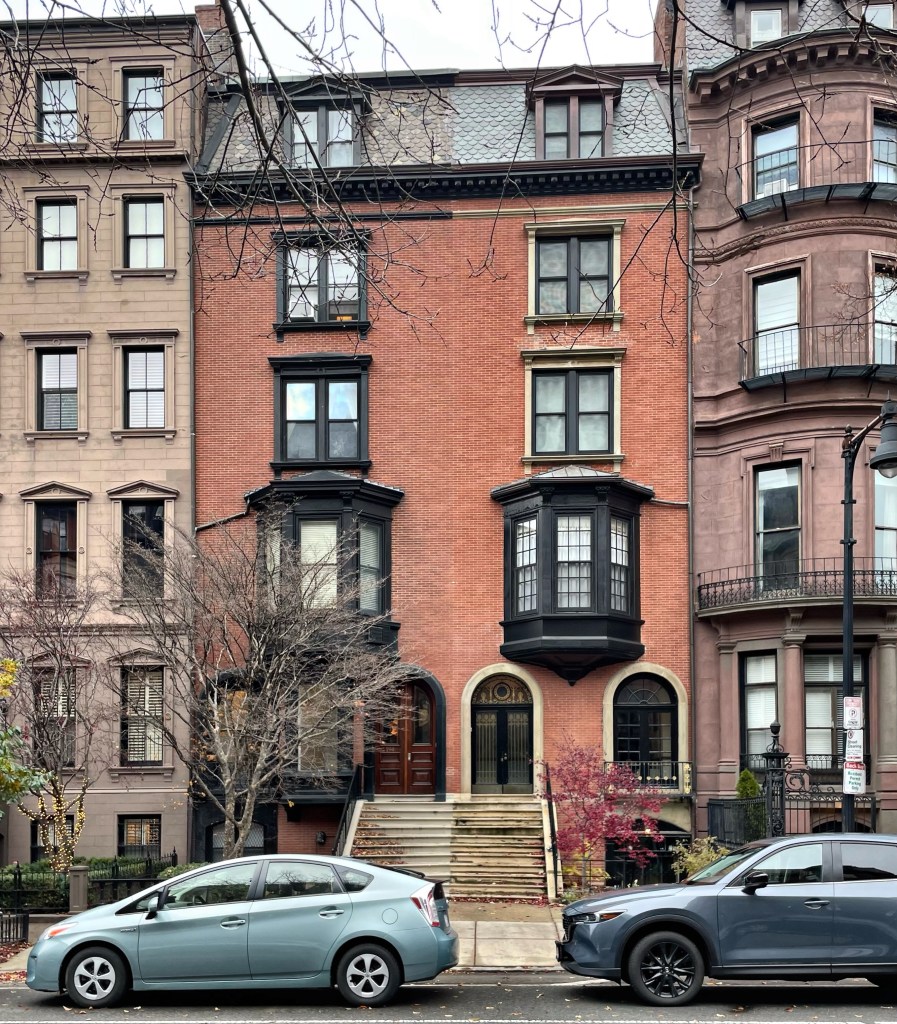
Two is always better than one, especially when it comes to historic townhouses! These two residences on Beacon Street in the Back Bay neighborhood were built in 1862 for two esteemed Boston families, the Storrows and the Meyers. 192 Beacon Street (right) was built as the home of Charles Storer Storrow and his wife, Lydia (Cabot Jackson) Storrow. Charles S. Storrow was an engineer by training and made his fortune as the chief engineer at the Essex Company, a company organized to harness the water power of the Merrimack River downstream from Lowell, Massachusetts in present-day. There, Storrow designed and built the Great Stone Dam across the Merrimack river, canals to distribute the water, several large textile mills, and a city, Lawrence, to house the mill workers. He came up with the idea to make roads that go to the mills in Lawrence, allowing him to become the first mayor of Lawrence in 1853. He retired and lived out his final years at this home in Boston. James J. Storrow, after whom Boston’s Storrow Drive is named, was Charles Storrow’s grandson. 194 Beacon Street (left) was built as the home of George Augustus Meyer and his wife, Grace Helen (Parker) Meyer. George Meyer was a prosperous German-American East India merchant and lived in this home until his death in 1889.
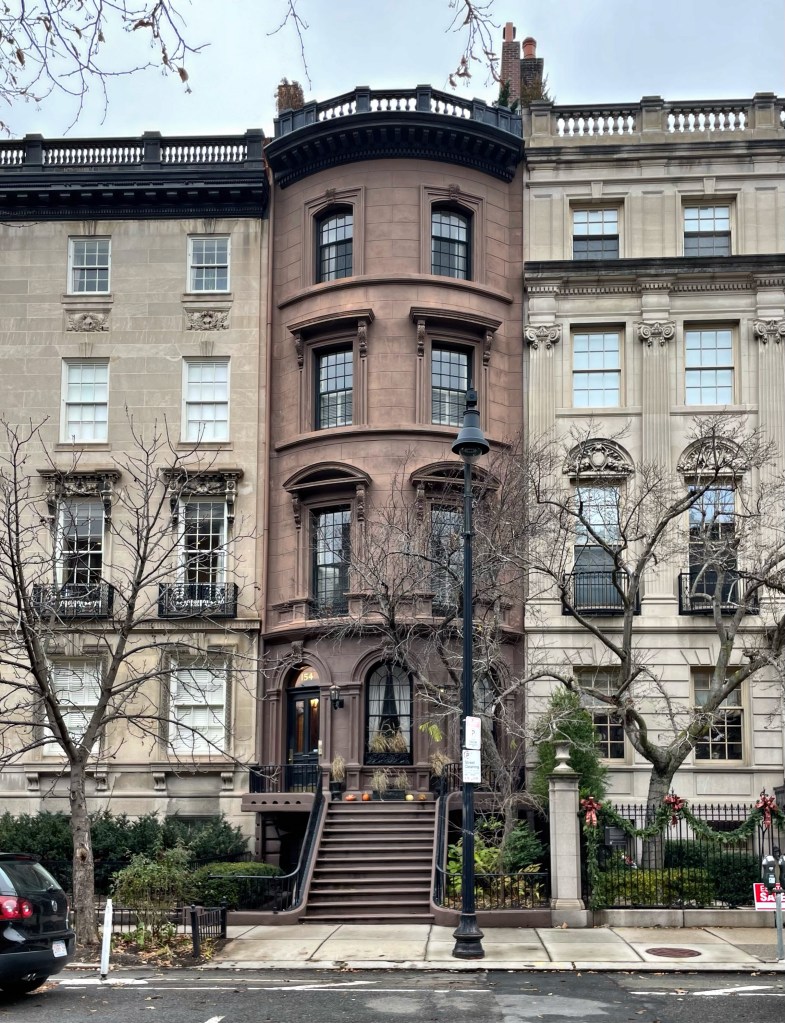
One of the most ingeniously symmetrical and academic facades on Beacon Street in the Back Bay neighborhood of Boston can be found at the Peleg Chandler House. Built in 1860 for Peleg Whitman Chandler (1816-1889), the two-bay bow-front townhouse appears to have been designed by architect Charles Kirk Kirby, a relatively unknown architect of Boston in this time period. The brownstone home originally had a mansard roof, but it was removed and replaced with a flat roof with parapet during the Great Depression, possibly to reduce the property taxes. Peleg Chandler was an attorney and publisher of the Law Reporter, which he established in 1838. He served as a member of the Massachusetts House of Representatives from 1845 to 1847 and as Boston City Solicitor from 1846 to 1853. He was an early advocate of the Public Garden and led efforts in 1859 to prevent the construction of houses on the eastern side of Arlington Street. The house has been divided up inside and now five fortunate families get to call this stunning building home!
Built ca. 1890 for Boston salesman Washington Libby Krogman (1858-1894), one of Boston’s finest Queen Anne style homes can be found in the Clam Point neighborhood of Dorchester. The pronounced sculptural qualities of this residence, together with the juxtaposition of clapboards and patterned shingles, variety of window sizes, and ornamentation place this house squarely within the pantheon of important Queen Anne designs within the city of Boston. Painted in a manner that showcases its sheathing and ornament to great advantage, this well-preserved house is particularly noteworthy for its graceful verandah that encircles a distinctive, round, conically-capped tower at its northeast corner. The home was only occupied by Washington Krogman for less than four years when he died unexpectedly in 1894 at just 35 years of age. The property was deeded to his widow Carrie for a few years before she sold the property to Thomas Francis McManus, a noted naval architect (schooner designer). The home remains one of the finest mansions in Dorchester.
Built in 1883 for a member of the Thomas Wales family, this house in Clam Point, Dorchester, possesses a compact essentially rectangular clapboard and wood shingle-clad form. The architect, John A. Fox, designed the main façade elegantly with an open Stick style porch projecting from the center of the first floor which is enclosed by a steeply-pitched roof. The pitch of the porch roof is echoed in the small and shallow gable-like lintels which are really unique to the area. The treatment makes the facade read somewhat like a face.
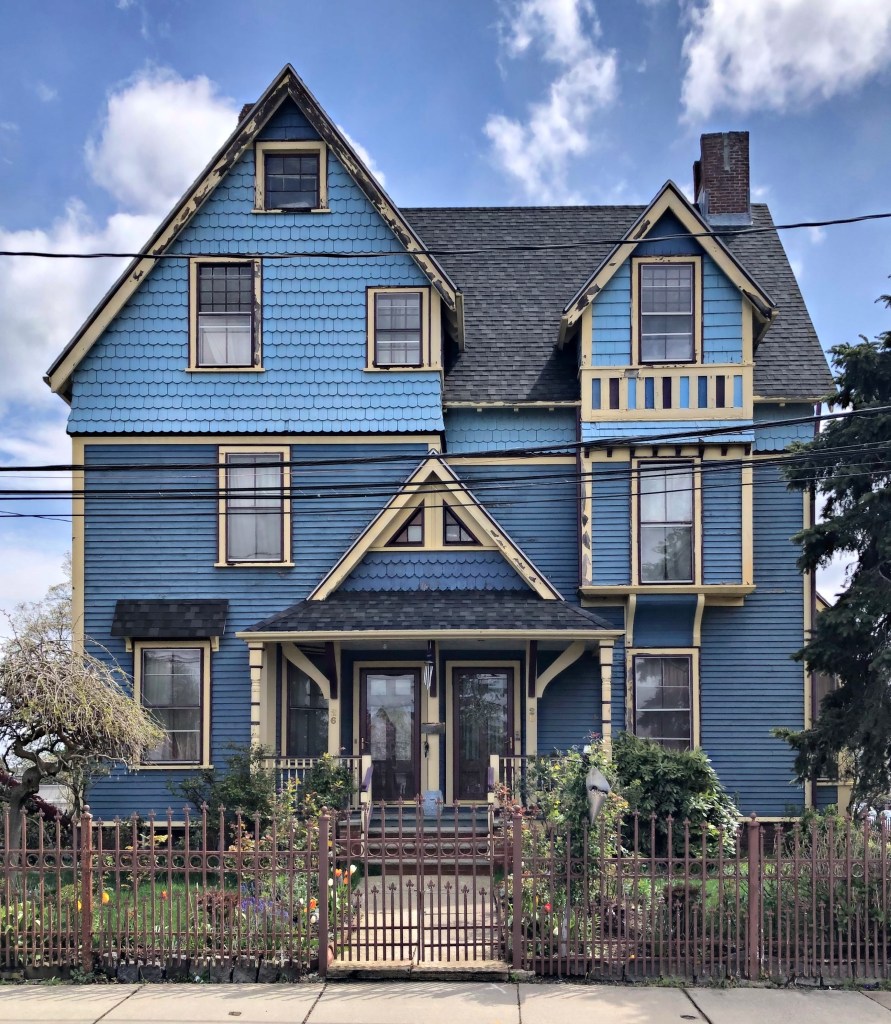
Nothing beats a good Victorian-era house! This example in the Clam Point neighborhood of Dorchester does not disappoint. The Stick-style double-house was built for miss Mary E. Noyes and Ms. Hersey replacing an older house on the lot. The women hired architect John A. Fox to design the house which possesses one of the most complex forms and roof configurations in the neighborhood. Clad with clapboards at the first and second stories, its six intersecting gables are sheathed with scalloped shingles. At the main entrance on the façade is an open porch with square posts and railings with turned balusters. The side façade is even more complex with two side gables and a two-tier porch enlivened by Chinese Chippendale and spool work railings. The Herseys, along with Mary E. Noyes, co-owned the house until 1884; thereafter it was owned by Mary E. Noyes until around World War I. The stick style home really pops with that blue color, what do you think?
For the last cottage on Grindstone Neck, I present the stunning Whelen Cottage. Charles S. Whelen (1850-1910), a banker and philanthropist who served as one of the directors of the Gouldsboro Land Improvement Company and as one of several of its stock agents in Philadelphia, purchased a house lot for him and his wife Migonette Violett. The couple did not hire Lindley Johnson, like so many other cottage-holders did, but they worked with esteemed architect Wilson Eyre to design the home. The Whelens were typical of the type of person who chose to summer on Grindstone. While comfortably well off, they were not in a financial position to commission the sort of cottages built on an ever increasing scale in Bar Harbor. The property left the Whelen’s ownership in 1897, and the house was altered and enlarged in 1900. The large porte cochere, porch, and additional rooms added at this time by William Winthrop Kent, an alumni of H. H. Richardson’s office.
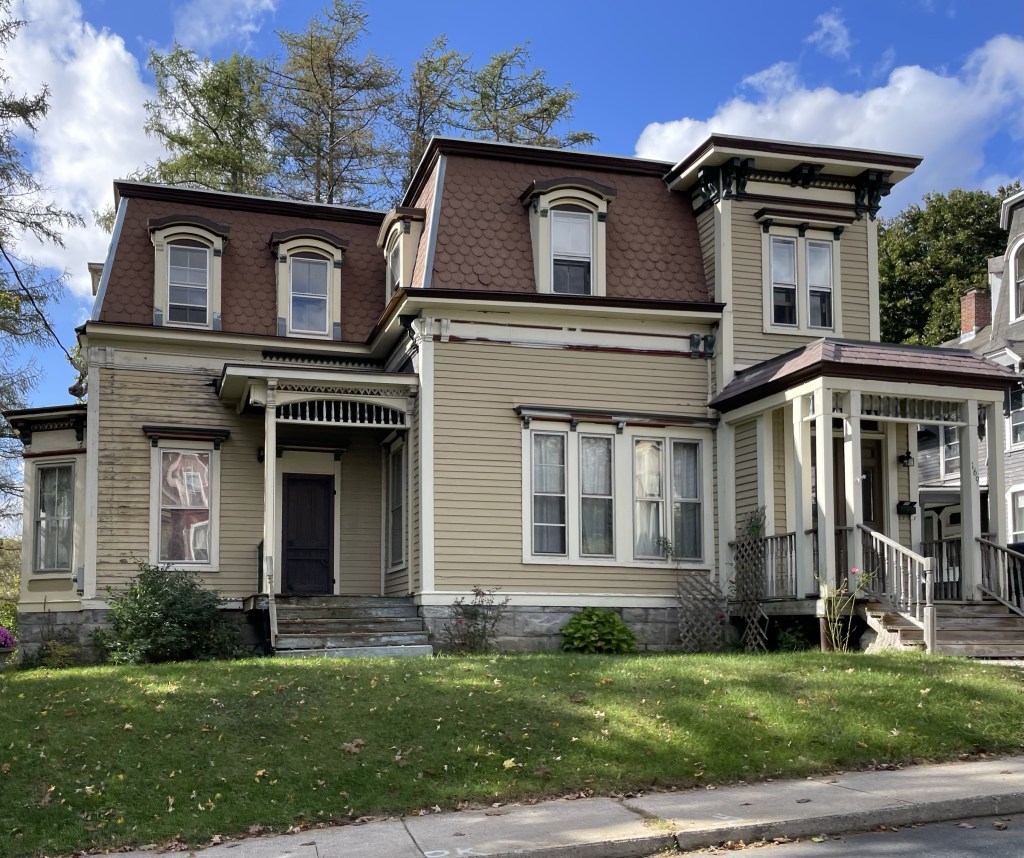
Located on the appropriately named Pleasant Street in North Adams, Massachusetts, this charming Second Empire style house is one of the finest in town. The house was built sometime between 1869-1875 for an R.J. Walden, who was listed in directories as a Deputy Sheriff for Berkshire County, an auctioneer, and real estate agent. Interestingly, the mansard roof is broken by a truncated corner tower with a flat roof. This is a unique one!
Queen Anne perfection! The Samuel Dearborn House sits at the beginning of Concord Avenue in Nashua, New Hampshire and is among the city’s finest examples of the great architectural style. Samuel Gerrish Dearborn was born in Northfield, New Hampshire, August 10, 1827. His father was an industrious farmer and allowed Samuel to be educated at Sanbornton Academy and the New Hampshire Conference Seminary. He graduated from Dartmouth in 1849 and began practicing medicine in various New Hampshire towns. He served as a surgeon during the Civil War and after, settled in Nashua, remaining a prominent doctor. He and his family were avid travelers and had trips to the Pacific northwest and Mexico. He had this stately Queen Anne style residence built in 1886 which exhibits all the hallmarks of the style. Varied materials and siding types, asymmetrical plan, ornate turned columned porch, gables with detailed shingling, and complex roofline are all so eye-catching.
Another stately Victorian-era house on Nashua’s Concord Street is this brick beauty, known as the Dana King House. The property was constructed in 1879 for Dana William King (1832-1912) who had quite a history. He was born in Alstead, New Hampshire where he lived until he was 19, moving to Boston to “make his fortune”. In 1852, he shipped aboard a whale boat in East Boston, and realized that whaling wasn’t for him. He was persuaded by his brother to move in with him in Detroit, where he worked as a grocery clerk before moving back to New Hampshire, settling in Nashua, where he did make his fortune. He began working at a local mill until the outbreak of the American Civil War, where he enlisted in the First Regiment of New Hampshire, eventually rising to the rank of Lt. Colonel. He was captured during the war and held in prison in Shreveport for over seven months, failing at least one prison escape. He was eventually included in a prisoner swap and returned to Nashua in 1865. Upon his return, King used his war stories to gather favor locally, and he was elected Register of the Hillsborough County of Deeds, a position he held for over 30 years. The King House is a great, and rare example of the Victorian Gothic style of architecture in Nashua, notable for its steeply pitched slate gable roof with octagonal corner tower serving as a belvedere or cupola.
WOW! Would you just look at this absolute stunner in Nashua? The town is not necessarily known for its historic architecture, but like most New England towns and cities, there are some amazing buildings to check out. This example, the James Tolles House, was built in 1890 and is one of the finest residences in the city. The stately residence was built for Mr. Tolles who served as Nashua’s 23rd mayor. The Tolles House stands out for the use of sandstone ashlar construction on the first floor with shingle siding above, carved terracotta panels, and a large, rounded corner tower capped with a domed copper roof. This one is pretty close to perfect!
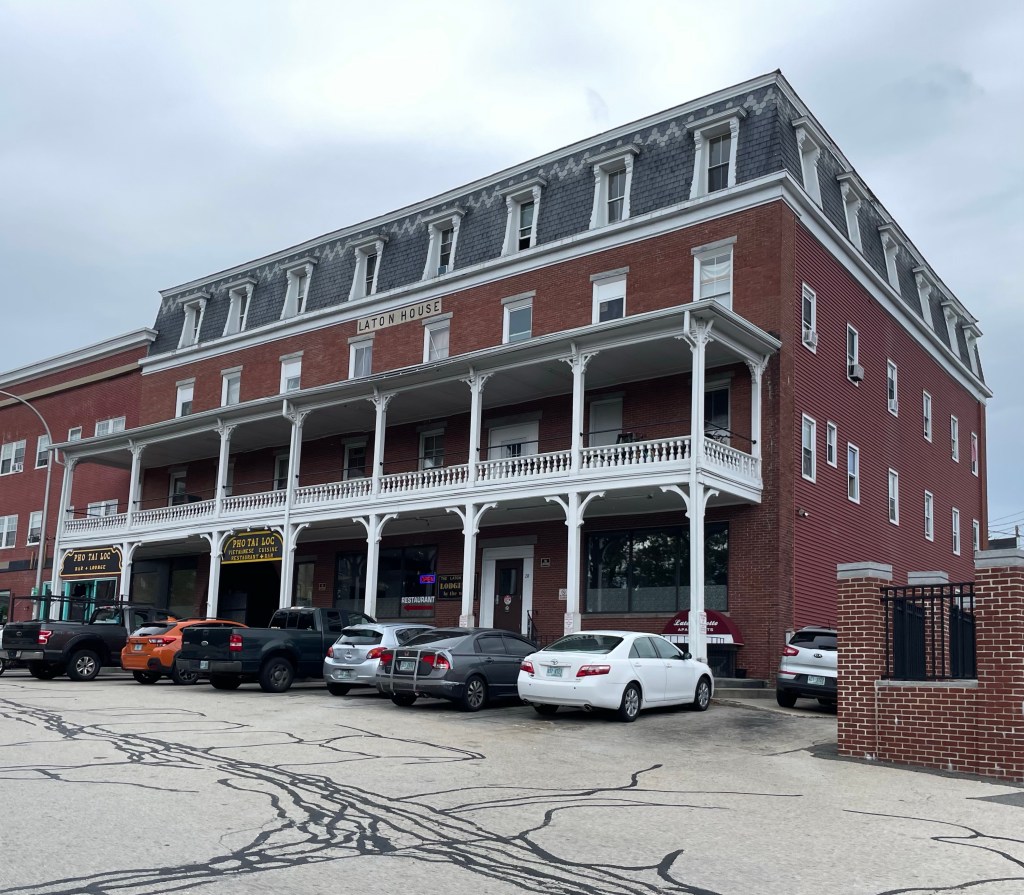
A late example of Second Empire style architecture, the Laton House in Nashua, New Hampshire, is a 3 ½ -story brick hotel building with a slate-covered mansard roof pierced by regularly spaced dormers. The facade is dominated by a two-story porch with decorative railings and brackets. The hotel was developed between 1878-1881 when Railroad Squareserved as the central square in town. The hotel thrived, allowing visitors cheap rooms while doing business in the manufacturing hub of Nashua. Eventually, the hotel closed and was converted to housing. Today, it houses commercial space on the ground floor with low-income housing above.
Dr. Eugene Forrest McQuesten was born in Litchfield, NH, on October 11, 1843. He enrolled at local schools before graduating from theJefferson Medical College in 1866. He practiced medicine in Lynn, Massachusetts for two years before moving to Nashua, New Hampshire to run a medical office. He worked in Nashua for years, later being nominated President of the New Hampshire Medical Society. In 1886, he purchased a house lot on Nashua’s Concord Street and razed the existing dwelling, building this stunning brick residence a year later.