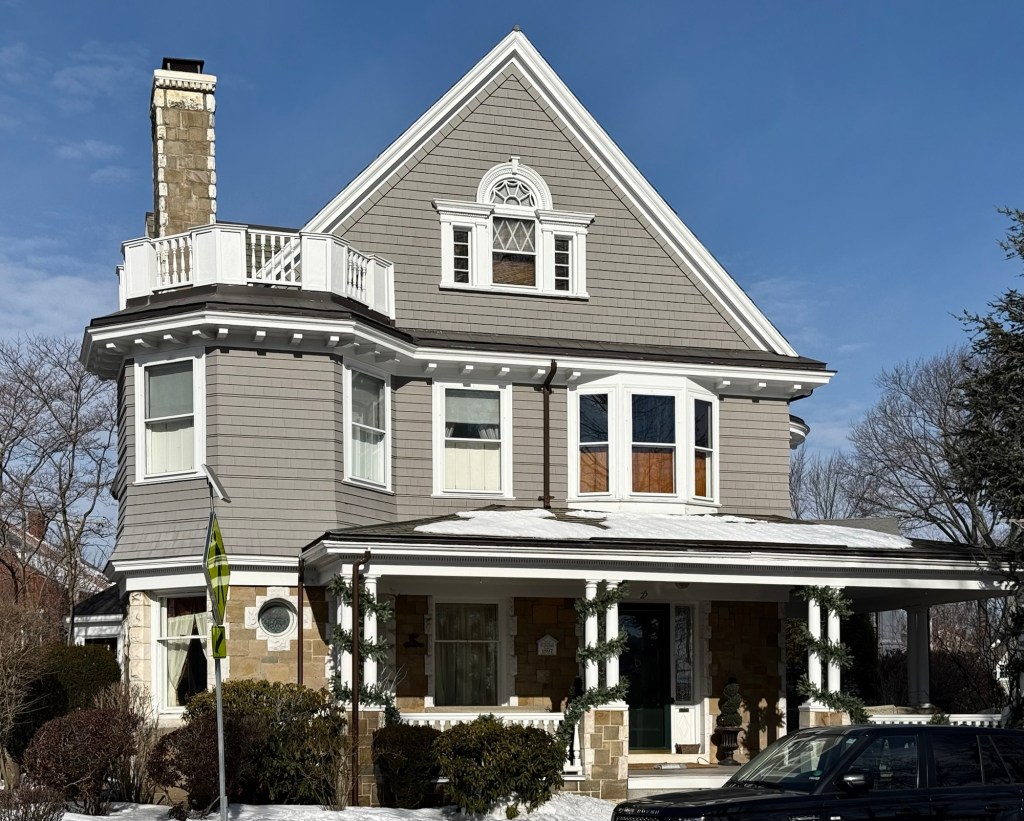
While Salem, Massachusetts, is best-known for its Colonial and 19th century architecture, there are some great 20th century buildings that deserve attention. This is the Kenneally House at 3 Williams Street, just north of the Salem Common, a c.1913 Colonial Revival home with great curb appeal. The house was built for Maurice D. Kenneally, a teamster, who lived here with his wife, Mary, and son, Patrick. Symmetrically arranged, the house has a center entry , with sidelights and an elliptical fanlight. The front facade is dominated by a full-width first story porch on paired Doric columns and a gable roof with Palladian window.
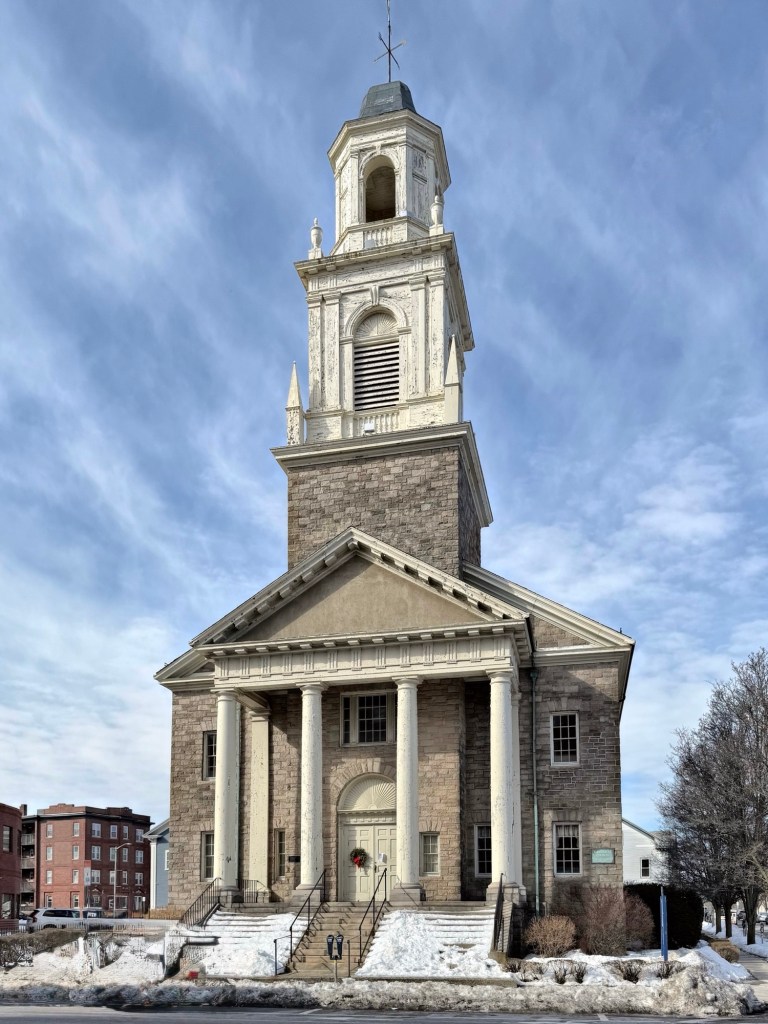
The Tabernacle Congregational Church at Washington and Federal streets in Salem, Massachusetts, was built in 1923 for one of the oldest congregations in the Commonwealth. The Tabernacle Church’s congregation traces its origins to the founding of the First Church of Salem in 1629. The church was originally located a few blocks away until a fire destroyed the wooden building in 1774. The congregation built a new wooden church on this site by 1777, and have remained on the site ever since the United States was established. The present, stone church building, was constructed from designs by the Boston firm of Philip Horton Smith and Edgar Walker in 1922. This dignified and graceful Colonial Revival church building (with attached parish house) is the third ecclesiastical structure to stand on this site. It replaced a large wooden Italianate church which the parish occupied from 1854 until it was torn down in 1922. Its predecessor, which stood from 1776 to 1854, possessed an elegant three-stage tower which Samuel McIntire added in 1805. The Tabernacle Church is a stone-veneered masonry building with a prominent engaged tower which contains a large arched entry, and a giant order porch consisting of four Tuscan columns and associated pilasters of the same type, which supports a pedimented roof that shelters the entrance. The tower is surmounted by a square, wood-frame belltower with pilastered corners above which is an open octagonal cupola with bell-cast roof. What a great Colonial Revival style church!
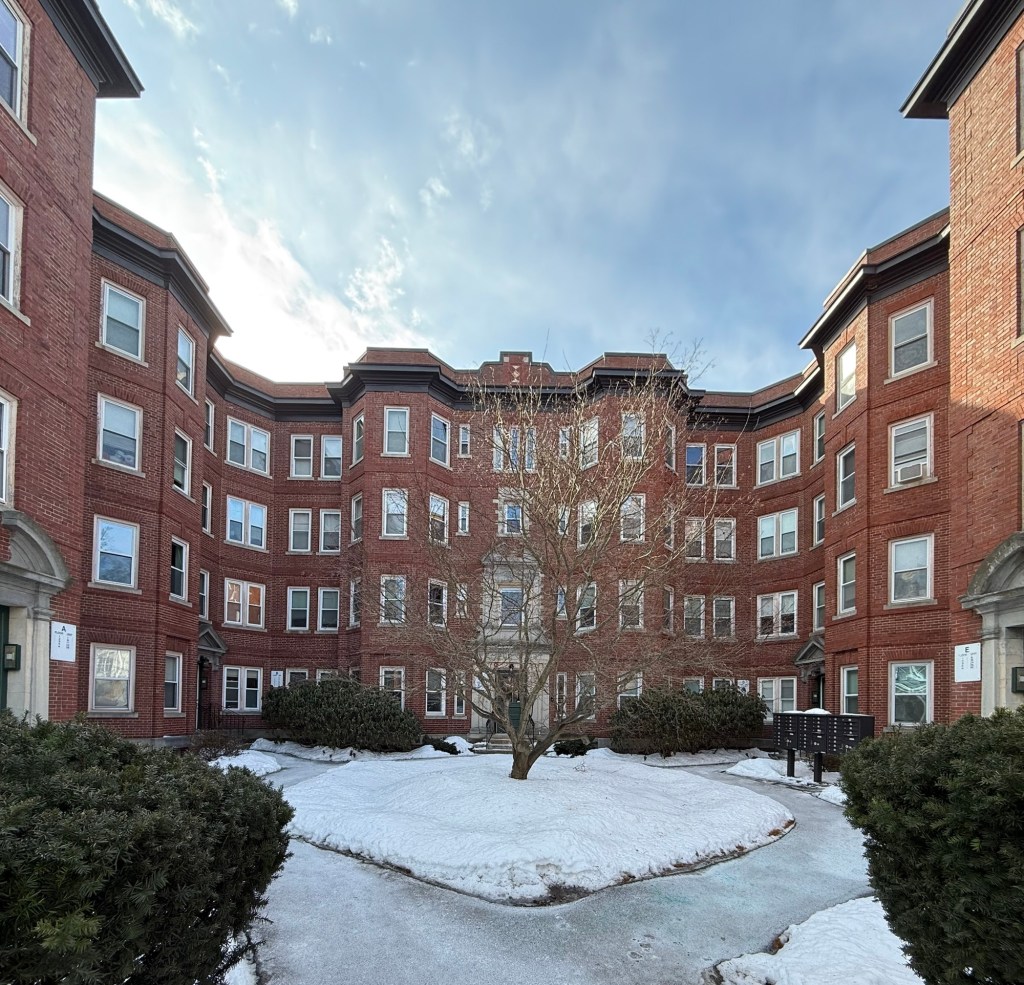
Constructed in 1912, Temple Court at 15 Lynde Street was erected on the site of two earlier buildings during a period of great population growth in Salem. The parcels here were acquired by Aroline C. Gove (1857-1939), a prominent local property-owner and developer between 1908 and 1911. Ms. Gove was a prominent Salem citizen and daughter of notable inventor and businesswoman Lydia Pinkham. With a business-oriented mindset like her mother, Aroline hired architect Harry Prescott Graves of Lowell to furnish plans for an apartment building on this site. Completed in 1912, the apartment building, known as Temple Court, included 36 units with two-, three-, and four-room suites with a live-in janitor. The building is unique for Salem as a courtyard style building, more common in Boston and Brookline. The building’s large mass is broken up by its setback with the U-shaped form and central landscaped courtyard, series of projecting octagonal bays, and multiple entrances. Temple Court was converted to condominiums in the 1980s.
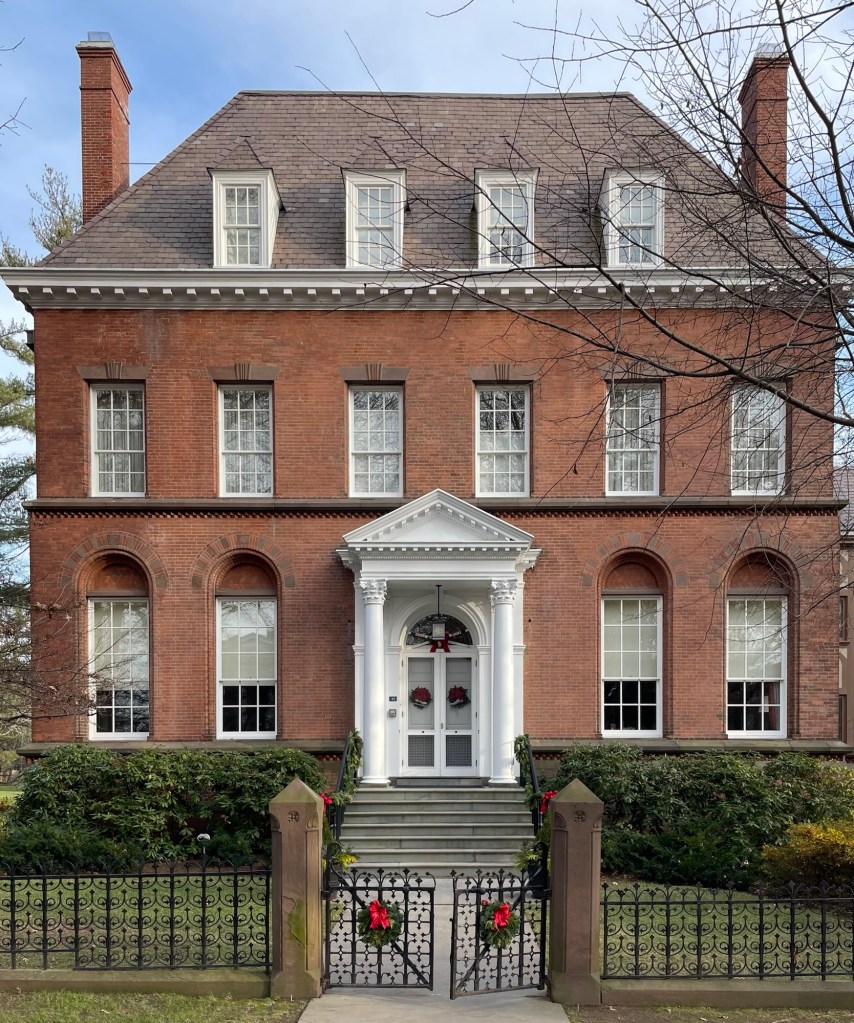
In 1871, wealthy engineer and philanthropist, Henry Farnam (1803-1883), purchased a house lot on the desirable Hillhouse Avenue in New Haven, Connecticut, where he would live out his final days in retirement. Mr. Farnam made his fortune beginning in 1839, when he was instrumental in building the railroad connecting New Haven to New York. In 1850, he moved to Illinois where he partnered with Joseph E. Sheffield to build the Chicago, Rock Island and Pacific Railroad, becoming that railroad’s president in 1854. In 1868, Farnam moved back to New Haven when he hired Russell Sturgis, Jr., to design and oversee construction on his home there. Henry Farnam also worked with Sturgis on Farnam Hall at Yale, where he is the benefactor and namesake of the building. Henry Farnam died in 1883, and in his will, he stipulated that he would gift his property to Yale College under the condition that his son, Henry W. Farnam, could live there until his death. Henry Walcott Farnam was an economist, and served as president of the American Economic Association. In 1933, the property ownership was officially transferred to Yale University, who in 1936, renovated the property, changing its appearance from Victorian Gothic to Colonial Revival. Architects, Richard A. Kimball and Ellery Husted furnished the designs for the stately residence. Since that time, the Farnam House has served as the residence of the Yale President.
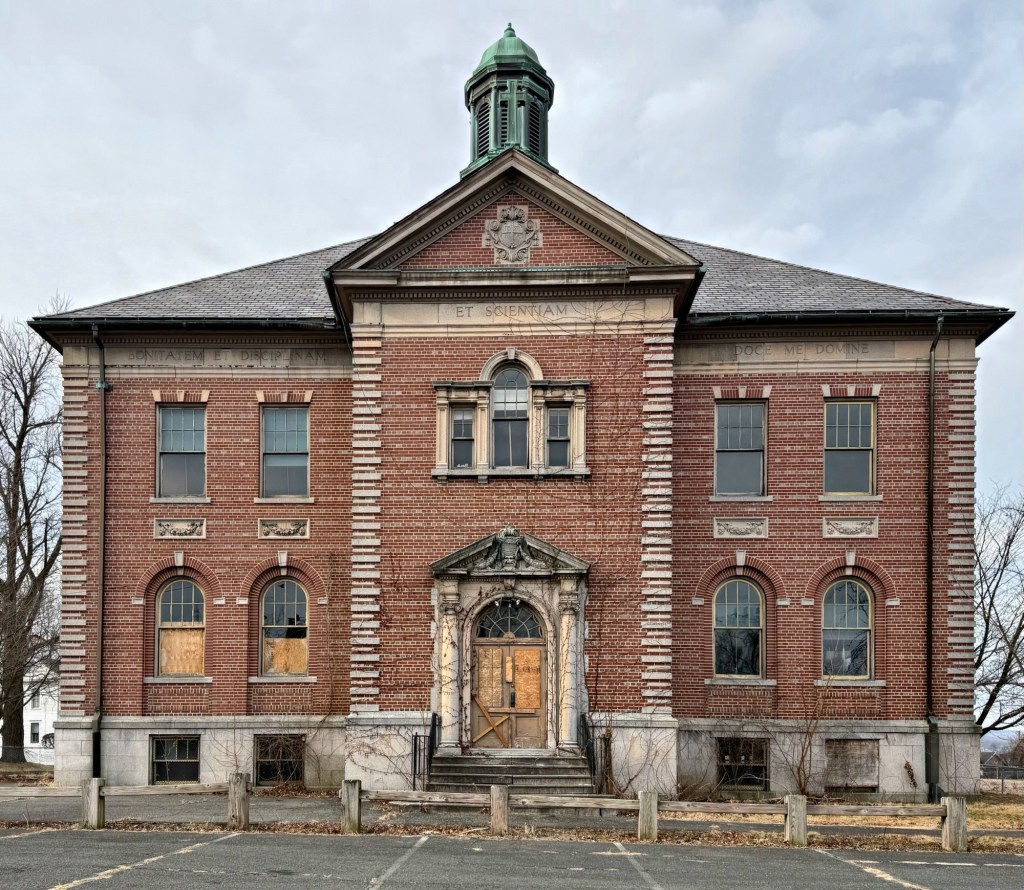
The third and final extant building on the former Church of the Holy Name of Jesus complex in Chicopee, Massachusetts, is this former school building, a stunning example of Colonial Revival architecture. Located behind the former church and rectory buildings, this three-story building was built in 1925 as a “Science” building to accompany an existing girl’s high school. Inside, the building had a “Commercial” department, where young girls could learn important skills like banking, stenography, and typing; with the second floor containing traditional science classrooms and labs along with the school library. Springfield-based architect, John W. Donahue, who specialized in ecclesiastical buildings in Western Massachusetts, designed the building in the Colonial Revival style with brick and stone construction, an elaborate entrance and Palladian window on the second floor facade. The school building closed in the late 20th century, and has seemingly sat vacant ever-since. I sincerely hope this important building could be incorporated as much-needed housing for Chicopee residents!
This site, in the heart of Cornwall village, was once occupied by an early 19th century Federal style residence, built by the wealthy Pierce family in town. The Pierces’ large home was acquired by John E. Calhoun (1859-1940), a successful New York businessman, who retreated to his father’s hometown for summers away from the city. In 1911, a fire destroyed the home, which was wood-frame construction. This event mobilized Mr. Calhoun, who was untrained but interested in architecture, to begin planning a new summer residence, but of fireproof construction. Calhoun is said to have designed (and funded) the town’s library just years before, and modeled his home in line with the Colonial-era residences in the village, just larger and of brick. From the 1950s through the 1990s, the house was occupied by the headmaster and administration of the local Marvelwood School, but was re-established as a private home, a use that remains today.
While most houses I have featured in Cornwall date to the early-mid 19th century, there are some great examples of early 20th century Colonial Revival dwellings, built at the time the town became eyed as a wealthy retreat for city-folk. This Colonial Revival residence was built for Ms. Harriet Bennett (1841-1928), an ardent suffragist and an active member of the Connecticut Woman Suffrage Association. Harriet was married to William C. Bennett and after his death in 1898, she devoted the rest of her life to charitable causes and giving back to others. As a widow and in her seventies, Harriet oversaw construction of this house, which was completed by 1912, in that same year, established the Cornwall Equal Suffrage League, hosting many of its events and meetings from this house. The League’s activities mirrored the efforts of suffragists throughout the nation. The house remains a well-preserved example of a house in the Colonial Revival style in town.
Built in 1892, at the height of the convergence of tastes of the Queen Anne Victorian and more traditional Colonial Revival architectural styles, the Louis E. Robinson House at 60 Stimson Avenue in Providence, Rhode Island, showcases the intricacies and whimsy that can be designed when a house is a blending of styles. The residence was built for Louis Elmer Robinson (not Robertson like so many sources claim), a cotton dealer and merchant, from plans by architect Frank W. Angell of the firm, Gould & Angell of Providence. The Robinson House is a gambrel-roofed mass, set gable end to the street, leaving only the ground story and side elevations in clapboard. The polygonal half-tower attached to the side elevation and its paneled grouping of windows retains the older medieval allusion of the early Queen Anne style, but with a swans neck pediment topping the stair hall window showcased the Colonial influence. I am imagining the home with a more period-appropriate color palette, but it still shines!
The period of the late 19th through early 20th centuries provided architects the opportunity of blending the two prominent styles, Queen Anne and Colonial Revival into a single composition, and as a result, this period has provided some of the most whimsical yet stately homes in New England. This modestly sized residence sits on Stimson Avenue, one of the finest streets in Providence, and despite its unassuming size, packs an architectural punch with its materials and detailing. The Henry Waldron House was built in 1893 for Henry A. Waldron, a clerk in Providence. From deed research, it appears a member of his family, Nathan Waldron, a wealthy grocer, purchased the site in 1891 and likely funded some or all of the construction of the residence there. The architectural firm of Hoppin, Read & Hoppin is credited with the design of the residence, which employs a Colonial Revival form with the gambrel roof and Columned and ornate entrance porch with fan motif, while the use of varied siding materials and octagonal tower with pyramidal roof veers into the Queen Anne style.
Apartment buildings get a bad rap, largely because of the cheaply built monstrosities built after WWII through today; but apartment buildings can be dignified and fit within their surrounding context, it just takes good design. These are the Cushing Apartments at Thayer and Bowen streets in Providence’s College Hill neighborhood. The building was constructed in 1902 for owner, Stephen Cushing Harris, from plans by young architect Frederick Ellis Jackson (1879-1950), who would have been in his mid-20s when he designed it! While not an academic example of the Tudor or Colonial Revival styles, the building blends both in a unique U-shaped form. The building is supposedly wood-frame and was eventually purchased by Brown University in 1963. The college renovated the building in 2012 to serve as an upperclassman dormitory with LBB Architects and Gilbane Construction overseeing the project. The building adds a subtle density to the block without being overbearing with the courtyard design.