Pousland House // c.1865

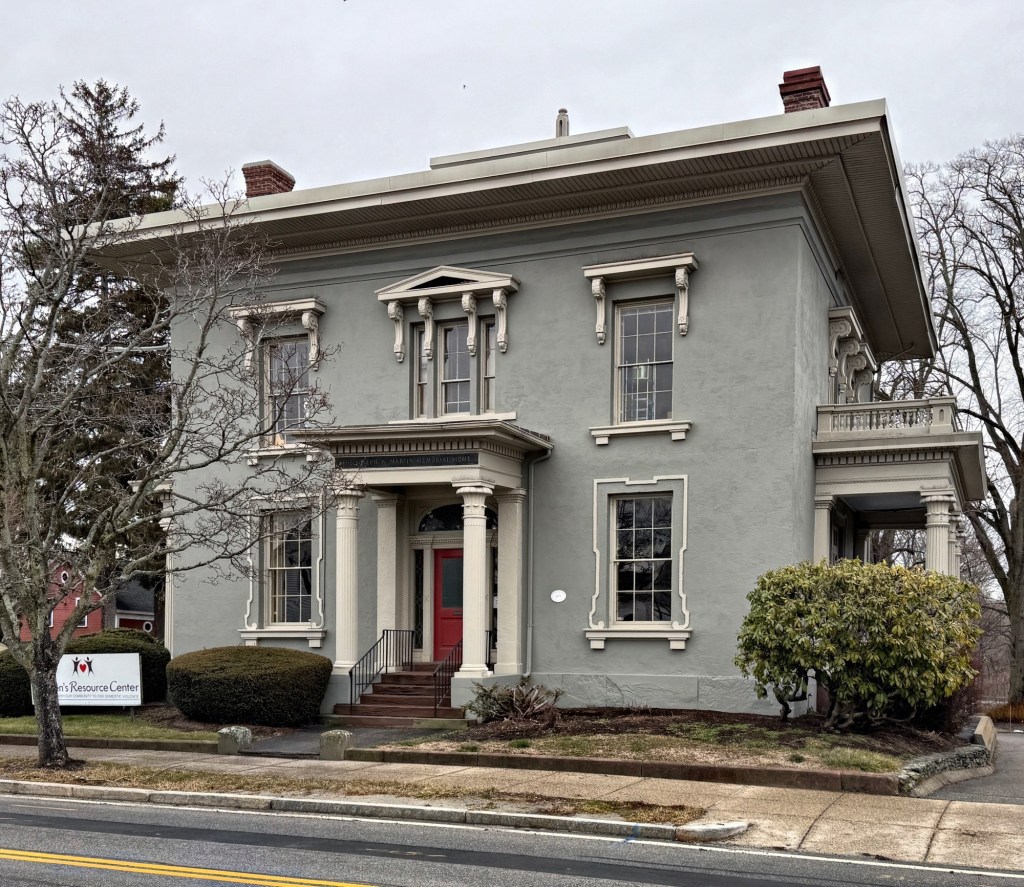
Built around 1865, this stately residence in Wayland, Massachusetts, was originally owned by sea captain, Edward Pousland who came to Wayland with his family around 1859. Interestingly, Mr. Pousland continued working as a sea captain, travelling to Salem and Beverly, where he would be at sea for months at a time. Likely due to his profession, the house features a ‘widow’s walk’, a common feature of houses by the sea where folklore holds that the wives of ships’ captains looked out for the return of their husbands. Edward, his wife Hannah W. (Langmaid) Pousland lived in this house at least until Edward’s death. After successive ownership, the property was purchased by Jonathan Maynard Parmenter (1831-1921), who gifted the house to the First Parish Church across the street, for use as a parsonage a use that continued until 1984 when the church sold the house back into private ownership. The house, designed in the Italianate style, was “modernized” in the early 20th century with Colonial Revival alterations, which added the portico and likely removed the brackets at the eaves.

First Parish Church, Wayland // 1814

The First Parish Church of Wayland, Massachusetts, is an iconic church that displays the typical early 19th-century meetinghouse form with Federal-style elaboration. Built in 1814, the church is two-stories with a five-bay gabled-front structure with a projecting enclosed portico of three entrance bays, and a four-stage bell tower that rises above the façade. Today known as Wayland, the town was originally called East Sudbury, after it split away from the western parish in 1780. In 1835, members of town meeting voted to rename East Sudbury “Wayland” in honor of Dr. Francis Wayland, a temperance advocate, abolitionist, and then president of Brown University. The First Parish Church of Wayland was built by Andrews Palmer of Newburyport, who used an Asher Benjamin design. The bell was cast by Paul Revere and Sons and first lifted into the bell tower in 1814. The property also includes the historic, twelve-bay horse/carriage sheds where parishioners would “park” their horses and carriages while attending services.

Derby Gas and Electric Company Offices // 1931

The former Derby Gas and Electric Company offices are located on Elizabeth Street in Derby, Connecticut, and stand as one of the great Art Deco buildings in New England. Built in 1931, the four-story office building features a limestone facade with bronze storefronts and light fixtures which were illuminated from the company’s plant nearby. In the 1950s the company was acquired by the United Illuminating Company.

Harcourt Wood Memorial Library // 1902

Derby’s main public library building, the Harcourt Wood Memorial Library, is located a few blocks from the city’s downtown on a unique triangular lot formed by Elizabeth and Caroline Streets. The one-story library is one of the finest of its period in all of New England and is built primarily out of Ansonia granite. The library was designed by architect Hartley Dennett and is notable for its Colonial Revival style porticoed entrance and distinctive rounded Flemish gables on the side walls. The interior is said to retain most of its original woodwork and many of its original furnishings. The building was constructed in 1902 following the donation of land and funds for its construction by Hamilton Holton Wood, a native of Montreal who made his fortune operating Derby’s streetcar railway system. The library is named in honor of Wood’s son Harcourt, who died at the age of 12 in 1897. The community does a great job at preserving the structure, which is one of the finest of its type in the region. 

Former Derby Savings Bank // 1893

The former Derby Savings Bank stands at the corner of Main and Caroline streets and is one of the many handsome commercial buildings in Derby, Connecticut, which have been preserved. Designed in the Romanesque and Classical Revival styles, the building is adorned by terracotta, brick, and brownstone, with medallions depicting the date of incorporation (1843) and the date of this building (1893) which flank the Palladian window at the second floor. The bank occupied this structure from the date of its completion in 1893 until it built a new banking facility farther down Main Street in 1923. The bank again built a new building during the period of urban renewal in Derby’s downtown in 1976 when the modern structure at Main and Elizabeth streets was completed. The Modern bank is presently used as the City Hall.

Former Birmingham National Bank // 1892

The former Birmingham National Bank building on Main Street in Derby, Connecticut, is one of the finest buildings in the former industrial village of Derby (originally named Birmingham). The bank was originally chartered in 1848 as the Manufacturers Bank of Birmingham, with Edward N. Shelton as its first president, and became a national bank after the Civil War. Designed by architect Warren R. Briggs and constructed in 1892, the building features an elaborately detailed facade of red sandstone with terracotta trim in the Sullivanesque and Romanesque Revival styles. Like many local and regional banks in the mid-late 20th century, the bank merged with others and the building was vacated. Today, the former Birmingham National Bank building is occupied by the Twisted Vine restaurant.

Randall House // 1927

This handsome stone mansion in Derby, Connecticut, was built by industrialist Walter Randall (1868-1949) and his bride, Olive Vouletti Whitlock Randall (1870-1938), in 1927 on a tract of about 200 acres of farmland. Olive was a granddaughter of Isaac Merritt Singer, the inventor of the first practical sewing machine for home use, which made him one of the wealthiest men in the world. It is unclear as to who the architect was, but the stone residence was built in an English Tudor/Arts and Crafts style, possibly from stones taken from the 200-acre estate. The property was sold in 1950 to Harold and Ida Yudkin, who developed much of the land into a shopping center and housing development, but maintained this stone house and a smaller parcel surrounding it. That smaller parcel was purchased in the 2010s by a developer who restored the old house, and developed a small cul-de-sac of “green” homes on the aptly named, Singer Village Drive.

Immanuel St. James Episcopal Church // 1843

The Gothic Revival style Immanuel St. James Episcopal Church of Derby is a landmark example of the style in this part of Connecticut and serves as the eastern anchor to the Birmingham Green in town. The church dates to 1843 and was built by The stone church was was built by stonemason, Harvey Johnson and Nelson Hinman, a carpenter. The land for the church was donated by Sheldon Smith and Anson G. Phelps, wealthy industrialists in town. The building originally had a wooden steeple, which was replaced by the present stone belfry in 1853. The church merged with another area congregation, which together, have preserved this significant structure, though the communications antennae on the battlements on the belfry is unfortunate.

Dr. Albert Phillips House // c.1875

Dr. Albert W. Phillips (1838-1929) was born in Marcellus, New York, the son of immigrant parents from England. He studied medicine in the Midwest and later opened a medical practice in Rockport, Illinois, but in response to President Lincoln’s first call for volunteers, he returned to New York and enlisted as a private in the Union cause. He served as assistant surgeon with the 149th N. Y. Volunteers, where he saw action in many battles, including at Gettysburg. After the war, Dr. Phillips moved to the rapidly developing industrial city of Derby, Connecticut, where he opened a family practice. By the 1870s, he built this Stick style residence on Caroline Street. While working as a doctor of great esteem, Dr. Phillips was elected as the fifth mayor of Derby in 1901 and in 1903, was elected as a state senator.His home on Caroline Street in Derby maintains its unique entry porch and trusswork in the gables.

Smith-Curtiss House // c.1714

The Smith-Curtiss House, which is possibly the oldest extant building in Derby, Connecticut, has sat vacant and decaying for years and is owned by the State of Connecticut. Believed to have been built sometime between 1714 and 1740, this historic saltbox farmhouse at 411 Hawthorne Avenue is slowly decaying due to lack of maintenance and funding. Early ownership is difficult to determine, but by the 19th century, the property was owned by Ms. Alice E. Curtiss. The old estate was sold by Ms. Curtiss in 1913 to Frances Osborne Kellogg, a businesswoman, philanthropist and environmentalist, as part of her 350-acre dairy farm and land-conservation holdings. The Smith-Curtiss House was used as a residence for the herdsmen who ran the farm nearby. Before her death in 1956, Frances deeded the property to the state as a public park, and allowed her head herdsman life-occupancy of this house for the remainder of his life. The State of Connecticut assumed possession of this house in 1981. The building has suffered from deferred maintenance since this period, with the State attempting to lease the building to tenants. I hope that local and statewide preservation groups can mobilize to secure grants and funding to restore this important property.