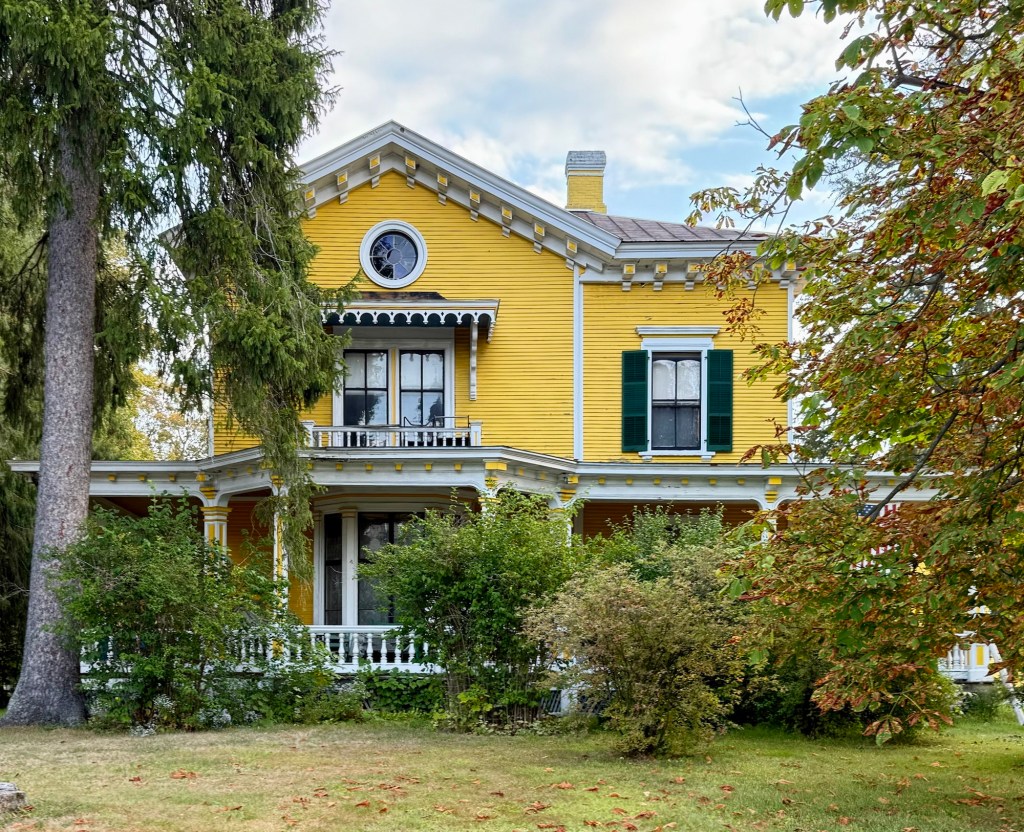
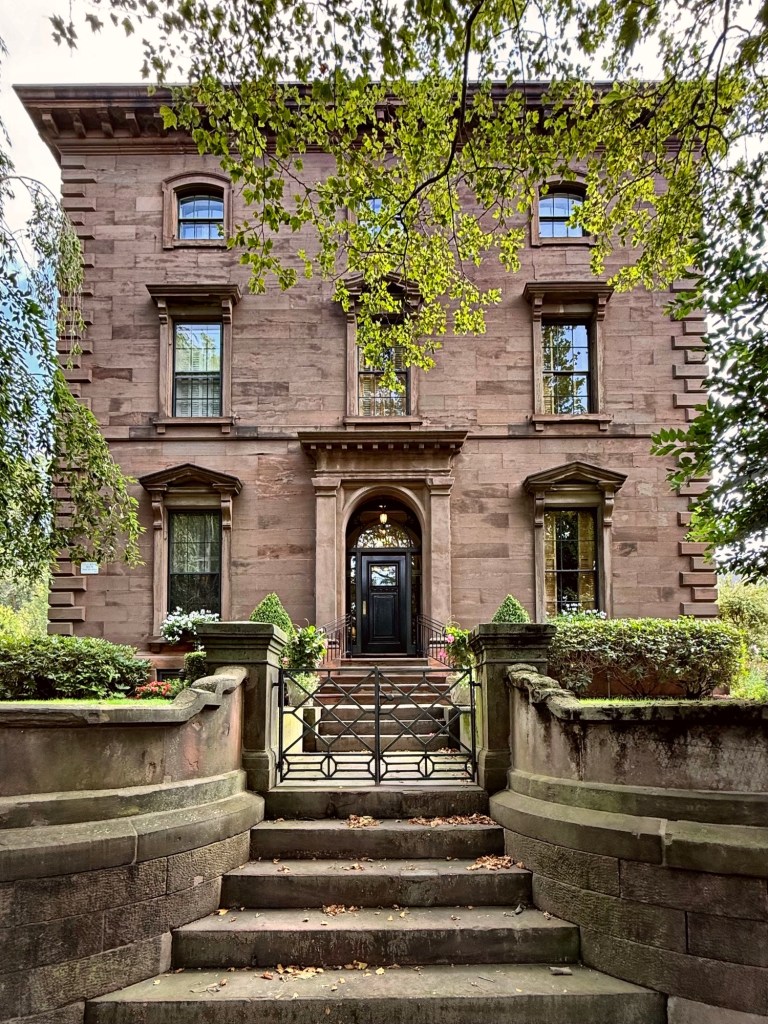
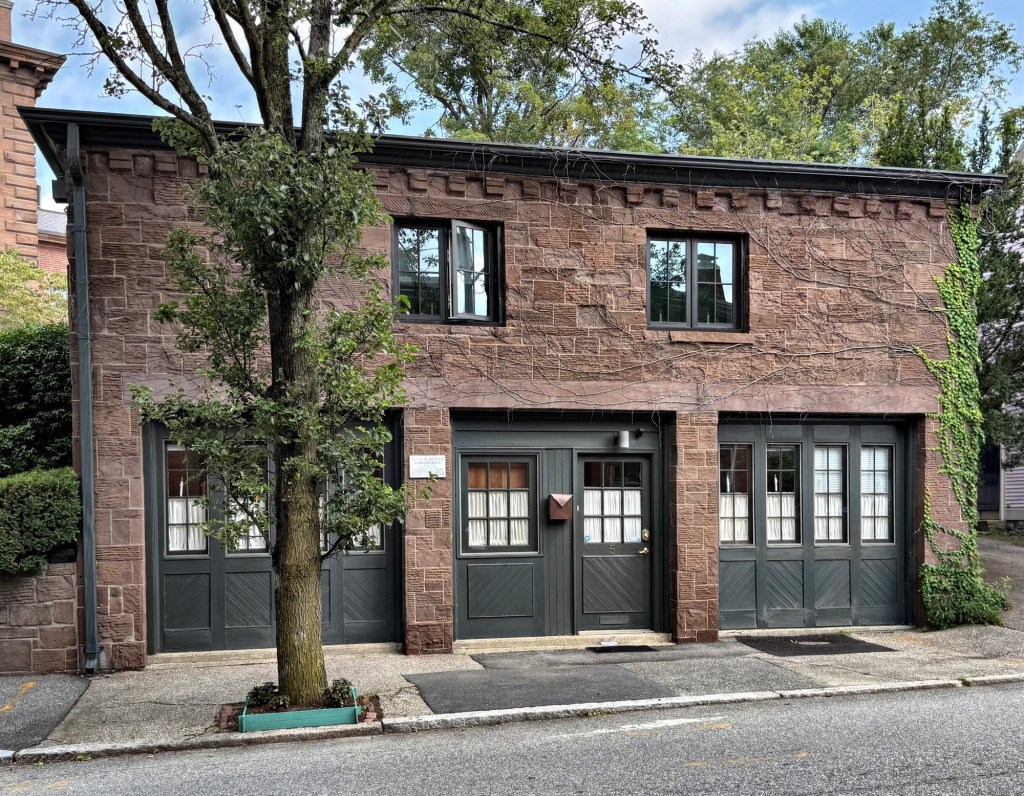
Zenas Lane House // c.1860

The Zenas Lane House on Union Street in Rockland, Massachusetts, was built circa 1860 for its namesake, a shoe manufacturer who later engaged in real estate and local politics. Zenas Meriet Lane married Emeline Morse and had this handsome Italianate style residence built on the town’s main street. The two-story house is capped with a shallow hip roof with eyebrow window heads breaking the eaves. At the rear of the site, there is a preserved carriage house which echoes design details from the main structure.

Arnold Shoe Factory // 1875

Moses Noyes Arnold (1844-1919) was born in Abington, Massachusetts and began making shoes in his free time, a task that would make him his fortune later as an adult. After serving in the Civil War and mustering out in 1863, he began a shoe-making business from his father’s property before renting a small factory space in town to increase operations. His company continued to grow and it was decided that Arnold would build his own factory in town. In 1875, Moses N. Arnold began the building of the main wing of the present brick shoe factory near the railroad station in North Abington. As the M. N. Arnold Shoe Company grew, five additions were made until it attained its present capacity of 3,000 pairs of shoes daily. The company weathered the collapse of the stock market in 1929 but the economic instability took its toll on the company, leading the company to sell in 1931 to the Stetson Shoe Company of South Weymouth. This factory was sold at auction and later in 1943, was purchased by The Abington Company which manufactured, installed, and serviced vacuum cleaning systems for textile factories. The handsome brick, Italianate style factory remains in a great state of preservation, and showcases the type of factories built all over New England following the Civil War. 

George Washington Smith House // c.1886

This house on Westminster Road in Canterbury, Connecticut, is architecturally distinguished by its extensive and imaginative detailing, which reflects the widespread availability of manufactured architectural ornament in the Victorian period. The porch columns, archways, bay window, and round-arched windows all reflect an Italianate influence and the work of its original owner, Mr. George Washington Smith (1857-1937). The house dates to about 1886 when George W. Smith, built it from his workshop formerly located across the street. Smith manufactured mast-hoops, the wooden fixtures for attaching sails to the masts of sailing ships, and utilized his woodworking skills to build and decorate the exterior of his family home.


Nathan S. Horton House // c.1860

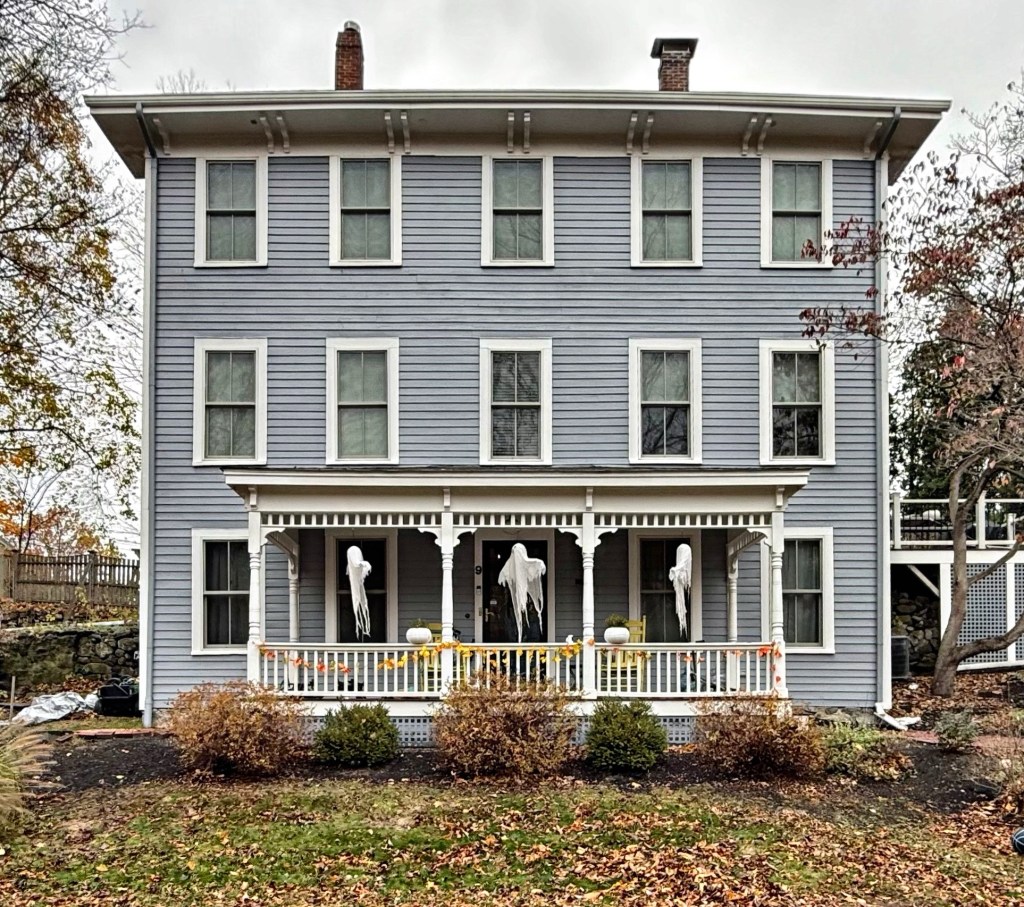
This modest, Italianate style house was built around 1860 by a carpenter and builder as his own residence. Nathan S. Horton (1819-1916) was a busy builder in Central Falls, Rhode Island in the mid-late 19th century as the population boomed along with the industrial growth and wealth that the city saw. For his own residence, Horton built this two-story wood-frame house with side entrances and porches, paired brackets in the eaves, and arched top windows, all commonly found in the Italianate style, popular around the time of the Civil War. Mr. Horton lived to his late 90s and likely remained in this home until his death.

Former Broad Street School // 1861

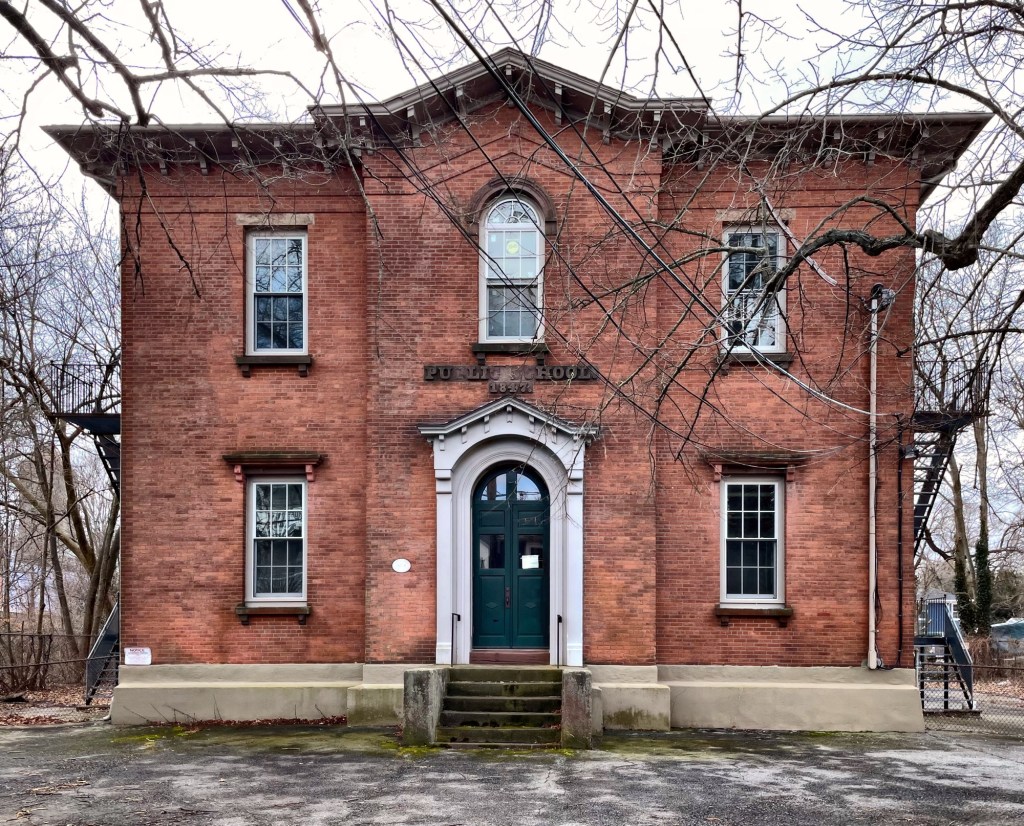
The oldest extant school building in present-day Central Falls, Rhode Island, is this brick schoolhouse, constructed in 1861, to serve as the main village school. The rather plain two-story brick building was built just before the Civil War, during a period of rapid industrialization and growth in Central Falls, when it was then the dense core of the town of Smithfield, Rhode Island. The building contained classrooms for pupils from elementary through high school. Italianate in style, the rather unadorned building does feature oversized windows with some containing rounded tops, deep eaves, and a subtle recessed arch in the central bay on the facade. The school has been vacated for some time, and in 2024, plans materialized to convert this building into affordable housing. Hopefully the renovation/restoration is thoughtful for such a significant piece of the city’s history.

First Baptist Church of Salem – Essex Law Library // 1805

The First Baptist Church of Salem was built in 1805 on Federal Street and is the oldest brick meetinghouse in Salem. The local Baptist congregation was established in 1804 when 24 parishioners formed the First Baptist Church, and began gathering funds to elect a pastor and build a house of worship. At the time, Baptists were a religious minority in Massachusetts, where nearly all churches were Congregational, so against large odds, the parishioners funded a brick building and lot on the prominent Federal Street in Salem. The structure was completed by 1805 and is said to have been one of only fifty brick structures that stood in the city at the time. A major renovation to the building occurred in 1850, when the church was renovated in the Italianate style. Its three bays are articulated as an English basement containing three identical entrances framed in heavy rusticated brownstone. A belt course separates this basement from a principal story composed of tall arched windows capped by drip-molded brownstone. A lunette window is the centerpiece of the strongly projecting modillioned pediment. The entire composition is very pleasing and showcases the ever-evolving architectural tastes in the 19th century. A tower was later removed due to structural issues. In the early 21st century, the site of the church was needed for an expansion of the Essex County Courts. The congregation sold the property and in the following year, the old brick church was moved a couple hundred feet to the west and restored and was converted into a law library for the new courthouse. Talk about historic preservation at work!

William Hunt Double-House // c.1858

The William Hunt Double House, located at 10-12 Lynde Street in Salem, is a 2 ½ story wood-frame Italianate building that showcases the emerging presence of the Victorian style on residential buildings in the mid-19th century, even in cities with strong support for Colonial and Federal period styles. The two-family house was built by William Hunt, a prominent Salem merchant, as a rental property with occupants of the building in 1859 including: John W. Lefavour, a cashier, and Benjamin F. Faber, a merchant. The property remained in the Hunt Family for three generations, and was converted to a boarding house in the 1930s. In November 2018, a fire gutted much of the building, displacing the residents, and concerned neighbors as to the future of this great property. Luckily for us, the owners hired  Seger Architects, Epsilon Associates and Groom Construction to fully restore the building to its former glory. The resulting project won a Salem Preservation Award and received Federal and State Tax Credits to offset restoration costs. What a great success story!

Norton Mansion – Steinbach Hall // 1849

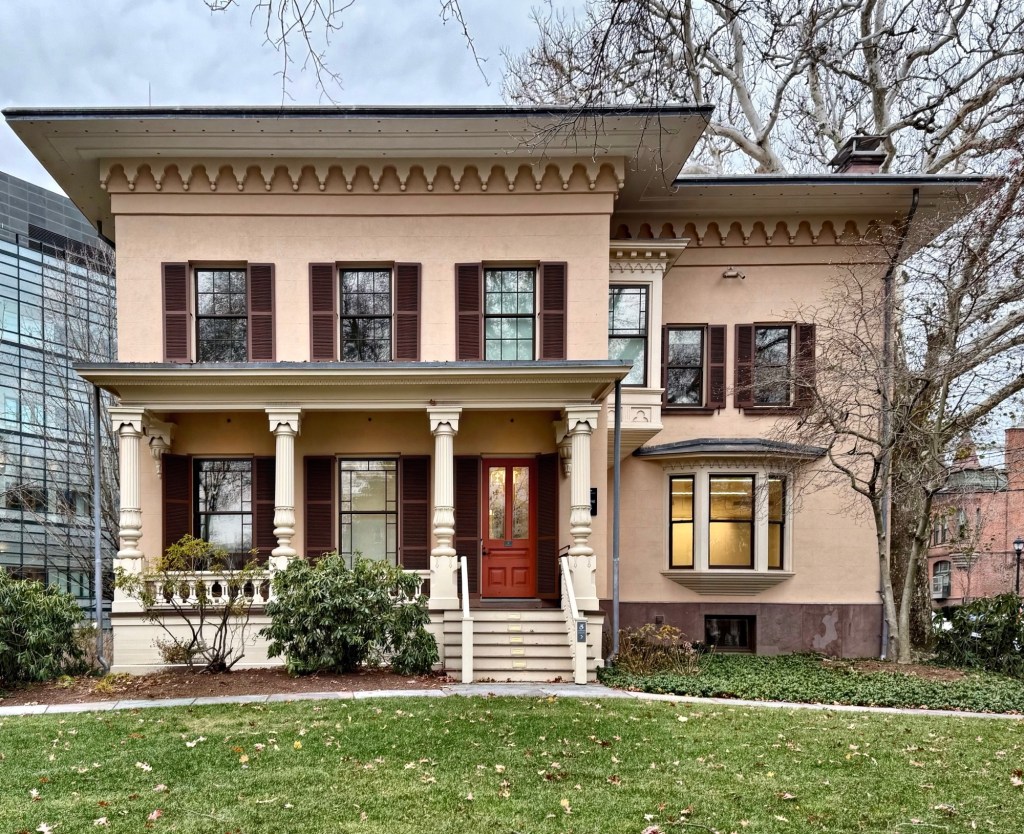
John Pitkin Norton (1822-1852) was a successful educator, chemist, and author, who at just 27-years-old, built this stately mansion on Hillhouse Avenue in New Haven, Connecticut, for his young family. John P. Norton studied chemistry under Benjamin Silliman at Yale College, and was eventually appointed Professor of Agricultural Chemistry at Yale in 1846. He helped to found the Department of Philosophy and the Arts at Yale College and authored many scientific papers, dealing with the chemistry of crops. Coming from an established family and beginning a successful career himself, John hired New Haven-based architect, Henry Austin, to design this large, Italianate villa. The window surrounds, canopies, and flamboyant Moorish entryway are typical of Austin, with the general form and detailing taking cues from architect Alexander Jackson Davis‘ work. The Norton Mansion was purchased by Yale University in 1923 and was long the home to the Yale School of Management and is now occupied by the Jackson School of Global Affairs.

Perit House – Horchow Hall // 1859

This Italianate Villa style mansion on Hillhouse Avenue in New Haven, Connecticut, was built in 1859 for Pelatiah Webster Perit (1785-1864), a successful New York City shipping merchant and president of the New York Chamber of Commerce. Perit split his time between New York and New Haven and would hire architect, Sidney Mason Stone, to design this home on Hillhouse Avenue in New Haven. The brownstone residence is notable for its elaborate scroll brackets supporting the window pediments and front entry portico with arched doorway with rope moldings. The mansion was occupied by Perit for just four years until his death in 1864, and it was later owned by Henry Lucius Hotchkiss, a businessman. Like nearly all buildings on Hillhouse Avenue, the building was acquired by Yale University and is now known as Horchow Hall, and is part of the Yale School of Management.

Graves-Dwight House // c.1862

Hillhouse Avenue in New Haven, Connecticut is lined with stunning 19th- and 20th- century mansions showcasing the evolution of styles and architectural taste for the wealthiest residents. This is the Graves-Dwight House, a high-style Italianate mansion built around 1862. The residence was built for John Samuel Graves (1807-1892), a local businessman and politician who was a founder of the New Haven Gas Light Company. The architect is not known, but the house is the work of a skilled designer with immense attention to detail. The highly ornamented exterior features a symmetrical facade, bracketed cornice and window hoods, a recessed third-floor balconette with segmental arch pediment above, and bold, period-appropriate paint scheme. The residence was later owned by James McLaren Breed Dwight, a lawyer, and his wife, Cora Tallmadge Dwight. Since the 20th century, the property has been owned and preserved by Yale University, and is now home to the Archaeology Department.