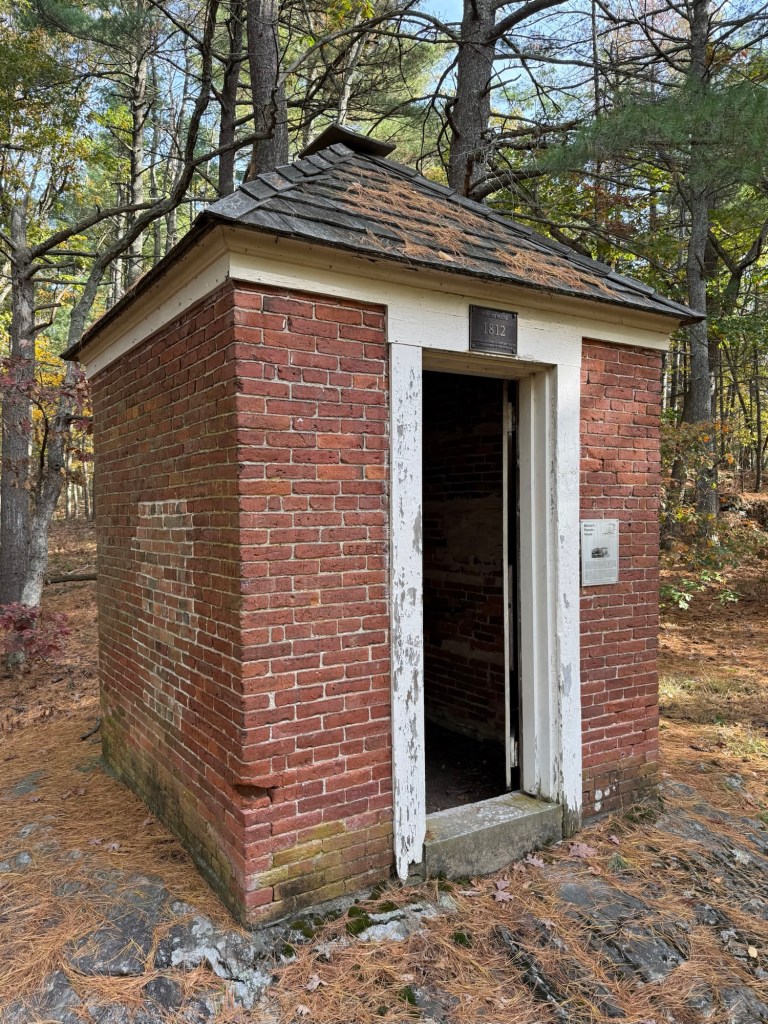
Hidden away in the woods behind the Bolton Town Hall, this small brick structure sits atop a rocky outcropping and showcases a piece of early history we often do not think about. Built in 1812 as a powder house, a storage facility far from homes and businesses to store the town’s supply of gunpowder, musketballs and cannonballs, the structure remains as the town’s oldest extant municipal building. Since the founding of the colonies, the procurement and storage of ammunition had been the responsibility of local governments. Before this structure was built in the forest, Bolton‘s gunpowder and ammunition had been kept under the meetinghouse pulpit, not the best place suitable for highly explosive storage. The structure is a well-preserved example of a typical early 19th-century powder house, built of brick manufactured in town, laid in common bond, measuring just over seven-feet square with a pyramidal wood shingle roof.
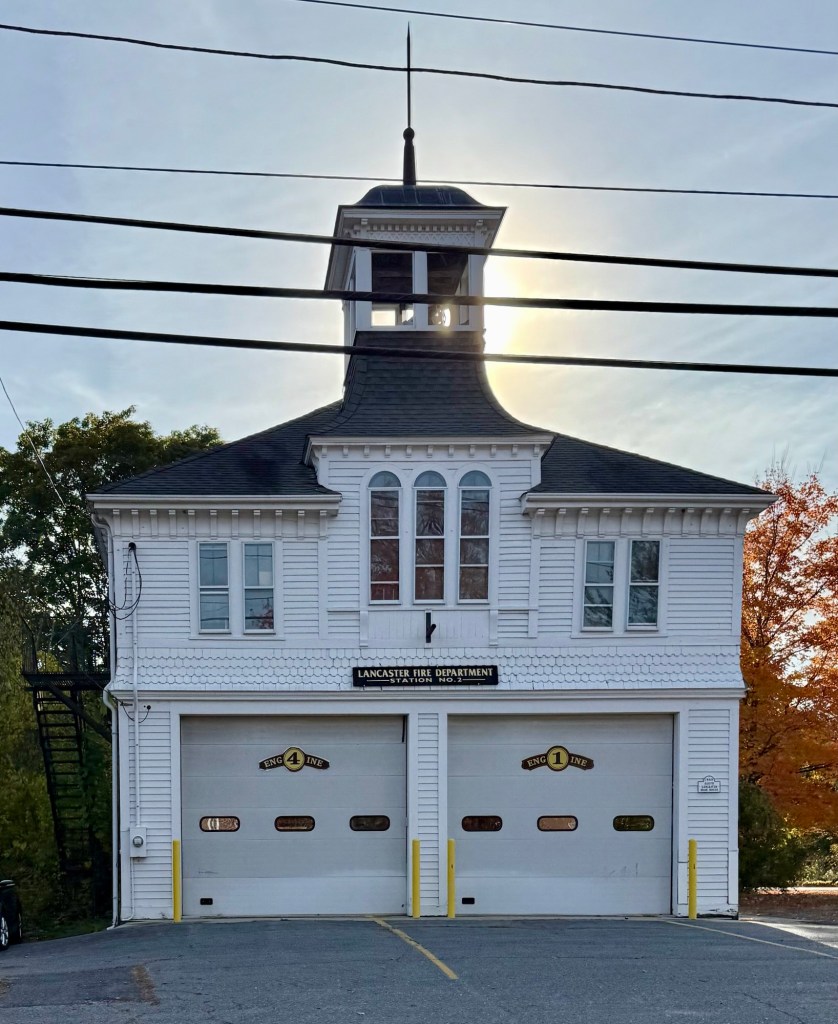
The South Lancaster Engine House is located in the village of South Lancaster, Massachusetts, and is one of the town’s three remaining historic fire stations and the oldest that remains in use by the local fire department. At the Town Meeting of June 18, 1887, it was decided that $3, 500 would be expended to build a station for the Fire Department in South Lancaster. Construction began in 1887, and was completed in March of 1888 from plans by architect, C.A. Woodruff. The station housed horse-drawn wagons, including one sleigh, and featured a bell in the belfry to call attention to the public. The station appears much like it did when built in 1888, besides the bright white paint color and the modification of the engine doors for the new, larger fire trucks.
The Stone Village of Chester, Vermont, is said to be the largest collection of stone buildings in the state, and is anchored by its largest building, the Unitarian Church. Built in 1845, the Unitarian Universalist Church is one of a few dozen “snecked ashlar” buildings in the region, where rubblestone is laid up with mortar using small long stones called “snecks” to tie an outer and an inner wall together. The construction method is said to have been brought to the area by masons from Scotland and Ireland which is known there as ‘Celtic Bond’. Oral tradition state that Scottish masons from Canada introduced the technique to local masons while erecting a mill in nearby Cavendish in 1832. Local Chester resident, Dr. Ptolemy Edson became such a fan of the building that in 1834, he had his home, the first stone building in Chester, built in this method. Dr. Edson served on the building committee for the new village church, and likely pushed for a cohesive material and construction method for this church and other buildings soon after. The Stone Village Unitarian Church blends Greek Revival and Gothic Revival styles in a more vernacular way, typical in many rural Vermont communities. The building exhibits stained glass windows that were added sometime in the late 19th or early 20th century.
The Yosemite Engine House on Route 103 in Chester, Vermont, is a unique and iconic architectural landmark that has stood for almost 150 years. Chester’s second fire district was established in 1871, following a number of large fires in the village, prompting funding from businessmen and the town for a new engine house. Built in 1879, the Yosemite Engine house was built as a fire station for the village defined by its rectangular massing, first-floor engine hall, second-floor meeting hall, and twin bell and hose-drying towers that are capped by mansard roofs. The station originally housed horse-drawn and human-operated fire engines until the 1920s, when the doors were enlarged for the first engine-powered fire truck. The fire district, a separate taxing entity from the town since its creation, was dissolved in 1967, and its properties, including this iconic fire station, reverted to the town. It was eventually sold into private hands, and was operated for a short time as a museum by the local historical society before being reacquired by the town in 2018. The building is awaiting a full restoration.
The Pierce-Guild House at 53 Transit Street in the Fox Point neighborhood of Providence, Rhode Island, is one of the most iconic and photographed residences in the state. Known as a “lightning splitter”, the unique name is taken from local folklore that the sharp angle of the gable roof will deflect or split lightning if struck. Whether or not this superstition is true, the unique house form numbers to less than a dozen in Rhode Island. This house, arguably the most well-known for its location off Benefit Street, was originally built in 1781 as a modest 1-1/2-story cottage with a gambrel roof for Daniel Pierce (Pearce), a tailor. In 1844, the property was sold to George Guild, a grocer, who modernized the house by creating the massive gable roof to provide a narrow third floor, which was illuminated by the end windows and a diminutive dormer at the roof. The house retains much of its character, after a restoration by owners in the mid-late 20th century.
In 1802, Kingston-based merchants and landowners Benjamin Delano and brother-in-law Peter Winsor built this stone wharf and warehouse at Rocky Nook, a small peninsula at the end of the Jones River where it meets Plymouth Bay. The Rocky Nook had several warehouses in the early 1800’s which were used to hold cargo for the busy Kingston vessels that carried passengers and goods all down the eastern seaboard for transit, with larger vessels sent to the West Indies for trade. Benjamin Delano and his son Joshua either owned or partly owned 37 vessels between 1803 and 1882 and were a wealthy family that built their fortune on shipbuilding and trade. The warehouse, built at the end of the wharf was used to store goods and also served as a ship chandlery, a store selling goods needed for newly outfitted ships that were berthed up the Jones River. A combination of the coming of the railroad and the need for faster and bigger vessels caused the decline of the shipping business in Kingston in the late 19th century with the shipbuilding industry largely evaporating by the 20th century. The Delano warehouse at the end of the wharf has since been converted to a private residence yet retains its unique character and siting with arguably the best view in town.
Overlooking the town green in Kingston, Massachusetts, this stately Greek Revival home was once the original town house for the community, containing meeting hall, town offices and even a jail cell! Before we go into that further, it is helpful to learn about history first. Present-day Kingston was within the tribal homeland of the Wampanoag people, who in the decades prior to the arrival of the Mayflower, saw their populations decimated from a rapidly spreading pandemics due to earlier contacts with Europeans. Originally part of Plymouth, Kingston was first settled by Europeans shortly after the landing of the Pilgrims at Plymouth Rock in 1620. In 1717, residents in the northern part of Plymouth petitioned the General Court to be set off from Plymouth as a separate township or a precinct. They were allowed to become the north precinct of Plymouth on the condition that they maintain a suitable minister. The northern precinct was wealthier and led to present-day Kingston incorporating as its own town in 1726, following a tax dispute. Early town meetings were held in the parish church until the separation of church and state necessitated a new town hall. The town hall here was built in 1841. As the town grew the building was re-oriented southward and enlarged in 1871 from plans by architectLuther Briggs. Further alterations were made to the building in 1935 under the guidance of the architectural firm of J. Williams Beal & Sons. In the early 2000s, space, parking, and accessibility concerns led the Town of Kingston to sell the 1841 Town House, which was purchased by private owners and converted to a residence. Inside, remnants of the old town house include old signs, office doors for city departments, former vaults converted to closets, and even a jail cell in the basement. Talk about a unique adaptive reuse!
Located at the corner of Washington Street and Welles Avenue, the Dorchester Temple Baptist Church was designed in 1889 by architect Arthur H. Vinal, as one of the best examples of a church designed in the Shingle Style in New England. The church began in 1886 as a mission church of the Tremont Temple Baptist Church in Boston. At this time, Dorchester was a semi-rural area and would surge in development when the streetcars were electrified in the 1880s. With a rapidly developing neighborhood, the congregation here, purchased lots and hired Vinal to furnish plans for a house of worship. The church’s cornerstone was laid October 3, 1889, with the church membership numbering ninety-nine at that time. Membership would decline in the decades following WWII, and shifting racial and ethnic demographics in the neighborhood brought new members to worship here. The building was renamed as the Global Ministries Christian Church by the current congregation, who with the assistance of preservation grants, worked with Mills Whitaker architects to restore the iconic landmark. Specific details of the building stand out, including the stained glass windows, the belfry with bulbous form, and the arched openings with continuous shingled walls.
A playful interpretation of a medieval English cottage, with its stucco cladding, half-timbering, weatherboards in the gable ends and ornamental well enclosure in the front yard, can be found on Woodland Road in Brookline. The whimsical cottage was built in 1928 for Arthur B. Bernard, the son of the president of the New England Leather Company in Boston’s Leather District. Arthur would follow his father’s footsteps and join the business himself. Architect and builder, Fred S. Wells of Newton designed and constructed the house (and others in the area in the same style). What’s your favorite part of this house?