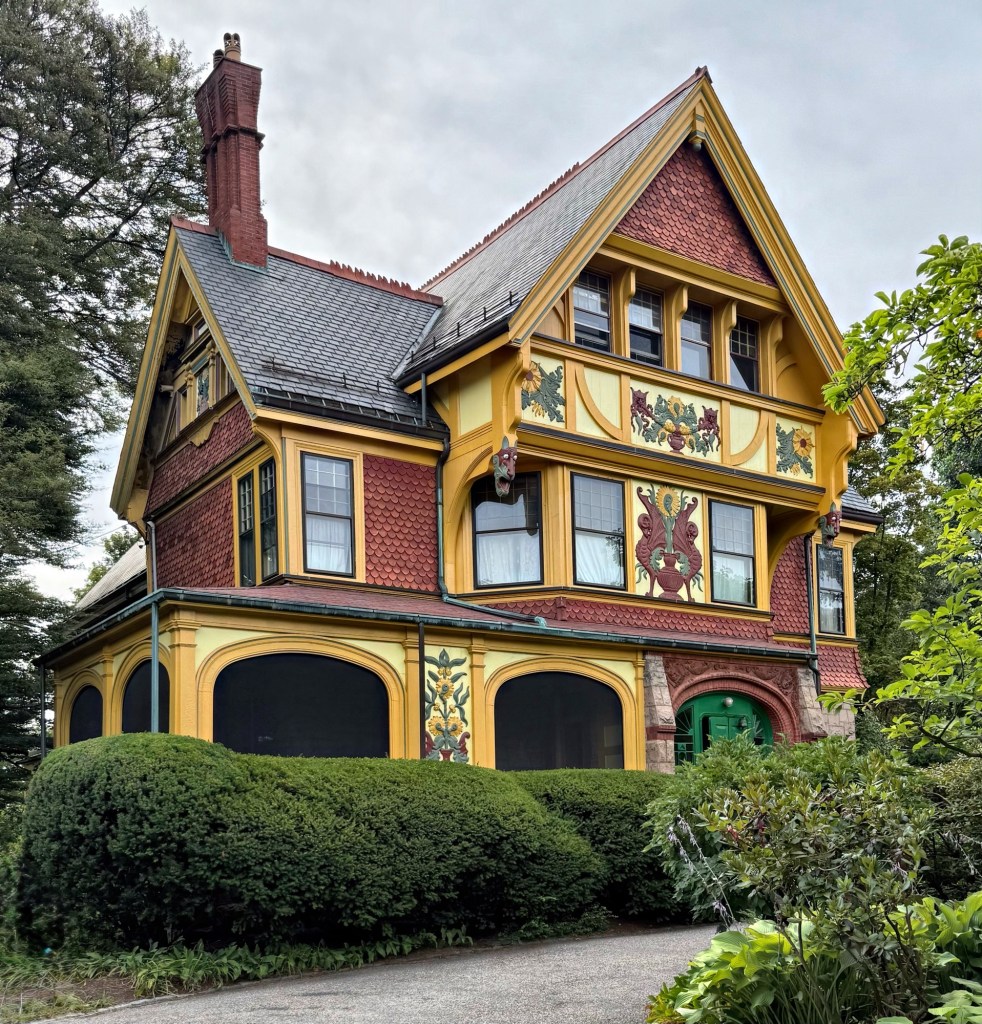
The Edward Stanwood House at 76 High Street in Brookline, Massachusetts, is one of the finest and exuberant examples of the English Victorian Queen Anne style, notable for its varied wall textures and materials, unique form, and applied ornament. The house was built in 1879-1880 for Edward Stanwood, who was for many years the editor of the Boston Daily Advertiser, and a children’s magazine, The Youth’s Companion. The ornate residence was designed by Clarence Sumner Luce, with interiors by Thomas Dewing. The Stanwood House features a well-preserved exterior and period-appropriate paint scheme, highlighting the bas-relief sunflower ornament and gargoyles. Of particular note is the use of hung tile siding, overlaid to give the appearance of fish scales and the roof cresting.
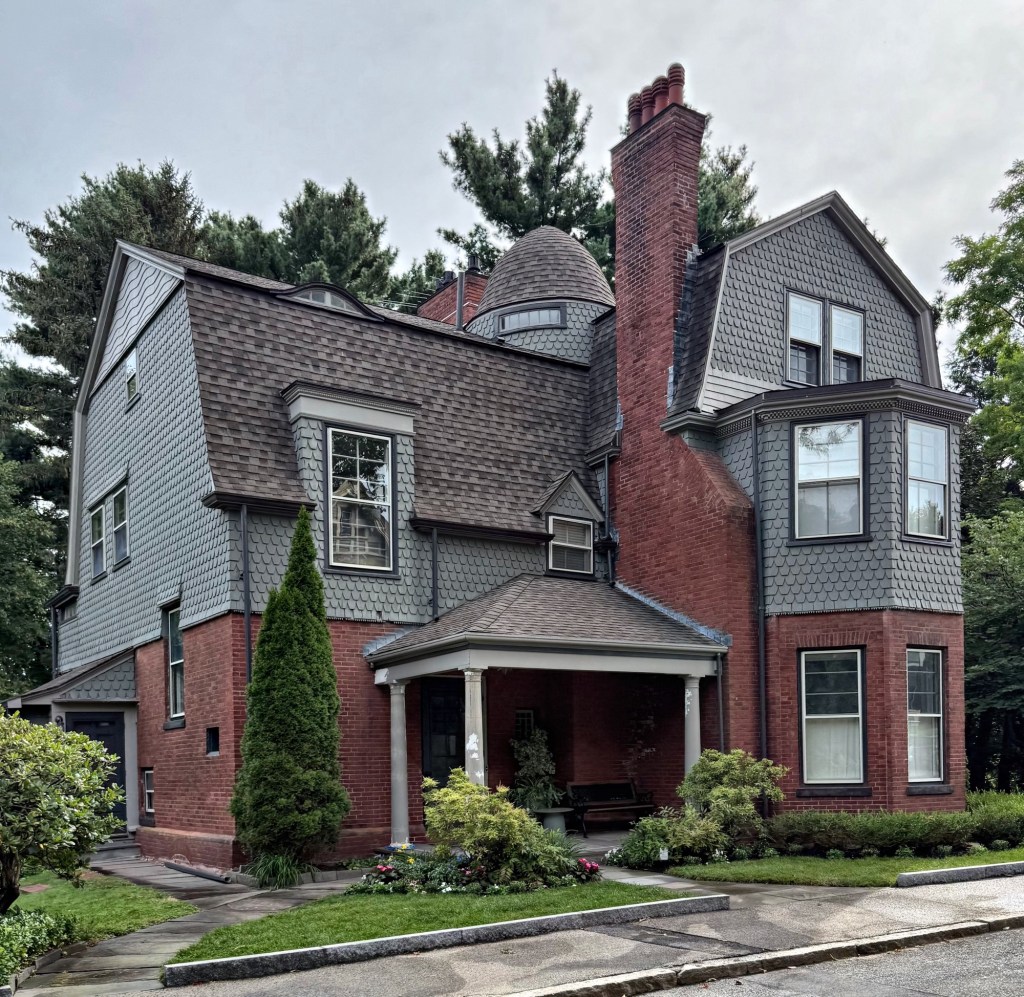
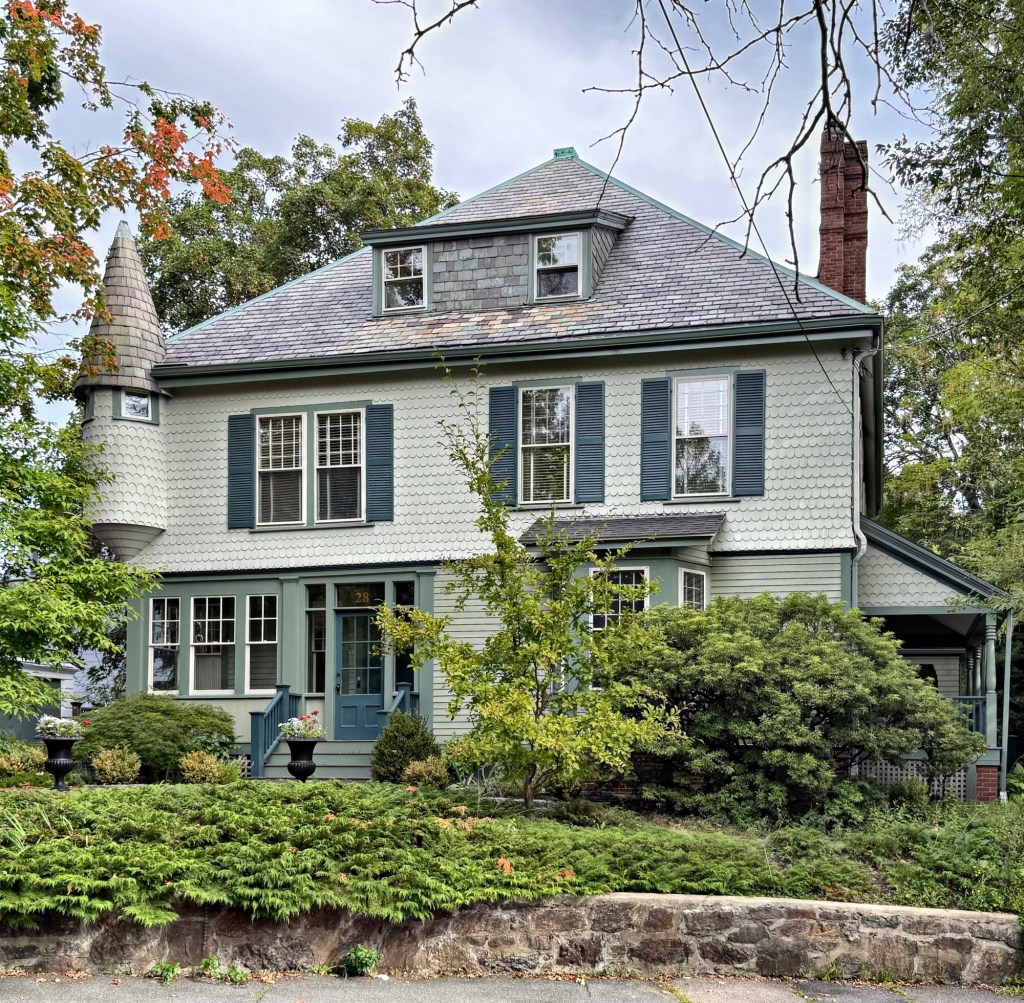
This charming and quirky Queen Anne style house on Edgehill Road in Brookline was built as a rental property on the estate of Charles Storrow (1841-1927), a wealthy businessman who lived in his home next door (see last post). Like his own home, the residence was designed by Edward Clarke Cabot, his wife, Martha’s father, who utilized varied materials, forms, and roof shapes to create a unique composition unlike anything else in the neighborhood. The bulbous central tower and eyebrow and wall dormers also add intrigue to the design.
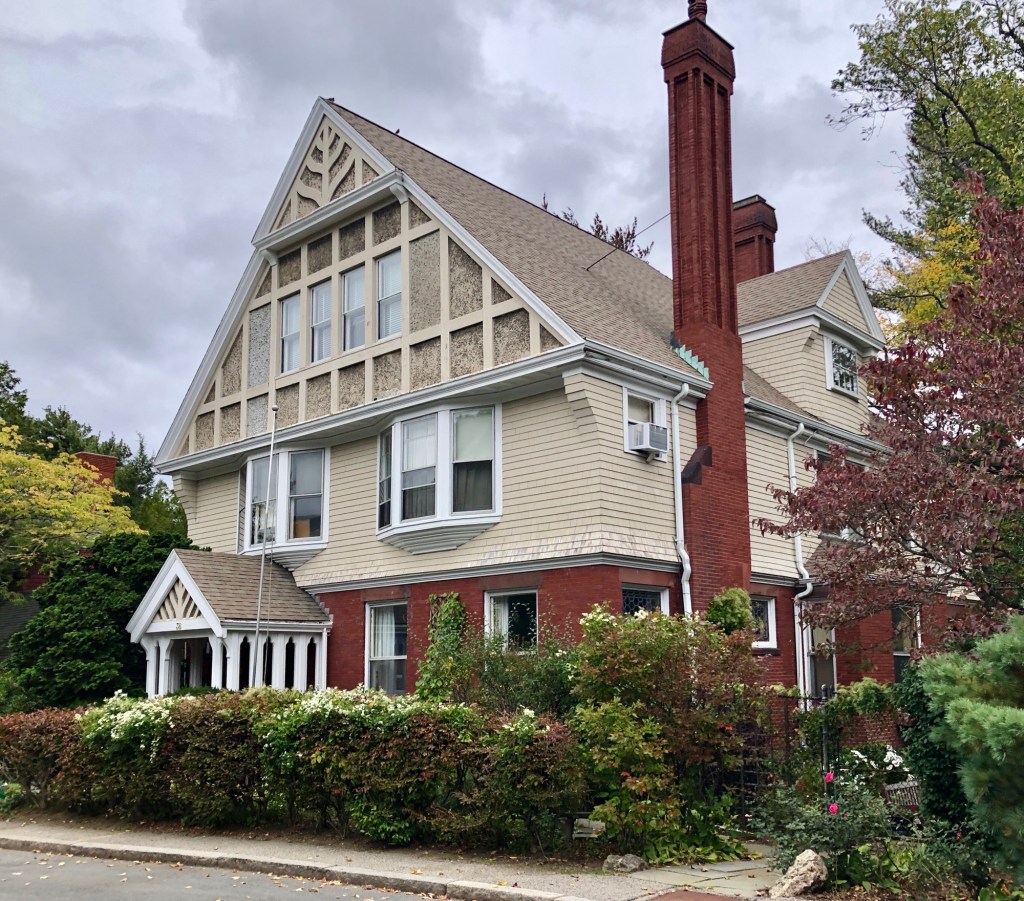
The Charles Torrey House at 36 Edgehill Road in Brookline, Massachusetts, is a great example of a Queen Anne style residence in the Boston suburbs. The stately home was constructed in 1889 for Charles Torrey, an artist who specialized in nautical scenes. The house is unique for its brick first floor, shingled second and stucco with half-timbering in the gable, a feature that suggests the renewed interest in English medieval motifs. The architect for the Queen Anne style home could not be located, but it appears to be from a more prominent Boston-area firm of the late-19th century. The house is currently (2025) undergoing a renovation.
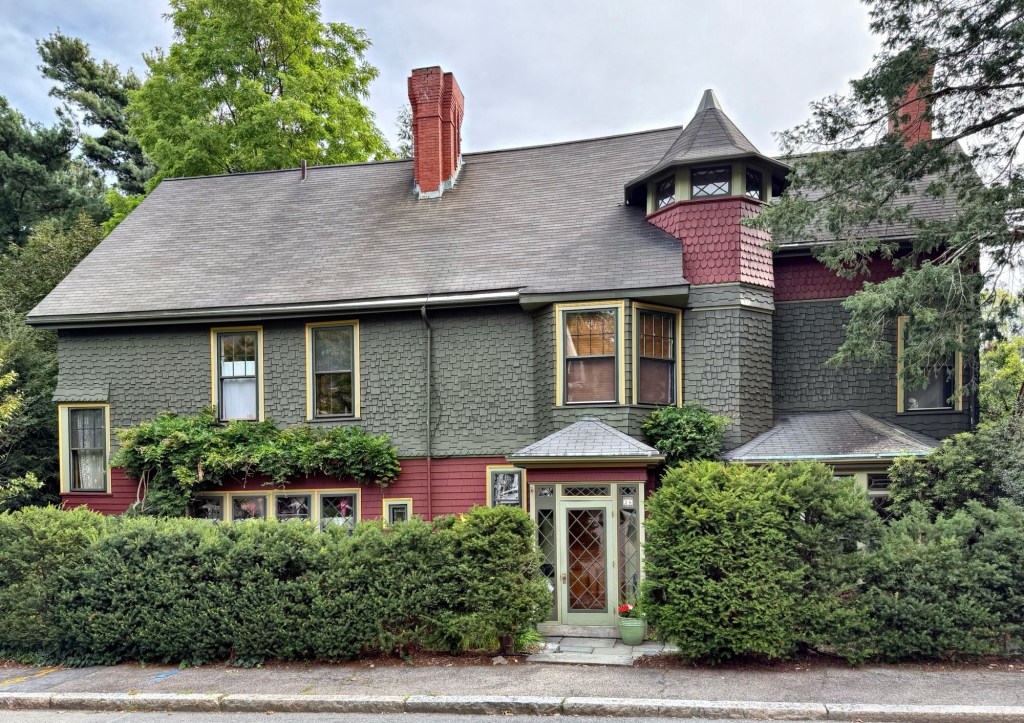
This handsome shingled Queen Anne style home on Allerton Street in Brookline, Massachusetts, is part of the reason why the “Pill Hill” neighborhood gets its name. The residence was built in 1888 for Mr. Sumner Flagg, likely as an investment property as the neighborhood developed into one of the finest in the Boston area. An early resident here was Judith Motley Low (1841-1933), founder of the Lowthorpe School of Landscape Architecture, which was the first school intended solely to prepare women as landscape professionals in a field dominated by men. In 1945, the Lowthorpe School merged into the Rhode Island School of Design and became the basis of RISD’s Landscape Architecture Department. Another prominent resident of the house in the 20th century was Dr. John Rock (1890-1984), a physician and scientist who worked nearby at the Massachusetts Hospital for Women. As a Catholic doctor, John Rock is best-known for two groundbreaking medical discoveries in women’s health: the birth control pill and in-vitro fertilization. Dr. John Rock and his lab technician, Miriam Menkin, were the first researchers to fertilize a human egg outside of a human body in February of 1944, this research was compounded and later led to in-vitro fertilization as we know it today. Additionally, while running his clinic, Dr. Rock encountered a number of women bearing unwanted children that they could neither afford financially nor handle physically. Rock observed numerous women who, after giving birth to multiple children, had prolapsed uteri, malfunctioning kidneys, and were prematurely aging. In 1952, Rock was recruited to investigate the clinical use of progesterone to prevent ovulation. Enovid, the brand name of the first pill, was approved by the U.S. Food and Drug Administration (FDA) and put on the market in 1957 as a menstrual regulator. In 1960, Enovid gained approval from the FDA for contraceptive use.
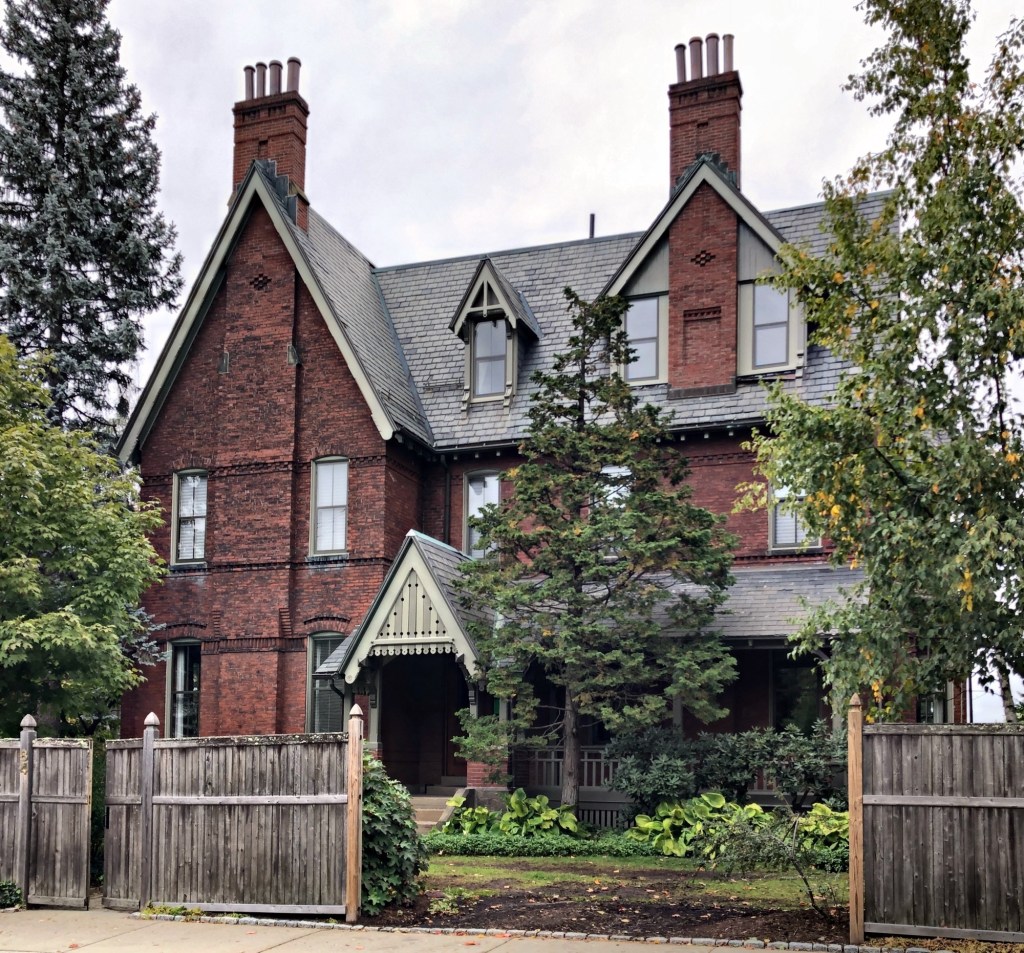
The John Runkle House on High Street, is one of the most interesting houses in Brookline. Built in 1875 for educator John Daniel Runkle (1822-1902), the brick residence excellently blends early Queen Anne form and flourish with Victorian Gothic design elements all with Stick style entry porches and dormers. John D. Runkle was a noted mathematician wholater became the second President of the Massachusetts Institute of Technology from 1868 until 1878. This occurred before MIT moved over the Charles to Cambridge, so President Runkle would not have traveled far to the Institute when located in the Back Bay. The Runkle House was designed by the architectural firm of Weston & Rand with an irregular plan of elaborate belt courses in the brickwork that is set against the extremely steep slate roof with tall prominent chimneys and corner turret. Sadly, the residence is largely obscured by a tall wooden fence, but I caught it on a good day that a panel was down.
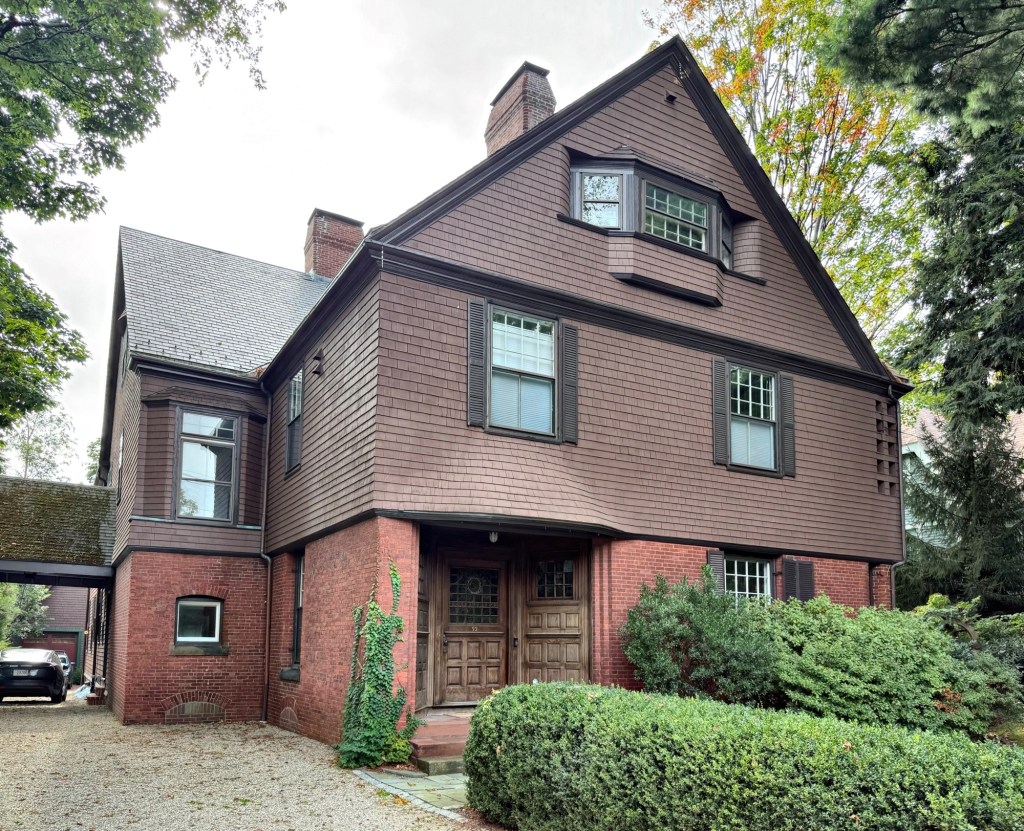
One of the many great Queen Anne/Shingle style homes in Brookline is this residence at 92 High Street built for Thacher Loring (1844-1928), president and treasurer of the National Dock and Warehouse Company, of Boston, founded by his father, Elisha Thacher Loring. For their Brookline home, Mr. Loring hired architect, William Ralph Emerson, one of the great architects who mastered the Shingle style of architecture. The Loring Family lived here until the early 1900s, when they sold the property and moved to the Back Bay in Boston. The property was purchased by John Henry Sherburne (1877-1959), who lived here with his family for over sixty years. John Sherburne was an attorney, politician, and military officer who served during the Pancho Villa Expedition, World War I, and World War II and attained the rank of brigadier general receiving numerous military awards, including the Silver Star and Purple Heart. During WWI, he commanded the U.S. Army’s first “negro” artillery battalion in France. After the war he testified before Congress about orders that pointlessly sent hundreds of U.S. soldiers from other units “over the top” to their deaths on the morning of November 11, 1918, when the armistice hour was already known. Following his World War I service, Sherburne advocated for civil rights for African Americans, including support for anti-lynching laws and from 1926 to 1931, he served on the board of trustees for Howard University. The Loring-Sherburne House is significant for its residents and for its architecture, including the use of brick and shingle siding, and the show-stopping recessed panel-wood entry with bulging shingles above.
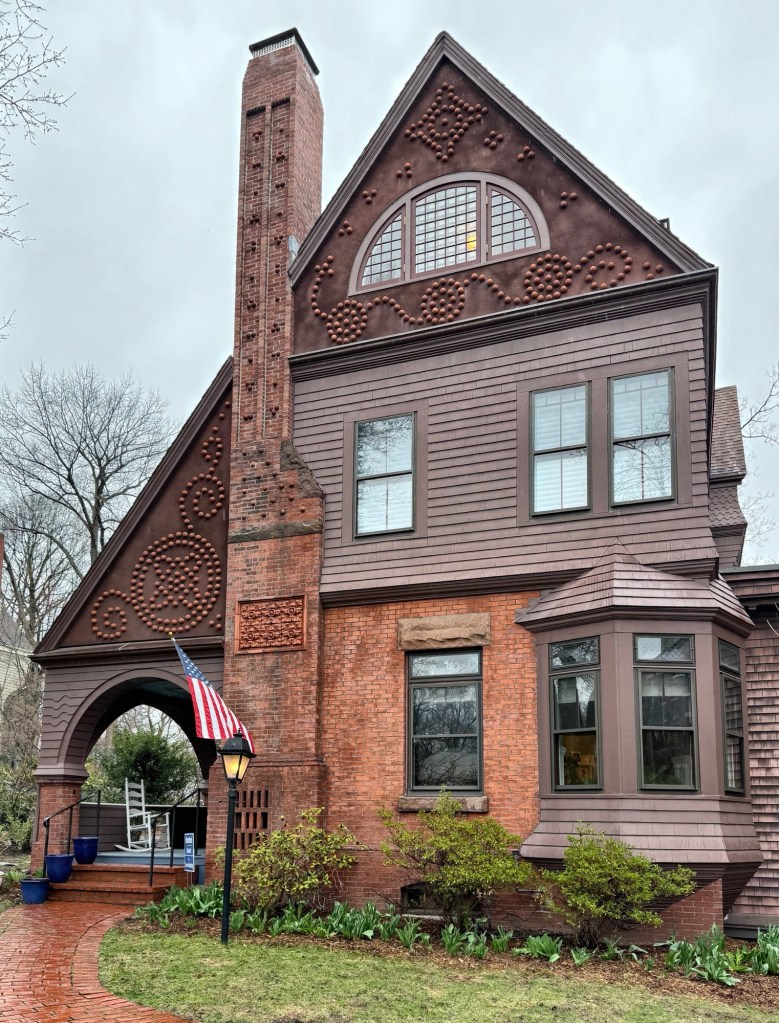
In the mid-1880s, John Wales, a wealthy hardware dealer with offices in Downtown Boston, purchased house lots in the Cottage Farm area of Brookline from Amos A. Lawrence, and set out develop the site with two stately Victorian homes. This lovely home was first occupied by John’s son, George Wales and his wife, Mabel, the year of their marriage in 1885. While the architect is unclear, it is probable that the design can be attributed to architect William Whitney Lewis, who was hired by John Wales the year prior to design a stable near his home in an adjacent neighborhood. The house was rented by Wales and subsequent owners for years. The elaborate Queen Anne style house exhibits an asymmetrical plan with recessed entrance set within an arched opening, shinged and brick walls with a prominent chimney at the facade containing a decorative terra cotta panel, and the most unique stucco gables containing what appear to be terracotta balls in geometric forms. This house is a perfect example of what is so special about the Queen Anne style!
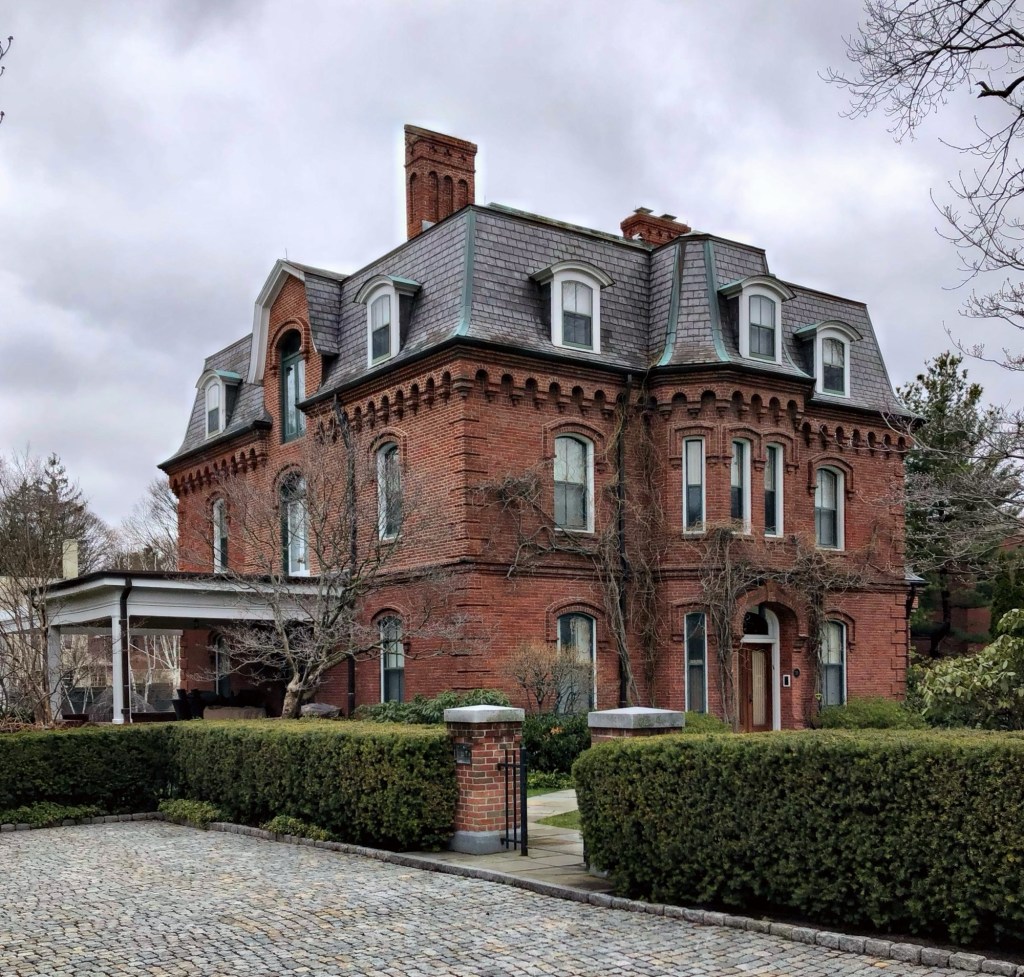
One of the finest Second Empire style houses in Brookline can be found on Prescott Street in the fashionable Cottage Farm neighborhood of the city. Built around 1868 by Amos A. Lawrence, who lived in a house nearby, this “cottage” was rented out to John Wells (1819-1875), a Judge on the Massachusetts State Supreme Court until his death. The property remained in the Lawrence family into the 20th century and was later rented to George E. Bullard, a banker. The brick house is notable for its siting at the center of the lot, corner quoins, brick corbelled cornice, arched door and windows, and slate mansard roof.
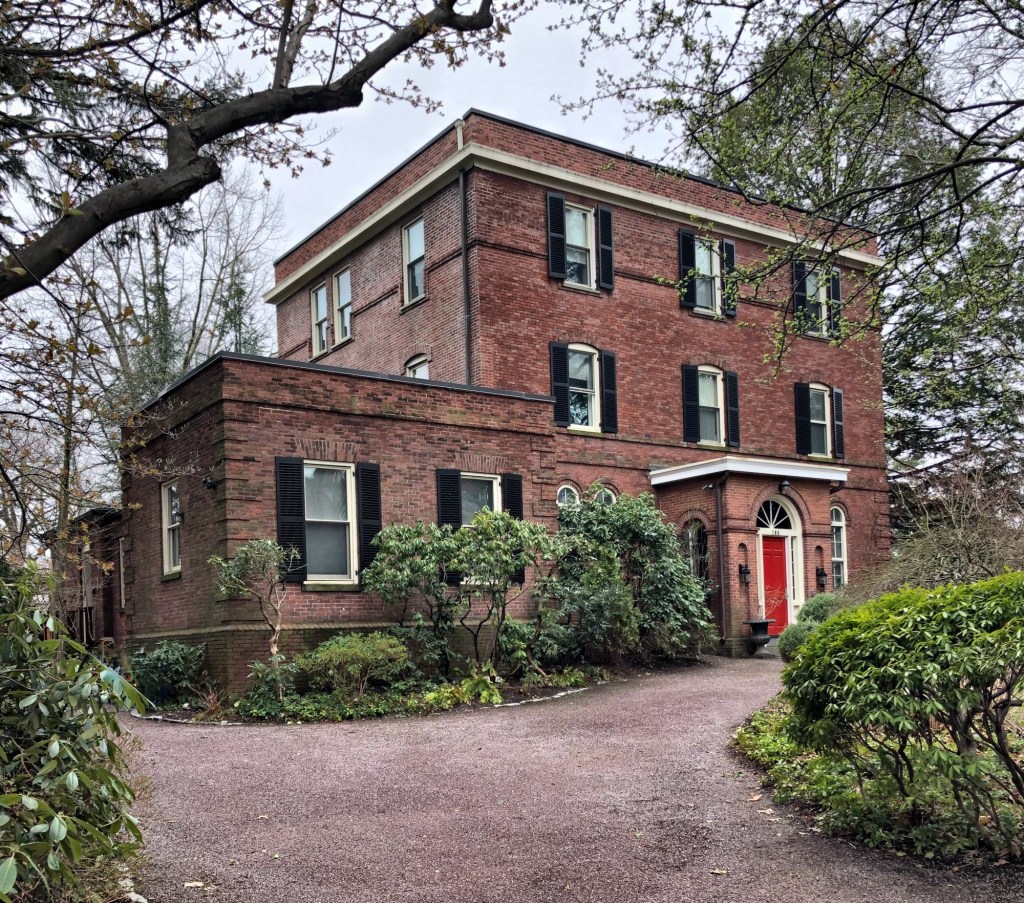
The area was developed thanks to Amos A. Lawrence (1814-1886), a wealthy second-generation Bostonian, who provided much of the capital and enthusiasm for the growth of the cotton industry in New England prior to the Civil War. Lawrence’s involvement in the industry aided the development of the Massachusetts mill towns of Lowell and Lawrence, whom the city was named after. In 1851, Amos Lawrence purchased 200 acres of land from David Sears, who himself developed the equally beautiful Longwood neighborhood of Brookline on the other side of Beacon Street. Amos began to subdivide the land, working with the architect George Minot Dexter and landscape architect and surveyor, Alexander Wadsworth, who designed Mount Auburn Cemetery in Cambridge, to create an early picturesque residential suburb. With houses designed in the newly popular Gothic Revival and Mansard styles and several small parks, the area became known as Cottage Farm. This house was built for Amos Lawrence as an early, brick Mansard home, and rented out to Frederick Almy, a wealthy Boston attorney. The property was sold out of the Lawrence Family and later purchased by John Gorham Palfrey (1875-1945) a lawyer, who modified the house by removing the mansard roof and replacing it with a full third story with a brick veneer to match the walls below to give it a more Colonial Revival design.
 Buildings of New England