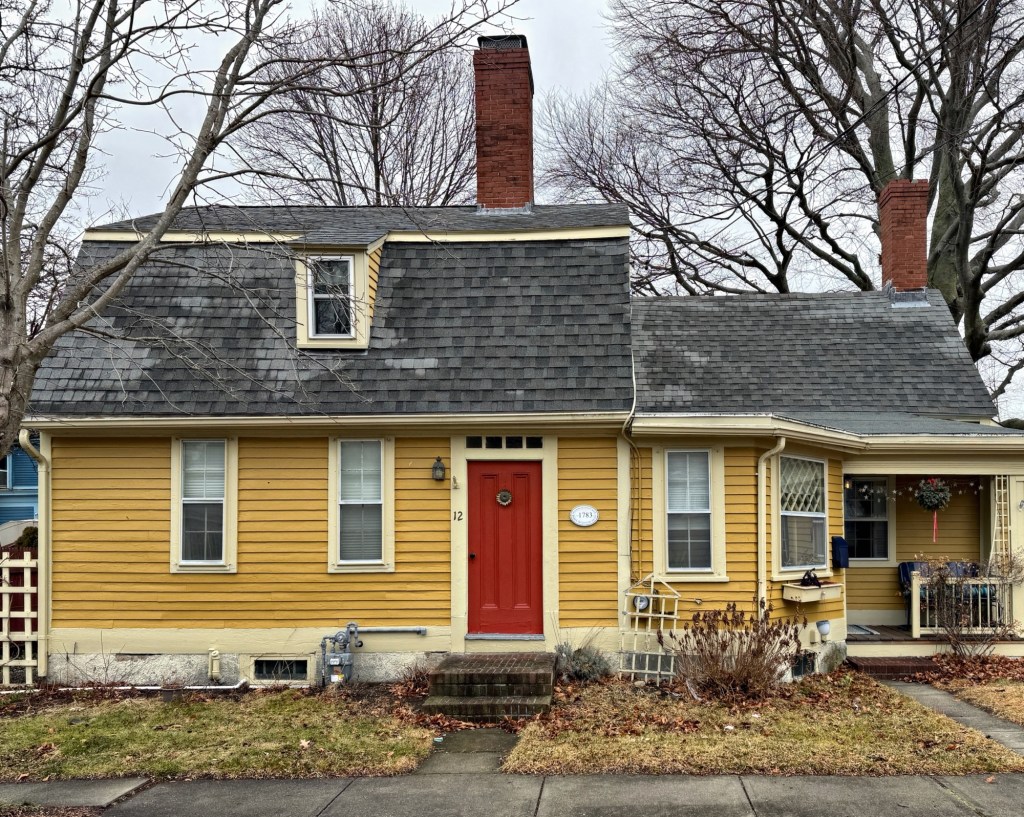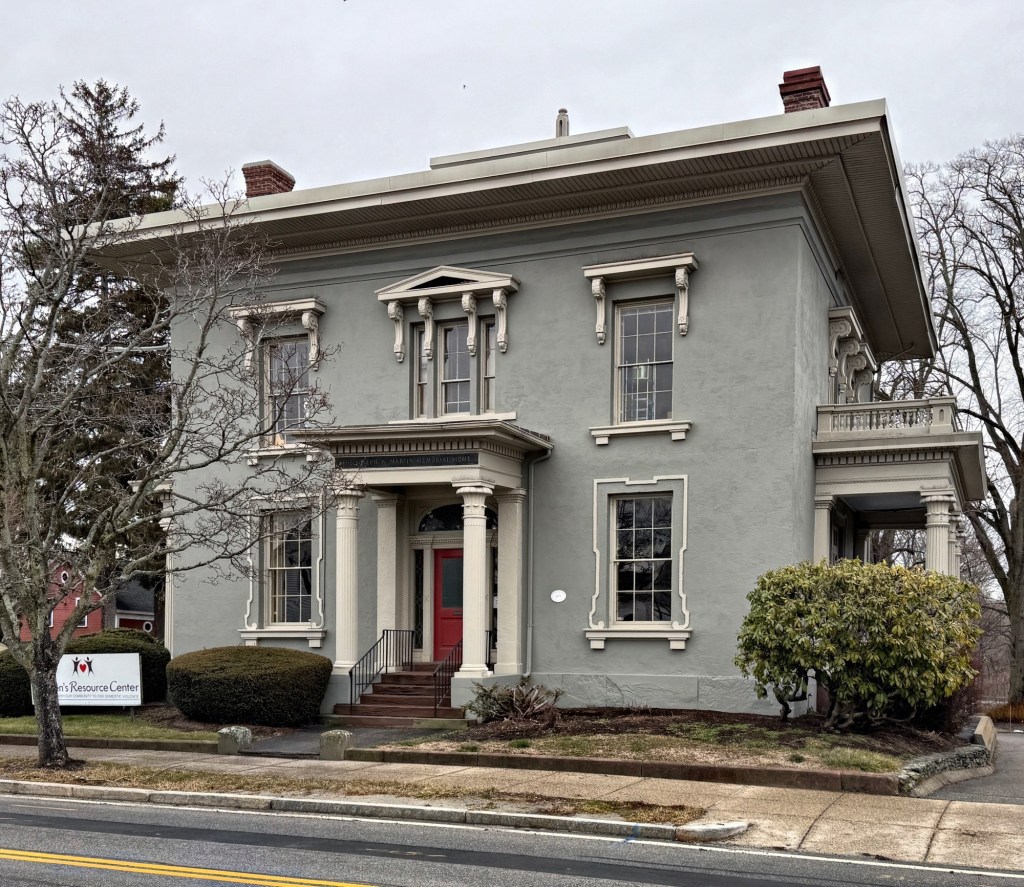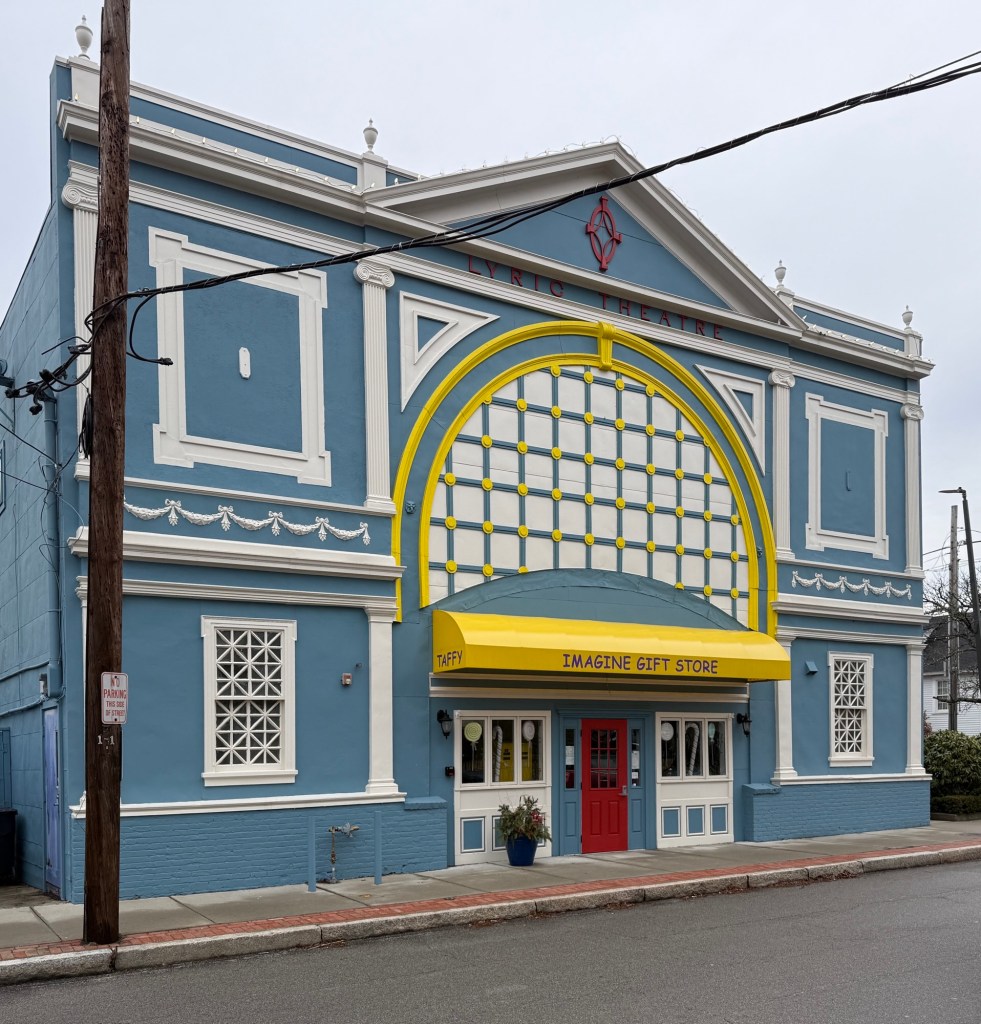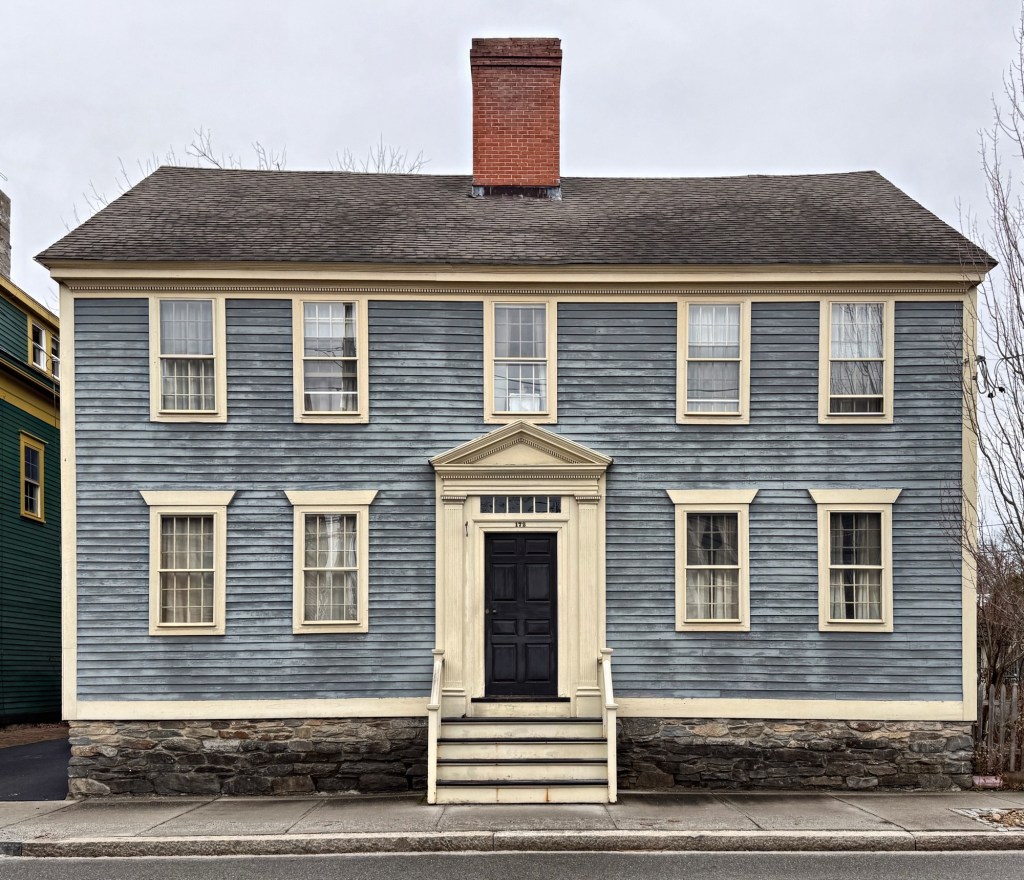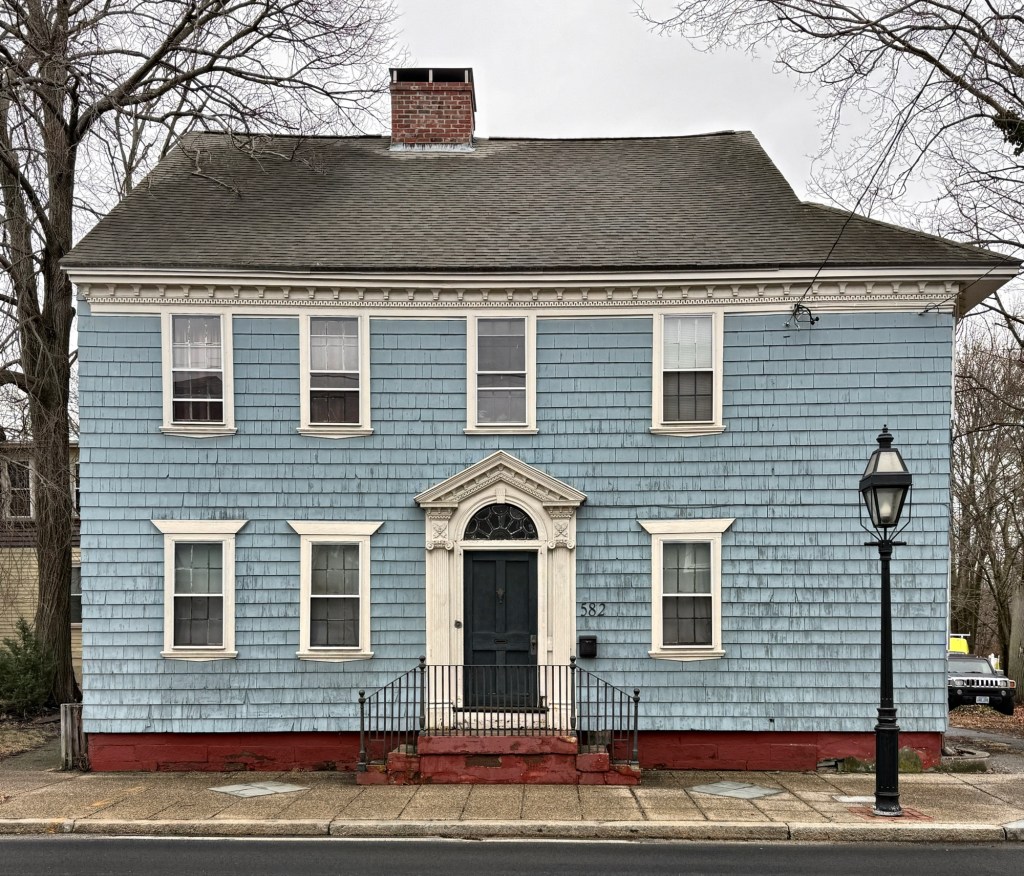
Charles Wheaton House // c.1815

Rehoboth, Massachusetts native, Charles Wheaton (1761-1863) enlisted in the Revolutionary army as a young man. After the war, he settled in Warren, Rhode Island and married Abigail Miller. They would have at least nine children. One of his children, Charles Wheaton, Jr., (1791-1863) would grow up in Warren and married Abiah Goodwin Turner in 1815, the daughter of a wealthy sea captain. Around the time of their marriage, they built this house on Liberty Street in Warren in the Federal style with a three bay facade and portico at the entrance with Ionic columns. By the end of the 19th century, the house was enlarged and a bay window was added over the Classical portico and a monitor on hip-roof.

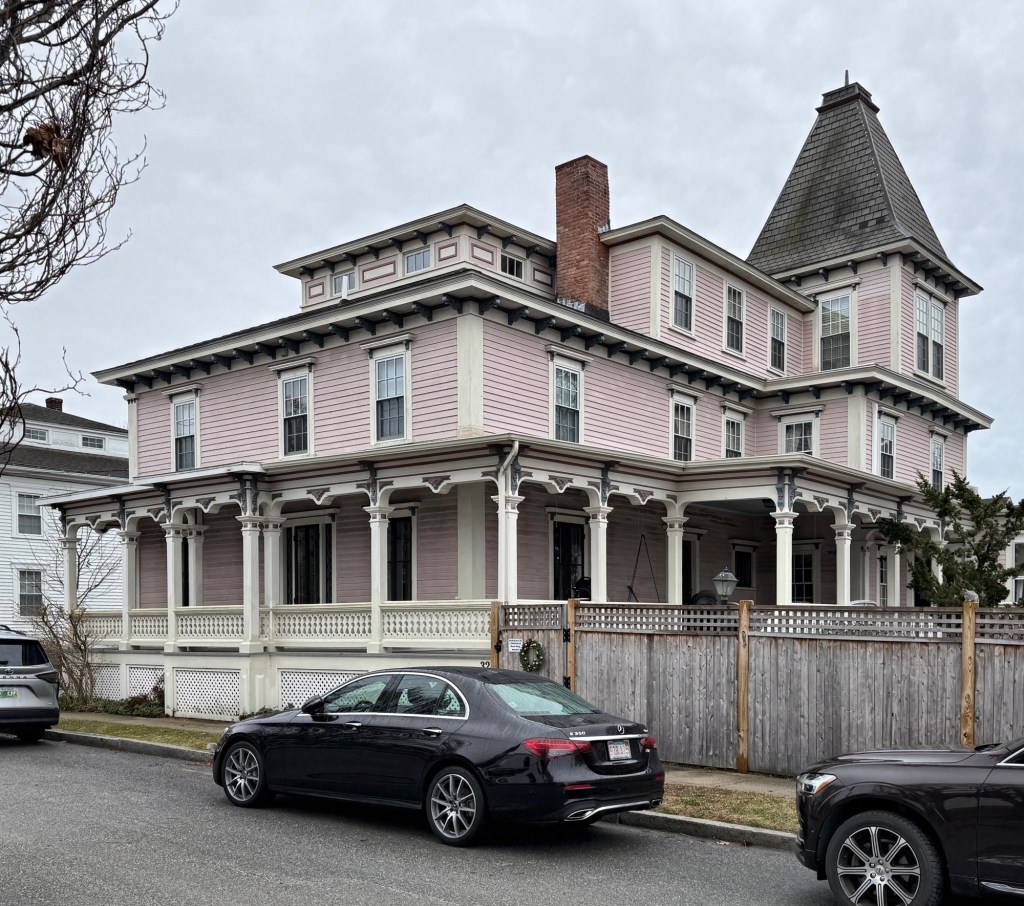
Miller-Abbot House // 1789

More impressive than elegant, this unusually large Federal house in Warren, Rhode Island was the home to two important military leaders, Nathan Miller and Joel Abbot. Nathan Miller (1743-1790) was a Brigadier General of the Rhode Island Militia during the Revolutionary War. He was a deputy in the Rhode Island State Assembly for six years, and he represented Rhode Island in the Continental Congress in 1786. After his death in 1790, the general’s daughter, Abigail, and her husband, Charles Wheaton inherited and enlarged the property. Their daughter Laura married Joel Abbot in 1825 and resided here afterwards. Joel Abbot (1793–1855) was a Naval officer in the War of 1812, and commanded a ship during Commodore Perry‘s 1853-1854 visit to Japan, opening the Asian country up to trade with the western world. The large home has maintained its charm and the dated chimney is just too perfect!

Warren Masonic Temple // 1796

Located next door to the Randall House (last post) on Baker Street in Warren, Rhode Island, this early building has some history! Constructed in 1796 by the Washington Association, Inc., this two-story Federal period building is considered to be the oldest Masonic hall building in the state of Rhode Island. The elongated building is fairly plain in plan, but is adorned by corner quoins, elaborate pedimented entries, ornate cornice, and (now filled) ocular windows in the gable ends. The Lodge was likely built by local carpenters using Asher Benjamin’s plan books for the detailing.

Warren Industrial Trust Building // 1906

This monumental Georgian Revival bank building sits on Main Street in Warren, Rhode Island, and is one of the finest buildings of the style in the entire state. The Warren Industrial Trust in 1906 hired Edmund R. Willson of the Providence architectural firm of Stone, Carpenter & Willson to design the bank for the town after it had absorbed the town’s multiple banks, under one roof. Four Corinthian columns support a robust pediment over the entrance with the red brick elevations enlivened with arched windows, oversized keystones, and pilasters with contrasting capitals and bases. The building shows that Colonial Revival architecture, while often seen as a refined, classical style, can be festive and ornate.

Linden Place // 1810

For the last post in this series on Bristol, Rhode Island, I am leaving you with a house that is architecturally stunning, but holds a dark history. Linden Place was built in 1810 by slave trader, merchant, privateer and ship owner George DeWolf and was designed by architect, Russell Warren. The DeWolfs of Bristol, who became the biggest slave-trading family in U.S. history, transported well over 11,000 Africans to the Americas between 1769 and 1820. The U.S. banned the slave trade in 1808, but the DeWolfs continued dealing in the slave trade until the 1840s by going through Cuba, where they had numerous plantations. They also got help from a DeWolf brother-in-law, who served as a customs inspector in Bristol — thus ensuring family slave ships continued to come and go. In 1825, George DeWolf suffered major financial hits and he and his family fled to his plantation in Cuba, where they’d be beyond reach of his creditors. Stories explain that with the possibility of legitimate payment out of the question, the townspeople sought compensation for George’s debts where they could, and they broke down the front door of Linden Place, and took everything, even peeling the silk wallpaper off the walls.

Following DeWolf’s bankruptcy, the house was bought by his uncle James DeWolf, who was alleged to have directed the murder of a female African slave in 1789 who was sick with smallpox on the slave ship Polly, which he commanded; she was bound to a chair and lowered overboard. James DeWolf was tried and effectively acquitted; which, sadly, should not surprise anyone based on historical precedent. In fact, James DeWolf financed another 25 slaving voyages, usually with other members of his family and was thought to be the second richest man in the United States upon his death in 1837. In later years the house passed to Samuel Pomeroy Colt, a grandson of George DeWolf (as well as the nephew of the inventor of the Colt revolver). His son Russell married actress Ethel Barrymore, who was the great-aunt of current actress Drew Barrymore, and lived in the home. Today, the grand estate is a house museum and event space.

Bristol County Courthouse // 1816

Located on the Bristol Town Green, facing the main commercial area and harbor, the old Bristol County Courthouse is a well-preserved example of a building for civic use in town, at the height of its growth. It is believed that the courthouse is the work of architect Russell Warren, who lived in a home he designed just blocks away. This Federal-style stone building is faced with brick and subsequently stuccoed, giving it the unique composition it has today. The focus of the symmetrical facade is the large central arched window with granite quoins, and Y-tracery that echos Gothic design. As part of the 1836 state Bicentennial, the stucco facing was added over the original brick facing, and the exterior was painted a Gothic Revival sand color with darker trim, replicated in a 1976 restoration. From 1819, the courthouse served as one of the five state houses used in rotation by the Rhode Island General Assembly (in 1854, the General Assembly decided to meet only in Providence or Newport). In 1853, it reverted to courthouse use, a function which ceased in the early 1980s. The Bristol County Sheriff maintained offices there until 1997, when the building was purchased from the state for $1 by the Bristol Statehouse Foundation. The nonprofit foundation has worked to restore and maintain the building. Today, the building is used for education, community programs, meetings, and events.

Lemuel Richmond House // 1856

Lemuel Clarke Richmond (1782-1876), a whaler, built this Octagon home in his seventies. This was the second home he built in Bristol Rhode Island, the first being the Richmond-Herreshoff House I featured previously. When Lemuel Richmond sold his 1803 Federal style home, his home was empty as his wife passed and all of his children married and moved out of the house. Octagon houses are fairly rare nationwide, and most were built in a small timeframe in the 1850s. The publication of Orson Squire Fowler’s A Home for All: or the Gravel Wall and Octagon Mode of Building in 1853 briefly brought popularity to octagonal structures. The
octagon, according to its proponents, offered greater floor space, increased air and sunlight, and was a healthful natural form. Orson Squire Fowler was a phrenologist (a pseudoscience which involves the measurement of bumps on the skull to predict mental traits) and lecturer who had a huge impact on American architecture, though only for about a decade. The Richmond House in Bristol also features an octagonal cupola, bracketed porch, and a single-room addition over the porch over the front door. Could you live in an Octagon?

Mount Hope Farm // 1745

Land that Mount Hope Farm sits upon in Bristol, Rhode Island was formerly council lands of the Wampanoag Indians, where King Philip’s War of 1675 may be said to have begun and ended. For those of you who do not know about the war, it was an armed conflict running 1675–1678 between indigenous peoples of New England and New England colonists and their indigenous allies. Massasoit, leader of the Wampanoag, had maintained a long-standing alliance with the colonists. Metacom (c. 1638–1676) was his younger son, and he became “sachem” (elected chief) in 1662 after Massasoit’s death. Metacom, however, forwent his father’s alliance between the Wampanoags and the colonists and they fought back. Metacom’s forces could not beat the growing numbers of the colonists, and he was eventually killed near Mount Hope, in Bristol. After his death, his wife and nine-year-old son were captured and sold as slaves in Bermuda. Philip’s head was mounted on a pike at the entrance to Plymouth, Massachusetts, where it remained for more than two decades. His body was cut into quarters and hung in trees. This story, shows how American history is built upon death and suffering and has often been whitewashed to portray early settlers treating native peoples with respect and as equals, which was rarely the case.

Mount Hope Farm as we know in colonial times, was originally 550 acres in size, owned in 1680 by Nathaniel Byfield. In 1744, the estate was acquired by Isaac Royall. Royall began construction of the house soon after. Isaac Royall Jr. was the son of Isaac Royall Sr. (1677–1739) a slave owner, slave trader, and Antiguan plantation owner who had a home and slave quarters (both extant) in Medford, MA. After his father’s death, Royall Jr. inherited his immense wealth, built upon the backs of others, and built this Georgian farmhouse. It is unknown to me if he ever resided there or had slaves maintain the property, but the home was rented for some time. In 1776, Mount Hope Farm was confiscated by the state, after Royall, a loyalist to England, fled to Nova Scotia. The property was added onto in the 19th and 20th centuries and now sits on 127-acres of land, and is run as a park, inn, and event space.

Richmond-Herreshoff House // c.1803

Located on Hope Street, just south of the downtown area of Bristol, Rhode Island, this beautiful Federal-style home overlooks the water, and once oversaw a large ship-building empire. The home was built by Lemuel Clarke Richmond (1782-1876), possibly in response to his marriage to Hannah Gorham in 1803. Richmond was a wealthy whaler who owned nearly twenty ships, including the Empress, a Bristol-built bark. The Federal style home features a five-bay facade with central entry. A modest portico surrounds the door which has a fan light transom above. Oh, and there are some gorgeous 12-over-12 windows on the home, at the ground floor the windows have flared lintels above. The home was sold by Richmond in the early 1850s and rented out to Charles and Julia Ann Herreshoff, who resided there with their eight children! It was here where sons John and Nathanael overlooked the water as young boys and became consumed by the beauty of the ships that sailed by their front yard. The brothers later ran the internationally renowned Herreshoff Manufacturing Company, which occupied land all around the home (and was featured previously). The home was acquired by the family in the 1860s, and often changed hands within the family over the next decades until it was inherited by Norman F. Herreshoff. A collector of Americana, Norman Hcrreshoff completed a series of renovations to the family home, including remodeling of the kitchen to be “old-fashioned” and replacement of the front porch with the small Ionic portico which we see today. The home is owned by the Herreshoff Marine Museum, but has seen better days.

Herreshoff Manufacturing Complex // 1853+

In 1859, 18 year old John Brown Herreshoff (1841-1915) of Bristol, accepted his first commission to design and build a yacht. The fact that he was blind, having completely lost his sight at 15, didn’t seem to slow him down. He became known as the “blind boat builder.” In his early years, John Herreshoff had acquired such a keen knowledge and “feel” of boats that his blindness was no obstacle. The handwork however, was done by his brother, Nathanael Greene Herreshoff, later known as “the Wizard of Bristol.” His skill in shipbuilding became well-known; so in 1863, John took on space in an old rifleworks, hired a crew of shipwrights and established what would become the Herreshoff Manufacturing Company. From 1864 to 1869, the boatworks built forty-three steam yachts, including Seven Brothers, the first steam-powered fishing boat in America. In 1876, Lightning, the first United States Navy torpedo boat, was completed. Construction of larger craft soon followed, including the 94-foot Stiletto, considered the fastest boat in the world, and was later purchased by the Navy, and was its first torpedo boat capable of launching self-propelled torpedoes. J.B. Herreshoff died in 1915 and the company continued under his brother Nathanael, until it was taken over by a syndicate of New York and Boston yachtsmen. Business stagnated after WWI and the business closed after WWII. Today, Burnside Street in Bristol showcases the lasting legacy of the Herreshoff Manufacturing Company and their impact. Also, the Herreshoff Marine Museum sits at the end of the street, continuing that legacy.