Years before the small town of Chaplin, Connecticut was incorporated as a town, early residents here had this Congregational church built at the future town’s center. The following decades would see the village develop into a cohesive street of Federal and Greek Revival style dwellings and shops, many of which remain to this day. The church was technically completed by 1815, but it would be decades until funding was acquired to add the steeple, pews, and other finishings for the edifice. The structure sits on a raised stone foundation and is prominently sited on the town’s main street.
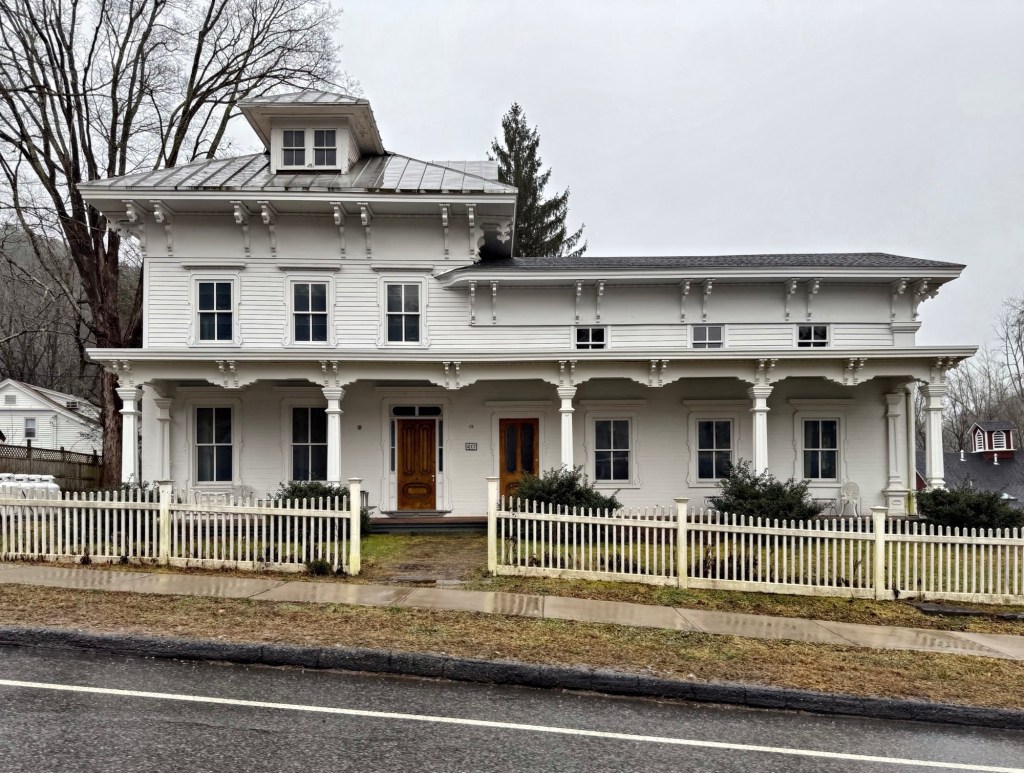
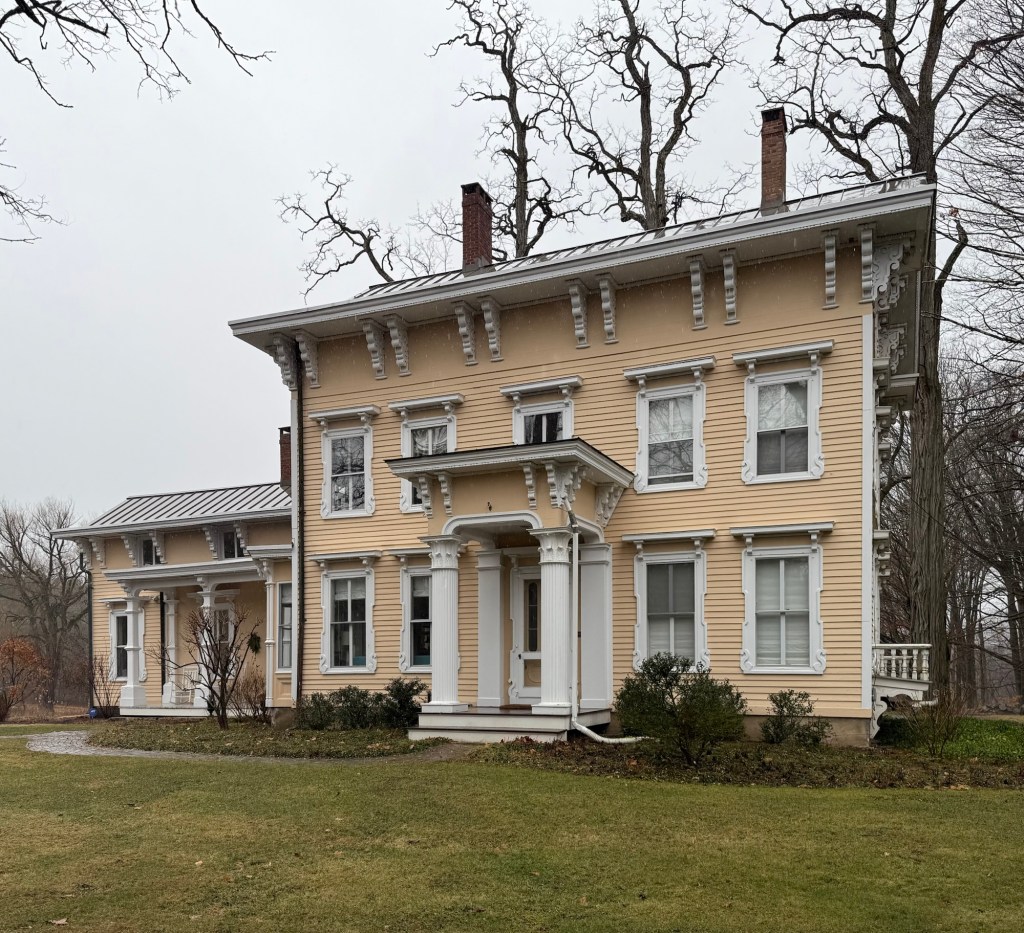
Edwin Eaton (1803-1873) was a lumber dealer and master carpenter in Chaplin, Connecticut when he built this home at the edge of the village center. Eaton built this large residence around 1835, after his marriage to Caroline Gaylord in 1831. It is said that he built more than half the houses in Chaplin Center, several meeting houses in other towns, and for a time, sold the timber for the Spragues’ when they were building industrial villages in nearby towns. The Eaton House is presently (2024) being renovated, hopefully the original high-quality woodworking is restored!
The area that is now Chaplin, Connecticut was settled in the 18th century. The impetus to separate the community occurred due to the difficulty of area residents in reaching the churches in nearby town centers. Benjamin Chaplin (1719-1795), bequeathed funds for the establishment of a church near his (now no longer standing) home. A village center developed around the church, and the town was incorporated in 1822. The village is unusual in Connecticut for its relatively late development, and because the center is not near usable water power, and was bypassed by railroads, it was not affected by later industrialization. The main street is extremely well-preserved and a visual link to 19th century Connecticut. In 1840, the town erected this one-story Greek Revival building to serve as the town hall. The gable end reads as a pediment with the walls constructed of smooth vertical boards. The town outgrew this building and it became the town’s museum after the present town hall building was constructed in the northern part of the village. The museum closed and the building appears unused today. Hopefully the town can find a way to use the structure and maintain it.
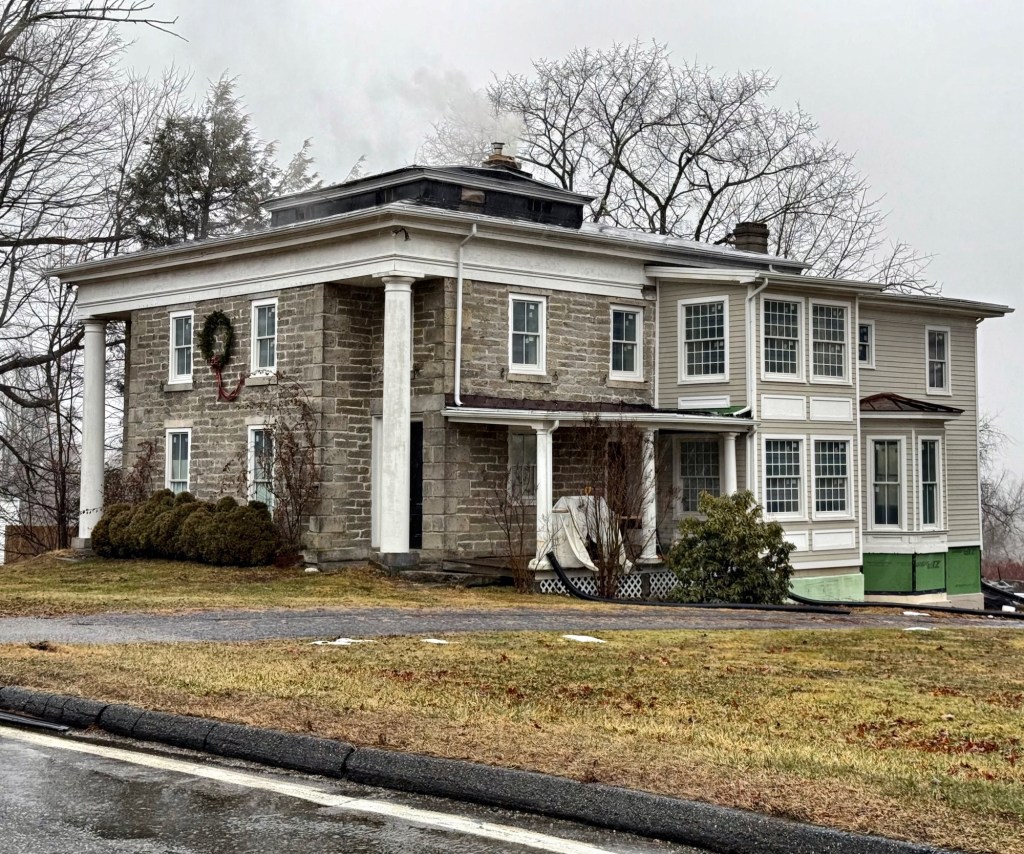
One of the most unique houses in Connecticut is this massive Federal style residence located in the small town of Eastford. Built next to the Congregational Church of Eastford (1829-2023), which burned down in 2023 by arson, the massive house has been known as both the Benjamin Bosworth House and Squire Bosworth’s Castle due to its first owner, Benjamin Bosworth (1762-1850). According to the Bosworth Family, the house was built in 1800 by Bosworth was a wealthy merchant, who hired Vini Goodell, a local carpenter to design and build the large Federal home. The house was completed by 1801 when the local Masonic group met in the building. As Bosworth was also a merchant, he used the basement as a storeroom. The house is also unusual for its monitor roof, a rarity in Federal period construction, which reads like a second structure on the house, due to the building’s size. After Bosworth’s death, the house was occupied by his niece, and was later purchased by Elisha Grant Trowbridge in 1897. Trowbridge was a grand-nephew of General Nathaniel Lyon (1818-1861), a local hero who was the first Union general killed during the Civil War. Trowbridge, an engineer, lived here until he died in 1963 at the age of 96. Later owners have had the monumental task of restoring and maintaining this behemoth of a house, to great success.
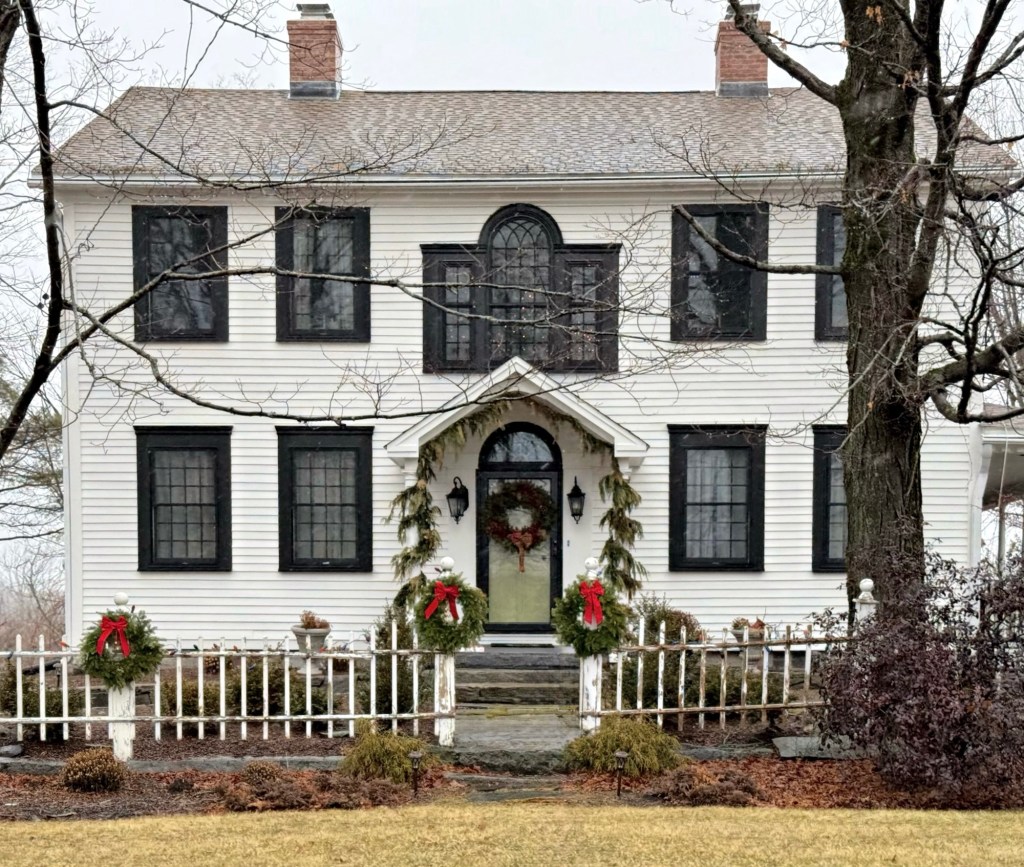
I don’t think any state does the Federal style as well as Connecticut (Massachusetts is a close second)! This is the Sumner-Carpenter House, a high-style example of a Federal residence that is located on the backroads of the small town of Eastford, Connecticut. The house was built in 1806 for John Newman Sumner (1775-1831) who resided here until just before his death. The elaborate Federal period house was sold out of the family. After trading hands a half-dozen times, the property was purchased by David and Harriet Carpenter in 1881. The property remained in the Carpenter family for generations, and remained as such after Orlo Carpenter (1865-1938) was killed in the collapse of a barn during the hurricane of 1938. Architecturally, the house has all of the hallmarks of the Federal style, with the symmetrical main facade five bays wide, with a center entrance flanked by wide sidelights, and topped by a fanlight transom and corniced entablature. The window above the entrance is in the Palladian style, with a rounded center window flanked by narrower sashes. The house is very well preserved and was listed on the National Register of Historic Places for its architectural quality and preservation.
We featured Ashford, Connecticut, so now it’s time to explore some of neighboring Eastford! Settled in the early 1700s, the eastern portion of Ashford separated from its parent town in 1847, and became the town of Eastford. Prior to this, light industry, such as the production of cotton batting, twine, and wooden handles, complemented what would remain a predominantly rural agricultural community well into the 20th century. The winding back roads are lined with charming farmhouses bounded by rugged historic stone walls, making the town retain its rural feel. When driving through, I stumbled upon this postcard-worthy historic farm complex. Historic maps show that the property was owned by D. Bartlett in 1869, which appears to be Daniel Bartlett (1812-1898). The Bartlett property is enhanced by two historic barns sited nearby on a bluff overlooking the fields, which were likely once lined with trees or crops. By the 1900s, the property was owned by Nicholas and Clementine Dechand, the small road leading up to the farmhouse was named after the couple.
Built in 1825, the Ashford Academy school building is the last remnant of what was Ashford, Connecticut’s once thriving town center. The taverns, church and businesses which were once located here have almost entirely been razed, leaving just this school building as the remaining structure. Ashford Academy was founded about 1825 when a group of citizens raised funds toward adding a second story to a schoolhouse then under construction in the town center. Only one teacher was hired per term, and some years there were no academy classes at all. The last academy session was held in 1875, though the building continued in use as a district school until 1949. The building is significant, not only for its siting and connections with the town’s early days, but also architecturally as a high-style school building for a more rural setting.
In 1921, the Catholic Diocese of Hartford purchased a Federal style farmhouse with 135-acres of land in Ashford, Connecticut, with the intention of establishing a new parish in the area. The Diocese assigned Father William J. Dunn, a Connecticut native and son of Irish Immigrants, to this daunting task. Since they had no church building at the time, Father Dunn partitioned off a section of his own home to serve as a chapel for about 100 worshipers, until the purpose-built St. Philip the Apostle Church was constructed in the 1930s. Father Dunn convinced summer resident Paul Chalfin to design the new building. Chalfin was not an architect, but he was an architectural designer whose best known building is the Villa Vizcaya in Miami, Florida. Chalfin was openly gay, and his hiring by the Catholic Church to design one of its churches in the 1930s is noteworthy. There were certainly several Irish immigrants and people of Irish descent in the congregation, but many parishioners came from small villages in Slovakia. The dome is a typical feature of churches in those villages and Chalfin included it in his design as a tribute to them. Due to material and construction costs during the Great Depression, members of the church largely built the church themselves with rocks acquired from stone walls and farms nearby. The church was completed in 1937.
Union, Connecticut is the smallest (by population) town in the state and it was the last Connecticut town east of the Connecticut River to be settled, largely because of its rough terrain and poor soil. The small town of under 800 residents was incorporated in 1734 and named Union, likely named after the fact that the new town was formed of a “union” of different sections of land which were left over when the boundaries of surrounding towns, though it is still speculation. Union erected this Town Hall building in 1847 which was fitting for the town’s small (and then-declining) population at the time. The one-story clapboard building is vernacular and lacks much adornment of other town halls and institutional buildings of the time period in nearby towns. Eventually, the town built a new city offices building and the small town continues to maintain the former building to this day and it houses the Union Historical Society.
Believe it or not, this church in Ridgefield Center was built in 1965! To know its full history, we have to go back to 1787, when the Methodist Episcopal Church had its beginnings in Ridgefield, the third in New England. Its first meeting was held – just 21 years after Methodism had been introduced into the U.S. from England. In 1789 Jesse Lee, a native of Virginia, was sent north as a circuit rider. His third sermon in Connecticut was preached at the Independent Schoolhouse on Main Street in Ridgefield. In the 1840s, a second meetinghouse in town was built, and the congregation grew. A third church and rectory were built on Main Street in 1884. When a large Main Street estate was available for a new, stately building, the congregation jumped at the opportunity, and hired ecclesiastical architect Harold Wagoner to design a refined, Colonial Revival style church, which was built in 1965. Executed in brick, the church has great verticality, created by the colossal columns supporting its pedimented portico and the spire that rises over an open belfry to a height of 149 feet. Set back from the street, the church still has a commanding presence.